
Management of Trauma in Chemical Accident Victims Amit

- Slides: 44
Management of Trauma in Chemical Accident Victims Amit Gupta Assistant Professor of Surgery JPN Apex Trauma Center All India Institute of Medical Sciences
Overview n HAZMAT Incident – Epidemiology ¨ What are common materials ¨ What are the common sites where accidents occur ¨ Fatality of Hazmat Incidents n Spectrum of Injuries in Chemical Accidents n Mechanism of Injuries n Principles of Management of Chemical Accident Victim n Summary
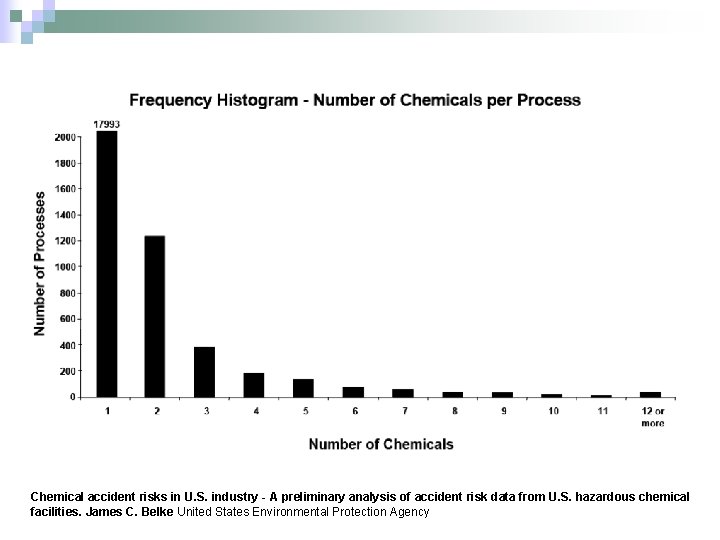
Chemical accident risks in U. S. industry - A preliminary analysis of accident risk data from U. S. hazardous chemical facilities. James C. Belke United States Environmental Protection Agency
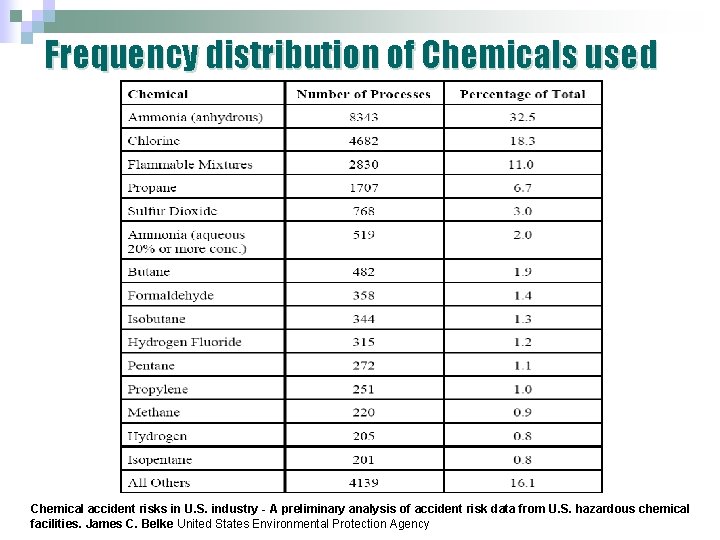
Frequency distribution of Chemicals used Chemical accident risks in U. S. industry - A preliminary analysis of accident risk data from U. S. hazardous chemical facilities. James C. Belke United States Environmental Protection Agency
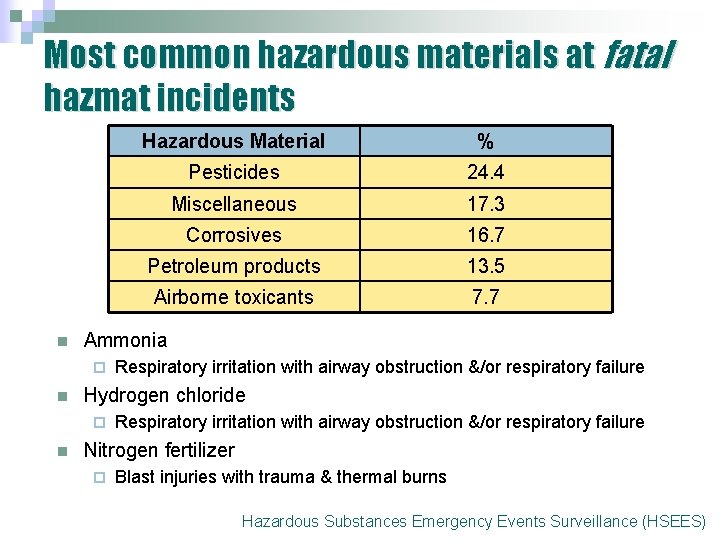
Most common hazardous materials at fatal hazmat incidents n Pesticides 24. 4 Miscellaneous 17. 3 Corrosives 16. 7 Petroleum products 13. 5 Airborne toxicants 7. 7 Respiratory irritation with airway obstruction &/or respiratory failure Hydrogen chloride ¨ n % Ammonia ¨ n Hazardous Material Respiratory irritation with airway obstruction &/or respiratory failure Nitrogen fertilizer ¨ Blast injuries with trauma & thermal burns Hazardous Substances Emergency Events Surveillance (HSEES)
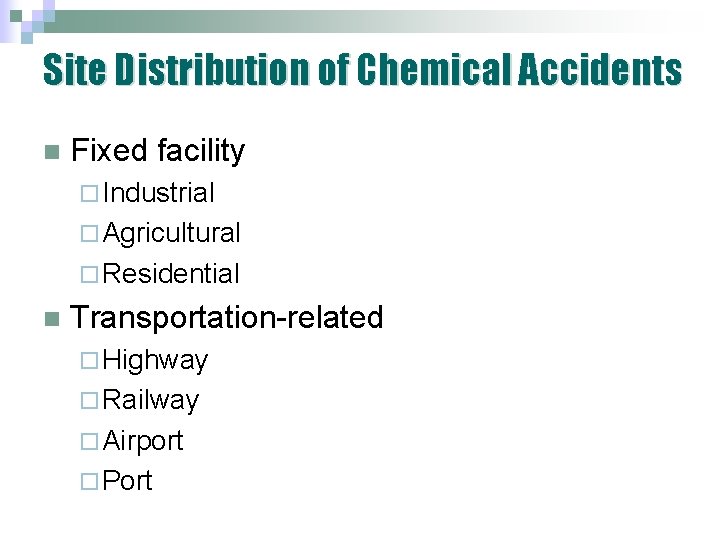
Site Distribution of Chemical Accidents n Fixed facility ¨ Industrial ¨ Agricultural ¨ Residential n Transportation-related ¨ Highway ¨ Railway ¨ Airport ¨ Port
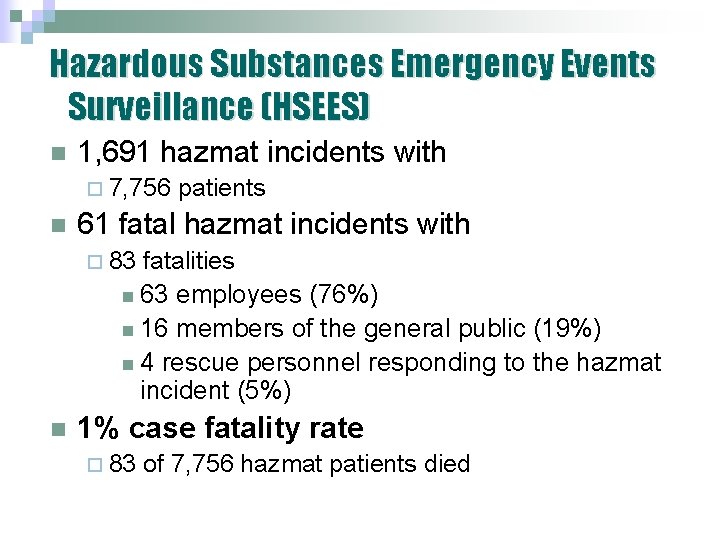
Hazardous Substances Emergency Events Surveillance (HSEES) n 1, 691 hazmat incidents with ¨ 7, 756 n patients 61 fatal hazmat incidents with ¨ 83 fatalities n 63 employees (76%) n 16 members of the general public (19%) n 4 rescue personnel responding to the hazmat incident (5%) n 1% case fatality rate ¨ 83 of 7, 756 hazmat patients died
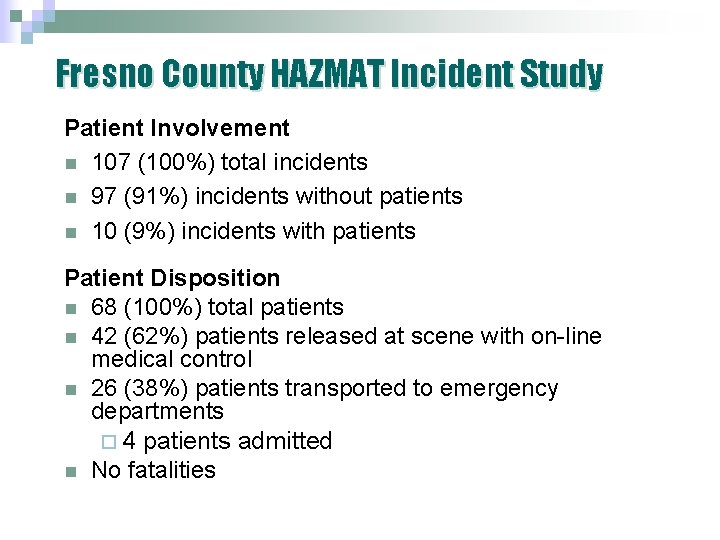
Fresno County HAZMAT Incident Study Patient Involvement n 107 (100%) total incidents n 97 (91%) incidents without patients n 10 (9%) incidents with patients Patient Disposition n 68 (100%) total patients n 42 (62%) patients released at scene with on-line medical control n 26 (38%) patients transported to emergency departments ¨ 4 patients admitted n No fatalities
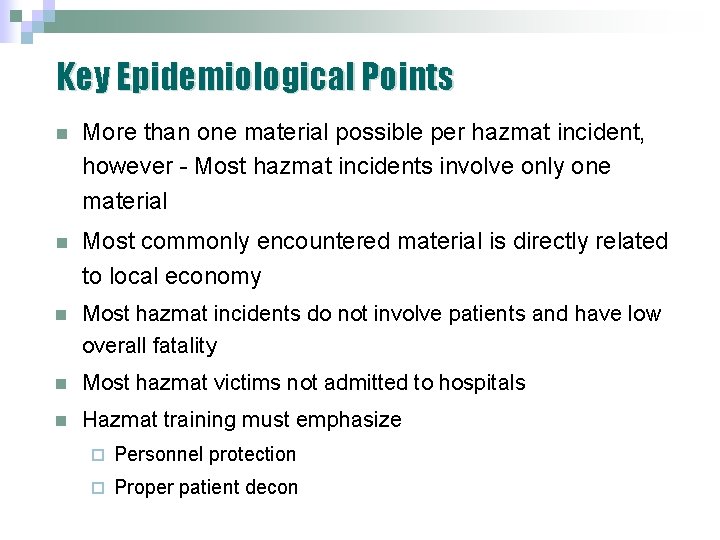
Key Epidemiological Points n More than one material possible per hazmat incident, however - Most hazmat incidents involve only one material n Most commonly encountered material is directly related to local economy n Most hazmat incidents do not involve patients and have low overall fatality n Most hazmat victims not admitted to hospitals n Hazmat training must emphasize ¨ Personnel protection ¨ Proper patient decon
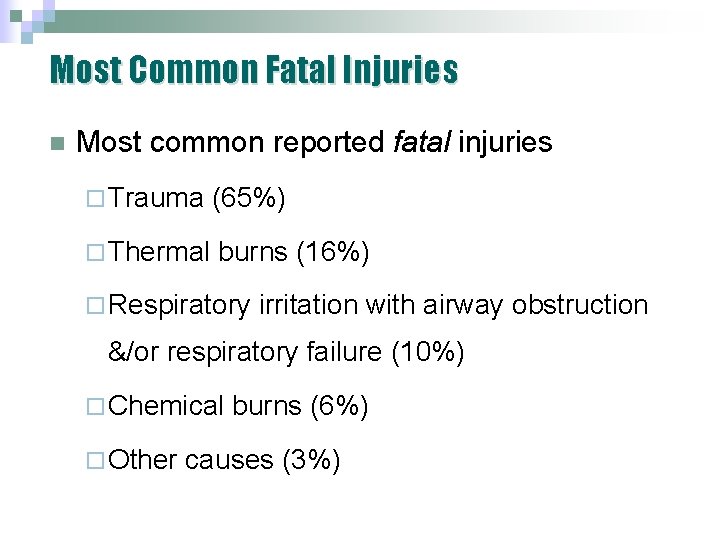
Most Common Fatal Injuries n Most common reported fatal injuries ¨ Trauma (65%) ¨ Thermal burns (16%) ¨ Respiratory irritation with airway obstruction &/or respiratory failure (10%) ¨ Chemical ¨ Other burns (6%) causes (3%)
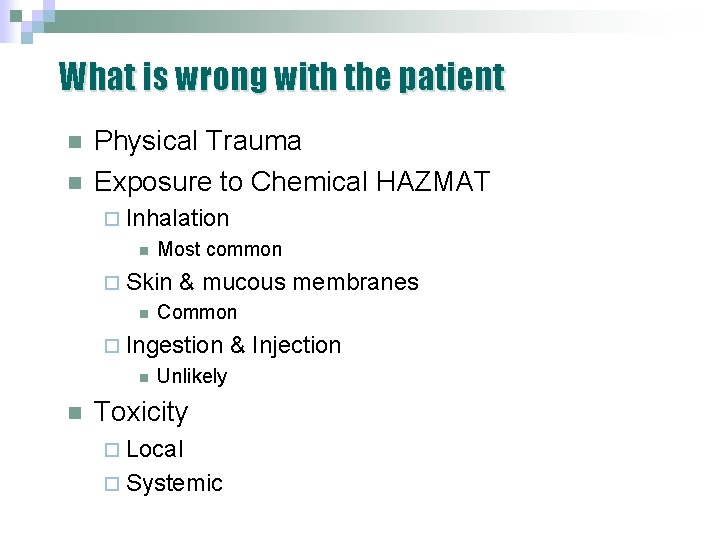
What is wrong with the patient n n Physical Trauma Exposure to Chemical HAZMAT ¨ Inhalation n Most common ¨ Skin n & mucous membranes Common ¨ Ingestion n n Unlikely Toxicity ¨ Local ¨ Systemic & Injection
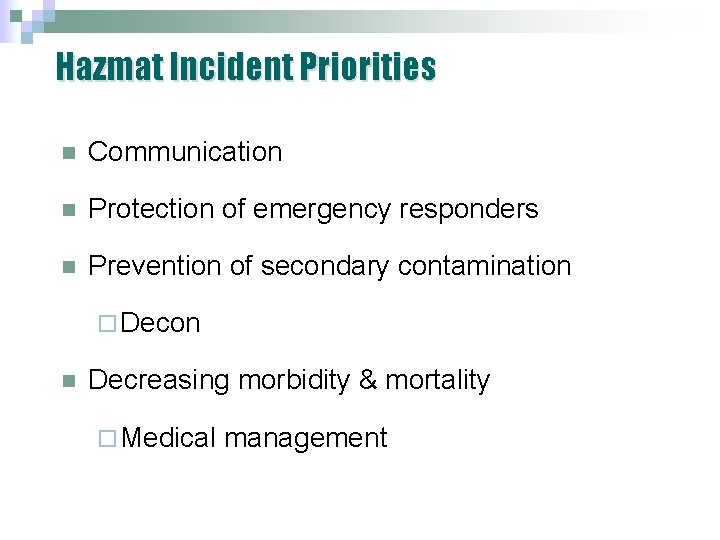
Hazmat Incident Priorities n Communication n Protection of emergency responders n Prevention of secondary contamination ¨ Decon n Decreasing morbidity & mortality ¨ Medical management
Scene Safety Responder/Receiver safety first!
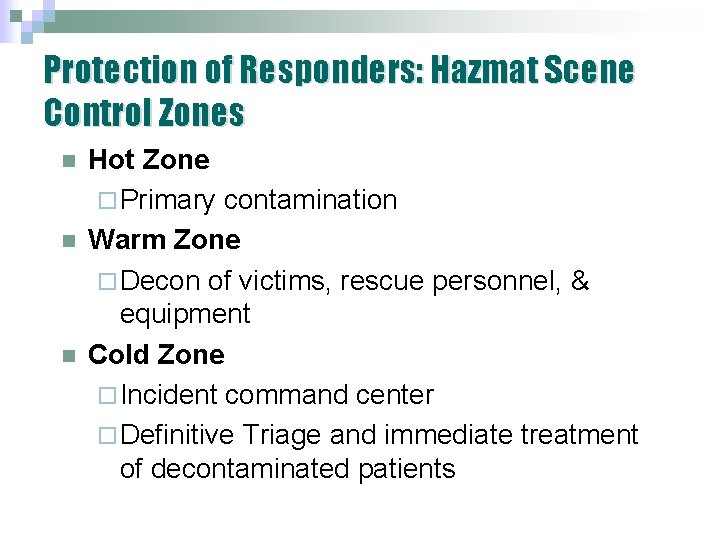
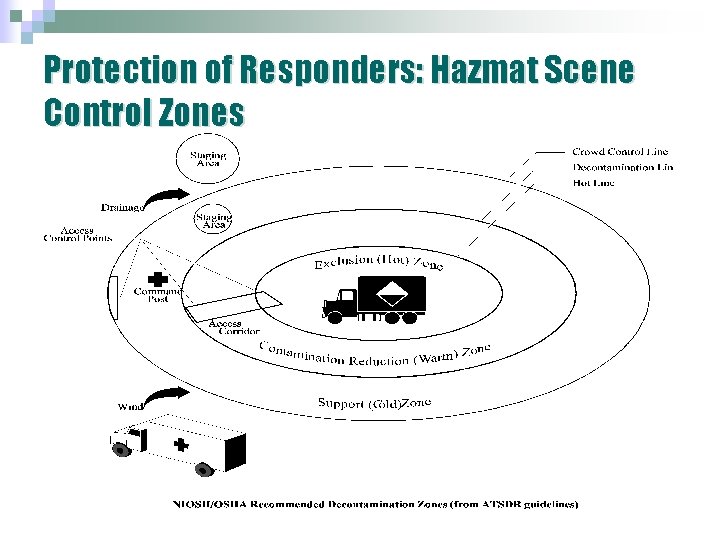
Protection of Responders: Hazmat Scene Control Zones n n n Hot Zone ¨ Primary contamination Warm Zone ¨ Decon of victims, rescue personnel, & equipment Cold Zone ¨ Incident command center ¨ Definitive Triage and immediate treatment of decontaminated patients
Protection of Responders: Hazmat Scene Control Zones
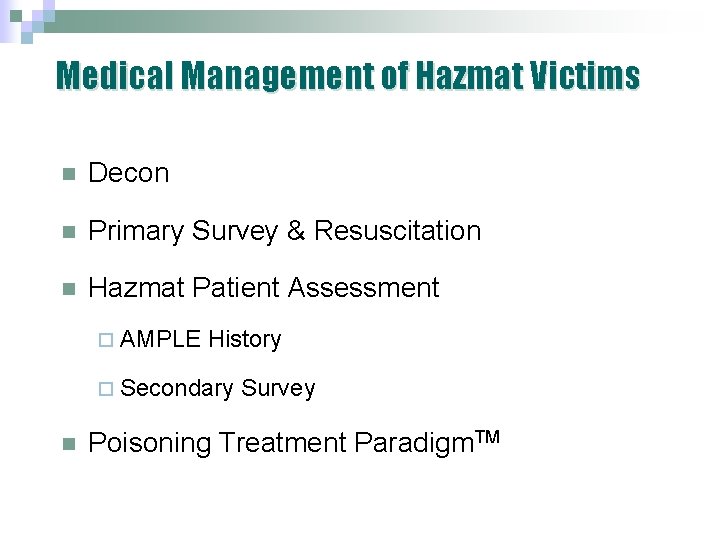
Medical Management of Hazmat Victims n Decon n Primary Survey & Resuscitation n Hazmat Patient Assessment ¨ AMPLE History ¨ Secondary n Survey Poisoning Treatment Paradigm. TM
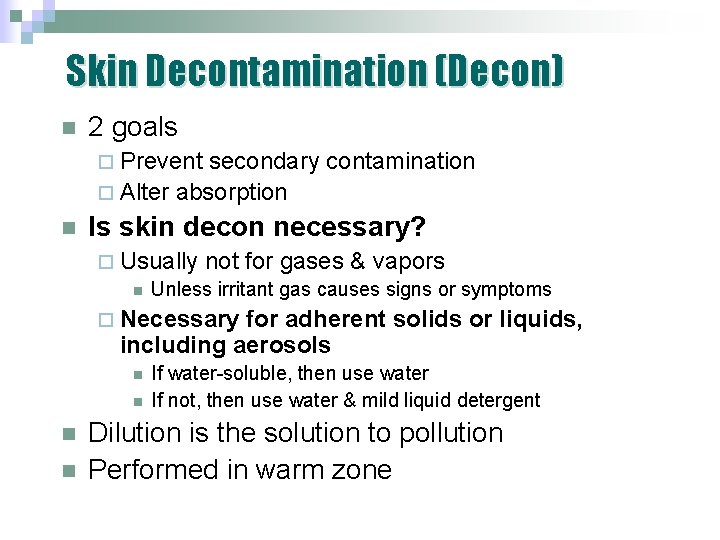
Skin Decontamination (Decon) n 2 goals ¨ Prevent secondary contamination ¨ Alter absorption n Is skin decon necessary? ¨ Usually not for gases & vapors n Unless irritant gas causes signs or symptoms ¨ Necessary for adherent solids or liquids, including aerosols n n If water-soluble, then use water If not, then use water & mild liquid detergent Dilution is the solution to pollution Performed in warm zone
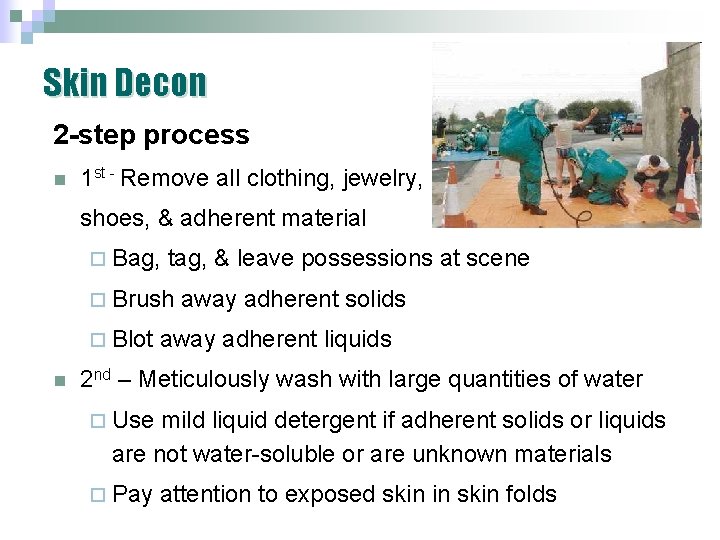
Skin Decon 2 -step process n 1 st - Remove all clothing, jewelry, shoes, & adherent material ¨ Bag, tag, & leave possessions at scene ¨ Brush ¨ Blot n away adherent solids away adherent liquids 2 nd – Meticulously wash with large quantities of water ¨ Use mild liquid detergent if adherent solids or liquids are not water-soluble or are unknown materials ¨ Pay attention to exposed skin in skin folds
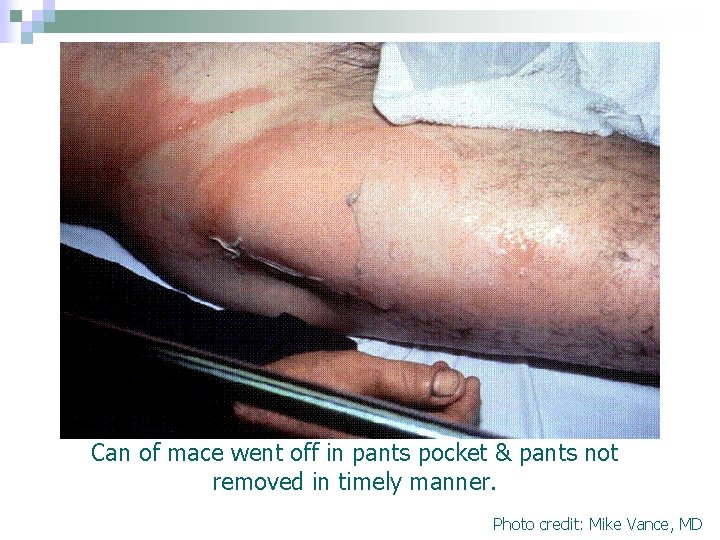
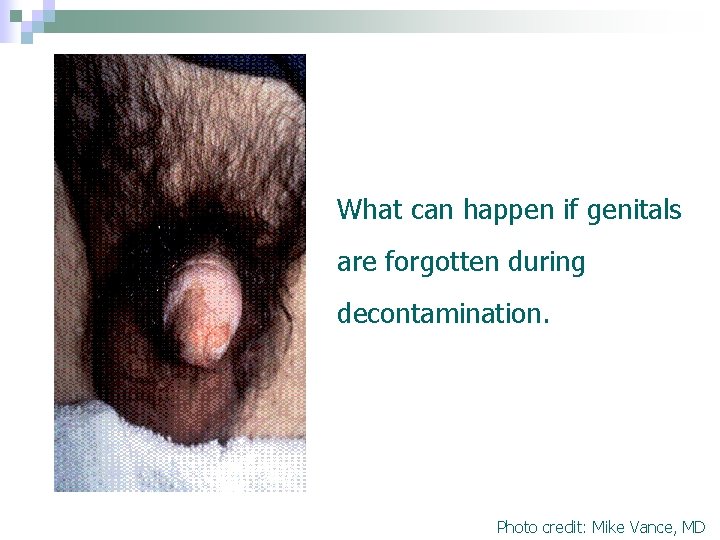
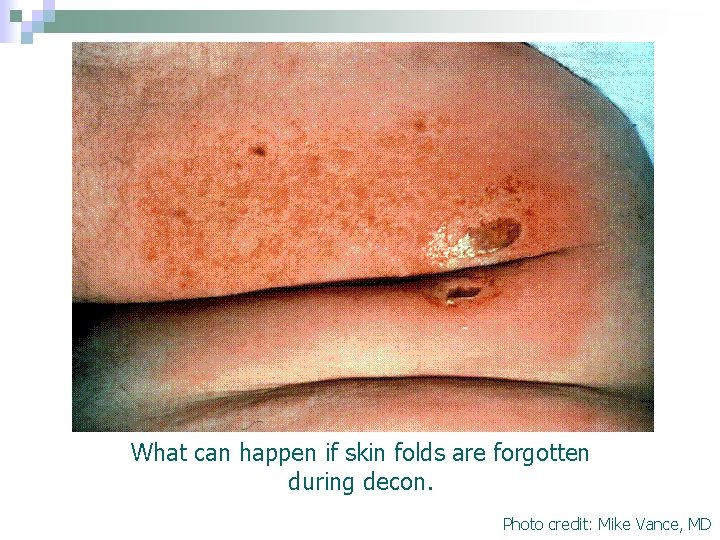
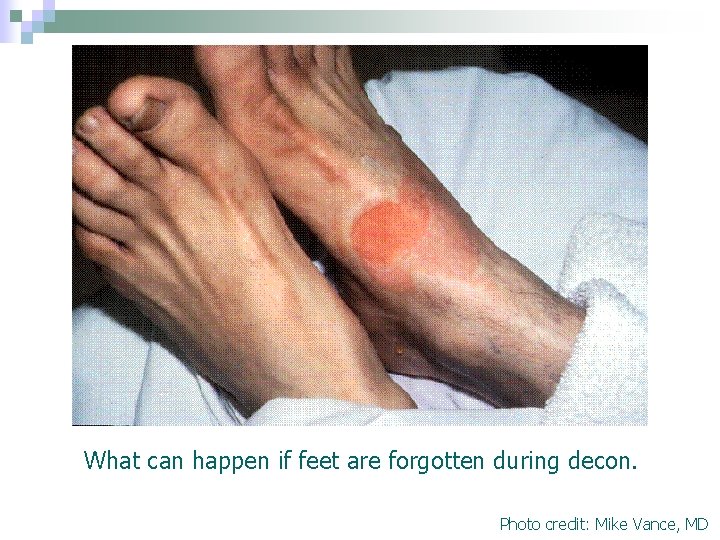
Skin Decon: Special Areas Commonly ignored during decon n Including n ¨ Scalp ¨ Body hair ¨ Genitalia ¨ Skin creases & folds ¨ Hands ¨ Feet ¨ Nails
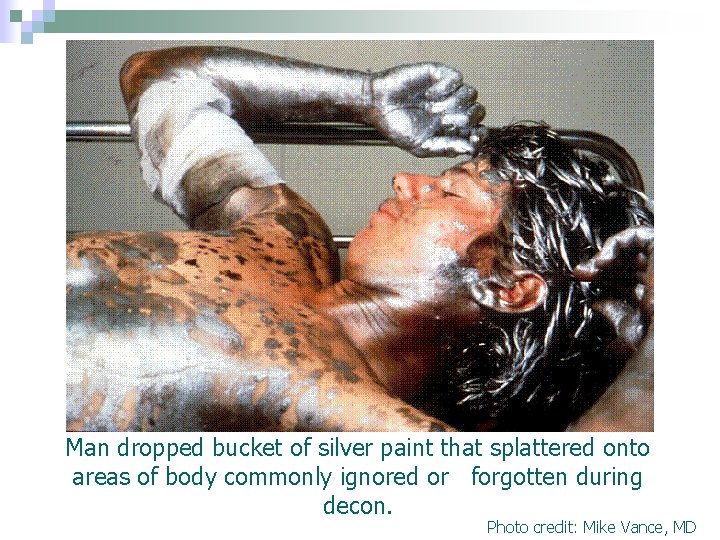
Man dropped bucket of silver paint that splattered onto areas of body commonly ignored or forgotten during decon. Photo credit: Mike Vance, MD
Can of mace went off in pants pocket & pants not removed in timely manner. Photo credit: Mike Vance, MD
What can happen if genitals are forgotten during decontamination. Photo credit: Mike Vance, MD
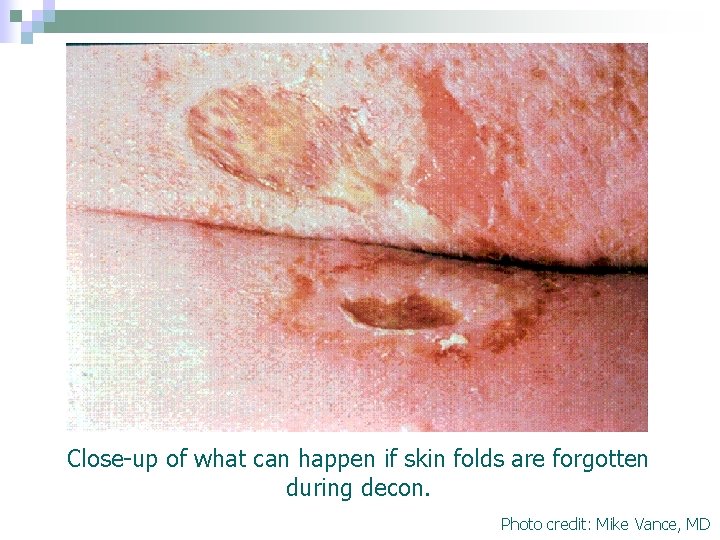
What can happen if skin folds are forgotten during decon. Photo credit: Mike Vance, MD
Close-up of what can happen if skin folds are forgotten during decon. Photo credit: Mike Vance, MD
What can happen if feet are forgotten during decon. Photo credit: Mike Vance, MD
Eye Decon n Irrigate exposed, symptomatic eyes immediately & continuously ¨Use water or saline n Water is best ¨Readily available in large quantity ¨Efficient n Check for & remove contact lenses
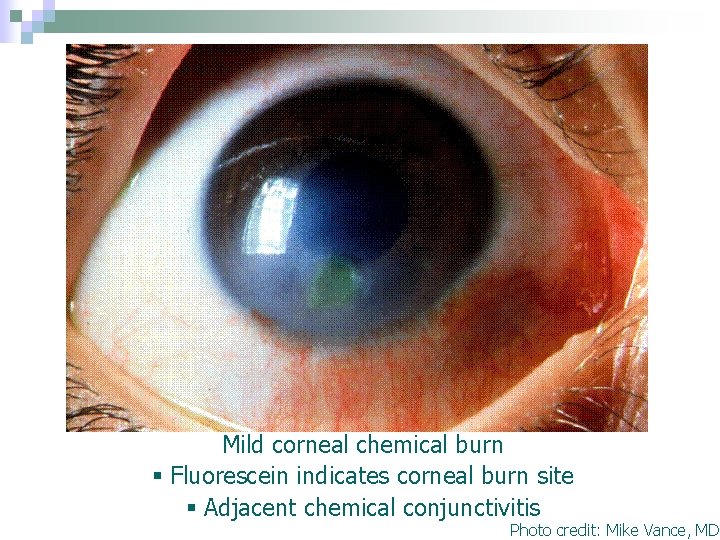
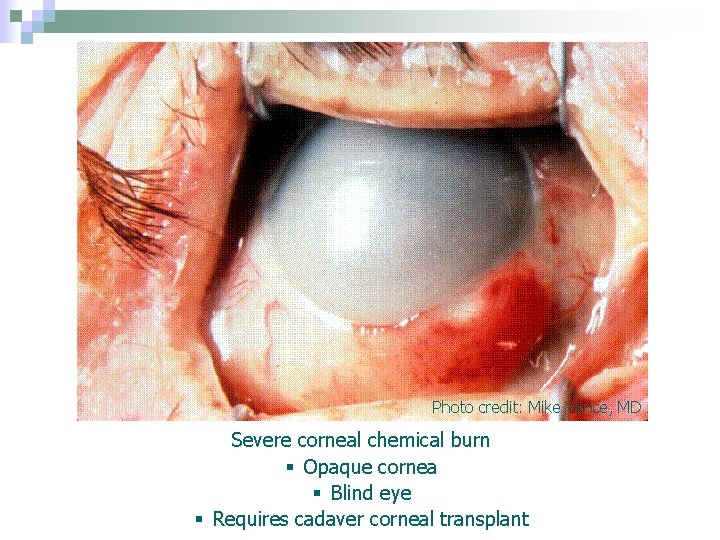
What happens if you don’t decon eyes?
Mild corneal chemical burn § Fluorescein indicates corneal burn site § Adjacent chemical conjunctivitis Photo credit: Mike Vance, MD
Photo credit: Mike Vance, MD Severe corneal chemical burn § Opaque cornea § Blind eye § Requires cadaver corneal transplant
Primary Survey & Resuscitation: The Basics Performed only after adequate decon in warm zone / ED Decon area n Only two procedures performed before decon n ¨ Open airway ¨ Spine precautions Use common sense n Safety comes first n
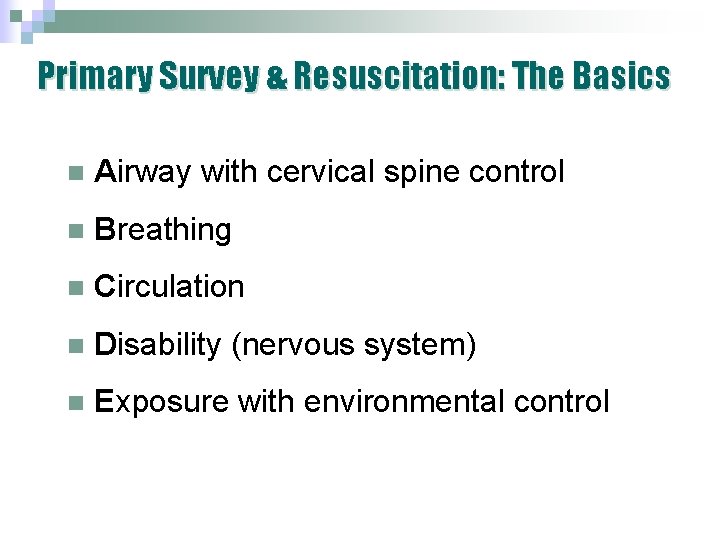
Primary Survey & Resuscitation: The Basics n Airway with cervical spine control n Breathing n Circulation n Disability (nervous system) n Exposure with environmental control
Airway with Cervical Spine Control n Ensure open & protected airway n Perform definitive airway management if airway is at risk, partially obstructed, or completely obstructed ¨ Endotracheal intubation preferred ¨ Cricothyroidotomy if unable to intubate
Breathing Ensure adequate ventilation & oxygenation n If not breathing n ¨ Bag-valve-mask ventilation with 100% oxygen, then intubate n If breathing adequately ¨ 100% oxygen therapy if n Cardiopulmonary or neurological signs or symptoms n Possible carbon monoxide poisoning
Circulation n n Check for pulse If no pulse ¨ CPR ¨ Follow ACLS guidelines If pulse ¨ Check blood pressure ¨ Follow ACLS guidelines IV normal saline for moderate to severe signs or symptoms Monitor for shock & treat accordingly
Disability (Nervous System) n Continually assess level of consciousness ¨ Mental status trend impacts triage, diagnosis, & treatment n If seizures develop, despite adequate oxygenation & blood glucose ¨ Treat with IV benzodiazepine
Exposure with Environmental Control n Remove patient clothing during Decon n Examine patient for other injuries ¨ Trauma n Treat the whole patient. ¨ Trauma n & burns or burns can kill hazmat victim Hypothermia is very realistic phenomenon
Hazmat Patient Assessment n Occurs concurrently n Only once Resuscitated and Stable n Patient history ¨ AMPLE n mnemonic Secondary survey
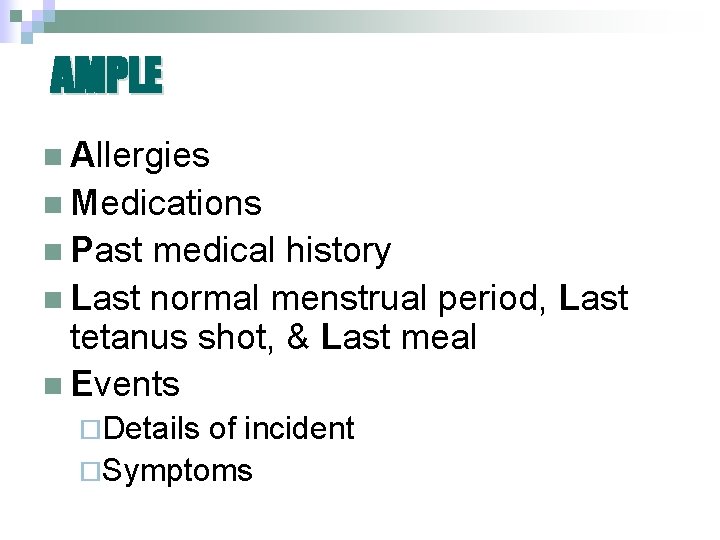
AMPLE n Allergies n Medications n Past medical history n Last normal menstrual period, Last tetanus shot, & Last meal n Events ¨Details of incident ¨Symptoms
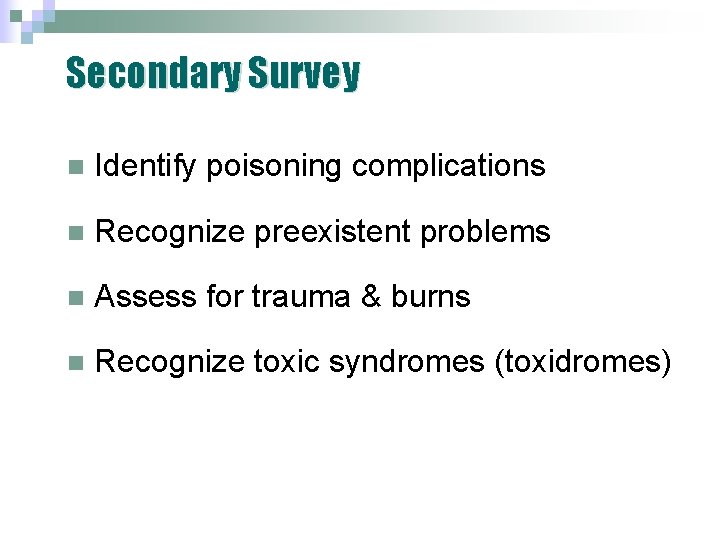
Secondary Survey n Identify poisoning complications n Recognize preexistent problems n Assess for trauma & burns n Recognize toxic syndromes (toxidromes)
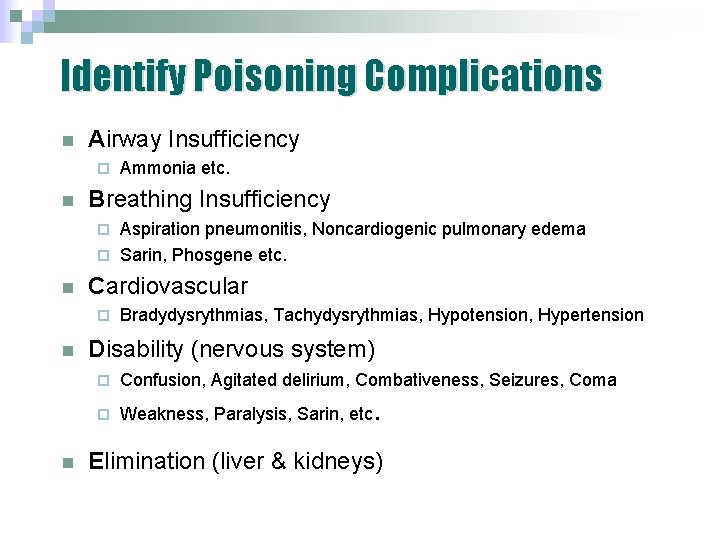
Identify Poisoning Complications n Airway Insufficiency ¨ n Ammonia etc. Breathing Insufficiency Aspiration pneumonitis, Noncardiogenic pulmonary edema ¨ Sarin, Phosgene etc. ¨ n Cardiovascular ¨ n n Bradydysrythmias, Tachydysrythmias, Hypotension, Hypertension Disability (nervous system) ¨ Confusion, Agitated delirium, Combativeness, Seizures, Coma ¨ Weakness, Paralysis, Sarin, etc . Elimination (liver & kidneys)
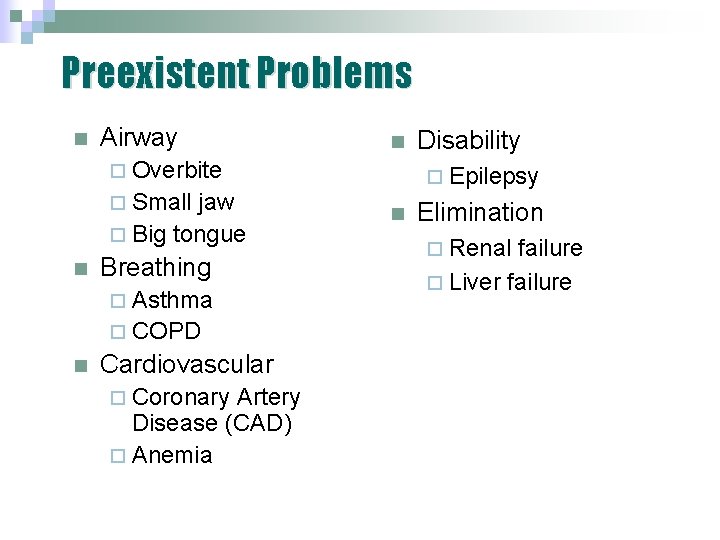
Preexistent Problems n Airway n ¨ Overbite ¨ Small jaw ¨ Big tongue n Breathing ¨ Asthma ¨ COPD n Cardiovascular ¨ Coronary Artery Disease (CAD) ¨ Anemia Disability ¨ Epilepsy n Elimination ¨ Renal failure ¨ Liver failure
Recognize Toxic Syndromes n Toxic + syndrome = Toxidrome n 5 fundamental hazmat toxidromes ¨Irritant gas ¨Asphyxiant ¨Cholinergic ¨Corrosive ¨Hydrocarbon & halogenated hydrocarbon
Summary n Decontaminate n Primary survey & resuscitation n Poisoning Treatment Paradigm. TM ¨Identify the hazardous material ¨Identify poisoning complications ¨Identify preexistent problems ¨Identify toxidromes
Thank You for a patient hearing JPN Apex Trauma Center All India Institute of Medical Sciences