
Management of Superficial Bladder Cancer Douglas S Scherr
Management of Superficial Bladder Cancer Douglas S. Scherr, M. D. Assistant Professor of Urology Clinical Director, Urologic Oncology Weill Medical College-Cornell University
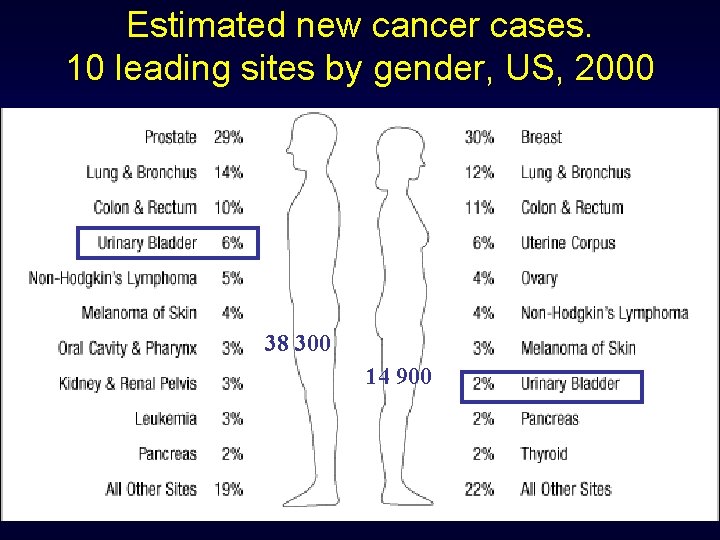
Estimated new cancer cases. 10 leading sites by gender, US, 2000 38 300 14 900
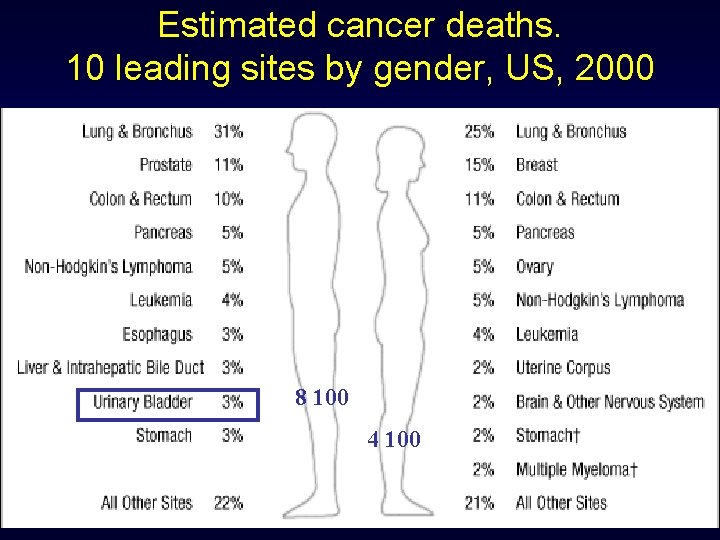
Estimated cancer deaths. 10 leading sites by gender, US, 2000 8 100 4 100
Epidemiology • 5 th most common cancer in men • 12, 000 cancer related deaths/year • 70% present as superficial TCC • “Superficial” = Ta, Tis, T 1 • Men>Women
Epidemiology • 2. 8% lifetime risk in caucasian men 0. 9% lifetime risk in African American men • 1% risk in caucasian women 0. 6% African American women • Carcinogens implicated in bladder cancer – could have 40 year latency period
Risk Factors for Superficial TCC • Cigarette smoking: 2 -4 fold increase risk 4 -Aminobiphenyl O-toluidine • Arylamine exposure 2 -Naphthylamine Benzidine 4 -Aminobiphenyl • Chemotherapy – cyclophosphamide • Pelvic radiation therapy
Pathology of Superficial Bladder Cancer • 90% Transitional Cell Carcinoma (TCC) • 5% squamous cell - more common in middle east – schistosomiasis -also seen in chronic catheterization • 0. 5%-2% Adenocarcinoma - urachal
Bladder Cancer WHO, International Society of Urological Pathology Consensus Classification of Urothelial Neoplasms
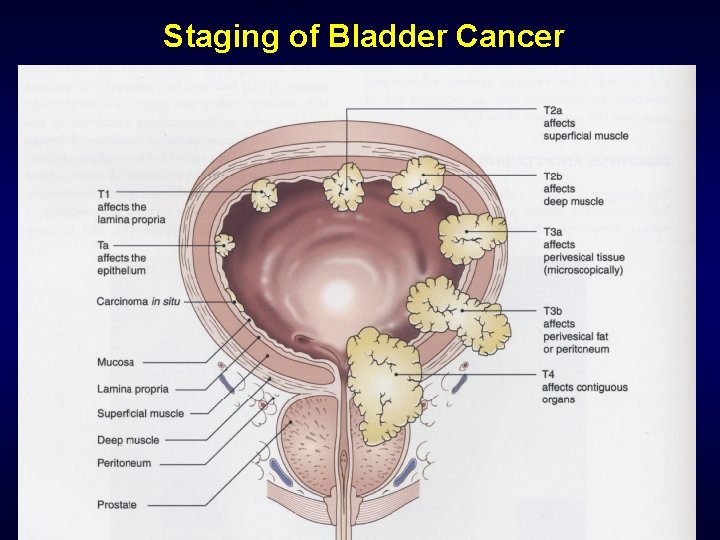
Staging of Bladder Cancer
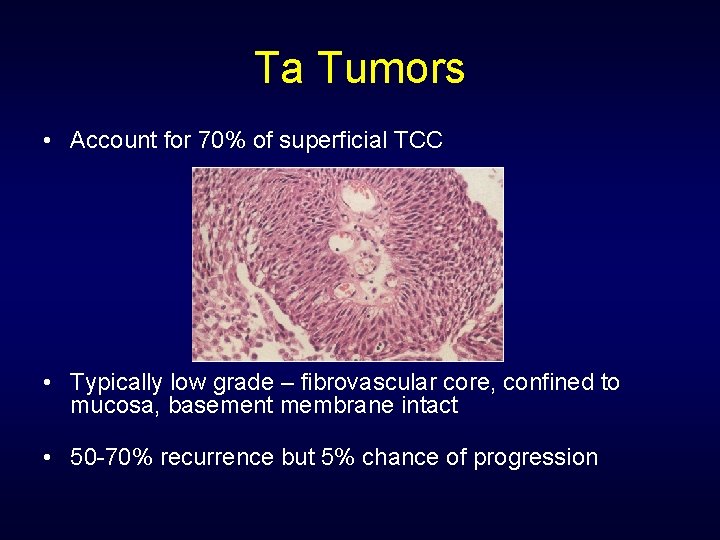
Ta Tumors • Account for 70% of superficial TCC • Typically low grade – fibrovascular core, confined to mucosa, basement membrane intact • 50 -70% recurrence but 5% chance of progression
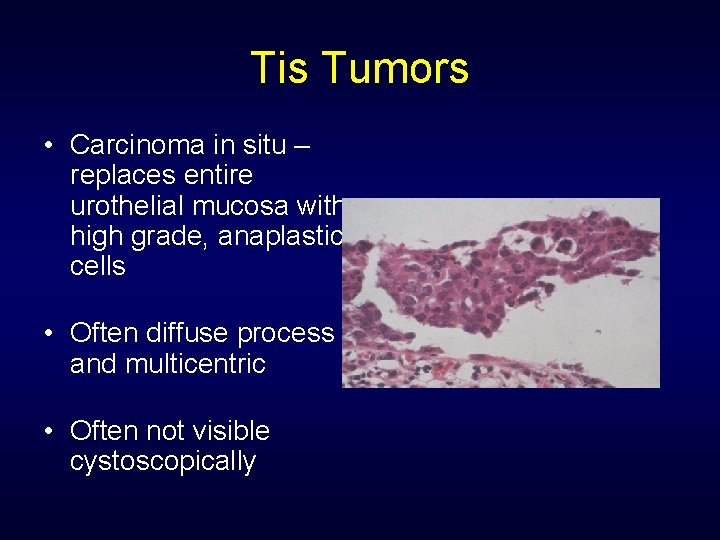
Tis Tumors • Carcinoma in situ – replaces entire urothelial mucosa with high grade, anaplastic cells • Often diffuse process and multicentric • Often not visible cystoscopically
T 1 Tumors • Invades into lamina propria • Often high grade
Papilloma of Low Malignant Potential (PLMP) • No more than 8 cell layers thick • Cytologically normal epithelium
Diagnosis of Superficial TCC “Hematuria” • Hematuria – most common – present 80% • Degree of hematuria not related to stage or grade of disease • 13% of population has microhematuria • >3 -5 RBC/HPF should undergo evaluation
Diagnosis of Superficial TCC Imaging and Cystoscopy • IVP or CT scan with hematuria protocol preferred • Retrograde pyelogram used to further evaluate suspicious findings on IVP/CT • Ultrasound inadequate to visualize collecting system • CT scan with late phase images and CT urograms ideal • Cystoscopy is gold standard – flexible instruments helpful – could obtain bladder wash
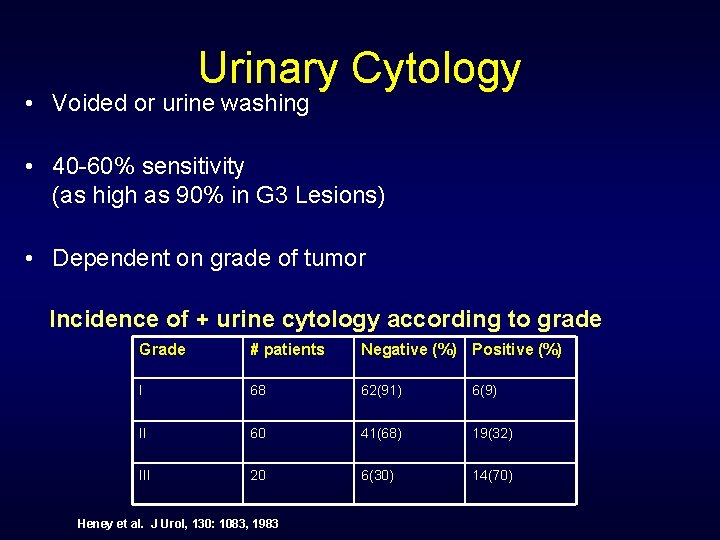
Urinary Cytology • Voided or urine washing • 40 -60% sensitivity (as high as 90% in G 3 Lesions) • Dependent on grade of tumor Incidence of + urine cytology according to grade Grade # patients Negative (%) Positive (%) I 68 62(91) 6(9) II 60 41(68) 19(32) III 20 6(30) 14(70) Heney et al. J Urol, 130: 1083, 1983
Potential Diagnostic Markers • S phase (Ki 67) • P 53 • P 21 – downstream of p 53 – if + favorable outcome • Rb
Natural History Ta Tumor • Recurrence and Progression • Overall 60 -70% recurrence rate • Progression based on Grade: Low grade – 4 -5% progression High grade – 39% progression (26% died of TCC) Bostwick, DG J Cell Biochem, 161: 31, 1992 Herr et al. J Urol, 163: 60, 2000
Natural History T 1 Tumor • Most often high grade • 30 -50% progression rate • Depth of lamina propria prognostic • 70% associated with Cis • Size of tumor predictive of recurrence
Natural History Tis • 54% progress to muscle invasive disease • If diffuse and associated with symptoms – progression rate higher • Worse prognosis if associated with papillary tumor Lamm et al, Urol Clin NA, 19: 499, 1992 Herr et al, J Urol, 147: 1020, 1992
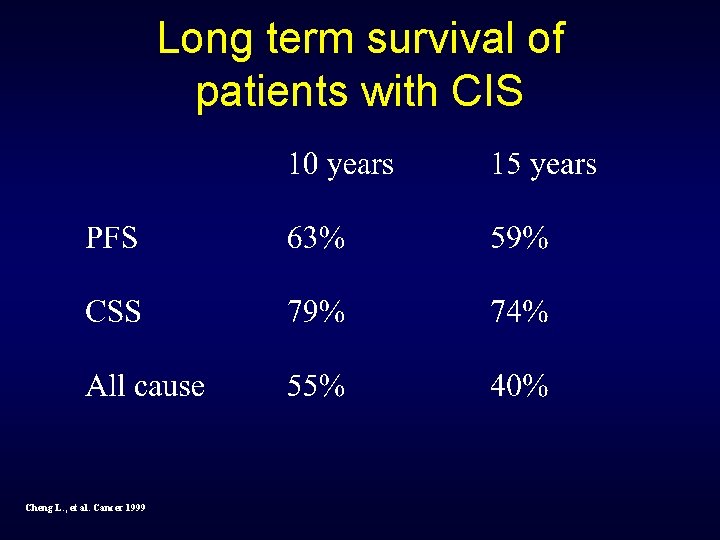
Long term survival of patients with CIS Cheng L. , et al. Cancer 1999
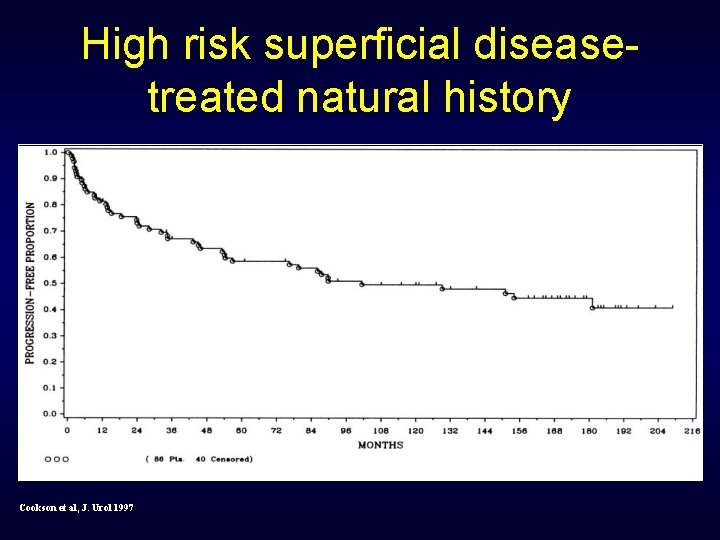
High risk superficial diseasetreated natural history Cookson et al, J. Urol 1997
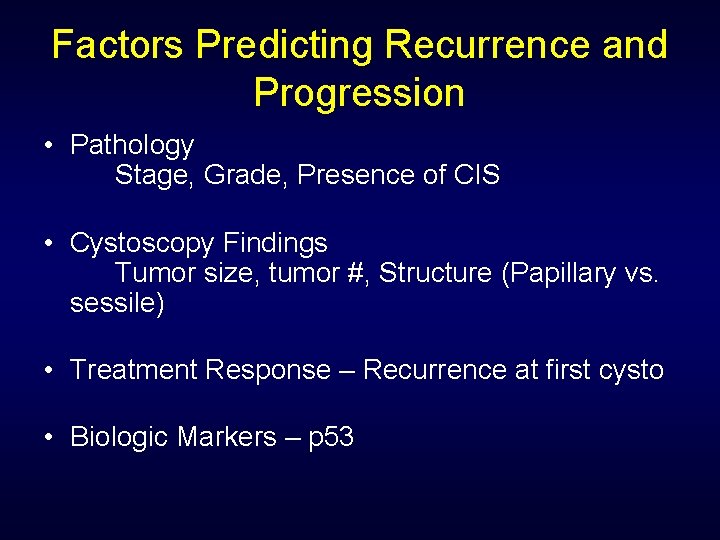
Factors Predicting Recurrence and Progression • Pathology Stage, Grade, Presence of CIS • Cystoscopy Findings Tumor size, tumor #, Structure (Papillary vs. sessile) • Treatment Response – Recurrence at first cysto • Biologic Markers – p 53
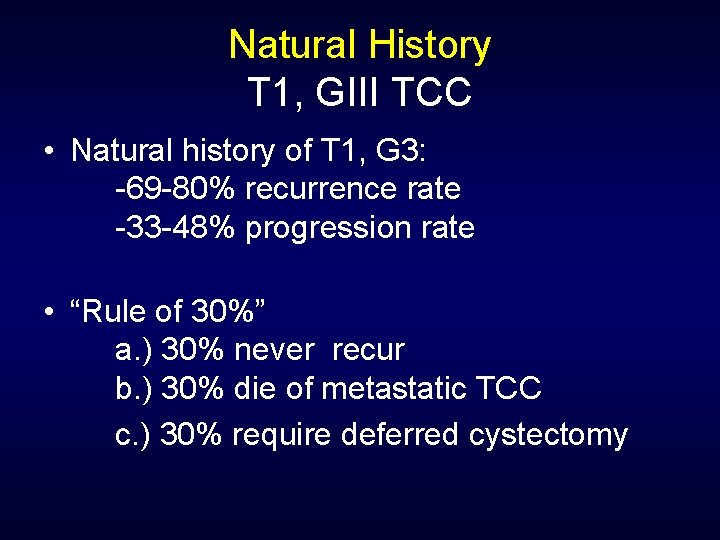
Natural History T 1, GIII TCC • Natural history of T 1, G 3: -69 -80% recurrence rate -33 -48% progression rate • “Rule of 30%” a. ) 30% never recur b. ) 30% die of metastatic TCC c. ) 30% require deferred cystectomy
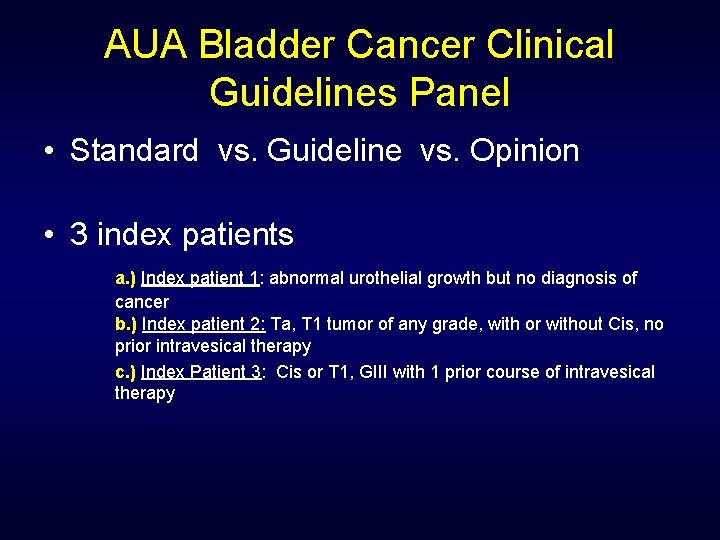
AUA Bladder Cancer Clinical Guidelines Panel • Standard vs. Guideline vs. Opinion • 3 index patients a. ) Index patient 1: abnormal urothelial growth but no diagnosis of cancer b. ) Index patient 2: Ta, T 1 tumor of any grade, with or without Cis, no prior intravesical therapy c. ) Index Patient 3: Cis or T 1, GIII with 1 prior course of intravesical therapy
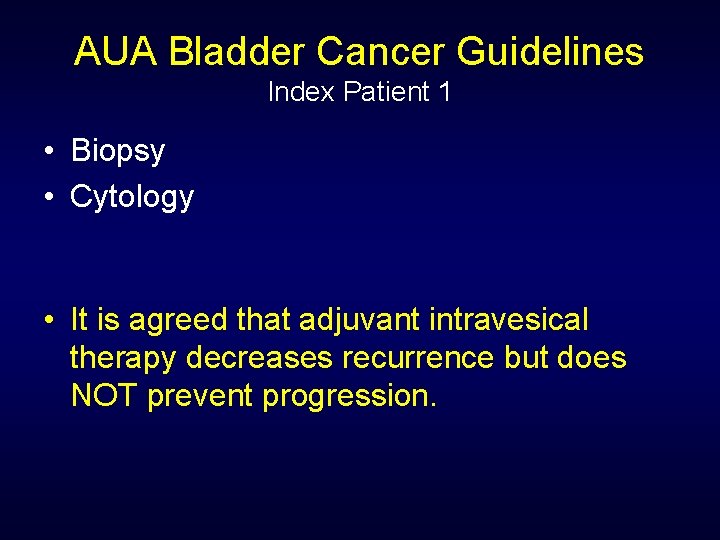
AUA Bladder Cancer Guidelines Index Patient 1 • Biopsy • Cytology • It is agreed that adjuvant intravesical therapy decreases recurrence but does NOT prevent progression.
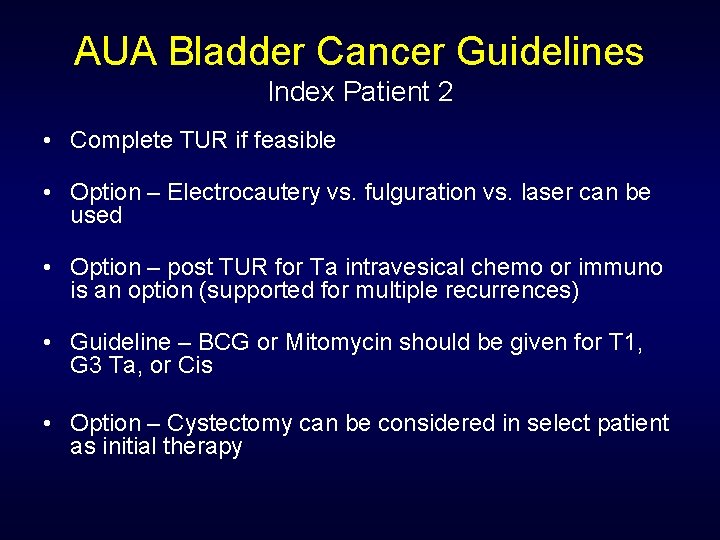
AUA Bladder Cancer Guidelines Index Patient 2 • Complete TUR if feasible • Option – Electrocautery vs. fulguration vs. laser can be used • Option – post TUR for Ta intravesical chemo or immuno is an option (supported for multiple recurrences) • Guideline – BCG or Mitomycin should be given for T 1, G 3 Ta, or Cis • Option – Cystectomy can be considered in select patient as initial therapy
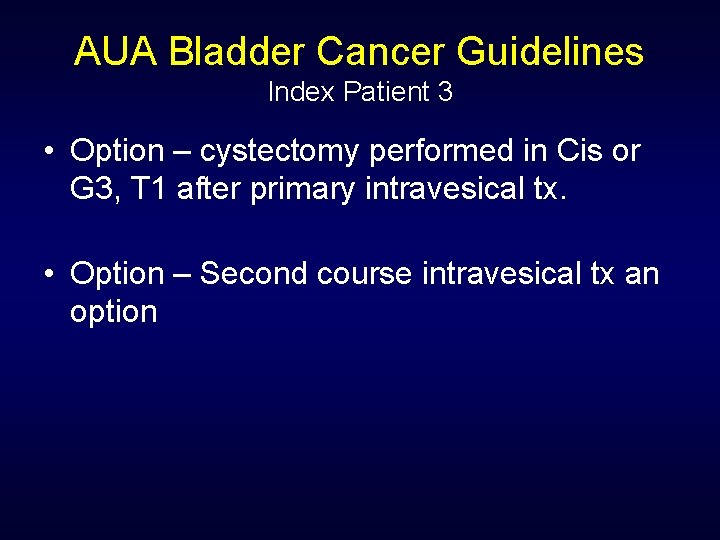
AUA Bladder Cancer Guidelines Index Patient 3 • Option – cystectomy performed in Cis or G 3, T 1 after primary intravesical tx. • Option – Second course intravesical tx an option

Treatment of Superficial TCC TURB • Electrosurgical resection • Complete resection and deep biopsies ensure adequate staging • Random biopsies controversial • Prostatic urethral sampling
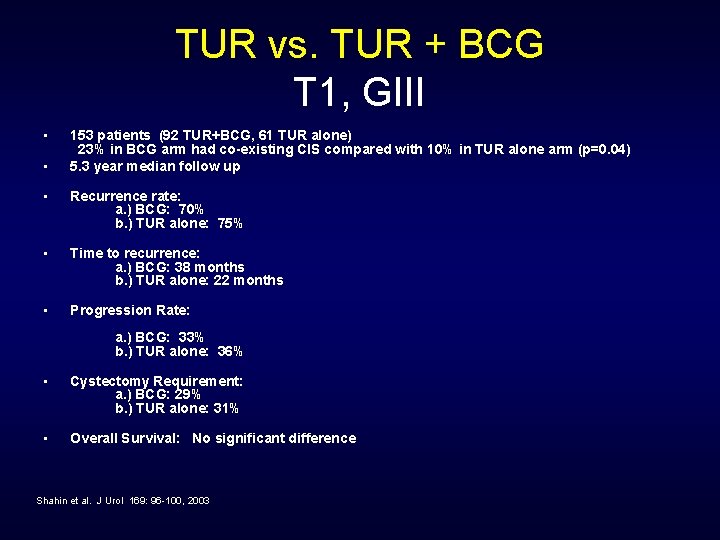
TUR vs. TUR + BCG T 1, GIII • • 153 patients (92 TUR+BCG, 61 TUR alone) 23% in BCG arm had co-existing CIS compared with 10% in TUR alone arm (p=0. 04) 5. 3 year median follow up • Recurrence rate: a. ) BCG: 70% b. ) TUR alone: 75% • Time to recurrence: a. ) BCG: 38 months b. ) TUR alone: 22 months • Progression Rate: a. ) BCG: 33% b. ) TUR alone: 36% • Cystectomy Requirement: a. ) BCG: 29% b. ) TUR alone: 31% • Overall Survival: No significant difference Shahin et al. J Urol 169: 96 -100, 2003
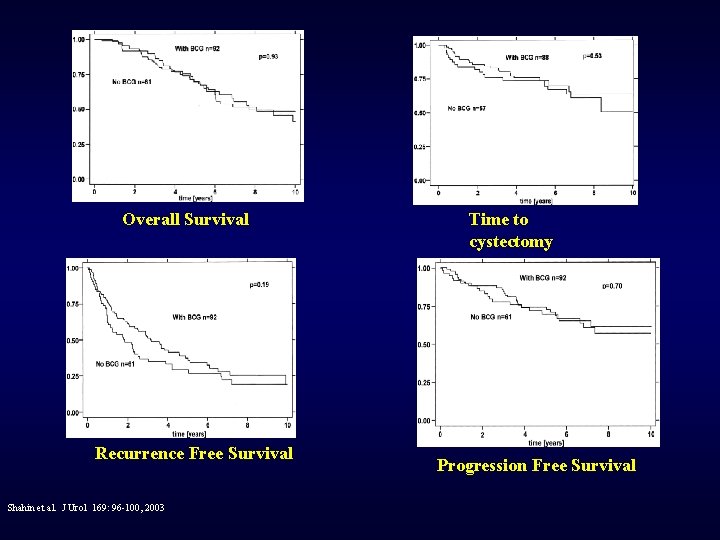
Overall Survival Recurrence Free Survival Shahin et al. J Urol 169: 96 -100, 2003 Time to cystectomy Progression Free Survival
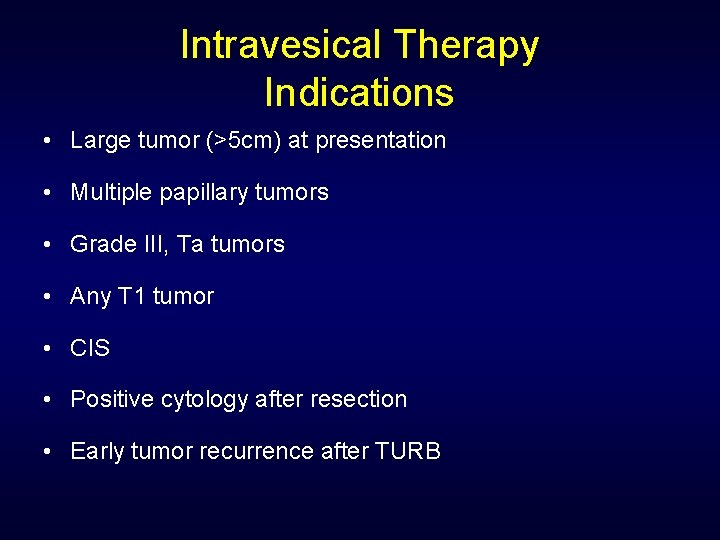
Intravesical Therapy Indications • Large tumor (>5 cm) at presentation • Multiple papillary tumors • Grade III, Ta tumors • Any T 1 tumor • CIS • Positive cytology after resection • Early tumor recurrence after TURB
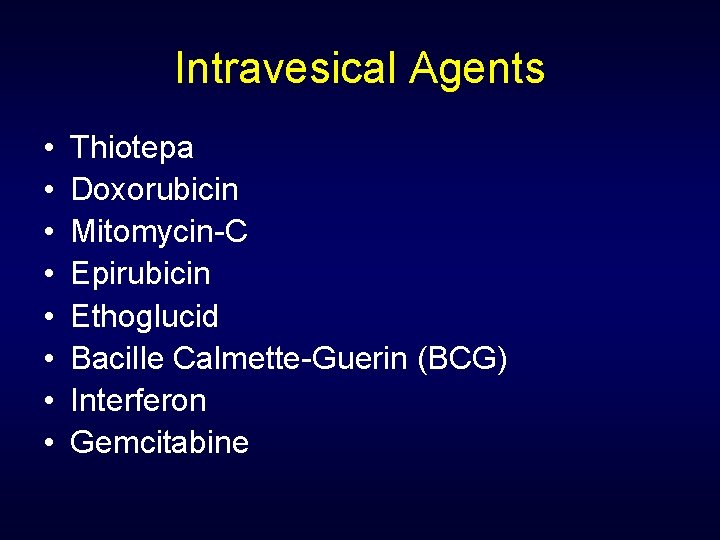
Intravesical Agents • • Thiotepa Doxorubicin Mitomycin-C Epirubicin Ethoglucid Bacille Calmette-Guerin (BCG) Interferon Gemcitabine
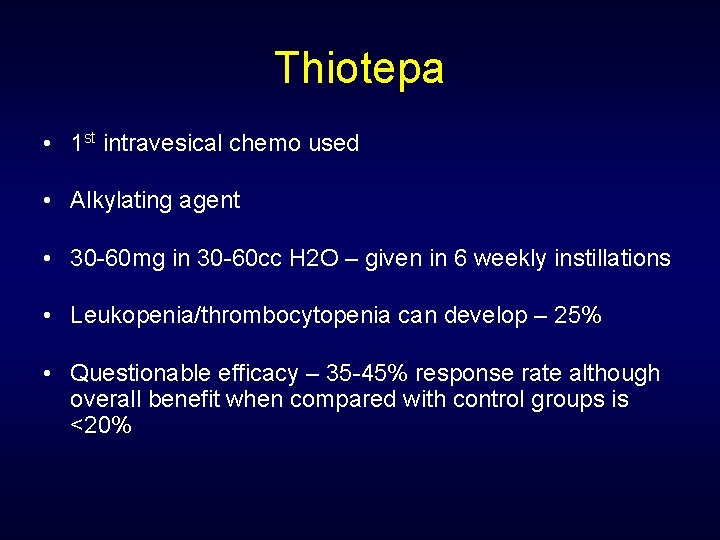
Thiotepa • 1 st intravesical chemo used • Alkylating agent • 30 -60 mg in 30 -60 cc H 2 O – given in 6 weekly instillations • Leukopenia/thrombocytopenia can develop – 25% • Questionable efficacy – 35 -45% response rate although overall benefit when compared with control groups is <20%
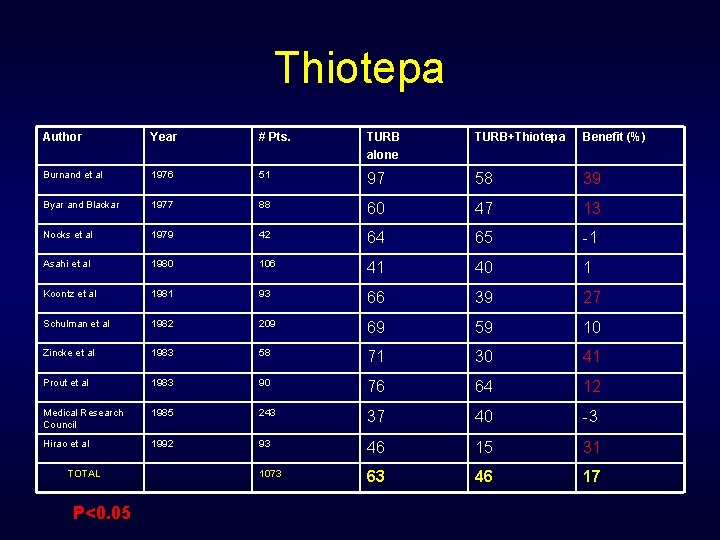
Thiotepa Author Year # Pts. TURB alone TURB+Thiotepa Benefit (%) Burnand et al 1976 51 97 58 39 Byar and Blackar 1977 88 60 47 13 Nocks et al 1979 42 64 65 -1 Asahi et al 1980 106 41 40 1 Koontz et al 1981 93 66 39 27 Schulman et al 1982 209 69 59 10 Zincke et al 1983 58 71 30 41 Prout et al 1983 90 76 64 12 Medical Research Council 1985 243 37 40 -3 Hirao et al 1992 93 46 15 31 1073 63 46 17 TOTAL P<0. 05
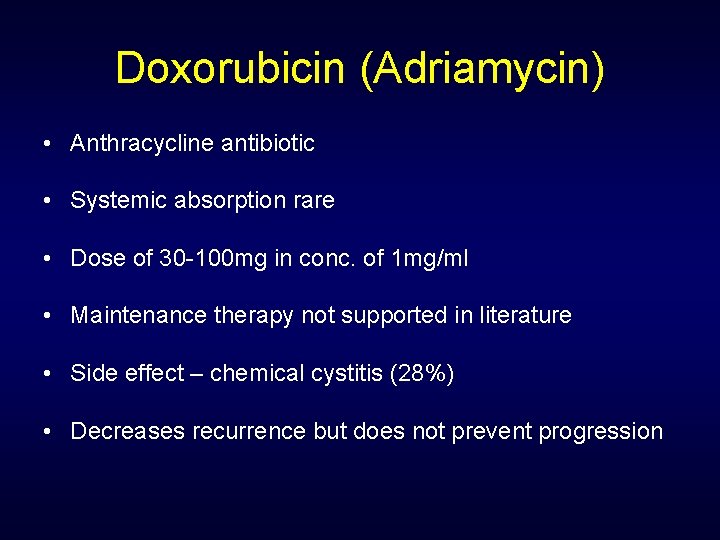
Doxorubicin (Adriamycin) • Anthracycline antibiotic • Systemic absorption rare • Dose of 30 -100 mg in conc. of 1 mg/ml • Maintenance therapy not supported in literature • Side effect – chemical cystitis (28%) • Decreases recurrence but does not prevent progression
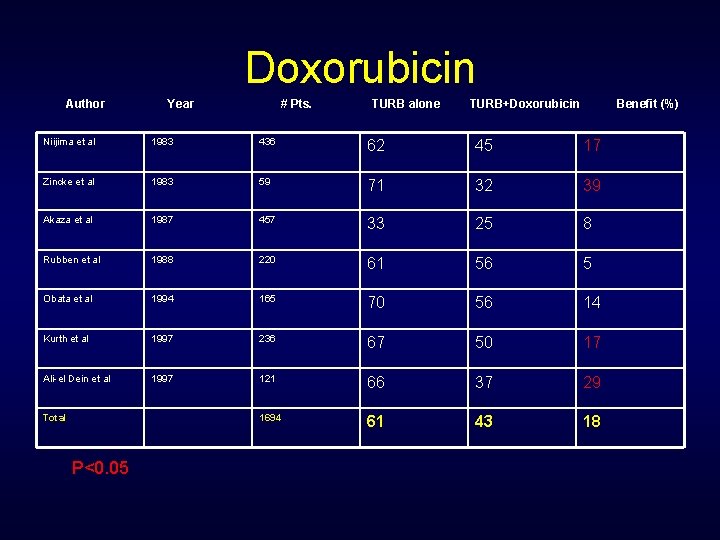
Doxorubicin Author Year # Pts. TURB alone TURB+Doxorubicin Benefit (%) Niijima et al 1983 436 62 45 17 Zincke et al 1983 59 71 32 39 Akaza et al 1987 457 33 25 8 Rubben et al 1988 220 61 56 5 Obata et al 1994 165 70 56 14 Kurth et al 1997 236 67 50 17 Ali-el Dein et al 1997 121 66 37 29 1694 61 43 18 Total P<0. 05
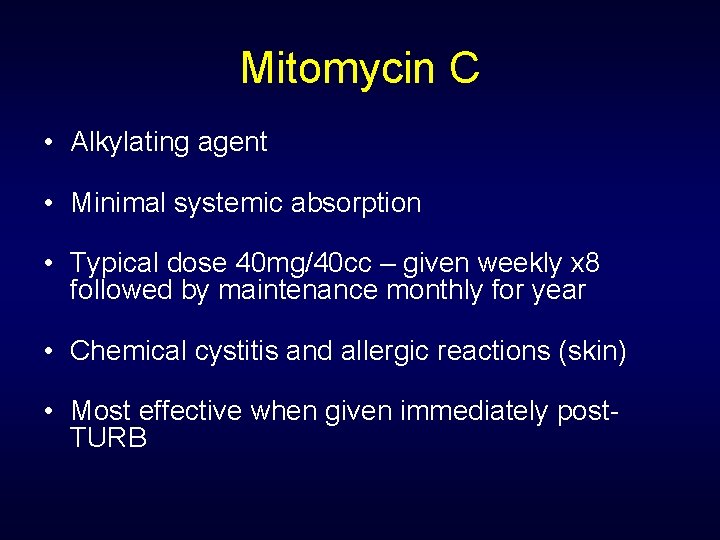
Mitomycin C • Alkylating agent • Minimal systemic absorption • Typical dose 40 mg/40 cc – given weekly x 8 followed by maintenance monthly for year • Chemical cystitis and allergic reactions (skin) • Most effective when given immediately post. TURB
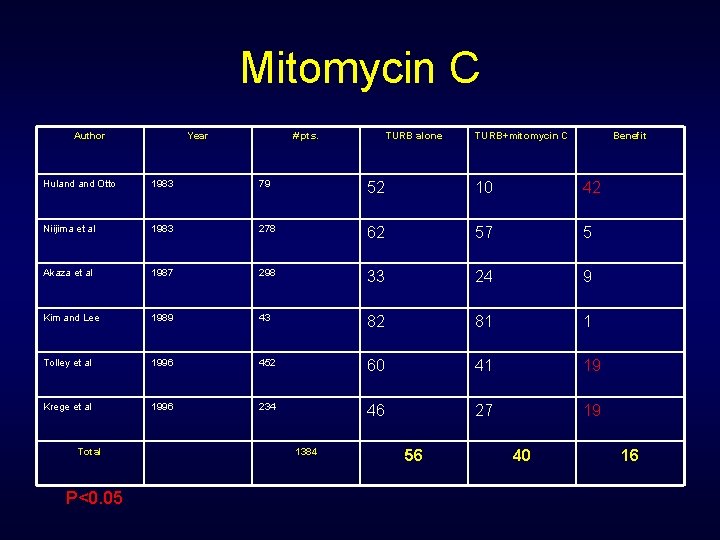
Mitomycin C Author Year # pts. TURB alone TURB+mitomycin C Benefit Huland Otto 1983 79 52 10 42 Niijima et al 1983 278 62 57 5 Akaza et al 1987 298 33 24 9 Kim and Lee 1989 43 82 81 1 Tolley et al 1996 452 60 41 19 Krege et al 1996 234 46 27 19 Total P<0. 05 1384 56 40 16
BCG Immunotherapy Most common agent for superficial TCC Unknown mechanism of action Side-effects a potential problem
BCG • Large studies by Lamm and Herr have demonstrated decrease in recurrence and delay in progression • Does not prevent progression • Theracys – live attenuated Mycobacterium Bovis from Connaught strain of Bacillus Calmette and Guerin
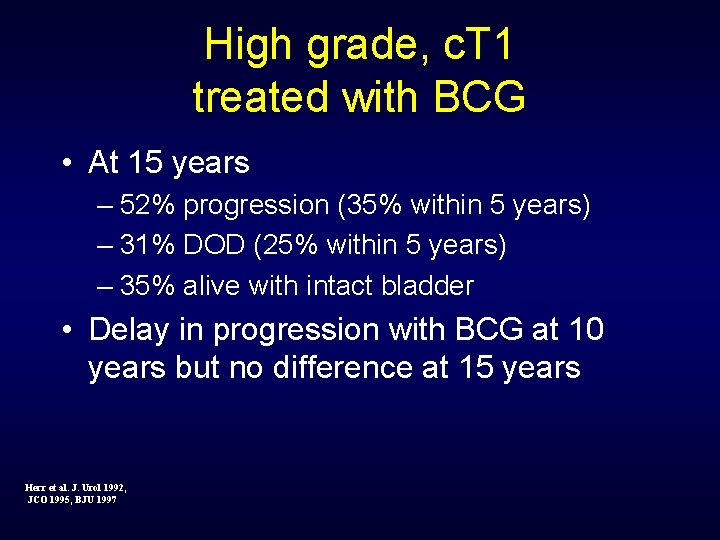
High grade, c. T 1 treated with BCG • At 15 years – 52% progression (35% within 5 years) – 31% DOD (25% within 5 years) – 35% alive with intact bladder • Delay in progression with BCG at 10 years but no difference at 15 years Herr et al. J. Urol 1992, JCO 1995, BJU 1997
BCG Two Methods for Therapy • Second induction course • Maintenance Therapy
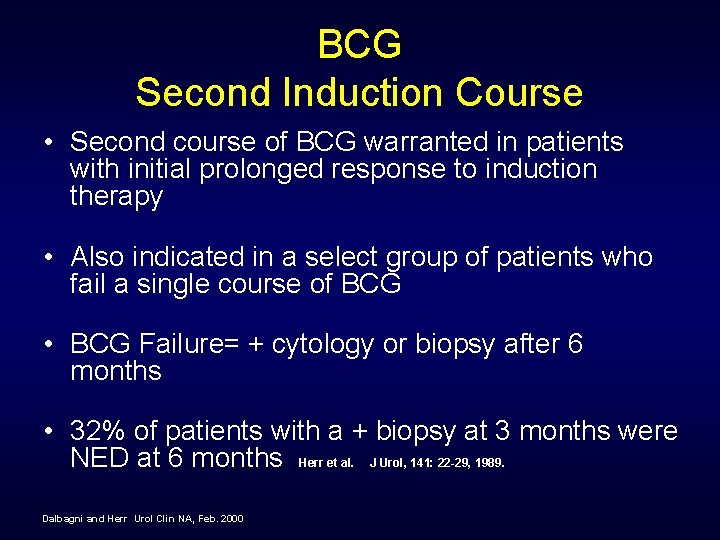
BCG Second Induction Course • Second course of BCG warranted in patients with initial prolonged response to induction therapy • Also indicated in a select group of patients who fail a single course of BCG • BCG Failure= + cytology or biopsy after 6 months • 32% of patients with a + biopsy at 3 months were NED at 6 months Herr et al. J Urol, 141: 22 -29, 1989. Dalbagni and Herr Urol Clin NA, Feb. 2000
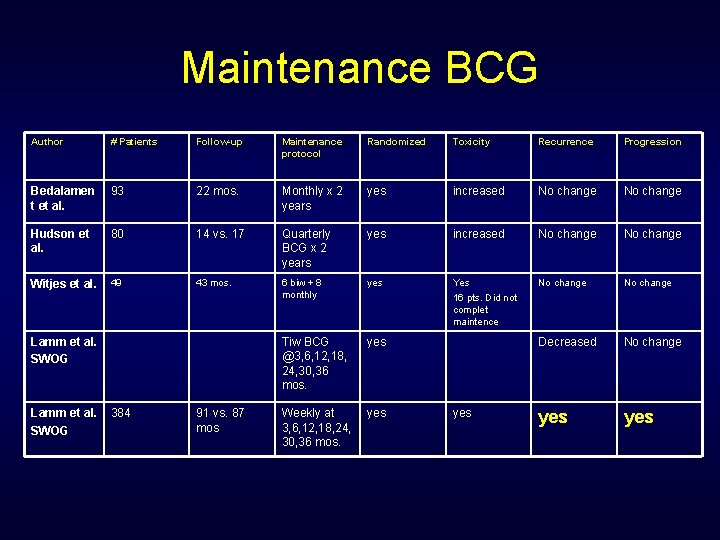
Maintenance BCG Author # Patients Follow-up Maintenance protocol Randomized Toxicity Recurrence Progression Bedalamen t et al. 93 22 mos. Monthly x 2 years yes increased No change Hudson et al. 80 14 vs. 17 Quarterly BCG x 2 years yes increased No change Witjes et al. 49 43 mos. 6 biw + 8 monthly yes Yes 16 pts. Did not complet maintence No change Tiw BCG @3, 6, 12, 18, 24, 30, 36 mos. yes Decreased No change Weekly at 3, 6, 12, 18, 24, 30, 36 mos. yes yes Lamm et al. SWOG 384 91 vs. 87 mos yes
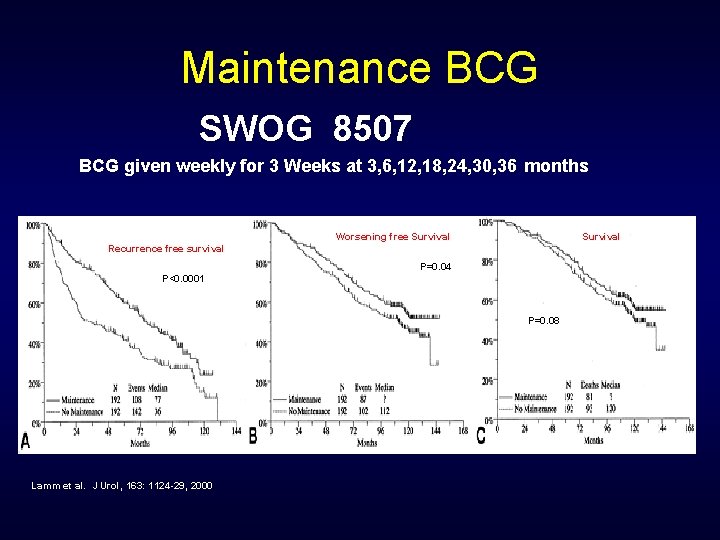
Maintenance BCG SWOG 8507 BCG given weekly for 3 Weeks at 3, 6, 12, 18, 24, 30, 36 months Worsening free Survival Recurrence free survival P=0. 04 P<0. 0001 P=0. 08 Lamm et al. J Urol, 163: 1124 -29, 2000
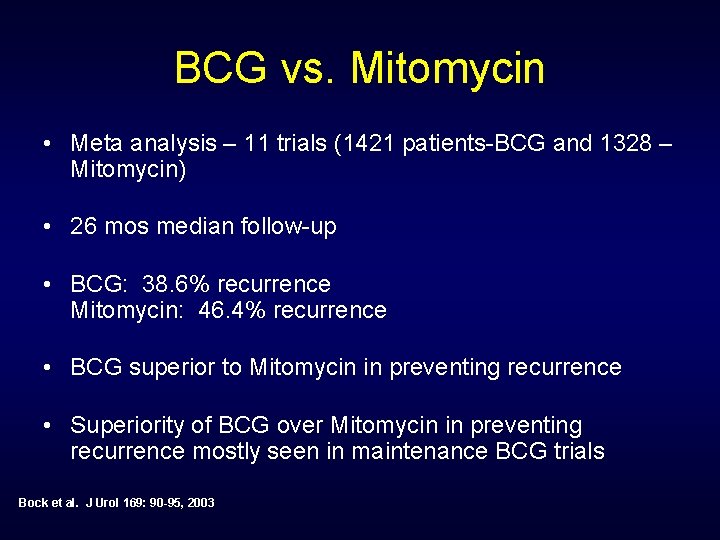
BCG vs. Mitomycin • Meta analysis – 11 trials (1421 patients-BCG and 1328 – Mitomycin) • 26 mos median follow-up • BCG: 38. 6% recurrence Mitomycin: 46. 4% recurrence • BCG superior to Mitomycin in preventing recurrence • Superiority of BCG over Mitomycin in preventing recurrence mostly seen in maintenance BCG trials Bock et al. J Urol 169: 90 -95, 2003
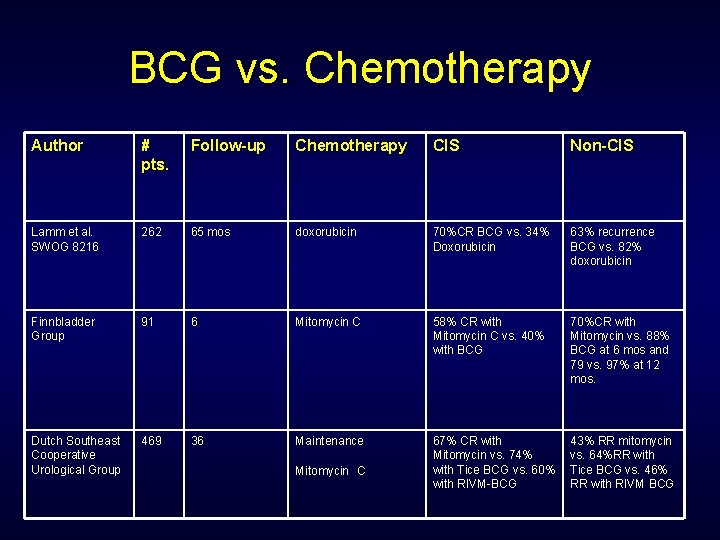
BCG vs. Chemotherapy Author # pts. Follow-up Chemotherapy CIS Non-CIS Lamm et al. SWOG 8216 262 65 mos doxorubicin 70%CR BCG vs. 34% Doxorubicin 63% recurrence BCG vs. 82% doxorubicin Finnbladder Group 91 6 Mitomycin C 58% CR with Mitomycin C vs. 40% with BCG 70%CR with Mitomycin vs. 88% BCG at 6 mos and 79 vs. 97% at 12 mos. Dutch Southeast Cooperative Urological Group 469 36 Maintenance 67% CR with Mitomycin vs. 74% with Tice BCG vs. 60% with RIVM-BCG 43% RR mitomycin vs. 64%RR with Tice BCG vs. 46% RR with RIVM BCG Mitomycin C
BCG + Interferon • O’Donnel et al. - effect in BCG-refractory patients • 5/99 -1/01 – 1100 patients 460 failed BCG 2 or more times 50%Ta, 22%T 1, 21%CIS, 7% mixed • 1/3 dose BCG+50 million U Interferonalpha 2 B (Intron A)
BCG and Interferon • 45% NED at 24 months • 28% NED if re-induction necessary
BCG + Interferon Factors that Influence Outcome • • • Papillary vs. Flat CIS - -no difference Ta and T 1 had same results (even if G 3) # BCG failures not significant Low grade tumors did worse Small tumors (<2. 5 cm) do better >5 TURB do worse Residual disease do worse Multifocal tumors do worse Longer duration of cancer do worse Failure of 3 or more courses of chemo do worse Those who fail initial BCG<6 mos do worse
Conclusion • 92% of all bladder cancer is Ta/T 1 – 15% deaths • 8% of all TCC is T 2 – 85% deaths • BCG effect in delaying progression • BCG + Interferon may have role • Molecular biology will further define bladder cancer
- Slides: 52