
MANAGEMENT OF SPECIAL WASTE INCLUDING DOMESTIC HAZARDOUS WASTE
- Slides: 41
MANAGEMENT OF SPECIAL WASTE INCLUDING DOMESTIC HAZARDOUS WASTE
Introduction Special waste including domestic hazardous waste comprises of any solid waste or a combination of solid wastes that requires special handling and disposal because of its quantity, concentration, physical and chemical characteristics, or biological properties, in order to protect human health, as well as the environment and to exploit its potential for recycling. the Special Wastes includes • Plastic waste • Bio-medical waste • Slaughterhouse waste • Electric and electronic waste (e-waste) • Waste tyres • Lead Battery Waste
Introduction-Cont. . • Special waste including domestic hazardous waste should not enter the municipal solid waste (MSW) streams. • These wastes are also generated at the household and commercial level and, due to lack of segregation at source or improper collection systems, they frequently end up in the mixed MSW stream.
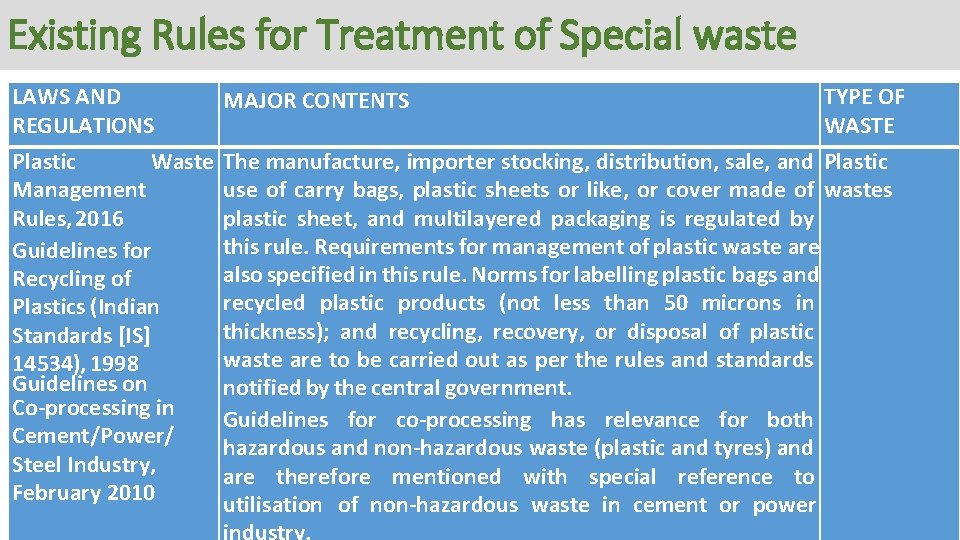
Existing Rules for Treatment of Special waste LAWS AND REGULATIONS MAJOR CONTENTS TYPE OF WASTE Plastic Waste Management Rules, 2016 Guidelines for Recycling of Plastics (Indian Standards [IS] 14534), 1998 Guidelines on Co-processing in Cement/Power/ Steel Industry, February 2010 The manufacture, importer stocking, distribution, sale, and Plastic use of carry bags, plastic sheets or like, or cover made of wastes plastic sheet, and multilayered packaging is regulated by this rule. Requirements for management of plastic waste are also specified in this rule. Norms for labelling plastic bags and recycled plastic products (not less than 50 microns in thickness); and recycling, recovery, or disposal of plastic waste are to be carried out as per the rules and standards notified by the central government. Guidelines for co-processing has relevance for both hazardous and non-hazardous waste (plastic and tyres) and are therefore mentioned with special reference to utilisation of non-hazardous waste in cement or power
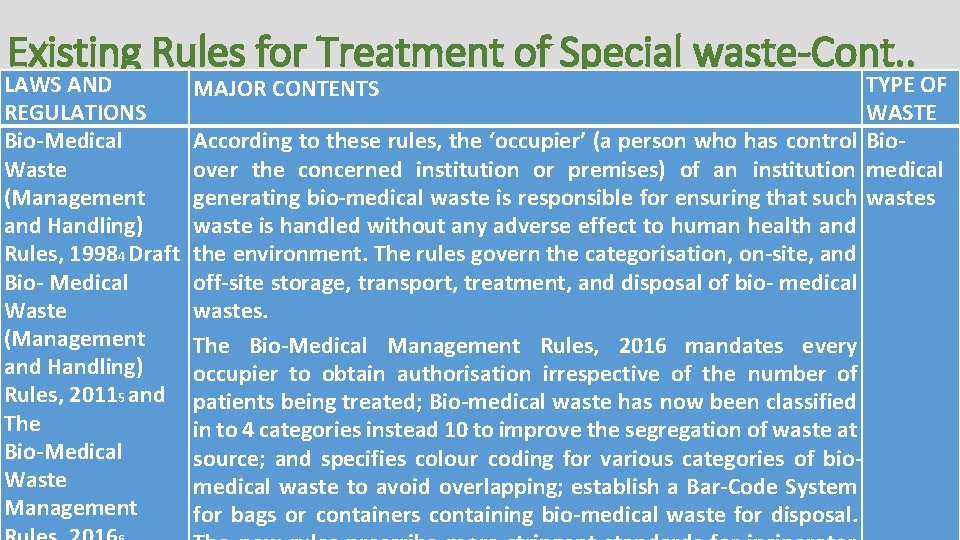
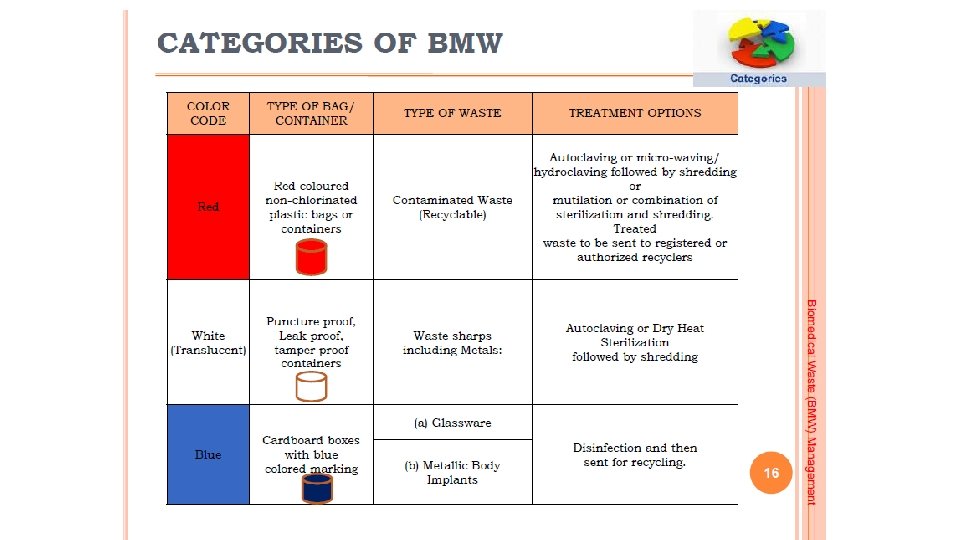
Existing Rules for Treatment of Special waste-Cont. . LAWS AND REGULATIONS Bio-Medical Waste (Management and Handling) Rules, 19984 Draft Bio- Medical Waste (Management and Handling) Rules, 20115 and The Bio-Medical Waste Management TYPE OF WASTE According to these rules, the ‘occupier’ (a person who has control Bioover the concerned institution or premises) of an institution medical generating bio-medical waste is responsible for ensuring that such wastes waste is handled without any adverse effect to human health and the environment. The rules govern the categorisation, on-site, and off-site storage, transport, treatment, and disposal of bio- medical wastes. The Bio-Medical Management Rules, 2016 mandates every occupier to obtain authorisation irrespective of the number of patients being treated; Bio-medical waste has now been classified in to 4 categories instead 10 to improve the segregation of waste at source; and specifies colour coding for various categories of biomedical waste to avoid overlapping; establish a Bar-Code System for bags or containers containing bio-medical waste for disposal. MAJOR CONTENTS
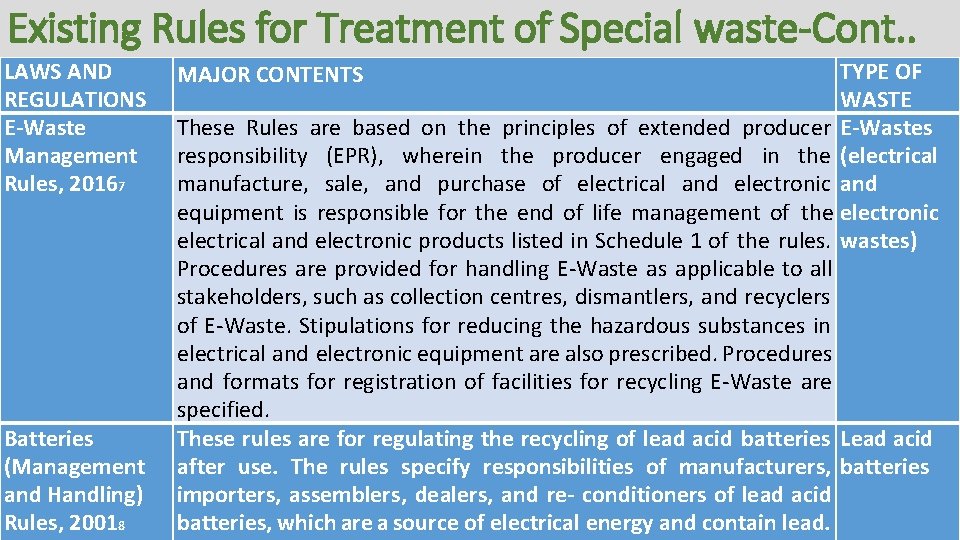
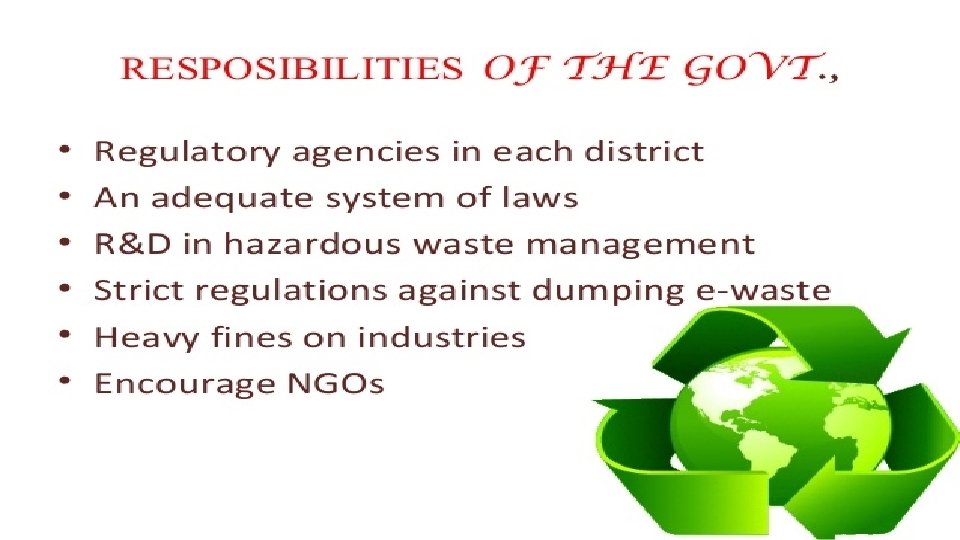
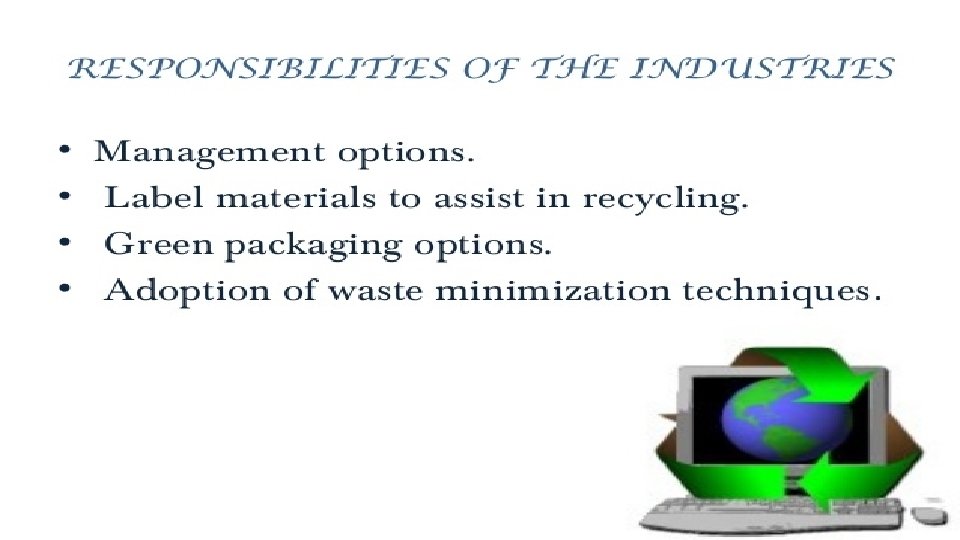
Existing Rules for Treatment of Special waste-Cont. . LAWS AND REGULATIONS E-Waste Management Rules, 20167 Batteries (Management and Handling) Rules, 20018 TYPE OF WASTE These Rules are based on the principles of extended producer E-Wastes responsibility (EPR), wherein the producer engaged in the (electrical manufacture, sale, and purchase of electrical and electronic and equipment is responsible for the end of life management of the electronic electrical and electronic products listed in Schedule 1 of the rules. wastes) Procedures are provided for handling E-Waste as applicable to all stakeholders, such as collection centres, dismantlers, and recyclers of E-Waste. Stipulations for reducing the hazardous substances in electrical and electronic equipment are also prescribed. Procedures and formats for registration of facilities for recycling E-Waste are specified. These rules are for regulating the recycling of lead acid batteries Lead acid after use. The rules specify responsibilities of manufacturers, batteries importers, assemblers, dealers, and re- conditioners of lead acid batteries, which are a source of electrical energy and contain lead. MAJOR CONTENTS
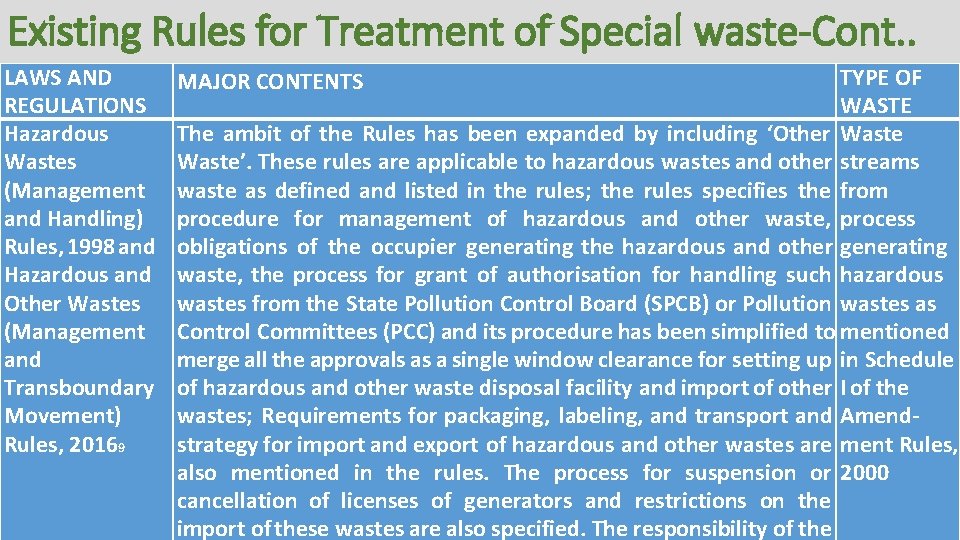
Existing Rules for Treatment of Special waste-Cont. . LAWS AND REGULATIONS Hazardous Wastes (Management and Handling) Rules, 1998 and Hazardous and Other Wastes (Management and Transboundary Movement) Rules, 20169 TYPE OF WASTE The ambit of the Rules has been expanded by including ‘Other Waste’. These rules are applicable to hazardous wastes and other streams waste as defined and listed in the rules; the rules specifies the from procedure for management of hazardous and other waste, process obligations of the occupier generating the hazardous and other generating waste, the process for grant of authorisation for handling such hazardous wastes from the State Pollution Control Board (SPCB) or Pollution wastes as Control Committees (PCC) and its procedure has been simplified to mentioned merge all the approvals as a single window clearance for setting up in Schedule of hazardous and other waste disposal facility and import of other I of the wastes; Requirements for packaging, labeling, and transport and Amendstrategy for import and export of hazardous and other wastes are ment Rules, also mentioned in the rules. The process for suspension or 2000 cancellation of licenses of generators and restrictions on the import of these wastes are also specified. The responsibility of the MAJOR CONTENTS
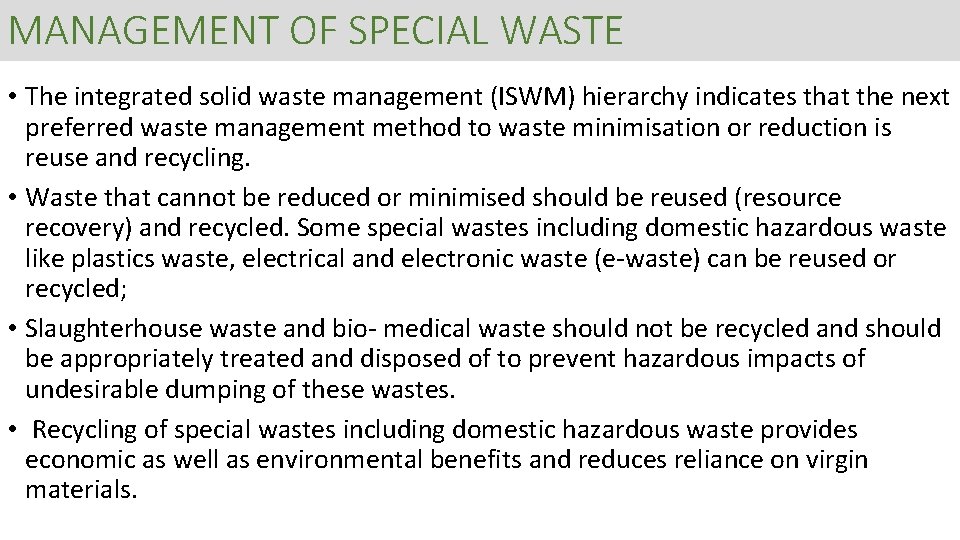
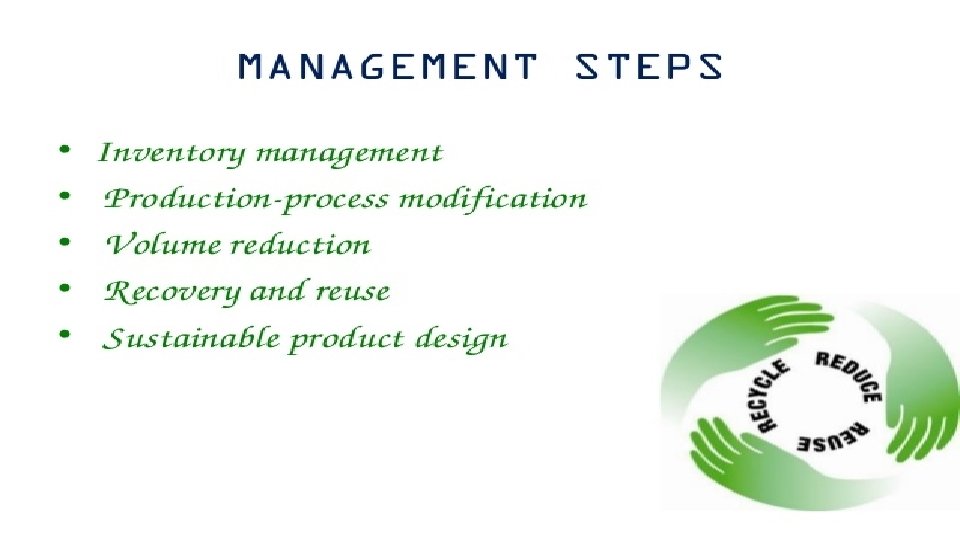
MANAGEMENT OF SPECIAL WASTE • The integrated solid waste management (ISWM) hierarchy indicates that the next preferred waste management method to waste minimisation or reduction is reuse and recycling. • Waste that cannot be reduced or minimised should be reused (resource recovery) and recycled. Some special wastes including domestic hazardous waste like plastics waste, electrical and electronic waste (e-waste) can be reused or recycled; • Slaughterhouse waste and bio- medical waste should not be recycled and should be appropriately treated and disposed of to prevent hazardous impacts of undesirable dumping of these wastes. • Recycling of special wastes including domestic hazardous waste provides economic as well as environmental benefits and reduces reliance on virgin materials.
• Plastic Waste and Slaughter Waste will be treated separately in this session we will deal with • Bio Medical Waste Management • E-Waste management • Waste Tyres • Waste Batteries
BIO MEDICAL WASTE MANAGEMENT
WHO GENERATES BMW Bio-Medical Waste is generated by • Hospitals • Nursing Homes • Clinics • Dispensaries • Veterinary Institutes/Animal Houses • Pathological Laboratories • Blood Banks/Blood Donation Camps • Ayush Hospitals • Clinical Establishment • Research/Educational Institute/Research Labs •
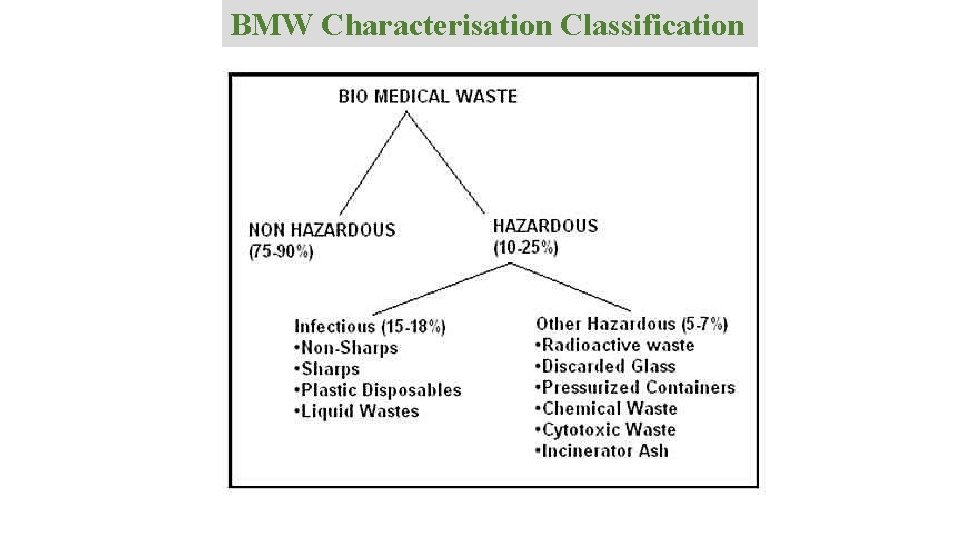
BMW Characterisation Classification
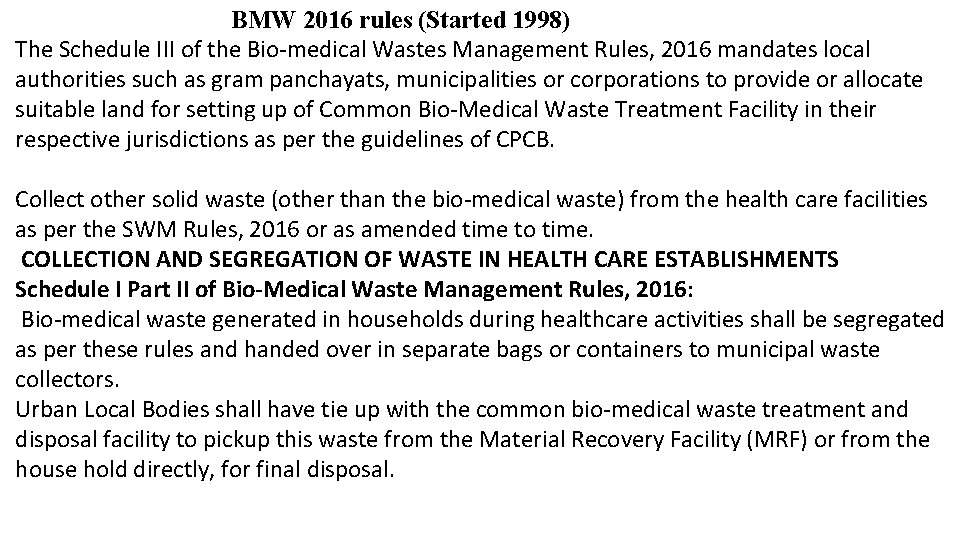
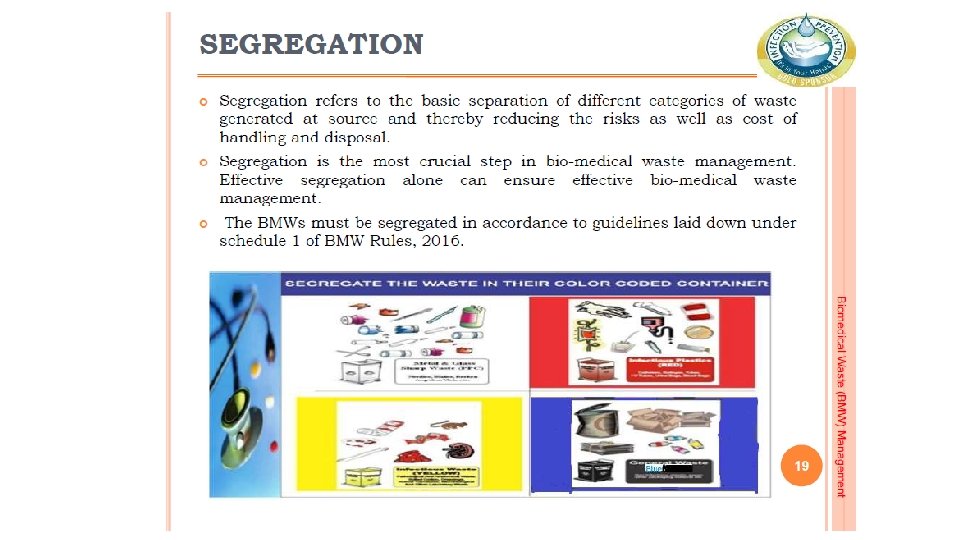
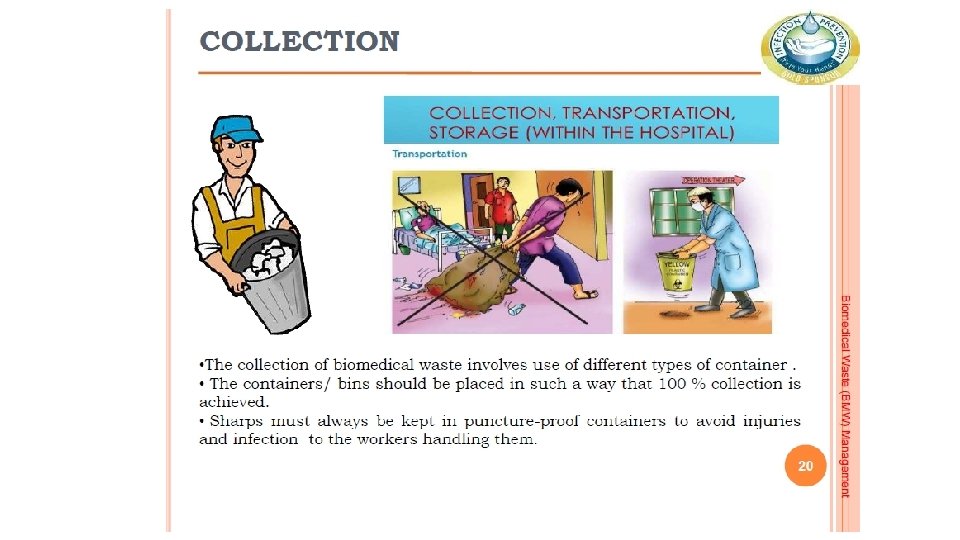
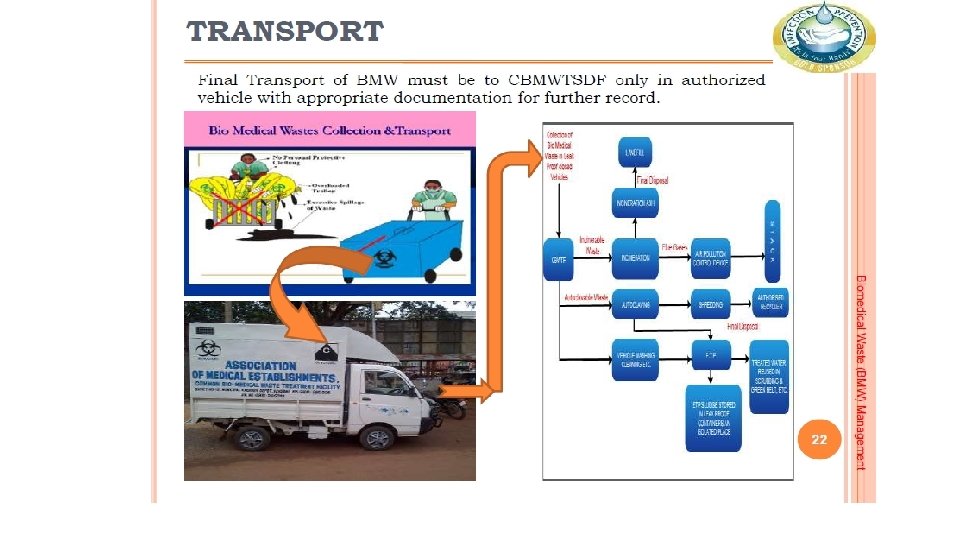
BMW 2016 rules (Started 1998) The Schedule III of the Bio-medical Wastes Management Rules, 2016 mandates local authorities such as gram panchayats, municipalities or corporations to provide or allocate suitable land for setting up of Common Bio-Medical Waste Treatment Facility in their respective jurisdictions as per the guidelines of CPCB. Collect other solid waste (other than the bio-medical waste) from the health care facilities as per the SWM Rules, 2016 or as amended time to time. COLLECTION AND SEGREGATION OF WASTE IN HEALTH CARE ESTABLISHMENTS Schedule I Part II of Bio-Medical Waste Management Rules, 2016: Bio-medical waste generated in households during healthcare activities shall be segregated as per these rules and handed over in separate bags or containers to municipal waste collectors. Urban Local Bodies shall have tie up with the common bio-medical waste treatment and disposal facility to pickup this waste from the Material Recovery Facility (MRF) or from the house hold directly, for final disposal.
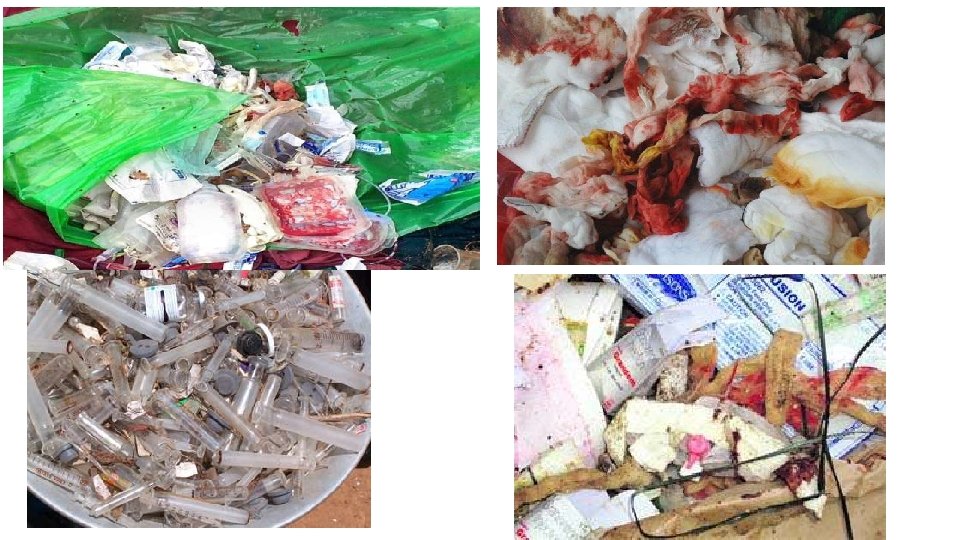
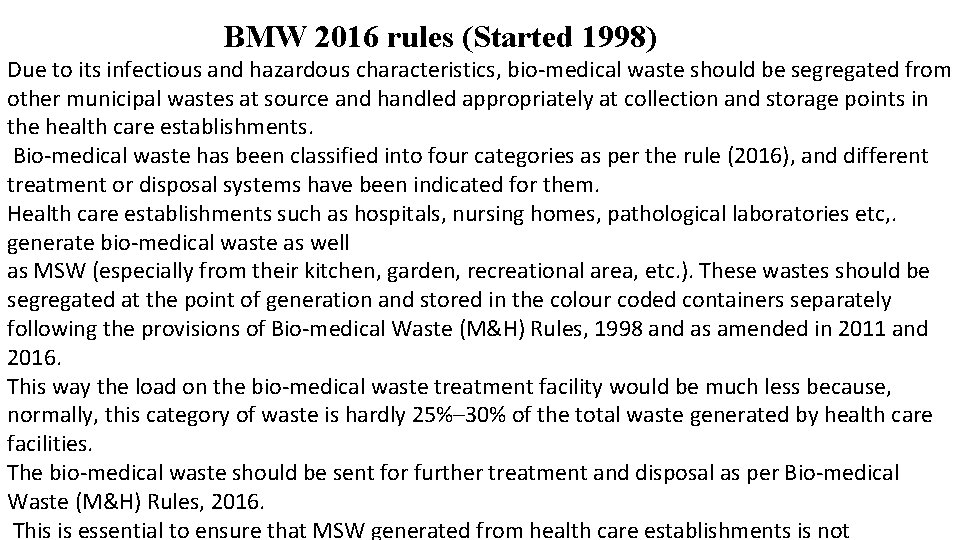
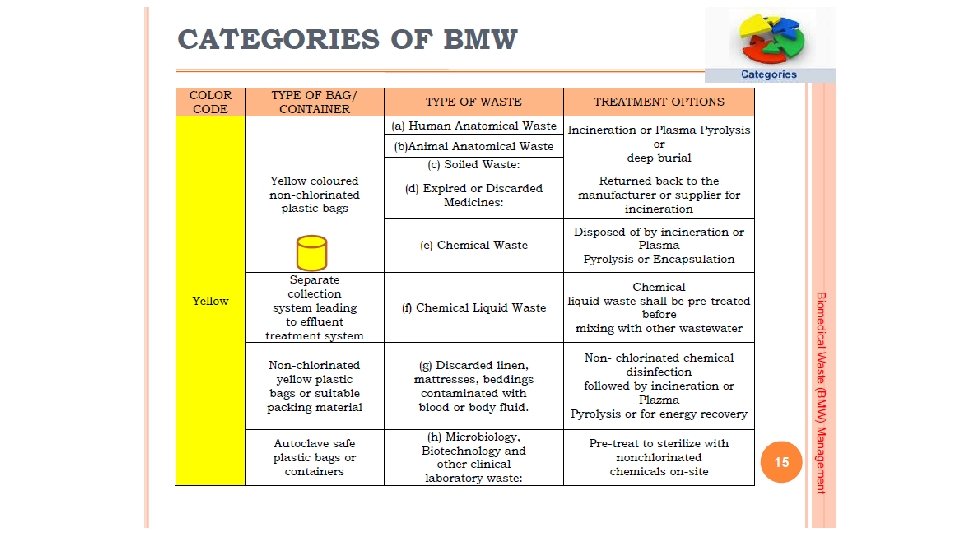
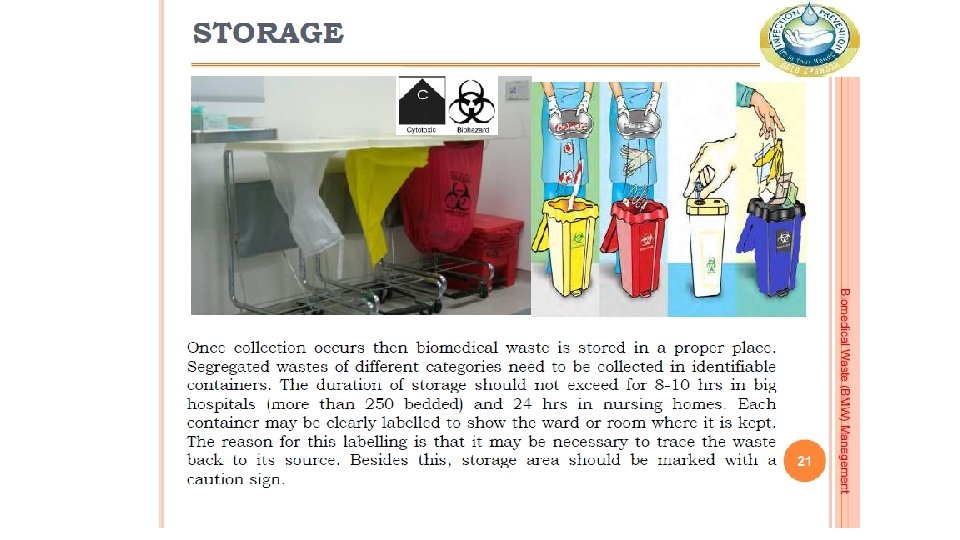
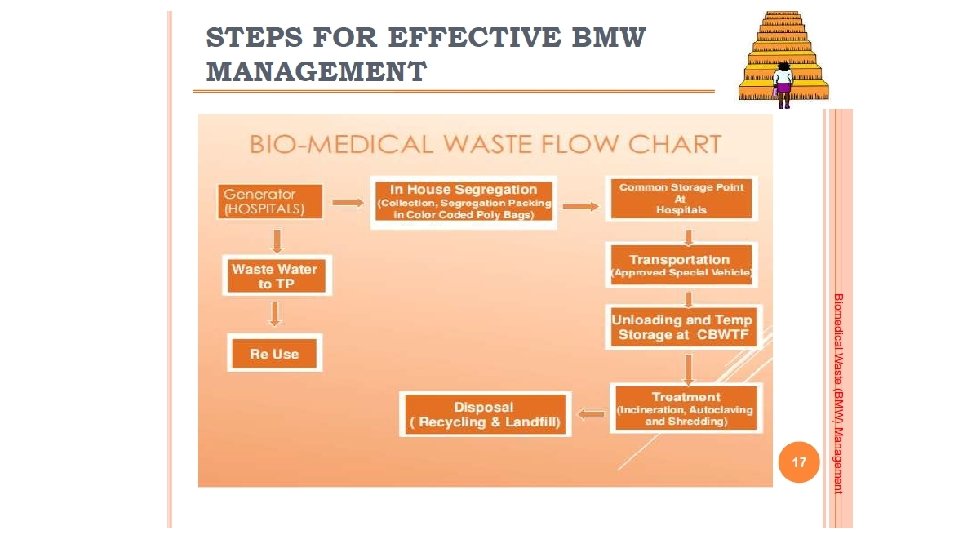
BMW 2016 rules (Started 1998) Due to its infectious and hazardous characteristics, bio-medical waste should be segregated from other municipal wastes at source and handled appropriately at collection and storage points in the health care establishments. Bio-medical waste has been classified into four categories as per the rule (2016), and different treatment or disposal systems have been indicated for them. Health care establishments such as hospitals, nursing homes, pathological laboratories etc, . generate bio-medical waste as well as MSW (especially from their kitchen, garden, recreational area, etc. ). These wastes should be segregated at the point of generation and stored in the colour coded containers separately following the provisions of Bio-medical Waste (M&H) Rules, 1998 and as amended in 2011 and 2016. This way the load on the bio-medical waste treatment facility would be much less because, normally, this category of waste is hardly 25%– 30% of the total waste generated by health care facilities. The bio-medical waste should be sent for further treatment and disposal as per Bio-medical Waste (M&H) Rules, 2016. This is essential to ensure that MSW generated from health care establishments is not
E-WASTE
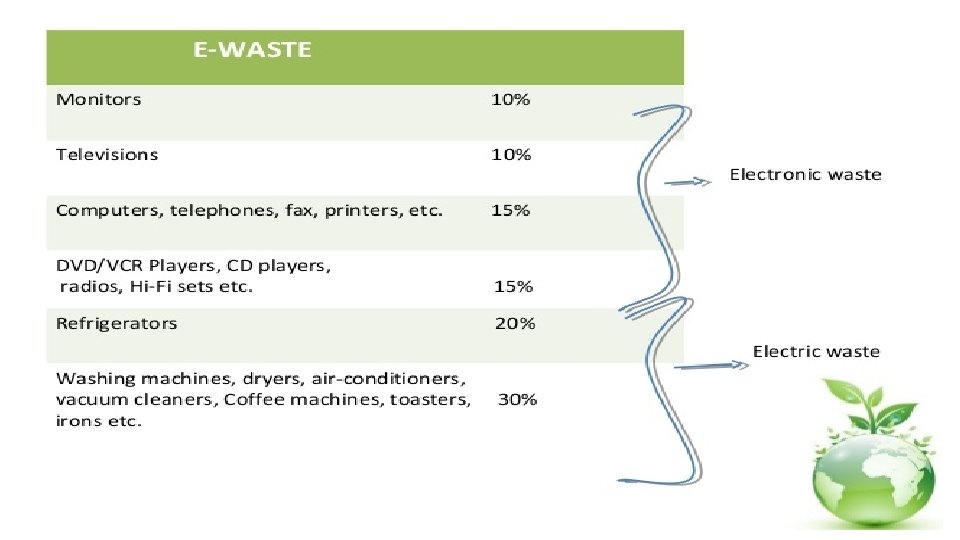
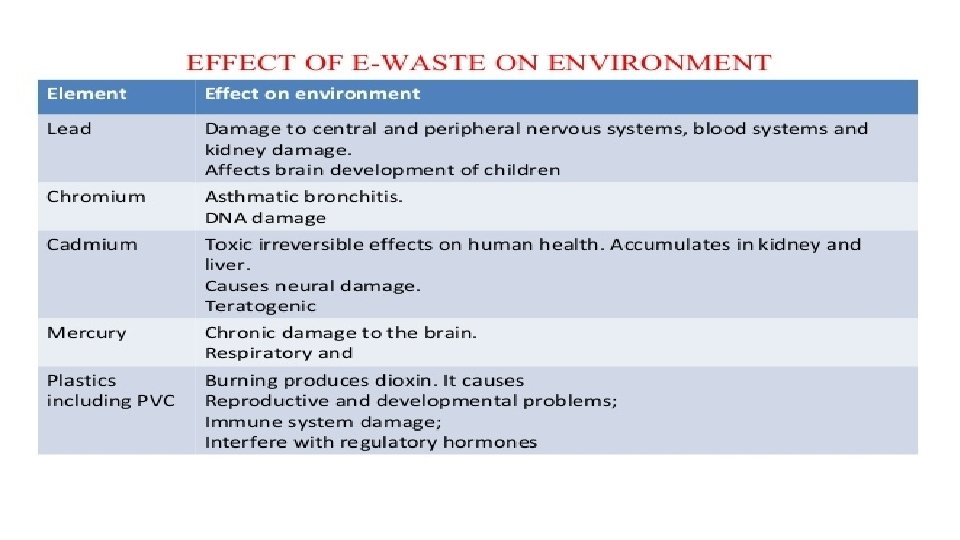
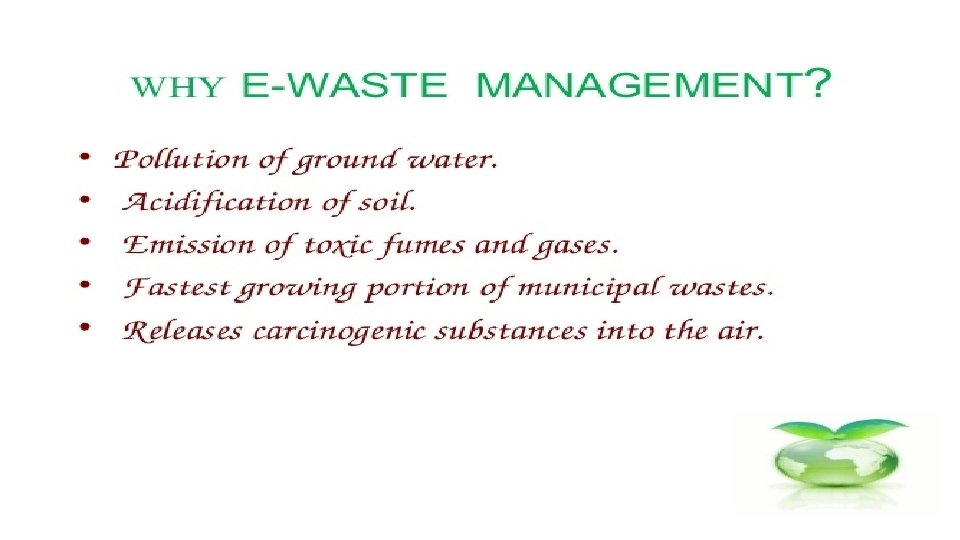
E-waste means any waste from electrical or electronic equipment, whole or in parts, or rejects from their manufacturing and repair processes, which are intended to be discarded. Electronic products often contain hazardous and toxic materials and should not be dumped with other wastes. Electronic waste is one of the fastest growing waste streams in the country with a growth rate of 10% per annum. An increase in the use of electrical and electronic products and their high rate of obsolescence leads to generation of huge amounts of electrical and electronic waste (e-waste). As per preliminary estimates of the Central Pollution Control Board (CPCB), e-waste generation in India was 0. 8 million tonnes in 2012. E-waste management practices in India are beset with numerous shortfalls, such as the difficulty in maintaining an inventory of generated e-waste, unhealthy conditions of informal recycling, inadequate capacities, and lack of awareness among generators and ULBs.
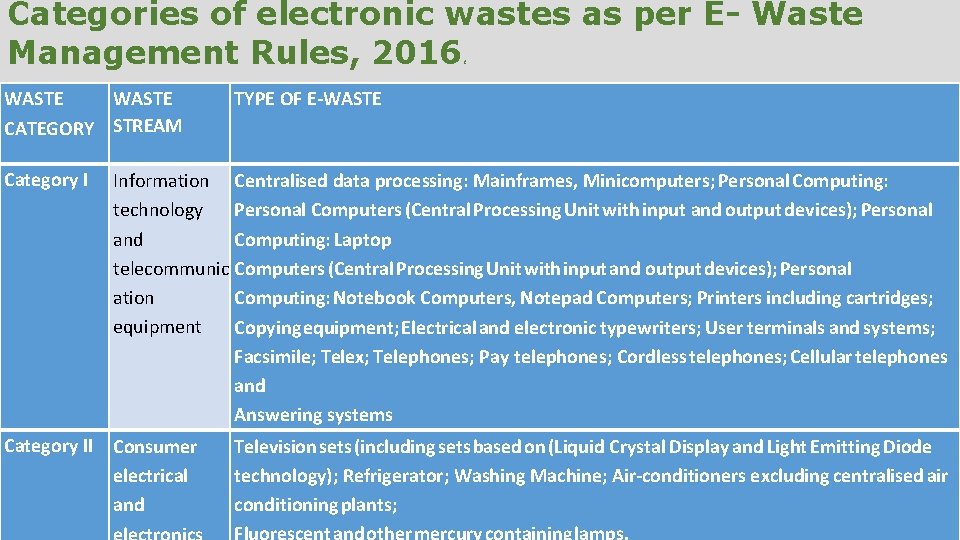
Categories of electronic wastes as per E- Waste Management Rules, 2016 1 WASTE CATEGORY STREAM Category I TYPE OF E-WASTE Information Centralised data processing: Mainframes, Minicomputers; Personal Computing: technology Personal Computers (Central Processing Unit with input and output devices); Personal and Computing: Laptop telecommunic Computers (Central Processing Unit with input and output devices); Personal ation Computing: Notebook Computers, Notepad Computers; Printers including cartridges; equipment Copying equipment; Electrical and electronic typewriters; User terminals and systems; Facsimile; Telex; Telephones; Pay telephones; Cordless telephones; Cellular telephones and Answering systems Category II Consumer electrical and Television sets (including sets based on (Liquid Crystal Display and Light Emitting Diode technology); Refrigerator; Washing Machine; Air-conditioners excluding centralised air conditioning plants; Fluorescent and other mercury containing lamps.
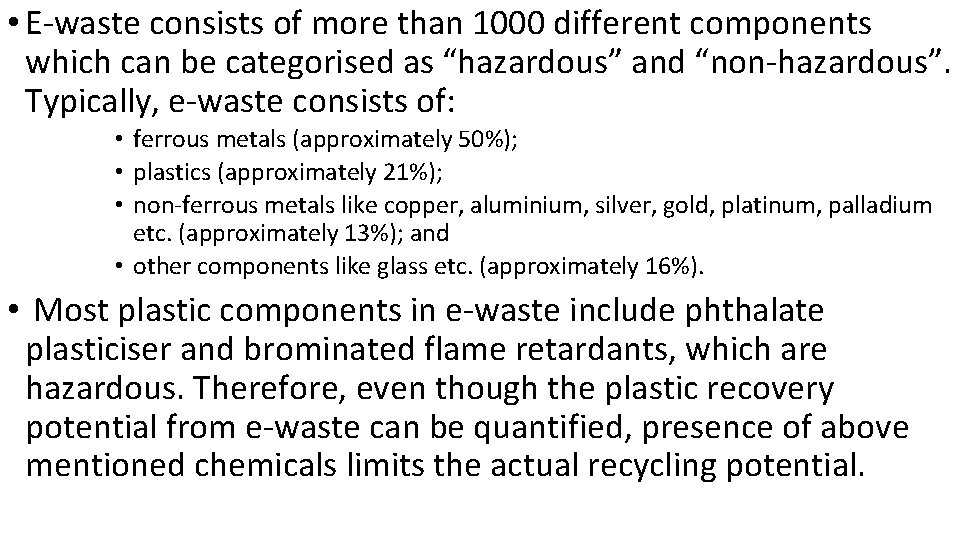
• E-waste consists of more than 1000 different components which can be categorised as “hazardous” and “non-hazardous”. Typically, e-waste consists of: • ferrous metals (approximately 50%); • plastics (approximately 21%); • non-ferrous metals like copper, aluminium, silver, gold, platinum, palladium etc. (approximately 13%); and • other components like glass etc. (approximately 16%). • Most plastic components in e-waste include phthalate plasticiser and brominated flame retardants, which are hazardous. Therefore, even though the plastic recovery potential from e-waste can be quantified, presence of above mentioned chemicals limits the actual recycling potential.
WASTE TYRES
WASTE TYRES • The management of used tyres is a challenge due to the physical properties and shape of tyres. Tyres are composed primarily of complex natural and synthetic rubber compounds, both of which have substantial heating value and various other materials. • Problems created by Storage of Waste Tyres Stockpiles of used tyres can create substantial land use problems, and serve as breeding grounds for insects and other small animals that harbour pathogens detrimental to human health and environment. Stockpiles can self-ignite; and when it does, the fire may be difficult to control, leading to negative human health and environmental impacts.
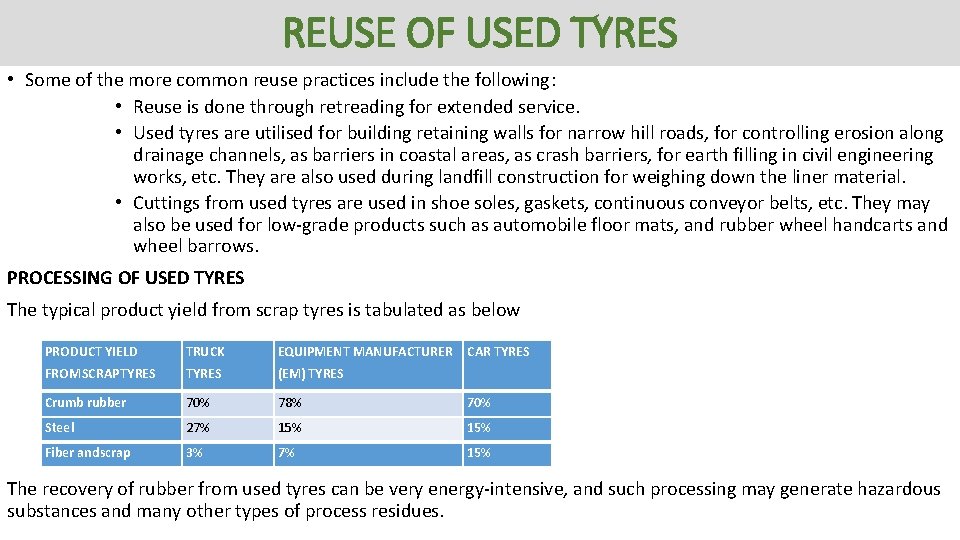
REUSE OF USED TYRES • Some of the more common reuse practices include the following: • Reuse is done through retreading for extended service. • Used tyres are utilised for building retaining walls for narrow hill roads, for controlling erosion along drainage channels, as barriers in coastal areas, as crash barriers, for earth filling in civil engineering works, etc. They are also used during landfill construction for weighing down the liner material. • Cuttings from used tyres are used in shoe soles, gaskets, continuous conveyor belts, etc. They may also be used for low-grade products such as automobile floor mats, and rubber wheel handcarts and wheel barrows. PROCESSING OF USED TYRES The typical product yield from scrap tyres is tabulated as below PRODUCT YIELD TRUCK EQUIPMENT MANUFACTURER CAR TYRES FROM SCRAP TYRES (EM) TYRES Crumb rubber 70% 78% 70% Steel 27% 15% Fiber andscrap 3% 7% 15% The recovery of rubber from used tyres can be very energy-intensive, and such processing may generate hazardous substances and many other types of process residues.
LEAD BATTERY WASTE
LEAD BATTERY WASTE • Once the lead acid battery is no longer capable of being recharged or cannot retain its charge, it is a waste and should be disposed. At the end of its life, the battery is classified as a hazardous waste and should be handled as prescribed in the Batteries (Management & Handling [M&H]) Rules, 2001 to prevent damage to human health and environment. • The Batteries (M&H) Rules, 2001 govern the management of lead acid batteries, which are a source of electrical energy and contain lead metal. Used lead acid batteries are not considered a part of MSW and should not be mixed while disposal. • These rules apply to every manufacturer, importer, re-conditioner, assembler, dealer, recycler, auctioneer, consumer, and bulk consumer involved in the manufacture, processing, sale, purchase, and use of batteries or components thereof. Responsibilities of dealer: • “It shall be the responsibility of the dealer to: • ensure that the used batteries are collected back as per the Schedule against new batteries sold; • ensure safe transportation of collected batteries to the designated collection centres or to the registered recyclers; and • ensure that no damage is caused to the environment during storage and transportation of used batteries. ”
LEAD BATTERY WASTE- Cont. . Responsibilities of consumer or bulk consumer: • “It shall be the responsibility of the consumer to ensure that the used batteries are not disposed of in any manner other than depositing with the dealer, manufacturer, importer, assembler, registered recycler, re- conditioner or at the designated collection centres. • It shall be the responsibility of the bulk consumer to: • ensure that the used batteries are not disposed of in any manner other than by depositing with the dealer or manufacturer or registered recycler or importer or re conditioner or at the designated collection centres” Responsibilities of auctioneer: • “The auctioneer shall ensure that used batteries are auctioned to the registered recyclers only. ” • Municipal authorities should acquaint their SWM staff with the above provisions. When disposed lead acid batteries are found mixed with MSW, ULB staff should be trained to report the identified defaulters to the concerned authority for taking appropriate action.
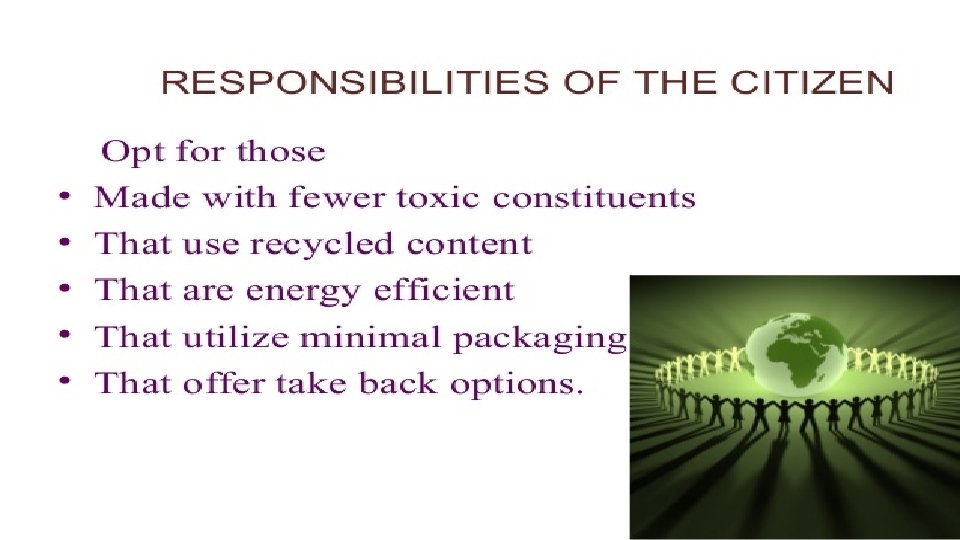
AWARENESS GENERATION THROUGH INFORMATION, EDUCATION, AND COMMUNICATION ACTIVITIES • Provide information to the community on different types of special wastes including domestic hazardous waste and their related impacts on human life and environment. • Generate awareness in the community about segregating special waste at household level to prevent its mixing with MSW. Equally important is to provide information on collection and disposal systems for special waste and related initiatives taken up by the ULB. • Encourage usage of sustainable material such as jute or cloth bags, energy efficient lighting and electronic appliances, and multi-use consumables as an effective strategy to minimise special waste generation.
AWARENESS GENERATION THROUGH INFORMATION, EDUCATION, AND COMMUNICATION ACTIVITIES • Provide and communicate incentives to the community for making use of dry waste and domestic hazardous waste collection centres. • Inform public about economic and environmental benefits of reducing, reusing, and recycling special waste. • Engage with local businesses or electronic suppliers and create awareness on EPR initiatives around special waste. Promote incentives to encourage such initiatives. • Educate public about prevalent EPR initiatives.