
Management of shock in Pediatric Patients Scope Overview


- Slides: 17
Management of shock in Pediatric Patients
Scope • Overview of management of Pediatric Shock • Scenario on management of Pediatric shock • Fluid drills
Overview • Manage a suspected or confirmed COVID-19 child like a sick child • Triage based on ETAT principles • COVID-19 can present with septic shock and a child could have comorbid conditions that must be considered when managing shock and include • Gastroenteritis • Anemia • Malnutrition
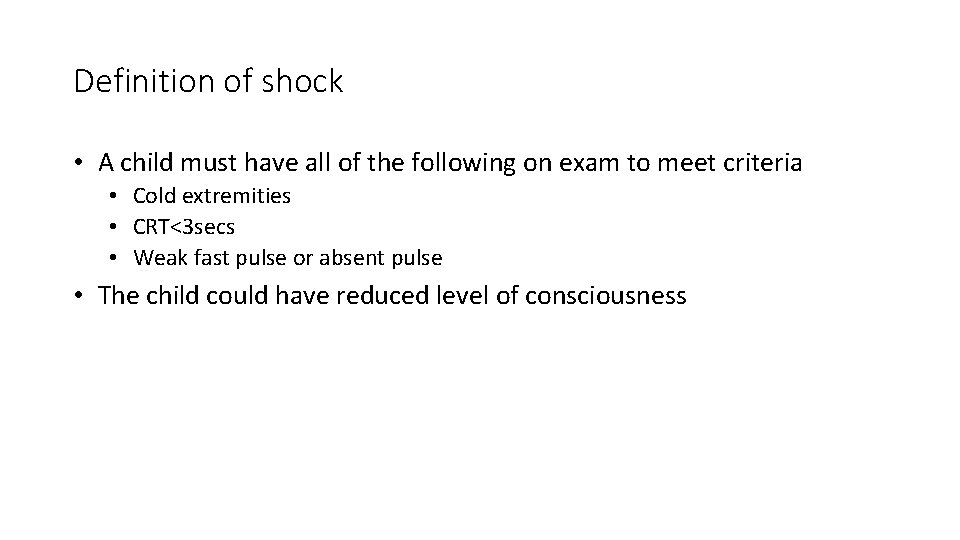
Definition of shock • A child must have all of the following on exam to meet criteria • Cold extremities • CRT<3 secs • Weak fast pulse or absent pulse • The child could have reduced level of consciousness
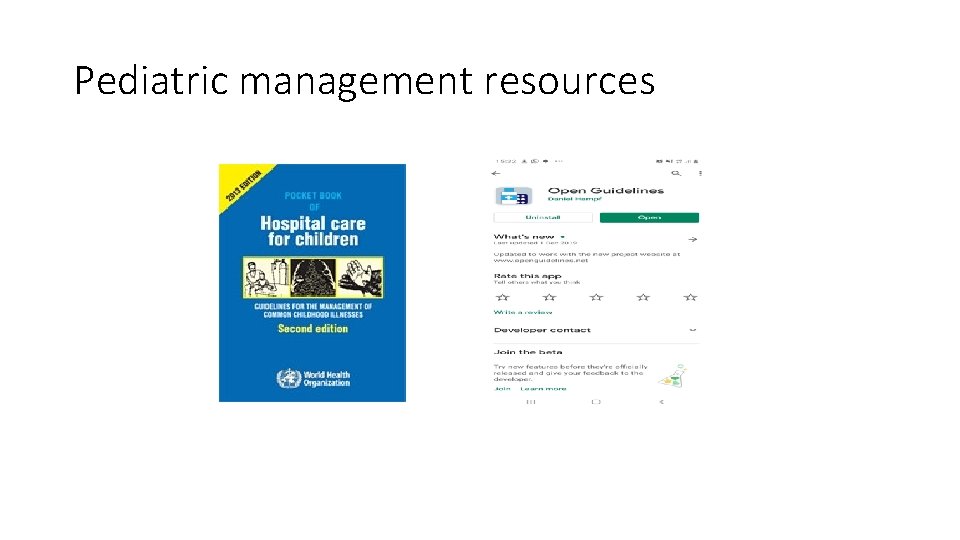
Resources For more comprehensive fluid management refer to: • COIN Manual • Pediatric open guidelines APP available on Playstore • IMCI WHO guidelines
Pediatric management resources
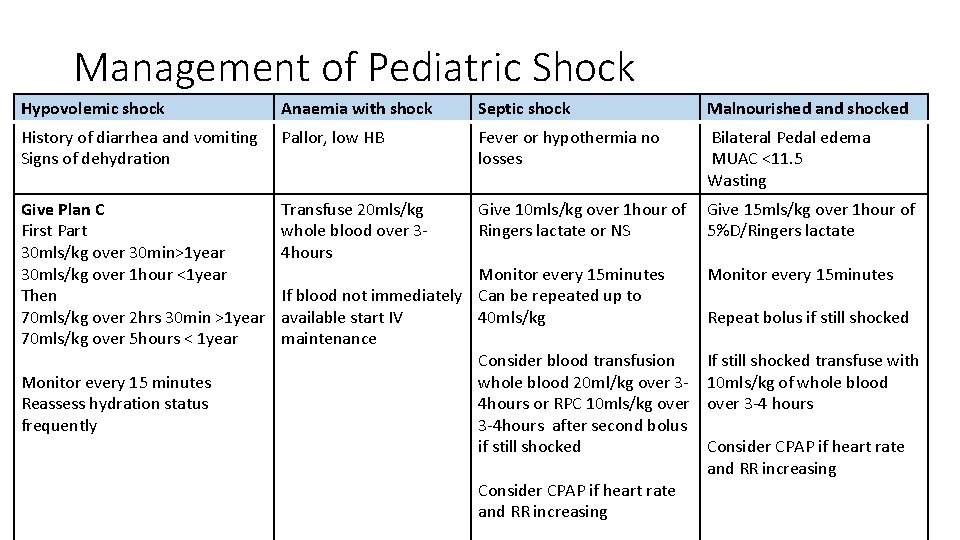
Management of Pediatric Shock Hypovolemic shock Anaemia with shock Septic shock Malnourished and shocked History of diarrhea and vomiting Signs of dehydration Pallor, low HB Fever or hypothermia no losses Bilateral Pedal edema MUAC <11. 5 Wasting Give Plan C First Part 30 mls/kg over 30 min>1 year 30 mls/kg over 1 hour <1 year Then 70 mls/kg over 2 hrs 30 min >1 year 70 mls/kg over 5 hours < 1 year Transfuse 20 mls/kg whole blood over 34 hours Give 10 mls/kg over 1 hour of Ringers lactate or NS Give 15 mls/kg over 1 hour of 5%D/Ringers lactate Monitor every 15 minutes Reassess hydration status frequently Monitor every 15 minutes If blood not immediately Can be repeated up to available start IV 40 mls/kg maintenance Consider blood transfusion whole blood 20 ml/kg over 34 hours or RPC 10 mls/kg over 3 -4 hours after second bolus if still shocked Consider CPAP if heart rate and RR increasing Monitor every 15 minutes Repeat bolus if still shocked If still shocked transfuse with 10 mls/kg of whole blood over 3 -4 hours Consider CPAP if heart rate and RR increasing
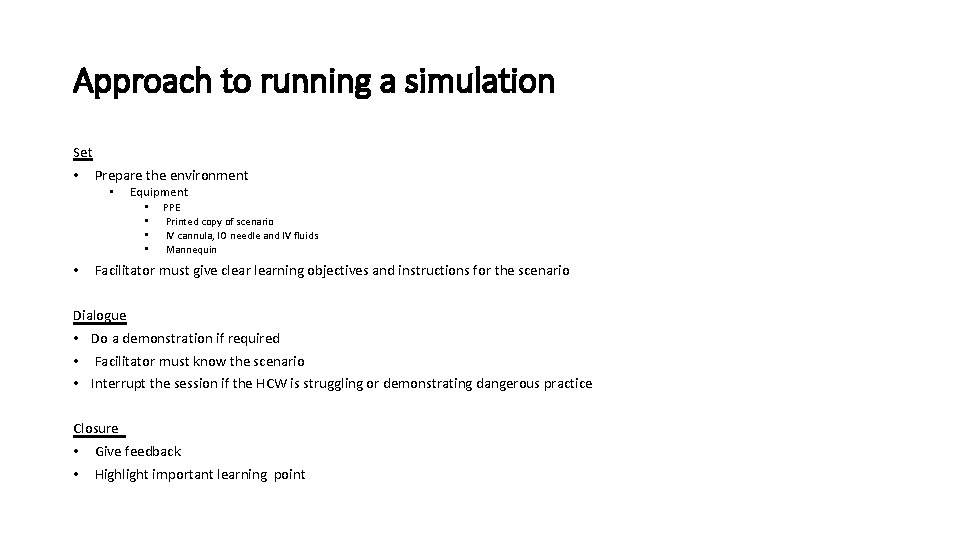
Approach to running a simulation Set • Prepare the environment • Equipment • • • PPE Printed copy of scenario IV cannula, IO needle and IV fluids Mannequin Facilitator must give clearning objectives and instructions for the scenario Dialogue • Do a demonstration if required • Facilitator must know the scenario • Interrupt the session if the HCW is struggling or demonstrating dangerous practice Closure • • Give feedback Highlight important learning point
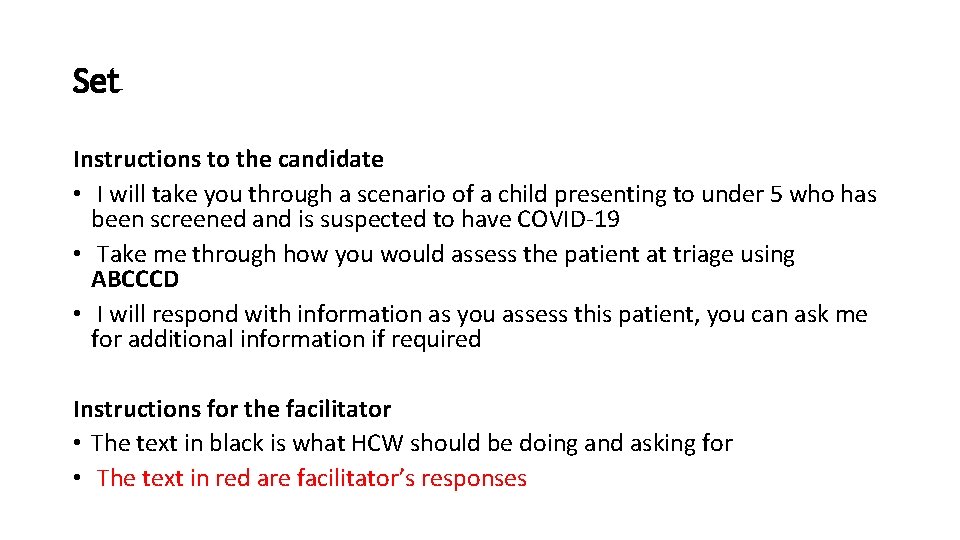
Set Instructions to the candidate • I will take you through a scenario of a child presenting to under 5 who has been screened and is suspected to have COVID-19 • Take me through how you would assess the patient at triage using ABCCCD • I will respond with information as you assess this patient, you can ask me for additional information if required Instructions for the facilitator • The text in black is what HCW should be doing and asking for • The text in red are facilitator’s responses
Dialogue Scenario A • A 4 year old is suspected to have COVID-19 at screening. She has no losses. She has had fever and cough for 3 days. She is brought to you at triage. How do you proceed?
Dialogue • Safety including PPE • Call for help • Assess Airway • look for chest rising • listen for noisy breating at a distance • her airway is patent Breathing • Asks for RR, O 2 saturations and auscultates • RR is 50, she has equal air entry but O 2 Saturations are not recording • Should put on oxygen
Scenario continued Circulation • Should ask for CRT, PR, Pulse volume, temperature of hands, pallor • has CRT of 5 secs, extremities are cold and radial pulse can not be felt, looks pink What does this patient have? Septic Shock
Scenario continued How will you manage the patient? Asks for weight or calculates weight using this formula (Age x 2)+ 8 (15 kg) • Insert cannula and draw samples FBC, RBS • Give 10 mls/kg over 1 hour • Reassess every 15 minutes • Repeat up to 40 mls/kg • Consider blood transfusion after second bolus if still shocked • Consider CPAP if worsening signs of respiratory distress or after 40 mls/kg bolus
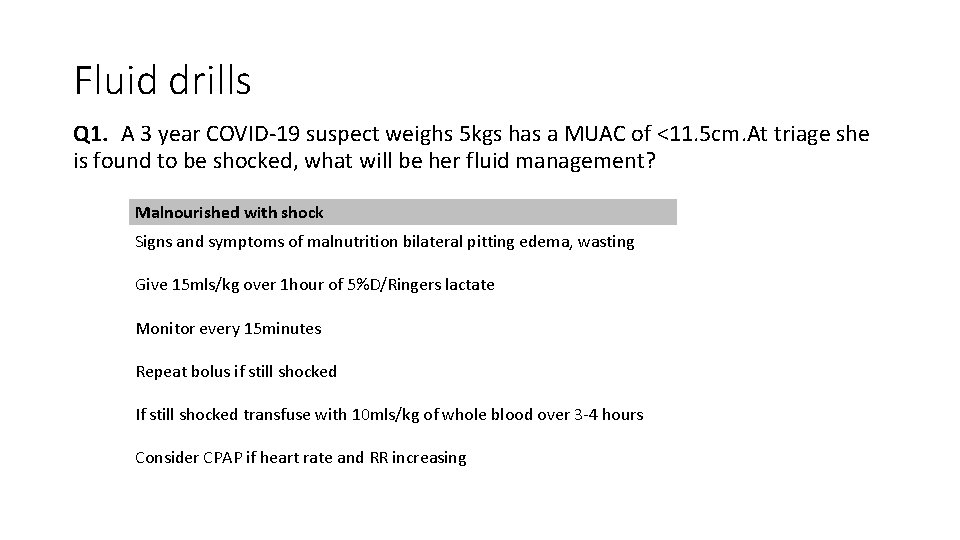
Fluid drills Q 1. A 3 year COVID-19 suspect weighs 5 kgs has a MUAC of <11. 5 cm. At triage she is found to be shocked, what will be her fluid management? Malnourished with shock Signs and symptoms of malnutrition bilateral pitting edema, wasting Give 15 mls/kg over 1 hour of 5%D/Ringers lactate Monitor every 15 minutes Repeat bolus if still shocked If still shocked transfuse with 10 mls/kg of whole blood over 3 -4 hours Consider CPAP if heart rate and RR increasing
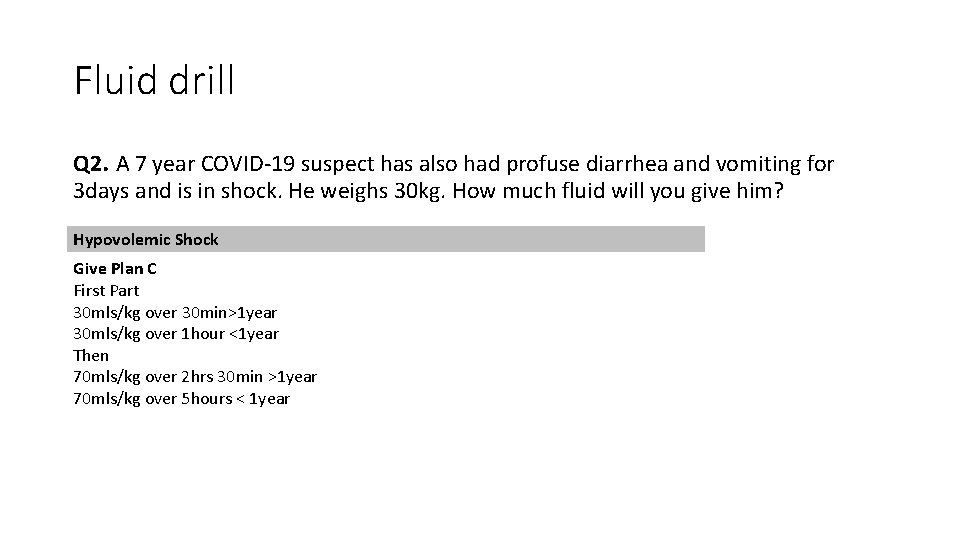
Fluid drill Q 2. A 7 year COVID-19 suspect has also had profuse diarrhea and vomiting for 3 days and is in shock. He weighs 30 kg. How much fluid will you give him? Hypovolemic Shock Give Plan C First Part 30 mls/kg over 30 min>1 year 30 mls/kg over 1 hour <1 year Then 70 mls/kg over 2 hrs 30 min >1 year 70 mls/kg over 5 hours < 1 year
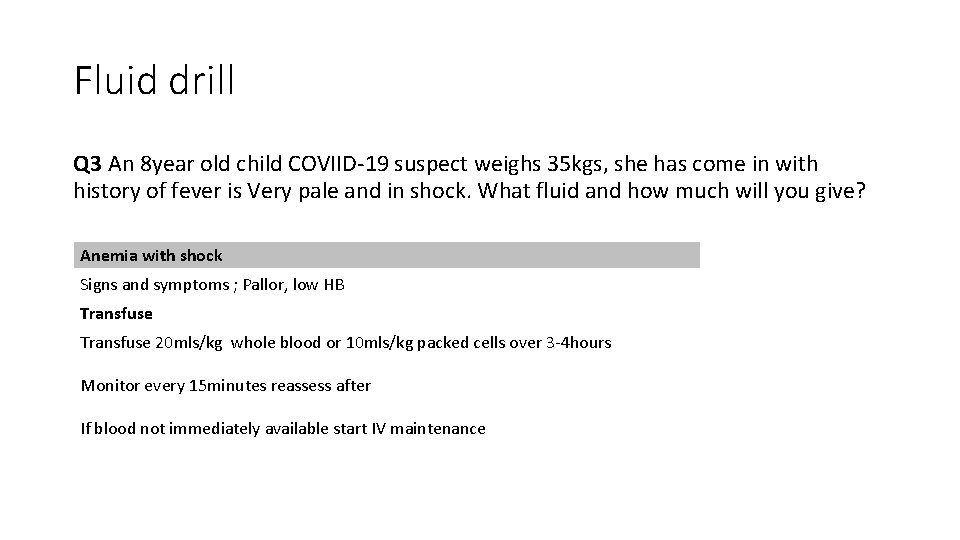
Fluid drill Q 3 An 8 year old child COVIID-19 suspect weighs 35 kgs, she has come in with history of fever is Very pale and in shock. What fluid and how much will you give? Anemia with shock Signs and symptoms ; Pallor, low HB Transfuse 20 mls/kg whole blood or 10 mls/kg packed cells over 3 -4 hours Monitor every 15 minutes reassess after If blood not immediately available start IV maintenance