
Management of Quality Chapter 9 1 Quality Management
- Slides: 51
Management of Quality Chapter 9 1
Quality Management § What does the term quality mean? § Quality is the ability of a product or service to consistently meet or exceed customer expectations. 2
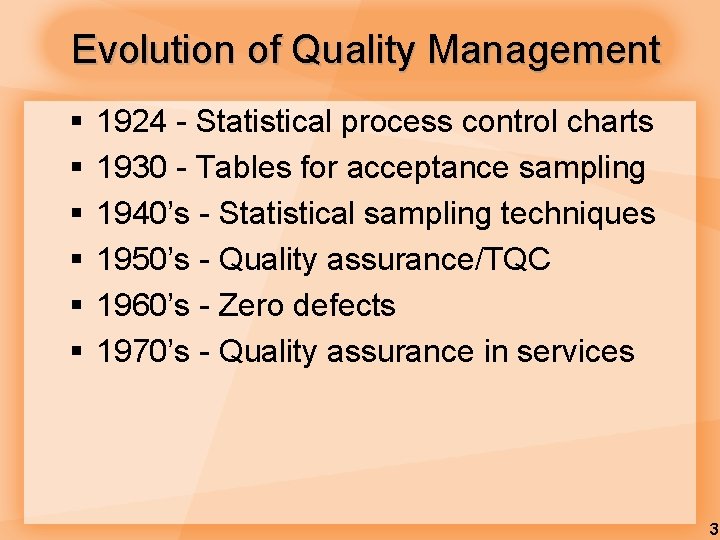
Evolution of Quality Management § § § 1924 - Statistical process control charts 1930 - Tables for acceptance sampling 1940’s - Statistical sampling techniques 1950’s - Quality assurance/TQC 1960’s - Zero defects 1970’s - Quality assurance in services 3
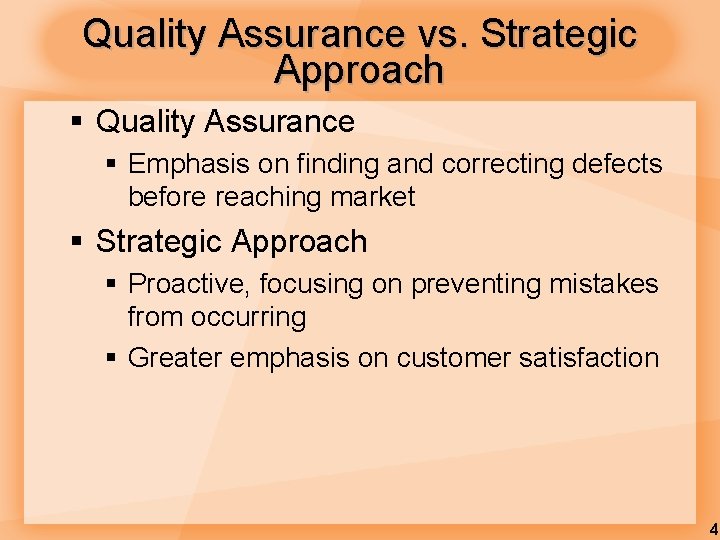
Quality Assurance vs. Strategic Approach § Quality Assurance § Emphasis on finding and correcting defects before reaching market § Strategic Approach § Proactive, focusing on preventing mistakes from occurring § Greater emphasis on customer satisfaction 4
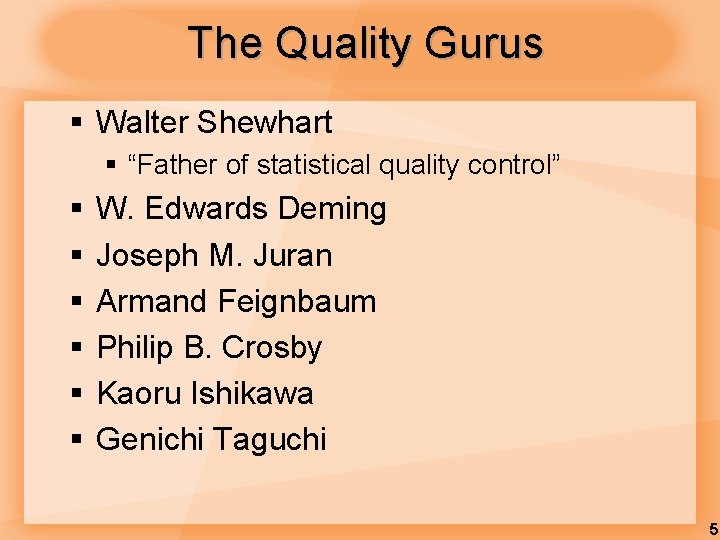
The Quality Gurus § Walter Shewhart § “Father of statistical quality control” § § § W. Edwards Deming Joseph M. Juran Armand Feignbaum Philip B. Crosby Kaoru Ishikawa Genichi Taguchi 5
Key Contributors to Quality Management 6
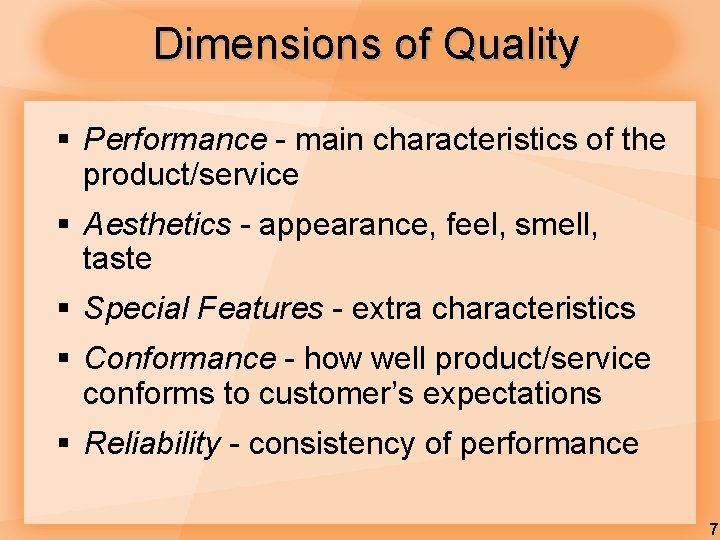
Dimensions of Quality § Performance - main characteristics of the product/service § Aesthetics - appearance, feel, smell, taste § Special Features - extra characteristics § Conformance - how well product/service conforms to customer’s expectations § Reliability - consistency of performance 7
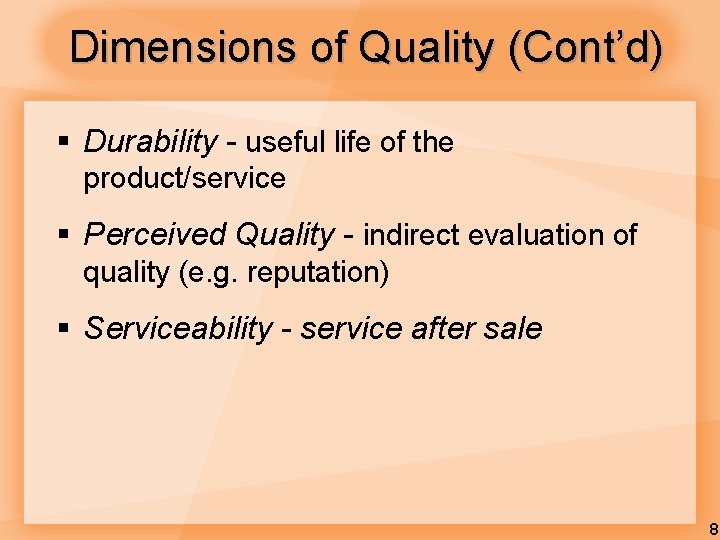
Dimensions of Quality (Cont’d) § Durability - useful life of the product/service § Perceived Quality - indirect evaluation of quality (e. g. reputation) § Serviceability - service after sale 8
Examples of Quality Dimensions 9
Examples of Quality Dimensions (Cont’d) 10
Service Quality § § § § Convenience Reliability Responsiveness Time Assurance Courtesy Tangibles 11
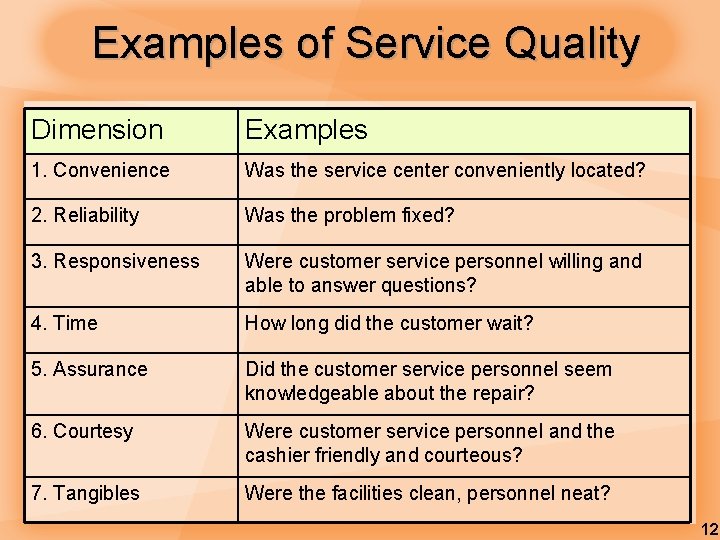
Examples of Service Quality Dimension Examples 1. Convenience Was the service center conveniently located? 2. Reliability Was the problem fixed? 3. Responsiveness Were customer service personnel willing and able to answer questions? 4. Time How long did the customer wait? 5. Assurance Did the customer service personnel seem knowledgeable about the repair? 6. Courtesy Were customer service personnel and the cashier friendly and courteous? 7. Tangibles Were the facilities clean, personnel neat? 12
Challenges with Service Quality § Customer expectations often change § Different customers have different expectations § Each customer contact is a “moment of truth” § Customer participation can affect perception of quality § Failsafe must be designed into the system 13
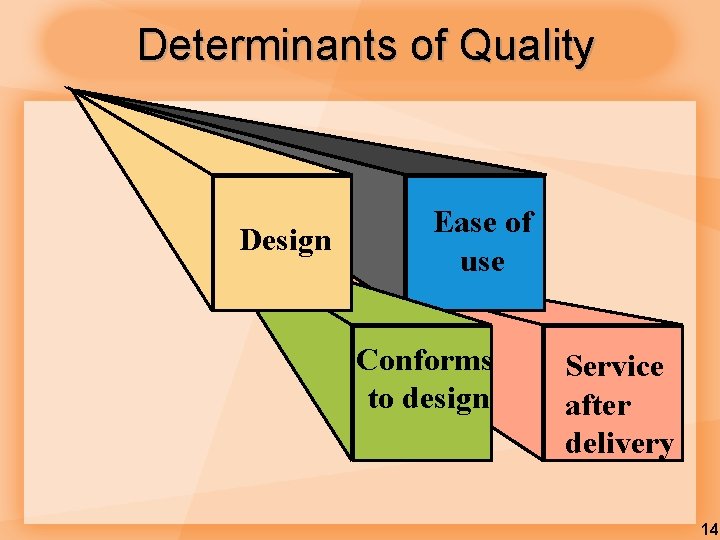
Determinants of Quality Design Ease of use Conforms to design Service after delivery 14
Determinants of Quality (cont’d) § Quality of design § Intension of designers to include or exclude features in a product or service § Quality of conformance § The degree to which goods or services conform to the intent of the designers 15
The Consequences of Poor Quality § § Loss of business Liability Productivity Costs 16
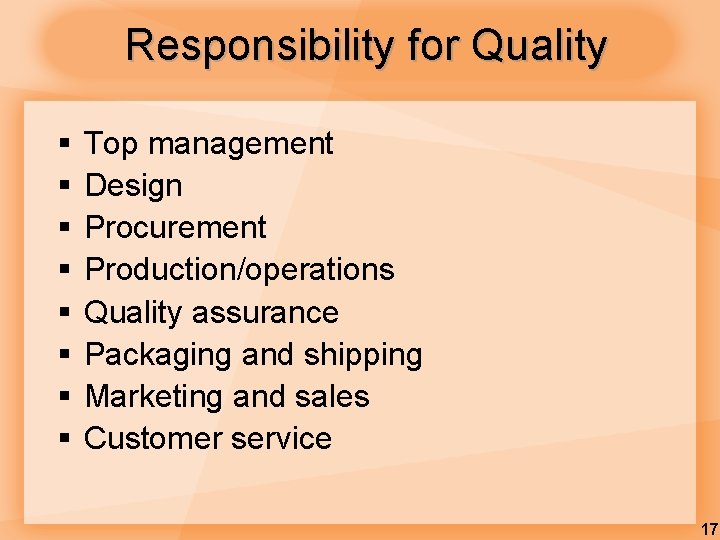
Responsibility for Quality § § § § Top management Design Procurement Production/operations Quality assurance Packaging and shipping Marketing and sales Customer service 17
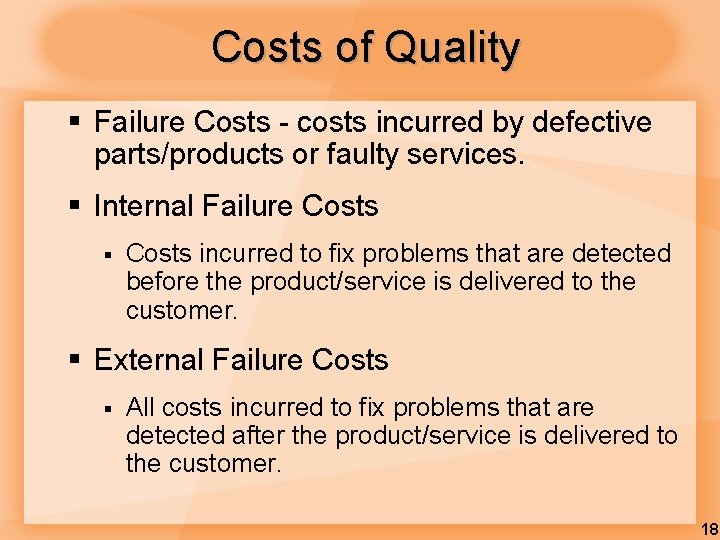
Costs of Quality § Failure Costs - costs incurred by defective parts/products or faulty services. § Internal Failure Costs § Costs incurred to fix problems that are detected before the product/service is delivered to the customer. § External Failure Costs § All costs incurred to fix problems that are detected after the product/service is delivered to the customer. 18
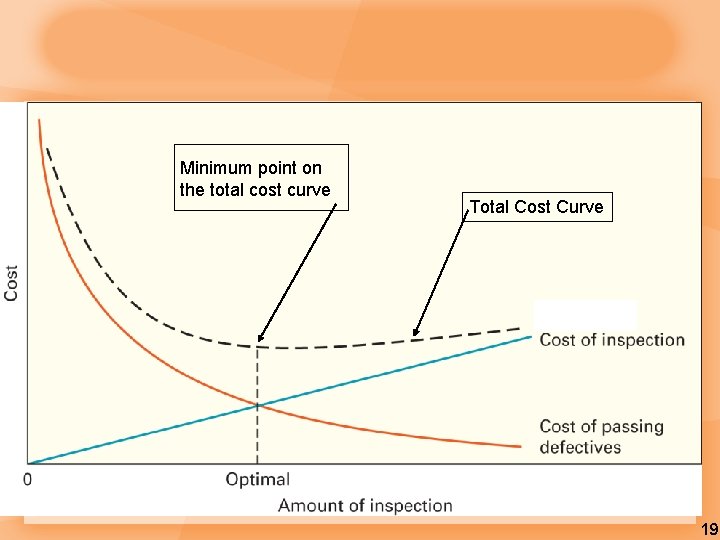
Minimum point on the total cost curve Total Cost Curve 19
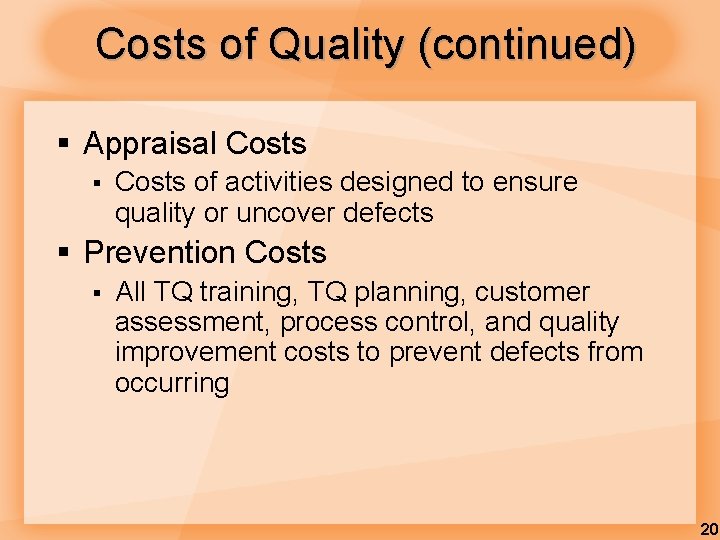
Costs of Quality (continued) § Appraisal Costs § Costs of activities designed to ensure quality or uncover defects § Prevention Costs § All TQ training, TQ planning, customer assessment, process control, and quality improvement costs to prevent defects from occurring 20
Ethics and Quality § Substandard work § § § Defective products Substandard service Poor designs Shoddy workmanship Substandard parts and materials Having knowledge of this and failing to correct and report it in a timely manner is unethical. 21
Quality Awards Baldrige Award Deming Prize 22
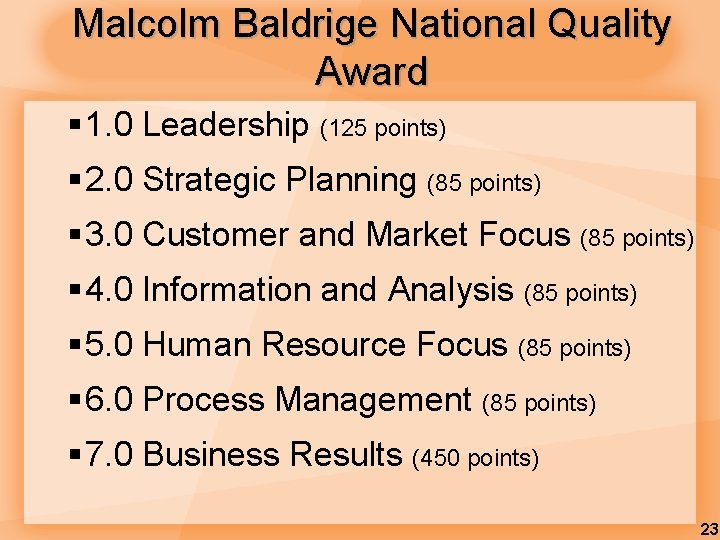
Malcolm Baldrige National Quality Award § 1. 0 Leadership (125 points) § 2. 0 Strategic Planning (85 points) § 3. 0 Customer and Market Focus (85 points) § 4. 0 Information and Analysis (85 points) § 5. 0 Human Resource Focus (85 points) § 6. 0 Process Management (85 points) § 7. 0 Business Results (450 points) 23
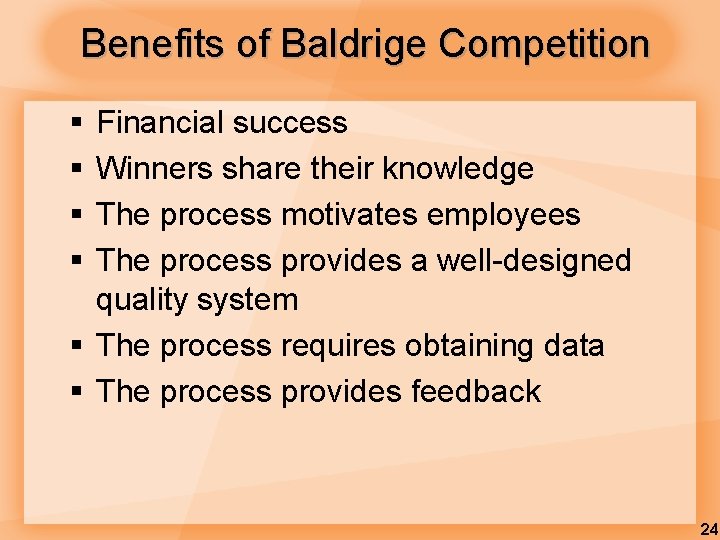
Benefits of Baldrige Competition § § Financial success Winners share their knowledge The process motivates employees The process provides a well-designed quality system § The process requires obtaining data § The process provides feedback 24
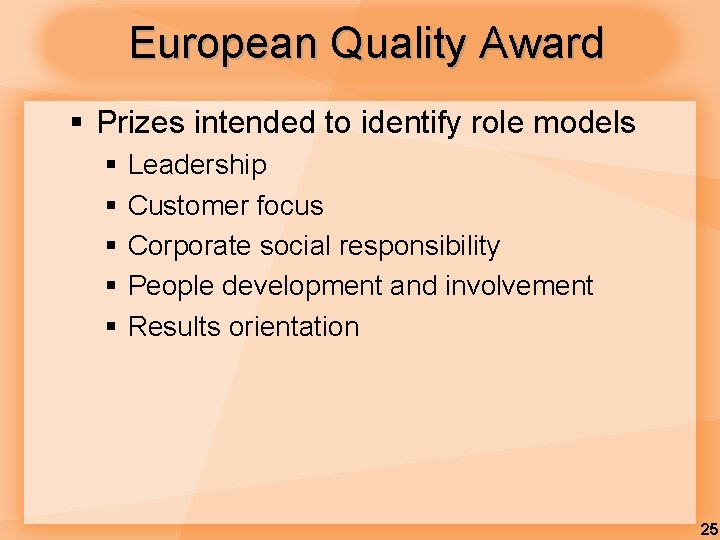
European Quality Award § Prizes intended to identify role models § § § Leadership Customer focus Corporate social responsibility People development and involvement Results orientation 25
The Deming Prize § Honoring W. Edwards Deming § Japan’s highly coveted award § Main focus on statistical quality control 26
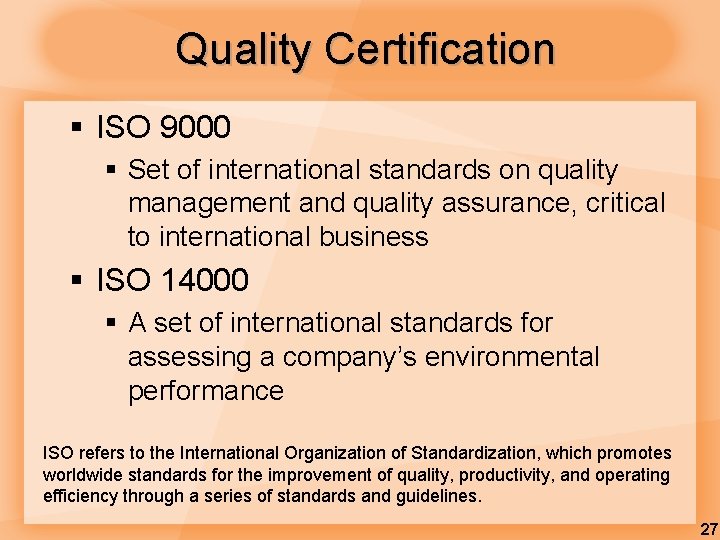
Quality Certification § ISO 9000 § Set of international standards on quality management and quality assurance, critical to international business § ISO 14000 § A set of international standards for assessing a company’s environmental performance ISO refers to the International Organization of Standardization, which promotes worldwide standards for the improvement of quality, productivity, and operating efficiency through a series of standards and guidelines. 27
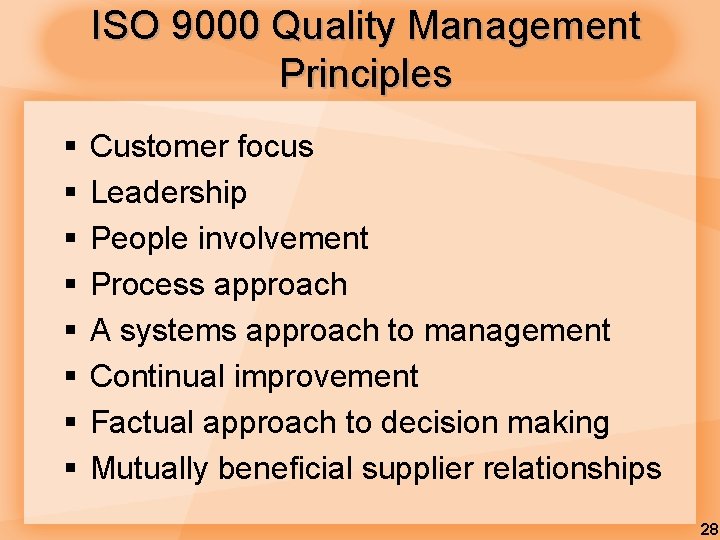
ISO 9000 Quality Management Principles § § § § Customer focus Leadership People involvement Process approach A systems approach to management Continual improvement Factual approach to decision making Mutually beneficial supplier relationships 28
ISO 14000 § ISO 14000 - A set of international standards for assessing a company’s environmental performance § Standards in three major areas § Management systems § Operations § Environmental systems 29
ISO 14000 § Management systems § Systems development and integration of environmental responsibilities into business planning § Operations § Consumption of natural resources and energy § Environmental systems § Measuring, assessing and managing emissions, effluents, and other waste 30
Total Quality Management A philosophy that involves everyone in an organization in a continual effort to improve quality and achieve customer satisfaction. T Q M 31
The TQM Approach 1. Find out what the customer wants 2. Design a product or service that meets or exceeds customer wants 3. Design processes that facilitates doing the job right the first time 4. Keep track of results 5. Extend these concepts to suppliers 32
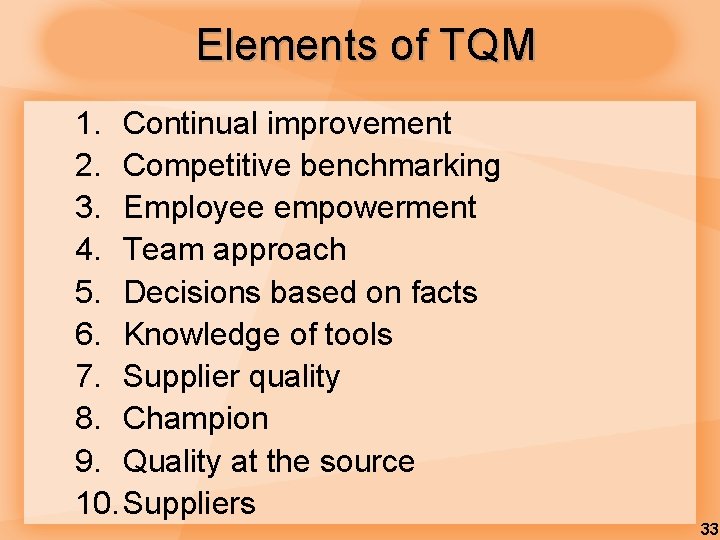
Elements of TQM 1. Continual improvement 2. Competitive benchmarking 3. Employee empowerment 4. Team approach 5. Decisions based on facts 6. Knowledge of tools 7. Supplier quality 8. Champion 9. Quality at the source 10. Suppliers 33
Continuous Improvement § Philosophy that seeks to make neverending improvements to the process of converting inputs into outputs. § Kaizen: Japanese word for continuous improvement. 34
Quality at the Source The philosophy of making each worker responsible for the quality of his or her work. 35
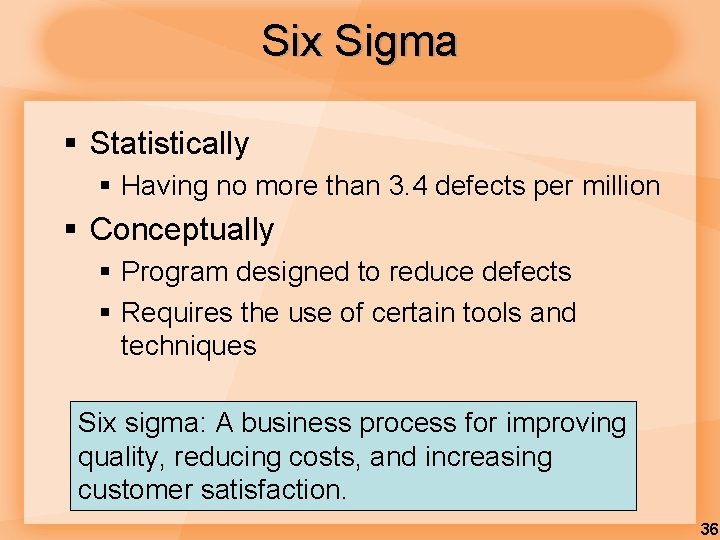
Six Sigma § Statistically § Having no more than 3. 4 defects per million § Conceptually § Program designed to reduce defects § Requires the use of certain tools and techniques Six sigma: A business process for improving quality, reducing costs, and increasing customer satisfaction. 36
Six Sigma Programs § Six Sigma programs § Improve quality § Save time § Cut costs § Employed in § § § Design Production Service Inventory management Delivery 37
Six Sigma Management § § Providing strong leadership Defining performance metrics Selecting projects likely to succeed Selecting and training appropriate people 38
Six Sigma Technical § § Improving process performance Reducing variation Utilizing statistical models Designing a structured improvement strategy 39
Six Sigma Team § § § Top management Program champions Master “black belts” “Black belts” “Green belts” 40
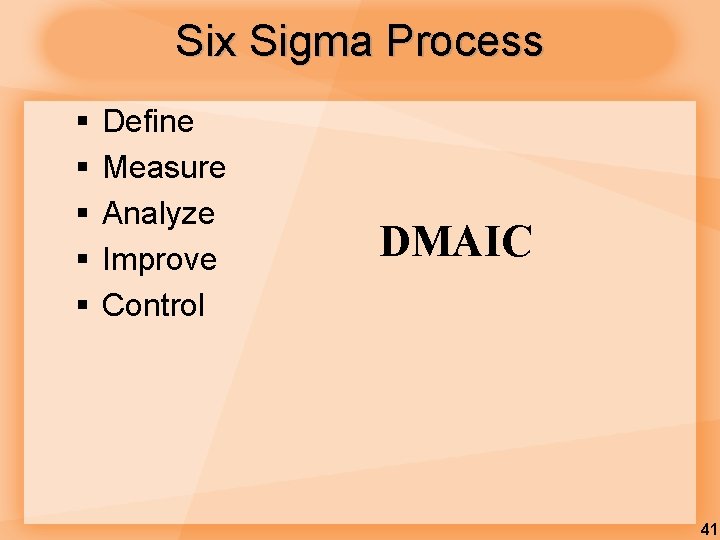
Six Sigma Process § § § Define Measure Analyze Improve Control DMAIC 41
Obstacles to Implementing TQM § Lack of: § § § § Company-wide definition of quality Strategic plan for change Customer focus Real employee empowerment Strong motivation Time to devote to quality initiatives Leadership 42
Obstacles to Implementing TQM § § Poor inter-organizational communication View of quality as a “quick fix” Emphasis on short-term financial results Internal political and “turf” wars 43
Criticisms of TQM 1. Blind pursuit of TQM programs 2. Programs may not be linked to strategies 3. Quality-related decisions may not be tied to market performance 4. Failure to carefully plan a program 44
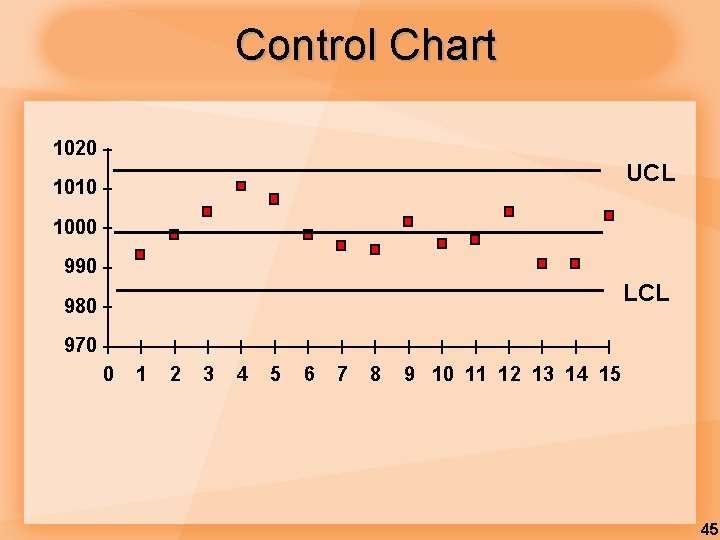
Control Chart 1020 UCL 1010 1000 990 LCL 980 970 0 1 2 3 4 5 6 7 8 9 10 11 12 13 14 15 45
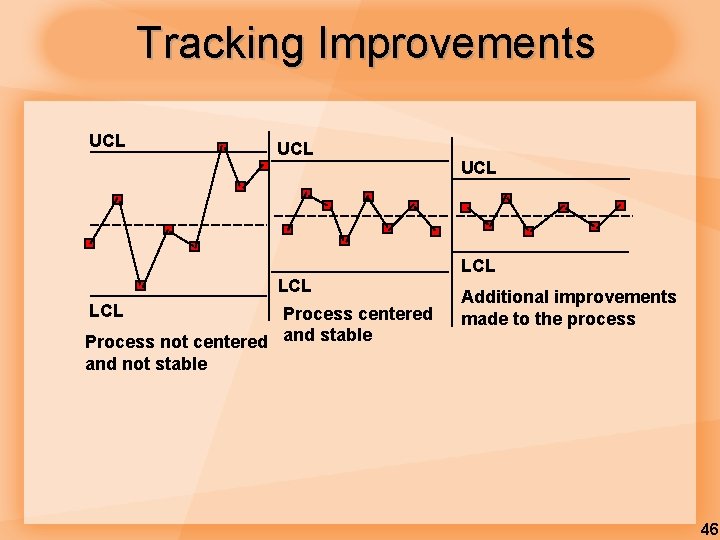
Tracking Improvements UCL LCL Process centered Process not centered and stable and not stable UCL LCL Additional improvements made to the process 46
Other Topics from the Reading Assignment § Quality circles § Interviewing § Benchmarking 47
Quality Circles § A Team approach! 48
Interviewing Used in identifying problems and collecting information 49
Benchmarking Process § Identify a critical process that needs improving § Identify an organization that excels in this process § Contact that organization § Analyze the data § Improve the critical process 50
This completes the presentation on Management of Quality, Chapter 9. 51