
Management of Pancreatitis at NMUH Chris Bretherton Surgical
Management of Pancreatitis at NMUH Chris Bretherton Surgical FY 1 Audited against UK guidelines for the management of acute pancreatitis from British Society of Gastroenterology – GUT 2005
What I did Obtained a list of patients with diagnosis of acute pancreatitis from April 2011 – April 2012 Went through the notes to determine were patients : 1. Being scored on admission 2. Being scored appropriately 3. Being rescored with 48 hours of admission 4. Receiving abdominal Ultrasound Scan within 24 hours 5. Receiving timely ERCP as appropriate 6. Having definite management of Gall stone disease (Laparoscopic Cholecystectomy)

Glasgow Score • P – O 2 <8 • A – ge >55 • N – eutrophilia – WCC >15 C – alcium <2 • R – aised Urea >16 • E – nzymes – LDH >600 AST > 100 • A – lbumin < 32 • S – ugar – Blood glucose > 10 k. Pa x 109/L mmol/L units g/L mmol/L (non diabetics)
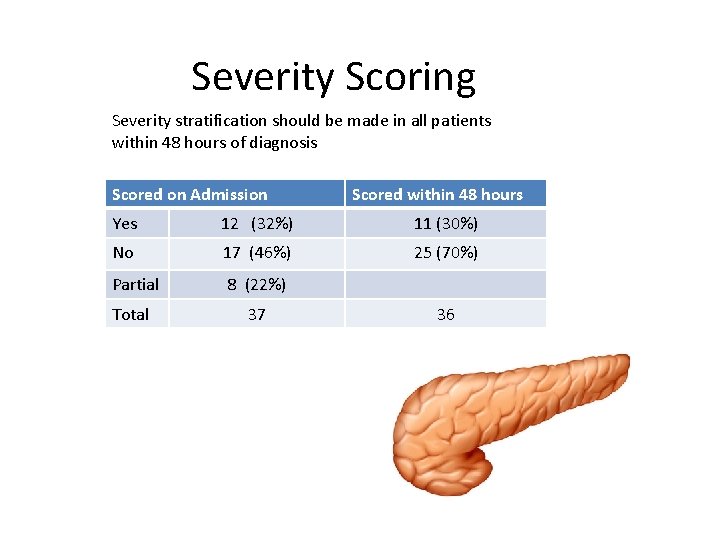
Severity Scoring Severity stratification should be made in all patients within 48 hours of diagnosis Scored on Admission Scored within 48 hours Yes 12 (32%) 11 (30%) No 17 (46%) 25 (70%) Partial 8 (22%) Total 37 36
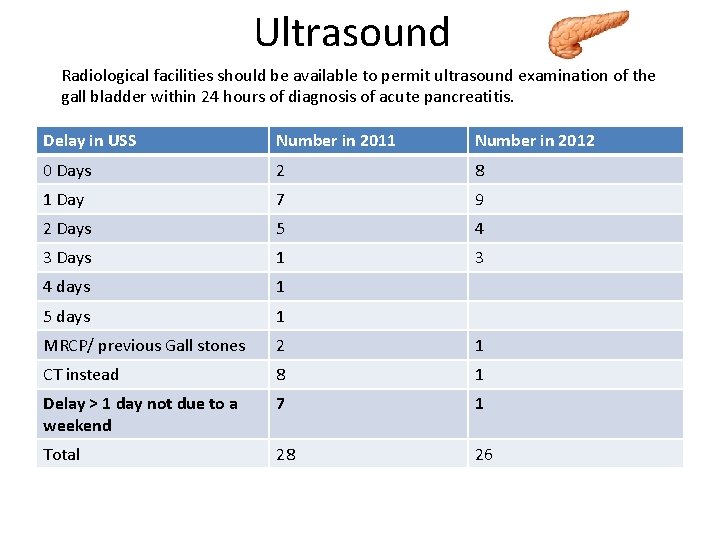
Ultrasound Radiological facilities should be available to permit ultrasound examination of the gall bladder within 24 hours of diagnosis of acute pancreatitis. Delay in USS Number in 2011 Number in 2012 0 Days 2 8 1 Day 7 9 2 Days 5 4 3 Days 1 3 4 days 1 5 days 1 MRCP/ previous Gall stones 2 1 CT instead 8 1 Delay > 1 day not due to a weekend 7 1 Total 28 26
Management of Gallstone Pancreatitis Urgent therapeutic endoscopic retrograde cholangiopancreatography (ERCP) should be performed in patients with acute pancreatitis of suspected or proven gall stone aetiology who satisfy the criteria for predicted or actual severe pancreatitis, or when there is cholangitis, jaundice, or a dilated common bile duct. The procedure is best carried out within the first 72 hours after the onset of pain. All patients undergoing early ERCP for severe gallstone pancreatitis require endoscopic sphincterotomy whether or not stones are found in the bile duct (recommendation grades B and C).
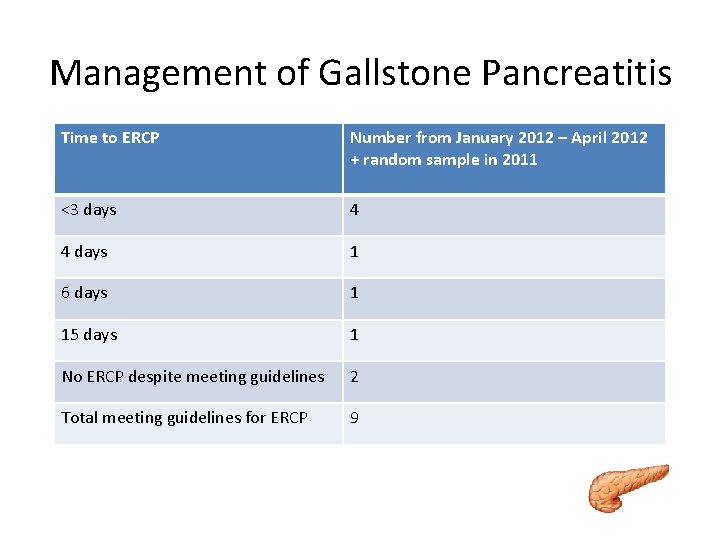
Management of Gallstone Pancreatitis Time to ERCP Number from January 2012 – April 2012 + random sample in 2011 <3 days 4 4 days 1 6 days 1 15 days 1 No ERCP despite meeting guidelines 2 Total meeting guidelines for ERCP 9
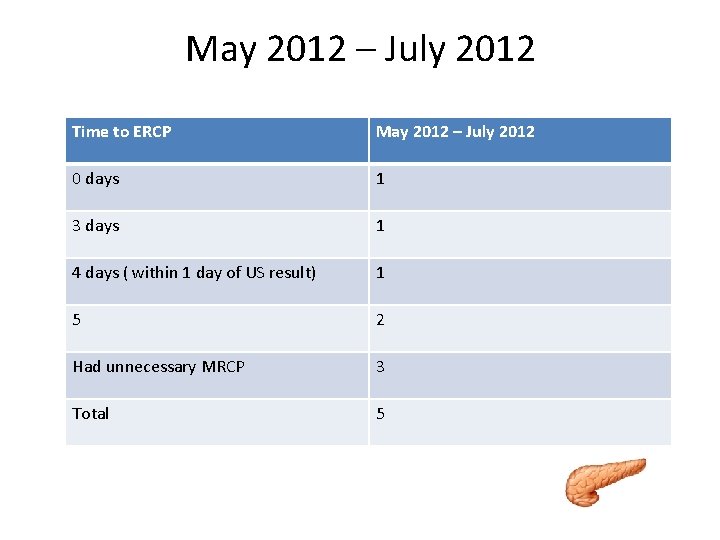
May 2012 – July 2012 Time to ERCP May 2012 – July 2012 0 days 1 3 days 1 4 days ( within 1 day of US result) 1 5 2 Had unnecessary MRCP 3 Total 5
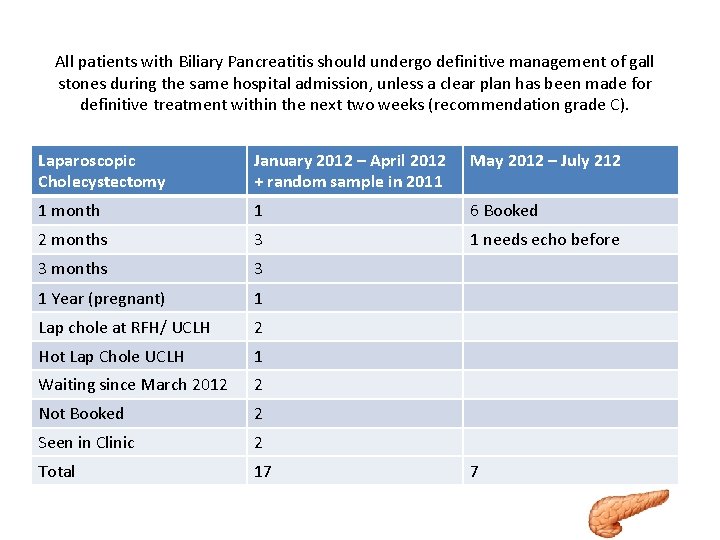
All patients with Biliary Pancreatitis should undergo definitive management of gall stones during the same hospital admission, unless a clear plan has been made for definitive treatment within the next two weeks (recommendation grade C). Laparoscopic Cholecystectomy January 2012 – April 2012 + random sample in 2011 May 2012 – July 212 1 month 1 6 Booked 2 months 3 1 needs echo before 3 months 3 1 Year (pregnant) 1 Lap chole at RFH/ UCLH 2 Hot Lap Chole UCLH 1 Waiting since March 2012 2 Not Booked 2 Seen in Clinic 2 Total 17 7
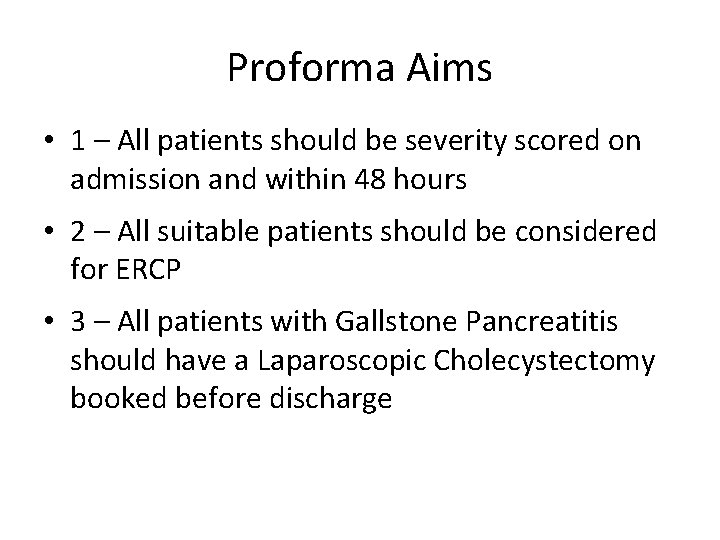
Proforma Aims • 1 – All patients should be severity scored on admission and within 48 hours • 2 – All suitable patients should be considered for ERCP • 3 – All patients with Gallstone Pancreatitis should have a Laparoscopic Cholecystectomy booked before discharge
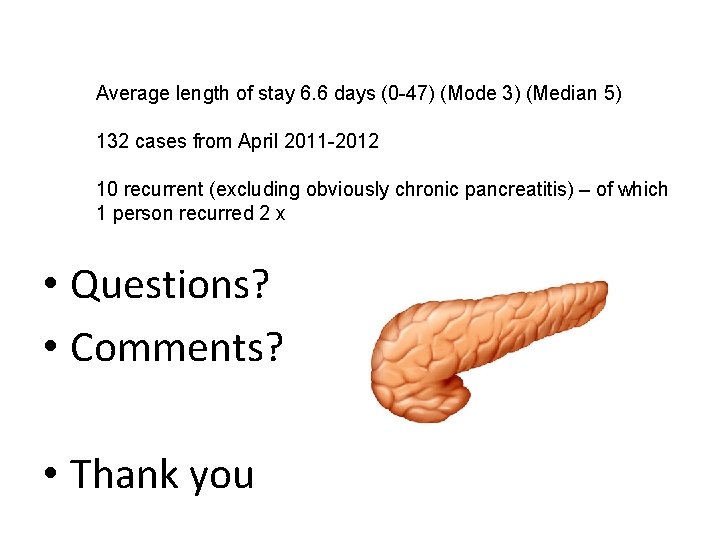
Average length of stay 6. 6 days (0 -47) (Mode 3) (Median 5) 132 cases from April 2011 -2012 10 recurrent (excluding obviously chronic pancreatitis) – of which 1 person recurred 2 x • Questions? • Comments? • Thank you
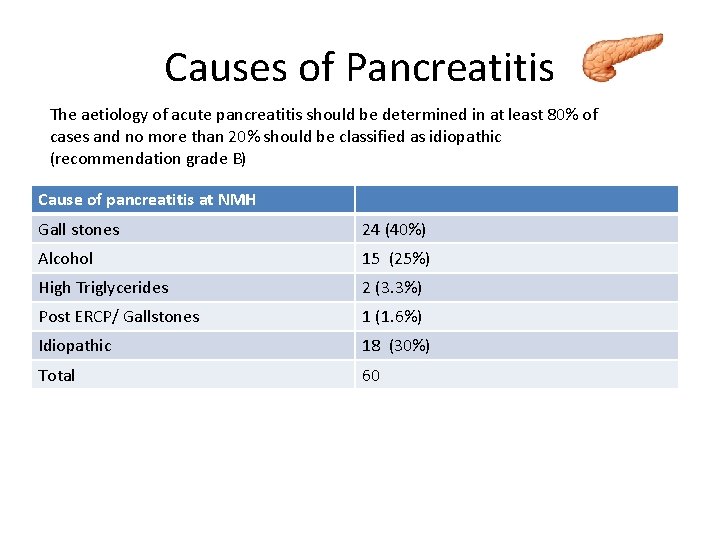
Causes of Pancreatitis The aetiology of acute pancreatitis should be determined in at least 80% of cases and no more than 20% should be classified as idiopathic (recommendation grade B) Cause of pancreatitis at NMH Gall stones 24 (40%) Alcohol 15 (25%) High Triglycerides 2 (3. 3%) Post ERCP/ Gallstones 1 (1. 6%) Idiopathic 18 (30%) Total 60
- Slides: 12