
Management of Low Birth Weight Babies Teaching Aids
Management of Low Birth Weight Babies Teaching Aids: NNF LBW- 1

Low birth weight (LBW) ¡ Definition : Birth weight <2500 g ¡ Incidence : 30% of neonates in India Teaching Aids: NNF LBW- 2
LBW: Significance 75% neonatal deaths and 50% infant deaths occur among LBW infants ¡ LBW babies are more prone to: ¡ l l l Malnutrition Recurrent infections Neuro developmental delay LBW babies have higher mortality and morbidity Teaching Aids: NNF LBW- 3

Types of LBW 2 types based on the origin Preterm ¡ ¡ < 37 completed weeks of gestation Account for 1/3 rd of LBW Teaching Aids: NNF Small-for-date (SFD) / intra uterine growth retardation (IUGR) ¡ ¡ < 10 th centile for gestational age Account for 2/3 rd of LBW neonates LBW- 4

Causation: LBW Etiology of prematurity ¡ ¡ ¡ Low maternal weight, teenage / multiple pregnancy Previous preterm baby, cervical incompetence Antepartum hemorrhage, acute systemic disease Induced premature delivery Majority unknown Teaching Aids: NNF LBW- 5
Causation: LBW Etiology of SFD / IUGR Poor nutritional status of mother ¡ Hypertension, toxemia, anemia ¡ Multiple pregnancy, post maturity ¡ Chronic malaria, chronic illness ¡ Tobacco use ¡ Teaching Aids: NNF LBW- 6

LBW: Identification of types Prematurity Date of LMP ¡ Physical features ¡ l l Breast nodule Genitalia Sole creases Ear cartilage / recoil Teaching Aids: NNF LBW- 7
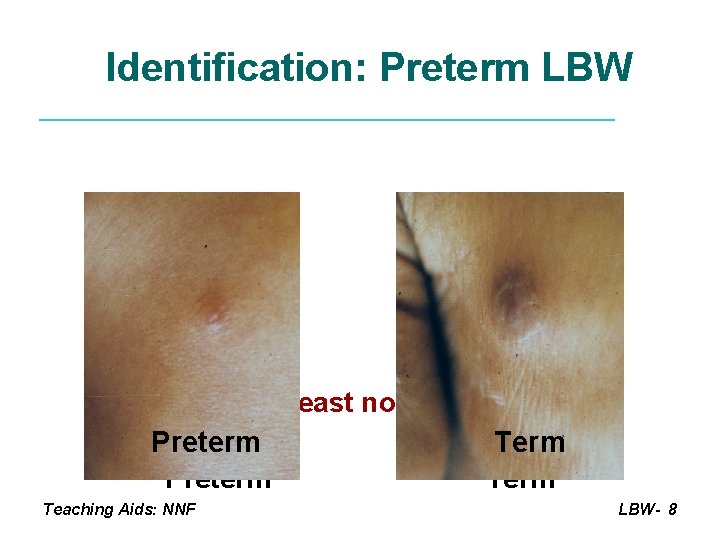
Identification: Preterm LBW Breast nodule Preterm Teaching Aids: NNF Term LBW- 8
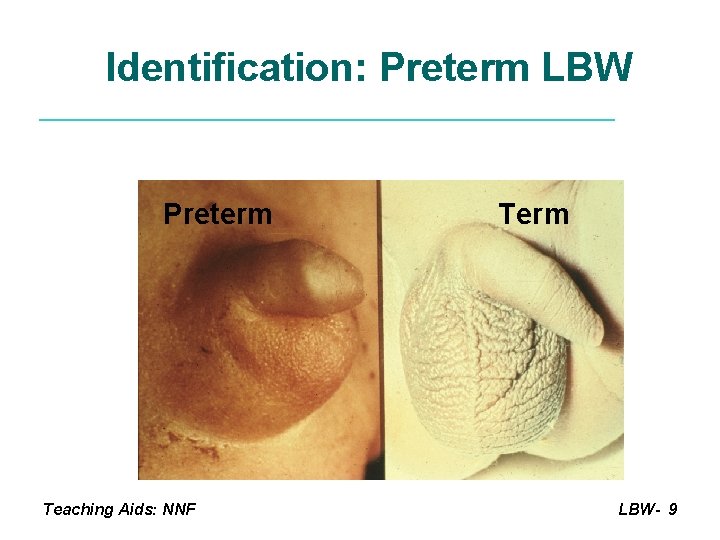
Identification: Preterm LBW Preterm Term Male genitalia Teaching Aids: NNF LBW- 9
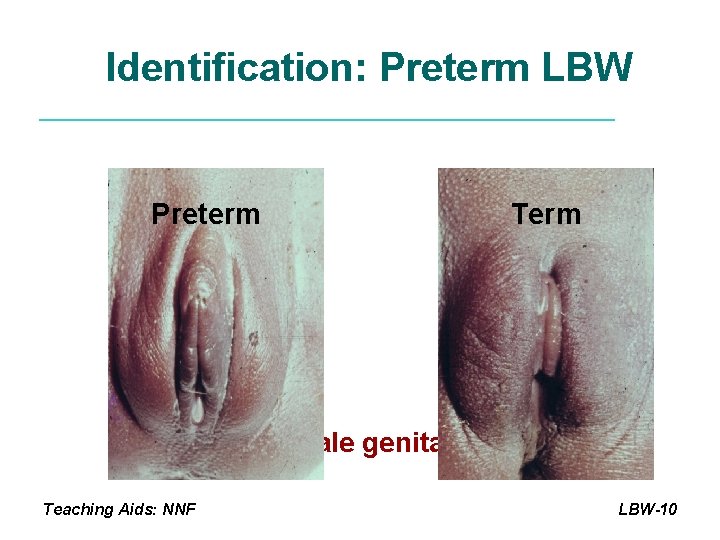
Identification: Preterm LBW Preterm Term Female genitalia Teaching Aids: NNF LBW-10
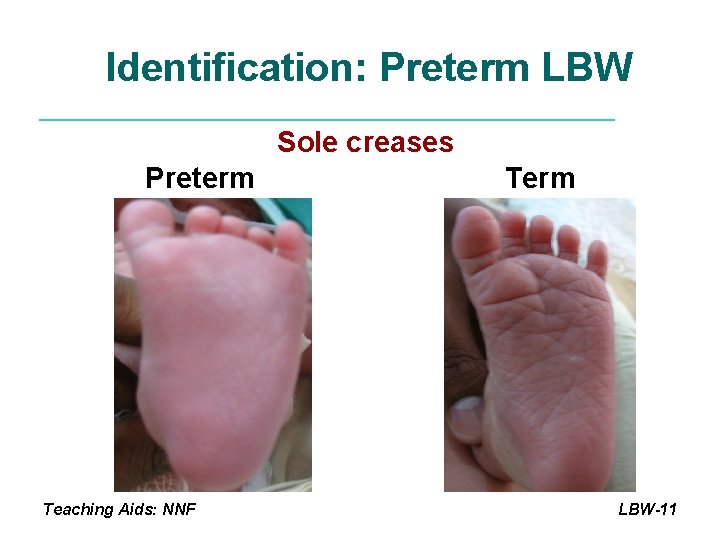
Identification: Preterm LBW Sole creases Preterm Teaching Aids: NNF Term LBW-11

Identification: Preterm LBW Ear Cartilage Preterm Teaching Aids: NNF Term LBW-12
LBW: Identification of types SFD / IUGR ¡ Intrauterine growth chart ¡ Physical characteristics l l Emaciated look Loose folds of skin Lack of subcutaneous tissue Head bigger than chest by >3 cm Teaching Aids: NNF LBW-13
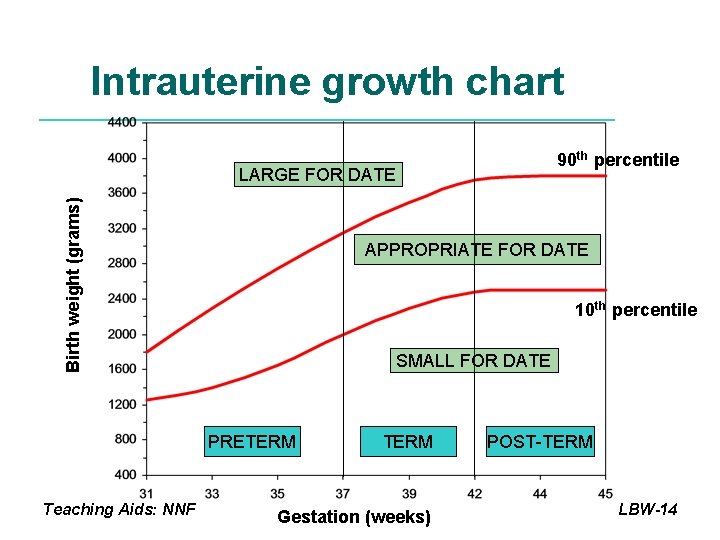
Intrauterine growth chart 90 th percentile Birth weight (grams) LARGE FOR DATE APPROPRIATE FOR DATE 10 th percentile SMALL FOR DATE PRETERM Teaching Aids: NNF TERM Gestation (weeks) POST-TERM LBW-14
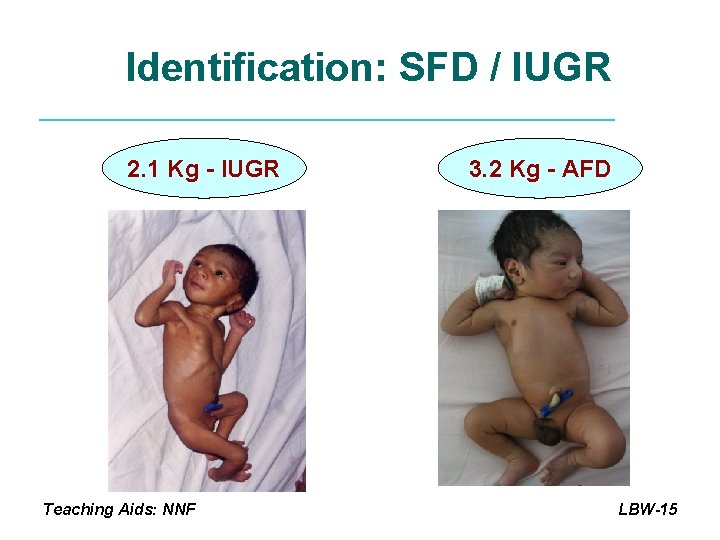
Identification: SFD / IUGR 2. 1 Kg - IUGR Teaching Aids: NNF 3. 2 Kg - AFD LBW-15
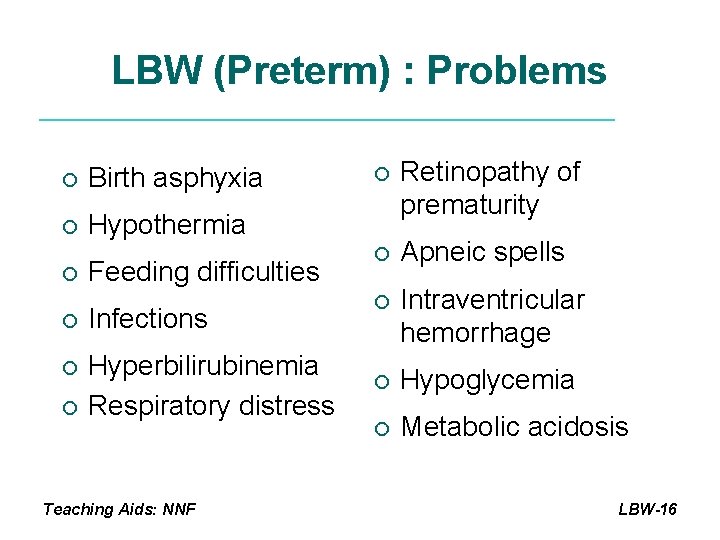
LBW (Preterm) : Problems ¡ Birth asphyxia ¡ Hypothermia ¡ Feeding difficulties ¡ Infections ¡ Hyperbilirubinemia Respiratory distress ¡ Teaching Aids: NNF ¡ Retinopathy of prematurity ¡ Apneic spells ¡ Intraventricular hemorrhage ¡ Hypoglycemia ¡ Metabolic acidosis LBW-16
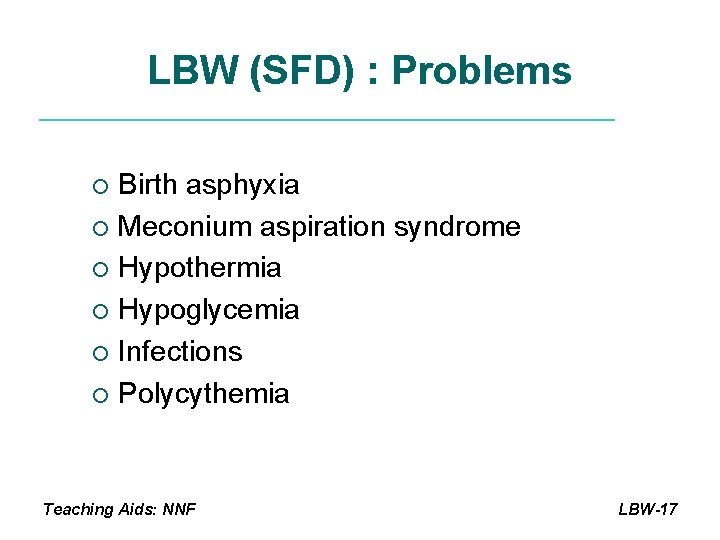
LBW (SFD) : Problems Birth asphyxia ¡ Meconium aspiration syndrome ¡ Hypothermia ¡ Hypoglycemia ¡ Infections ¡ Polycythemia ¡ Teaching Aids: NNF LBW-17
LBW: Issues in delivery Transfer mother to a well-equipped centre before delivery ¡ Skilled person needed for effective resuscitation ¡ Prevention of hypothermia - topmost priority ¡ Teaching Aids: NNF LBW-18

LBW: Indications for hospitalization Birth weight <1800 g ¡ Gestation <34 wks ¡ Unable to feed* ¡ Sick neonate* ¡ * Irrespective of birth weight and gestation Teaching Aids: NNF LBW-19
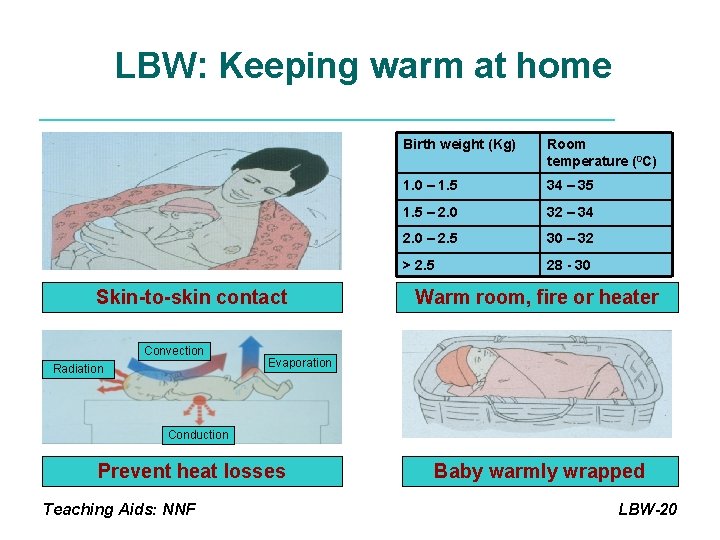
LBW: Keeping warm at home Skin-to-skin contact Convection Radiation Birth weight (Kg) Room temperature (0 C) 1. 0 – 1. 5 34 – 35 1. 5 – 2. 0 32 – 34 2. 0 – 2. 5 30 – 32 > 2. 5 28 - 30 Warm room, fire or heater Evaporation Conduction Prevent heat losses Teaching Aids: NNF Baby warmly wrapped LBW-20
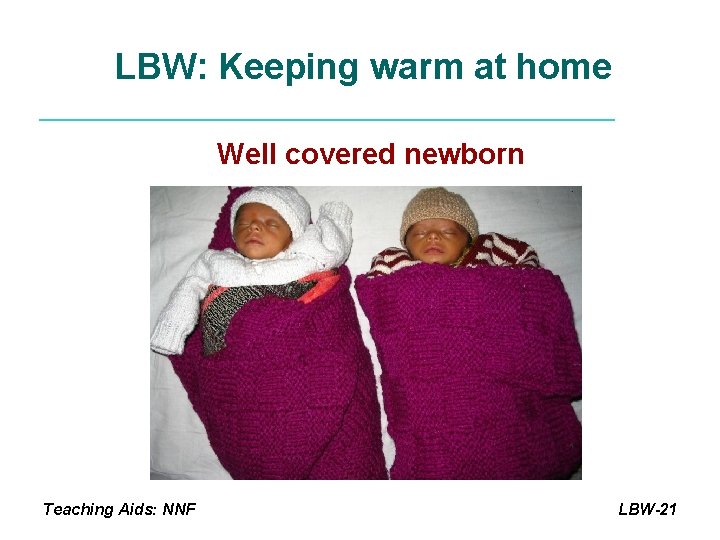
LBW: Keeping warm at home Well covered newborn Teaching Aids: NNF LBW-21
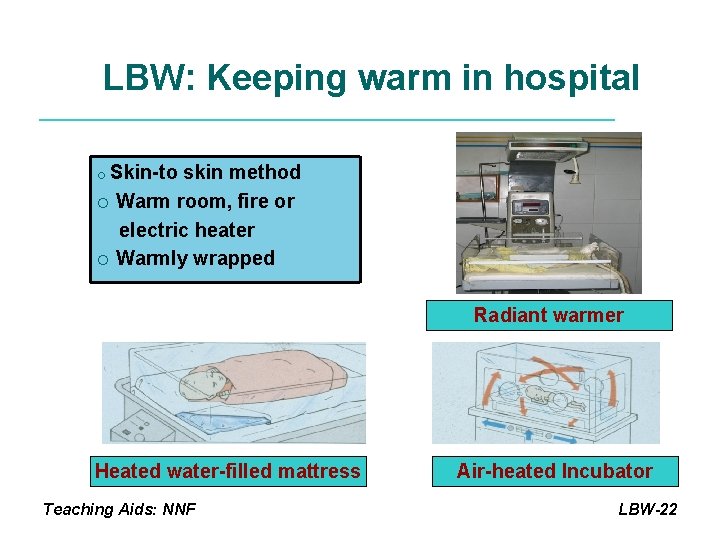
LBW: Keeping warm in hospital Skin-to skin method ¡ Warm room, fire or electric heater ¡ Warmly wrapped ¡ Radiant warmer Heated water-filled mattress Teaching Aids: NNF Air-heated Incubator LBW-22
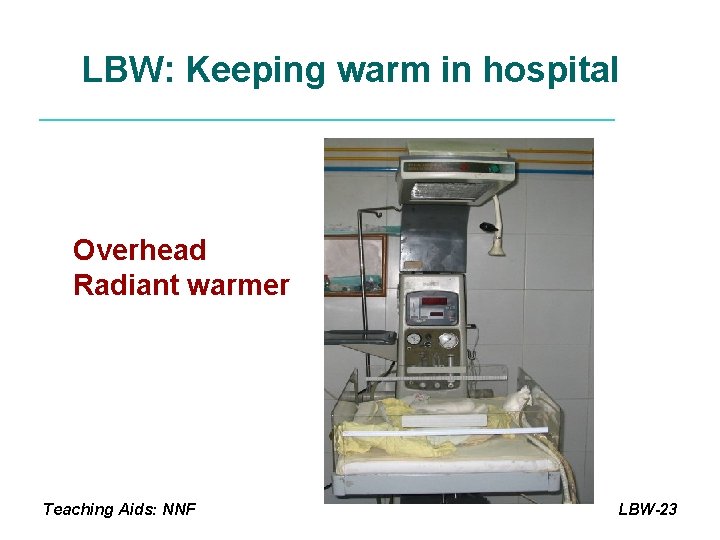
LBW: Keeping warm in hospital Overhead Radiant warmer Teaching Aids: NNF LBW-23

LBW: Fluids and feeding Weight <1200 g; Gestation <30 wks* Start initial intravenous fluids ¡ Introduce gavage feeds once stable ¡ Shift to katori-spoon feeds over next few days. Later on breast feeds ¡ * May try gavage feeds, if not sick Teaching Aids: NNF LBW-24
LBW: Fluids and feeding Weight 1200 -1800 g; Gestation 30 -34 wks* Start initial gavage feeds ¡ Katori-spoon feeding after 1 -3 days ¡ Shift to breast feeds as soon as baby is able to suck ¡ * May need intravenous fluids, if sick Teaching Aids: NNF LBW-25
LBW: Fluids and feeding Weight >1800 g; Gestation > 34 wks* Breast feeding ¡ Katori-spoon feeding, if sucking not satisfactory on breast ¡ Shift to breast feeds as soon as possible ¡ Teaching Aids: NNF LBW-26
LBW: Feeding schedule ¡ Begin at 60 to 80 ml/kg/day Increase by 15 ml/kg/day ¡ Maximum of 180 -200 ml/kg/day ¡ ¡ First feed at 2 hrs of age then every 2 hourly Teaching Aids: NNF LBW-27
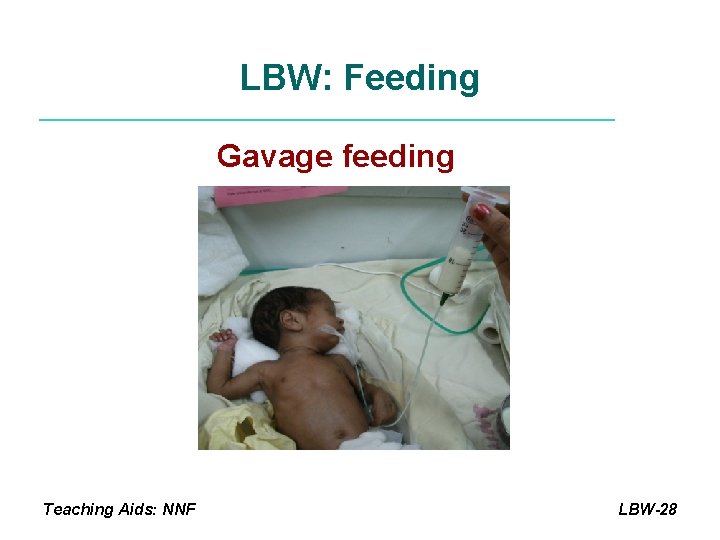
LBW: Feeding Gavage feeding Teaching Aids: NNF LBW-28
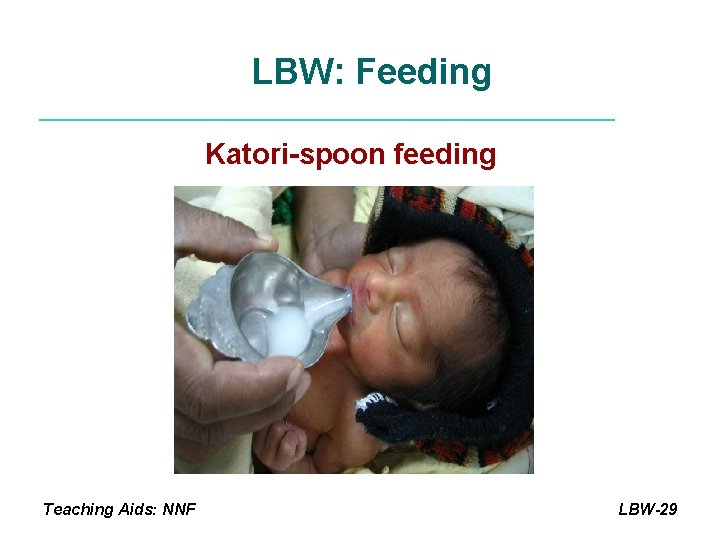
LBW: Feeding Katori-spoon feeding Teaching Aids: NNF LBW-29
Guidelines for fluid requirements First day 60 -80 ml/kg/day ¡ Daily increment 15 ml/kg till day 7 ¡ Add extra 20 -30 ml/kg for infants under radiant warmer and 15 ml/kg for those receiving phototherapy ¡ Teaching Aids: NNF LBW-30
Fluid requirements (ml/kg) Teaching Aids: NNF LBW-31

LBW: Adequacy of nutrition Weight pattern* ¡ ¡ Loses 1 to 2% weight every day initially Cumulative weight loss 10%; more in preterm Regains birth weight by 10 -14 days Then gains weight up to 1. 5% of birth weight daily Excessive loss or inadequate weight ¡ Cold stress, anemia, poor intake, sepsis * SFD - LBW term baby does not lose weight Teaching Aids: NNF LBW-32
LBW: Supplements ¡ Vitamins : IM Vit K 1. 0 mg at birth Vit A* 1000 I. U. per day Vit D* 400 I. U. per day ¡ Iron : Oral 2 mg/kg per day from 8 weeks of age *From 2 weeks of age Teaching Aids: NNF LBW-33
Danger signals (Early detection and referral) Lethargy, refusal to feed ¡ Hypothermia ¡ Tachypnea, grunt, gasping, apnea ¡ Seizures, vacant stare ¡ Abdominal distension ¡ Bleeding, icterus over palms/soles ¡ Teaching Aids: NNF LBW-34
Transportation of LBW baby Adequate warmth ¡ Life support ¡ With mother ¡ Referral note ¡ Teaching Aids: NNF LBW-35
Prognosis ¡ Mortality l l ¡ Inversely related to birth weight and gestation Directly related to severity of complications Long term l Depends on birth weight, gestation and severity of complications Teaching Aids: NNF LBW-36
- Slides: 36