
MANAGEMENT of INFORMATION SECURITY Fifth Edition SECURITY ARCHITECTURE





- Slides: 36
MANAGEMENT of INFORMATION SECURITY, Fifth Edition
SECURITY ARCHITECTURE MODELS Management of Information Security, 5 th Edition, © Cengage Learning 2
Security Architecture Models • Security architecture models illustrate information security implementations, and can help organizations to quickly make improvements through adaptation • Some models are implemented into computer hardware and software, some are implemented as policies and practices, and some are implemented in both • Some models focus on the confidentiality of information, while other focus on the integrity of the information as it is being processed Management of Information Security, 5 th Edition, © Cengage Learning 3
Trusted Computing Base • The Trusted Computer System Evaluation Criteria (TCSEC) is an older U. S. Government Department of Defense (Do. D) standard that defines the criteria for assessing the access controls in a computer system • This standard is part of a larger series of standards collectively referred to as the Rainbow Series, due to the color-coding used to uniquely identify each document • TCSEC is also known as the “Orange Book” and is considered the cornerstone of the series • TCSEC was replaced by the “Common Criteria” in 2005 Management of Information Security, 5 th Edition, © Cengage Learning 4
Trusted Computing Base • TCSEC defines a trusted computing base (TCB) as the combination of all hardware, firmware, and software responsible for enforcing the security policy • In this context, security policy refers to the rules of configuration for a system, rather than a managerial guidance document • The TCB is made up of the hardware and software that has been implemented to provide security for a particular information system Management of Information Security, 5 th Edition, © Cengage Learning 5
Trusted Computing Base Reference Monitor • Within the TCB is a conceptual object known as the reference monitor to mediate access to objects by subjects • Systems administrators must be able to audit or periodically review the reference monitor to ensure it is functioning effectively, without unauthorized modification Management of Information Security, 5 th Edition, © Cengage Learning 6
Covert Channels • Covert channels are unauthorized or unintended methods of communications hidden inside a computer system – Storage channels, which communicate by modifying a stored – Timing channels, which transmit information by managing the relative timing of events Management of Information Security, 5 th Edition, © Cengage Learning 7
Information Technology System Evaluation Criteria • The Information Technology System Evaluation Criteria (ITSEC), an international set of criteria for evaluating computer systems, is very similar to TCSEC • Under ITSEC, Targets of Evaluation (To. E) are compared to detailed security function specifications, resulting in an assessment of systems functionality and comprehensive penetration testing • Like TCSEC, ITSEC was, for the most part, functionally replaced by the Common Criteria Management of Information Security, 5 th Edition, © Cengage Learning 8
The Common Criteria • The Common Criteria for Information Technology Security Evaluation (often called “Common Criteria” or “CC”) is an international standard (ISO/IEC 15408) for computer security certification • It is widely considered the successor to both TCSEC and ITSEC in that it reconciles some of the differences between the various other standards • CC is a combined effort of contributors from Australia, New Zealand, Canada, France, Germany, Japan, the Netherlands, Spain, the United Kingdom, and the United States • The CC process assures that the specification, implementation, and evaluation of computer security products are performed in a rigorous and standard manner Management of Information Security, 5 th Edition, © Cengage Learning 9
Chapter 08: Security Management Models ACADEMIC ACCESS CONTROL MODELS Management of Information Security, 5 th Edition, © Cengage Learning 10
Bell-La. Padula Confidentiality Model • The Bell-La. Padula (BLP) confidentiality model is a state machine reference model that helps ensure the confidentiality of an information system by means of mandatory access controls (MACs), data classification, and security clearances • A state machine model is one in which the design follows a conceptual approach in which the state of the content of the system being modeled is always in a known secure condition, in other words, this kind of model is provably secure Management of Information Security, 5 th Edition, © Cengage Learning 11
Bell-La. Padula Confidentiality Model • A system that serves as a reference monitor compares the level of classification of the data with the clearance of the entity requesting access; it allows access only if the clearance is equal to or higher than the classification • BLP security rules prevent information from being moved from a level of higher security level to a level of lower security Management of Information Security, 5 th Edition, © Cengage Learning 12
BLP Confidentiality Model • Access modes can be one of two types: simple security and the * (star) property – Simple security (also called the read property) prohibits a subject of lower clearance from reading an object of higher classification, but allows a subject with a higher clearance level to read an object at a lower level (read down) – The * property (the write property) prohibits a highlevel subject from sending messages to a lower-level object – In short, the principle is “no read up, no write down” Management of Information Security, 5 th Edition, © Cengage Learning 13
Biba Integrity Model • The Biba integrity model is similar to BLP • The intent is to provide access controls to ensure that objects or subjects cannot have less integrity as a result of read/write operations • The Biba model ensures that no information from a subject can be passed on to an object in a higher security level – This prevents contaminating data of higher integrity with data of lower integrity Management of Information Security, 5 th Edition, © Cengage Learning 14
Biba Integrity Model • The Biba Model assigns integrity levels to subjects and objects using two properties: the simple integrity (read) property or the integrity * property (write) – The simple integrity property permits a subject to have read access to an object only if the security level of the subject is either lower or equal to the level of the object – The integrity * property permits a subject to have write access to an object only if the security level of the subject is equal to or higher than that of the object • In short “no write up, no read down” Management of Information Security, 5 th Edition, © Cengage Learning 15
Clark-Wilson Integrity Model • The Clark-Wilson integrity model, which is built upon principles of change control rather than integrity levels, was designed for the commercial environment • The change control principles upon which it operates are: – No changes by unauthorized subjects – No unauthorized changes by authorized subjects – The maintenance of internal and external consistency Management of Information Security, 5 th Edition, © Cengage Learning 16
Clark-Wilson Integrity Model • These controls are part of the CWI model: – Subject authentication and identification – Access to objects by means of well-formed transactions – Execution by subjects on a restricted set of programs • The elements of the Clark-Wilson model are: – Constrained data item (CDI)—Data item with protected integrity – Unconstrained data item—Data not controlled by Clark. Wilson; nonvalidated input or any output – Integrity verification procedure (IVP)—Procedure that scans data and confirms its integrity – Transformation procedure (TP)—Procedure that only allows changes to a constrained data item Management of Information Security, 5 th Edition, © Cengage Learning 17
Graham-Denning Access Control Model • The Graham-Denning access control model has three parts: a set of objects, a set of subjects, and a set of rights • The subjects are composed of two things: a process and a domain • The domain is the set of constraints controlling how subjects may access objects • The eight primitive protection rights are: – – Create object Create subject Delete object Delete subject – – Read access right Grant access right Delete access right Transfer access right Management of Information Security, 5 th Edition, © Cengage Learning 18
Harrison-Ruzzo-Ullman (HRU) model • The Harrison-Ruzzo-Ullman (HRU) model defines a method to allow changes to access rights and the addition and removal of subjects and objects, a process that the Bell-La. Padula model does not • Since systems change over time, their protective states need to change • HRU is built on an access control matrix and includes a set of generic rights and a specific set of commands Management of Information Security, 5 th Edition, © Cengage Learning 19
Brewer-Nash (Chinese Wall) • The Brewer-Nash model–commonly known as a Chinese Wall–is designed to prevent a conflict of interest between two parties • The Brewer-Nash model requires users to select one of two conflicting sets of data, after which they cannot access the conflicting data Management of Information Security, 5 th Edition, © Cengage Learning 20
Chapter 08: Security Management Models OTHER SECURITY MANAGEMENT MODELS Management of Information Security, 5 th Edition, © Cengage Learning 21
The ISO 27000 Series • One of the most widely referenced and often discussed security models is Information Technology – Code of Practice for Information Security Management, which was originally published as British Standard BS 7799 and then later as ISO/IEC 17799. It has since been renumbered ISO/IEC 27002 • The original purpose of ISO/IEC 27002 was to offer guidance for the management of Info. Sec to individuals responsible for their organization’s security programs • According to 27000. org, the standard was “intended to provide a common basis for developing organizational security standards and effective security management practice and to provide confidence in interorganizational dealings” Management of Information Security, 5 th Edition, © Cengage Learning 22
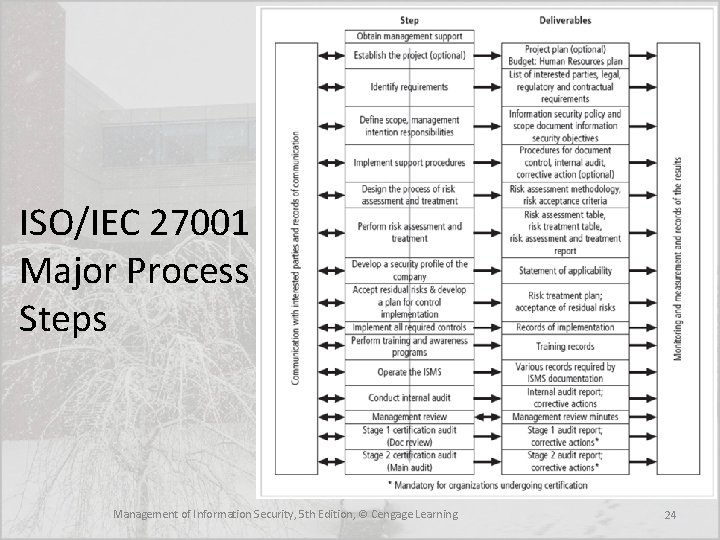
The ISO 27000 Series • ISO/IEC 27002: 2013 provides information on 14 security control clauses and addresses 35 control objectives and more than 110 individual controls • Its companion document, ISO/IEC 27001: 2013, provides information for how to implement ISO/IEC 27002 and set up an Information Security Management System (ISMS) Management of Information Security, 5 th Edition, © Cengage Learning 23
ISO/IEC 27001 Major Process Steps Management of Information Security, 5 th Edition, © Cengage Learning 24
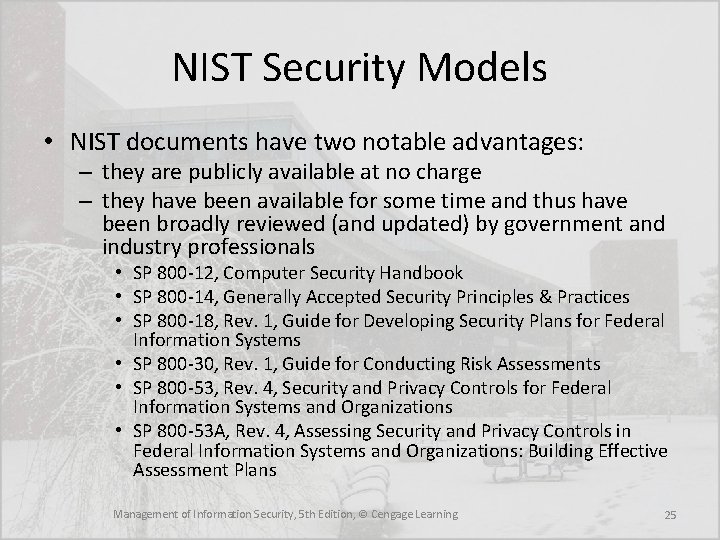
NIST Security Models • NIST documents have two notable advantages: – they are publicly available at no charge – they have been available for some time and thus have been broadly reviewed (and updated) by government and industry professionals • SP 800 -12, Computer Security Handbook • SP 800 -14, Generally Accepted Security Principles & Practices • SP 800 -18, Rev. 1, Guide for Developing Security Plans for Federal Information Systems • SP 800 -30, Rev. 1, Guide for Conducting Risk Assessments • SP 800 -53, Rev. 4, Security and Privacy Controls for Federal Information Systems and Organizations • SP 800 -53 A, Rev. 4, Assessing Security and Privacy Controls in Federal Information Systems and Organizations: Building Effective Assessment Plans Management of Information Security, 5 th Edition, © Cengage Learning 25
NIST Security Control Assessment Process Overview Management of Information Security, 5 th Edition, © Cengage Learning 26
NIST Security Control Classes, Families, and Identifiers Management of Information Security, 5 th Edition, © Cengage Learning 27
Control Objectives for Information and related Technology (COBIT) • Control Objectives for Information and related Technology (COBIT) also provides advice about the implementation of sound controls an control objectives for Info. Sec • COBIT was created by the Information Systems Audit and Control Association (ISACA) and the IT Governance Institute (ITGI) in 1992 Management of Information Security, 5 th Edition, © Cengage Learning 28
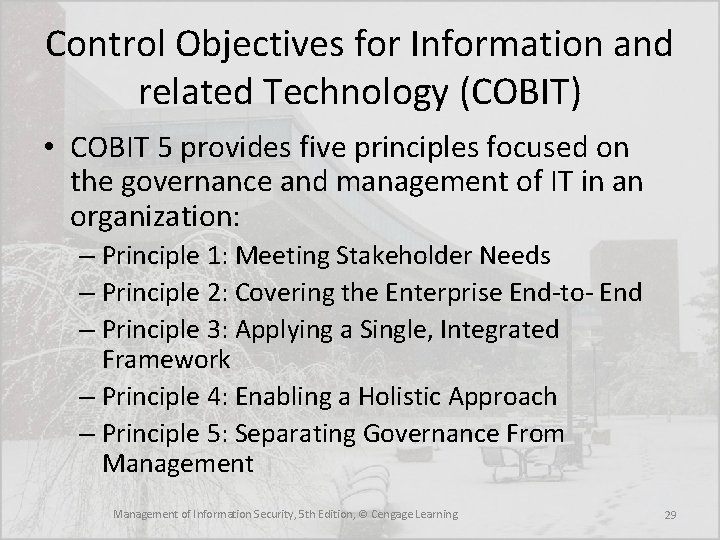
Control Objectives for Information and related Technology (COBIT) • COBIT 5 provides five principles focused on the governance and management of IT in an organization: – Principle 1: Meeting Stakeholder Needs – Principle 2: Covering the Enterprise End-to- End – Principle 3: Applying a Single, Integrated Framework – Principle 4: Enabling a Holistic Approach – Principle 5: Separating Governance From Management of Information Security, 5 th Edition, © Cengage Learning 29
Control Objectives for Information and related Technology (COBIT) • The COBIT 5 framework also incorporates a series of “enablers” to support the principles: – Principles, policies and frameworks are the vehicle to translate the desired behavior into practical guidance for day-to-day management – Processes describe an organized set of practices and activities to achieve certain objectives and produce a set of outputs in support of achieving overall IT-related goals – Organizational structures are the key decision-making entities in an enterprise – Culture, ethics and behavior of individuals and of the enterprise are very often underestimated as a success factor in governance and management activities – Information is required for keeping the organization running and well governed, but at the operational level, information is very often the key product of the enterprise itself – Services, infrastructure and applications include the infrastructure, technology and applications that provide the enterprise with information technology processing and services Management of Information Security, 5 th Edition, © Cengage Learning 30
Committee of Sponsoring Organizations (COSO) • COSO is a U. S. private-sector initiative formed in 1985 – Its major objective is to identify the factors that cause fraudulent financial reporting and to make recommendations to reduce its incidence • COSO has established a common definition of internal controls, standards and criteria, and helps organizations comply with critical regulations like Sarbanes-Oxley Management of Information Security, 5 th Edition, © Cengage Learning 31
Committee of Sponsoring Organizations (COSO) • [I]nternal control is a process, effected by an entity’s board of directors, management and other personnel, designed to provide reasonable assurance regarding the achievement of objectives in the following categories: – Effectiveness and efficiency of operations – Reliability of financial reporting – Compliance with applicable laws and regulations Management of Information Security, 5 th Edition, © Cengage Learning 32
Committee of Sponsoring Organizations (COSO) • COSO is built on five interrelated components: – Control environment – Risk assessment – Control activities – Information and communication – Monitoring Management of Information Security, 5 th Edition, © Cengage Learning 33
Information Technology Infrastructure Library (ITIL) • The Information Technology Infrastructure Library (ITIL) is a collection of methods and practices useful for managing the development and operation of information technology infrastructures • The ITIL has been produced as a series of books, each of which covers an IT management topic • Since it includes a detailed description of a many significant IT-related practices it can be tailored to many IT organizations Management of Information Security, 5 th Edition, © Cengage Learning 34
Information Security Governance Framework • The Information Security Governance Framework is a managerial model which provides guidance in the development and implementation of an organizational information security governance structure • The core of the Information Security Governance Framework includes recommendations for the responsibilities of members of an organization Management of Information Security, 5 th Edition, © Cengage Learning 35
Info. Sec Governance Responsibilities • Board of directors/trustees: Provide strategic oversight regarding information security • Senior executives: Provide oversight of a comprehensive information security program for the entire organization • Executive team members who report to a senior executive: Oversee the organization’s security policies and practices • Senior managers: Provide information security for the information and information systems that support the operations and assets under their control • All employees and users: Maintain security of information and information systems accessible to them Management of Information Security, 5 th Edition, © Cengage Learning 36