
MANAGEMENT of INFORMATION SECURITY Fifth Edition Risk Management

- Slides: 33
MANAGEMENT of INFORMATION SECURITY, Fifth Edition
Risk Management – Risk Identification Management of Information Security, 5 th Edition, © Cengage Learning 2
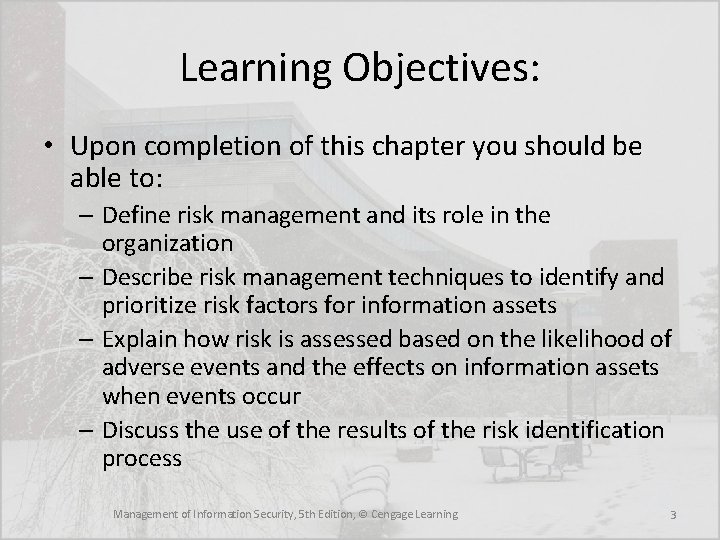
Learning Objectives: • Upon completion of this chapter you should be able to: – Define risk management and its role in the organization – Describe risk management techniques to identify and prioritize risk factors for information assets – Explain how risk is assessed based on the likelihood of adverse events and the effects on information assets when events occur – Discuss the use of the results of the risk identification process Management of Information Security, 5 th Edition, © Cengage Learning 3
Chapter 06: Risk Management: Identifying and Assessing Risk INTRODUCTION TO RISK MANAGEMENT Management of Information Security, 5 th Edition, © Cengage Learning 4
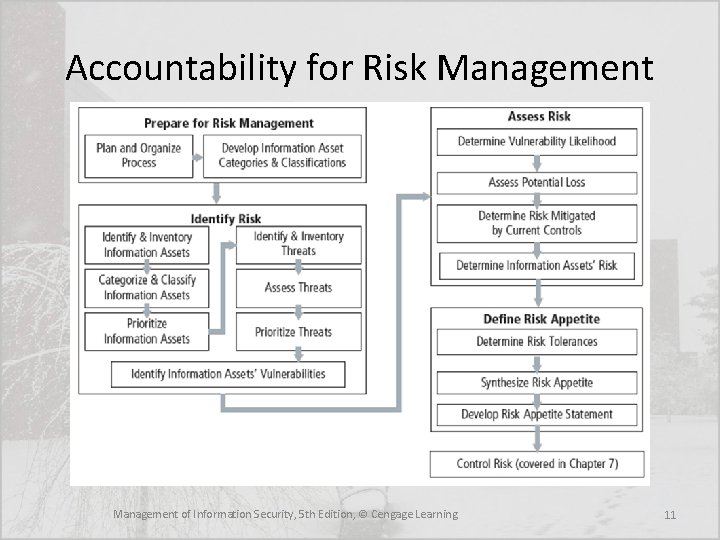
Introduction • Info. Sec departments exist primarily to manage the risk to information assets stemming from the use of information technology • Managing risk is one of the key responsibilities of every manager within the organization • Risk Management includes risk identification, risk assessment, risk appetite and risk control Management of Information Security, 5 th Edition, © Cengage Learning 5
Introduction • Each manager in the organization should focus on reducing risk, and is often done as follows: – General management must structure the IT and Info. Sec functions in ways that will result in the successful defense of the organization’s information assets, including data, hardware, software, procedures, and people – IT management must serve the IT needs of the broader organization and at the same time exploit the special skills and insights of the Info. Sec community – Info. Sec management must lead the way with skill, professionalism, and flexibility as it works with the other communities of interest to balance the constant trade-offs between Info. Sec utility and security Management of Information Security, 5 th Edition, © Cengage Learning 6
Risk Management • Therefore I say: One who knows the enemy and knows himself will not be in danger in a hundred battles • One who does not know the enemy but knows himself will sometimes win, sometimes lose • One who does not know the enemy and does not know himself will be in danger in every battle --Sun Tzu Management of Information Security, 5 th Edition, © Cengage Learning 7
Knowing Yourself • When operating any kind of organization, a certain amount of risk is always involved • For an organization to manage risk properly, managers should understand how information is collected, processed, stored and transmitted • Knowing yourself in this context requires knowing which information assets are valuable to the organization, identifying, categorizing, and classifying those assets, and understanding how they are currently being protected • Armed with this knowledge, the organization can then initiate an in-depth risk management program Management of Information Security, 5 th Edition, © Cengage Learning 8
Knowing the Enemy • This means identifying, examining, and understanding the threats facing the organization’s information assets • Managers must be prepared to fully identify those threats that pose risks to the organization and the security of its information assets • Risk management is the process of discovering and assessing the risks to an organization’s operations and determining how those risks can be controlled or mitigated Management of Information Security, 5 th Edition, © Cengage Learning 9
Accountability for Risk Management • All of the communities of interest bear responsibility for the management of risks: – Info. Sec—Because members of the Info. Sec community best understand the threats and attacks that introduce risk, they often take a leadership role in addressing risk. – IT—This group must help to build secure systems and ensure their safe operation – Management and users—When properly trained and kept aware of the threats faced by the organization, this group plays a part in the early detection and response process. Members of this community also ensure that sufficient resources are allocated to the Info. Sec and IT groups to meet the security needs of the organization Management of Information Security, 5 th Edition, © Cengage Learning 10
Accountability for Risk Management of Information Security, 5 th Edition, © Cengage Learning 11
Risk Identification • The Risk Management project should be well organized and funded, with a clear champion, a statement of work, and all needed support. • Risk identification begins with the process of self-examination • Managers: – Identify the organization’s information assets – Classify and categorize them into useful groups – Prioritize them by overall importance Management of Information Security, 5 th Edition, © Cengage Learning 12
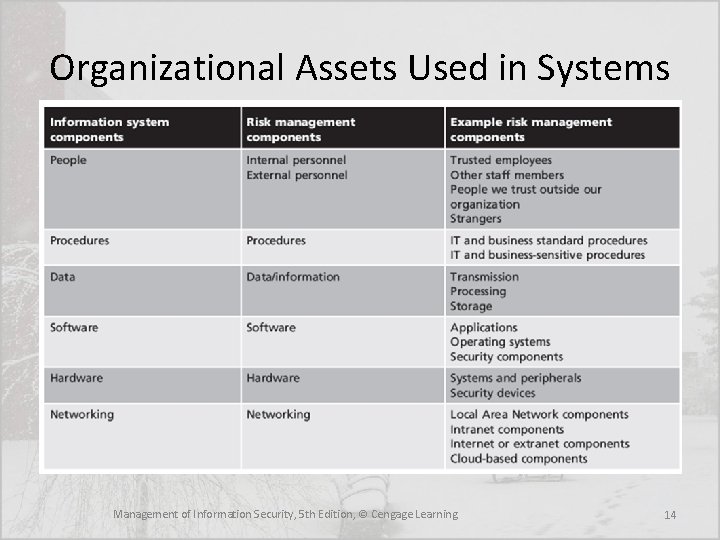
Identification and Prioritization of Information Assets • The risk identification process begins with the identification of information assets, including people, procedures, data and information, software, hardware, and networking elements • This step should be done without pre-judging the value of each asset; values will be assigned later in the process Management of Information Security, 5 th Edition, © Cengage Learning 13
Organizational Assets Used in Systems Management of Information Security, 5 th Edition, © Cengage Learning 14
Identifying Hardware, Software, and Network Assets • Many organizations use asset inventory systems to keep track of their hardware, network, and software components • Whether automated or manual, the inventory process requires a certain amount of planning • Determine which attributes of each of these information assets should be tracked • That will depend on the needs of the organization and its risk management efforts Management of Information Security, 5 th Edition, © Cengage Learning 15
Attributes for Assets • When deciding which attributes to track for each information asset, consider the following list of potential attributes: – – – Name Asset tag IP address MAC address Asset type Serial number Manufacturer name Manufacturer’s model or part number Software version, update revision, or FCO number Physical location Logical location Controlling entity Management of Information Security, 5 th Edition, © Cengage Learning 16
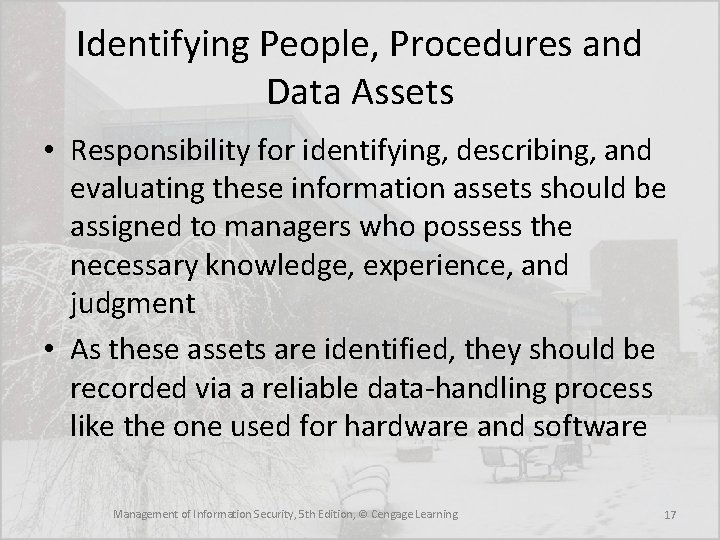
Identifying People, Procedures and Data Assets • Responsibility for identifying, describing, and evaluating these information assets should be assigned to managers who possess the necessary knowledge, experience, and judgment • As these assets are identified, they should be recorded via a reliable data-handling process like the one used for hardware and software Management of Information Security, 5 th Edition, © Cengage Learning 17
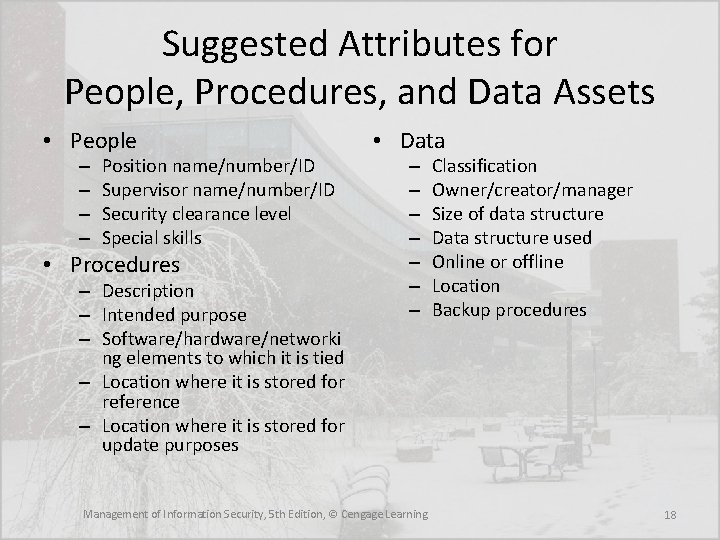
Suggested Attributes for People, Procedures, and Data Assets • People – – Position name/number/ID Supervisor name/number/ID Security clearance level Special skills • Procedures – Description – Intended purpose – Software/hardware/networki ng elements to which it is tied – Location where it is stored for reference – Location where it is stored for update purposes • Data – – – – Management of Information Security, 5 th Edition, © Cengage Learning Classification Owner/creator/manager Size of data structure Data structure used Online or offline Location Backup procedures 18
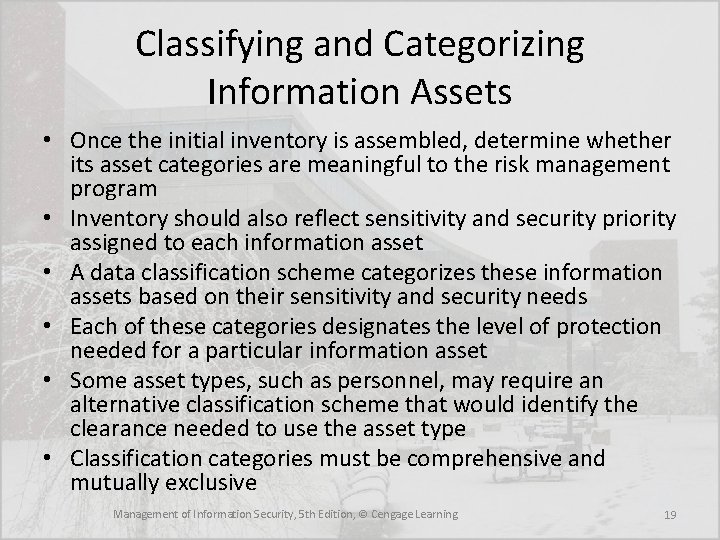
Classifying and Categorizing Information Assets • Once the initial inventory is assembled, determine whether its asset categories are meaningful to the risk management program • Inventory should also reflect sensitivity and security priority assigned to each information asset • A data classification scheme categorizes these information assets based on their sensitivity and security needs • Each of these categories designates the level of protection needed for a particular information asset • Some asset types, such as personnel, may require an alternative classification scheme that would identify the clearance needed to use the asset type • Classification categories must be comprehensive and mutually exclusive Management of Information Security, 5 th Edition, © Cengage Learning 19
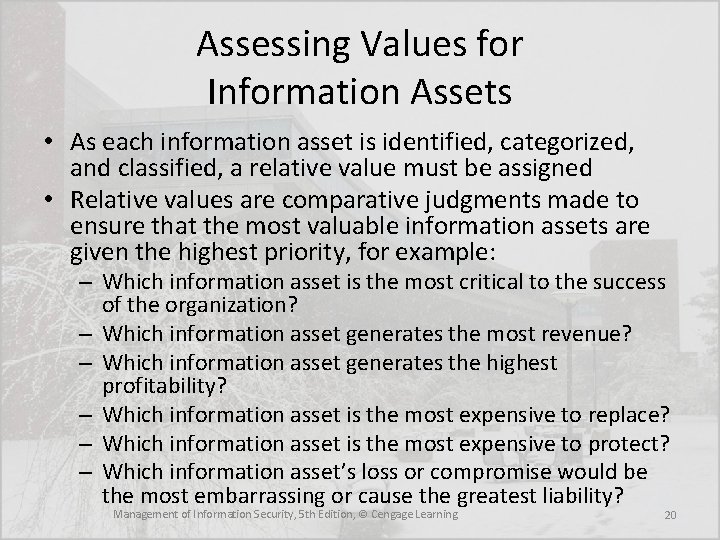
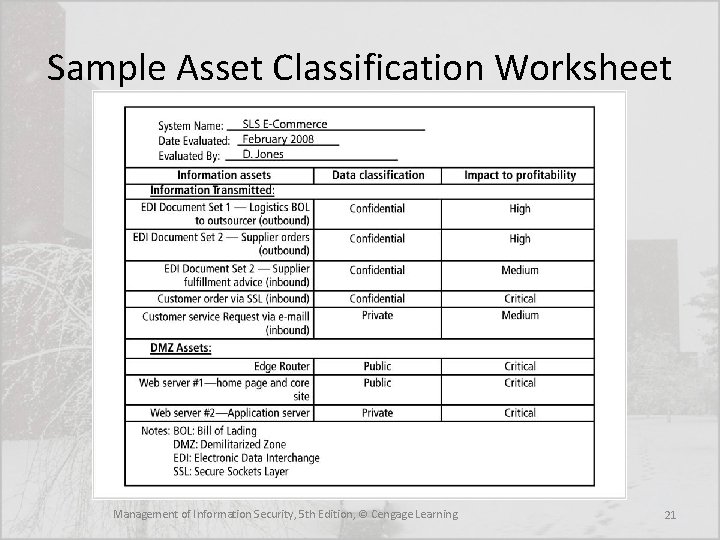
Assessing Values for Information Assets • As each information asset is identified, categorized, and classified, a relative value must be assigned • Relative values are comparative judgments made to ensure that the most valuable information assets are given the highest priority, for example: – Which information asset is the most critical to the success of the organization? – Which information asset generates the most revenue? – Which information asset generates the highest profitability? – Which information asset is the most expensive to replace? – Which information asset is the most expensive to protect? – Which information asset’s loss or compromise would be the most embarrassing or cause the greatest liability? Management of Information Security, 5 th Edition, © Cengage Learning 20
Sample Asset Classification Worksheet Management of Information Security, 5 th Edition, © Cengage Learning 21
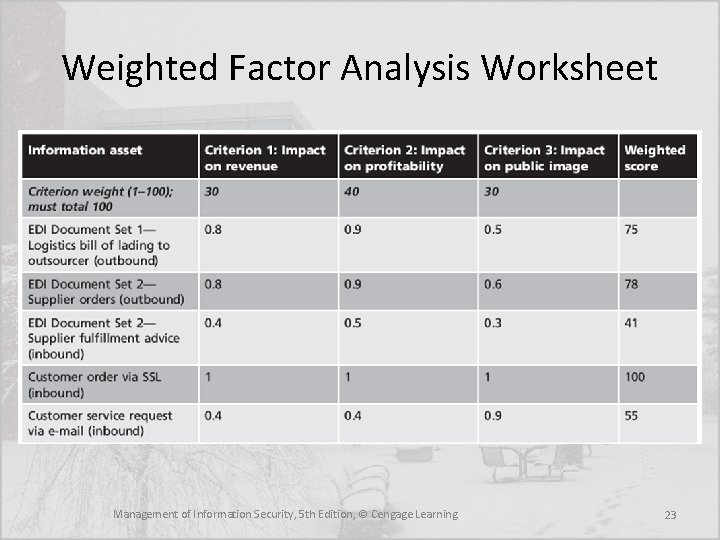
Prioritizing (Rank Ordering) Information Assets • The final step in the risk identification process is to prioritize, or rank order, the assets • This goal can be achieved by using a weighted table analysis Management of Information Security, 5 th Edition, © Cengage Learning 22
Weighted Factor Analysis Worksheet Management of Information Security, 5 th Edition, © Cengage Learning 23
Threat Assessment • Armed with a properly classified inventory, you can assess potential weaknesses in each information asset —a process known as threat assessment • Any organization typically faces a wide variety of threats; if you assume that every threat can and will attack every information asset, then the project scope becomes too complex • To make the process less unwieldy, each step in the threat identification and vulnerability identification processes is managed separately and then coordinated at the end Management of Information Security, 5 th Edition, © Cengage Learning 24
Identifying Threats • Each threat presents a unique challenge to information security and must be handled with specific controls that directly address the particular threat and the threat agent’s attack strategy • Before threats can be assessed in the risk identification process, however, each threat must be further examined to determine its potential to affect the targeted information asset • In general, this process is referred to as a threat assessment Management of Information Security, 5 th Edition, © Cengage Learning 25
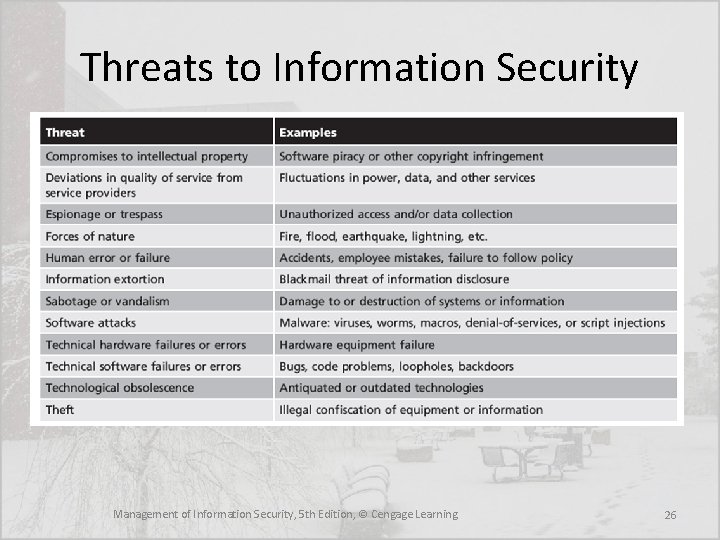
Threats to Information Security Management of Information Security, 5 th Edition, © Cengage Learning 26
Assessing Threats • The following can help you understand the various threats and their potential effects on an information asset • Which threats… – present a danger to this organization’s information assets in its current environment? – represent the gravest danger to the organization’s information assets? – have the highest probability of success? – could result in the greatest loss if successful? – is the organization least prepared to handle? – cost the most to protect against? – cost the most to recover from? Management of Information Security, 5 th Edition, © Cengage Learning 27
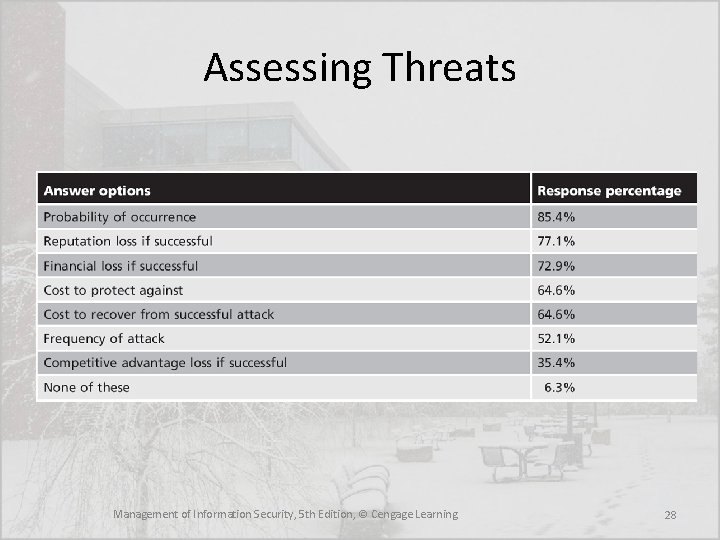
Assessing Threats Management of Information Security, 5 th Edition, © Cengage Learning 28
Prioritizing Threats • Just as it did with information assets, the organization should conduct a weighted table analysis with threats • The organization should list the categories of threats it faces, and then select categories that correspond to the questions of interest Management of Information Security, 5 th Edition, © Cengage Learning 29
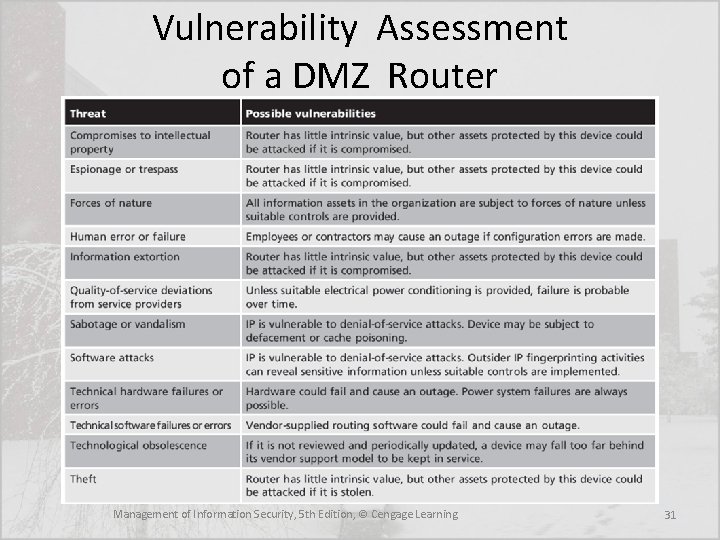
Vulnerability Assessment • Once the organization has identified and prioritized both its information assets and the threats facing those assets it can begin to compare information asset to threats • This review leads to the creation of a list of vulnerabilities that remain potential risks to the organization • Vulnerabilities are specific avenues that threat agents can exploit to attack an information asset • A list should be created for each information asset to document its vulnerability to each possible or likely attack Management of Information Security, 5 th Edition, © Cengage Learning 30
Vulnerability Assessment of a DMZ Router Management of Information Security, 5 th Edition, © Cengage Learning 31
The TVA Worksheet • At the end of the risk identification process, an organization should have – a prioritized list of assets and their vulnerabilities and – a prioritized list of threats facing the • The prioritized lists of assets and threats can be combined into a Threats-Vulnerabilities-Assets (TVA) worksheet, in preparation for the addition of vulnerability and control information during risk assessment Management of Information Security, 5 th Edition, © Cengage Learning 32
Sample TVA Spreadsheet Management of Information Security, 5 th Edition, © Cengage Learning 33