
Management of Direct Oral Anticoagulants Teresa Kwong Pharm

- Slides: 36
Management of Direct Oral Anticoagulants Teresa Kwong, Pharm. D, BCPS, BCACP University of California Davis Health System
Department of Pharmacy Services Objectives § Review considerations when initiating Direct Oral Anticoagulants (DOACs) § Discuss chronic management issues related to DOACs § Describe issues that arise during transitions of care § Describe how DOACs are managed at UCD
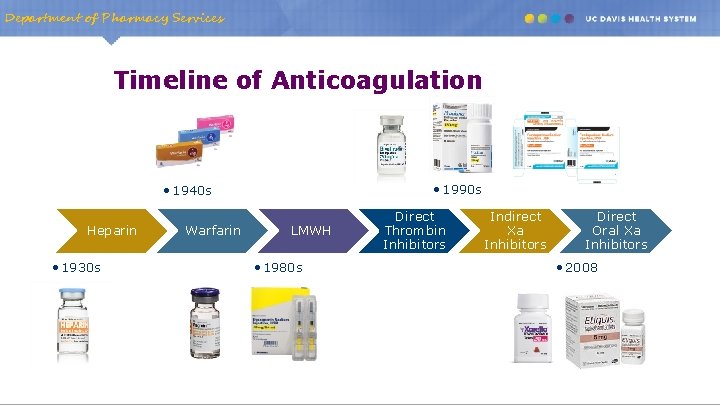
Department of Pharmacy Services Timeline of Anticoagulation • 1990 s • 1940 s Heparin • 1930 s Warfarin LMWH • 1980 s Direct Thrombin Inhibitors Indirect Xa Inhibitors Direct Oral Xa Inhibitors • 2008
Department of Pharmacy Services DOACs on the Market § Direct Thrombin Inhibitor – Dabigatran (Pradaxa®, 2010) § Factor Xa Inhibitor – Rivaroxaban (Xarelto®, 2011) – Apixaban (Eliquis®, 2012) – Edoxaban (Savaysa®, 2015)
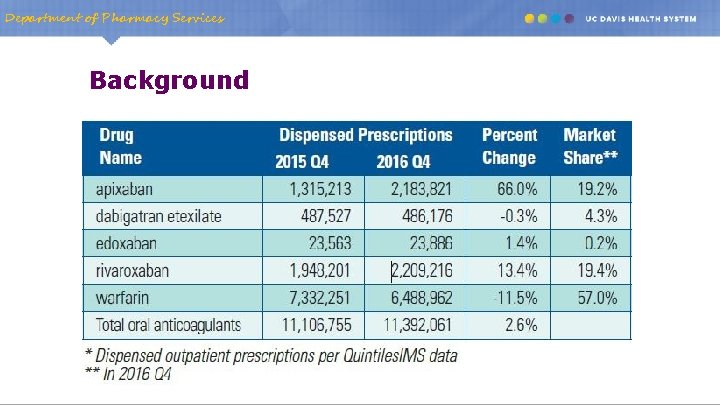
Department of Pharmacy Services Background
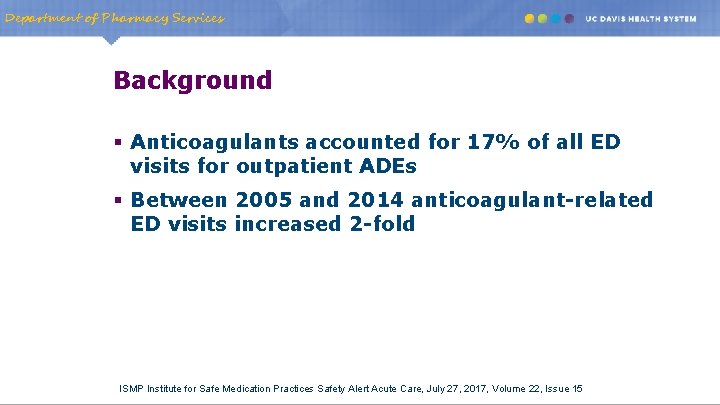
Department of Pharmacy Services Background § Anticoagulants accounted for 17% of all ED visits for outpatient ADEs § Between 2005 and 2014 anticoagulant-related ED visits increased 2 -fold ISMP Institute for Safe Medication Practices Safety Alert Acute Care, July 27, 2017, Volume 22, Issue 15
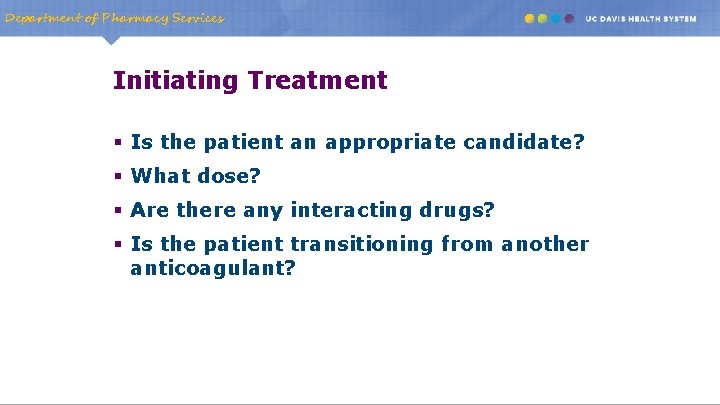
Department of Pharmacy Services Initiating Treatment § Is the patient an appropriate candidate? § What dose? § Are there any interacting drugs? § Is the patient transitioning from another anticoagulant?
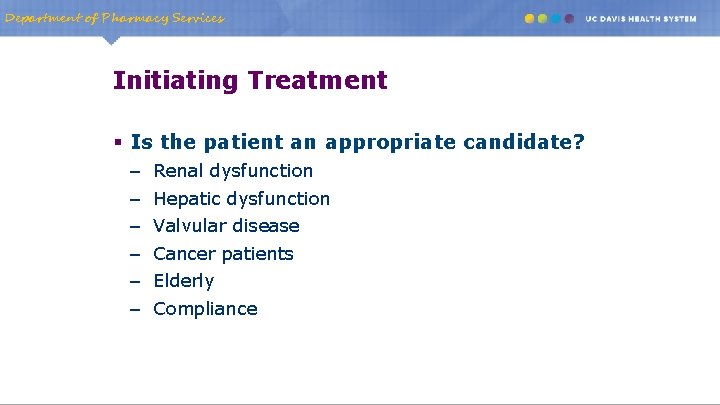
Department of Pharmacy Services Initiating Treatment § Is the patient an appropriate candidate? – – – Renal dysfunction Hepatic dysfunction Valvular disease Cancer patients Elderly Compliance
Department of Pharmacy Services Initiating Treatment § Is the patient an appropriate candidate? § What dose?
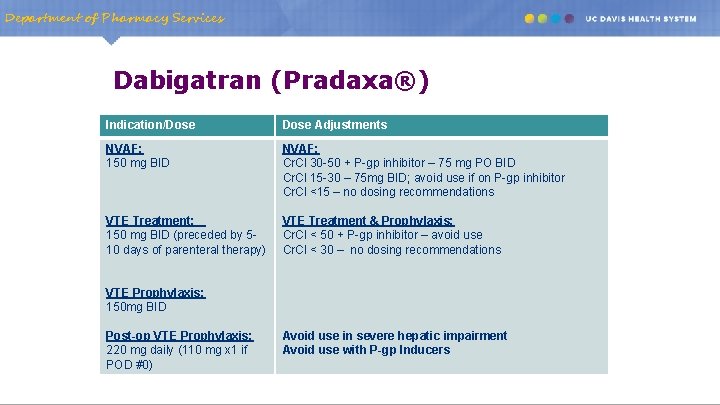
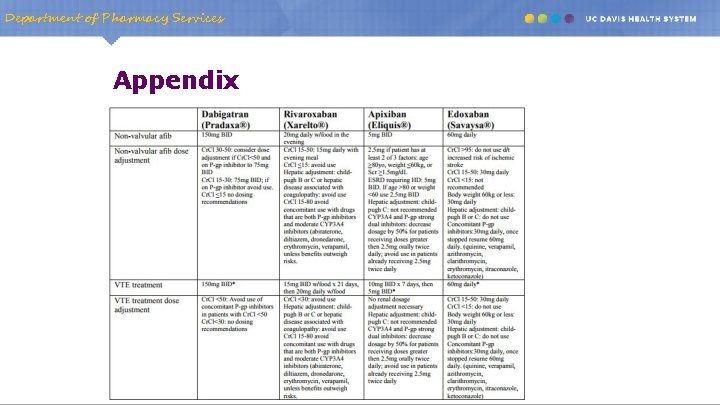
Department of Pharmacy Services Dabigatran (Pradaxa®) Indication/Dose Adjustments § Various Dosing Schemes NVAF: 150 mg BID Cr. Cl 30 -50 + P-gp inhibitor – 75 mg PO BID Cr. Cl 15 -30 – 75 mg BID; avoid use if on P-gp inhibitor Cr. Cl <15 – no dosing recommendations § Insert chart about dosing § Xarelto Starter pack VTE Treatment & Prophylaxis: VTE Treatment: 150 mg BID (preceded by 510 days of parenteral therapy) Cr. Cl < 50 + P-gp inhibitor – avoid use Cr. Cl < 30 – no dosing recommendations VTE Prophylaxis: 150 mg BID Post-op VTE Prophylaxis: 220 mg daily (110 mg x 1 if POD #0) Avoid use in severe hepatic impairment Avoid use with P-gp Inducers
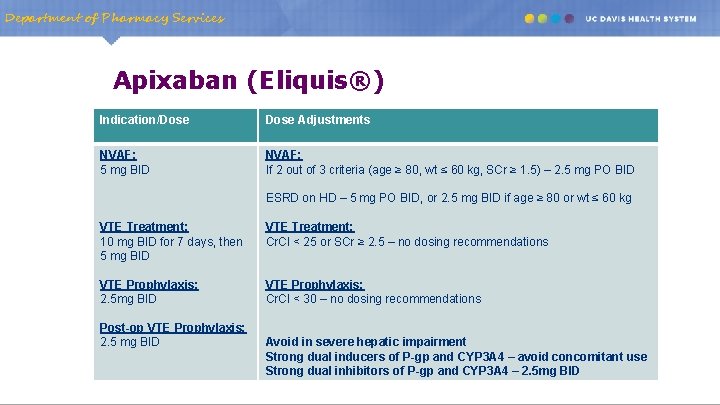
Department of Pharmacy Services Apixaban (Eliquis®) Indication/Dose Adjustments § Various Dosing Schemes NVAF: 5 mg BID If 2 out of 3 criteria (age ≥ 80, wt ≤ 60 kg, SCr ≥ 1. 5) – 2. 5 mg PO BID § Insert chart about dosing ESRD on HD – 5 mg PO BID, or 2. 5 mg BID if age ≥ 80 or wt ≤ 60 kg § Xarelto Starter pack VTE Treatment: 10 mg BID for 7 days, then 5 mg BID VTE Treatment: Cr. Cl < 25 or SCr ≥ 2. 5 – no dosing recommendations VTE Prophylaxis: 2. 5 mg BID VTE Prophylaxis: Cr. Cl < 30 – no dosing recommendations Post-op VTE Prophylaxis: 2. 5 mg BID Avoid in severe hepatic impairment Strong dual inducers of P-gp and CYP 3 A 4 – avoid concomitant use Strong dual inhibitors of P-gp and CYP 3 A 4 – 2. 5 mg BID
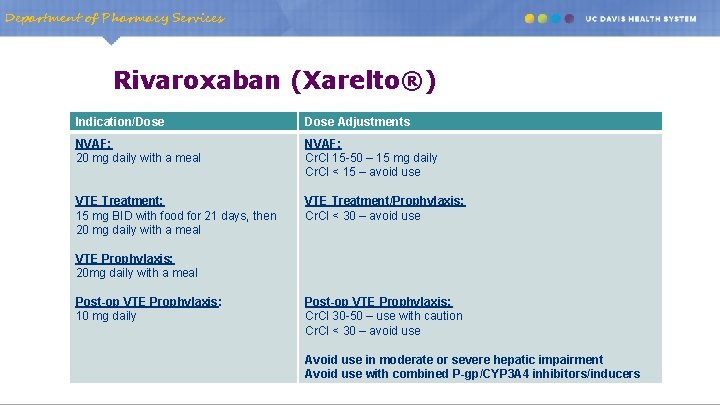
Department of Pharmacy Services Rivaroxaban (Xarelto®) Indication/Dose Adjustments NVAF: § Various Dosing Schemes NVAF: 20 mg daily with a meal Cr. Cl 15 -50 – 15 mg daily Cr. Cl < 15 – avoid use § Insert chart about dosing VTE Treatment: 15 mg BID with food for 21 days, then 20 mg daily with a meal VTE Treatment/Prophylaxis: § Xarelto Starter pack Cr. Cl < 30 – avoid use VTE Prophylaxis: 20 mg daily with a meal Post-op VTE Prophylaxis: 10 mg daily Post-op VTE Prophylaxis: Cr. Cl 30 -50 – use with caution Cr. Cl < 30 – avoid use Avoid use in moderate or severe hepatic impairment Avoid use with combined P-gp/CYP 3 A 4 inhibitors/inducers
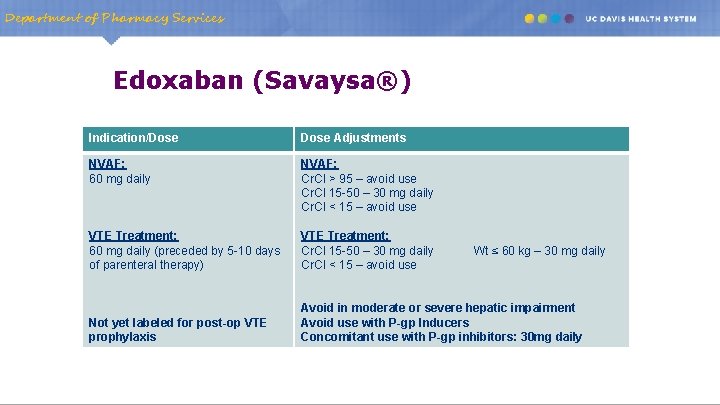
Department of Pharmacy Services Edoxaban (Savaysa®) Dose Adjustments § Various Dosing Schemes Indication/Dose NVAF: 60 mg daily NVAF: Cr. Cl > 95 – avoid use § Insert chart about dosing Cr. Cl 15 -50 – 30 mg daily Cr. Cl < 15 – avoid use § Xarelto Starter pack VTE Treatment: 60 mg daily (preceded by 5 -10 days of parenteral therapy) VTE Treatment: Cr. Cl 15 -50 – 30 mg daily Cr. Cl < 15 – avoid use Not yet labeled for post-op VTE prophylaxis Avoid in moderate or severe hepatic impairment Avoid use with P-gp Inducers Concomitant use with P-gp inhibitors: 30 mg daily Wt ≤ 60 kg – 30 mg daily
Department of Pharmacy Services Initiating Treatment § Is the patient an appropriate candidate? § What dose? § Are there any interacting drugs?
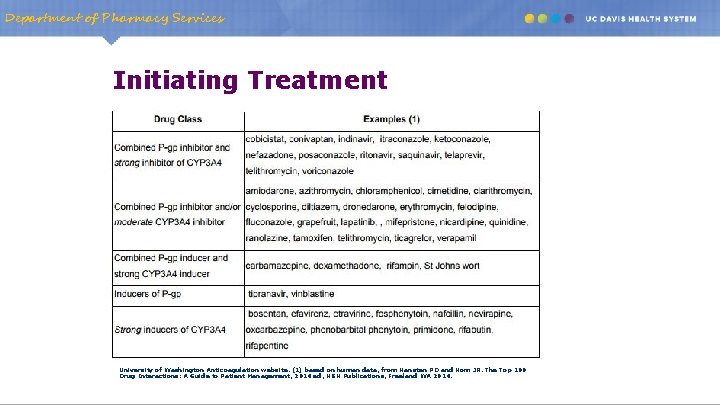
Department of Pharmacy Services Initiating Treatment University of Washington Anticoagulation website. (1) based on human data, from Hansten PD and Hom JR. The Top 100 Drug Interactions: A Guide to Patient Management, 2014 ed, H&H Publications, Freeland WA 2014.
Department of Pharmacy Services Initiating Treatment § Is the patient an appropriate candidate? § What dose? § Are there any interacting drugs? § Is the patient transitioning from another anticoagulant?
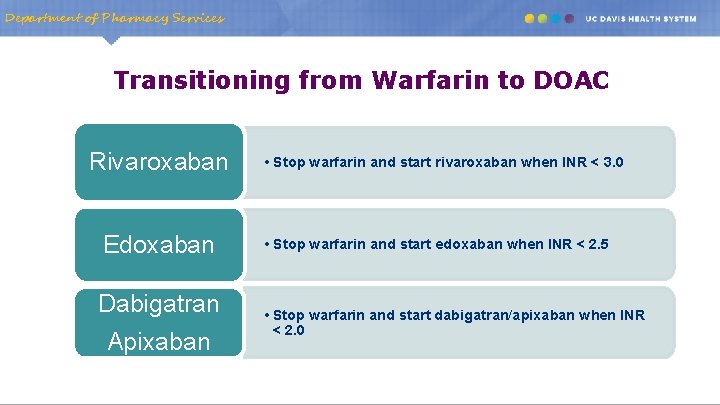
Department of Pharmacy Services Transitioning from Warfarin to DOAC Rivaroxaban Edoxaban Dabigatran Apixaban • Stop warfarin and start rivaroxaban when INR < 3. 0 • Stop warfarin and start edoxaban when INR < 2. 5 • Stop warfarin and start dabigatran/apixaban when INR < 2. 0
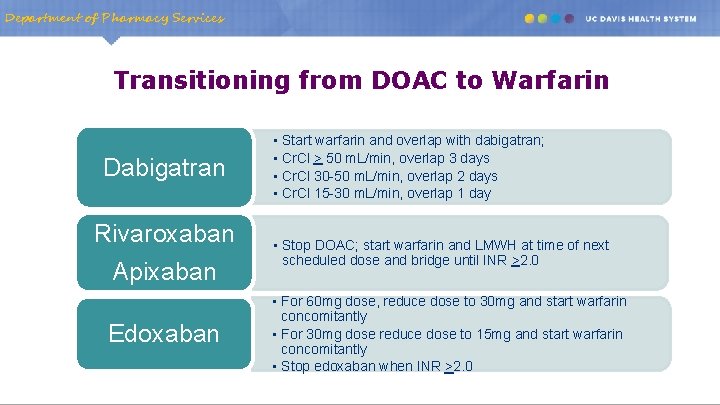
Department of Pharmacy Services Transitioning from DOAC to Warfarin Dabigatran Rivaroxaban Apixaban Edoxaban • Start warfarin and overlap with dabigatran; • Cr. Cl > 50 m. L/min, overlap 3 days • Cr. Cl 30 -50 m. L/min, overlap 2 days • Cr. Cl 15 -30 m. L/min, overlap 1 day • Stop DOAC; start warfarin and LMWH at time of next scheduled dose and bridge until INR >2. 0 • For 60 mg dose, reduce dose to 30 mg and start warfarin concomitantly • For 30 mg dose reduce dose to 15 mg and start warfarin concomitantly • Stop edoxaban when INR >2. 0
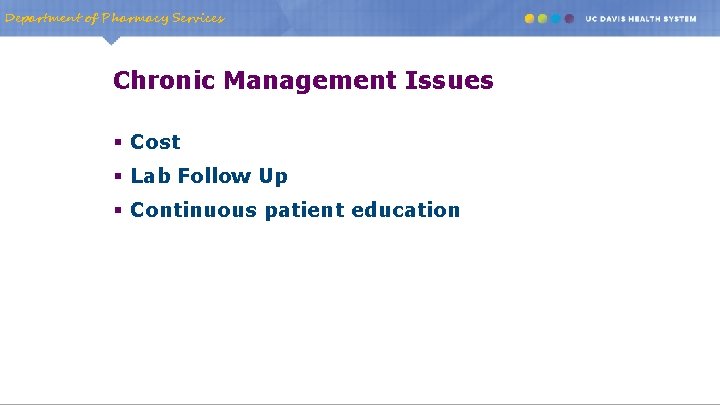
Department of Pharmacy Services Chronic Management Issues § Cost § Lab Follow Up § Continuous patient education
Department of Pharmacy Services Chronic Management Issues § Cost – Manufacturer coupons available – Patient Assistance Programs – Medicare Part D coverage gap
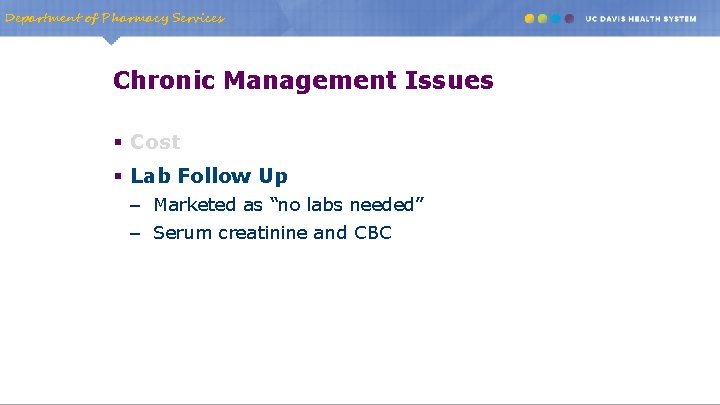
Department of Pharmacy Services Chronic Management Issues § Cost § Lab Follow Up – Marketed as “no labs needed” – Serum creatinine and CBC
Department of Pharmacy Services Chronic Management Issues § Cost § Lab Follow Up § Continuous patient education – – Adverse reactions Medication changes Compliance Periprocedural management
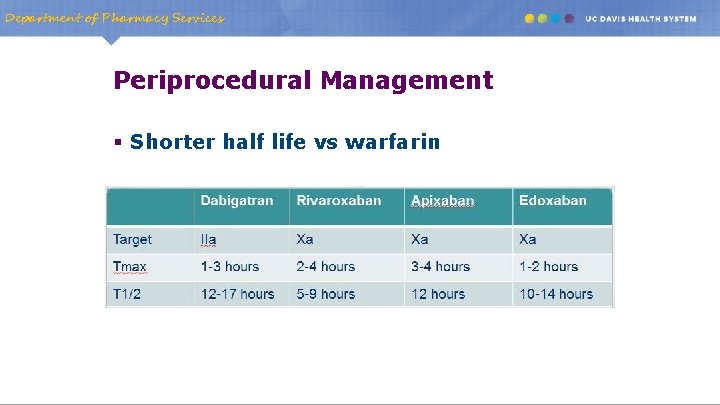
Department of Pharmacy Services Periprocedural Management § Shorter half life vs warfarin
Department of Pharmacy Services Chronic Management Issues § Cost § Lab Follow Up § Continuous patient education
Department of Pharmacy Services Transitioning Care § Cost after discharge § Provider follow up § Patient Education
Department of Pharmacy Services UC Davis Anticoagulation Services § Outpatient Anticoagulation Clinic § Thrombosis Clinic § Inpatient CLOT service § Transitions of Care service § Emergency Department Pharmacists
Department of Pharmacy Services DOAC Management at UCD ü Is the patient an appropriate candidate? ü What dose? ü Are there any interacting drugs? ü Is the patient transitioning from another anticoagulant? ü Cost ü Lab Follow Up ü Continuous patient education
Department of Pharmacy Services Resources Utilized at UCD § Anticoagulation Website § Patient educational handouts § Best Practice Alerts § Anticoagulation Specialists
Department of Pharmacy Services Ongoing Issues at UCD § How often should the clinic be in contact? § Should the Anticoagulation Clinic monitor all patients on DOACs? § Time spent with DOAC patients – – Initial education: 20 -30 min Initial Dosing adjustments: 15 min Insurance issues: 15 -60 min Follow ups: 5 -45 min
Department of Pharmacy Services Recap § Consider patient characteristics when initiating a DOAC § DOAC patients need monitoring throughout therapy § Consider costs and long term management when transitioning from hospital/ED to outpatient § Offer providers resources to assist with prescribing and monitoring DOACs
Department of Pharmacy Services Discussion Questions § Do your providers currently have resources to assist with DOAC management? § Is there process during transitions of care to ensure patients receive the appropriate follow up?
Department of Pharmacy Services References 1. ISMP Institute for Safe Medication Practices Safety Alert Acute Care, July 27, 2017, Volume 22, Issue 15 2. Xarelto [package insert]. Jansen Pharmaceuticals; Revised May. 2016. 3. Savaysa [package insert]. Daiichi Sankyo; Revised September. 2015. 4. Pradaxa [package insert]. Boehringer Ingelheim Pharmaceuticals, Inc. ; Revised November. 2015. 5. Eliquis [package insert]. Bristol-Myers Squibb; Revised July. 2016. 6. UC Davis Health Policies & Procedures. Managing Warfarin in the UCDMC Adult Anticoagulation (AC) Clinic. Policy ID: IV-79 7. Ashjian E, Kurtz B, et al. Evaluation of a pharmacist-led outpatient direct oral anticoagulant service. American Journal of Health-System Pharmacy April 2017, 74 (7) 483 -489.
Department of Pharmacy Services Appendix
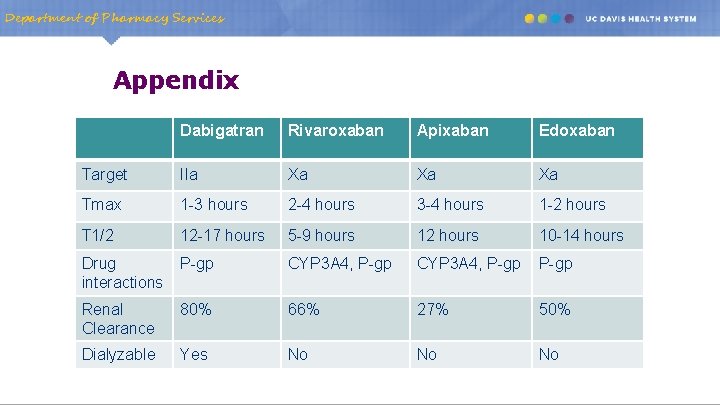
Department of Pharmacy Services Appendix Dabigatran Rivaroxaban Apixaban Edoxaban Target IIa Xa Xa Xa Tmax 1 -3 hours 2 -4 hours 3 -4 hours 1 -2 hours T 1/2 12 -17 hours 5 -9 hours 12 hours 10 -14 hours Drug interactions P-gp CYP 3 A 4, P-gp Renal Clearance 80% 66% 27% 50% Dialyzable Yes No No No
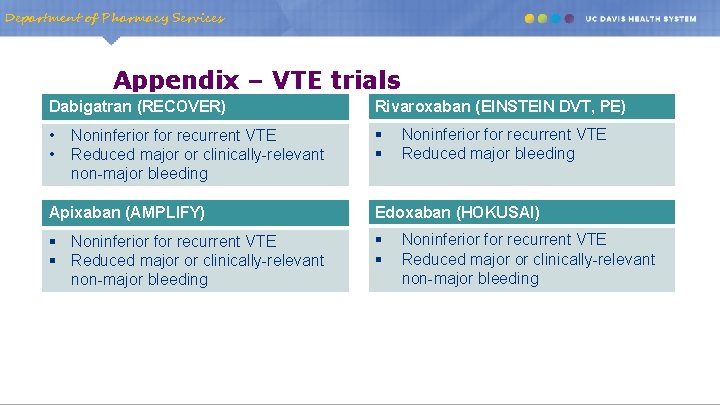
Department of Pharmacy Services Appendix – VTE trials Dabigatran (RECOVER) Rivaroxaban (EINSTEIN DVT, PE) • • § § Noninferior for recurrent VTE Reduced major or clinically-relevant non-major bleeding Noninferior for recurrent VTE Reduced major bleeding Apixaban (AMPLIFY) Edoxaban (HOKUSAI) § Noninferior for recurrent VTE § Reduced major or clinically-relevant non-major bleeding § § Noninferior for recurrent VTE Reduced major or clinically-relevant non-major bleeding
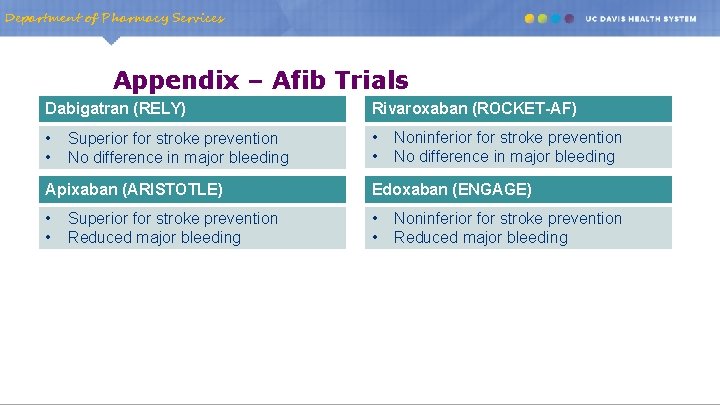
Department of Pharmacy Services Appendix – Afib Trials Dabigatran (RELY) Rivaroxaban (ROCKET-AF) • • Superior for stroke prevention No difference in major bleeding Noninferior for stroke prevention No difference in major bleeding Apixaban (ARISTOTLE) Edoxaban (ENGAGE) • • Superior for stroke prevention Reduced major bleeding Noninferior for stroke prevention Reduced major bleeding