
Management of diabetic ketoacidosis and hypoglycemia Prof Hanan
Management of diabetic ketoacidosis and hypoglycemia Prof. Hanan Hagar
Diabetic ketoacidosis l Is a serious acute emergency situation that requires admission to hospital with a risk of death. l It develops as a result of insulin deficiency l It is a characteristic feature of type I diabetes but may occur with type II especially during stress.
Diabetic ketoacidosis In absence of insulin, many metabolic changes can occur: Carbohydrates – ↑ Glycogenolysis – ↑ Gluconeogenesis
Diabetic ketoacidosis In absence of insulin, Protein ↑ proteolysis thus providing amino acid as precursors for gluconeogenesis.
Diabetic ketoacidosis In absence of insulin, Fats: ↑ Lipolysis & ketogenesis Fat breakdown to free fatty acids then to acetyl-Co. A that is converted to ketone bodies – Acetoacetic acid, β-hydroxybutyric acid and acetone (↑ ketogenesis ).
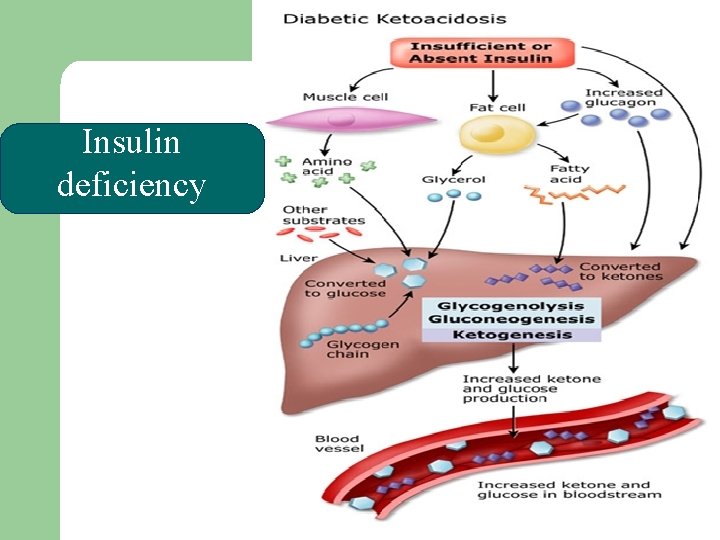
Insulin deficiency
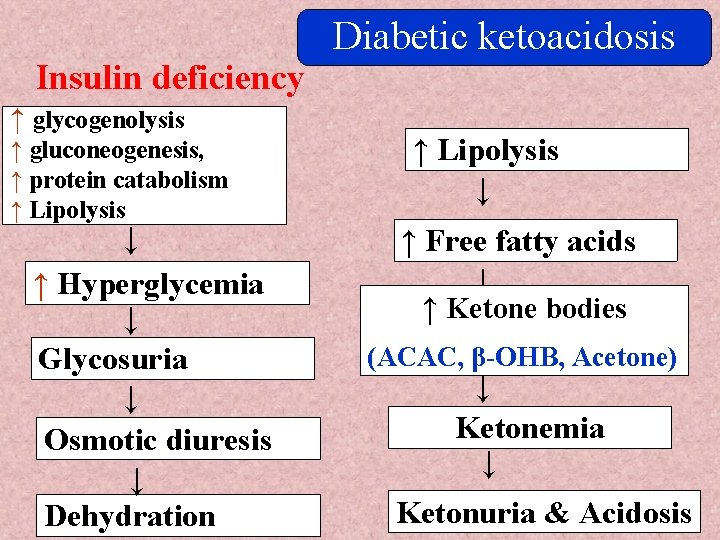
Insulin deficiency ↑ glycogenolysis ↑ gluconeogenesis, ↑ protein catabolism ↑ Lipolysis ↓ ↑ Hyperglycemia ↓ Glycosuria ↓ Osmotic diuresis ↓ Dehydration Diabetic ketoacidosis ↑ Lipolysis ↓ ↑ Free fatty acids ↓ ↑ Ketone bodies (ACAC, β-OHB, Acetone) ↓ Ketonemia ↓ Ketonuria & Acidosis
Diabetic ketoacidosis – Hyperglycemia-induced glucosuria, osmotic diuresis & severe fluid loss. – Fluid loss induces dehydration & electrolyte imbalance – Metabolic acidosis induces hyperventilation
Characters of diabetic ketoacidosis • • • Hyperglycemia Glucosuria Osmotic diuresis Polyuria Thirst Polydipsia (increased drinking). Dehydration Electrolyte imbalance Ketogenesis (ketonemia, ketonuria) Metabolic acidosis
Clinical symptoms for diabetic ketoacidosis l Classic features of hyperglycemia (thirst, polyuria) l Nausea, vomiting, abdominal pain l Tachycardia l Kussmaul–Kien respiration (rapid & deep). l Ketotic breath (fruity, with acetone smell) l Mental status changes (confusion, coma)
Diagnostic Criteria in diabetic ketoacidosis • Blood glucose level > 250 mg/dl • Arterial p. H < 7. 35 • Serum bicarbonate level < 15 mmol/L • Ketonemia • Ketonuria
Lines of treatment of diabetic ketoacidosis Adequate correction of : – Dehydration (Fluid therapy) – Hyperglycemia (Insulin) – Electrolyte deficits (Potassium therapy) – Ketoacidosis (Bicarbonate therapy)
Treatment of diabetic ketoacidosis l Fluid therapy (Rehydration) – Restore blood volume and perfusion of tissues. – Infusion of isotonic saline (0. 9% sodium chloride) at a rate of 15– 20 ml/kg/hour.
Treatment of diabetic ketoacidosis l Insulin therapy (Short acting insulin) – Regular insulin, should be administered by means of continuous intravenous infusion in small doses through an infusion pump (0. 1 U/kg/h). – Insulin stops lipolysis and promotes degradation of ketone bodies.
Treatment of diabetic ketoacidosis l Potassium therapy – potassium replacement must be initiated. – potassium is added to infusion fluid to correct the serum potassium concentration.
Treatment of diabetic ketoacidosis l Bicarbonate therapy – – Correct for metabolic acidosis bicarbonate therapy should be used only if the arterial p. H < 7. 0 after 1 hour of hydration, (sodium bicarbonate should be administered every 2 hours until the p. H is at least 7. 0).
Hypoglycemia l Blood sugar of less than 70 mg/dl is considered hypoglycemia. l Is a life threatening disorder that occurs when blood glucose level becomes < 50 mg/dl l One of the common side effects of insulin in treating type I diabetes.
Causes of Hypoglycemia – Overdose of insulin or oral hypoglycemic drugs (sulfonylureas - meglitinides). – Excessive physical exercise – Missed or delayed meal.
Causes of Hypoglycemia – Hypoglycemia can be an early manifestation of other serious disorders (sepsis, congenital heart disease, brain hemorrhage).
Characters of Hypoglycemia Autonomic features – sympathetic: tachycardia, palpitation, sweating, anxiety, tremor. – parasympathetic: nausea, vomiting.
Characters of Hypoglycemia Neurological defects: – Headache, visual disturbance, slurred speech, dizziness. – Tremors, mental confusion, convulsions. – Coma due to blood glucose to the brain.
Precautions Hypoglycemia can be prevented by: l Monitoring of blood glucose level (blood sugar level should be checked routinely). l Patients should carry glucose tablets or hard candy to eat if blood sugar gets too low.
Precautions Diabetic patient should wear a medical ID bracelet or carry a card. l Patient should not skip meals or eat partial meals. l Patient should eat extra carbohydrates if he will be active than usual. l
Treatment of Hypoglycemia Conscious patient: – Sugar containing beverage or food (30 g orally). Unconscious patient: – Glucagon (1 mg S. C. or I. M. ) – 20 -50 ml of 50% glucose solution I. V. infusion (risk of possible phlebitis).
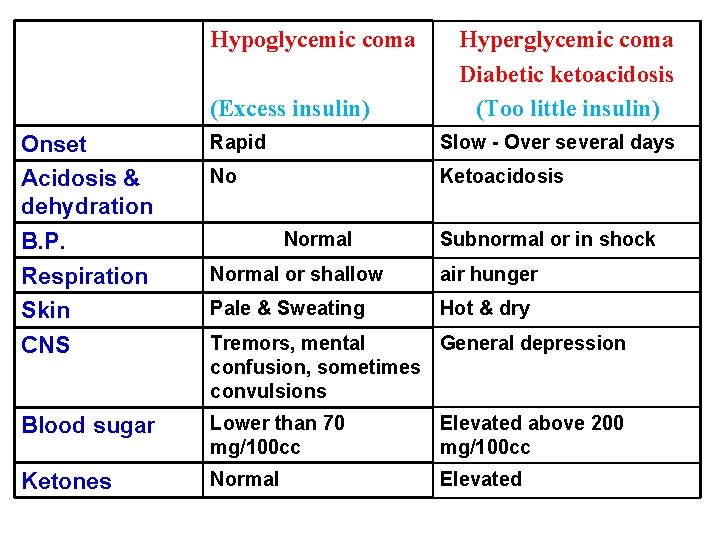
Hypoglycemic coma (Excess insulin) Hyperglycemic coma Diabetic ketoacidosis (Too little insulin) Onset Rapid Slow - Over several days Acidosis & dehydration No Ketoacidosis Normal B. P. Subnormal or in shock Respiration Normal or shallow air hunger Skin Pale & Sweating Hot & dry CNS Tremors, mental General depression confusion, sometimes convulsions Blood sugar Lower than 70 mg/100 cc Elevated above 200 mg/100 cc Ketones Normal Elevated
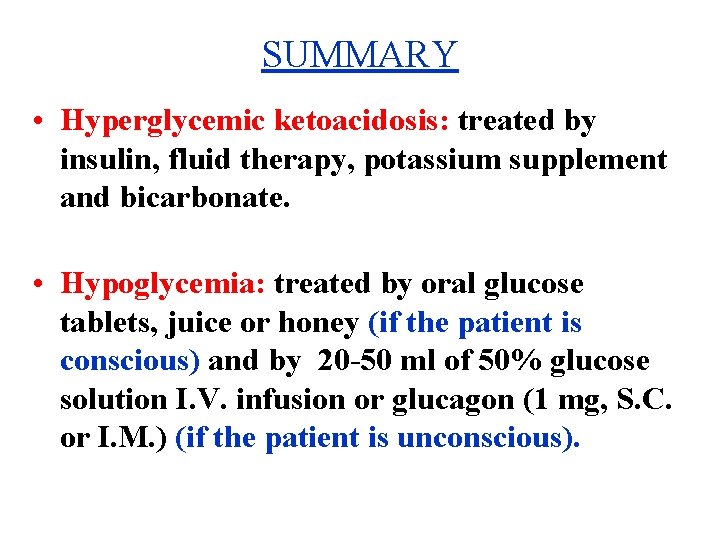
SUMMARY • Hyperglycemic ketoacidosis: treated by insulin, fluid therapy, potassium supplement and bicarbonate. • Hypoglycemia: treated by oral glucose tablets, juice or honey (if the patient is conscious) and by 20 -50 ml of 50% glucose solution I. V. infusion or glucagon (1 mg, S. C. or I. M. ) (if the patient is unconscious).
- Slides: 26