
Management of Closed Head Injuries in an Austere
- Slides: 27
Management of Closed Head Injuries in an Austere Environment 1 LT Greg Nix, APA-C //UNCLASSIFIED// 1
Overview – Pathophysiology of an injured brain – Intracranial Pressure – TBI • Mild/Mod/Severe – Skull Fx – Brain Bleeds – Diffuse Axonal Inj. – Eval & Tx – Evacuation suggestions //UNCLASSIFIED// 2
Pathophysiology of Brain Inj. -Terms: • CPP Cerebral Perfusion Pressure • CBF Cerebral Blood Flow – Auto regulation • MAP Mean Arterial Pressure • ICP Intracranial Pressure //UNCLASSIFIED// 3
Intracranial Pressure • Pressure changes – Increase – Decrease • Cushing's Reflex (triad) – HTN – Bradycardia – Irregular Respirations //UNCLASSIFIED// 4
Specific Injuries • TBI – Head trauma + AMS/LOC/PTA – Mild (Concussion) – Mod – Severe • Skull Fx • Brain Bleeds • Diffuse Axonal Injuries //UNCLASSIFIED// 5
TBI • Mild/Concussion – Classification: LOC < 30 m, AMS < 1 d, PTA < 1 d – s/sx: • HA/Vis disturb/N/V/Irritability – GCS: 14 -15 – Dx: • Physical exam & MACE – Tx: • Supportive, brain rest, monitor //UNCLASSIFIED// 6
TBI • Moderate – Classification: LOC 30 m 24 hrs, AMS >1 d, PTA 1 -7 d – s/sx: • HA/Vis disturb/N/V/Irritability – GCS: 9 -13 – Dx: • AMS, PTA/RTA, MACE – Tx: • +/- Airway, Supportive, +/- Evac, Brain rest, non-operational //UNCLASSIFIED// 7
TBI • Severe – Classification: LOC > 24 hrs, AMS > 24 hrs, PTA > 7 d – s/sx: • HA/Vis disturb/N/V/Irritability – GCS: <9 – Dx: • AMS, PTA/RTA, MACE – Tx: • RSI Airway, ASAP Evac, Brain rest, nonoperational //UNCLASSIFIED// 8
Skull Fx • Linear & Comminuted – s/sx: • May be obvious or occult • Basilar – Ascending/Descending point of many vessels & nerves. – s/sx: • Raccoon eyes, Battle signs, CSF leak, CN def. – Tx: • Airway, Supportive, ASAP Evac //UNCLASSIFIED// 9
//UNCLASSIFIED// 10
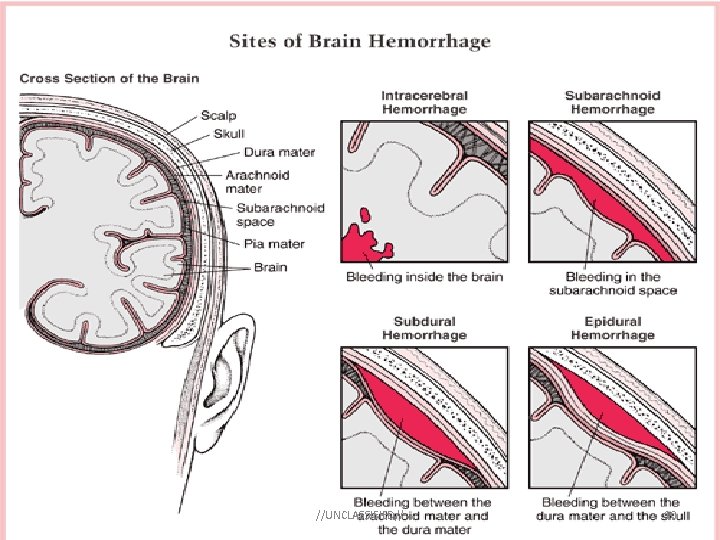
Brain Bleeds • Cerebral Contusion – s/sx: • Exaggerated Concussion sx • Intracerebral Hemorrhage • Focal Neuro def. often present – Dx: – Pt may have residual effects • RTA/PTA without resolution • AMS – Tx: • +/- Airway, Supportive, ASAP evac //UNCLASSIFIED// 11
Brain Bleeds • Subarachnoid Hemorrhage (SAH) – s/sx: (often sudden/aneurysm) • Profound photophobia, HA, N/V • Textbook: “Worst HA of life” – Dx: • Abrupt onset of sx mod/severe TBI – Tx: • Control BP do not allow to exceed 140 Syst. • CCB & CT would be preferred but prob not avail. • Airway & Evac! (Nimodipine to stop vasospasm. Vasospasm stops flow to brain) //UNCLASSIFIED// 12
Brain Bleeds • Epidural Hematoma – s/sx: • MOI: blast/fall, sports, MVA • Probable skull fx – Middle Meningeal Artery! • HA, AMS, Sz – Dx: • S/sx, MOI, LOC with lucid interval – Tx: • EVAC! Be prepared for RSI! • Control Sz //UNCLASSIFIED// 13
Brain Bleeds • Subdural Hematoma (SDH) – s/sx: • LOC, AMS • Becomes sx within x 14 d – Dx: • Acceleration/Deceleration MOI • Increase of sx over period of time • Venous Hemorrhage – Tx: • Evac, CT • Beware of death within x 14 d; usually 72 hrs. //UNCLASSIFIED// 14
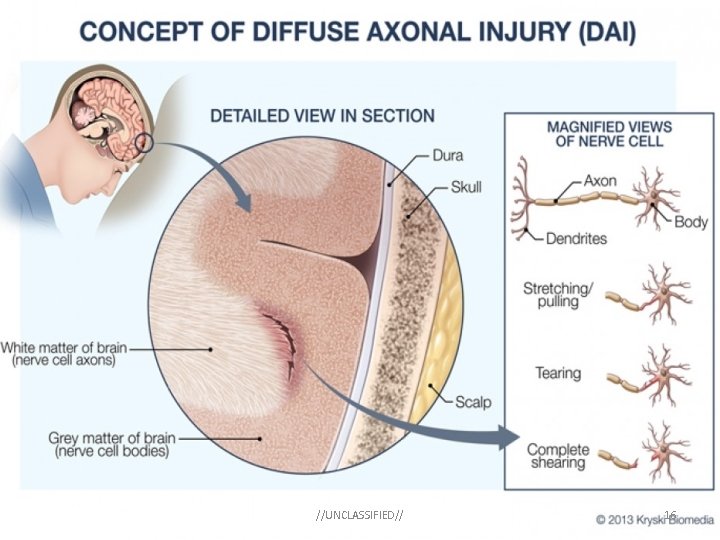
Diffuse Axonal Injury (DAI) – s/sx: • Sudden LOC/Unresponsive • Shearing MOI – Dx: • MOI, Prolonged unresponsiveness – Tx: • Respectful care, Irreversible. //UNCLASSIFIED// 15
//UNCLASSIFIED// 16
Pt Eval/Exam • Eval – Determine MOI, Level of consciousness • • PE & HEENT MACE/AVPU/GCS Cognition Coordination • CN II-XII exam – Look for focal deficits //UNCLASSIFIED// 17
Pt Eval/Exam • Ultrasound of Ocular nerve sheath – Place tegaderms over pt’s eyes – Visualize the Optic nerve – Approx x 3 mm from the globe, the nerve should be 5 mm in width • 3 x 5 • >5 mm = increased ICP – Watch if tx are efficacious!!!!! //UNCLASSIFIED// 18
Interventions – Packaging • Trendelenburg 30 -45* – Increases venous flow – non-constricting C-spine protection – Temp • Increased ICP pts tend to have elevated temps – Increased metabolic needs!!! – Keep pt cool – Fluids • Isotonic vs. Hypotonic //UNCLASSIFIED// 19
Interventions – Diuretics • Mannitol – Decreases ICP via Increasing Outflow and stimulating Autoregulation – 1 g/kg – Use Foley to measure pt’s outflow… » Replace fluids to avoid Ho. TN – Best used for HTN pts with increased ICP (hypotension) //UNCLASSIFIED// 20
Interventions – Diuretics • Hypertonic Saline 3% – Increases CO 2 – Increases Na+ gradient – Decreases ICP by pulling fluid – Admin 250 mg over 10 min – Best utilized in nml/Ho. TN pts //UNCLASSIFIED// 21
Interventions – RSI: • Succinylcholine • Etomidate/Ketamine/Propofol – Steroid use • No longer used • Especially not used with hemorrhage – CO 2 • Watch End-tidal carefully – 33 -38 ideal //UNCLASSIFIED// 22
Interventions – Hyperventilation? • No longer advocated due to ischemia • Still acceptable with s/sx of Herniation. – Life > perm. Adverse effects – Pain Control • Fentanyl/Ketamine • Helps prevent excess metabolic needs //UNCLASSIFIED// 23
To Evac, or Not to Evac? • PECARN/New Orleans Trial Normal mental status No LOC No severe mechanism of injury No vomiting No severe headache No signs of basilar skull fracture No Injuries superior to clavicles //UNCLASSIFIED// 24
Case Study • • • GSW face Massive post. Neck bleed Unresponsive Anisocoric No Resp. drive Tachycardic //UNCLASSIFIED// 25
References • • • Auerbach, Paul S. , Howard J. Donner, and Eric A. Weiss. "Head Injury. " Field Guide to Wilderness Medicine. 4 th ed. St. Louis: Mosby, 1999. 139 -44. Print. Lenhart, Martha K. , Eric Savitsky, and Brian Eastridge. "Traumatic Brain Injury Management. " Combat Casualty Care: Lessons Learned from OEF and OIF. N. p. : n. p. , n. d. 33 -378. Print. "Medicolegal Visuals. " Medical Illustrator Medical Illustration Scientific Illustration. N. p. , n. d. Web. 20 Feb. 2015. "Minor Head Trauma in Infants and Children: Evaluation. " Minor Head Trauma in Infants and Children: Evaluation. Up. To. Date. com, 17 Oct. 2014. Web. 20 Feb. 2015. Papadakis, Maxine A. , Stephen J. Mc. Phee, and Michael W. Rabow. Current Medical Diagnosis & Treatment 2014 ed. N. p. : n. p. , n. d. Print. "Pictures. " Teach. Me. Anatomy. N. p. , n. d. Web. 20 Feb. 2015. "Subarachnoid Hemorrhage vs. Subdural Hematoma. " Galleryhip. com Images of Hemorrhage Types. N. p. , n. d. Web. 20 Feb. 015. Swisher, Linda, and Kevin T. Patton. Study and Review Guide to Accompany Anatomy & Physiology, 7 th Edition: Kevin T. Patton, Gary A. Thibodeau. 7 th ed. St. Louis, MO: Mosby Elsevier, 2010. Print. Tintinalli, Judith E. , Gabor D. Kelen, and J. Stephan. Stapczynski. "Ch. 255 HEAD INJURY. " Emergency Medicine: A Comprehensive Study Guide. 6 th ed. New York: Mc. Graw-Hill, Medical Pub. Division, 2004. 1557 -569. Print. "Welcome - EMCrit CME Site. " EMCrit CME Site. N. p. , n. d. Web. 21 Feb. 2015. //UNCLASSIFIED// 26
QUESTIONS? //UNCLASSIFIED// 27