
MANAGEMENT OF CHALLENGED CHILDREN 372021 Mrs Sharin Neetal

- Slides: 29
MANAGEMENT OF CHALLENGED CHILDREN 3/7/2021 Mrs. Sharin Neetal D'souza 1
MANAGEMENT OF CHALLENGED CHILDREN Prepared by: Mrs. Sharin Neetal D’souza Lecturer Dept. Child health nursing Yenepoya nursing college 3/7/2021 Reviewed by: Prof. Umarani J Dr. Priya Reshma Aranha Mrs. Sharin Neetal D'souza 2
Learning objectives At the end of the class students will be able to • classify handicaps • explain the management of challenged child along with disorder 3/7/2021 Mrs. Sharin Neetal D'souza 3
Impairment is defined as any loss or abnormality of the psychological, physiological or anatomical structure or function. This is defined within the concept of health experience 3/7/2021 Mrs. Sharin Neetal D'souza 4
Disability is any restriction or lack of ability to perform an activity in the manner or within the range considered normal. This usually results from an impairment. Handicap is a disadvantage for a given individual resulting from an impairment or disability that prevents or limits the fulfillment of a role that is normal for the individual. 3/7/2021 Mrs. Sharin Neetal D'souza 5
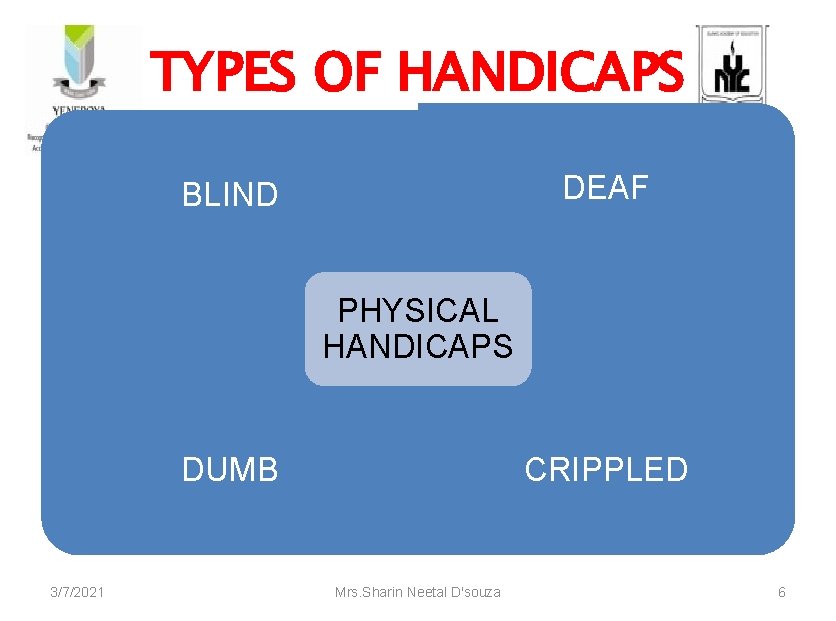
TYPES OF HANDICAPS DEAF BLIND PHYSICAL HANDICAPS DUMB 3/7/2021 CRIPPLED Mrs. Sharin Neetal D'souza 6
MENTAL HANDICAPS • Mental retardation • Cerebral palsy Social handicaps • Orphans • Neglected and abused children • Children of divorced or step parents • Delinquents 3/7/2021 Mrs. Sharin Neetal D'souza 7
Causes of handicaps q. Pre conceptual factors q. Antenatal and intra natal factors - Asphyxia - Birth trauma q. Post natal factors 3/7/2021 Mrs. Sharin Neetal D'souza 8
MENTAL RETARDATION 3/7/2021 Mrs. Sharin Neetal D'souza 9
Definition “Mental retardation refers to significantly subaverage general intellectual functioning resulting in or associated with concurrent impairments in adaptive behavior & manifested during the developmental period” (American Association on Mental Deficiency, 1983). 3/7/2021 Mrs. Sharin Neetal D'souza 10
Epidemiology • About 3% of the world population is estimated to be mentally retarded. • In India, 5 out of 1000 children are mentally retarded (The Indian Express, 13 th March 2001). • Mental retardation is more common in boys than girls. • With severe & profound mental retardation mortality is high due to associated physical disease. 3/7/2021 Mrs. Sharin Neetal D'souza 13
Etiology Genetic Factors Chromosomal abnormalities • • • Down’s syndromes Fragile X syndrome Trisomy X syndrome Turner’s syndrome Cat-cry syndrome Prader-willi syndrome Cranial malformation • Hydrocephaly • Microcephaly 3/7/2021 Genetic Factors Metabolic disorders � Phenylketonuria � Wilson’s disease � Galactosemia Gross disease of brain � Tuberous scleroses � Neurofibromatosis � Epilepsy Mrs. Sharin Neetal D'souza 14
Prenatal Factors Physical damage & • Rubella disorders • Cytomegalovirus �Injury • Syphilis �Hypoxia • Toxoplasmosis, � Radiation herpes simplex � Hypertension Endocrine disorders � Anemia � Emphysema • Hypothyroidism Placental dysfunction • Hypoparathyrodism �Toxemia of pregnancy � �Placenta previa • Diabetes mellitus Intoxication �Cord prolapse • Lead & certain drug �Nutrition growth retardation • Substance abuse Infection 3/7/2021 Mrs. Sharin Neetal D'souza 15
Perinatal Factors • Birth asphyxia • Prolonged or difficult birth • Prematurity • Kernicterus • Instrumental delivery Postnatal Factors �Infections i. Encephalitis ii. Measles iii. Meningitis iv. Septicemia �Environmental & socio- cultural Factors �Cultural deprivation �Low socio-economic status �Inadequate caretakers �Child abuse � Accidents � Lead poisoning 3/7/2021 Mrs. Sharin Neetal D'souza 16
Classification: • Mild Retardation (IQ 50 -70 This is commonest type of mental retardation accounting for 85 -90% of all cases. These individuals have minimum retardation in sensory-motor areas. • Moderate Retardation (IQ 35 -50) About 10% of mentally retarded come under this group. 3/7/2021 Mrs. Sharin Neetal D'souza 17
Severe Retardation (IQ 20 -35) Severe mental retardation is often recognized early in life with poor motor development & absent or markedly delayed speech & communication skills. Profound Retardation (IQ below 20) This group accounts for 1 -2% of all mentally retarded. The achievement of developmental milestones is markedly delayed. They require constant nursing care & supervision. 3/7/2021 Mrs. Sharin Neetal D'souza 18
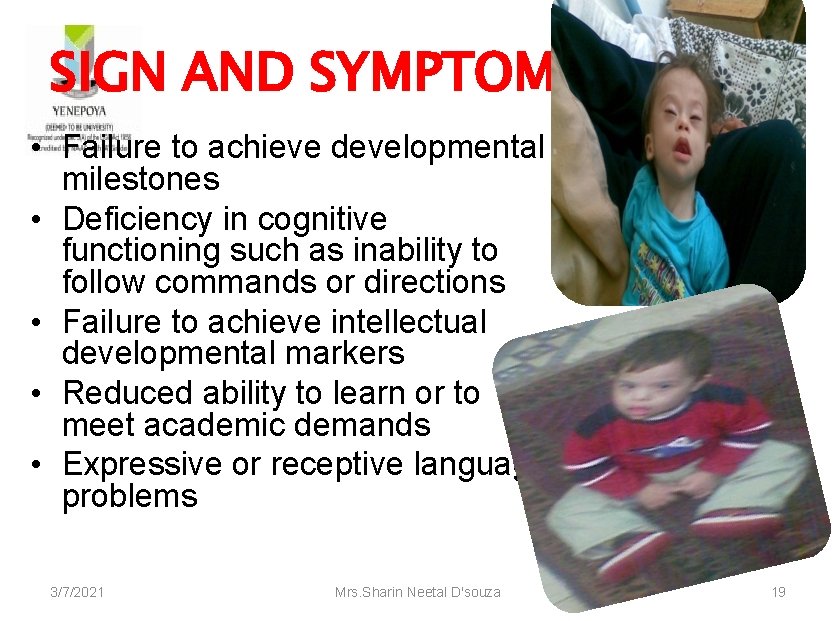
SIGN AND SYMPTOMS • Failure to achieve developmental milestones • Deficiency in cognitive functioning such as inability to follow commands or directions • Failure to achieve intellectual developmental markers • Reduced ability to learn or to meet academic demands • Expressive or receptive language problems 3/7/2021 Mrs. Sharin Neetal D'souza 19
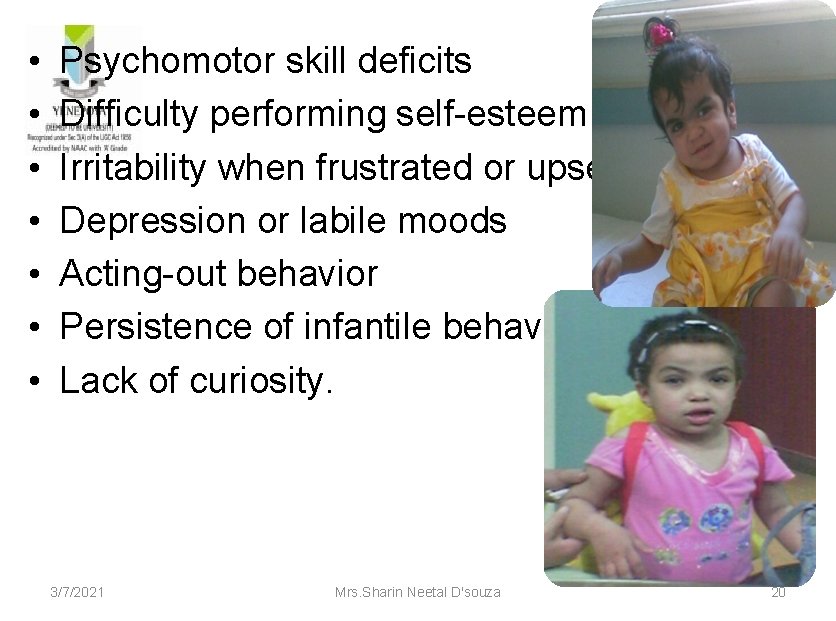
• • Psychomotor skill deficits Difficulty performing self-esteem Irritability when frustrated or upset Depression or labile moods Acting-out behavior Persistence of infantile behavior Lack of curiosity. 3/7/2021 Mrs. Sharin Neetal D'souza 20
DIAGNOSIS • History collection from parents & caretakers • Physical examination • Neurological examination • Assessing milestones development • Investigations – Urine & blood examination for metabolic disorders – Culture for cytogenic & biochemical studies – Amniocentesis in infant chromosomal disorders – chorionic villi sampling – Hearing & speech evaluation 3/7/2021 Mrs. Sharin Neetal D'souza 21
• EEG, especially if seizure are present • CT scan or MRI brain, for example, in tuberous sclerosis • Thyroid function tests when cretinism is suspected • Psychological tests like Stanford Binet Intelligence Scale & Wechsler Intelligence Scale for Children’s (WISC), for categorizing the child’s level of disability. 3/7/2021 Mrs. Sharin Neetal D'souza 22
TREATMENT MODALITIES • Behavior management • Environmental supervision • Monitoring the child’s development needs & problems. • Programs that maximize speech, language, cognitive, psychomotor, social, self-care, & occupational skills. • Ongoing evaluation for overlapping psychiatric disorders, such as depression, bipolar disorder, & ADHD. • Family therapy to help parents develop coping skills & deal with guilt or anger. 3/7/2021 Mrs. Sharin Neetal D'souza 23
• Early intervention programs for children younger than 3 with mental retardation • Provide day schools to train the child in basic skills, such as bathing & feeding. • Vocational training. 3/7/2021 Mrs. Sharin Neetal D'souza 24
NURSING MANAGEMENT • Determine the child’s strengths & abilities & develop a plan of care to maintain & enhance capabilities. • Monitor the child’s developmental levels & initiate supportive interventions, such as speech, language, or occupational skills as needed. • Teach him about natural & normal feelings & emotions. • Provide for his safety needs. 3/7/2021 Mrs. Sharin Neetal D'souza 25
• Prevent self-injury. Be prepared to intervene if self-injury occurs. • Monitor the child for physical or emotional distress. • Modify his behavior by having him redirect his energy. • Keep communication brief, simple, & consistent. • Teach the child adaptive skills, such as eating, dressing, grooming & toileting. • Demonstrate & help him practice selfcare skills. 3/7/2021 Mrs. Sharin Neetal D'souza 26
• Work to increase his compliance with conventional social norms & behaviors. • Maintain a consistent & supervised environment. • Maintain adequate environmental stimulation. • Set supportive limits on activities. • Work to maintain & enhance his positive feelings about self & daily accomplishments. 3/7/2021 Mrs. Sharin Neetal D'souza 27
PROGNOSIS • The prognosis for children with mental retardation has improved & institutional care is no longer recommended. • These children are mainstreamed whenever feasible & are taught survival skills. • A multidimensional orientation is used when working with these children, considering their psychological, cognitive, social & emotional development. 3/7/2021 Mrs. Sharin Neetal D'souza 28
Evaluation • Name 2 socially handicaps • Formula to calculate IQ • List the types of mental retardation 3/7/2021 Mrs. Sharin Neetal D'souza 29
References • Wong’s essentials of pediatric nursing; 17 th edition • Marlow. Text book of paediatric nursing, 6 th edition • Rimple sharma. Text book of paediatric nursing • Parul Datta. Text book of child health nursing 3/7/2021 Mrs. Sharin Neetal D'souza 30
THANK YOU 3/7/2021 Mrs. Sharin Neetal D'souza 31