
Management of CBD stone during laparoscopic cholecystectomy Dr
Management of CBD stone during laparoscopic cholecystectomy Dr Wong Tak Mandy Kwong Wah Hospital

• The incidence of choledocholithiasis in patients undergoing cholecystectomy varies with age, ranging from 6% in patients less than 80 years old to 33% in patients more than 80 years old. Johnson AG, Hosking SW. Appraisal of the management of bile duct stones. Br J Surg 1987; 74: 555– 560. • Approximately 10% of patients who undergo laparoscopic cholecystectomy harbor common bile duct stones Way LW, Admirand WJ, Dunphy JE (1972) Management of choledocholithiasis. Ann Surg 176: 347– 359
• It is estimated that 5% to 12% of patients with choledocholithiasis may be completely asymptomatic and have normal liver function tests. Acosta MJ. The usefulness of stool screening for diagnosing cholelithiasis in acute pancreatitis. A description of the technique. Am J Dig Dis 1977; 22: 168– 172.
• 2 -step approach: – Lap cholecystectomy, then post-cholecystectomy ERCP • 1 -step approach: – Lap cholecystectomy and lap CBD exploration – Lap cholecystectomy and intra-operative ERCP – Open cholecystectomy and CBD exploration
• 2 -step approach: – Lap cholecystectomy, then post-cholecystectomy ERCP • 1 -step approach: – Lap cholecystectomy and lap CBD exploration – Lap cholecystectomy and intra-operative ERCP – Open cholecystectomy and CBD exploration

Post-cholecystectomy ERCP (2 -stage approach) Failure rate: 2 -4% Need further endoscopic procedure or reoperation Huntington TR. Laparoscopic biliary guide wire: a simplified approach to choledocholithiasis. Gastrointest Endosc 1997; 45: 295 -7.
Transcystic biliary stenting ◦ Insert a biliary stent through the cystic duct into the CBD and through the sphincter of Oddi. ◦ Ensures access to the bile duct for postoperative endoscopic sphincterotomy. ◦ Increase the success rate of post-operative ERCP
• 2 -step approach: – Lap cholecystectomy, then post-cholecystectomy ERCP • 1 -step approach: – Lap cholecystectomy and lap CBD exploration • Transcystic approach • Transcholedocal approach – Lap cholecystectomy and intra-operative ERCP – Open cholecystectomy and CBD exploration
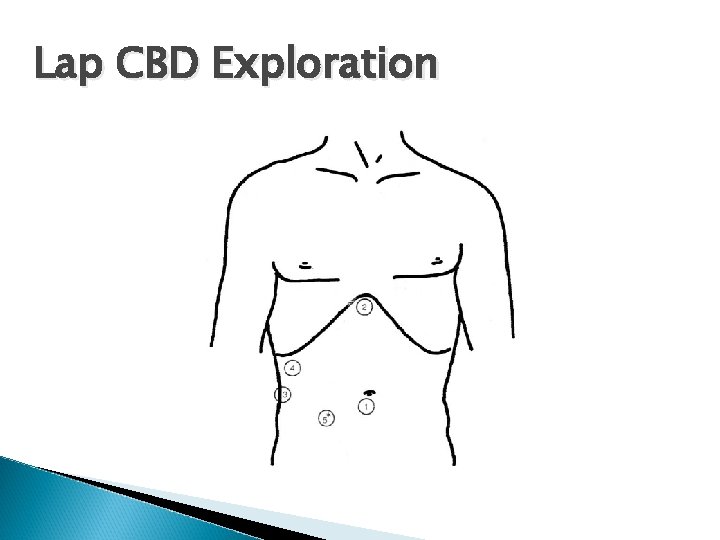
Lap CBD Exploration
Methods for stone retrieval: ◦ ◦ ◦ Irrigation Balloon manipulation (Fogarty catheter) Basket maneuver Choledochoscopy Electrohydraulic lithotripsy Completion cholangiogram to confirm ductal clearance, or to decide for open conversion in case of retained stones
LCBDE (transcystic approach) Gallbladder is retracted toward right hemidiaphragm with forceps inserted through the most lateral port. Cystic duct is dilated, if necessary, either with over-the-wire mechanical dilator or over-the-wire pneumatic dilator. Choledochoscope is inserted through midclavicular port into cystic duct and guided into CBD with atraumatic forceps inserted through medial epigastric port.
• Advantage: • Less invasive • Minimal morbidity, no T-tube, no drain, and a rapid return to normal activity in most cases • Disadvantage: • Limited by cystic duct diameter • Depends on the stone that need to be removed
• Indications: • filling defects at cholangiography • Stones smaller than 10 mm • fewer than 9 stones • Contraindications: • stones larger than 1 cm • stones proximal to the cystic duct entrance into the CBD • small friable cystic duct, <3 mm in diameter • tortuous cystic duct • 10 or more stones
• • • Applicable in more than 85% of cases Success rate of 85% to 95% More cost effective than postoperative endoscopic retrograde cholangiopancreatography (ERCP) S. Lyass. Laparoscopic transcystic duct common bile duct exploration. Surg Endosc (2006) 20: S 441–S 445
LCBDE (transcholedocal approach) Longitudinal incision at supraduodenal CBD Limited to 1 cm or diameter of the largest stone Choledochoscope is inserted through midclavicular port and guided into CBD with atraumatic forceps inserted through medial epigastric port No stay suture is required
• Advantage: • Useful in cases when transcystic method is not feasible, such as large stones, intrahepatic stones, or a miniscule or tortuous cystic duct • Disadvantage: • Technically demanding – Require suturing and knot-tying skills not necessary in the transcystic method • Limited by CBD diameter • Increased risk of post-operative bile leakage and late stenosis
Transcystic approach N=218 Choledochotomy approach N=44 Operating time 93. 2 144. 6 Hospital stay (hours) 39. 2 69. 8 Conversion rate (%) 0. 9 0 Complication (%) 8. 3 11. 4 J. B. Petelin. Laparoscopic common bile duct exploration. Lessons learned from >12 years’ experience. Surg Endosc (2003) 17: 1705– 1715
Transcystic or transcholedochal? Which method should we choose?
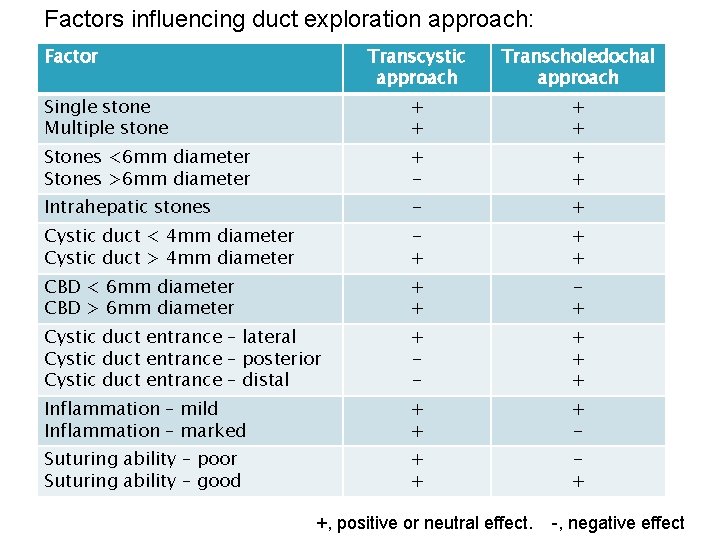
Factors influencing duct exploration approach: Factor Transcystic approach Transcholedochal approach Single stone Multiple stone + + Stones <6 mm diameter Stones >6 mm diameter + - + + Intrahepatic stones - + Cystic duct < 4 mm diameter Cystic duct > 4 mm diameter + + + CBD < 6 mm diameter CBD > 6 mm diameter + + + Cystic duct entrance – lateral Cystic duct entrance – posterior Cystic duct entrance – distal + - + + + Inflammation – mild Inflammation – marked + + + - Suturing ability – poor Suturing ability – good + +, positive or neutral effect. -, negative effect
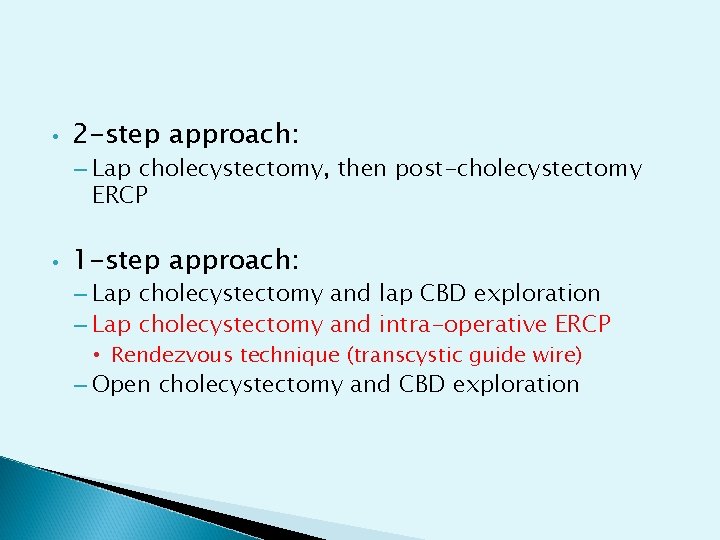
• 2 -step approach: – Lap cholecystectomy, then post-cholecystectomy ERCP • 1 -step approach: – Lap cholecystectomy and lap CBD exploration – Lap cholecystectomy and intra-operative ERCP • Rendezvous technique (transcystic guide wire) – Open cholecystectomy and CBD exploration
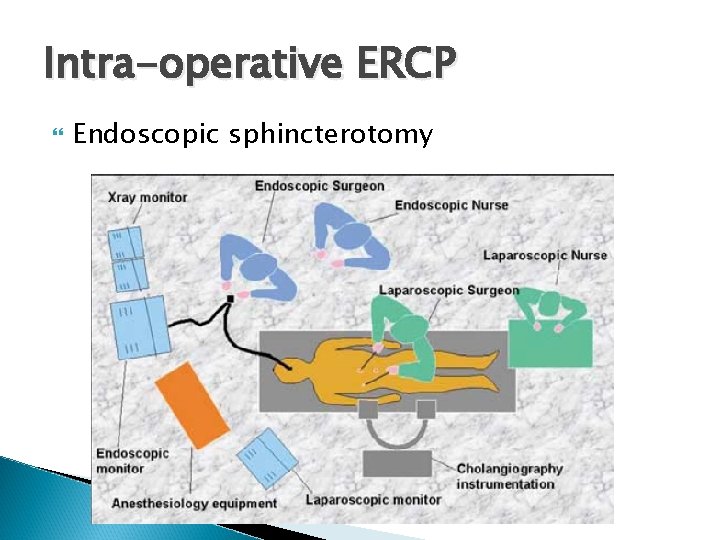
Intra-operative ERCP Endoscopic sphincterotomy
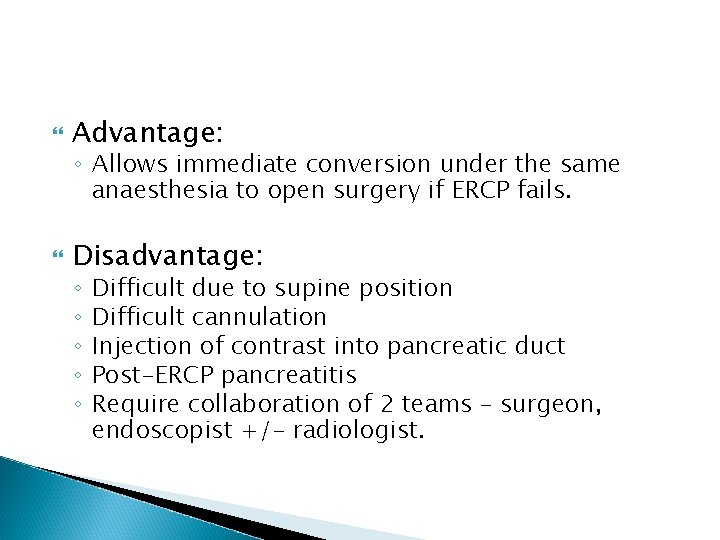
Advantage: Disadvantage: ◦ Allows immediate conversion under the same anaesthesia to open surgery if ERCP fails. ◦ ◦ ◦ Difficult due to supine position Difficult cannulation Injection of contrast into pancreatic duct Post-ERCP pancreatitis Require collaboration of 2 teams – surgeon, endoscopist +/- radiologist.
Rendezvous technique: ◦ After intra-operative cholangiogram, a transcystic guide wire in inserted through a small incision at cystic duct, advanced into duodenum through papilla ◦ The tip of the guide wire is viewed using endoscope, and pulled out of patient’s mouth by a polypectomy snare ◦ A traditional sphincterotome is introduced along the guide wire that allow direct cannulation of papilla and sphincterotomy ◦ Stone extraction can also be performed using the guidance of the wire
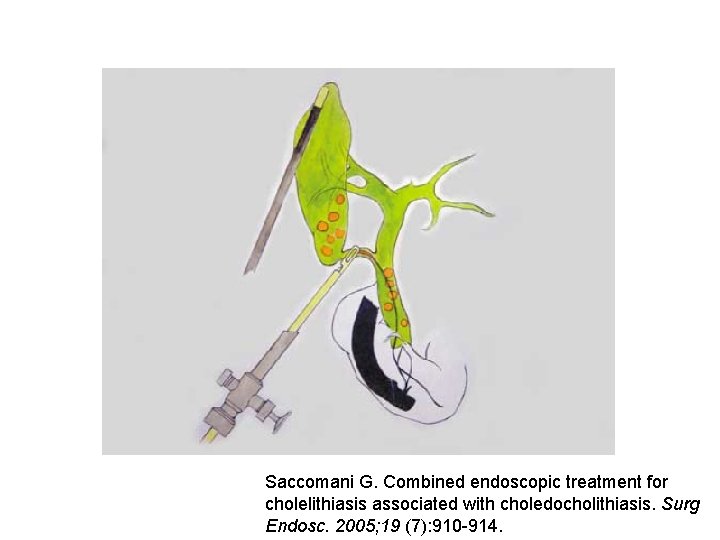
Saccomani G. Combined endoscopic treatment for cholelithiasis associated with choledocholithiasis. Surg Endosc. 2005; 19 (7): 910 -914.
Advantage: ◦ Easy cannulation of CBD ◦ Avoid contrast injection into pancreatic duct
Rendezvous technique (case series): ◦ Success rate: 95% ◦ Failure due to difficulty in passing guide wire through the papilla ◦ CBD stone clearance can still be achieved with traditional sphincterotomy ◦ Complication rate: 3. 7% post-sphincterotomy bleeding (2) post-sphincterotomy perforation (2) death due to post-ERCP pancreatitis (1) Giuseppe Borzellino. Treatment for Retrieved Common Bile Duct Stones During Laparoscopic Cholecystectomy. The Rendezvous Technique. ARCH SURG/VOL 145 (NO. 12), DEC 2010

Comparing different approach
Lap CBDE vs post-op ERCP
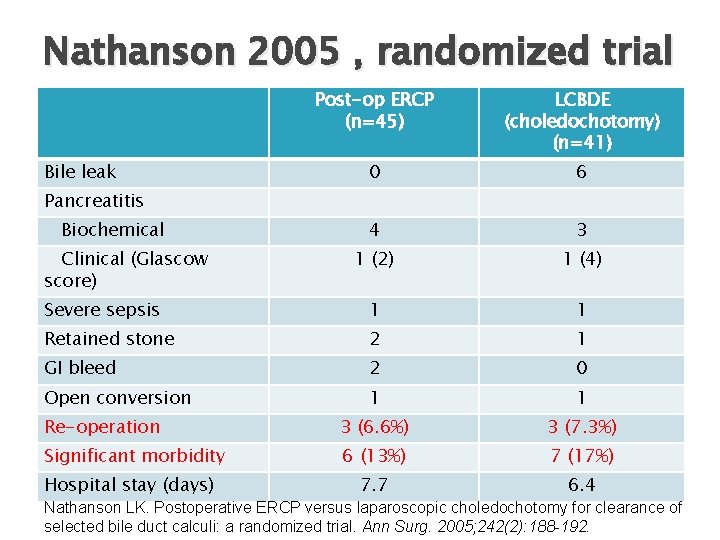
Nathanson 2005 , randomized trial Post-op ERCP (n=45) LCBDE (choledochotomy) (n=41) 0 6 4 3 1 (2) 1 (4) Severe sepsis 1 1 Retained stone 2 1 GI bleed 2 0 Open conversion 1 1 Re-operation 3 (6. 6%) 3 (7. 3%) Significant morbidity 6 (13%) 7 (17%) 7. 7 6. 4 Bile leak Pancreatitis Biochemical Clinical (Glascow score) Hospital stay (days) Nathanson LK. Postoperative ERCP versus laparoscopic choledochotomy for clearance of selected bile duct calculi: a randomized trial. Ann Surg. 2005; 242(2): 188 -192.
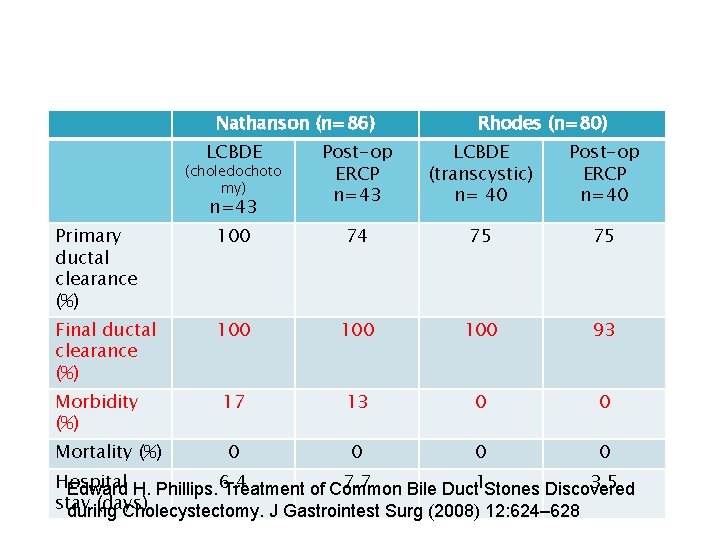
Nathanson (n=86) LCBDE Rhodes (n=80) (choledochoto my) Post-op ERCP n=43 LCBDE (transcystic) n= 40 Post-op ERCP n=40 Primary ductal clearance (%) 100 74 75 75 Final ductal clearance (%) 100 100 93 17 13 0 0 0 n=43 Morbidity (%) Mortality (%) Hospital 7. 7 3. 5 Edward H. Phillips. 6. 4 Treatment of Common Bile Duct 1 Stones Discovered stay (days) during Cholecystectomy. J Gastrointest Surg (2008) 12: 624– 628
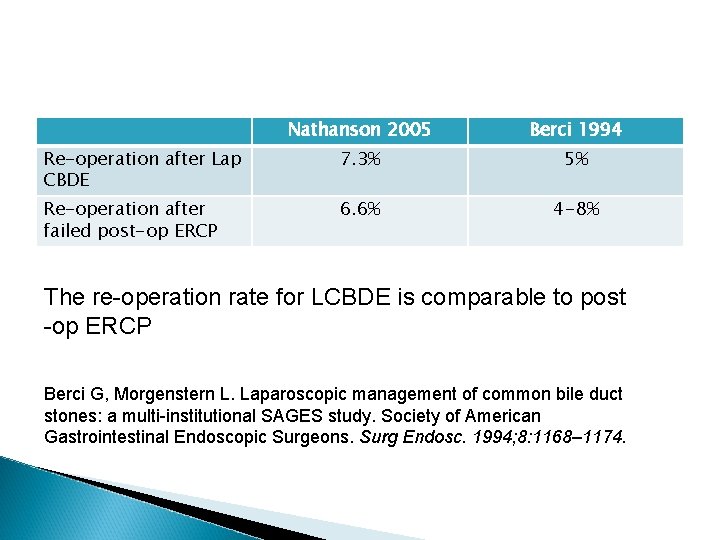
Nathanson 2005 Berci 1994 Re-operation after Lap CBDE 7. 3% 5% Re-operation after failed post-op ERCP 6. 6% 4 -8% The re-operation rate for LCBDE is comparable to post -op ERCP Berci G, Morgenstern L. Laparoscopic management of common bile duct stones: a multi-institutional SAGES study. Society of American Gastrointestinal Endoscopic Surgeons. Surg Endosc. 1994; 8: 1168– 1174.
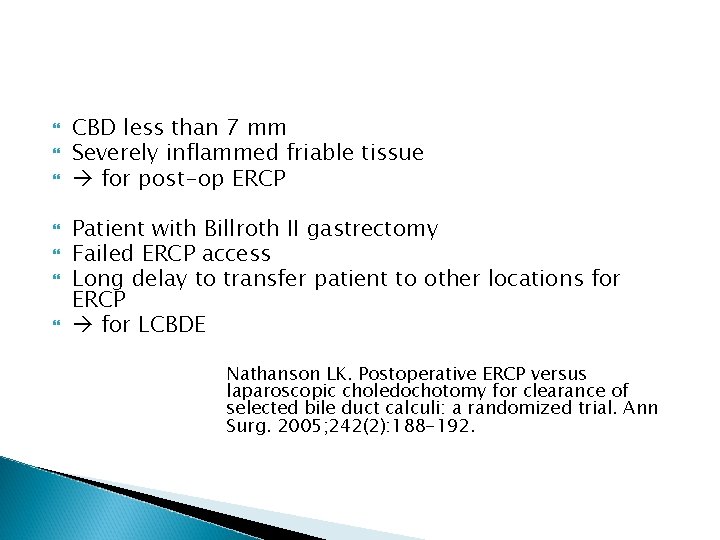
CBD less than 7 mm Severely inflammed friable tissue for post-op ERCP Patient with Billroth II gastrectomy Failed ERCP access Long delay to transfer patient to other locations for ERCP for LCBDE Nathanson LK. Postoperative ERCP versus laparoscopic choledochotomy for clearance of selected bile duct calculi: a randomized trial. Ann Surg. 2005; 242(2): 188 -192.
Intra-op ERCP vs post-op ERCP
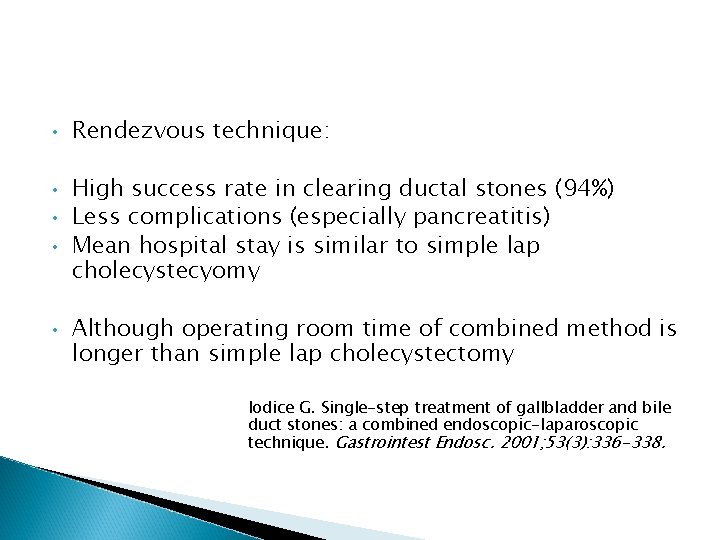
• • • Rendezvous technique: High success rate in clearing ductal stones (94%) Less complications (especially pancreatitis) Mean hospital stay is similar to simple lap cholecystecyomy Although operating room time of combined method is longer than simple lap cholecystectomy Iodice G. Single-step treatment of gallbladder and bile duct stones: a combined endoscopic-laparoscopic technique. Gastrointest Endosc. 2001; 53(3): 336 -338.
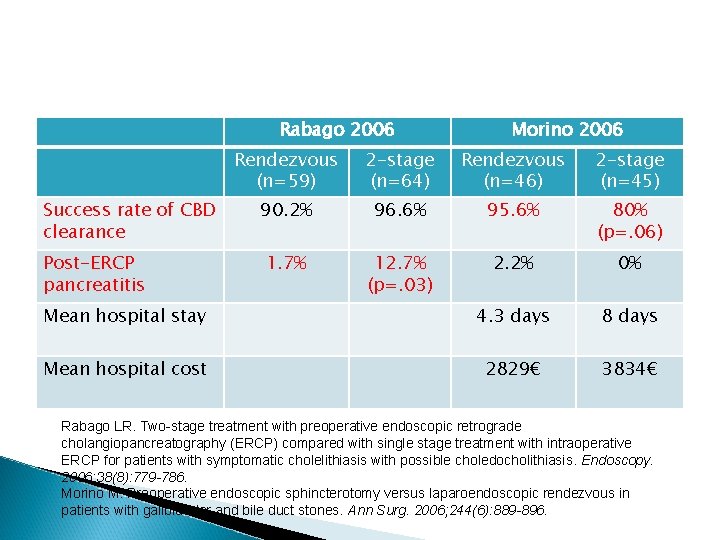
Rabago 2006 Morino 2006 Rendezvous (n=59) 2 -stage (n=64) Rendezvous (n=46) 2 -stage (n=45) 90. 2% 96. 6% 95. 6% 80% (p=. 06) 1. 7% 12. 7% (p=. 03) 2. 2% 0% Mean hospital stay 4. 3 days 8 days Mean hospital cost 2829€ 3834€ Success rate of CBD clearance Post-ERCP pancreatitis Rabago LR. Two-stage treatment with preoperative endoscopic retrograde cholangiopancreatography (ERCP) compared with single stage treatment with intraoperative ERCP for patients with symptomatic cholelithiasis with possible choledocholithiasis. Endoscopy. 2006; 38(8): 779 -786. Morino M. Preoperative endoscopic sphincterotomy versus laparoendoscopic rendezvous in patients with gallbladder and bile duct stones. Ann Surg. 2006; 244(6): 889 -896.
Intra-operative ERCP (Rendezvous technique) has high success rate of CBD clearance, and less post-ERCP pancreatitis when compared to the 2 -stage method.
LCBDE vs intra-op ERCP
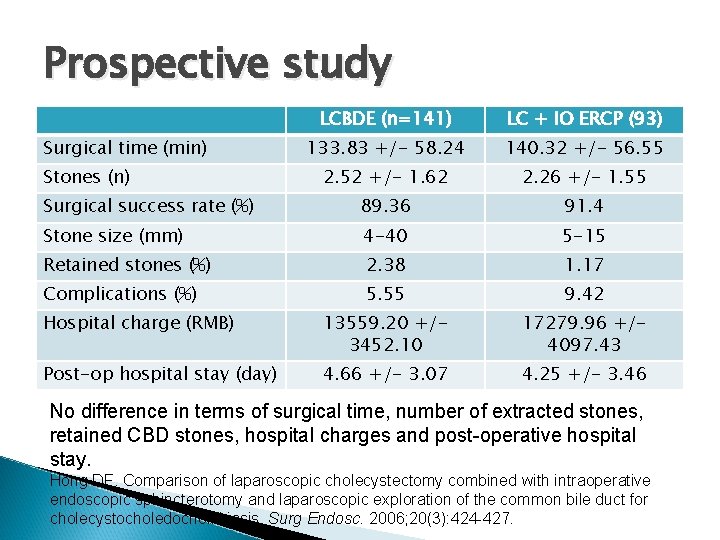
Prospective study LCBDE (n=141) LC + IO ERCP (93) 133. 83 +/- 58. 24 140. 32 +/- 56. 55 2. 52 +/- 1. 62 2. 26 +/- 1. 55 Surgical success rate (%) 89. 36 91. 4 Stone size (mm) 4 -40 5 -15 Retained stones (%) 2. 38 1. 17 Complications (%) 5. 55 9. 42 Hospital charge (RMB) 13559. 20 +/3452. 10 17279. 96 +/4097. 43 Post-op hospital stay (day) 4. 66 +/- 3. 07 4. 25 +/- 3. 46 Surgical time (min) Stones (n) No difference in terms of surgical time, number of extracted stones, retained CBD stones, hospital charges and post-operative hospital stay. Hong DF. Comparison of laparoscopic cholecystectomy combined with intraoperative endoscopic sphincterotomy and laparoscopic exploration of the common bile duct for cholecystocholedocholithiasis. Surg Endosc. 2006; 20(3): 424 -427.
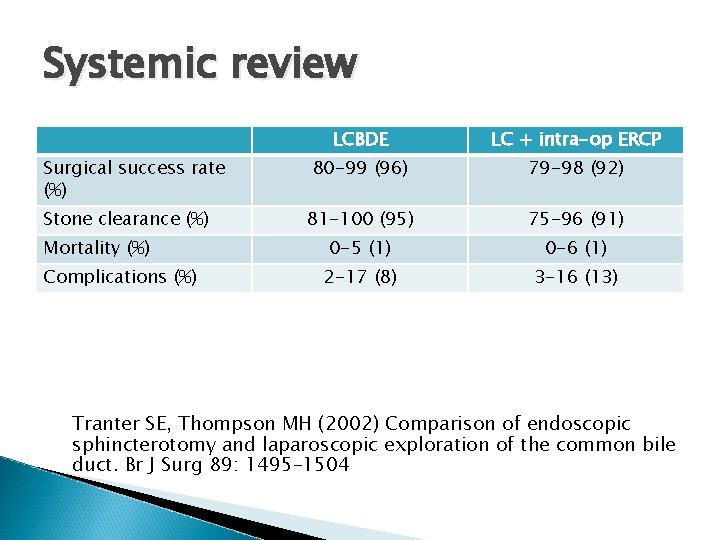
Systemic review Surgical success rate (%) Stone clearance (%) Mortality (%) Complications (%) LCBDE LC + intra-op ERCP 80 -99 (96) 79 -98 (92) 81 -100 (95) 75 -96 (91) 0 -5 (1) 0 -6 (1) 2 -17 (8) 3 -16 (13) Tranter SE, Thompson MH (2002) Comparison of endoscopic sphincterotomy and laparoscopic exploration of the common bile duct. Br J Surg 89: 1495– 1504
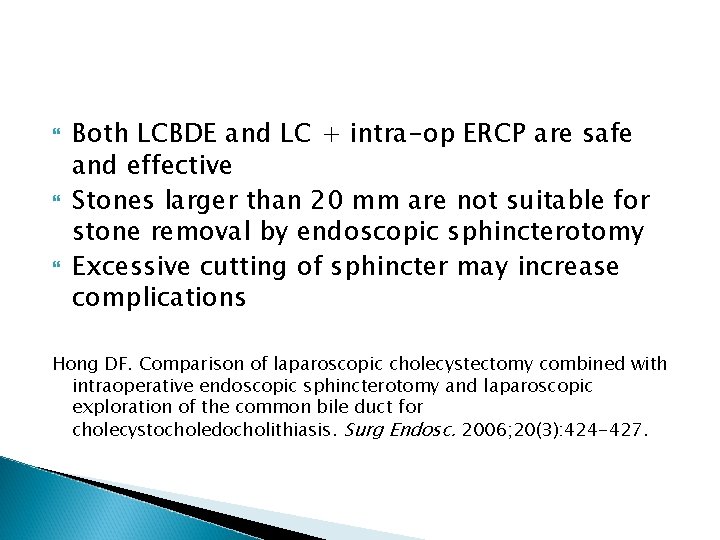
Both LCBDE and LC + intra-op ERCP are safe and effective Stones larger than 20 mm are not suitable for stone removal by endoscopic sphincterotomy Excessive cutting of sphincter may increase complications Hong DF. Comparison of laparoscopic cholecystectomy combined with intraoperative endoscopic sphincterotomy and laparoscopic exploration of the common bile duct for cholecystocholedocholithiasis. Surg Endosc. 2006; 20(3): 424 -427.
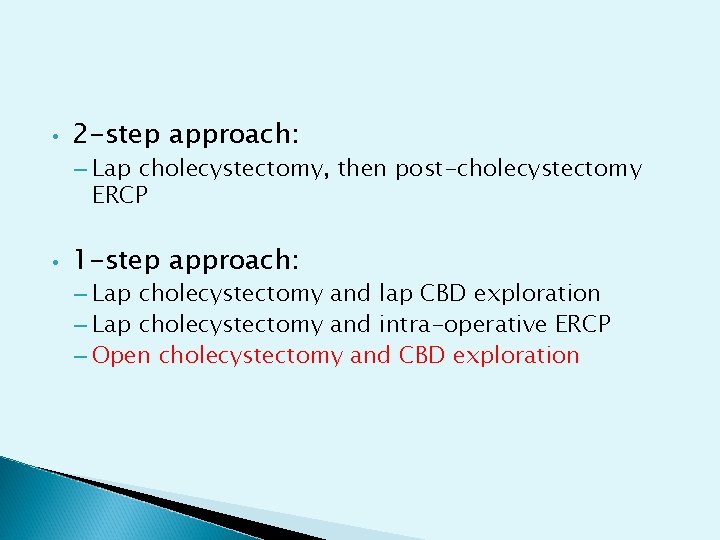
• 2 -step approach: – Lap cholecystectomy, then post-cholecystectomy ERCP • 1 -step approach: – Lap cholecystectomy and lap CBD exploration – Lap cholecystectomy and intra-operative ERCP – Open cholecystectomy and CBD exploration
Open CBD exploration Open CBDE remains the “gold standard” for selected, rare patients such as those with Mirizzi syndrome, Billroth II anatomy, and those requiring a drainage procedure. Morbidity from 11% to 14% Mortality from 0. 6% to 1%. Morgenstern L, Wong L, Berci G. Twelve hundred open cholecystectomies before the laparoscopic era. A standard for comparison. Arch Surg 1992; 127: 400– 403.
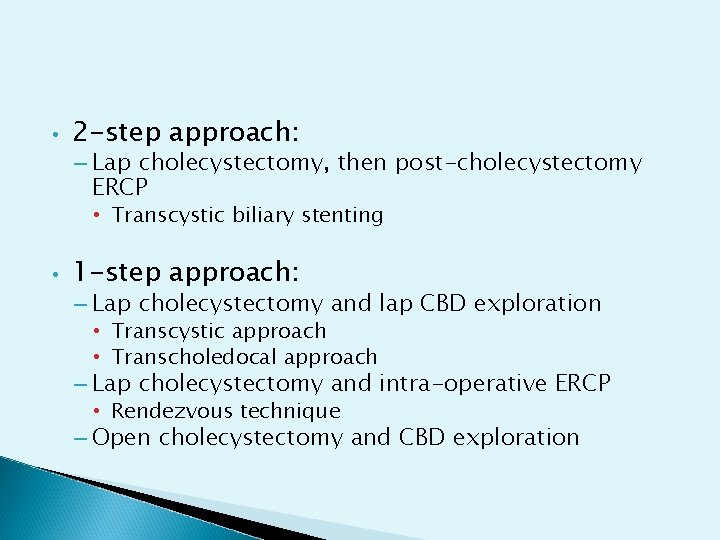
• 2 -step approach: – Lap cholecystectomy, then post-cholecystectomy ERCP • Transcystic biliary stenting • 1 -step approach: – Lap cholecystectomy and lap CBD exploration • Transcystic approach • Transcholedocal approach – Lap cholecystectomy and intra-operative ERCP • Rendezvous technique – Open cholecystectomy and CBD exploration
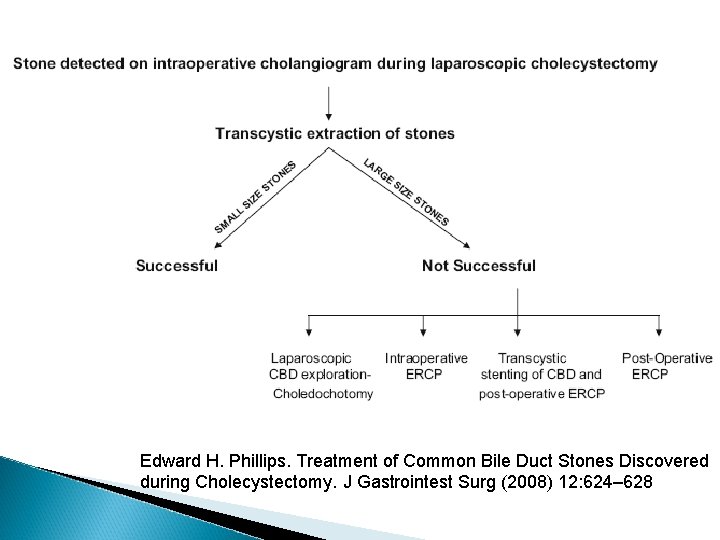
Edward H. Phillips. Treatment of Common Bile Duct Stones Discovered during Cholecystectomy. J Gastrointest Surg (2008) 12: 624– 628
However, it is unrealistic to extrapolate standards of care based on the available RCTs given the wide variation in skills and resources available in different communities. Individual surgeons must recognize their own limitations and the limitations of available endoscopists and perform the safest approach.
Conclusion Lap CBD exploration is comparable to postop ERCP in terms of ductal clearance, morbidity and re-operation rate. Lap CBD exploration is comparable to intraoperative ERCP in terms of success rate, stone clearance and complications. Intra-operative ERCP has higher success rate and less complications (esp. pancreatitis) when compared to post-op ERCP
Decision depends on: ◦ ◦ ◦ Stone number and size Cystic duct size and anatomy CBD size Severity of tissue inflammation Past surgical history Surgeon’s experience

THANK YOU!


What are the methods for closing choledochotomy?
Choledochotomy can be closed by either primary closure or insertion of T-tube Primary closure: ◦ Choledochotomy is closed with 40 or 50 vicryl, either interrupted or continuous suture. T-tube: ◦ The entire 14 -French T-tube is placed into abdomen ◦ Then the “T” is inserted into the CBD
• Use of T-tube is based on for three primary factors: • decompression of the duct, in the case of residual distal obstruction; • ductal imaging in the postoperative period • provision of an access route for removal of residual CBD stones, should they be left after CBD exploration Williams JAR. (1994) Primary duct closure versus T-tube drainage following exploration of the common bile duct. Aust N Z J Surg 64: 823– 826
• Drawbacks of T-tubes during postoperative period: • • • Bacteremia Dislodgment of the tube Obstruction by the tube Fracture of the tube Removal of T-tubes has been associated with bile leaks, peritonitis, and reoperation
• • T-tube cholangiography should be performed before removal of the tube Removal of T-tubes has been suggested as early as 4 days postoperatively and as late as 6 weeks after surgery Norrby S (1988) Duration of T-tube drainage after exploration of the common bile duct. Acta Chir Scand 154: 113– 115
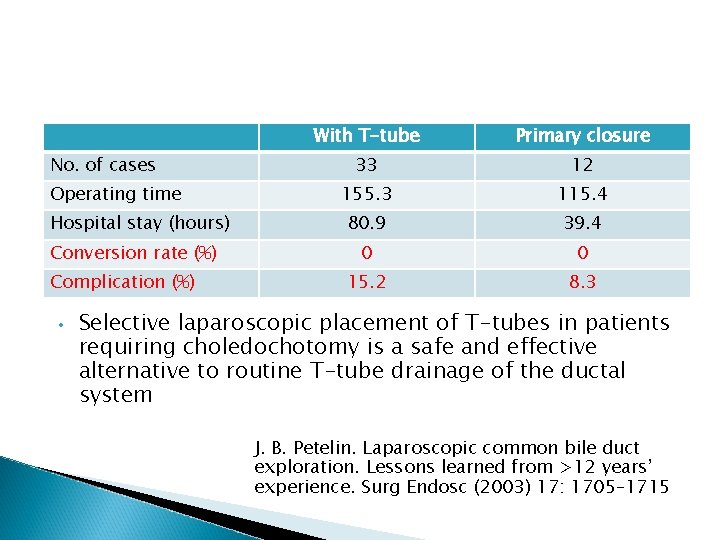
No. of cases Operating time Hospital stay (hours) Conversion rate (%) Complication (%) • With T-tube Primary closure 33 12 155. 3 115. 4 80. 9 39. 4 0 0 15. 2 8. 3 Selective laparoscopic placement of T-tubes in patients requiring choledochotomy is a safe and effective alternative to routine T-tube drainage of the ductal system J. B. Petelin. Laparoscopic common bile duct exploration. Lessons learned from >12 years’ experience. Surg Endosc (2003) 17: 1705– 1715
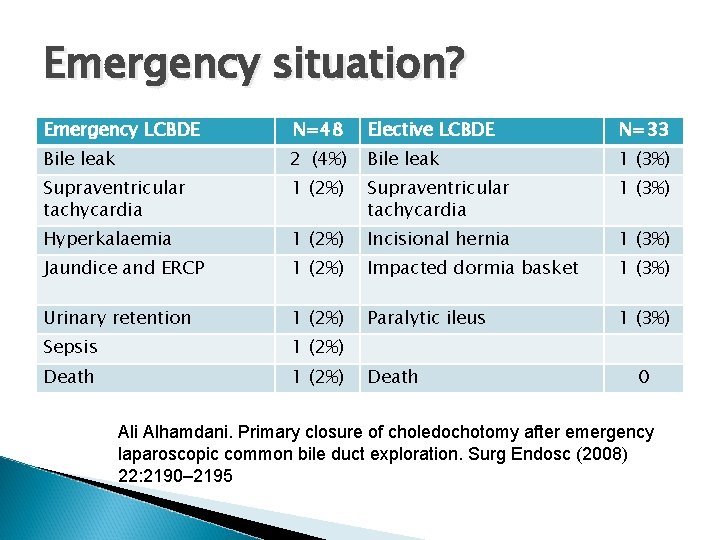
Emergency situation? Emergency LCBDE N=48 Elective LCBDE N=33 Bile leak 2 (4%) Bile leak 1 (3%) Supraventricular tachycardia 1 (2%) Supraventricular tachycardia 1 (3%) Hyperkalaemia 1 (2%) Incisional hernia 1 (3%) Jaundice and ERCP 1 (2%) Impacted dormia basket 1 (3%) Urinary retention 1 (2%) Paralytic ileus 1 (3%) Sepsis 1 (2%) Death 0 Ali Alhamdani. Primary closure of choledochotomy after emergency laparoscopic common bile duct exploration. Surg Endosc (2008) 22: 2190– 2195
• • Safe for primary closure in emergency setting by comparing it to the elective setting. Moreover, no difference was shown in operative time or the hospital stay between the two groups
- Slides: 58