
Management of ascending aortic aneurysm M MUSONI REGISTRAR

- Slides: 37
Management of ascending aortic aneurysm M. MUSONI REGISTRAR DEPARTMENT OF CARDIOTHORACIC SURGERY UNIVERSITY OF WITWATERSRAND Hannes Meyer Registrar Symposium – 11/7/2015
Overview • Defined arbitrarily as increase of at least 50% in diameter of ascending aorta compared to normal aorta for a particular age , gender and BSA • True aneurysm: all layers of vessel wall • False: localized, contained by adventitia alone or with part of the media • Saccular Vs fusiform
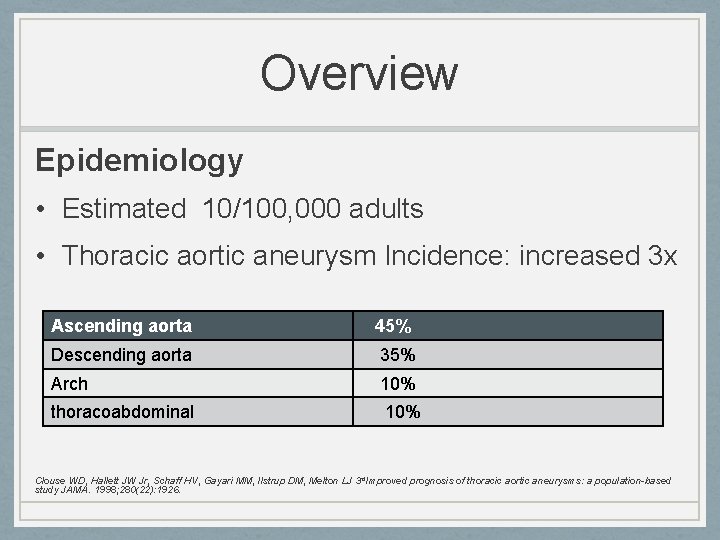
Overview Epidemiology • Estimated 10/100, 000 adults • Thoracic aortic aneurysm Incidence: increased 3 x Ascending aorta 45% Descending aorta 35% Arch 10% thoracoabdominal 10% Clouse WD, Hallett JW Jr, Schaff HV, Gayari MM, Ilstrup DM, Melton LJ 3 rd. Improved prognosis of thoracic aortic aneurysms: a population-based study JAMA. 1998; 280(22): 1926.
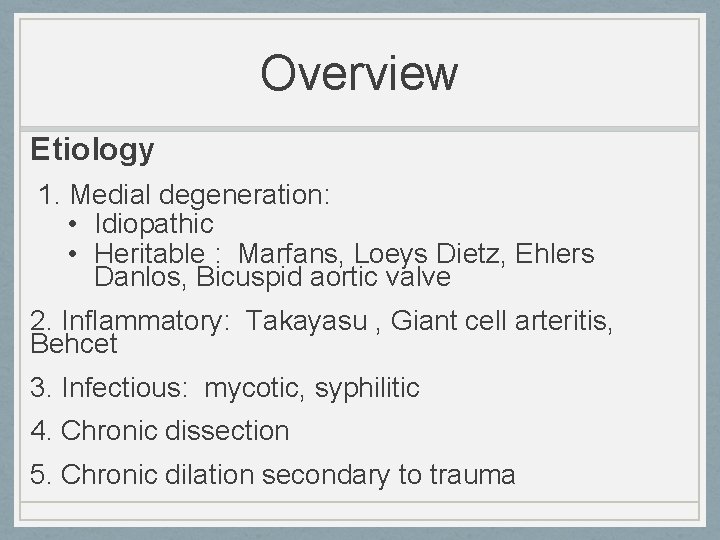
Overview Etiology 1. Medial degeneration: • Idiopathic • Heritable : Marfans, Loeys Dietz, Ehlers Danlos, Bicuspid aortic valve 2. Inflammatory: Takayasu , Giant cell arteritis, Behcet 3. Infectious: mycotic, syphilitic 4. Chronic dissection 5. Chronic dilation secondary to trauma
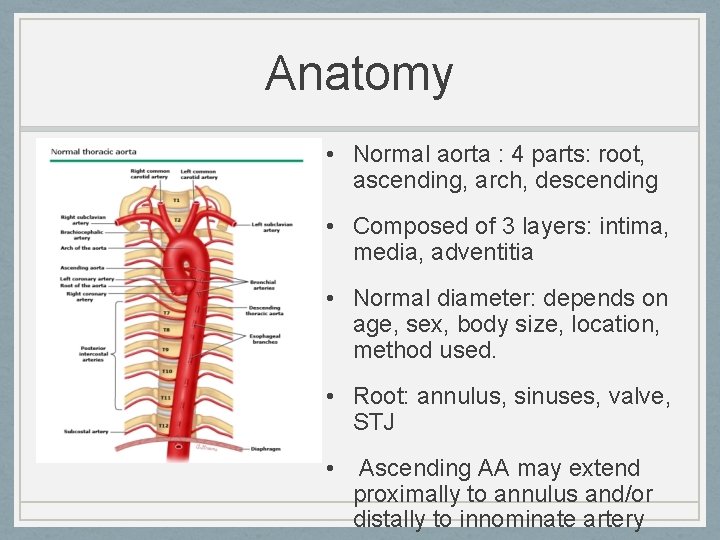
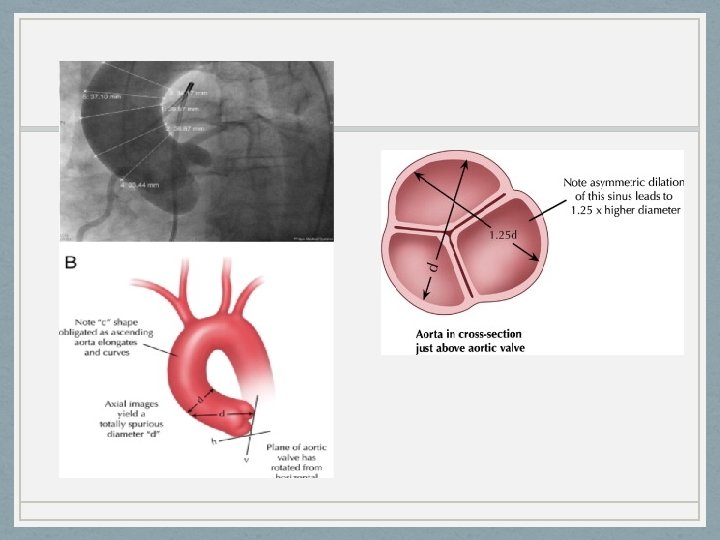
Anatomy • Normal aorta : 4 parts: root, ascending, arch, descending • Composed of 3 layers: intima, media, adventitia • Normal diameter: depends on age, sex, body size, location, method used. • Root: annulus, sinuses, valve, STJ • Ascending AA may extend proximally to annulus and/or distally to innominate artery
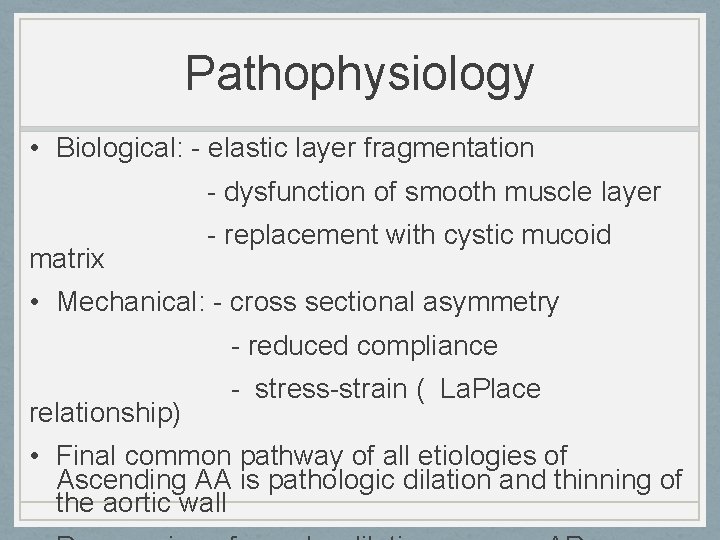
Pathophysiology • Biological: - elastic layer fragmentation - dysfunction of smooth muscle layer matrix - replacement with cystic mucoid • Mechanical: - cross sectional asymmetry - reduced compliance relationship) - stress-strain ( La. Place • Final common pathway of all etiologies of Ascending AA is pathologic dilation and thinning of the aortic wall
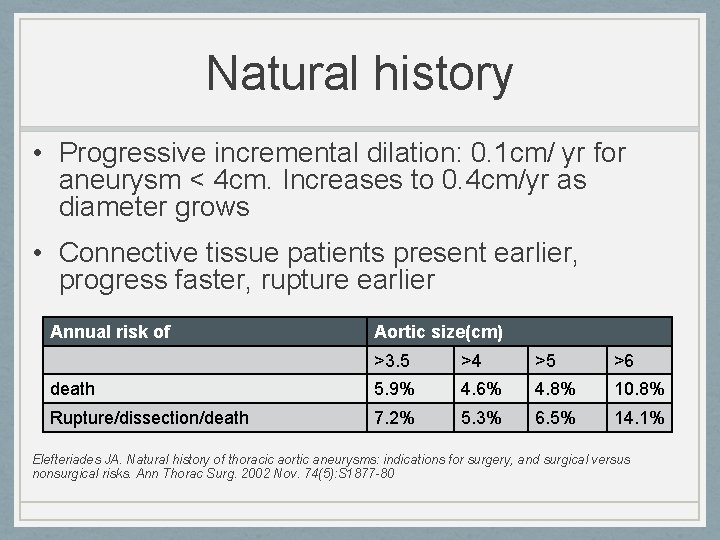
Natural history • Progressive incremental dilation: 0. 1 cm/ yr for aneurysm < 4 cm. Increases to 0. 4 cm/yr as diameter grows • Connective tissue patients present earlier, progress faster, rupture earlier Annual risk of Aortic size(cm) >3. 5 >4 >5 >6 death 5. 9% 4. 6% 4. 8% 10. 8% Rupture/dissection/death 7. 2% 5. 3% 6. 5% 14. 1% Elefteriades JA. Natural history of thoracic aortic aneurysms: indications for surgery, and surgical versus nonsurgical risks. Ann Thorac Surg. 2002 Nov. 74(5): S 1877 -80
Clinical picture • Symptoms: - asymptomatic/ incidental finding -Chest pain: radiating to jaw, acute extension or impeding rupture - Compression symptoms: SVC syndrome, hoarseness • Signs: - mostly unremarkable, may have wide pulse pressure, diastolic murmur due to AR
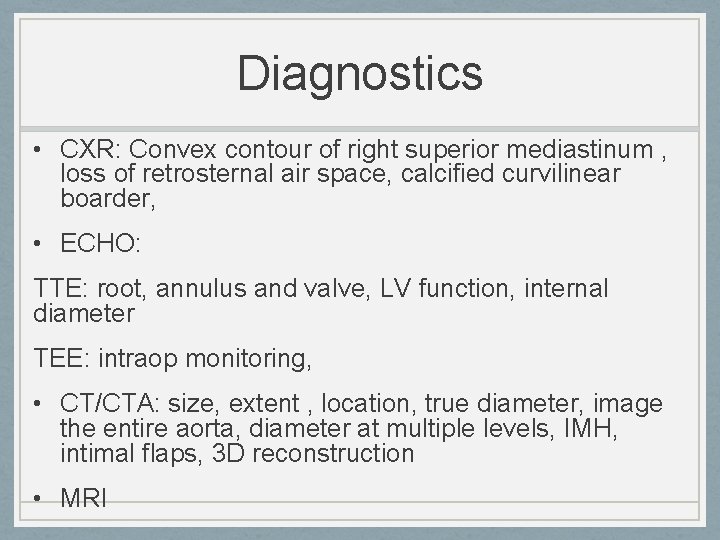
Diagnostics • CXR: Convex contour of right superior mediastinum , loss of retrosternal air space, calcified curvilinear boarder, • ECHO: TTE: root, annulus and valve, LV function, internal diameter TEE: intraop monitoring, • CT/CTA: size, extent , location, true diameter, image the entire aorta, diameter at multiple levels, IMH, intimal flaps, 3 D reconstruction • MRI
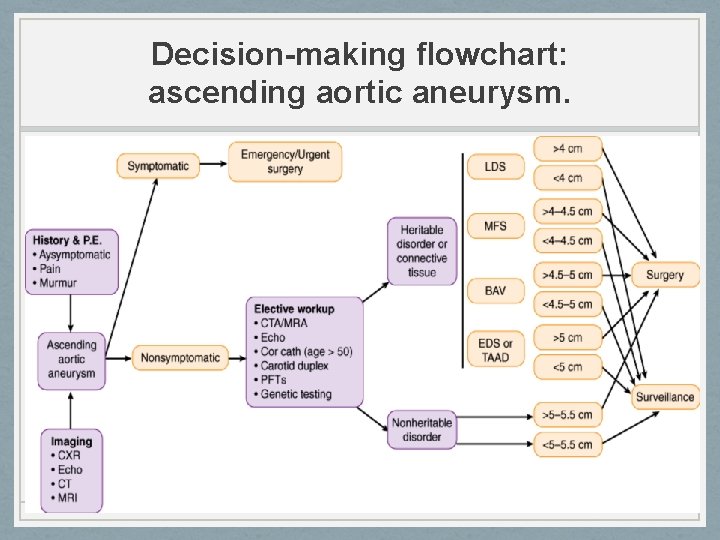
Decision-making flowchart: ascending aortic aneurysm.
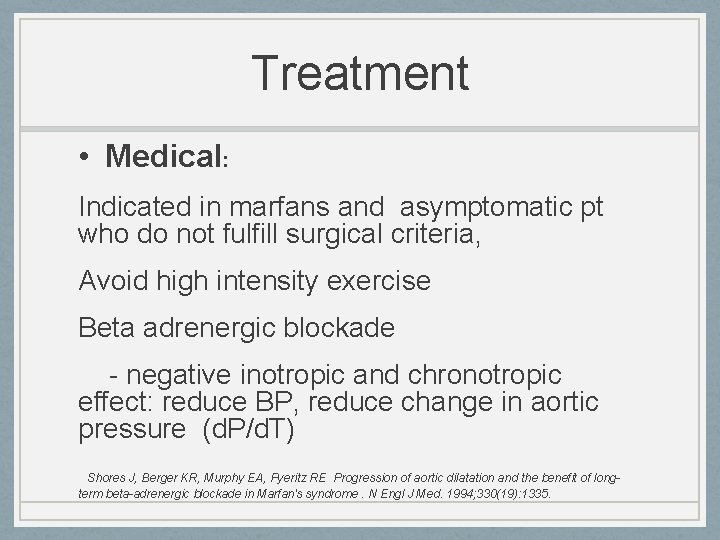
Treatment • Medical: Indicated in marfans and asymptomatic pt who do not fulfill surgical criteria, Avoid high intensity exercise Beta adrenergic blockade - negative inotropic and chronotropic effect: reduce BP, reduce change in aortic pressure (d. P/d. T) Shores J, Berger KR, Murphy EA, Pyeritz RE Progression of aortic dilatation and the benefit of longterm beta-adrenergic blockade in Marfan's syndrome. N Engl J Med. 1994; 330(19): 1335.
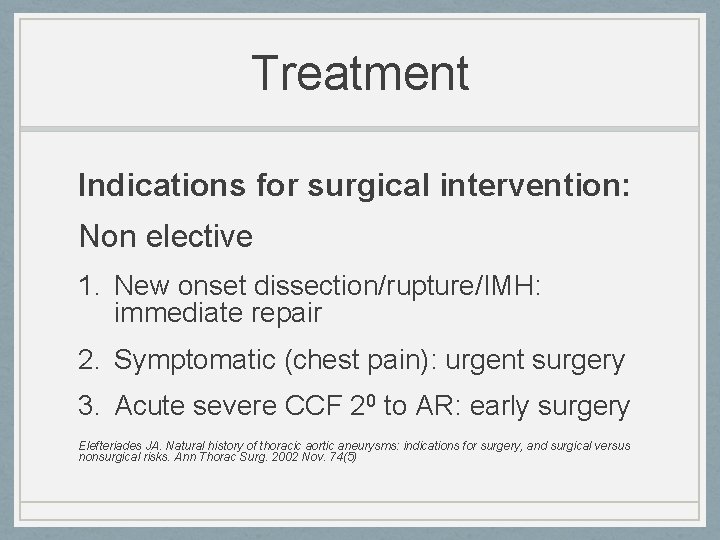
Treatment Indications for surgical intervention: Non elective 1. New onset dissection/rupture/IMH: immediate repair 2. Symptomatic (chest pain): urgent surgery 3. Acute severe CCF 20 to AR: early surgery Elefteriades JA. Natural history of thoracic aortic aneurysms: indications for surgery, and surgical versus nonsurgical risks. Ann Thorac Surg. 2002 Nov. 74(5)
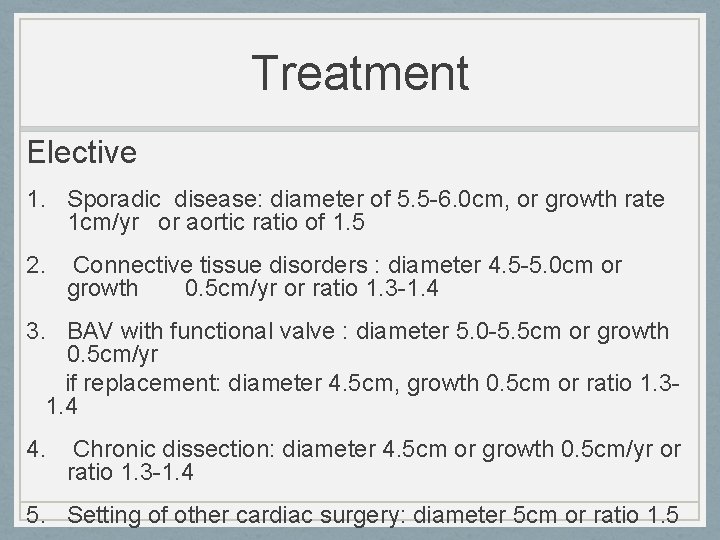
Treatment Elective 1. Sporadic disease: diameter of 5. 5 -6. 0 cm, or growth rate 1 cm/yr or aortic ratio of 1. 5 2. Connective tissue disorders : diameter 4. 5 -5. 0 cm or growth 0. 5 cm/yr or ratio 1. 3 -1. 4 3. BAV with functional valve : diameter 5. 0 -5. 5 cm or growth 0. 5 cm/yr if replacement: diameter 4. 5 cm, growth 0. 5 cm or ratio 1. 31. 4 4. Chronic dissection: diameter 4. 5 cm or growth 0. 5 cm/yr or ratio 1. 3 -1. 4 5. Setting of other cardiac surgery: diameter 5 cm or ratio 1. 5
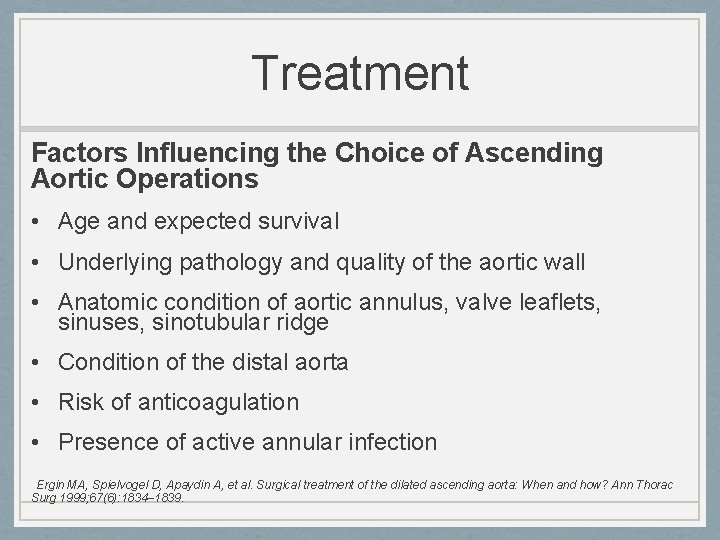
Treatment Factors Influencing the Choice of Ascending Aortic Operations • Age and expected survival • Underlying pathology and quality of the aortic wall • Anatomic condition of aortic annulus, valve leaflets, sinuses, sinotubular ridge • Condition of the distal aorta • Risk of anticoagulation • Presence of active annular infection Ergin MA, Spielvogel D, Apaydin A, et al. Surgical treatment of the dilated ascending aorta: When and how? Ann Thorac Surg 1999; 67(6): 1834– 1839.
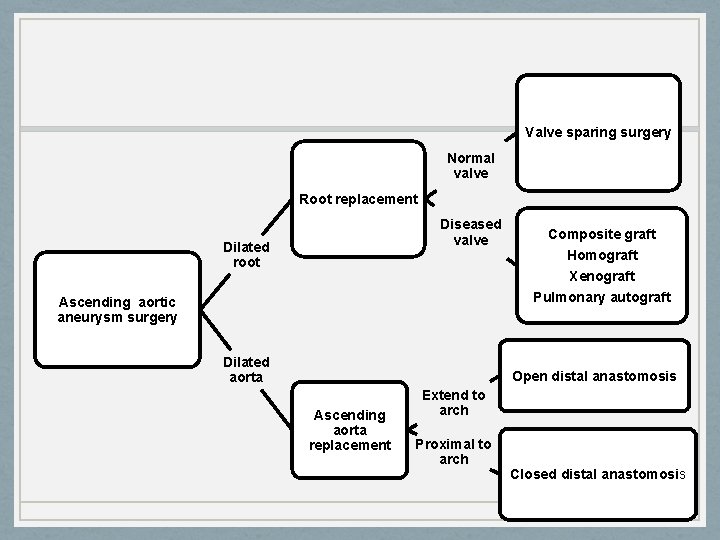
Valve sparing surgery Normal valve Root replacement Diseased valve Dilated root Composite graft Homograft Xenograft Pulmonary autograft Ascending aortic aneurysm surgery Dilated aorta Open distal anastomosis Ascending aorta replacement Extend to arch Proximal to arch Closed distal anastomosis
Operative technique • Procedural steps will vary depending on extent of aneurysm, whether aortic valve is normal or needs replacement • Anesthesia and monitoring • CV access, PAC, • A line: preferably right radial • Foley catheter and nasopharyngeal temp probe • TEE:
Replacement of ascending aorta • Aneurysm not involving root and not extending to arch • Arterial cannulation is high in the arch • Cardioprotection: antegrade and retrograde, • LV vent, cool to 28 -340 C, Cohn LH, Rizzo RJ, Adams DH et al Reduced mortality and morbidity for ascending aortic aneurysm resection regardless of cause. Ann Thorac Surg 1996; 62(2): 463– 468
Replacement of ascending aorta • Dissection: transect aneurysm at midpoint, resect aneurysmal tissue, leave enough room to do proximal and proximally for anastomosis, • Impregnated dacron graft and 4 -0 prolene for anastomosis, Felt may be used to reinforce aorta, start distal anastomosis first • Proximal anastomosis completed after turning off vent to aid deairing Outcomes: operative mortality 2 -5%, late survival 65% at 5 yrs, 55% at 7 yrs
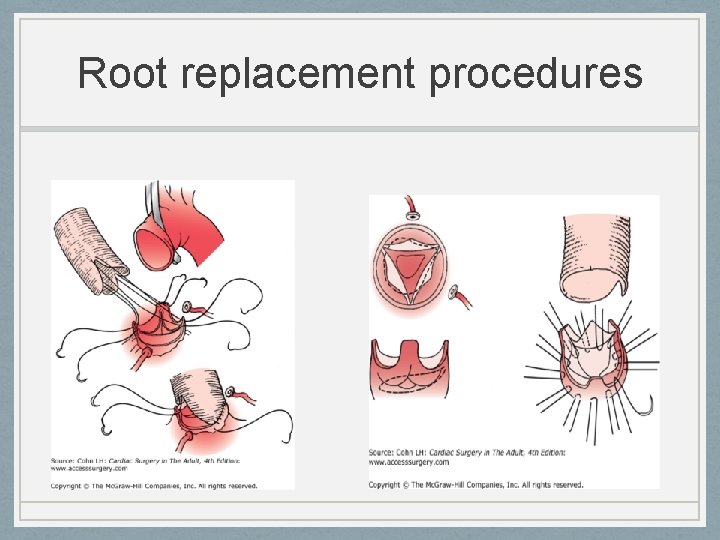
Root replacement procedures Valve-sparing root procedures Ideal candidates: ascending AA, abnormal root, normal or near normal valves ( functional AR) - Controversial in MFS but early outcomes are promising - Conduits: dacron tube graft - Contraindicated: abnormal valves, patient requiring anticoagulation
Root replacement procedures Valve-sparing root procedures Outcomes: Yacoub: remodelling Vs David: reimplantation Low operative mortality for both, higher redo for bleeding in Yacoub (18 vs 3%), lower trend in late AR in David, 17% reoperation at 10 yrs in Yacoub David TE et al. Aortic valve-sparing operations in patients with aneurysms of the aortic root or ascending aorta. Ann Thorac Surg. 2002 Nov. 74(5): S 1758 -61
Root replacement procedures
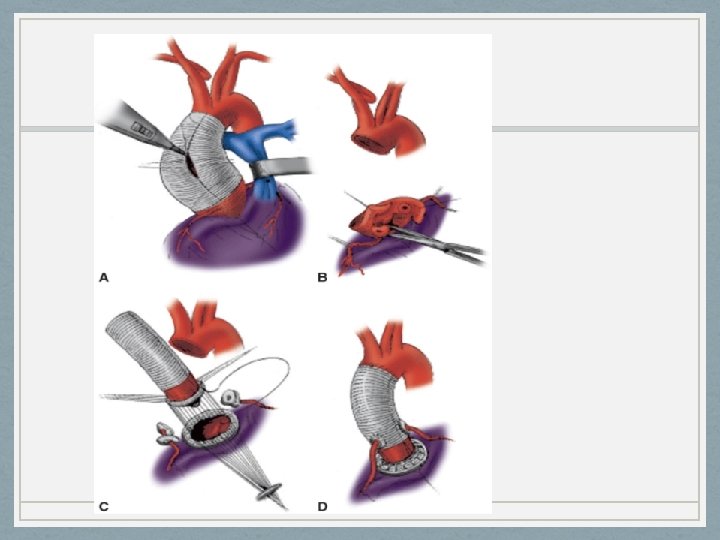
Root replacement procedures Composite graft -Ideal candidates: asc AA, root aneurysm, abnormal valve -Conduit: dacron valved mechanical or hand sewn bioprosthetic valve Mechanical: <60 yrs, no contraindication to anticoagulation, Bioprosthesis: > 65 yrs, contraindication to anticoagulation, female desiring to have child, Outcomes: in Marfans, operative mortality 1. 5% (elective), 11. 7% (emergency) , survival at 10 yrs 5070% Smith JA, Fann JI, Miller DC et al Surgical management of aortic dissection in patients with the Marfan syndrome. Circulation 1994; 90(5 Pt 2): II 235–II 242.
Root replacement procedures Replacement with Aortic homograft -Ideal candidates: active annular infection+ root dilatation, -Conduit: cryopreserved aortic homograft Outcomes: Operative mortality 5. 3%, long-term survival (8 yr) 80%, long-term freedom from reoperation (8 yrs) 10% El-Hamamsy I, Clark L, Stevens LM, Sarang Z, Melina G, et al: Late outcomes following freestyle versus homograft aortic root replacement results from a prospective randomized trial. J Am Coll Cardiol 2010; 55(4): 368 -376
Root replacement procedures Replacement with Aortic xenograft - Ideal candidate: patient > 60 yrs with diseased valve and aortic root aneurysm - Conduit: stent less porcine (freestyle) Outcomes: Freedom from mod/severe AR at 8 yrs was 98. 7%, stable EOA for 8 yrs, 10 yrs freedom from valve related death 89 -96%, freedom from structural deterioration 100% Bach DS, Kon ND Long-term clinical outcomes 15 years after aortic valve replacement with the Freestyle stentless aortic bioprosthesis. Ann Thorac Surg. 2014 Feb; 97(2): 544 -51 .
Root replacement procedures Pulmonary autograft - Very young patient needing replacement - Controversial in adult, - Conduit: pulmonary autograft - Homograft needed in pulmonary position Outcomes: Freedom from endocarditis at 13 yrs : 97%, actuarial survival at 10 yrs: 97% , periop mortality <1% El hamamsy I et al , Long-term outcomes after autograft versus homograft aortic root replacement in adults with aortic valve disease: a randomised controlled trial. Lancet. 2010 Aug 14; 376(9740): 524 -31.
Other procedures Reduction aortoplasty +/- wrapping - Elderly patient unfit for complex surgery Hybrid and stent graft approaches - Evidence from large studies on benefit still lacking - May offer option for high risk surgical candidates
Deep hypothermic circulatory arrest • Aneurysm involving the proximal arch requiring open distal anastomosis necessitating DHCA • Simple and gives bloodless field • Circulatory arrest at 18 -200 C • Safe arrest time 25 -30 min • Longer periods have shown worse outcomes, • In addition to basic monitoring: EEG, NIRS, Temp probe at two sites
Deep hypothermic circulatory arrest Circulatory management: cannulation strategies • Arterial: • central cannulation (arch) stab or Seldinger technique • right axillary artery: through dacron graft • femoral artery: avoid in atheroma of descending aorta • Venous: Dual stage or bicaval in concomitant MV/TR repair or retrograde cerebral perfusion
Deep hypothermic circulatory arrest Circulatory management: cooling • CPB, head cooling jacket, cool to 12 -180 C • Cooling to EEG silence preferred over choosing a threshold • Maintain 2 -30 C gradient between arterial and venous flow - even cooling • 22 -250 C if using Retrograde cerebral perfusion or Selective antegrade cerebral perfusion
Deep hypothermic circulatory arrest Cerebral protection strategies Hypothermia, retrograde cerebral perfusion (CP), selective antegrade CP, pharmacological adjuncts q Hypothermia - Patient cooled to 18 -200 C - Safe arrest time 25 -30 min - Bispectral index or jugular venous bulb oxygen saturation monitoring -Disadvantages: coagulopathy, long CPB time, renal and neurological dysfunction
Deep hypothermic circulatory arrest Cerebral protection strategies q Retrograde cerebral perfusion - Adjunct to DHCA - Maintain cerebral hypothermia and perfusion, washout of embolic debris, - 24 F wire reinforced cannula in SVC beyond azygous - Flow rates 200 -300 cc/min, perfusate at 12 -180 C, Trendelenburg position - Pressure in right Internal jugular maintained at 25 mm. Hg
Deep hypothermic circulatory arrest Cerebral protection strategies q Ante grade selective cerebral perfusion - Beneficial over RCP if circulatory arrest > 35 -45 min - Direct cannulation of head vessels with balloon tipped cannula or right axillary artery cannulation : contralateral ischemia may occur -Perfusate flow of 10 cc/kg/min with pressure of 4070 mm. Hg at 10 -180 C q Pharmacological protection - Barbiturates ? /steroids
Complications Early: • Bleeding 2. 4 -11% • Stroke 1. 9 -5% • Pulmonary dysfunction: ARDS 0. 5 -1. 7% • Myocardial dysfunction: 18 -25% requiring support • Periop mortality: 1. 7 -17. 1% Late: • Late mortality • Reoperation: pseudoaneurysm, progression of disease, • Graft infection: 0. 9 -6%
Conclusion Current data shows preemptive surgery on the ascending aorta has much less mortality rate than that in the natural history of rupture, dissection or other aneurysm related death.
Thank you.