
Management Information System Comprehensive and Organized Chapter 3
- Slides: 18
Management Information System Comprehensive and Organized Chapter 3 Computer Software
Chapter Highlights • Computer software • Algorithm • Flowchart • Programming languages • Language generations • Open source software • Server software • C Programming Language
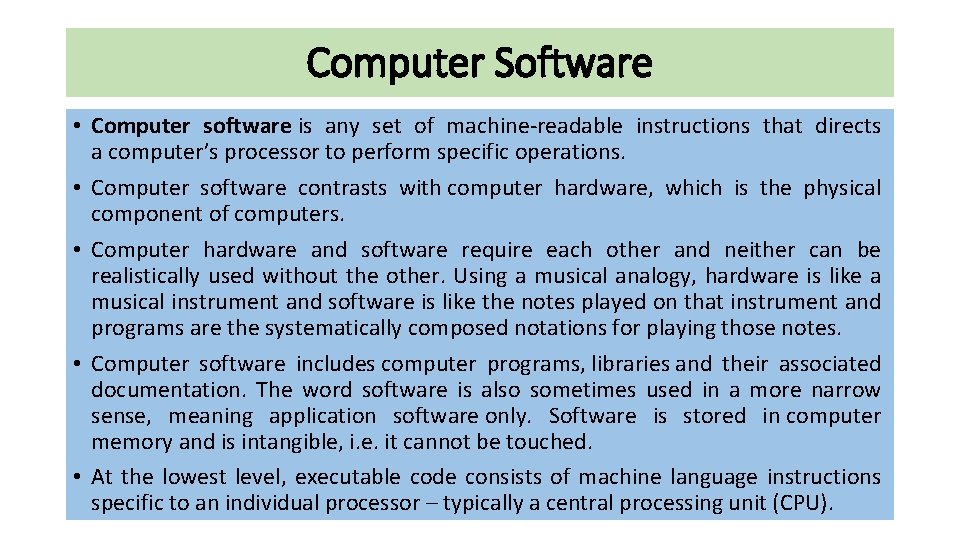
Computer Software • Computer software is any set of machine-readable instructions that directs a computer’s processor to perform specific operations. • Computer software contrasts with computer hardware, which is the physical component of computers. • Computer hardware and software require each other and neither can be realistically used without the other. Using a musical analogy, hardware is like a musical instrument and software is like the notes played on that instrument and programs are the systematically composed notations for playing those notes. • Computer software includes computer programs, libraries and their associated documentation. The word software is also sometimes used in a more narrow sense, meaning application software only. Software is stored in computer memory and is intangible, i. e. it cannot be touched. • At the lowest level, executable code consists of machine language instructions specific to an individual processor – typically a central processing unit (CPU).
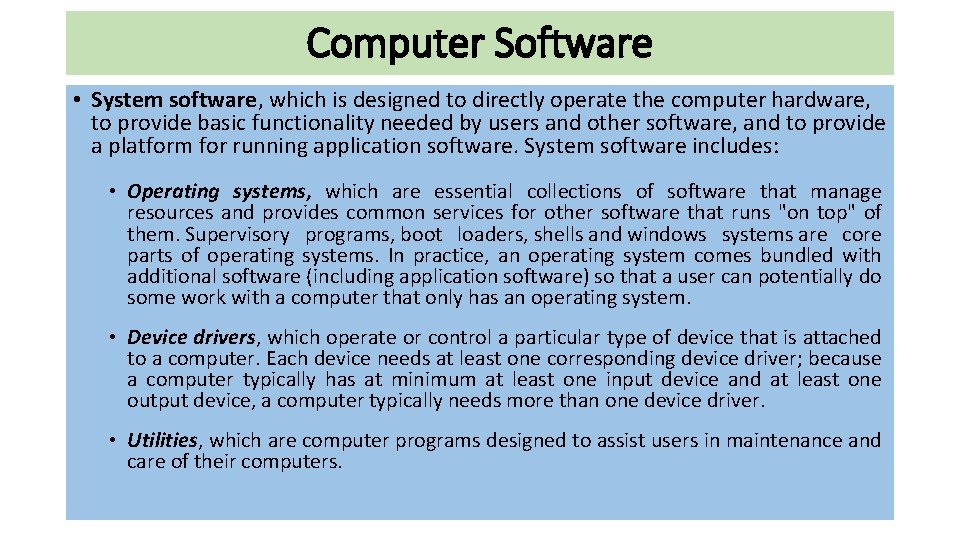
Computer Software • System software, which is designed to directly operate the computer hardware, to provide basic functionality needed by users and other software, and to provide a platform for running application software. System software includes: • Operating systems, which are essential collections of software that manage resources and provides common services for other software that runs "on top" of them. Supervisory programs, boot loaders, shells and windows systems are core parts of operating systems. In practice, an operating system comes bundled with additional software (including application software) so that a user can potentially do some work with a computer that only has an operating system. • Device drivers, which operate or control a particular type of device that is attached to a computer. Each device needs at least one corresponding device driver; because a computer typically has at minimum at least one input device and at least one output device, a computer typically needs more than one device driver. • Utilities, which are computer programs designed to assist users in maintenance and care of their computers.
Computer Software • Application Software, which uses the computer system to perform special functions or provide entertainment, functions beyond the basic operation of the computer itself. • There are many different types of application software, because the range of tasks that can be performed with a modern computer is so large. • Application software is often purchased separately from computer hardware. Sometimes applications are bundled with the computer, but that does not change the fact that they run as independent applications. • Applications are usually independent programs from the operating system, though they are often tailored for specific platforms. • Customized Software: These are the customized products using application software in order to cater to specific business requirements of the customers. Examples of such products are railway reservation system, core banking and insurance system, stock exchange system. • Malicious software or malware, which are computer programs developed to harm and disrupt computers. As such, malware is undesirable. Malware is closely associated with computer-related crimes.
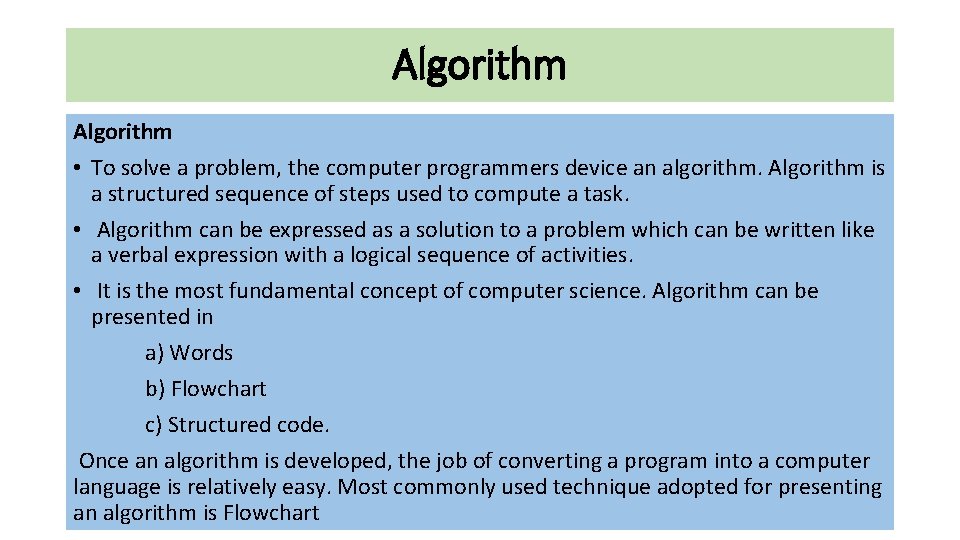
Algorithm • To solve a problem, the computer programmers device an algorithm. Algorithm is a structured sequence of steps used to compute a task. • Algorithm can be expressed as a solution to a problem which can be written like a verbal expression with a logical sequence of activities. • It is the most fundamental concept of computer science. Algorithm can be presented in a) Words b) Flowchart c) Structured code. Once an algorithm is developed, the job of converting a program into a computer language is relatively easy. Most commonly used technique adopted for presenting an algorithm is Flowchart
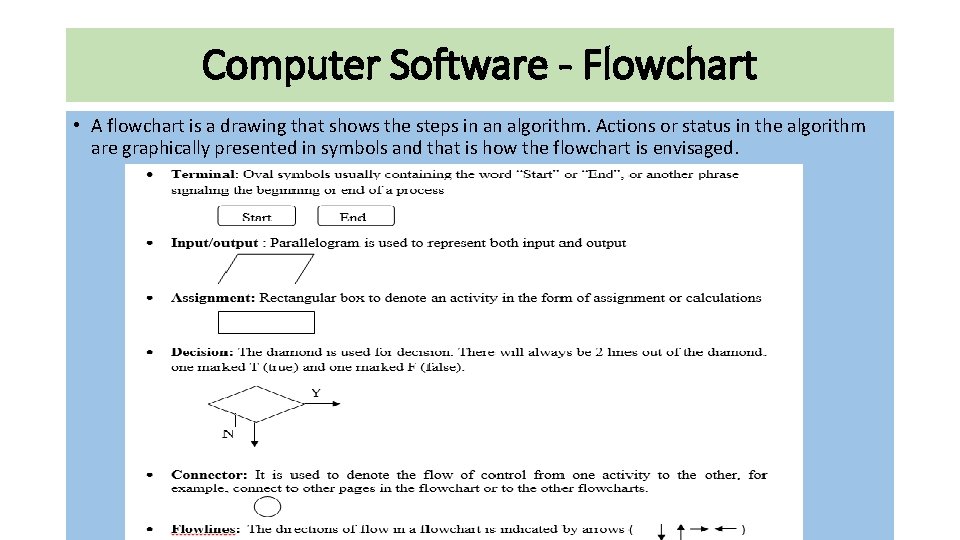
Computer Software - Flowchart • A flowchart is a drawing that shows the steps in an algorithm. Actions or status in the algorithm are graphically presented in symbols and that is how the flowchart is envisaged.
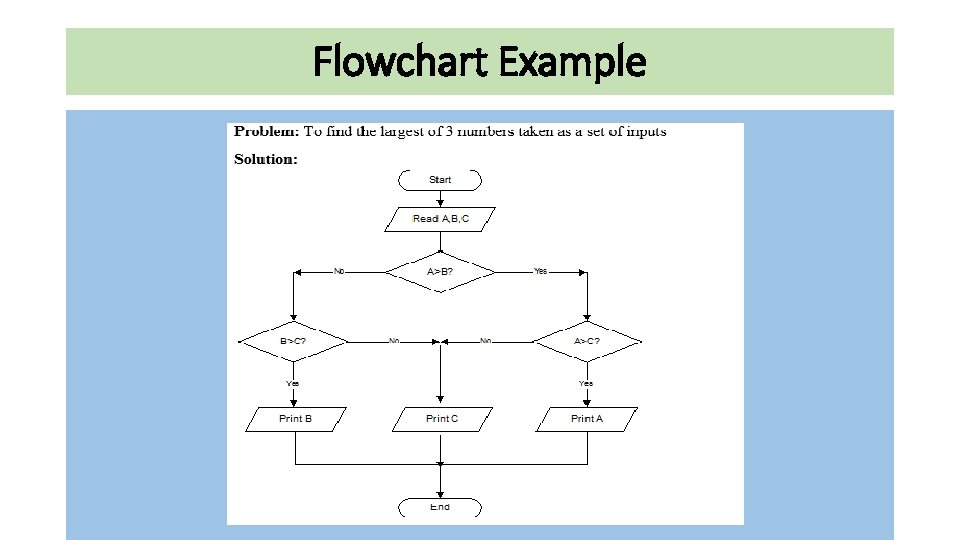
Flowchart Example
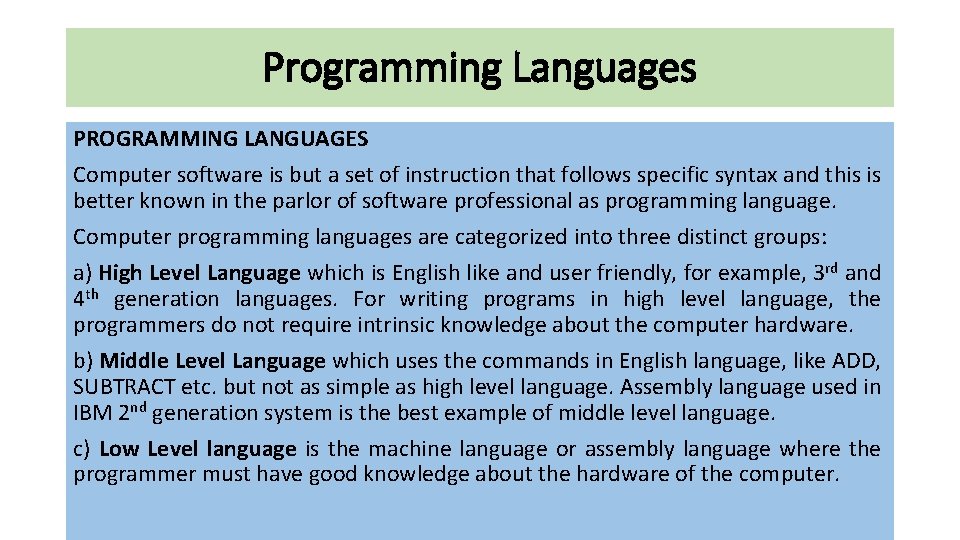
Programming Languages PROGRAMMING LANGUAGES Computer software is but a set of instruction that follows specific syntax and this is better known in the parlor of software professional as programming language. Computer programming languages are categorized into three distinct groups: a) High Level Language which is English like and user friendly, for example, 3 rd and 4 th generation languages. For writing programs in high level language, the programmers do not require intrinsic knowledge about the computer hardware. b) Middle Level Language which uses the commands in English language, like ADD, SUBTRACT etc. but not as simple as high level language. Assembly language used in IBM 2 nd generation system is the best example of middle level language. c) Low Level language is the machine language or assembly language where the programmer must have good knowledge about the hardware of the computer.
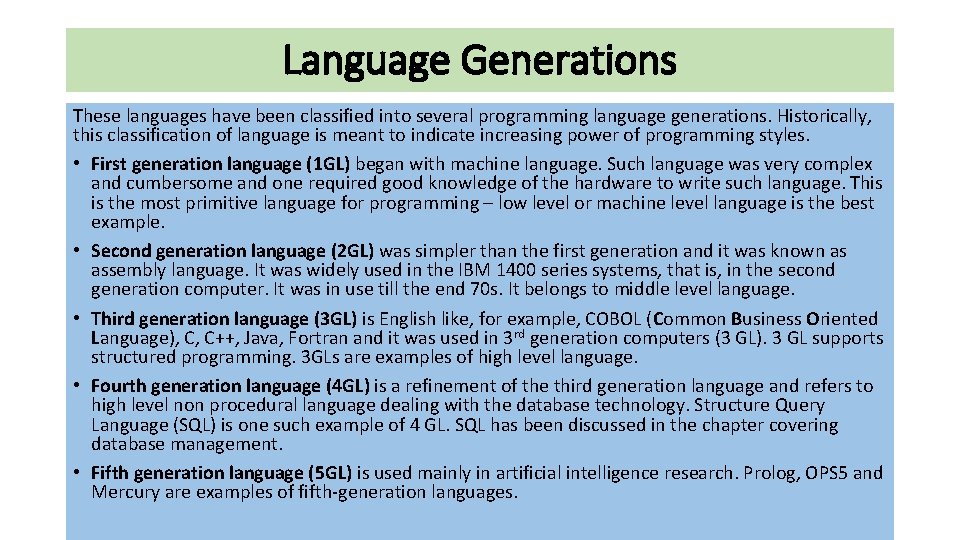
Language Generations These languages have been classified into several programming language generations. Historically, this classification of language is meant to indicate increasing power of programming styles. • First generation language (1 GL) began with machine language. Such language was very complex and cumbersome and one required good knowledge of the hardware to write such language. This is the most primitive language for programming – low level or machine level language is the best example. • Second generation language (2 GL) was simpler than the first generation and it was known as assembly language. It was widely used in the IBM 1400 series systems, that is, in the second generation computer. It was in use till the end 70 s. It belongs to middle level language. • Third generation language (3 GL) is English like, for example, COBOL (Common Business Oriented Language), C, C++, Java, Fortran and it was used in 3 rd generation computers (3 GL). 3 GL supports structured programming. 3 GLs are examples of high level language. • Fourth generation language (4 GL) is a refinement of the third generation language and refers to high level non procedural language dealing with the database technology. Structure Query Language (SQL) is one such example of 4 GL. SQL has been discussed in the chapter covering database management. • Fifth generation language (5 GL) is used mainly in artificial intelligence research. Prolog, OPS 5 and Mercury are examples of fifth-generation languages.
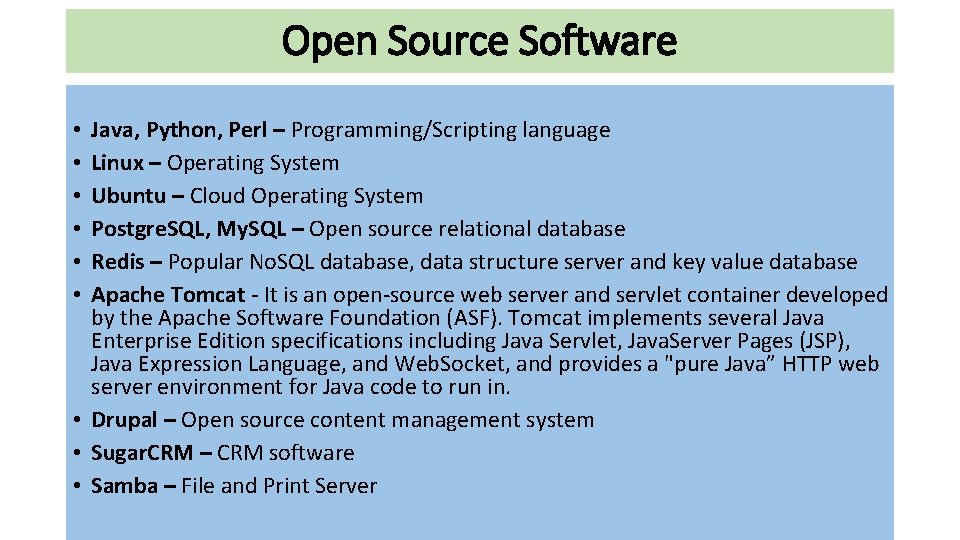
Open Source Software Java, Python, Perl – Programming/Scripting language Linux – Operating System Ubuntu – Cloud Operating System Postgre. SQL, My. SQL – Open source relational database Redis – Popular No. SQL database, data structure server and key value database Apache Tomcat - It is an open-source web server and servlet container developed by the Apache Software Foundation (ASF). Tomcat implements several Java Enterprise Edition specifications including Java Servlet, Java. Server Pages (JSP), Java Expression Language, and Web. Socket, and provides a "pure Java” HTTP web server environment for Java code to run in. • Drupal – Open source content management system • Sugar. CRM – CRM software • Samba – File and Print Server • • •
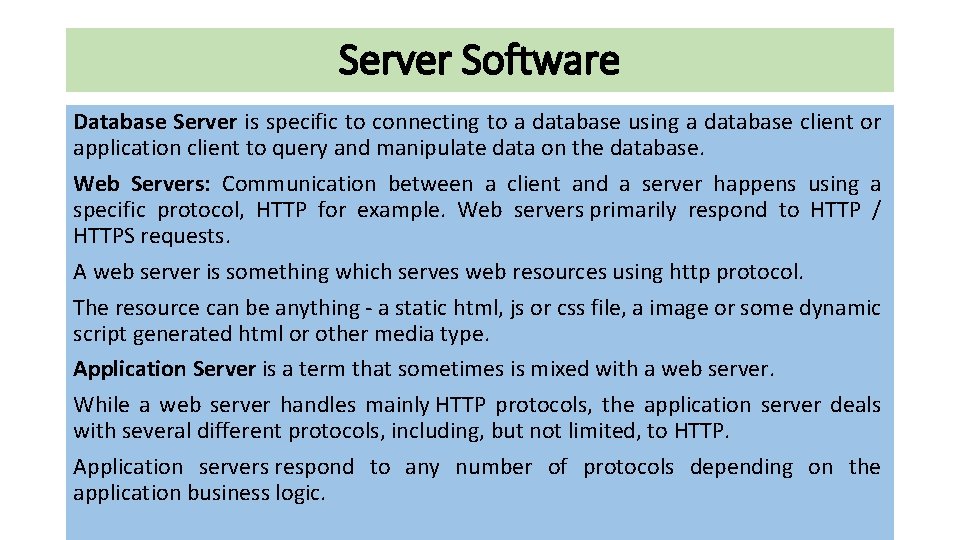
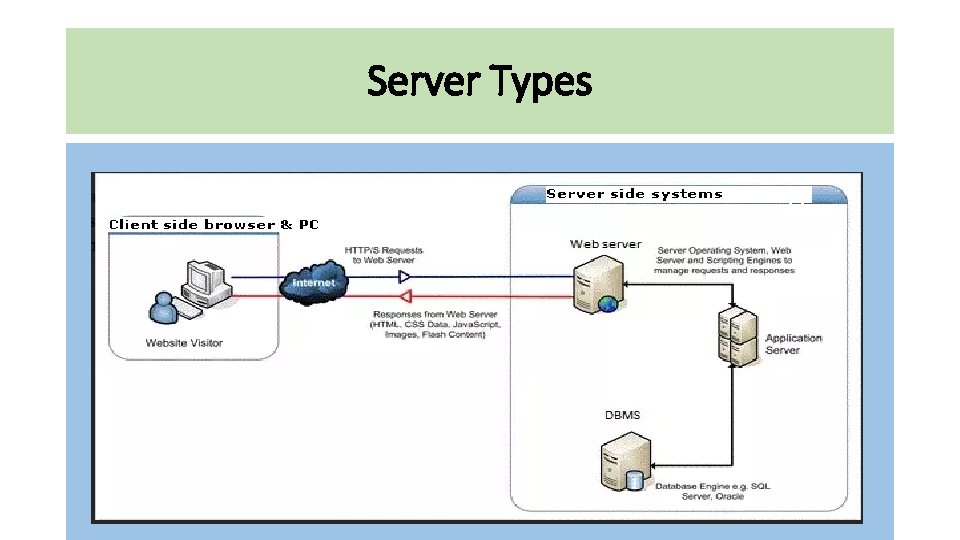
Server Software Database Server is specific to connecting to a database using a database client or application client to query and manipulate data on the database. Web Servers: Communication between a client and a server happens using a specific protocol, HTTP for example. Web servers primarily respond to HTTP / HTTPS requests. A web server is something which serves web resources using http protocol. The resource can be anything - a static html, js or css file, a image or some dynamic script generated html or other media type. Application Server is a term that sometimes is mixed with a web server. While a web server handles mainly HTTP protocols, the application server deals with several different protocols, including, but not limited, to HTTP. Application servers respond to any number of protocols depending on the application business logic.
Server Types
C Programming Language • C is a general purpose computer programming language which has found lasting use in applications that had formerly been coded in assembly language, including operating systems, as well as various application software for computers. • This may be one of the reasons that C is known as both high and low level language. • C was originally developed by Dennis Ritchie between 1969 and 1973 at AT&T Bell Labs. • They used to re-implement the Unix operating system. • It has since become one of the most widely used programming languages of all time with C compliers from various vendors available for the majority of existing computer architectures and operating systems.
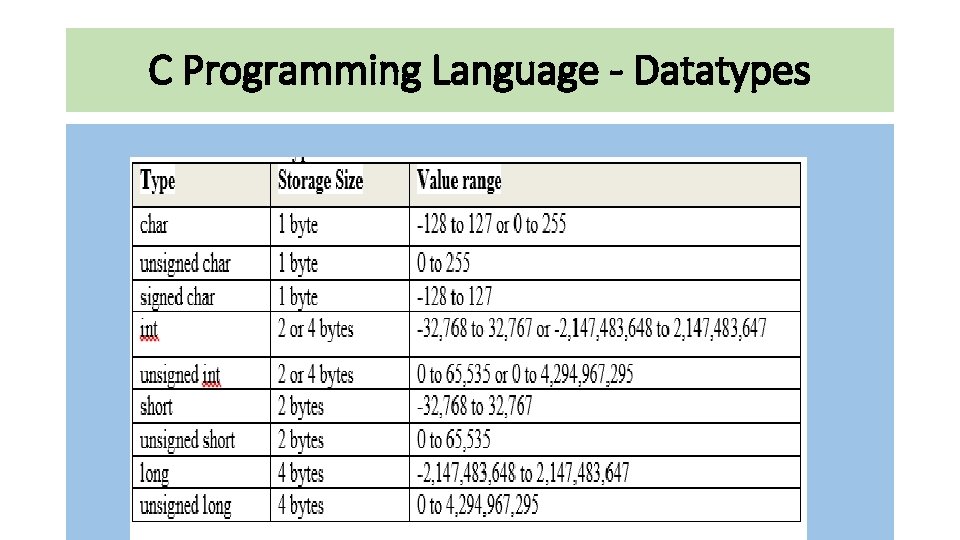
C Programming Language - Datatypes
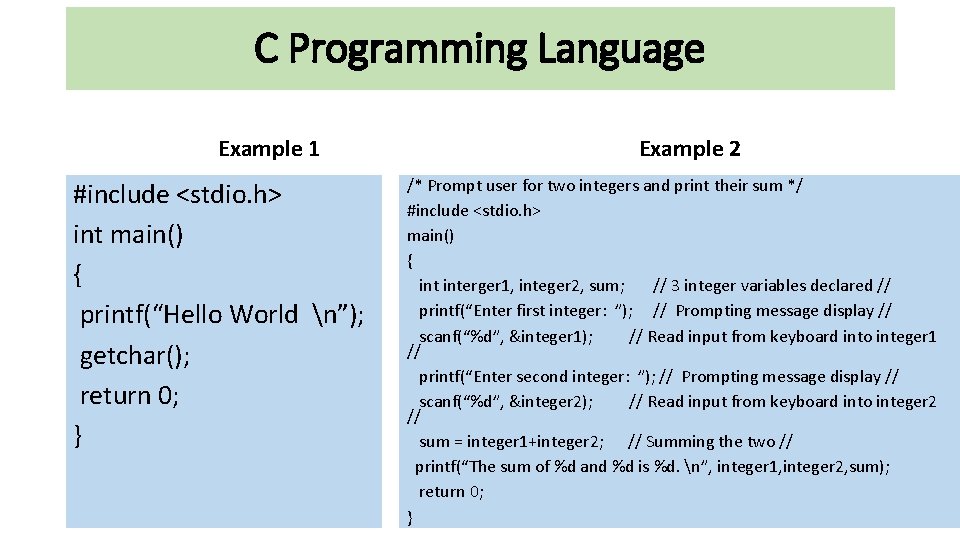
C Programming Language Example 1 #include <stdio. h> int main() { printf(“Hello World n”); getchar(); return 0; } Example 2 /* Prompt user for two integers and print their sum */ #include <stdio. h> main() { interger 1, integer 2, sum; // 3 integer variables declared // printf(“Enter first integer: ”); // Prompting message display // scanf(“%d”, &integer 1); // Read input from keyboard into integer 1 // printf(“Enter second integer: ”); // Prompting message display // scanf(“%d”, &integer 2); // Read input from keyboard into integer 2 // sum = integer 1+integer 2; // Summing the two // printf(“The sum of %d and %d is %d. n”, integer 1, integer 2, sum); return 0; }
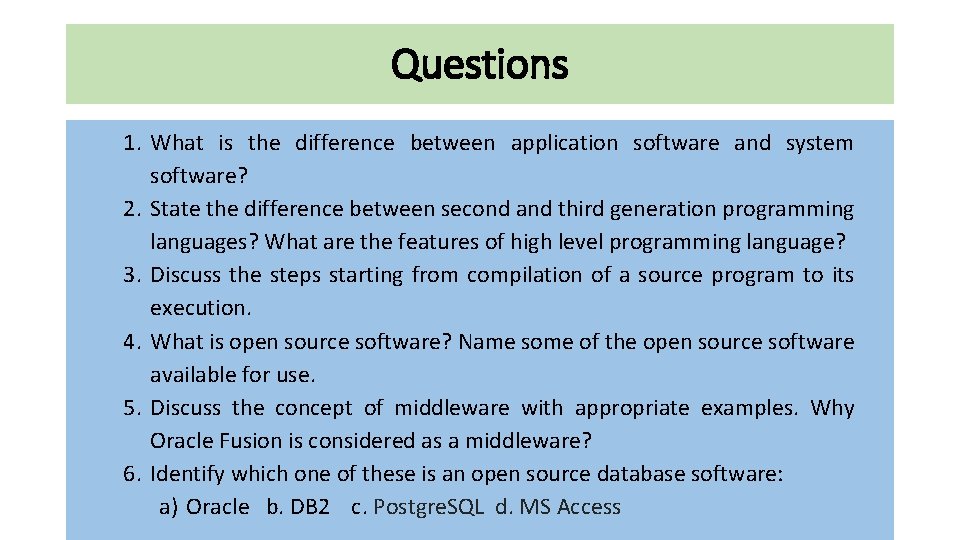
Questions 1. What is the difference between application software and system software? 2. State the difference between second and third generation programming languages? What are the features of high level programming language? 3. Discuss the steps starting from compilation of a source program to its execution. 4. What is open source software? Name some of the open source software available for use. 5. Discuss the concept of middleware with appropriate examples. Why Oracle Fusion is considered as a middleware? 6. Identify which one of these is an open source database software: a) Oracle b. DB 2 c. Postgre. SQL d. MS Access
Computer Software End of Chapter 3 Thank you