
Management Information System Challenges in Community Oriented Programmes
- Slides: 17
Management Information System Challenges in Community Oriented Programmes B. R. Shamanna Hyderabad, AP, India 9 th General Assembly, IAPB, Course 5, 17 th September 2012, Hall E, HICC, Hyderabad
Acknowledgements Dr. G. V. S. Murthy, India Dr. Hans Limburg, Netherlands "Those who have the data make the rules"
Management Information System (MIS) MIS is an organized method of providing accurate, timely, relevant data to leadership/managers
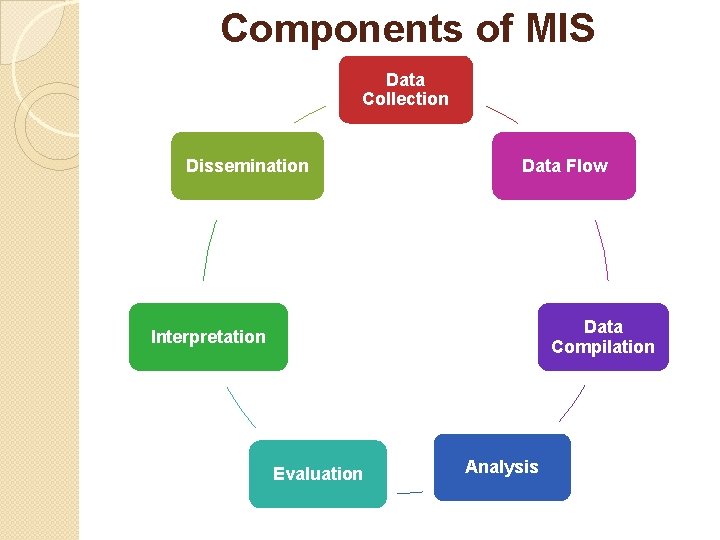
Components of MIS Data Collection Dissemination Data Flow Data Compilation Interpretation Evaluation Analysis
Why do we need MIS for eye care? �Adequate eye care infrastructure �Adequate equipment �Adequate staffing �Good professional knowledge and skills �High output and good quality of care NOT a clinical MIS to control individual patient care!
Current situation & Challenges �WHO standardised indicators (2002) �No standardised MIS software �Some countries developed own systems �NGOs often have their own system and hence incompatibilities �Difficult to evaluate achievements within and across countries
Need for a robust, standardised MIS Requirements: �Standardised indicators �Standardised protocol for data collection and reporting �Emphasis on management of eye care services in country �No individual patient data �Comparable between countries
Need for a robust, standardised MIS �Web-based software �Multilingual �Data entry and automatic data analysis and feedback at district, state and country level �Mapping of indicators to identify trends
Features � User Friendly / Menu Driven / Multi - user � On Line Help � Exception Reports � Adequate system / Data Security � Back up / Restore option � Data transfer from the old to the new system � Reports / Outputs both in Graphical and tabular Form � User - Defined Components / Categories
MIS – The Indian Programme Experience PURPOSE �Dissemination of Information �Status of Eye Health �Augmentation of Ophthalmic Services �Infrastructure support �For Monitoring and Evaluation
Some Features of the MIS �Service Delivery Details �Blindness Prevalence Tracking �Expenditure Monitoring �Infrastructure Monitoring �Eye Care Facility Mapping
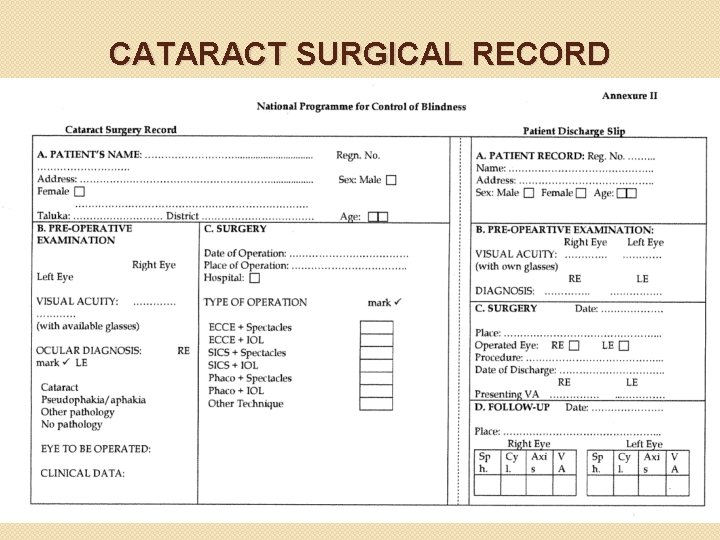
CATARACT SURGICAL RECORD
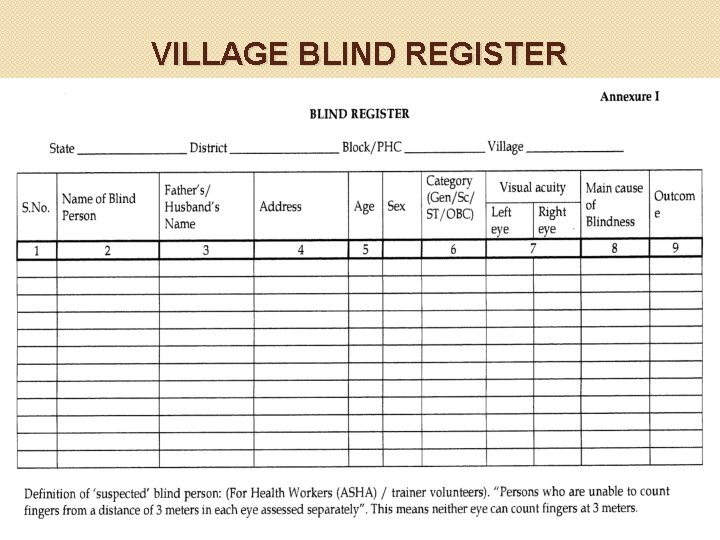
VILLAGE BLIND REGISTER
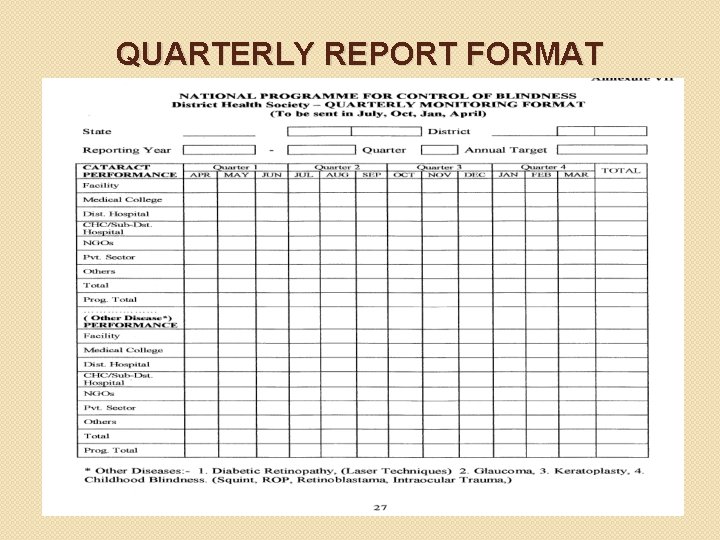
QUARTERLY REPORT FORMAT
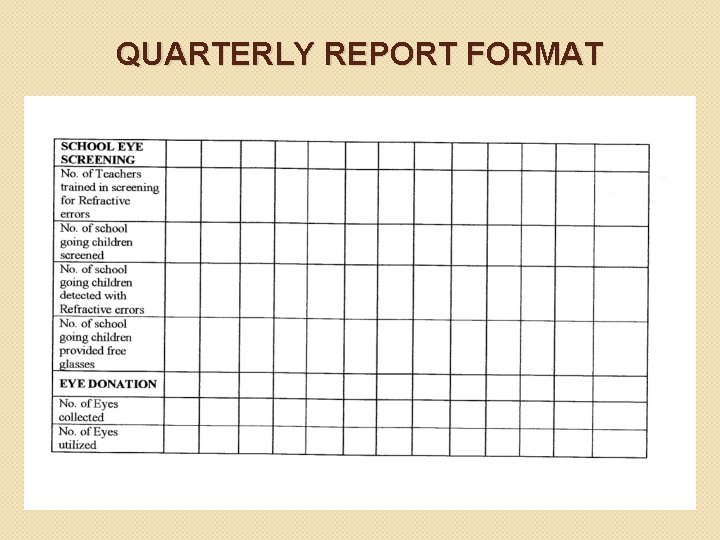
QUARTERLY REPORT FORMAT
Points to Ponder! • Learn from experiences of countries that have introduced MIS • Do not commit mistakes which have been committed Ex: Frequent reviews and no capacity! • Use MIS to advocate and sustain funding and resource commitments • Build a generic model that allows comparisons and compatibilities.
Thank You!