
Management in the Age of Artificial Intelligence AI
- Slides: 43
Management in the Age of Artificial Intelligence #AI #managersfor. EU Seminar 25 May 2019 Mainz
Welcome Greetings by Roland Leroux Greetings by Michael Ebling and Opening remarks by Ludger Ramme #AI #managersfor. EU
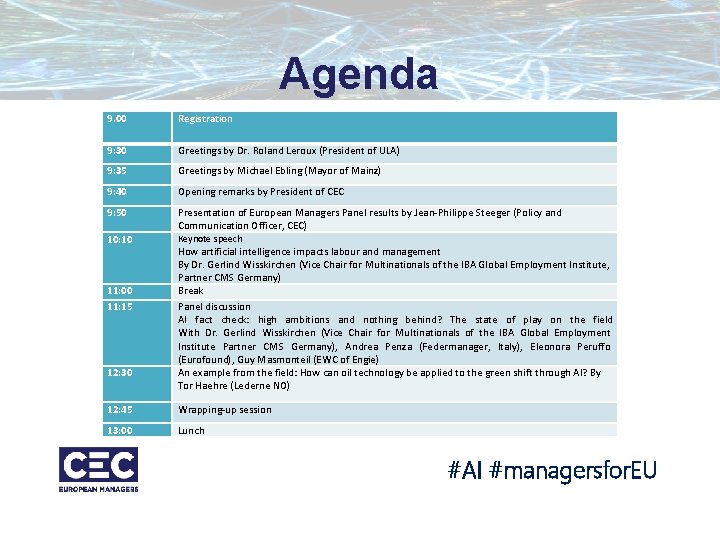
Agenda 9. 00 Registration 9: 30 Greetings by Dr. Roland Leroux (President of ULA) 9: 35 Greetings by Michael Ebling (Mayor of Mainz) 9: 40 Opening remarks by President of CEC 9: 50 Presentation of European Managers Panel results by Jean-Philippe Steeger (Policy and Communication Officer, CEC) 10: 10 11: 00 11: 15 12: 30 Keynote speech How artificial intelligence impacts labour and management By Dr. Gerlind Wisskirchen (Vice Chair for Multinationals of the IBA Global Employment Institute, Partner CMS Germany) Break Panel discussion AI fact check: high ambitions and nothing behind? The state of play on the field With Dr. Gerlind Wisskirchen (Vice Chair for Multinationals of the IBA Global Employment Institute Partner CMS Germany), Andrea Penza (Federmanager, Italy), Eleonora Peruffo (Eurofound), Guy Masmonteil (EWC of Engie) An example from the field: How can oil technology be applied to the green shift through AI? By Tor Haehre (Lederne NO) 12: 45 Wrapping-up session 13: 00 Lunch #AI #managersfor. EU
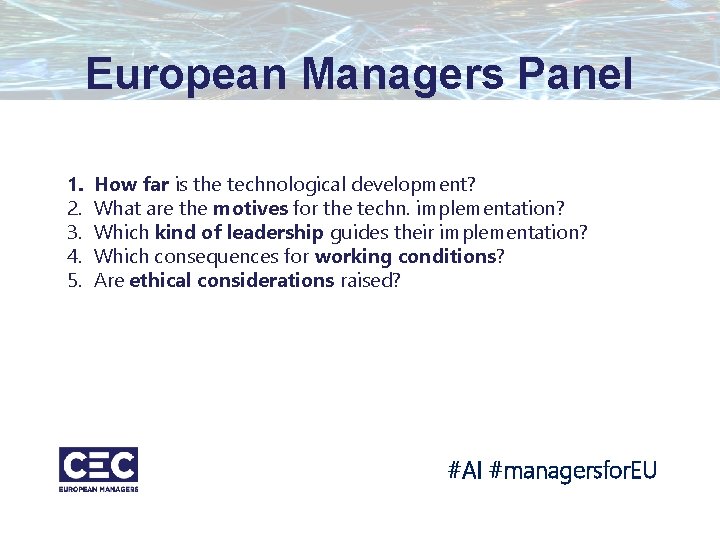
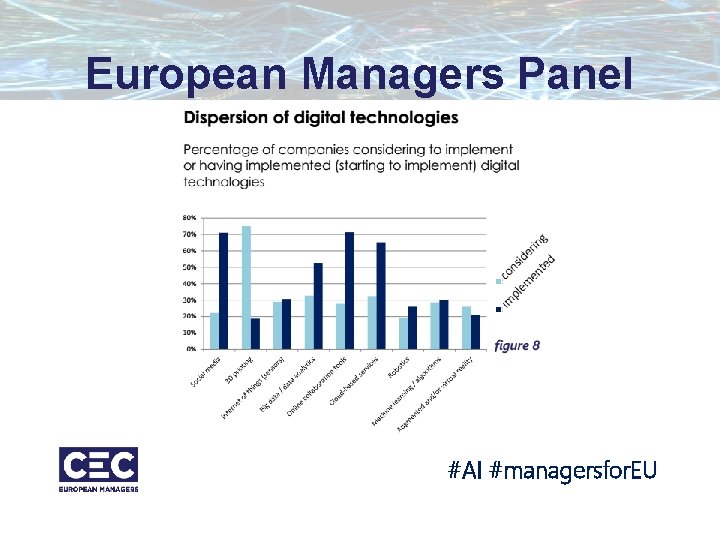
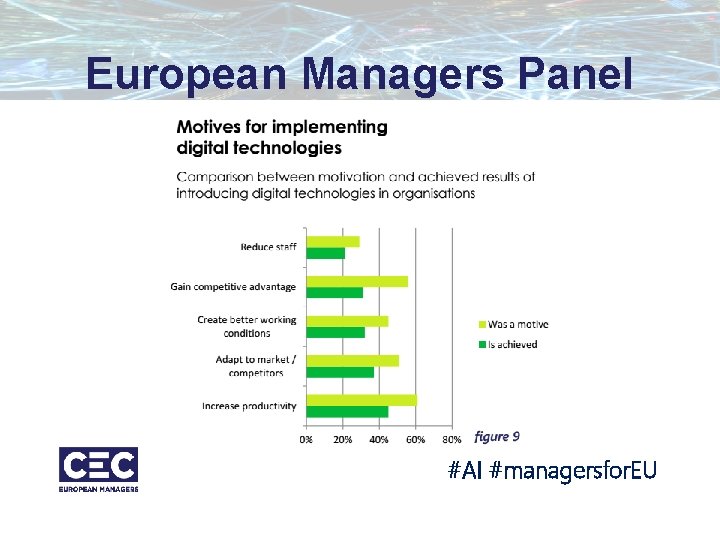
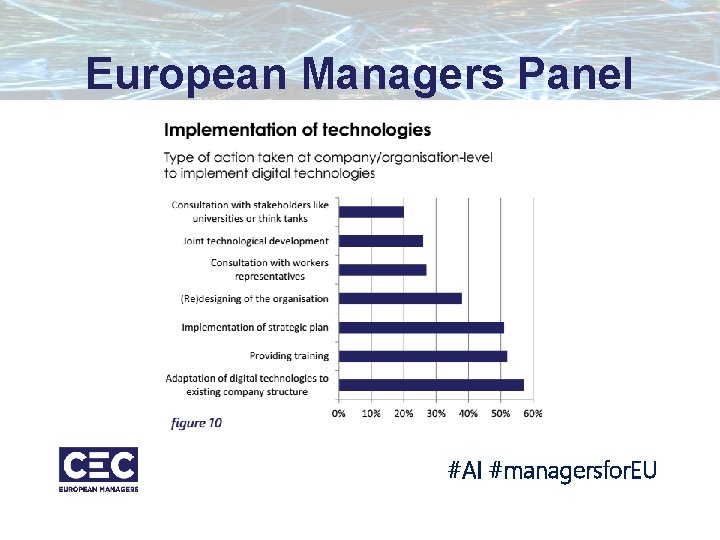
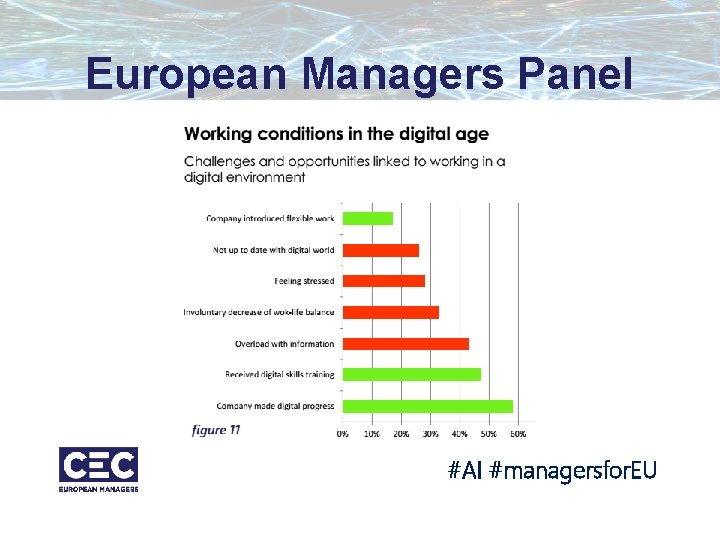
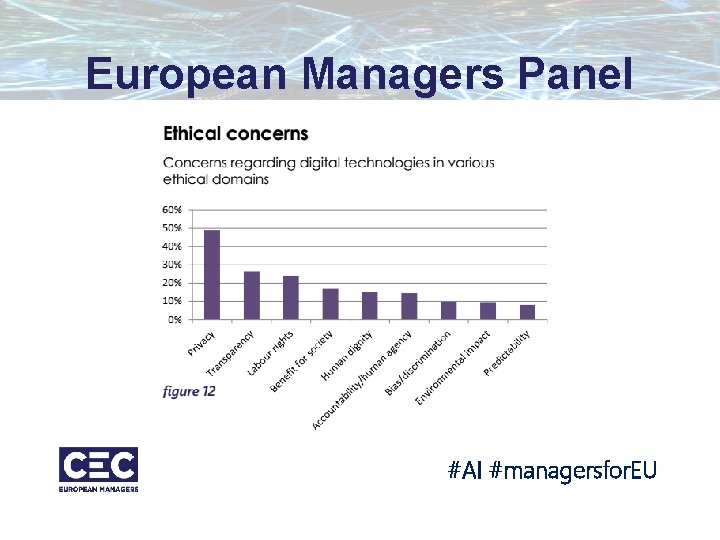
European Managers Panel 1. 2. 3. 4. 5. How far is the technological development? What are the motives for the techn. implementation? Which kind of leadership guides their implementation? Which consequences for working conditions? Are ethical considerations raised? #AI #managersfor. EU
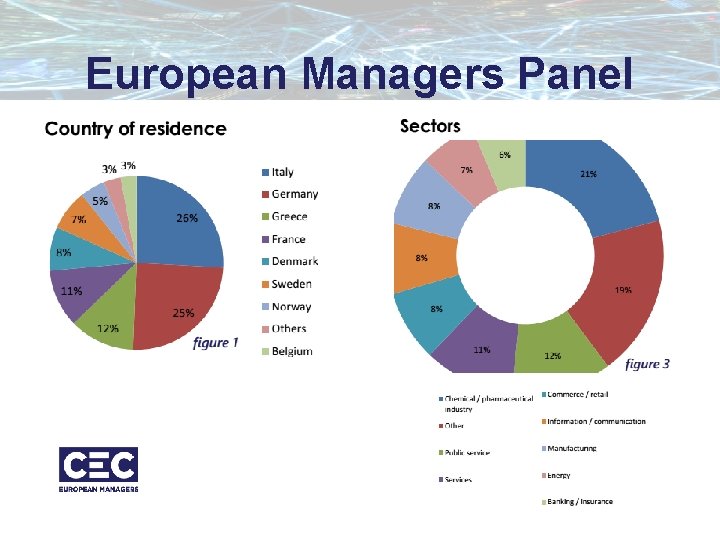
European Managers Panel Total of 350 participants out of 1400 panelists #AI #managersfor. EU
European Managers Panel #AI #managersfor. EU
European Managers Panel #AI #managersfor. EU
European Managers Panel #AI #managersfor. EU
European Managers Panel #AI #managersfor. EU
European Managers Panel #AI #managersfor. EU
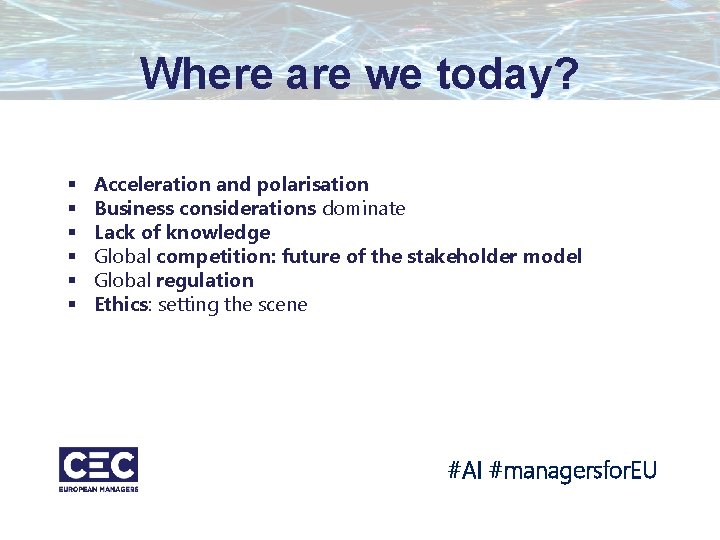
Where are we today? § § § Acceleration and polarisation Business considerations dominate Lack of knowledge Global competition: future of the stakeholder model Global regulation Ethics: setting the scene #AI #managersfor. EU
Note: To read about the content of the presentation, please consult the script for the presentation of Dr. Gerlind Wisskirchen, available on www. cec-managers. org How Artificial Intelligence (AI) Impacts Labour and Management CEC European Managers Management in the Age of AI Employment, Economics and Ethics Mainz, May 25, 2018 Dr. Gerlind Wisskirchen CMS Germany
CEC SEMINAR Management in the Age of Artificial Intelligence Eleonora Peruffo, Eurofound Research Assistant Mainz, Friday 25 May 18
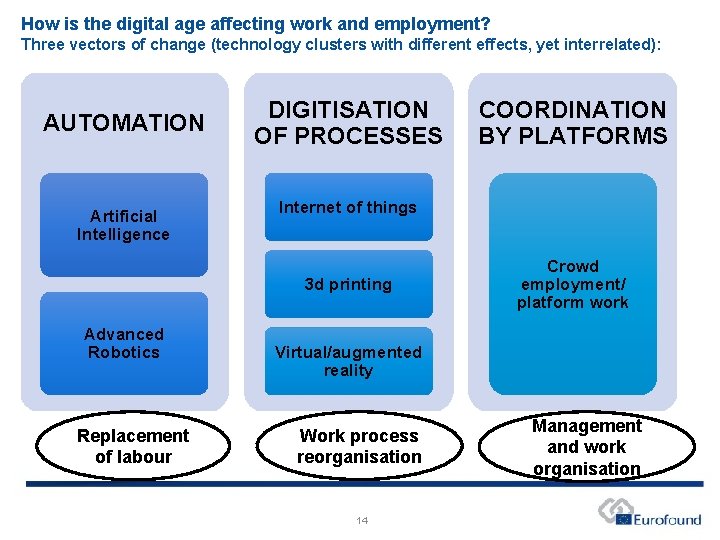
How is the digital age affecting work and employment? Three vectors of change (technology clusters with different effects, yet interrelated): AUTOMATION Artificial Intelligence DIGITISATION OF PROCESSES Internet of things 3 d printing Advanced Robotics Replacement of labour COORDINATION BY PLATFORMS Crowd employment/ platform work Virtual/augmented reality Work process reorganisation 14 Management and work organisation
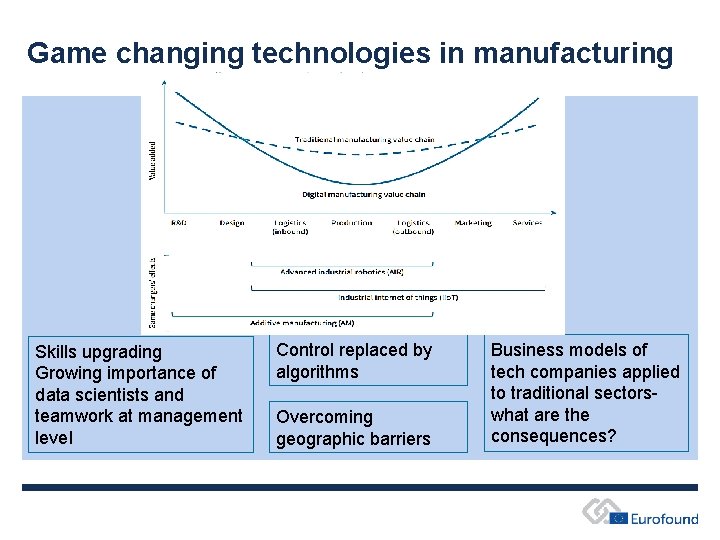
Game changing technologies in manufacturing Skills upgrading Growing importance of data scientists and teamwork at management level Control replaced by algorithms Overcoming geographic barriers Business models of tech companies applied to traditional sectorswhat are the consequences?
Management in the Age of Artificial Intelligence Andrea Penza Mainz, 2018 May 25 th
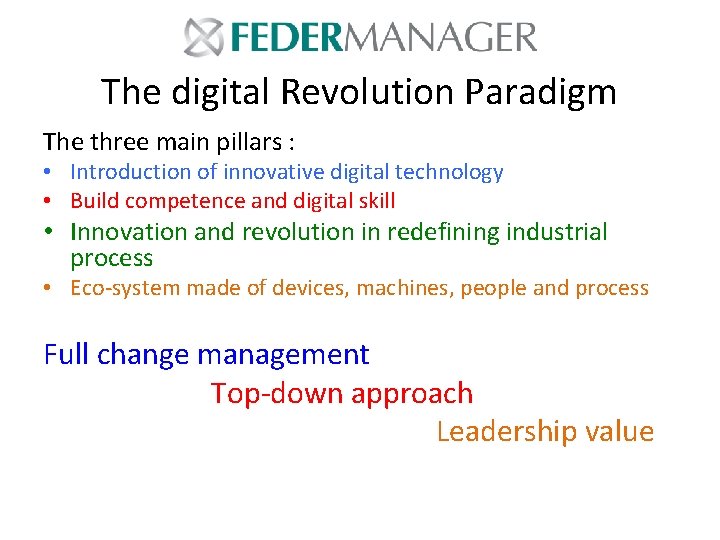
The digital Revolution Paradigm The three main pillars : • Introduction of innovative digital technology • Build competence and digital skill • Innovation and revolution in redefining industrial process • Eco-system made of devices, machines, people and process Full change management Top-down approach Leadership value
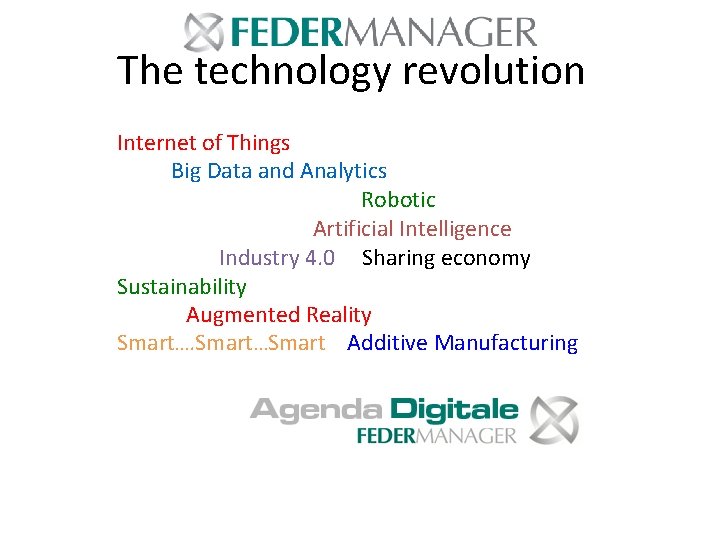
The technology revolution Internet of Things Big Data and Analytics Robotic Artificial Intelligence Industry 4. 0 Sharing economy Sustainability Augmented Reality Smart…Smart Additive Manufacturing
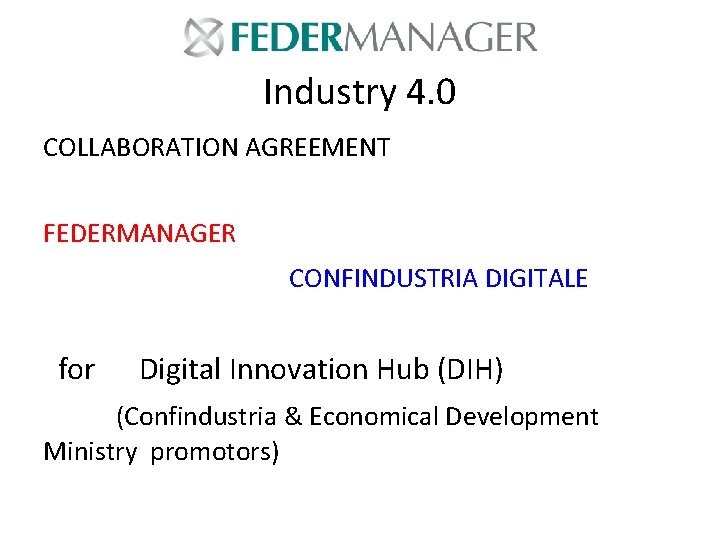
Industry 4. 0 COLLABORATION AGREEMENT FEDERMANAGER CONFINDUSTRIA DIGITALE for Digital Innovation Hub (DIH) (Confindustria & Economical Development Ministry promotors)
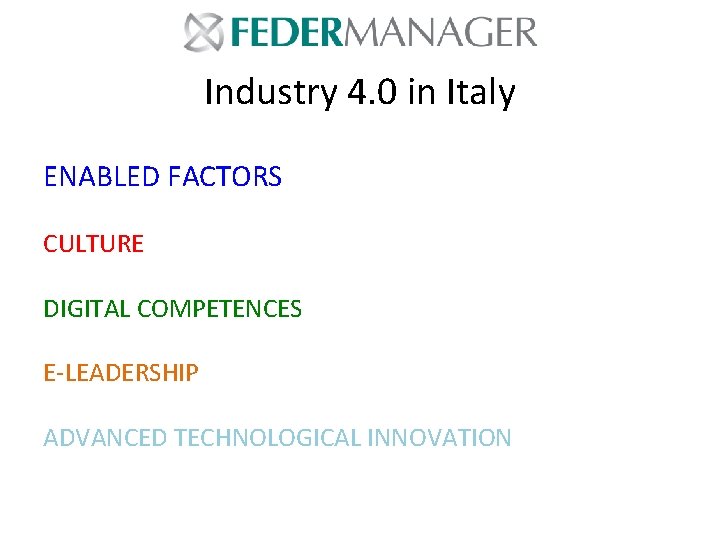
Industry 4. 0 in Italy ENABLED FACTORS CULTURE DIGITAL COMPETENCES E-LEADERSHIP ADVANCED TECHNOLOGICAL INNOVATION
Industry 4. 0 COLLABORATION AGREEMENT Expert Managers for temporary time in Small-Medium Enterprise in order to address the digital transformation process within the company Competence skill built and certificated Expert Professionals coming from professional associations
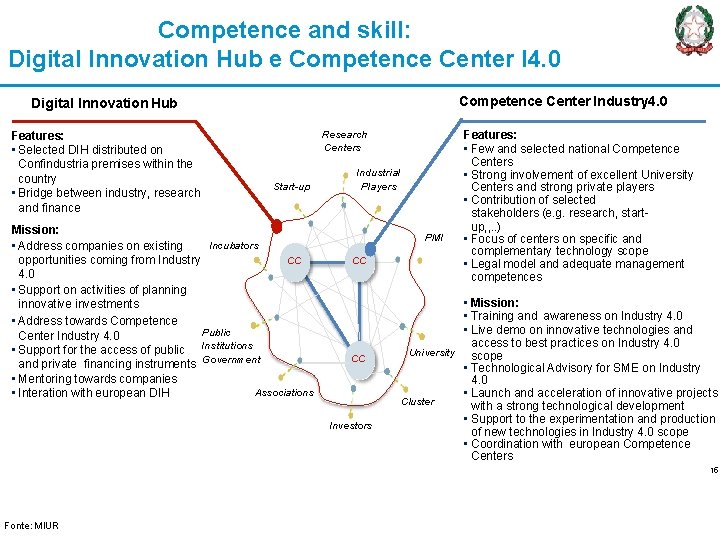
Competence and skill: Digital Innovation Hub e Competence Center I 4. 0 Competence Center Industry 4. 0 Digital Innovation Hub Features: • Selected DIH distributed on Confindustria premises within the country • Bridge between industry, research and finance Research Centers Start-up Mission: Incubators • Address companies on existing CC opportunities coming from Industry 4. 0 • Support on activities of planning innovative investments • Address towards Competence Public Center Industry 4. 0 • Support for the access of public Institutions and private financing instruments Government • Mentoring towards companies Associations • Interation with european DIH Industrial Players PMI CC CC Investors Features: • Few and selected national Competence Centers • Strong involvement of excellent University Centers and strong private players • Contribution of selected stakeholders (e. g. research, startup, , . . ) • Focus of centers on specific and complementary technology scope • Legal model and adequate management competences • Mission: • Training and awareness on Industry 4. 0 • Live demo on innovative technologies and access to best practices on Industry 4. 0 University scope • Technological Advisory for SME on Industry 4. 0 • Launch and acceleration of innovative projects Cluster with a strong technological development • Support to the experimentation and production of new technologies in Industry 4. 0 scope • Coordination with european Competence Centers 15 Fonte: MIUR
Industry 4. 0 COLLABORATION AGREEMENT Expert Managers for temporary time in Small-Medium Enterprise in order to address the digital transformation process within the company Competence skill built and certificated Expert Professionals coming from professional associations
Industry 4. 0 From Industry 4. 0 Program to Impresa 4. 0 Smart Business, Smart work
Thank you!!! Andrea Penza andrea. penza@gmail. com Member of Federmanager Industry 4. 0 President & CEO INTRATEL s. r. l
Panel debate AI fact check: high ambitions and nothing behind? 1. Where do we stand? 2. What has been done? 3. What can we do? #AI #managersfor. EU
How can high tech oil and gas technology be applied for the green shift in a global perspective? Tor Haehre, political advisor, Lederne, Norway
Norwegian government: • Being a long term exporter of oil, gas and LNG, Norway has a responsibility to be among the green shift- leaders • Norway has for decades played a major and leading role in developing high tech petroleum technology, both offshore and onshore, which can be applied in the green shift change
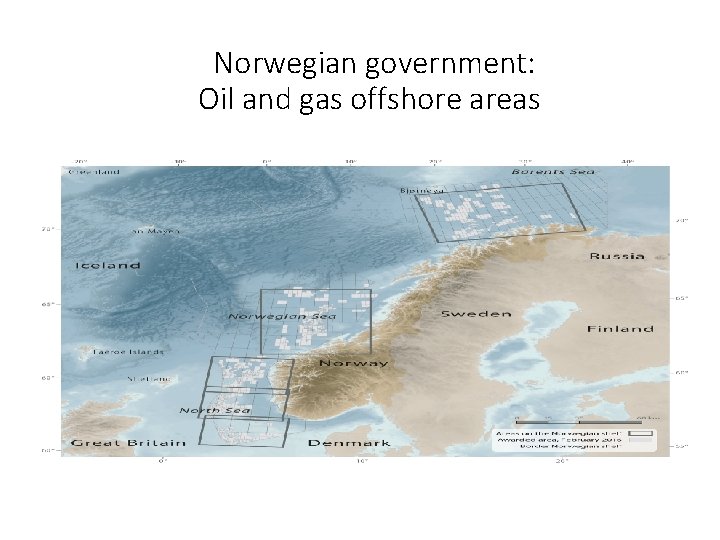
Norwegian government: Oil and gas offshore areas
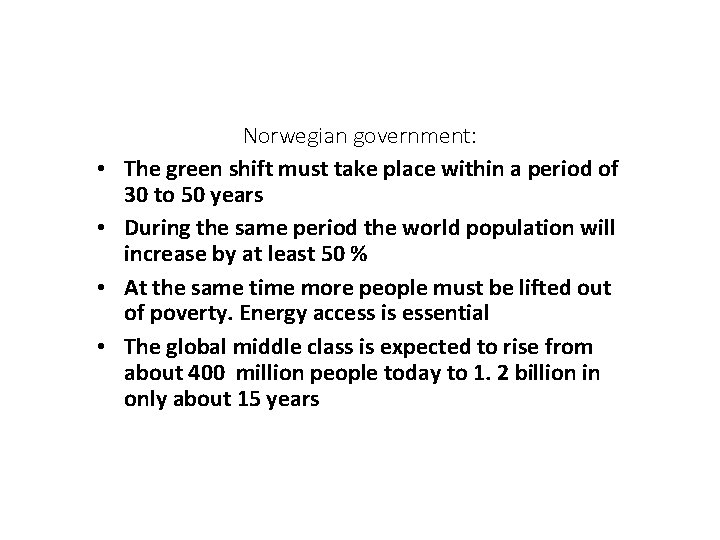
• • Norwegian government: The green shift must take place within a period of 30 to 50 years During the same period the world population will increase by at least 50 % At the same time more people must be lifted out of poverty. Energy access is essential The global middle class is expected to rise from about 400 million people today to 1. 2 billion in only about 15 years
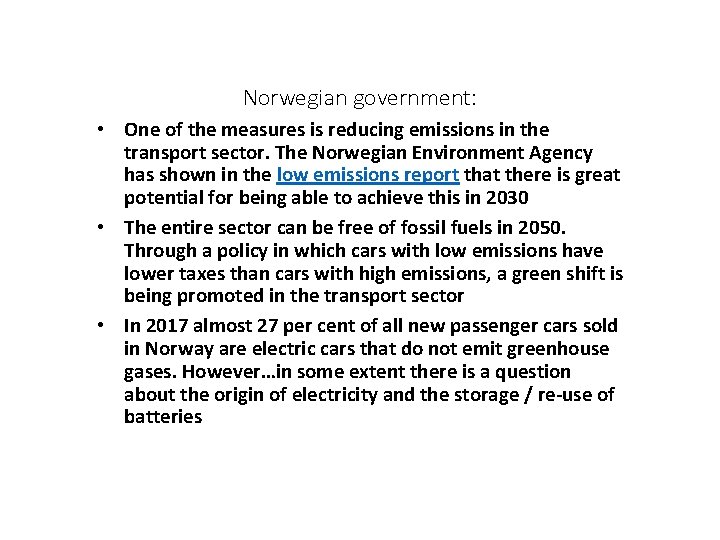
Norwegian government: • One of the measures is reducing emissions in the transport sector. The Norwegian Environment Agency has shown in the low emissions report that there is great potential for being able to achieve this in 2030 • The entire sector can be free of fossil fuels in 2050. Through a policy in which cars with low emissions have lower taxes than cars with high emissions, a green shift is being promoted in the transport sector • In 2017 almost 27 per cent of all new passenger cars sold in Norway are electric cars that do not emit greenhouse gases. However…in some extent there is a question about the origin of electricity and the storage / re-use of batteries
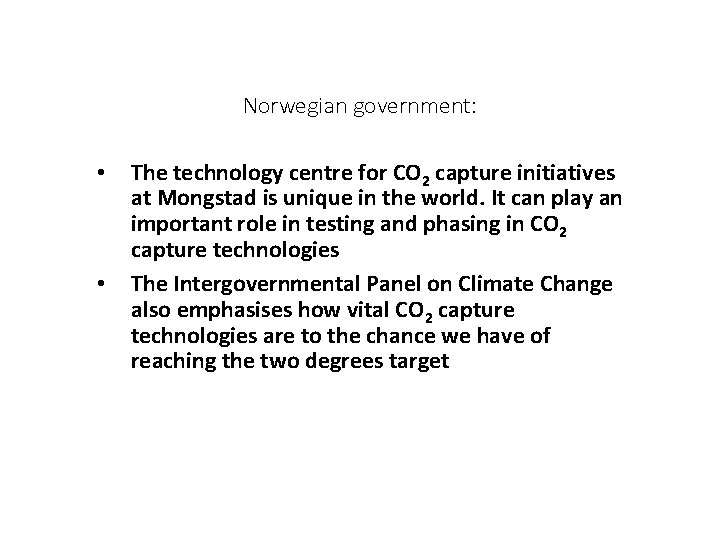
Norwegian government: • • The technology centre for CO 2 capture initiatives at Mongstad is unique in the world. It can play an important role in testing and phasing in CO 2 capture technologies The Intergovernmental Panel on Climate Change also emphasises how vital CO 2 capture technologies are to the chance we have of reaching the two degrees target
Norwegian government: • The goals for the green shift in Norway are based on the Government platform, on the goal that Norway shall be a low-emission society in 2050, on strengthening the Climate Agreement and on the Government's aim of safeguarding prudent management of nature as a basis for future growth and welfare • A green shift is part of the work for sustainable development
Key word: REMOTE CONTROL RELATED TO SEARCHING FOR AND THE PRODUCTION OF OIL AND GAS
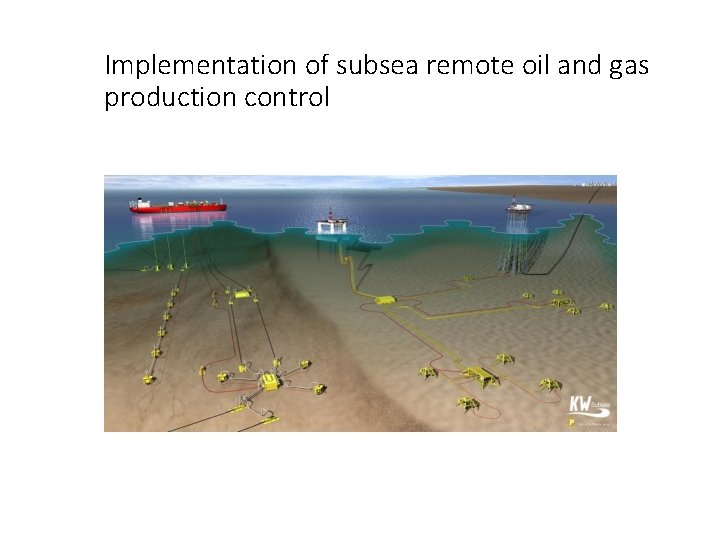
Implementation of subsea remote oil and gas production control
How can petroleum technology be applied for non-petroleum activities? • Robotics Advances for Precision Farming Sub-sea industry remotely operated robots might be further developed to make themselves useful in European agriculture. EU announces funds for development and demonstration of smart robot technology to ensure high precision in modern agriculture. The robots will be able to operate in rough terrain, have sensors for monitoring of both animals and plants living conditions, and could contribute to the proper care of crops
How can petroleum technology be applied for non-petroleum activities? • CCS (Geological storage pilots) EU has stated a commitment to reduce 80% greenhouse gas emissions by 2050. This requires the development of a commercial mature CCS technology with geological structure storage. Research and innovation projects will be designed under "real life" conditions, and will subsequently develop and demonstrate best practices for the entire CCS value chain, including transport infrastructure for CO 2, state control to prevent gas leakage, and the education of professionals and operators. The announcement is relevant for employees in the oil sector, geologists, seismologists and geophysicists in academia and industry
How can petroleum technology be applied for non-petroleum activities? • EGS (enhanced geothermal systems) in different geological conditions The EU Commission asks for an innovation project to test different geothermal systems that deliver electricity and / or heat. The aim is increased productivity of the reservoir in different geological formations according to cost price. The announcement is appropriate for environments related to drilling and wells
How can petroleum technology be applied for non-petroleum activities? • Border Security: autonomous systems and control systems Border surveillance, both at sea and on land, will be introduced preferably at EU's external borders. EU has asked for an innovation project on technology that can enhance border surveillance by developing unmanned installations more robust, and being more operational suitable in demanding physical environments, both by sea surface, in the water column, and on land. The announcement is relevant to a variety of environments that develops self-propelled and remote controlled devices for advanced operations
How can petroleum technology be applied for non-petroleum activities? • Safer waterborne transport and maritime operations In general, EU will solve a whole range of challenges. Among these are new types of vessels and equipment design, which implies a clear risk reduction for both people and equipment, thereby increasing operability, fire safety and better conditions for monitoring operations and transport offshore under extreme external conditions. Mathematical simulations, cost-benefit calculations and better rescue and evacuation conditions are also in demand. The EU will spend money both on this and on related maritime research themes.
How can petroleum technology be applied for non-petroleum activities? • Multi-use of the oceans marine space, offshore and near-shore: Enabling technologies EU asks for new technology being adapted to many types of exploitation of marine resources (renewable energy, farming, mineral extraction, transport and others). This technology shall be conducted simultaneously within the geographical boundary waters. This requires new types of platforms that can serve for several maritime activities simultaneously. Previously, EU has funded some concept development for such devices. Now there is a need for research and innovation that takes this further to specific technologies that can be tested, and providing both environmental and commercial benefits. The announcement is relevant for the maritine cluster associated with sub sea- and offshore activity.
Summary • Petroleum technologies, that have been developed for decades both offshore and onshore under rough and extreme weather conditions, have already been applied to a wide range of non-petroleum activities • EU, and several countries individually, has requested for further implementation of these technologies being adapted for a wide range of «green» industries • But…there will still be petroleum production, particularly gas production, for decades. Europe and the world increasingly demand for energy, and gas is among the cleanest energy source • The former Norwegian minister of oil and energy, Tord Lien, stated: «The people who shall close petroleum production in Norway has not yet been born»
Management in the Age of Artificial Intelligence #AI #managersfor. EU Seminar 25 May 2019 Mainz