
Management Fourteenth Edition Chapter MH1 Management History Module

- Slides: 47
Management Fourteenth Edition Chapter MH-1 Management History Module prepared by Prof. Faris Abu Mouamer
Learning Objectives MH 1. 1 Describe some early management examples. MH 1. 2 Explain the various theories in the classical approach. MH 1. 3 Discuss the development and uses of the behavioral approach. MH 1. 4 Describe the quantitative approach. MH 1. 5 Explain various theories in the contemporary approach. prepared by Prof. Faris Abu Mouamer
Early Management • The Egyptian pyramids and the Great Wall of China are proof that projects of tremendous scope, employing tens of thousands of people, were completed in ancient times. prepared by Prof. Faris Abu Mouamer
Early Management • Who told each worker what to do? • Who ensured there would be enough stones at the site to keep workers busy? • Someone had to plan what was to be done. • Controls must be imposed to ensure that everything was done as planned. • The answer is managers (management) prepared by Prof. Faris Abu Mouamer
Early Management • Great Wall of China is a good example of projects of tremendous scope and magnitude that employed tens of thousands of people. • How it was possible for these projects to be completed? The answer is management. prepared by Prof. Faris Abu Mouamer
Early Management • Other examples of early management practices can be seen at the Arsenal of Venice. For instance, assembly lines, accounting systems, and personnel functions are just a few of the processes and activities in organizations at that time that are also common to today’s organizations. prepared by Prof. Faris Abu Mouamer
Job Specialization • In 1776 Adam Smith published “The Wealth of Nations” – division of labor (job specialization): the breakdown of jobs into narrow and repetitive tasks prepared by Prof. Faris Abu Mouamer
Historical Background Of Management Adam Smith, (1776) author of the classical economics doctrine, The Wealth of Nations, argued about the economic advantages that division of labor (the breakdown of jobs into narrow, repetitive tasks) would bring to organizations and society. • C. • D. The Industrial Revolution (late 18 th century) can be thought of as possibly the most important pre-twentieth-century influence on management. The introduction of machine powers, combined with the division of labor, made large, efficient factories possible. Planning, organizing, leading, and controlling became necessary. • E. The development of management theories has been characterized by differing beliefs about what managers do and how they should do it. prepared by Prof. Faris Abu Mouamer © Prentice Hall, 2002 2 -8
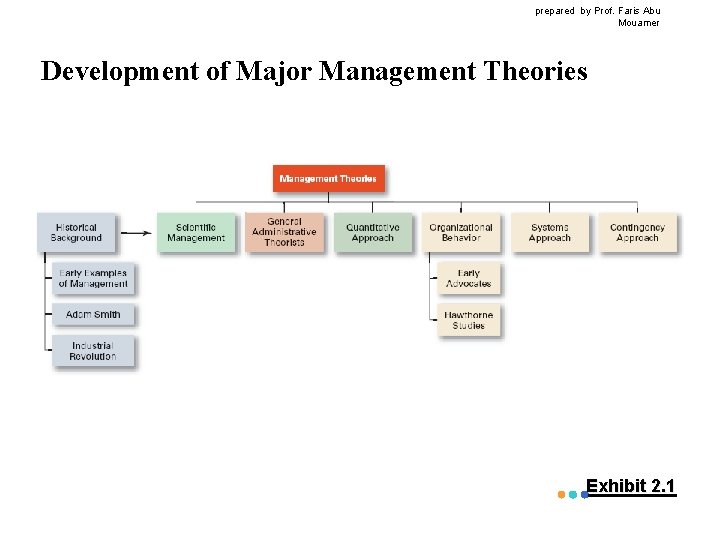
prepared by Prof. Faris Abu Mouamer Development of Major Management Theories Exhibit 2. 1
Classical Approach • Classical approach: first studies of management, which emphasized rationality and making organizations and workers as efficient as possible. • Two major theories comprise the classical approach: scientific management and general administrative theory. prepared by Prof. Faris Abu Mouamer
Classical Approach • Classical approach: • The two most important contributors to scientific management theory were Frederick W. Taylor and the husband– wife team of Frank and Lillian Gilbreth. • The two most important contributors to general administrative theory were Henri Fayol and Max Weber. prepared by Prof. Faris Abu Mouamer
Scientific Management • Scientific management: an approach that involves using the scientific method to find the “one best way” for a job to be done. prepared by Prof. Faris Abu Mouamer
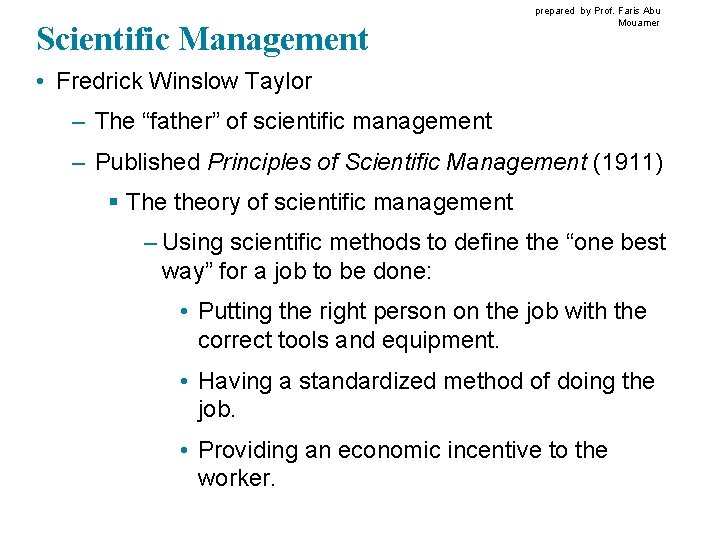
Scientific Management prepared by Prof. Faris Abu Mouamer • Fredrick Winslow Taylor – The “father” of scientific management – Published Principles of Scientific Management (1911) § The theory of scientific management – Using scientific methods to define the “one best way” for a job to be done: • Putting the right person on the job with the correct tools and equipment. • Having a standardized method of doing the job. • Providing an economic incentive to the worker.
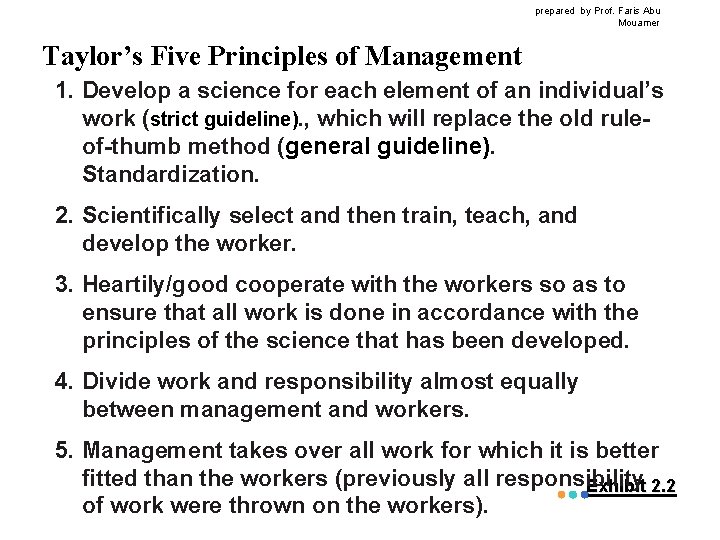
prepared by Prof. Faris Abu Mouamer Taylor’s Five Principles of Management 1. Develop a science for each element of an individual’s work (strict guideline). , which will replace the old ruleof-thumb method (general guideline). Standardization. 2. Scientifically select and then train, teach, and develop the worker. 3. Heartily/good cooperate with the workers so as to ensure that all work is done in accordance with the principles of the science that has been developed. 4. Divide work and responsibility almost equally between management and workers. 5. Management takes over all work for which it is better fitted than the workers (previously all responsibility Exhibit 2. 2 of work were thrown on the workers).
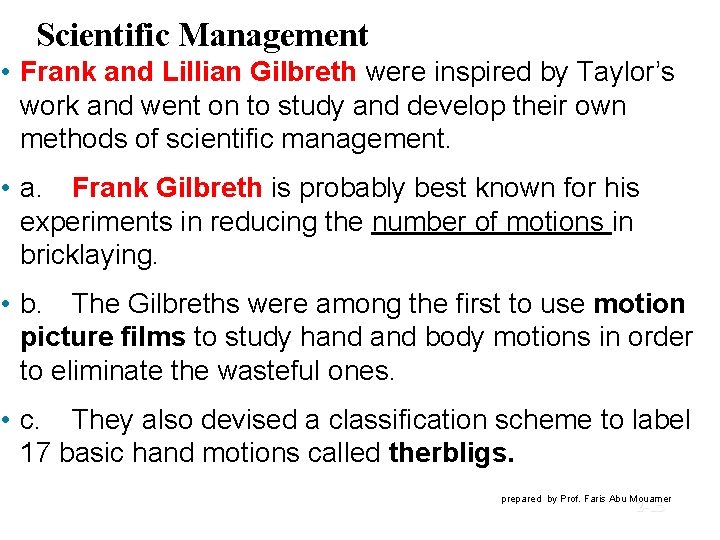
Scientific Management • Frank and Lillian Gilbreth were inspired by Taylor’s work and went on to study and develop their own methods of scientific management. • a. Frank Gilbreth is probably best known for his experiments in reducing the number of motions in bricklaying. • b. The Gilbreths were among the first to use motion picture films to study hand body motions in order to eliminate the wasteful ones. • c. They also devised a classification scheme to label 17 basic hand motions called therbligs. © Prentice Hall, 2002 prepared by Prof. Faris Abu Mouamer 2 -15
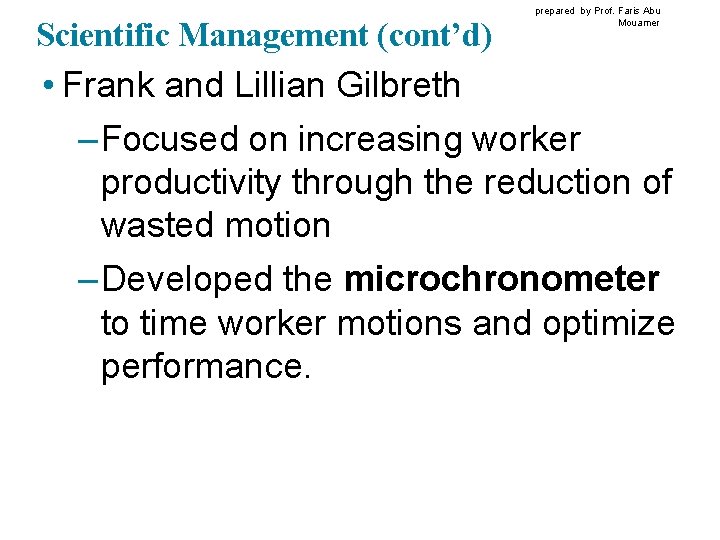
Scientific Management (cont’d) prepared by Prof. Faris Abu Mouamer • Frank and Lillian Gilbreth – Focused on increasing worker productivity through the reduction of wasted motion – Developed the microchronometer to time worker motions and optimize performance.
prepared by Prof. Faris Abu Mouamer Scientific Management (cont’d) • How Do Today’s Managers Use Scientific Management? – Use time and motion studies to increase productivity – Hire the best qualified employees – Design incentive systems based on output – Training programs designed to improve skills.
General Administrative Theory • General administrative theory: an approach to management that focuses on describing what managers do and what constitutes good management practice. prepared by Prof. Faris Abu Mouamer
General Administrative Theory • Fayol tried to follow Taylor. • While Taylor was concerned with firstline managers and the scientific method. • Fayol’s attention was directed at the activities of all managers. He wrote from his personal experience as the managing director of a large French coal-mining firm. prepared by Prof. Faris Abu Mouamer
General Administrative Theorists • This group of writers focused on the entire organization. • Henri Fayol – Believed that the practice of management was distinct from other organizational functions – Developed fourteen principles of management that applied to all organizational situations © Prentice Hall, 2002 prepared by Prof. Faris Abu Mouamer 2 -20
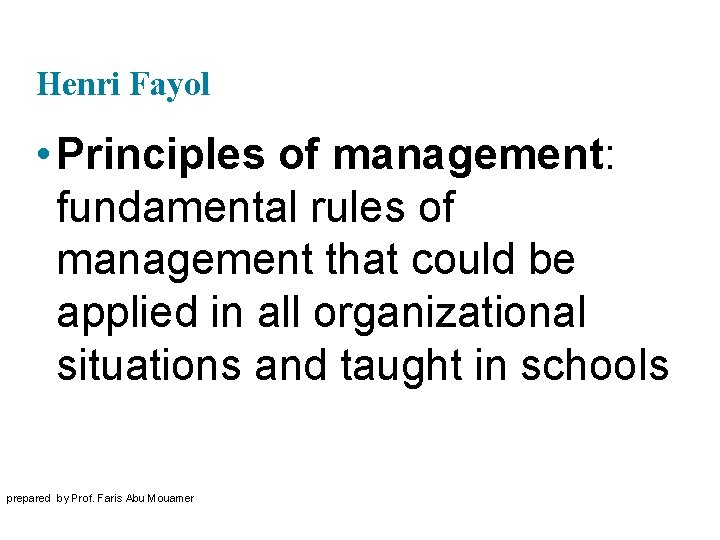
Henri Fayol • Principles of management: fundamental rules of management that could be applied in all organizational situations and taught in schools prepared by Prof. Faris Abu Mouamer
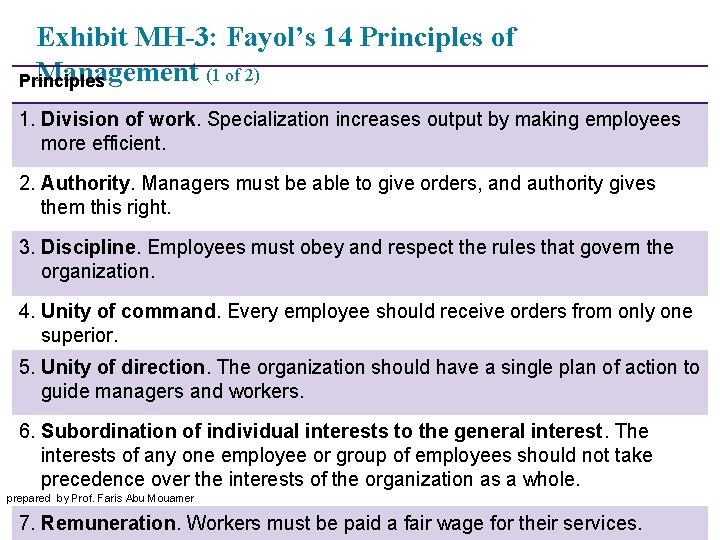
Exhibit MH-3: Fayol’s 14 Principles of Management (1 of 2) Principles 1. Division of work. Specialization increases output by making employees more efficient. 2. Authority. Managers must be able to give orders, and authority gives them this right. 3. Discipline. Employees must obey and respect the rules that govern the organization. 4. Unity of command. Every employee should receive orders from only one superior. 5. Unity of direction. The organization should have a single plan of action to guide managers and workers. 6. Subordination of individual interests to the general interest. The interests of any one employee or group of employees should not take precedence over the interests of the organization as a whole. prepared by Prof. Faris Abu Mouamer 7. Remuneration. Workers must be paid a fair wage for their services.
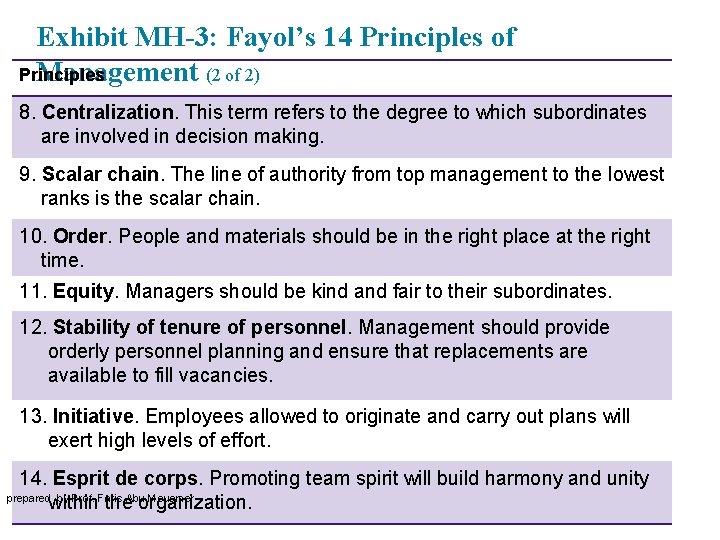
Exhibit MH-3: Fayol’s 14 Principles of Management (2 of 2) Principles 8. Centralization. This term refers to the degree to which subordinates are involved in decision making. 9. Scalar chain. The line of authority from top management to the lowest ranks is the scalar chain. 10. Order. People and materials should be in the right place at the right time. 11. Equity. Managers should be kind and fair to their subordinates. 12. Stability of tenure of personnel. Management should provide orderly personnel planning and ensure that replacements are available to fill vacancies. 13. Initiative. Employees allowed to originate and carry out plans will exert high levels of effort. 14. Esprit de corps. Promoting team spirit will build harmony and unity prepared by Prof. Faris Abu Mouamer within the organization.
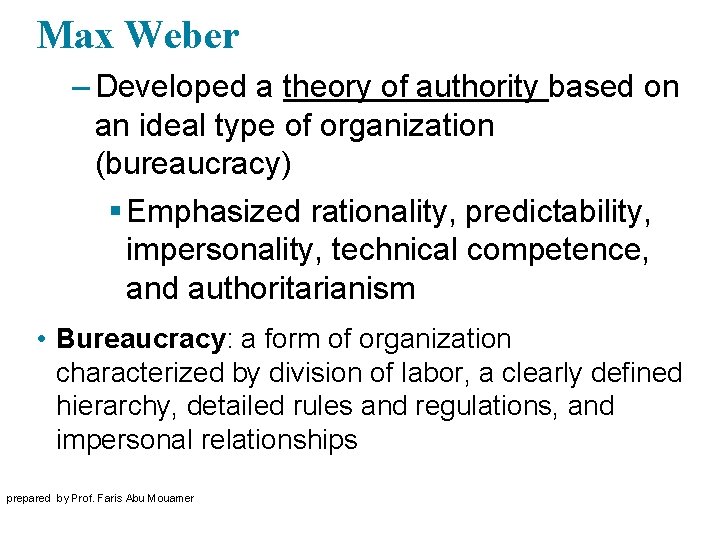
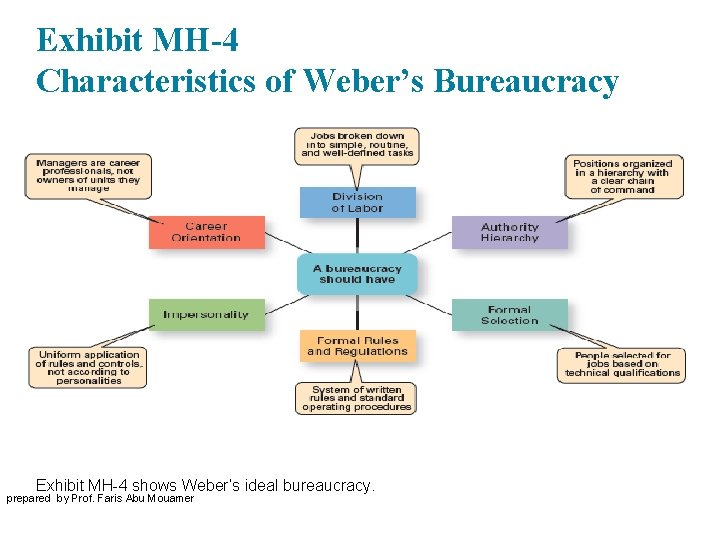
Max Weber – Developed a theory of authority based on an ideal type of organization (bureaucracy) § Emphasized rationality, predictability, impersonality, technical competence, and authoritarianism • Bureaucracy: a form of organization characterized by division of labor, a clearly defined hierarchy, detailed rules and regulations, and impersonal relationships prepared by Prof. Faris Abu Mouamer
Exhibit MH-4 Characteristics of Weber’s Bureaucracy Exhibit MH-4 shows Weber’s ideal bureaucracy. prepared by Prof. Faris Abu Mouamer
prepared by Prof. Faris Abu Mouamer Quantitative Approach to Management • Quantitative Approach – Also called operations research or management science – Evolved from mathematical and statistical methods developed to solve WWII military logistics and quality control problems – Focuses on improving managerial decision making by applying: § Statistics, optimization models, information models, and computer simulations
Behavioral Approach • Organizational behavior (OB): the study of the actions of people at work. • People are the most important asset of an organization. prepared by Prof. Faris Abu Mouamer
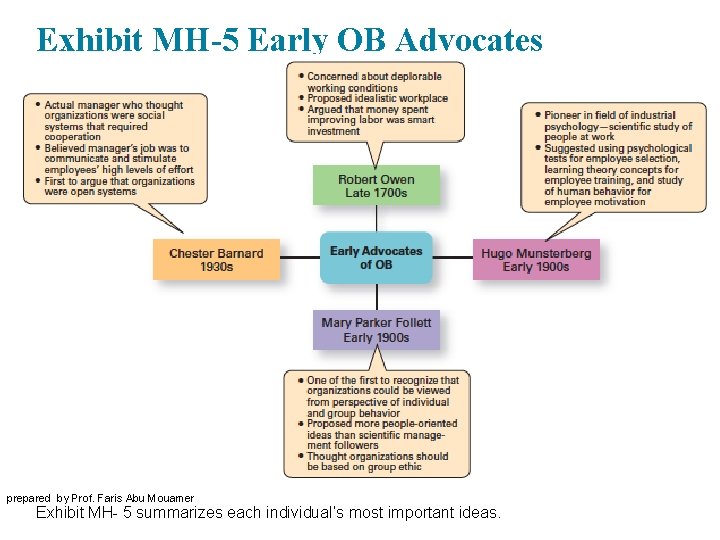
Exhibit MH-5 Early OB Advocates prepared by Prof. Faris Abu Mouamer Exhibit MH- 5 summarizes each individual’s most important ideas.
Early OB Advocates – Robert Owen – Hugo Munsterberg – Mary Parker Follett – Chester Barnard prepared by Prof. Faris Abu Mouamer
Hawthorne Studies • Hawthorne studies: a series of studies during the 1920 s and 1930 s that provided new insights into individual and group behavior prepared by Prof. Faris Abu Mouamer
Toward Understanding Organizational Behavior • Organizational Behavior – study of the actions of people at work – early advocates § late 1800 s and early 1900 s § believed that people were the most important asset of the organization § ideas provided the basis for a variety of human resource management programs – employee selection – employee motivation – Organizational behavior (OB) research has contributed much of what we know about human resources management, motivation, leadership, trust, teamwork, and conflict management. © Prentice Hall, 2002 prepared by Prof. Faris Abu Mouamer 2 -31
Organizational Behavior (cont. ) • Hawthorne Studies – started in 1924 at Western Electric Company § began with illumination studies § intensity of illumination not related to productivity – Elton Mayo (prof. of Harvard U. )- studies of job design § revealed the importance of social norms as determinants of individual work behavior – changed the dominant view that employees were no different from any other machines © Prentice Hall, 2002 prepared by Prof. Faris Abu Mouamer 2 -32
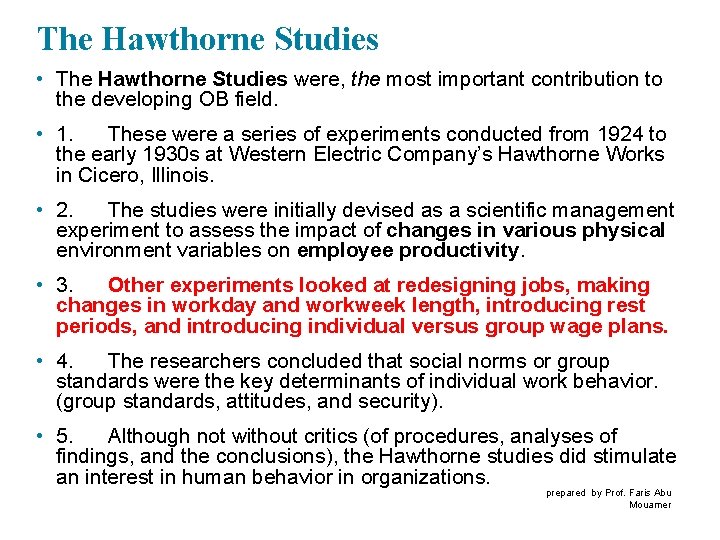
The Hawthorne Studies • The Hawthorne Studies were, the most important contribution to the developing OB field. • 1. These were a series of experiments conducted from 1924 to the early 1930 s at Western Electric Company’s Hawthorne Works in Cicero, Illinois. • 2. The studies were initially devised as a scientific management experiment to assess the impact of changes in various physical environment variables on employee productivity. • 3. Other experiments looked at redesigning jobs, making changes in workday and workweek length, introducing rest periods, and introducing individual versus group wage plans. • 4. The researchers concluded that social norms or group standards were the key determinants of individual work behavior. (group standards, attitudes, and security). • 5. Although not without critics (of procedures, analyses of findings, and the conclusions), the Hawthorne studies did stimulate an interest in human behavior in organizations. prepared by Prof. Faris Abu Mouamer
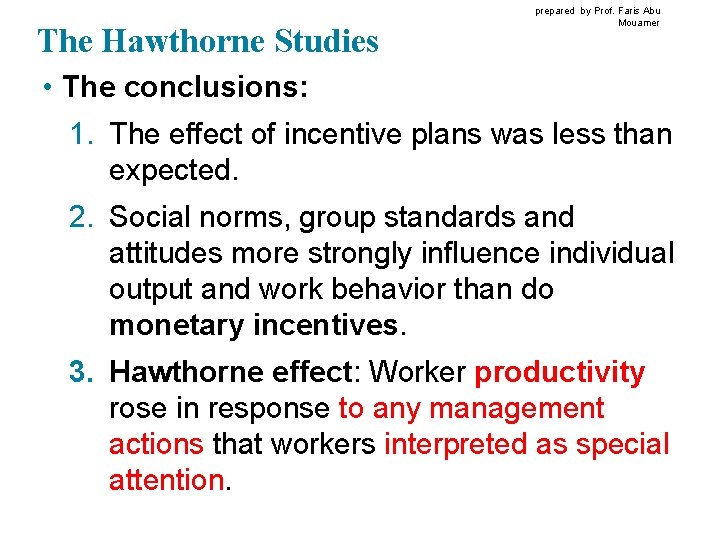
The Hawthorne Studies prepared by Prof. Faris Abu Mouamer • The conclusions: 1. The effect of incentive plans was less than expected. 2. Social norms, group standards and attitudes more strongly influence individual output and work behavior than do monetary incentives. 3. Hawthorne effect: Worker productivity rose in response to any management actions that workers interpreted as special attention.
Total Quality Management • Total quality management (TQM): a philosophy of management that is driven by continuous improvement and responsiveness to customer needs and expectations prepared by Prof. Faris Abu Mouamer
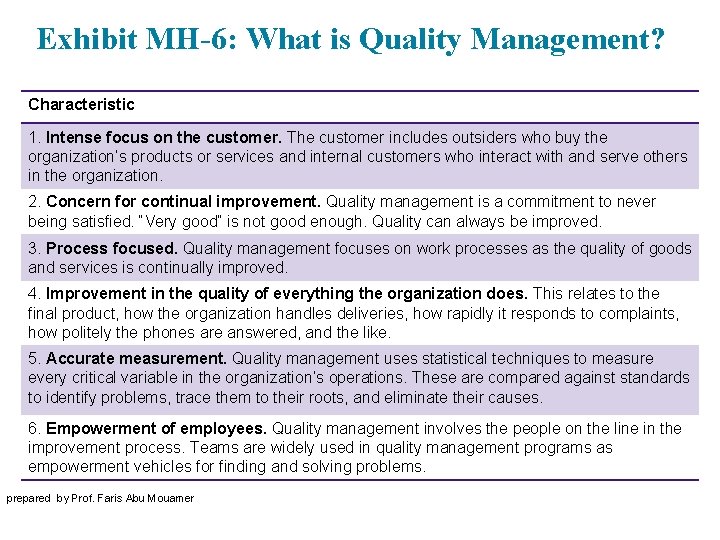
Exhibit MH-6: What is Quality Management? Characteristic 1. Intense focus on the customer. The customer includes outsiders who buy the organization’s products or services and internal customers who interact with and serve others in the organization. 2. Concern for continual improvement. Quality management is a commitment to never being satisfied. “Very good” is not good enough. Quality can always be improved. 3. Process focused. Quality management focuses on work processes as the quality of goods and services is continually improved. 4. Improvement in the quality of everything the organization does. This relates to the final product, how the organization handles deliveries, how rapidly it responds to complaints, how politely the phones are answered, and the like. 5. Accurate measurement. Quality management uses statistical techniques to measure every critical variable in the organization’s operations. These are compared against standards to identify problems, trace them to their roots, and eliminate their causes. 6. Empowerment of employees. Quality management involves the people on the line in the improvement process. Teams are widely used in quality management programs as empowerment vehicles for finding and solving problems. prepared by Prof. Faris Abu Mouamer
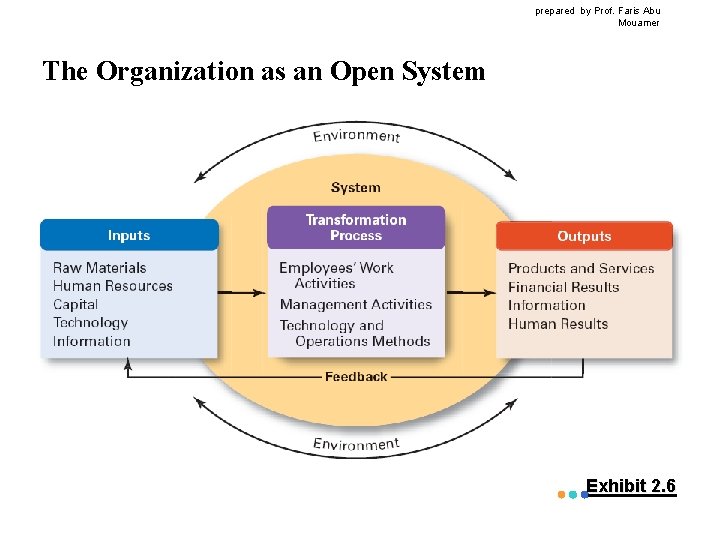
The Systems Approach prepared by Prof. Faris Abu Mouamer • System Defined – During the 1960’s researches began to analyze organizations from a systems perspective based on the physical sciences. – A set of interrelated and interdependent parts arranged in a manner that produces a unified whole. • Basic Types of Systems – Closed systems – Open systems § Dynamically interact to their environments by taking in inputs and transforming them into outputs that are distributed into their environments.
prepared by Prof. Faris Abu Mouamer The Organization as an Open System Exhibit 2. 6
prepared by Prof. Faris Abu Mouamer Implications of the Systems Approach 1. Coordination of the organization’s parts is essential for proper functioning of the entire organization. 2. Decisions and actions taken in one area of the organization will have an effect in other areas of the organization. 3. Organizations are not self-contained and, therefore, must adapt to changes in their external environment.
The Contingency Approach • Contingency Approach Defined prepared by Prof. Faris Abu Mouamer – Also sometimes called the situational approach. – There is no one universally applicable set of management principles (rules) by which to manage organizations. – Organizations are individually different, face different situations (contingency variables), require different ways of managing.
prepared by Prof. Faris Abu Mouamer Popular Contingency Variables • Organization size • Routineness of task technology • Environmental uncertainty • Individual differences Exhibit 2. 7
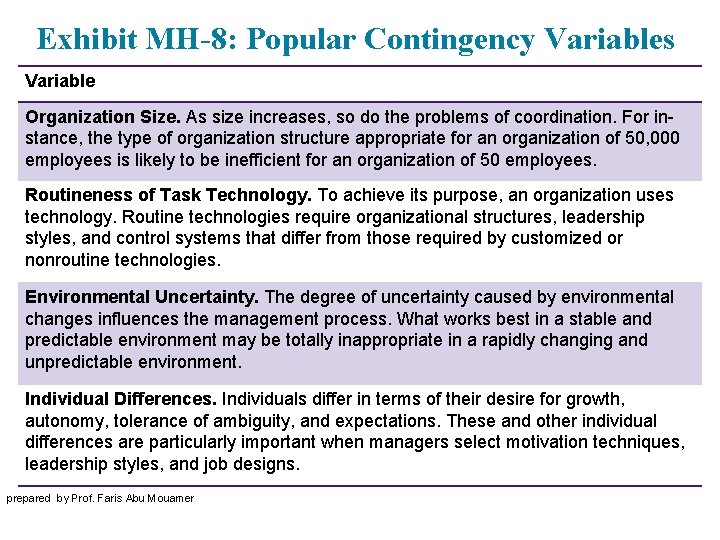
Exhibit MH-8: Popular Contingency Variables Variable Organization Size. As size increases, so do the problems of coordination. For instance, the type of organization structure appropriate for an organization of 50, 000 employees is likely to be inefficient for an organization of 50 employees. Routineness of Task Technology. To achieve its purpose, an organization uses technology. Routine technologies require organizational structures, leadership styles, and control systems that differ from those required by customized or nonroutine technologies. Environmental Uncertainty. The degree of uncertainty caused by environmental changes influences the management process. What works best in a stable and predictable environment may be totally inappropriate in a rapidly changing and unpredictable environment. Individual Differences. Individuals differ in terms of their desire for growth, autonomy, tolerance of ambiguity, and expectations. These and other individual differences are particularly important when managers select motivation techniques, leadership styles, and job designs. prepared by Prof. Faris Abu Mouamer
Review Learning Objective MH 1. 1 • Describe some early management examples. – Early examples of management practice include the construction of the Egyptian pyramids and the Great Wall of China. – One important historical event was the publication of Adam Smith’s “Wealth of Nations, ” in which he argued the benefits of division of labor (job specialization). – Another was the industrial revolution, where it became more economical to manufacture in factories than at home. prepared by Prof. Faris Abu Mouamer
Review Learning Objective MH 1. 2 • Explain the various theories in the classical approach. – – Frederick W. Taylor The Gilbreths Henri Fayol Max Weber prepared by Prof. Faris Abu Mouamer
Review Learning Objective MH 1. 3 • Discuss the development and uses of the behavioral approach. – Early advocates of OB – The Hawthorne Studies prepared by Prof. Faris Abu Mouamer
Review Learning Objective MH 1. 4 • Describe the quantitative approach. – The quantitative approach – Total quality management (TQM) prepared by Prof. Faris Abu Mouamer
Review Learning Objective MH 1. 5 • Explain various theories in the contemporary approach. – Systems approach – Contingency approach prepared by Prof. Faris Abu Mouamer