
Management Fourteenth Edition Chapter 12 Managing Human Resources

- Slides: 46
Management Fourteenth Edition Chapter 12 Managing Human Resources Copyright © 2018, 2016, 2014 Pearson Education, Inc. All Rights Reserved
Learning Objectives 12. 1 Explain the importance of human resource management and the human resource management process. 12. 2 Describe the external influences that affect the human resource management process. 12. 3 Discuss the tasks associated with identifying and selecting competent employees. Know how to write effective job descriptions. Develop your skill at being a good interviewer. 12. 4 Explain how companies provide employees with skills and knowledge. 12. 5 Describe strategies for retaining competent, high-performing employees. 12. 6 Discuss contemporary issues in managing human resources. Copyright © 2018, 2016, 2014 Pearson Education, Inc. All Rights Reserved
Why Human Resource Management is Important and the Human Resource Management Process • Human resource management (HRM) can be a significant source of competitive advantage • HRM is an important part of organizational strategies • The way organizations treat their people can significantly impact performance Copyright © 2018, 2016, 2014 Pearson Education, Inc. All Rights Reserved
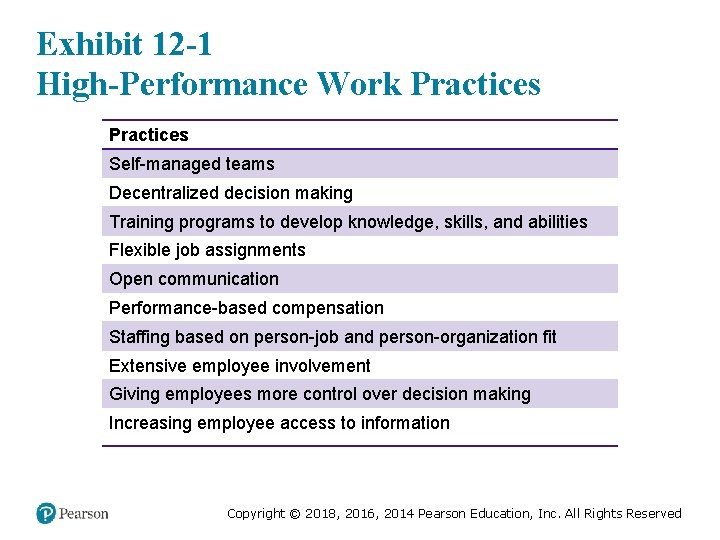
High-Performance Work Practices • High-performance work practices: work practices that lead to both high individual and high organizational performance Copyright © 2018, 2016, 2014 Pearson Education, Inc. All Rights Reserved
Exhibit 12 -1 High-Performance Work Practices Self-managed teams Decentralized decision making Training programs to develop knowledge, skills, and abilities Flexible job assignments Open communication Performance-based compensation Staffing based on person-job and person-organization fit Extensive employee involvement Giving employees more control over decision making Increasing employee access to information Copyright © 2018, 2016, 2014 Pearson Education, Inc. All Rights Reserved
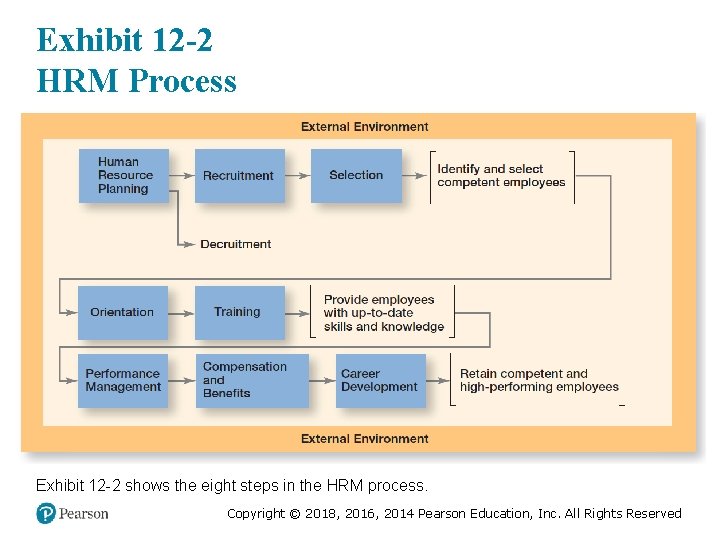
Exhibit 12 -2 HRM Process Exhibit 12 -2 shows the eight steps in the HRM process. Copyright © 2018, 2016, 2014 Pearson Education, Inc. All Rights Reserved
External Factors that Affect the Human Resource Management Process • The economy: lasting impact of the Great Recession Copyright © 2018, 2016, 2014 Pearson Education, Inc. All Rights Reserved
Labor Unions • Labor union: an organization that represents workers and seeks to protect their interests through collective bargaining Copyright © 2018, 2016, 2014 Pearson Education, Inc. All Rights Reserved
Laws and Rulings • Affirmative action: Organizational programs that enhance the status of members of protected groups Copyright © 2018, 2016, 2014 Pearson Education, Inc. All Rights Reserved
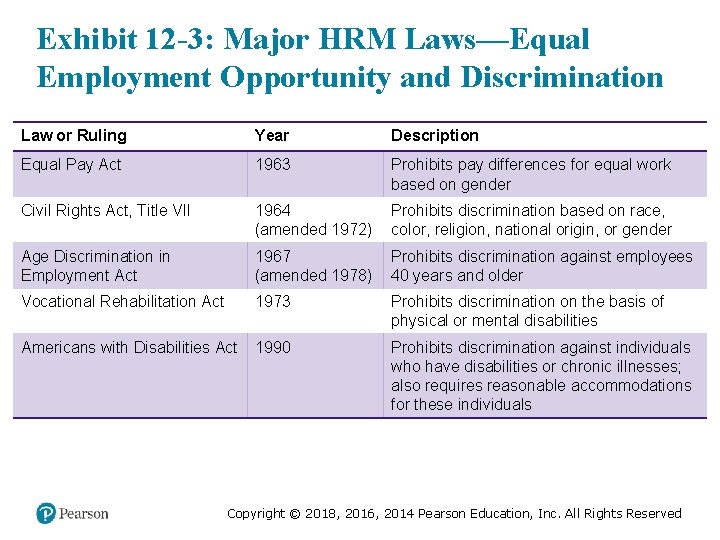
Exhibit 12 -3: Major HRM Laws—Equal Employment Opportunity and Discrimination Law or Ruling Year Description Equal Pay Act 1963 Prohibits pay differences for equal work based on gender Civil Rights Act, Title VII 1964 (amended 1972) Prohibits discrimination based on race, color, religion, national origin, or gender Age Discrimination in Employment Act 1967 (amended 1978) Prohibits discrimination against employees 40 years and older Vocational Rehabilitation Act 1973 Prohibits discrimination on the basis of physical or mental disabilities Americans with Disabilities Act 1990 Prohibits discrimination against individuals who have disabilities or chronic illnesses; also requires reasonable accommodations for these individuals Copyright © 2018, 2016, 2014 Pearson Education, Inc. All Rights Reserved
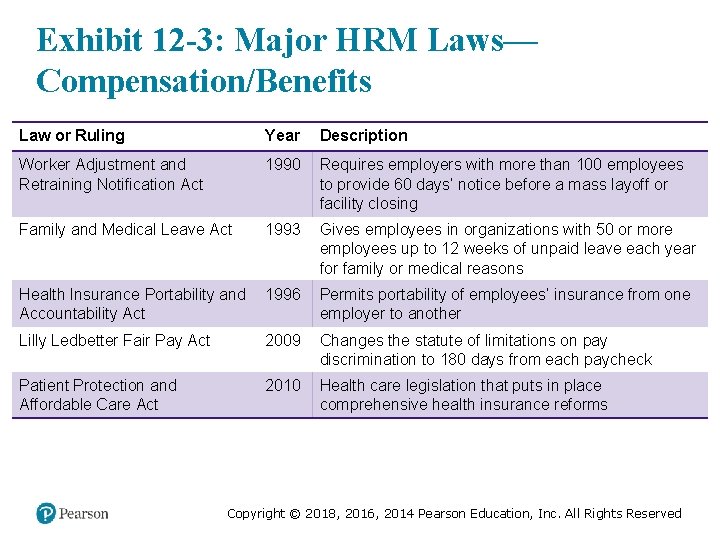
Exhibit 12 -3: Major HRM Laws— Compensation/Benefits Law or Ruling Year Description Worker Adjustment and Retraining Notification Act 1990 Requires employers with more than 100 employees to provide 60 days’ notice before a mass layoff or facility closing Family and Medical Leave Act 1993 Gives employees in organizations with 50 or more employees up to 12 weeks of unpaid leave each year for family or medical reasons Health Insurance Portability and Accountability Act 1996 Permits portability of employees’ insurance from one employer to another Lilly Ledbetter Fair Pay Act 2009 Changes the statute of limitations on pay discrimination to 180 days from each paycheck Patient Protection and Affordable Care Act 2010 Health care legislation that puts in place comprehensive health insurance reforms Copyright © 2018, 2016, 2014 Pearson Education, Inc. All Rights Reserved
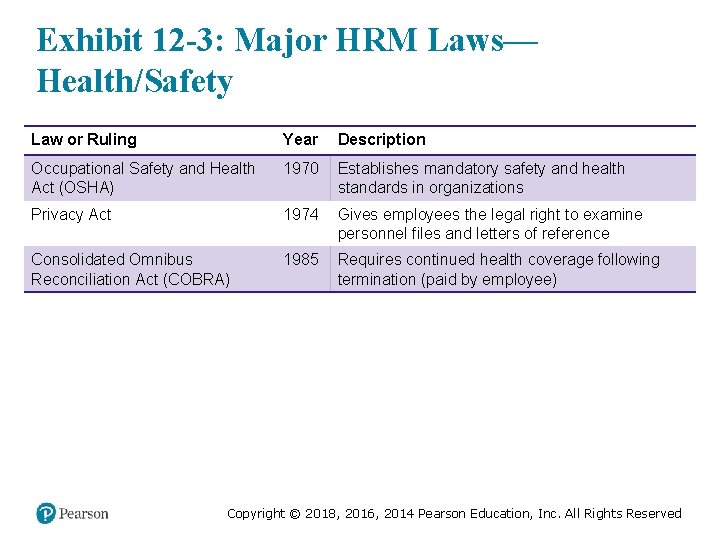
Exhibit 12 -3: Major HRM Laws— Health/Safety Law or Ruling Year Description Occupational Safety and Health Act (OSHA) 1970 Establishes mandatory safety and health standards in organizations Privacy Act 1974 Gives employees the legal right to examine personnel files and letters of reference Consolidated Omnibus Reconciliation Act (COBRA) 1985 Requires continued health coverage following termination (paid by employee) Copyright © 2018, 2016, 2014 Pearson Education, Inc. All Rights Reserved
Global HRM • Work councils: groups of nominated or elected employees who must be consulted when management makes decisions involving personnel • Board representatives: employees who sit on a company’s board of directors and represent the interests of the firm’s employees Copyright © 2018, 2016, 2014 Pearson Education, Inc. All Rights Reserved
Demography • The oldest, most experienced workers (those born before 1946) make up 6% of the workforce • Baby boomers make up 41. 5% of the workforce • Gen Xers make up almost 29% of the workforce • Gen Yers make up almost 24% of the workforce Copyright © 2018, 2016, 2014 Pearson Education, Inc. All Rights Reserved
Human Resource Planning • Human resource planning: ensuring that the organization has the right number and kinds of capable people in the right places and at the right times • Two steps: – Assessing current human resources – Meeting future HR needs Copyright © 2018, 2016, 2014 Pearson Education, Inc. All Rights Reserved
Current Assessment • Job analysis: an assessment that defines jobs and the behaviors necessary to perform them • Job description (position description): a written statement that describes a job • Job specifications: a written statement of the minimum qualifications a person must possess to perform a given job successfully Copyright © 2018, 2016, 2014 Pearson Education, Inc. All Rights Reserved
Meeting Future HR Needs/Increased Scrutiny in Selection Process • Future HR needs are determined by the organization’s mission, goals, and strategies. • Companies that do not carefully scrutinize the qualifications or backgrounds of employees surely pose risks of increased liability, poor reputation, and lower performance. Copyright © 2018, 2016, 2014 Pearson Education, Inc. All Rights Reserved
Recruitment and Decruitment • Recruitment: locating, identifying, and attracting capable applicants • Decruitment: reducing an organization’s workforce Copyright © 2018, 2016, 2014 Pearson Education, Inc. All Rights Reserved
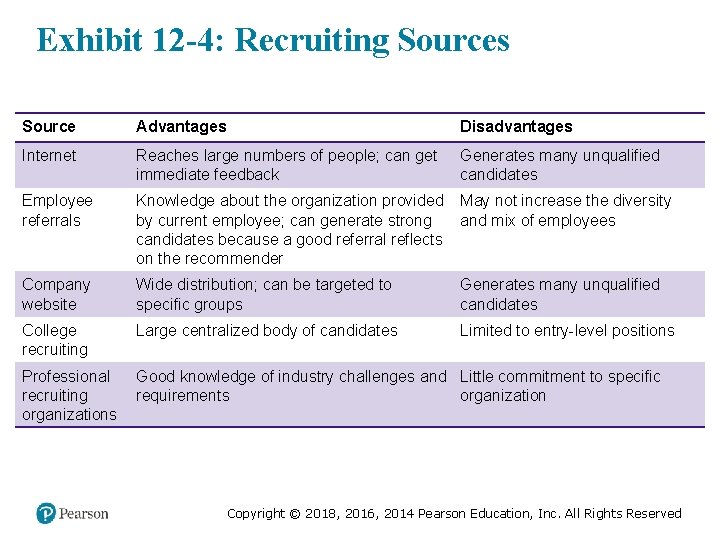
Exhibit 12 -4: Recruiting Sources Source Advantages Disadvantages Internet Reaches large numbers of people; can get immediate feedback Generates many unqualified candidates Employee referrals Knowledge about the organization provided by current employee; can generate strong candidates because a good referral reflects on the recommender May not increase the diversity and mix of employees Company website Wide distribution; can be targeted to specific groups Generates many unqualified candidates College recruiting Large centralized body of candidates Limited to entry-level positions Professional recruiting organizations Good knowledge of industry challenges and Little commitment to specific requirements organization Copyright © 2018, 2016, 2014 Pearson Education, Inc. All Rights Reserved
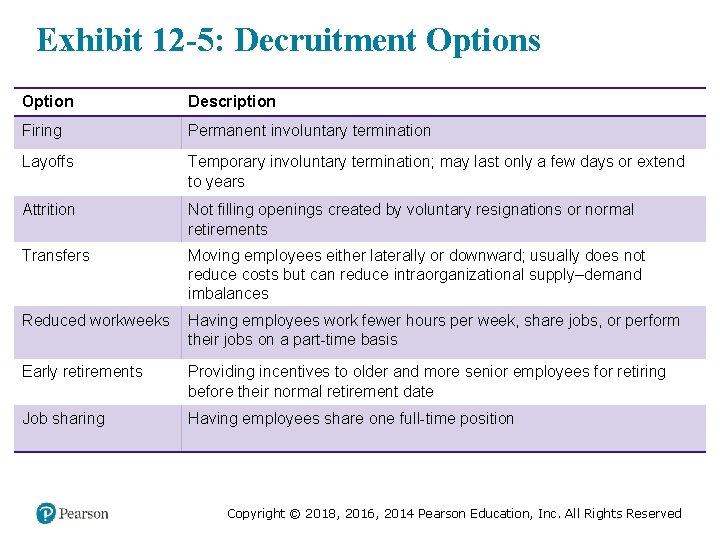
Exhibit 12 -5: Decruitment Options Option Description Firing Permanent involuntary termination Layoffs Temporary involuntary termination; may last only a few days or extend to years Attrition Not filling openings created by voluntary resignations or normal retirements Transfers Moving employees either laterally or downward; usually does not reduce costs but can reduce intraorganizational supply–demand imbalances Reduced workweeks Having employees work fewer hours per week, share jobs, or perform their jobs on a part-time basis Early retirements Providing incentives to older and more senior employees for retiring before their normal retirement date Job sharing Having employees share one full-time position Copyright © 2018, 2016, 2014 Pearson Education, Inc. All Rights Reserved
Selection • Selection: screening job applicants to ensure that the most appropriate candidates are hired Copyright © 2018, 2016, 2014 Pearson Education, Inc. All Rights Reserved
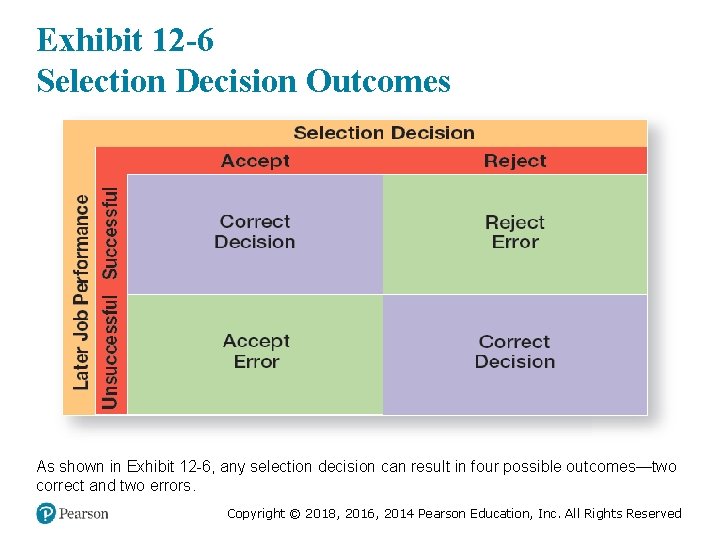
Exhibit 12 -6 Selection Decision Outcomes As shown in Exhibit 12 -6, any selection decision can result in four possible outcomes—two correct and two errors. Copyright © 2018, 2016, 2014 Pearson Education, Inc. All Rights Reserved
Validity and Reliability • A valid selection device is characterized by a proven relationship between the selection device and some relevant criterion. • A reliable selection device indicates that it measures the same thing consistently. Copyright © 2018, 2016, 2014 Pearson Education, Inc. All Rights Reserved
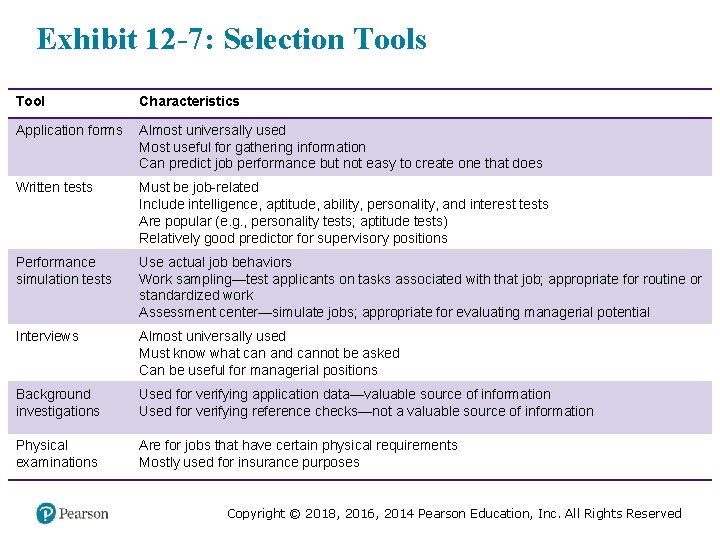
Exhibit 12 -7: Selection Tools Tool Characteristics Application forms Almost universally used Most useful for gathering information Can predict job performance but not easy to create one that does Written tests Must be job-related Include intelligence, aptitude, ability, personality, and interest tests Are popular (e. g. , personality tests; aptitude tests) Relatively good predictor for supervisory positions Performance simulation tests Use actual job behaviors Work sampling—test applicants on tasks associated with that job; appropriate for routine or standardized work Assessment center—simulate jobs; appropriate for evaluating managerial potential Interviews Almost universally used Must know what can and cannot be asked Can be useful for managerial positions Background investigations Used for verifying application data—valuable source of information Used for verifying reference checks—not a valuable source of information Physical examinations Are for jobs that have certain physical requirements Mostly used for insurance purposes Copyright © 2018, 2016, 2014 Pearson Education, Inc. All Rights Reserved
Realistic Job Preview • Realistic job preview (RJP): a preview of a job that provides both positive and negative information about the job and the company Copyright © 2018, 2016, 2014 Pearson Education, Inc. All Rights Reserved
Orientation • Orientation: introducing a new employee to his or her job and the organization Copyright © 2018, 2016, 2014 Pearson Education, Inc. All Rights Reserved
Employee Training • On average, U. S. companies spent $702 per employee for training. Copyright © 2018, 2016, 2014 Pearson Education, Inc. All Rights Reserved
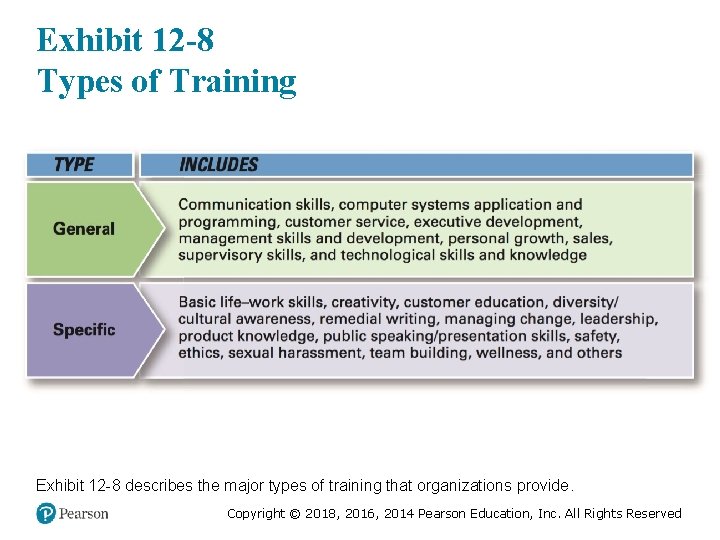
Exhibit 12 -8 Types of Training Exhibit 12 -8 describes the major types of training that organizations provide. Copyright © 2018, 2016, 2014 Pearson Education, Inc. All Rights Reserved
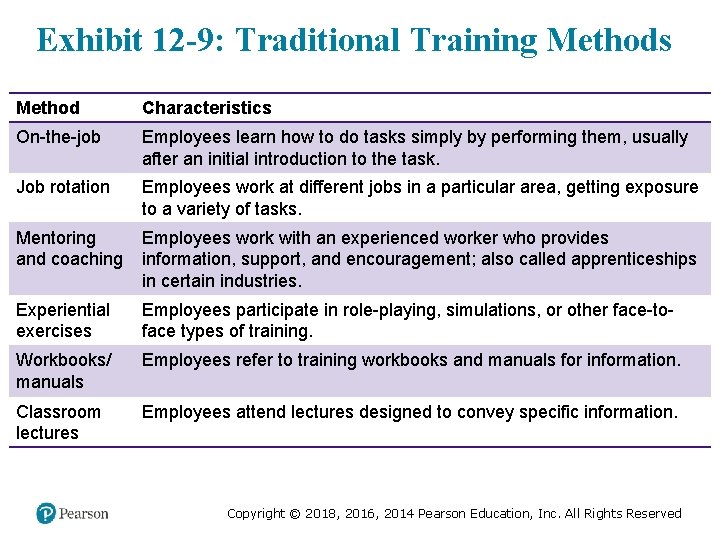
Exhibit 12 -9: Traditional Training Methods Method Characteristics On-the-job Employees learn how to do tasks simply by performing them, usually after an initial introduction to the task. Job rotation Employees work at different jobs in a particular area, getting exposure to a variety of tasks. Mentoring and coaching Employees work with an experienced worker who provides information, support, and encouragement; also called apprenticeships in certain industries. Experiential exercises Employees participate in role-playing, simulations, or other face-toface types of training. Workbooks/ manuals Employees refer to training workbooks and manuals for information. Classroom lectures Employees attend lectures designed to convey specific information. Copyright © 2018, 2016, 2014 Pearson Education, Inc. All Rights Reserved
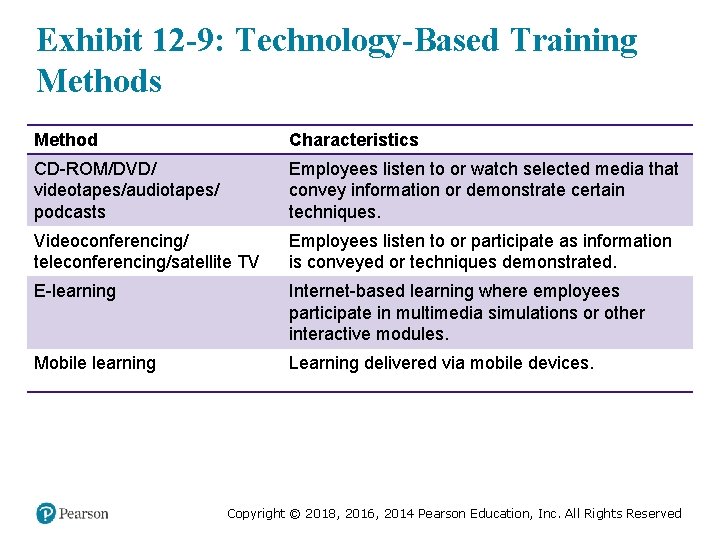
Exhibit 12 -9: Technology-Based Training Methods Method Characteristics CD-ROM/DVD/ videotapes/audiotapes/ podcasts Employees listen to or watch selected media that convey information or demonstrate certain techniques. Videoconferencing/ teleconferencing/satellite TV Employees listen to or participate as information is conveyed or techniques demonstrated. E-learning Internet-based learning where employees participate in multimedia simulations or other interactive modules. Mobile learning Learning delivered via mobile devices. Copyright © 2018, 2016, 2014 Pearson Education, Inc. All Rights Reserved
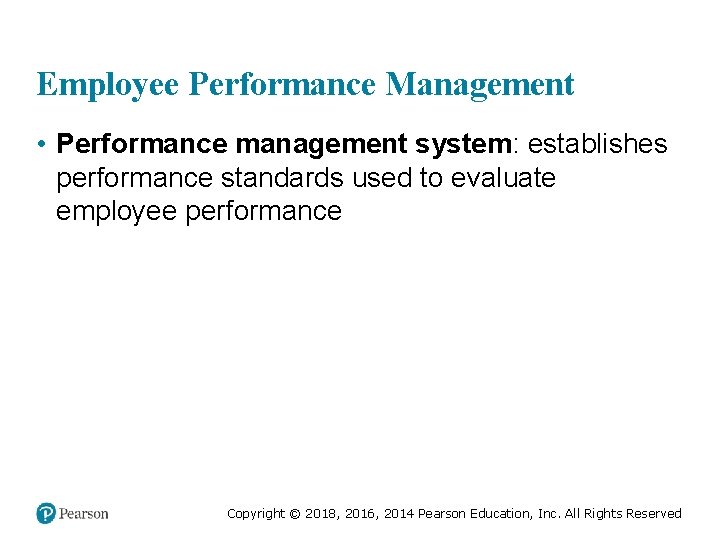
Employee Performance Management • Performance management system: establishes performance standards used to evaluate employee performance Copyright © 2018, 2016, 2014 Pearson Education, Inc. All Rights Reserved
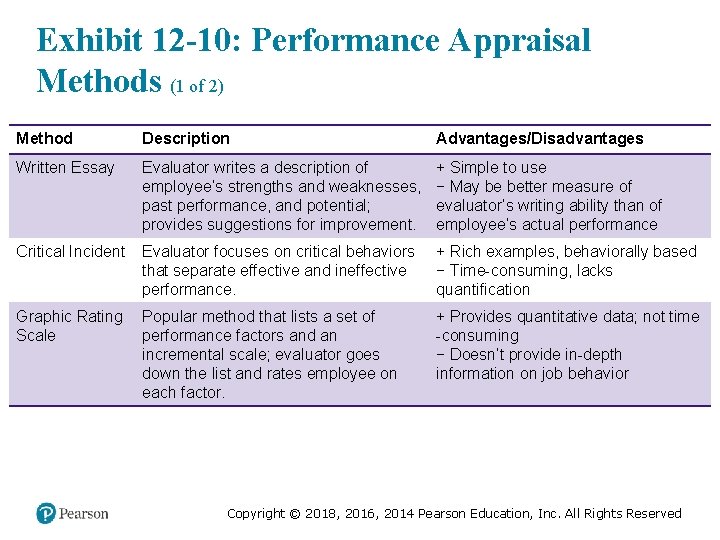
Exhibit 12 -10: Performance Appraisal Methods (1 of 2) Method Description Advantages/Disadvantages Written Essay Evaluator writes a description of employee’s strengths and weaknesses, past performance, and potential; provides suggestions for improvement. + Simple to use − May be better measure of evaluator’s writing ability than of employee’s actual performance Critical Incident Evaluator focuses on critical behaviors that separate effective and ineffective performance. + Rich examples, behaviorally based − Time-consuming, lacks quantification Graphic Rating Scale Popular method that lists a set of performance factors and an incremental scale; evaluator goes down the list and rates employee on each factor. + Provides quantitative data; not time -consuming − Doesn’t provide in-depth information on job behavior Copyright © 2018, 2016, 2014 Pearson Education, Inc. All Rights Reserved
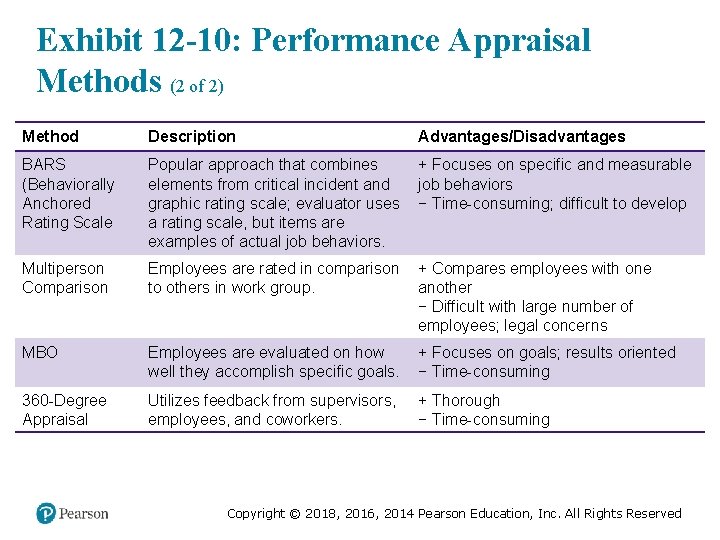
Exhibit 12 -10: Performance Appraisal Methods (2 of 2) Method Description Advantages/Disadvantages BARS (Behaviorally Anchored Rating Scale Popular approach that combines elements from critical incident and graphic rating scale; evaluator uses a rating scale, but items are examples of actual job behaviors. + Focuses on specific and measurable job behaviors − Time-consuming; difficult to develop Multiperson Comparison Employees are rated in comparison to others in work group. + Compares employees with one another − Difficult with large number of employees; legal concerns MBO Employees are evaluated on how well they accomplish specific goals. + Focuses on goals; results oriented − Time-consuming 360 -Degree Appraisal Utilizes feedback from supervisors, employees, and coworkers. + Thorough − Time-consuming Copyright © 2018, 2016, 2014 Pearson Education, Inc. All Rights Reserved
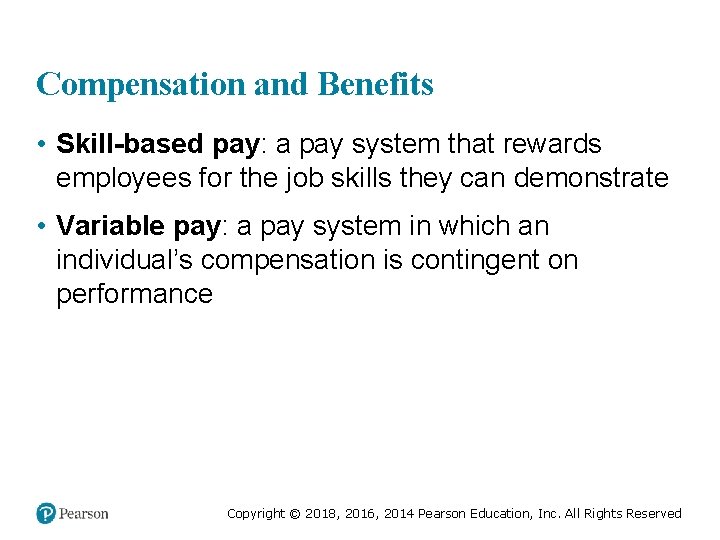
Compensation and Benefits • Skill-based pay: a pay system that rewards employees for the job skills they can demonstrate • Variable pay: a pay system in which an individual’s compensation is contingent on performance Copyright © 2018, 2016, 2014 Pearson Education, Inc. All Rights Reserved
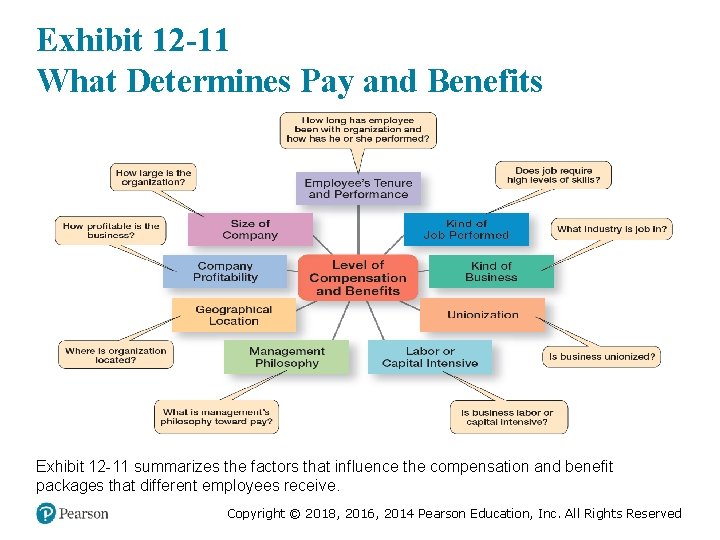
Exhibit 12 -11 What Determines Pay and Benefits Exhibit 12 -11 summarizes the factors that influence the compensation and benefit packages that different employees receive. Copyright © 2018, 2016, 2014 Pearson Education, Inc. All Rights Reserved
Managing Downsizing • Downsizing: the planned elimination of jobs in an organization Copyright © 2018, 2016, 2014 Pearson Education, Inc. All Rights Reserved
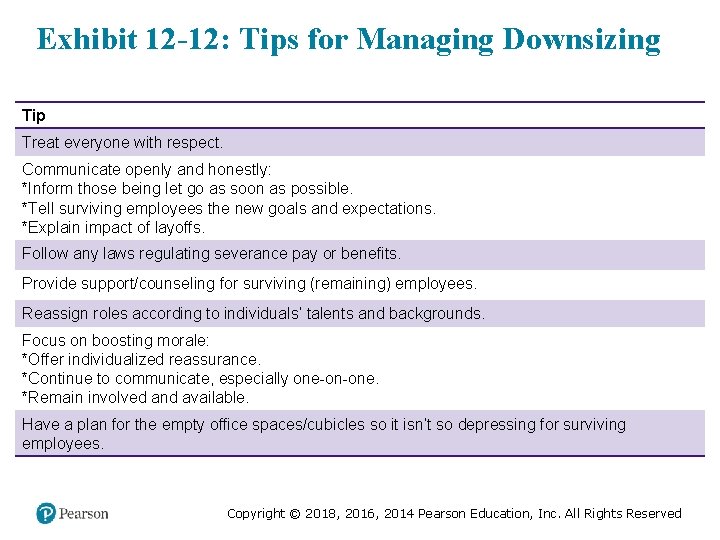
Exhibit 12 -12: Tips for Managing Downsizing Tip Treat everyone with respect. Communicate openly and honestly: *Inform those being let go as soon as possible. *Tell surviving employees the new goals and expectations. *Explain impact of layoffs. Follow any laws regulating severance pay or benefits. Provide support/counseling for surviving (remaining) employees. Reassign roles according to individuals’ talents and backgrounds. Focus on boosting morale: *Offer individualized reassurance. *Continue to communicate, especially one-on-one. *Remain involved and available. Have a plan for the empty office spaces/cubicles so it isn’t so depressing for surviving employees. Copyright © 2018, 2016, 2014 Pearson Education, Inc. All Rights Reserved
Managing Sexual Harassment • Sexual harassment: any unwanted action or activity of a sexual nature that explicitly or implicitly affects an individual’s employment, performance, or work environment Copyright © 2018, 2016, 2014 Pearson Education, Inc. All Rights Reserved
Controlling HR Costs • Employee health-care costs • Employee pension plan costs Copyright © 2018, 2016, 2014 Pearson Education, Inc. All Rights Reserved
Review Learning Objective 12. 1 • Explain the importance of human resource management and the Human Resource Management Process. 1. Competitive advantage 2. Organizational strategies 3. Impact of employee treatment on organizational performance Copyright © 2018, 2016, 2014 Pearson Education, Inc. All Rights Reserved
Review Learning Objective 12. 2 • Describe the external influences that affect the human resources management process. – – Economy Labor unions Legal environment Demographic trends Copyright © 2018, 2016, 2014 Pearson Education, Inc. All Rights Reserved
Review Learning Objective 12. 3 • Discuss the tasks associated with identifying and selecting competent employees. – Planning: § Job analysis § Job description § Job specification – Recruitment/decruitment – Selection – Realistic job preview Copyright © 2018, 2016, 2014 Pearson Education, Inc. All Rights Reserved
Review Learning Objective 12. 4 • Explain how companies provide employees with skills and knowledge. – Orientation – Training: § Profession/industry-specific training § Management/supervisory skills § Mandatory/compliance information § Customer service training – Traditional training versus technology-based methods Copyright © 2018, 2016, 2014 Pearson Education, Inc. All Rights Reserved
Review Learning Objective 12. 5 • Describe strategies for retaining competent, high-performing employees. – – Performance management system Performance appraisal methods Factors influencing compensation and benefits Skill-based pay systems versus variable pay system Copyright © 2018, 2016, 2014 Pearson Education, Inc. All Rights Reserved
Review Learning Objective 12. 6 • Discuss contemporary issues in managing human resources. – Downsizing – Sexual harassment – Controlling HR costs Copyright © 2018, 2016, 2014 Pearson Education, Inc. All Rights Reserved
Copyright © 2018, 2016, 2014 Pearson Education, Inc. All Rights Reserved