
Management for Knowledge Accumulation and Creation A generic

- Slides: 44
Management for Knowledge Accumulation and Creation - A generic analysis of the mechanism and its application to the Myanmar situation Keynote speech for APSITT 2005 November 9, 2005 Makoto (Mike) Takei Waseda University Copyright: M. Takei 1
What is knowledge • The definition is irrelevant in this speech. However, for your information, the following is a way to define several related words. • Data: objective facts and phenomena • Information: processed data to have meaning with intention and objectives • Knowledge: matters and criteria which are helpful to achieve objectives • Know-how: way, technique and criteria based on experience Copyright: M. Takei 2
Importance of knowledge Two kinds aspects • Physical aspects: With good knowledge you can achieve the goals faster and better, or achieve the goals which would be impossible without it. Sometimes you may find achieve a new goal by accumulating knowledge for the original goal. • Psychological aspects: The success in physical aspects often brings satisfaction in human desire of high level, such as sense of accomplishment, self realization, being well recognized. These are important factors at HR management. Copyright: M. Takei 3
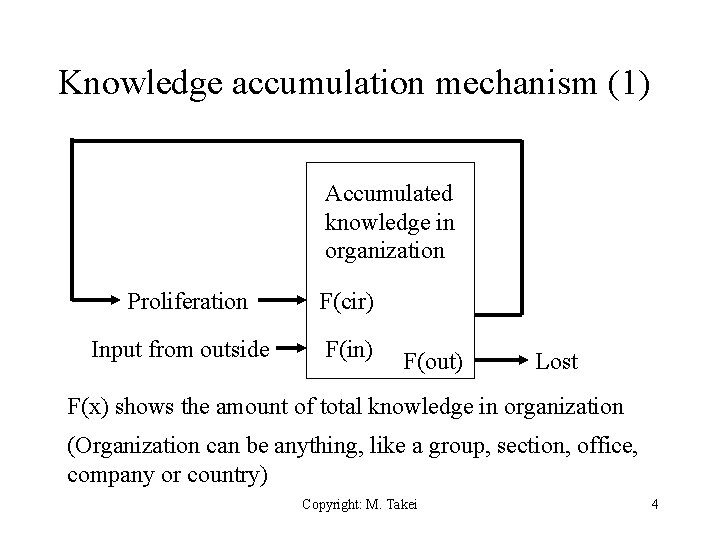
Knowledge accumulation mechanism (1) Accumulated knowledge in organization Proliferation Input from outside F(cir) F(in) F(out) Lost F(x) shows the amount of total knowledge in organization (Organization can be anything, like a group, section, office, company or country) Copyright: M. Takei 4
The objectives of this speech is to address how to accumulate knowledge through the mechanism • What is success and failure of the knowledge accumulation mechanism? • What are possible reasons of failure? • What makes the mechanism success? Copyright: M. Takei 5
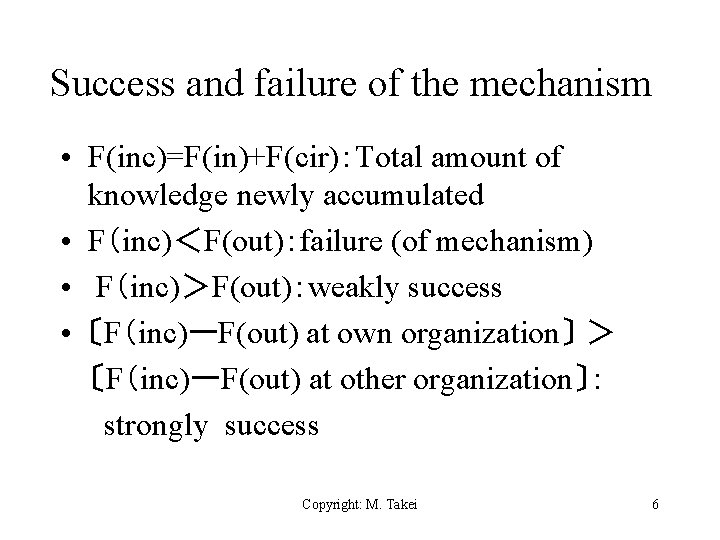
Success and failure of the mechanism • F(inc)=F(in)+F(cir):Total amount of knowledge newly accumulated • F(inc)<F(out):failure (of mechanism) • F(inc)>F(out):weakly success • 〔F(inc)ーF(out) at own organization〕 > 〔F(inc)ーF(out) at other organization〕: strongly success Copyright: M. Takei 6
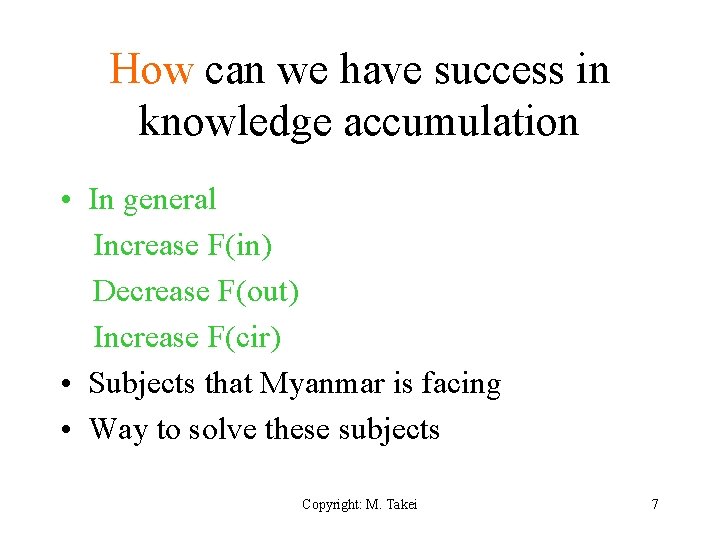
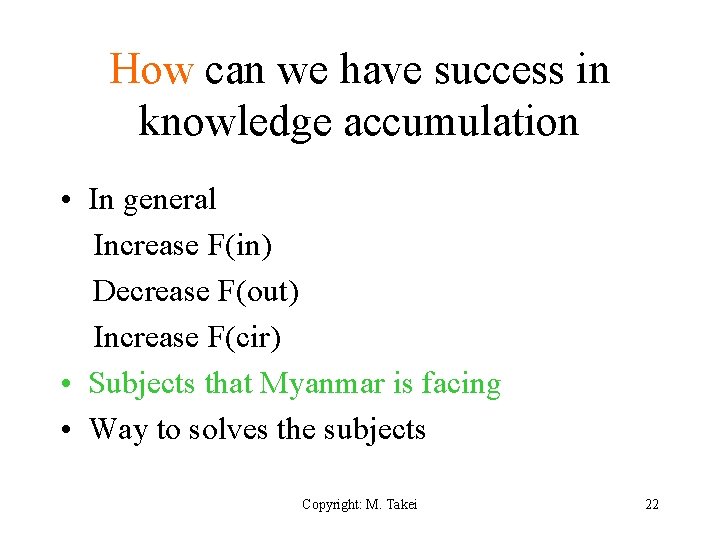
How can we have success in knowledge accumulation • In general Increase F(in) Decrease F(out) Increase F(cir) • Subjects that Myanmar is facing • Way to solve these subjects Copyright: M. Takei 7
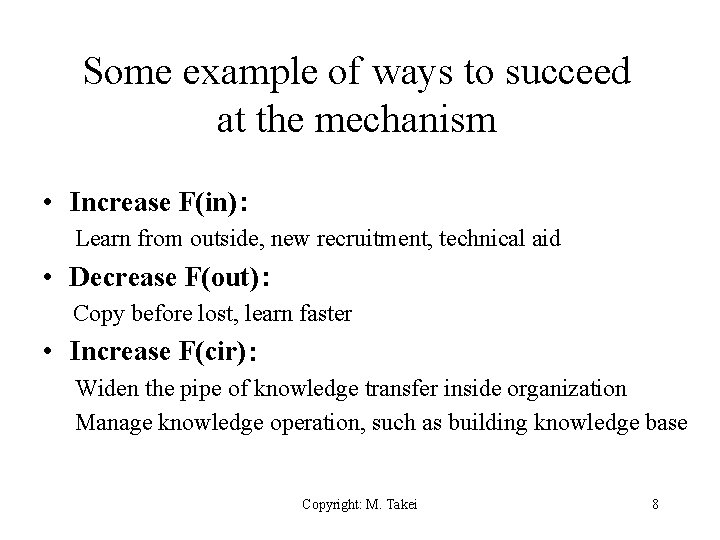
Some example of ways to succeed at the mechanism • Increase F(in): Learn from outside, new recruitment, technical aid • Decrease F(out): Copy before lost, learn faster • Increase F(cir): Widen the pipe of knowledge transfer inside organization Manage knowledge operation, such as building knowledge base Copyright: M. Takei 8
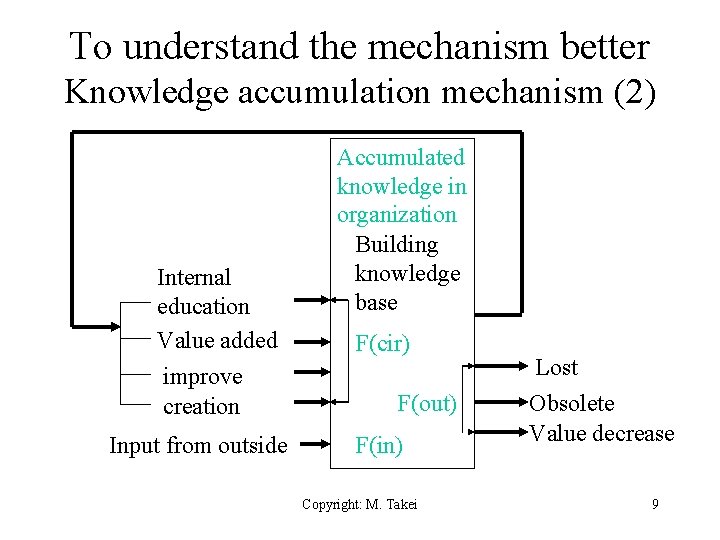
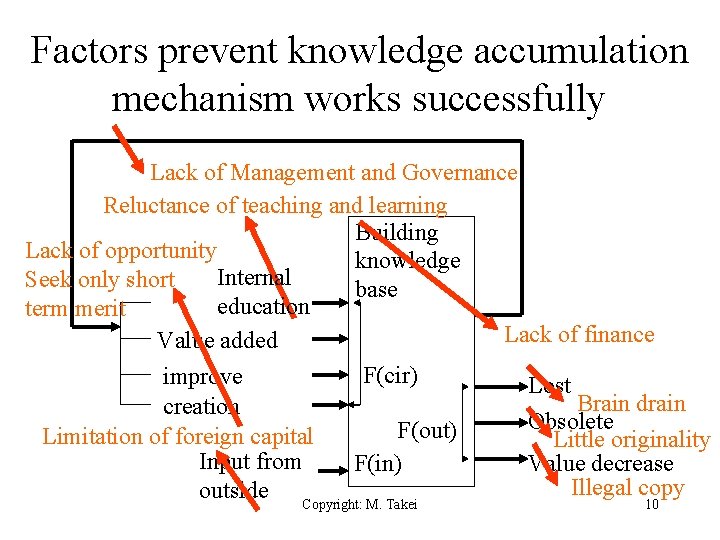
To understand the mechanism better Knowledge accumulation mechanism (2) Internal education Value added improve creation Input from outside Accumulated knowledge in organization Building knowledge base F(cir) F(out) F(in) Copyright: M. Takei Lost Obsolete Value decrease 9
Factors prevent knowledge accumulation mechanism works successfully Lack of Management and Governance Reluctance of teaching and learning Building Lack of opportunity knowledge Internal Seek only short base education term merit Lack of finance Value added F(cir) improve Lost Brain drain creation Obsolete F(out) Limitation of foreign capital Little originality Input from F(in) Value decrease Illegal copy outside Copyright: M. Takei 10
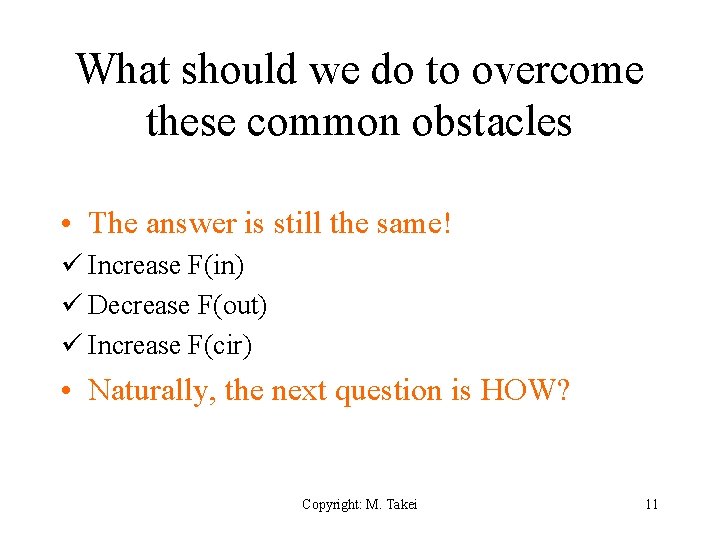
What should we do to overcome these common obstacles • The answer is still the same! ü Increase F(in) ü Decrease F(out) ü Increase F(cir) • Naturally, the next question is HOW? Copyright: M. Takei 11
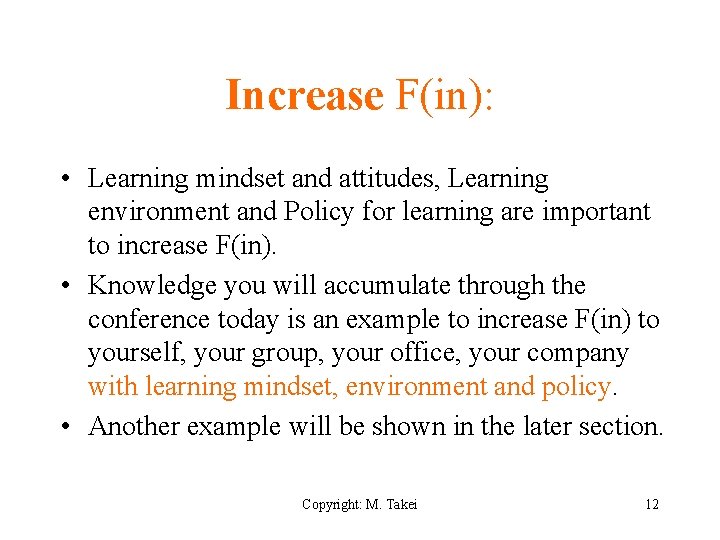
Increase F(in): • Learning mindset and attitudes, Learning environment and Policy for learning are important to increase F(in). • Knowledge you will accumulate through the conference today is an example to increase F(in) to yourself, your group, your office, your company with learning mindset, environment and policy. • Another example will be shown in the later section. Copyright: M. Takei 12
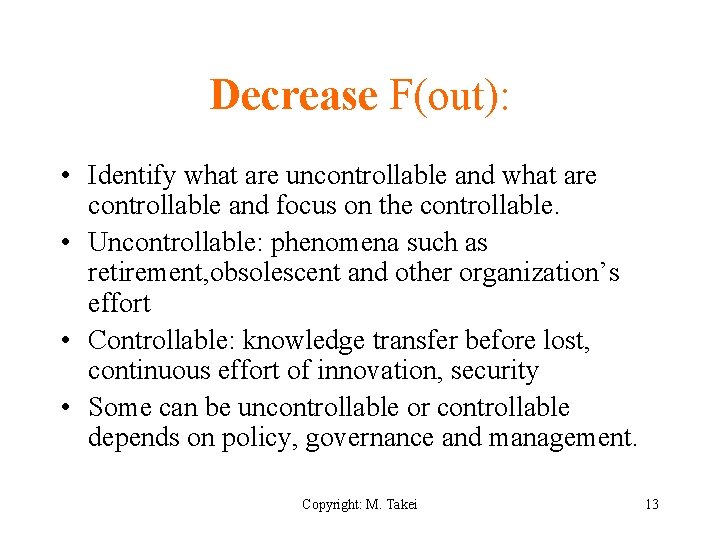
Decrease F(out): • Identify what are uncontrollable and what are controllable and focus on the controllable. • Uncontrollable: phenomena such as retirement, obsolescent and other organization’s effort • Controllable: knowledge transfer before lost, continuous effort of innovation, security • Some can be uncontrollable or controllable depends on policy, governance and management. Copyright: M. Takei 13
Examples of Way to Decrease F(out) • National level Policy against brain drain, illegal copy • Management level Encouragement of internal training and knowledge accumulation and creation • Technical level Effort to develop own technology and methodology Information security Copyright: M. Takei 14
Increase F(cir): Three major factors • Propagate Knowledge propagation within organization • Harmonize Harmonization between new and conventional knowledge, between one’s and others’ knowledge • Use Practical use of knowledge Copyright: M. Takei 15
Propagate through…. • Education/ Training/Teaching • Workshop/ Team work/ Task force group • Transferring from one’s brain to shared file The points are, • Propagation within organization increases the total amount of knowledge in the organization. • Good management and policy will encourage the internal propagation. And how about those who do not want to share? Copyright: M. Takei 16
Sub-products by propagation (Especially to those who are reluctant to share) • Teaching is learning. • Out of the counsel of three comes Manjusri’s wisdom. ( Manjusri, or Monjyu, is the bodhisattva of wisdom and intellect) • Drawing pictures often make things clear and helps to find new ideas for the drawers. These imply, • as long as knowledge is concerned, to share is not to lose but to gain, • and effort for propagation sometimes creates new knowledge. Copyright: M. Takei 17
Harmonize with…. • Being harmonized with conventional knowledge, new knowledge sometimes becomes much easier to be adapted or used in the existing environment. • Harmonizing one’s knowledge with others’ will increase the amount of knowledge by complementing each other and may help to generate new knowledge. Copyright: M. Takei 18
Use, Use and Use • Knowledge displays its value by being used. • Knowledge confirmed by being used. • Using knowledge often provides a chance to generate new additional knowledge for improvement or adjustment in different environment. Copyright: M. Takei 19
Accumulation mechanism and Creation mechanism of knowledge • We have already seen activities for accumulation, (1) Propagation sometimes creates new knowledge (2) Harmonization may help to generate new knowledge (3) Using knowledge often provides a chance to generate new knowledge • Therefore, the mechanism is not only for accumulation but also works for creation of knowledge. Copyright: M. Takei 20
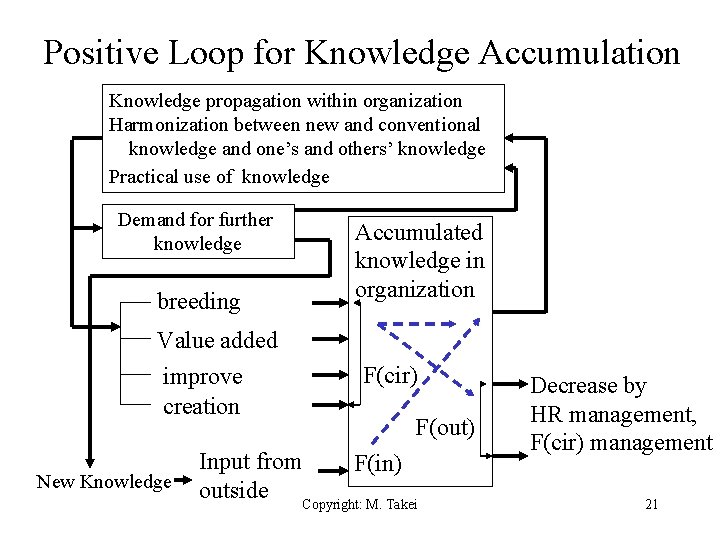
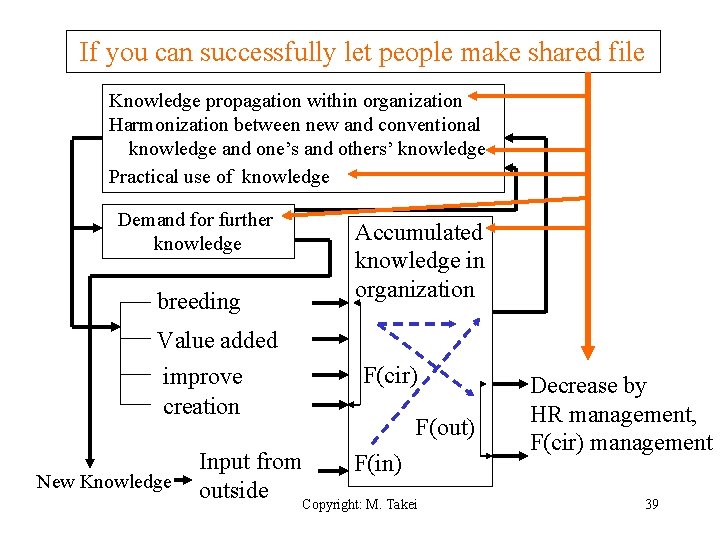
Positive Loop for Knowledge Accumulation Knowledge propagation within organization Harmonization between new and conventional knowledge and one’s and others’ knowledge Practical use of knowledge Demand for further knowledge breeding Value added improve creation New Knowledge Accumulated knowledge in organization F(cir) F(out) Input from F(in) outside Copyright: M. Takei Decrease by HR management, F(cir) management 21
How can we have success in knowledge accumulation • In general Increase F(in) Decrease F(out) Increase F(cir) • Subjects that Myanmar is facing • Way to solves the subjects Copyright: M. Takei 22
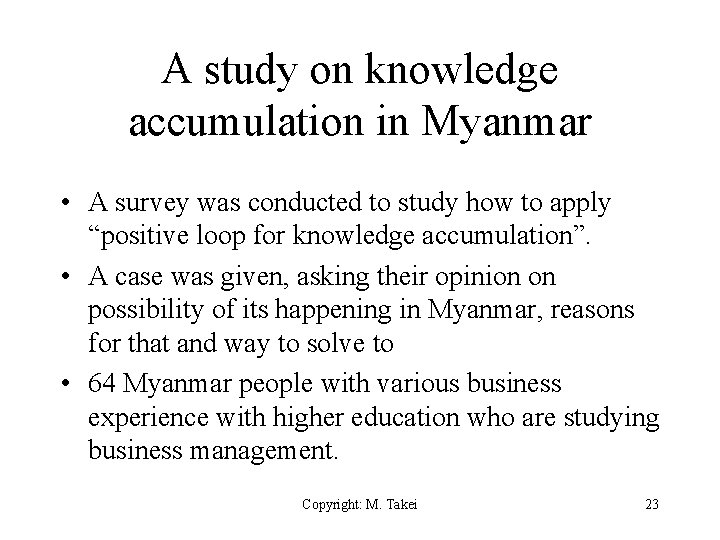
A study on knowledge accumulation in Myanmar • A survey was conducted to study how to apply “positive loop for knowledge accumulation”. • A case was given, asking their opinion on possibility of its happening in Myanmar, reasons for that and way to solve to • 64 Myanmar people with various business experience with higher education who are studying business management. Copyright: M. Takei 23
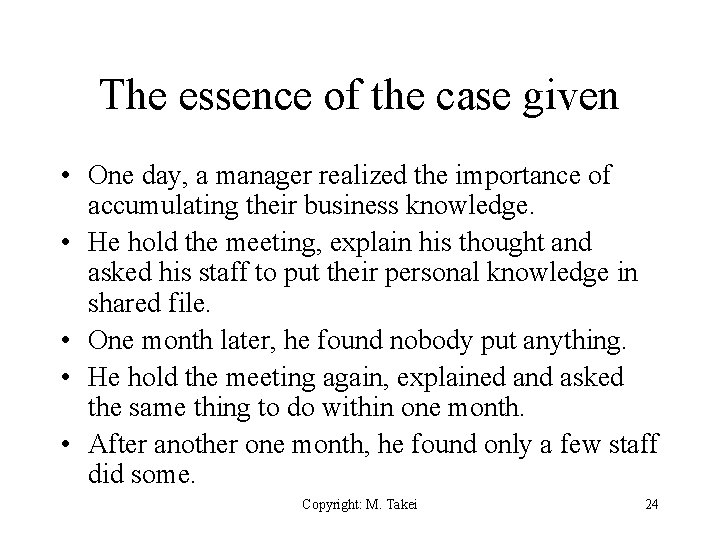
The essence of the case given • One day, a manager realized the importance of accumulating their business knowledge. • He hold the meeting, explain his thought and asked his staff to put their personal knowledge in shared file. • One month later, he found nobody put anything. • He hold the meeting again, explained and asked the same thing to do within one month. • After another one month, he found only a few staff did some. Copyright: M. Takei 24
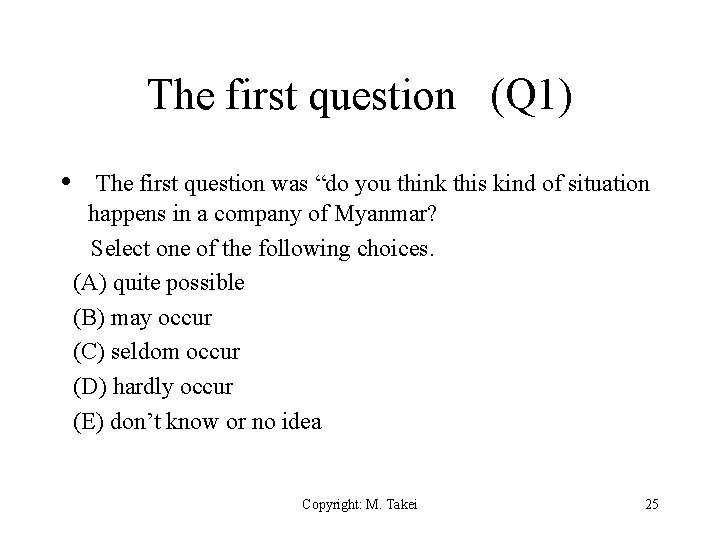
The first question (Q 1) • The first question was “do you think this kind of situation happens in a company of Myanmar? Select one of the following choices. (A) quite possible (B) may occur (C) seldom occur (D) hardly occur (E) don’t know or no idea Copyright: M. Takei 25
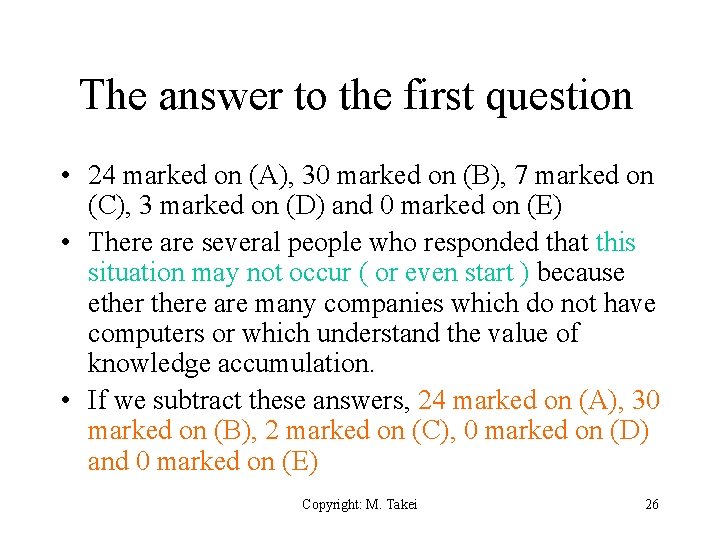
The answer to the first question • 24 marked on (A), 30 marked on (B), 7 marked on (C), 3 marked on (D) and 0 marked on (E) • There are several people who responded that this situation may not occur ( or even start ) because ethere are many companies which do not have computers or which understand the value of knowledge accumulation. • If we subtract these answers, 24 marked on (A), 30 marked on (B), 2 marked on (C), 0 marked on (D) and 0 marked on (E) Copyright: M. Takei 26
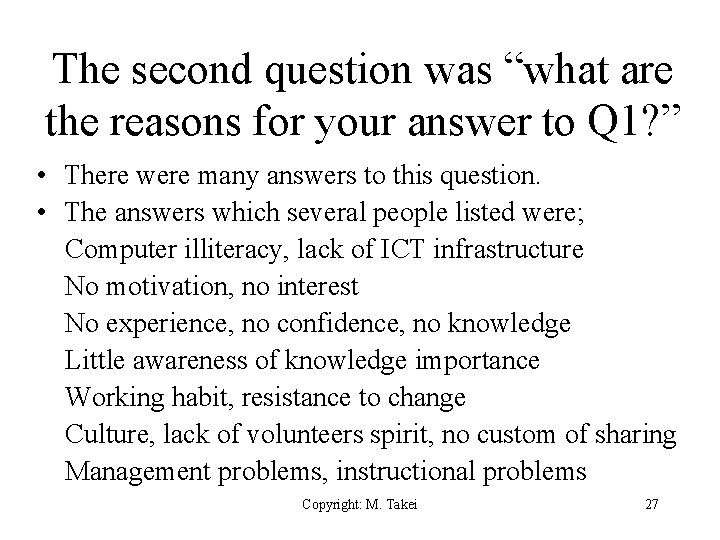
The second question was “what are the reasons for your answer to Q 1? ” • There were many answers to this question. • The answers which several people listed were; Computer illiteracy, lack of ICT infrastructure No motivation, no interest No experience, no confidence, no knowledge Little awareness of knowledge importance Working habit, resistance to change Culture, lack of volunteers spirit, no custom of sharing Management problems, instructional problems Copyright: M. Takei 27
How can we have success in knowledge accumulation • In general Increase F(in) Decrease F(out) Increase F(cir) • Subjects that Myanmar is facing • Way to solve the subjects Copyright: M. Takei 28
Clues to solve these subjects • Several slides in the previous pages already show some clues, such as “explain the importance” and “convince reluctant people”. • Lessons from the survey • Lessons from Japanese industry • My personal experience Copyright: M. Takei 29
Lessons from the survey • The third question of the survey was “as a management, what will you do next to solve this problem? ” • There were many answers to this question, too. • The answers which several people listed were; Explain importance, clarify expectation and persuade, encourage Training of IT, computer program, assign IT specialist Training of sharing habit, collaboration, change culture Analyze (the situation) Copyright: M. Takei 30
Lessons from Japanese industry How Japanese industry could achieve the following • Encourage and give incentive people to learn and to get trained • Make people open minded to share • Get strong commitment Copyright: M. Takei 31
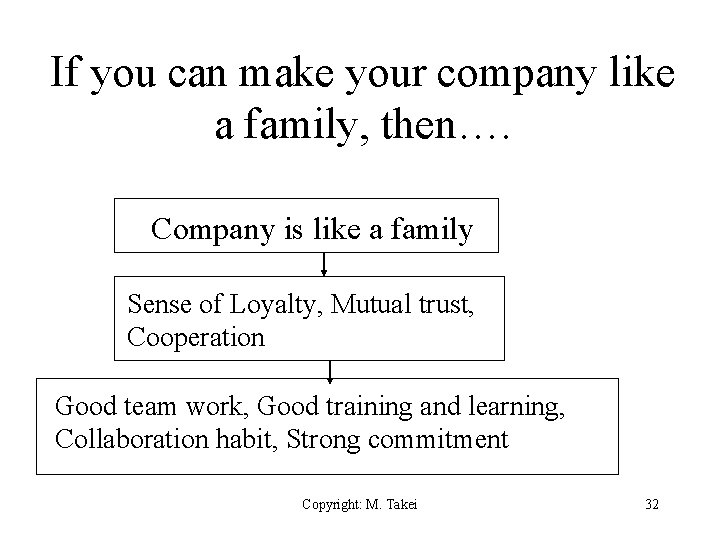
If you can make your company like a family, then…. Company is like a family Sense of Loyalty, Mutual trust, Cooperation Good team work, Good training and learning, Collaboration habit, Strong commitment Copyright: M. Takei 32
How Japanese companies made themselves like a family • Life time employment or Long term employment or Employment till age limit (55⇒ 60⇒ 65? ) • Seniority based wage system • Relative equality Copyright: M. Takei 33
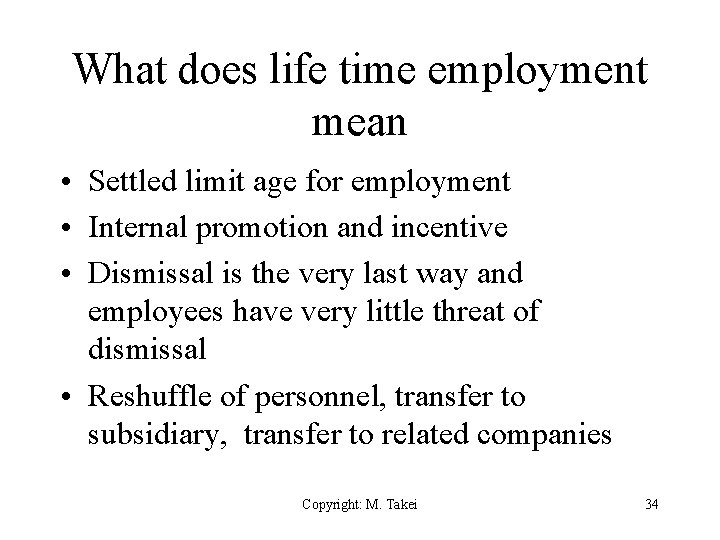
What does life time employment mean • Settled limit age for employment • Internal promotion and incentive • Dismissal is the very last way and employees have very little threat of dismissal • Reshuffle of personnel, transfer to subsidiary, transfer to related companies Copyright: M. Takei 34
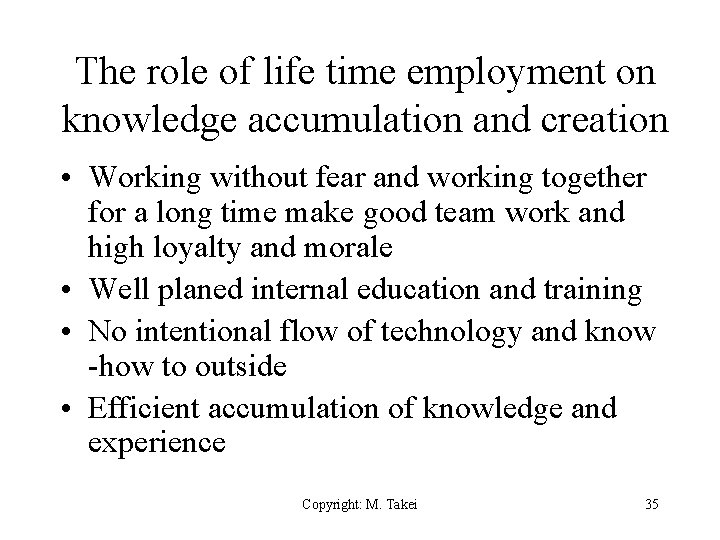
The role of life time employment on knowledge accumulation and creation • Working without fear and working together for a long time make good team work and high loyalty and morale • Well planed internal education and training • No intentional flow of technology and know -how to outside • Efficient accumulation of knowledge and experience Copyright: M. Takei 35
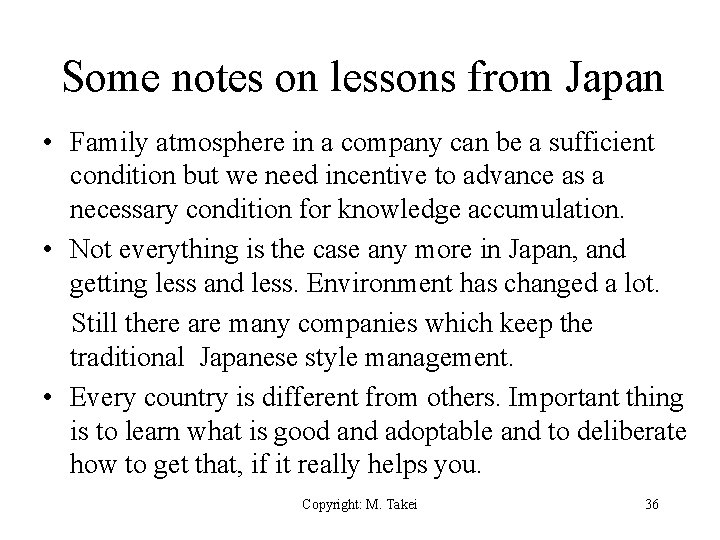
Some notes on lessons from Japan • Family atmosphere in a company can be a sufficient condition but we need incentive to advance as a necessary condition for knowledge accumulation. • Not everything is the case any more in Japan, and getting less and less. Environment has changed a lot. Still there are many companies which keep the traditional Japanese style management. • Every country is different from others. Important thing is to learn what is good and adoptable and to deliberate how to get that, if it really helps you. Copyright: M. Takei 36
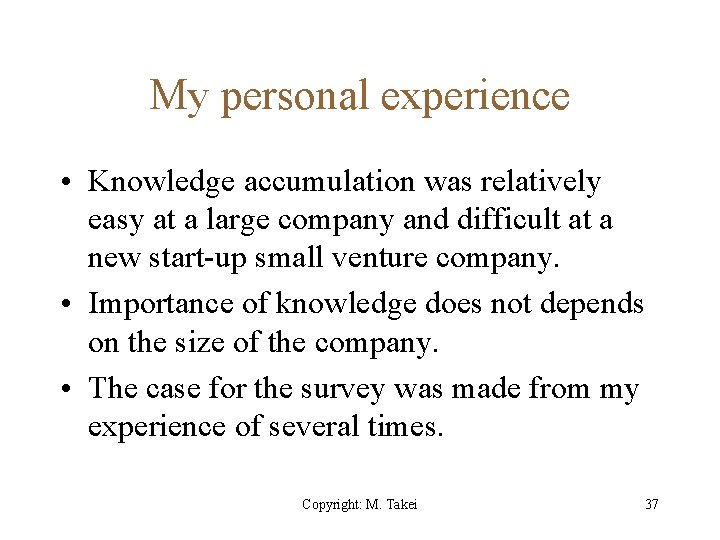
My personal experience • Knowledge accumulation was relatively easy at a large company and difficult at a new start-up small venture company. • Importance of knowledge does not depends on the size of the company. • The case for the survey was made from my experience of several times. Copyright: M. Takei 37
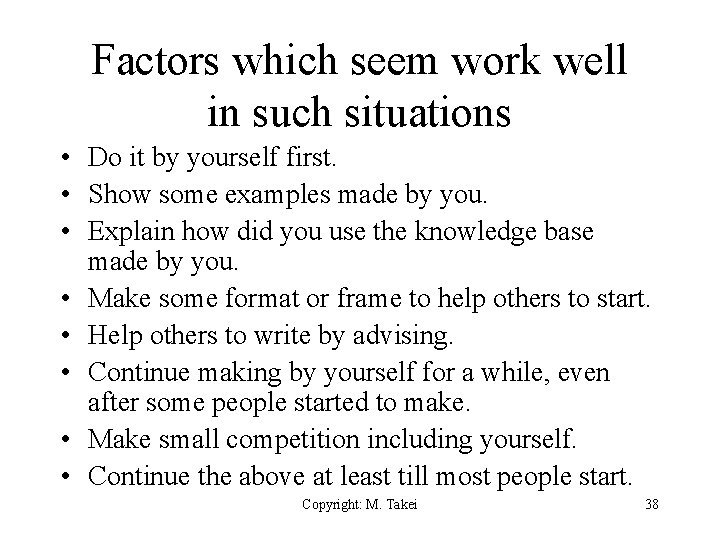
Factors which seem work well in such situations • Do it by yourself first. • Show some examples made by you. • Explain how did you use the knowledge base made by you. • Make some format or frame to help others to start. • Help others to write by advising. • Continue making by yourself for a while, even after some people started to make. • Make small competition including yourself. • Continue the above at least till most people start. Copyright: M. Takei 38
If you can successfully let people make shared file Knowledge propagation within organization Harmonization between new and conventional knowledge and one’s and others’ knowledge Practical use of knowledge Demand for further knowledge breeding Value added improve creation New Knowledge Accumulated knowledge in organization F(cir) F(out) Input from F(in) outside Copyright: M. Takei Decrease by HR management, F(cir) management 39
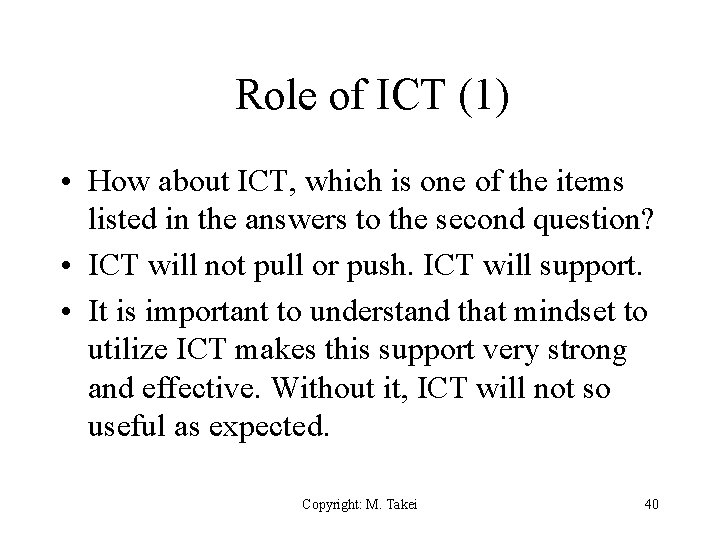
Role of ICT (1) • How about ICT, which is one of the items listed in the answers to the second question? • ICT will not pull or push. ICT will support. • It is important to understand that mindset to utilize ICT makes this support very strong and effective. Without it, ICT will not so useful as expected. Copyright: M. Takei 40
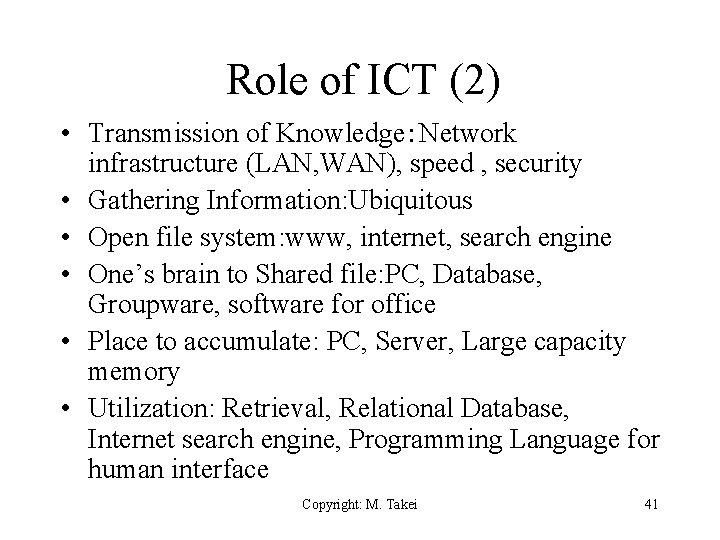
Role of ICT (2) • Transmission of Knowledge:Network infrastructure (LAN, WAN), speed , security • Gathering Information: Ubiquitous • Open file system: www, internet, search engine • One’s brain to Shared file: PC, Database, Groupware, software for office • Place to accumulate: PC, Server, Large capacity memory • Utilization: Retrieval, Relational Database, Internet search engine, Programming Language for human interface Copyright: M. Takei 41
Knowledge on ICT • I hope you will accumulate lot of new knowledge on these ICT related items through this conference. • And hope that you will propagate and share them with your colleagues. • Knowledge on ICT is not exception, it is important to have success in accumulation mechanism. Copyright: M. Takei 42
Before closing • Do not expect everything. • Make the situation better step by step. • Still you need continuous efforts and patience. • To understand is the first step and the next step is to implement! Copyright: M. Takei 43
I hope my speech can help you to accumulate some knowledge on knowledge management. Copyright: M. Takei 44