
MANAGEMENT Course by Ph D Oleh Rudkivskyi Topic
MANAGEMENT Course by Ph. D Oleh Rudkivskyi
Topic 8. Motivation 1. The essence of Motivation. 2. Process of Motivation. 3. Sources of Motivation. 4. Theories of Motivation Regarding Behaviour. 5. Theories of Motivation Regarding Work. 6. Management by Objectives.
The essence of Motivation • • • Generally, people differ by nature, not only in their ability to perform a specific task but also in their will to do so. People with less ability but a lot of strength are able to perform better than people with superior ability and lack of will. The force of motivation is a dynamic force setting a person into motion or action. The concept of motivation can be traced back to nearly twenty-three centuries ago in the Greek and Indian writings. The idea that people are motivated to do what brings them the best results for their benefit is found in the early Indian philosophy through such writings as "Charvak". The Greek view of motivation has been dominated by the concept of hedonism, which is a view that people seek pleasure and comfort, and avoids pain and discomfort. This view prevailed right up to the eighteenth and, nineteenth centuries and is evident in the social and economical philosophies of such famous men as Adam Smith, Jeremy Bentham and John Stuart Mill. The concept of motivation came under scientific scrutiny during 1930 s and has led to formulation of many theories and models that try to scientifically explain the concept of motivation.
The essence of Motivation • • The word ‘motivation’ is derived from ‘motive’, which is defined as an active form of a desire, craving or need, which must be satisfied. All motives are directed towards goals and the needs and desires affect or change your behaviour, which becomes goal oriented. Motivation represents an unsatisfied need which creates a state of tension or disequilibria, causing the individual to move in a goal directed pattern - towards restoring a state of equilibrium, by satisfying the need. (by Viteles) Motivation is one of the most important functions of management that tries to create willingness amongst the employees to perform in the best of their abilities. Therefore the role of a leader is to arouse interest in performance of employees in their jobs.
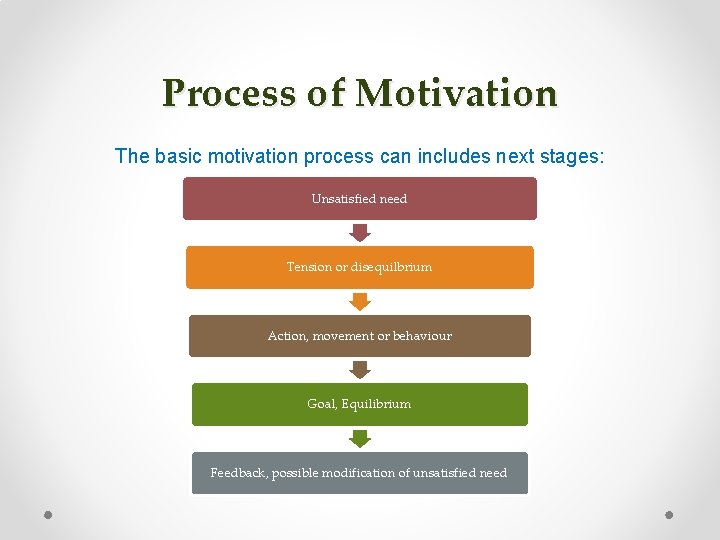
Process of Motivation The basic motivation process can includes next stages: Unsatisfied need Tension or disequilbrium Action, movement or behaviour Goal, Equilibrium Feedback, possible modification of unsatisfied need
Process of Motivation • Effort The amount of effort put into the activity identifies the strength of the person's work-related behaviour. Hard work usually reflects high motivation. • Persistence Motivation is a permanent and an integral part of a human being. Its second characteristic is persistence in the efforts. Motivation is continuously goal directed so that once a goal is achieved, a higher goal is selected and efforts are exercised towards this higher goal. High motivation requires persistent efforts. • Direction All efforts are to be directed towards the organizational goal. This would ensure that the persistent effort is actually resulting into accepted organizational outcomes.
Process of Motivation The motivation process involves the following steps: 1. Analysis of situation The situation that needs motivational inducement must be sized up so as to ascertain the motivational needs. From organizational behaviour point of view the needs of different employees differ both in nature as well as intensity, a composite view of the collective needs of the group is established with appropriate recognition of differences in individual needs. 2. Selecting and applying appropriate motivators A list of all motivators is drawn and a selection made of such motivators that motivate different types of people under different circumstances. Proper timing and the extent of motivation are also to be considered. The individual goals should be given adequate attention within the framework of group goals and the organizational goals. 3. Follow-up All efforts are to be directed towards the organizational goal. This would ensure that the persistent effort is actually resulting into accepted organizational outcomes. The motivators selected are providing the desired motivation. This can be accomplished by getting and evaluating the feedback. If these motivators are not-showing the optimum effect, then alternative motivators should be selected and applied.
Sources of Motivation It is not clear that workers are motivated by factors in the external environment such as rewards or fear or whether motivation is self generated without the application of external factors. All workers in the organisation are not equally motivated under the same set of external factors. The motivational sources are: 1. Positive Motivation Positive motivation involves proper recognition of employee, efforts and appreciation of employee contribution towards the organizational goal-achievement. Such motivations improve the standards of performance, lead to good team spirit and pride, a sense of cooperation and a feeling of belonging and happiness. Some of the positive motivators are: • Praise and credit for work done. • A sincere interest in the welfare of subordinates. • Delegation of authority and responsibility to subordinates. • Participation of subordinates in the decision making process.

Sources of Motivation 2. Negative or Fear Motivation This motivation is based upon the use of force, power, fear and threats. The fear of punishment or unfavourable consequences affects the behavioural changes. It is not recommended or considered as a viable alternative in the current business and industrial environment. However, punishment or fear of it is still the most common technique of behaviour modification or control in today's life. This area has received considerable attention and has become highly controversial. It has been proposed that while punishment has immediate and short-term effect in affecting and changing behaviour, the long-term effects are highly questionable. If the worker is punished for an occasional undesired behaviour, it will have a negative effect on his morale, make him bitter with a hostile state of mind, affecting negatively his social interaction as well as his sense of loyalty, perhaps resulting in poor performance and productivity and quality.
Sources of Motivation 3. Extrinsic Motivation This type of motivation is induced by external factors, which are primarily financial in nature. It is based upon the assumption that the behaviour, which results in positive rewards, tends to be repeated. The reward the desired behaviour should be sufficiently powerful and durable so that it improves the probability of occurrence' of desirable behaviour. Money is probably the most important incentive for positive behaviour since money can be used for a number of other resources. These financial incentives and rewards have been a subject of debate whether they really motivate the employees or simply move them to work and perform. These include higher pay, fringe benefits such as retirement plans, stock options, profit sharing scheme, paid vacation, health and medical insurance, sympathetic supervision and people oriented company policies. 4. Intrinsic Motivation Intrinsic motivation stems from feelings of achievement and accomplishment and is concerned with the state of selfactualization in which the satisfaction of accomplishing something worthwhile motivates the employee further so that this motivation is selfgenerated and is independent of financial rewards. Some of the intrinsic motivators are praise, recognition, responsibility, esteem, power, status, challenges and decision-making responsibility.
Theories of Motivation The most important theories of motivation are as follows: 1. Maslow’s Need Hierarchy Theory. 2. Herzberg’s Motivation Hygiene Theory. 3. Mc. Clelland’s Need Theory. 4. Mc. Gregor’s Participation Theory. 5. Urwick’s Theory Z. 6. Argyris’s Theory. 7. Vroom’s Expectancy Theory. 8. Porter and Lawler’s Expectancy Theory. There are basically two types of motivation theories: the "content theories" which attempt to determine and specify drives and needs that motivate people to work and "process theories" which attempt to identify the variables that go into motivation and their relationship with each other.
Theories of Motivation Regarding Behaviour The content theories have been developed to explain the nature of motivation in terms of types of need that people experience. They attempt to focus on factors within a person that initiate and direct a certain type of behaviour or check certain other type of behaviour. The basic idea underlying such theories is that people 366 have certain fundamental needs, both physiological and psychological in nature, and that they are motivated to engage in activities that would satisfy these needs. Thus the nature of needs establishes the nature of motivation that results in a specific behaviour aimed at reaching the goal of satisfying such needs. The more important content theories are: • • Maslow’s Need Hierarchy Theory ERG Theory Mcclelland's Theory of Needs Herzberg's Two-Factor Theory
Maslow’s Need Hierarchy Theory • • • Maslow’s "needs hierarchy theory" is probably the most widely used theory of motivation in organizations. Abraham Maslow suggested that people have a complex set of exceptionally strong needs and the behaviour of individuals at a particular moment is usually determined by their strongest need. He developed his model of human motivation in 1943, based upon his own clinical experience. His theory is based upon two assumptions: 1. Human beings have many needs those are different in nature ranging from the biological needs at the lower level, which is the level of survival, to psychological needs at the upper extreme, which is the level of growth. 2. These needs occur in an order of hierarchy so that lower level needs must be satisfied before higher level needs arise or become motivators. Maslow postulates five groups of basic needs. The first three level needs at the bottom are known as “deficiency” needs, because they must be satisfied in order to ensure the individual's very existence and security and make him fundamentally comfortable. The top two sets of needs are termed "growth" needs because they are concerned with personal growth, development and realization of one’s potential.
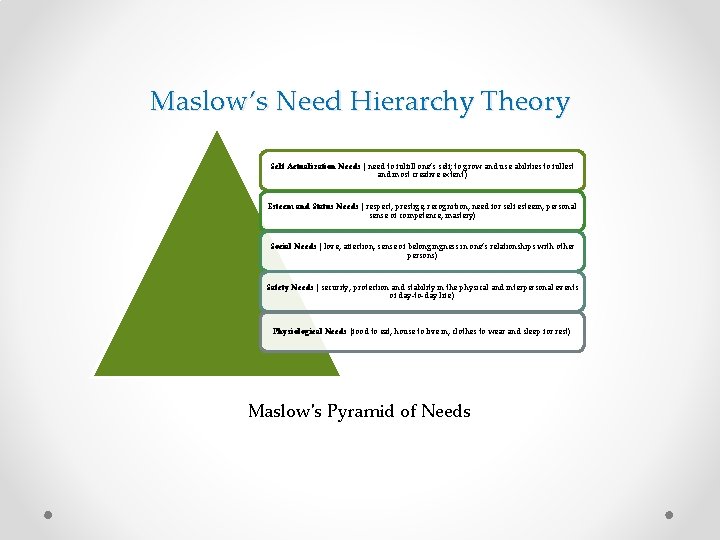
Maslow’s Need Hierarchy Theory Self Actualization Needs ( need to fulfill one’s self; to grow and use abilities to fullest and most creative extent ) Esteem and Status Needs ( respect, prestige, recognition, need for self esteem, personal sense of competence, mastery) Social Needs ( love, affection, sense of belongingness in one’s relationships with other persons) Safety Needs ( security, protection and stability in the physical and interpersonal events of day-to-day life ) Physiological Needs (food to eat, house to live in, clothes to wear and sleep for rest) Maslow's Pyramid of Needs
ERG Theory The ERG need theory, developed by Clayton Alerter is a refinement of Maslow's needs hierarchy. Instead of Maslow's five needs, ERG theory condenses these five needs into three needs. These three needs are: 1. Existence needs These needs include need for basic material necessities. In short, it includes an individual’s physiological and physical safety needs. 2. Relatedness needs These needs include the aspiration individual’s have for maintaining significant interpersonal relationships (be it with family, peers or superiors), getting public fame and recognition. Maslow’s social needs and external component of esteem needs fall under this class of need. 3. Growth needs These needs include need for self-development and personal growth and advancement. Maslow’s self-actualization needs and intrinsic component of esteem needs fall under this category of need. ERG theory differs from Maslow's theory in proposing that people may be motivated by more than one -kind of need at tile same time. While Maslow proposes that in hierarchy of needs, a person will satisfy the lower level needs before he moves up to the next level of needs and will stay at that, need until it is satisfied, ERG theory suggests that if a person is frustrated in satisfying his needs at a given level, he will move back to lower level needs.
Mcclelland's Theory of Needs Since the lower level needs in Maslow's model are generally satisfied by the business, societal and legal systems, they are no longer strong motivators. David Mc. Clelland his associates proposed Mc. Clelland’s theory of Needs / Achievement Motivation Theory. This theory states that human behaviour is affected by three needs: 1. Need for Power Need for power is the desire to influence other individual’s behaviour as per your wish. In other words, it is the desire to have control over others and to be influential. The individuals who are motivated by power have a strong urge to be influential and controlling. They want that their views and ideas should dominate and thus, they want to lead. Such individuals are motivated by the need for reputation and self-esteem. Individuals with greater power and authority will perform better than those possessing less power. 2. Need for Achievement Need for achievement is the urge to excel, to accomplish in relation to a set of standards, to struggle to achieve success. The individuals with high achievement needs are highly motivated by competing and challenging work. They look for promotional opportunities in job. They have a strong urge for feedback on their achievement. Such individuals try to get satisfaction in performing things better. High achievement is directly related to high performance. Individuals who are better and above average performers are highly motivated.
Mcclelland's Theory of Needs 3. Need for Affiliation Need for affiliation is a need for open and sociable interpersonal relationships. In other words, it is a desire for relationship based on co-operation and mutual understanding. The individuals who are motivated by affiliation have an urge for a friendly and supportive environment. Such individuals are effective performers in a team. These people want to be liked by others.
Herzberg's Two-Factor Theory In 1959, Frederick Herzberg, a behavioural scientist proposed a two-factor theory or the motivator-hygiene theory. According to Herzberg, there are some job factors that result in satisfaction while there are other job factors that prevent dissatisfaction. According to Herzberg, the opposite of “Satisfaction” is “No satisfaction” and the opposite of “Dissatisfaction” is “No Dissatisfaction”. Herzberg classified these job factors into two categories: 1. Hygiene factors are those job factors which are essential for existence of motivation at workplace. These do not lead to positive satisfaction for long-term. But if these factors are absent / if these factors are nonexistant at workplace, then they lead to dissatisfaction. Hygiene factors are also called as dissatisfiers or maintenance factors as they are required to avoid dissatisfaction. The hygiene factors symbolized the physiological needs which the individuals wanted and expected to be fulfilled. Hygiene factors include: • Pay - The pay or salary structure should be appropriate and reasonable. It must be equal and competitive to • • • those in the same industry in the same domain. Company Policies and administrative policies - The company policies should not be too rigid. They should be fair and clear. It should include flexible working hours, dress code, breaks, vacation, etc. Fringe benefits - The employees should be offered health care plans (mediclaim), benefits for the family members, employee help programs, etc. Physical Working conditions - The working conditions should be safe, clean and hygienic. The work equipment should be updated and well-maintained. Status - The employees’ status within the organization should be familiar and retained. Interpersonal relations - The relationship of the employees with his peers, superiors and subordinates should be appropriate and acceptable. There should be no conflict or humiliation element present. Job Security - The organization must provide job security to the employees.
Herzberg's Two-Factor Theory 2. Motivational factors According to Herzberg, the hygiene factors cannot be regarded as motivators. The motivational factors yield positive satisfaction. These factors are inherent to work. These factors motivate the employees for a superior performance. These factors are called satisfiers. These are factors involved in performing the job. Employees find these factors intrinsically rewarding. The motivators symbolized the psychological needs that were perceived as an additional benefit. Motivational factors include: • Recognition - The employees should be praised and recognized for their accomplishments by the managers. • Sense of achievement - The employees must have a sense of achievement. This depends on the job. There must be a fruit of some sort in the job. • Growth and promotional opportunities - There must be growth and advancement opportunities in an organization to motivate the employees to perform well. • Responsibility - The employees must hold themselves responsible for the work. The managers should give them ownership of the work. They should minimize control but retain accountability. • Meaningfulness of the work - The work itself should be meaningful, interesting and challenging for the employee to perform and to get motivated. The Two-Factor theory implies that the managers must stress upon guaranteeing the adequacy of the hygiene factors to avoid employee dissatisfaction. Also, the managers must make sure that the work is stimulating and rewarding so that the employees are motivated to work and perform harder and better. This theory emphasize upon job-enrichment so as to motivate the employees. The job must utilize the employee’s skills and competencies to the maximum. Focusing on the motivational factors can improve work-quality.
Theory X and Theory Y (Douglas Mc. Gregor) In 1960, Douglas Mc. Gregor formulated Theory X and Theory Y suggesting two aspects of human behaviour at work, or in other words, two different views of individuals (employees): one of which is negative, called as Theory X and the other is positive, so called as Theory Y. According to Mc. Gregor, the perception of managers on the nature of individuals is based on various assumptions. Assumptions of Theory X • An average employee intrinsically does not like work and tries to escape it whenever possible. • Since the employee does not want to work, he must be persuaded, compelled, or warned with punishment so as to achieve organizational goals. A close supervision is required on part of managers. The managers adopt a more dictatorial style. • Many employees rank job security on top, and they have little or no aspiration/ ambition. • Employees generally dislike responsibilities. • Employees resist change. • An average employee needs formal direction. Assumptions of Theory Y • Employees can perceive their job as relaxing and normal. They exercise their physical and mental efforts in an inherent manner in their jobs. • Employees may not require only threat, external control and coercion to work, but they can use selfdirection and self-control if they are dedicated and sincere to achieve the organizational objectives. • If the job is rewarding and satisfying, then it will result in employees’ loyalty and commitment to organization. • An average employee can learn to admit and recognize the responsibility. In fact, he can even learn to obtain responsibility. • The employees have skills and capabilities. Their logical capabilities should be fully utilized. In other words, the creativity, resourcefulness and innovative potentiality of the employees can be utilized to solve organizational problems.
Theory X and Theory Y (Douglas Mc. Gregor) Theory X presents a pessimistic view of employees’ nature and behaviour at work, while Theory Y presents an optimistic view of the employees’ nature and behaviour at work. If correlate it with Maslow’s theory, we can say that Theory X is based on the assumption that the employees emphasize on the physiological needs and the safety needs; while Theory X is based on the assumption that the social needs, esteem needs and the self-actualization needs dominate the employees. Mc. Gregor views Theory Y to be more valid and reasonable than Theory X. Thus, he encouraged cordial team relations, responsible and stimulating jobs, and participation of all in decision-making process. Quite a few organizations use Theory X today. Theory X encourages use of tight control and supervision. It implies that employees are reluctant to organizational changes. Thus, it does not encourage innovation. Many organizations are using Theory Y techniques. Theory Y implies that the managers should create and encourage a work environment which provides opportunities to employees to take initiative and self-direction. Employees should be given opportunities to contribute to organizational well-being. Theory Y encourages decentralization of authority, teamwork and participative decision making in an organization. Theory Y searches and discovers the ways in which an employee can make significant contributions in an organization. It harmonizes and matches employees’ needs and aspirations with organizational needs and aspirations.
Urwick’s Theory Z Much after the propositions of theories X and Y by Mc. Gregor, the three theorists Urwick, Rangnekar, and Ouchi-propounded the third theory lebeled as Z theory. The two propositions in Urwicks’s theory are that: • Each individual should know the organisational goals precisely and the amount of contribution through his efforts towards these goals. • Each individual should also know that the relation of organisational goals is going to satisfy his/her needs positively. In Urwick’s view, the above two make people ready to behave positively to accomplish both organisational and individual goals. However, Ouchi’s Theory Z has attracted the lot of attention of management practitioners as well as researchers. It must be noted that Z does not stand for anything, is merely the last alphabet in the English Language. Theory Z is based on the following four postulates: 1. Strong Bond between Organisation and Employees 2. Employee Participation and Involvement 3. No Formal Organisation Structure 4. Human Resource Development Ouchi’s Theory Z represents the adoption of Japanese management practices (group decision making, social cohesion, job security, holistic concern for employees, etc. )by the American companies. In India, Maruti. Suzuki, Hero-Honda, etc. , apply the postulates of theory Z.
Theories of Motivation Regarding Work While "need theories" of motivation concentrate upon "what" motivates persons, "process theories" concentrate upon "how" motivation occurs. These theories identify the variables that go into motivation and their relationship with each other. The more important process theories are: • Vroom's Expectancy Model • Equity Theory • Goal-setting Theory
Vroom's Expectancy Model The expectancy theory was proposed by Victor Vroom of Yale School of Management in 1964. Vroom stresses and focuses on outcomes, and not on needs unlike Maslow and Herzberg. The theory states that the intensity of a tendency to perform in a particular manner is dependent on the intensity of an expectation that the performance will be followed by a definite outcome and on the appeal of the outcome to the individual. The Expectancy theory states that employee’s motivation is an outcome of how much an individual wants a reward (Valence), the assessment that the likelihood that the effort will lead to expected performance (Expectancy) and the belief that the performance will lead to reward (Instrumentality). Valence is an expected and not the actual satisfaction that an employee expects to receive after achieving the goals. Expectancy is the faith that better efforts will result in better performance. It is influenced by factors such as possession of appropriate skills for performing the job, availability of right resources, availability of crucial information and getting the required support for completing the job. Instrumentality is the faith that if you perform well, then a valid outcome will be there. Instrumentality is affected by factors such as believe in the people who decide who receives what outcome, the simplicity of the process deciding who gets what outcome, and clarity of relationship between performance and outcomes.
Vroom's Expectancy Model The expectancy theory concentrates on the following three relationships: 1. Effort-performance relationship 2. Performance-reward relationship 3. Rewards-personal goals relationship Vroom was of view that employees consciously decide whether to perform or not at the job. This decision solely depended on the employee’s motivation level which in turn depends on three factors of expectancy, valence and instrumentality. The managers can correlate the preferred outcomes to the aimed performance levels. The managers must ensure that the employees can achieve the aimed performance levels. The deserving employees must be rewarded for their exceptional performance. The reward system must be fair and just in an organization. Organizations must design interesting, dynamic and challenging jobs. The employee’s motivation level should be continually assessed through various techniques such as questionnaire, personal interviews, etc.
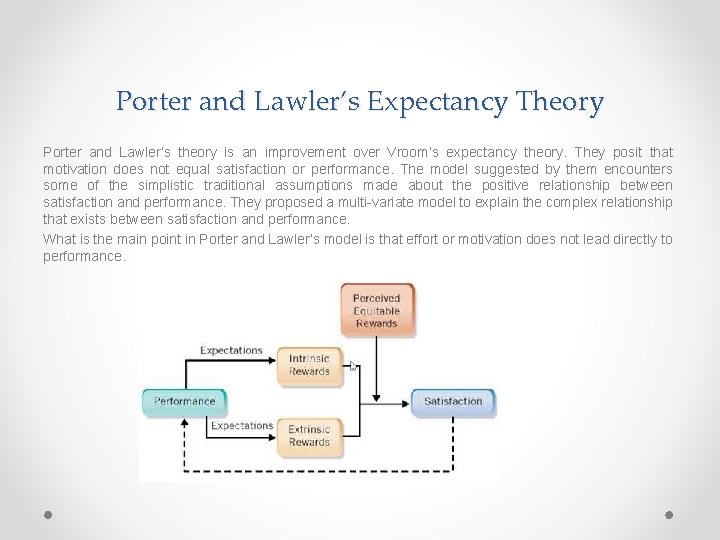
Porter and Lawler’s Expectancy Theory Porter and Lawler’s theory is an improvement over Vroom’s expectancy theory. They posit that motivation does not equal satisfaction or performance. The model suggested by them encounters some of the simplistic traditional assumptions made about the positive relationship between satisfaction and performance. They proposed a multi-variate model to explain the complex relationship that exists between satisfaction and performance. What is the main point in Porter and Lawler’s model is that effort or motivation does not lead directly to performance.
Equity Theory Equity theory is based on the assumption of some researchers that one of the most widely assumed source of job dissatisfaction is the feeling of the employees that they are not being treated fairly by the management or the organizational system. The “Equity theory" has two elements: 1. The workers want to get a fair reward for their efforts (if you put in more efforts into-your work, you expect to get out of it more rewards). 2. You would compare your rewards with the rewards of others who put in similar efforts. Equity theory is based upon the recognition that employees are not only concerned with the rewards that they receive for their efforts but also with the relationship of their rewards with the rewards received by others. They make judgments of equity or inequity between their input and outcomes an the inputs and outcomes of others. The theory demonstrates that the individuals are concerned both with their own rewards and also with what others get in their comparison. Employees expect a fair and equitable return for their contribution to their jobs. Employees decide what their equitable return should be after comparing their inputs and outcomes with those of their colleagues. Employees who perceive themselves as being in an inequitable scenario will attempt to reduce the inequity either by distorting inputs and/or outcomes psychologically, by directly altering inputs and/or outputs, or by quitting the organization.
Goal-setting Theory In 1960’s, Edwin Locke put forward the Goal-setting theory of motivation. This theory states that goal setting is essentially linked to task performance. It states that specific and challenging goals along with appropriate feedback contribute to higher and better task performance. Goals indicate and give direction to an employee about what needs to be done and how much efforts are required to be put in. The willingness to work towards attainment of goal is main source of job motivation. Clear, particular and difficult goals are greater motivating factors than easy, general and vague goals. Specific and clear goals lead to greater output and better performance. Unambiguous, measurable and clear goals accompanied by a deadline for completion avoids misunderstanding. Goals should be realistic and challenging. This gives an individual a feeling of pride and triumph when he attains them, and sets him up for attainment of next goal. The more challenging the goal, the greater is the reward generally and the more is the passion for achieving it. Better and appropriate feedback of results directs the employee behaviour and contributes to higher performance than absence of feedback. Feedback is a means of gaining reputation, making clarifications and regulating goal difficulties. It helps employees to work with more involvement and leads to greater job satisfaction.
Reinforcement Theory Reinforcement theory of motivation was proposed by BF Skinner and his associates. It states that individual’s behaviour is a function of its consequences. It is based on “law of effect”, i. e, individual’s behaviour with positive consequences tends to be repeated, but individual’s behaviour with negative consequences tends not to be repeated. Reinforcement theory of motivation overlooks the internal state of individual, i. e. , the inner feelings and drives of individuals are ignored by Skinner. This theory focuses totally on what happens to an individual when he takes some action. Thus, according to Skinner, the external environment of the organization must be designed effectively and positively so as to motivate the employee. This theory is a strong tool for analyzing controlling mechanism for individual’s behaviour. However, it does not focus on the causes of individual’s behaviour. The managers use the following methods for controlling the behaviour of the employees: 1. Positive Reinforcement. This implies giving a positive response when an individual shows positive and required behaviour. 2. Negative Reinforcement. This implies rewarding an employee by removing negative / undesirable consequences. 3. Punishment. It implies removing positive consequences so as to lower the probability of repeating undesirable behaviour in future. 4. Extinction. It implies absence of reinforcements.
Management by Objectives A logical extension of goal setting theory is Management by Objectives, which involves systematic and programmatic goal setting throughout an organization. Management by Objectives (MBO) is a process by which managers and subordinates work together in identifying goals and setting up objectives and make plans together in order to achieve these objectives. These objectives and goals are consistent with the organizational goals. The system of management by objectives can be described as a process whereby the superior and subordinate managers of an organization jointly identify its common goals, define each individual's major areas of responsibility in terms of results expected of him and use these measures as guides for operating the unit and assessing, the contribution of each of its members. Advantages of MBO: • • It encourages managers to do detailed planning Managers are required to establish measurable targets and standards of performance and priorities for these targets oth the manager and the subordinates know what is expected of them and therefore there is no role ambiguity or confusion It makes individuals more aware of company goals It often highlights the area in which the employees need further training The system of periodic evaluation lets the subordinates know how well they are doing. It improves communication between management and subordinates.

Thank YOU for your attention! Any questions?
- Slides: 31