
Management Control System Reference Books A Management Control
Management Control System Reference Books : A. Management Control Systems ----- Robert N. Anthony & Vijay Govindarajan, Tata Mc. Graw-Hill, 2010 B. Management Control Systems ---- Joseph Maciariello & Calvin J. Kirby Prentice-Hall of India Limited, 1997
Overview of chapters 1. Introduction to Management Control Systems 2. Designing the control process and managerial controls 3. Behavior in organizations 4. Key success variables and measures of performance 5. Responsibility centers 6. Budget preparation and financial reporting 7. MCS in Service and non-profit organizations 8. MCS in Multi National Corporations 9. MCS in Projects 10. Management Audit
Management : The process of integrating resources and tasks toward the achievement of stated organisational goals.
Management : Management is both art and science. ART: It is the art of making people more effective than they would have been without you SCIENCE : The science is how you do that BASIC TOOLS : Planning Organising Directing Monitoring
CONTROL : Control is the process of ensuring that a firms’ activities / operations proceed and confirm to it’s plans Objectives are met Reduce difference between plan and reality No control without plan and objectives Control exercised only for components internal to the system Not possible to control the external environment
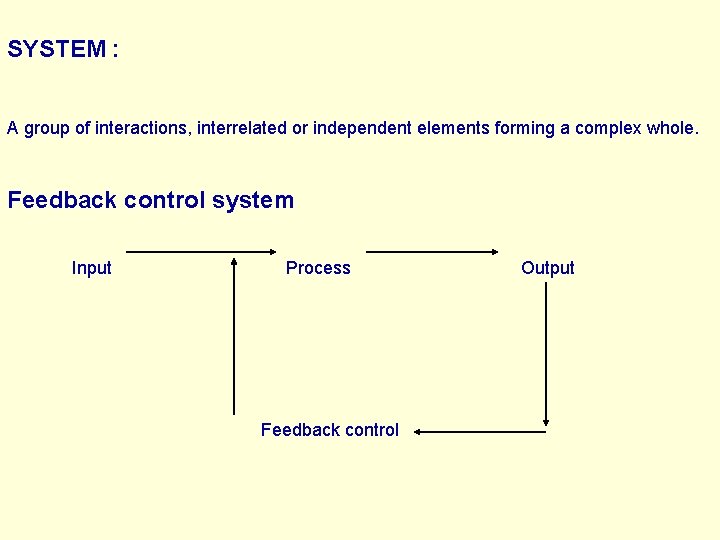
SYSTEM : A group of interactions, interrelated or independent elements forming a complex whole. Feedback control system Input Process Feedback control Output
Feedback control system Output is measured against desired results Variance is fed to the feed back control system Corrective signal goes back to input mechanism to modify input. EXAMPLES : # Parallel parking of your vehicle # Temperature control in an air conditioned room # Temperature control in an electroplating bath # Management interference in firm’s performance.
CONTROLS Vs CONTROL ( Peter Drucker ) CONTROLS CONTROL • Measurement & Information Direction • Means to an end End • Info provided to take control To do actual work. action Examples : Material costs have exceeded budget Action to ensure purchase prices are monitored & controlled. Quality of material not okay Action taken to ensure quality.
Essence of Management Control System I recommend you take care of the minutes, for the hours will take care of themselves. -- Lord of Chesterfield
Purpose of Management Control System : • Assist management in the co-ordination of all sections of an organisation • Steer these sections towards achievement of its overall purpose / goal / objectives • Bring unity out of the diverse activities of an organisation • Meet both short term and long term objectives CONTROL SYSTEM : A set of formal and informal systems to assist management
Levels in an organisation : A. Strategic level : Vision / Mission Direction setting Long term planning B. Management : Resource utilisation Achieve unit objectives Competitiveness C. Operational : Functional goals Section level goals Cost Utilization Waste
Important features of Management Control System Decisions : • Management control decisions are based on the framework established by organization’s strategy Considers quantity and quality of reserves Implementation at different levels Systematic and Rhythmic : • In tune with strategies and procedures laid down by top management • Balance among all functions Eg; Operations and distribution should be balanced with the sales programme.
Strategy implementation tool : • A vehicle for strategy execution • Interlinks organisation structure / Human resources management / organisation culture Behavioral considerations : • Proper direction or lack of it • Motivation or lack of it • Personal limitations of employees.
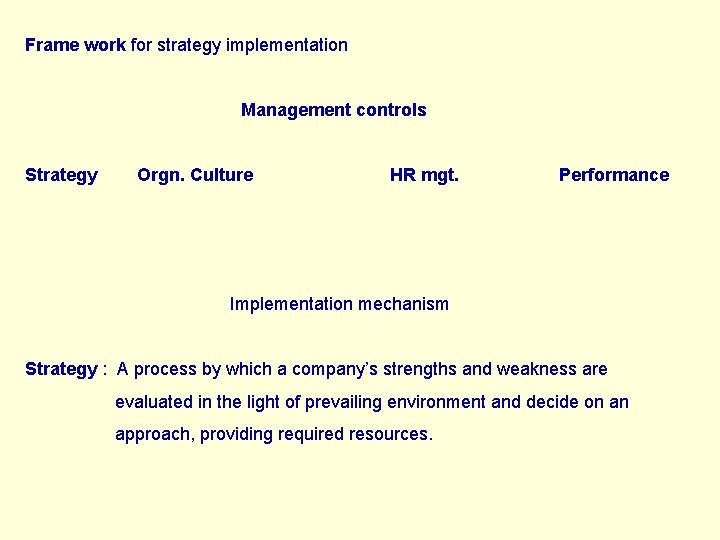
Frame work for strategy implementation Management controls Strategy Orgn. Culture HR mgt. Performance Implementation mechanism Strategy : A process by which a company’s strengths and weakness are evaluated in the light of prevailing environment and decide on an approach, providing required resources.
DEFINITION : Management Control Systems are the formal, information – based routines and procedures that managers use to maintain or alter patterns in organisational activities. FOCUS of Control A. Output control B. Process Control C. Input control
Examples of MCS • Budgeting system • Performance measurement system • Variance analysis and reporting • Incentive / Reward system • Capital budgeting system • Standard operating procedures • Internal control system
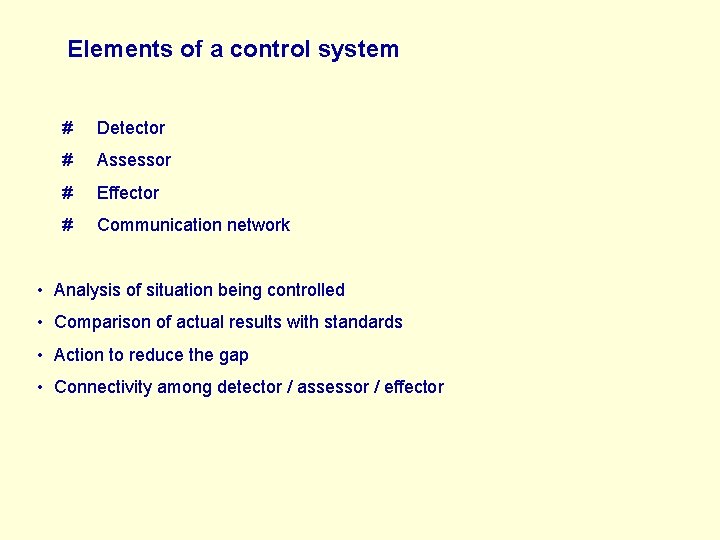
Elements of a control system # Detector # Assessor # Effector # Communication network • Analysis of situation being controlled • Comparison of actual results with standards • Action to reduce the gap • Connectivity among detector / assessor / effector
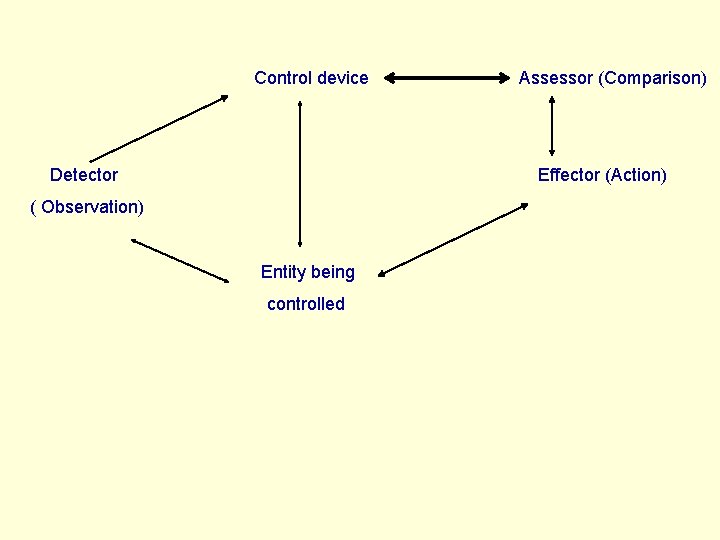
Control device Detector Assessor (Comparison) Effector (Action) ( Observation) Entity being controlled
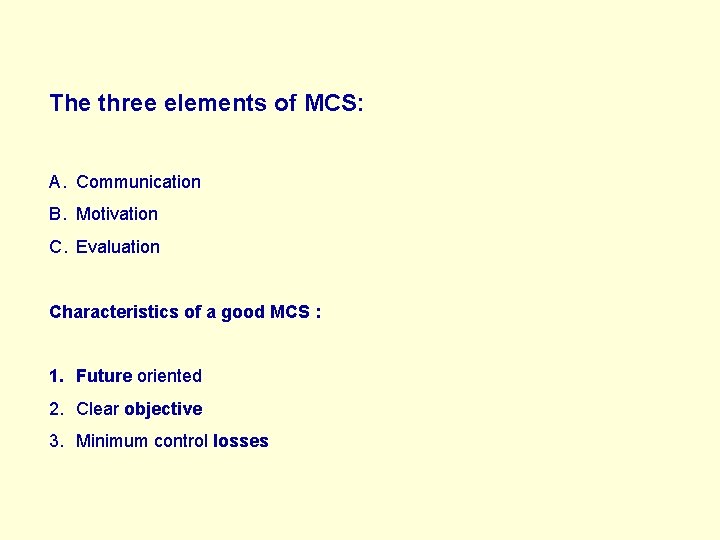
The three elements of MCS: A. Communication B. Motivation C. Evaluation Characteristics of a good MCS : 1. Future oriented 2. Clear objective 3. Minimum control losses
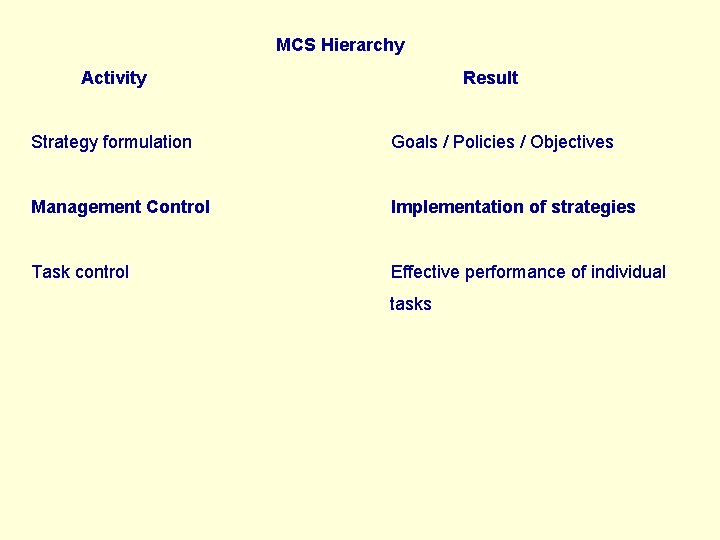
MCS Hierarchy Activity Result Strategy formulation Goals / Policies / Objectives Management Control Implementation of strategies Task control Effective performance of individual tasks
Activities in MCS Planning the future course • Coordinating and communicating • Evaluation of information and decisions • Influencing people towards organisation goals Features of MCS • Possess a defined framework • Systematic and rhythmic • Implementation Behavioral considerations • Provides needed direction • Motivate the employees
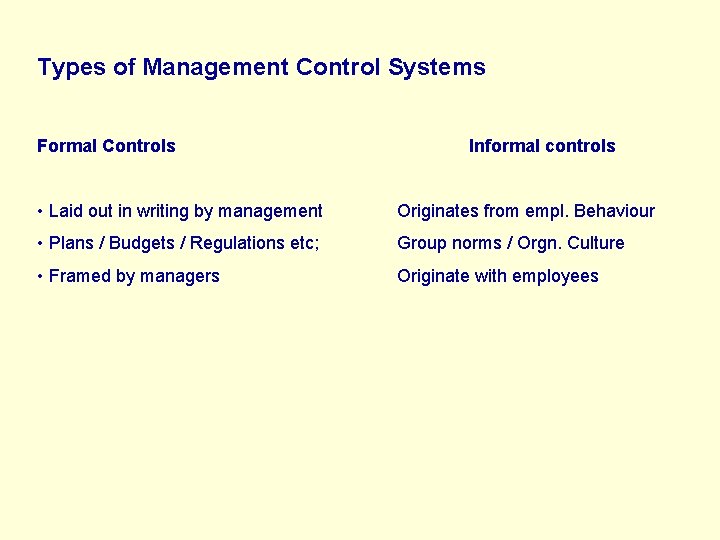
Types of Management Control Systems Formal Controls Informal controls • Laid out in writing by management Originates from empl. Behaviour • Plans / Budgets / Regulations etc; Group norms / Orgn. Culture • Framed by managers Originate with employees
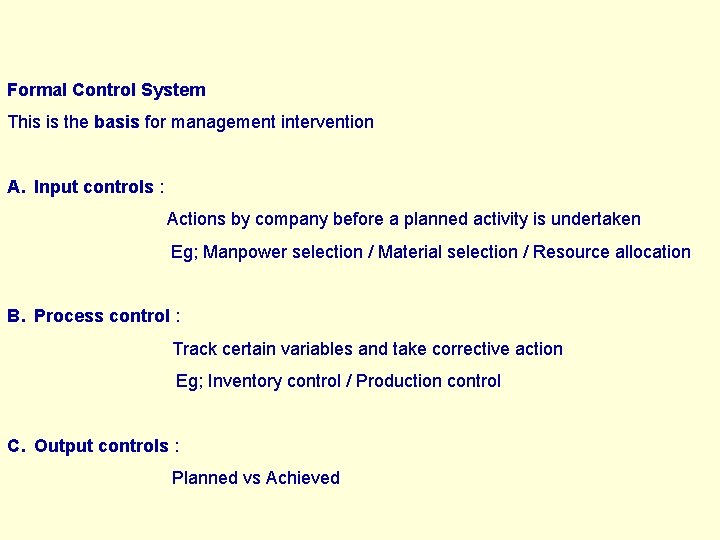
Formal Control System This is the basis for management intervention A. Input controls : Actions by company before a planned activity is undertaken Eg; Manpower selection / Material selection / Resource allocation B. Process control : Track certain variables and take corrective action Eg; Inventory control / Production control C. Output controls : Planned vs Achieved
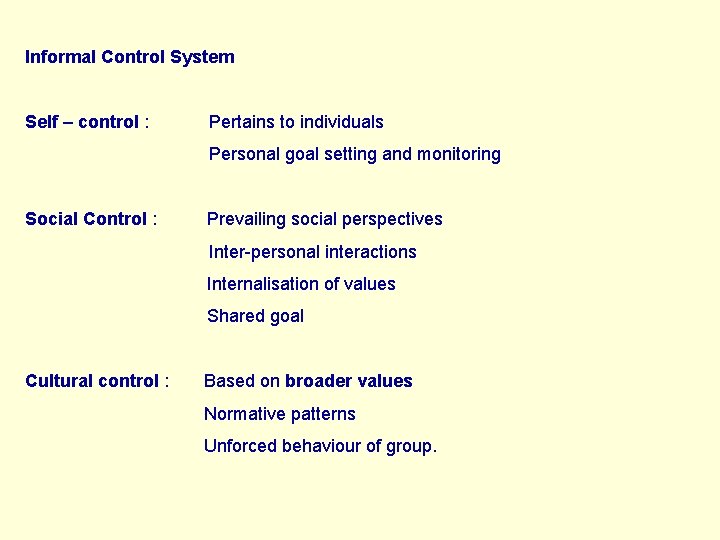
Informal Control System Self – control : Pertains to individuals Personal goal setting and monitoring Social Control : Prevailing social perspectives Inter-personal interactions Internalisation of values Shared goal Cultural control : Based on broader values Normative patterns Unforced behaviour of group.
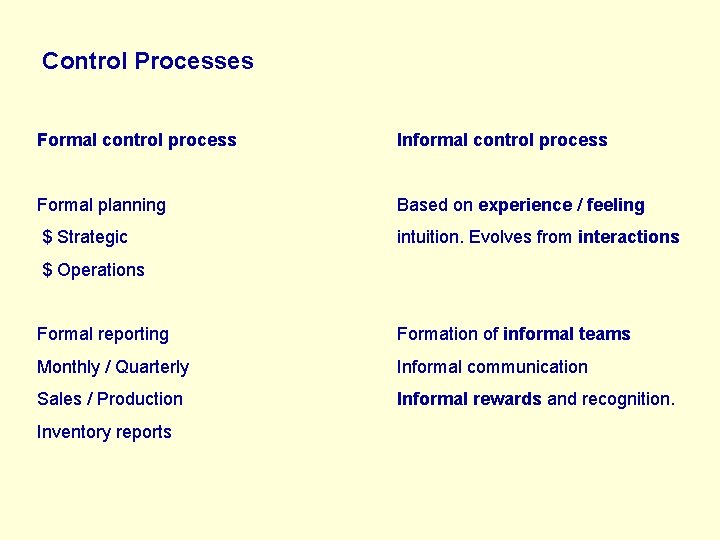
Control Processes Formal control process Informal control process Formal planning Based on experience / feeling $ Strategic intuition. Evolves from interactions $ Operations Formal reporting Formation of informal teams Monthly / Quarterly Informal communication Sales / Production Informal rewards and recognition. Inventory reports
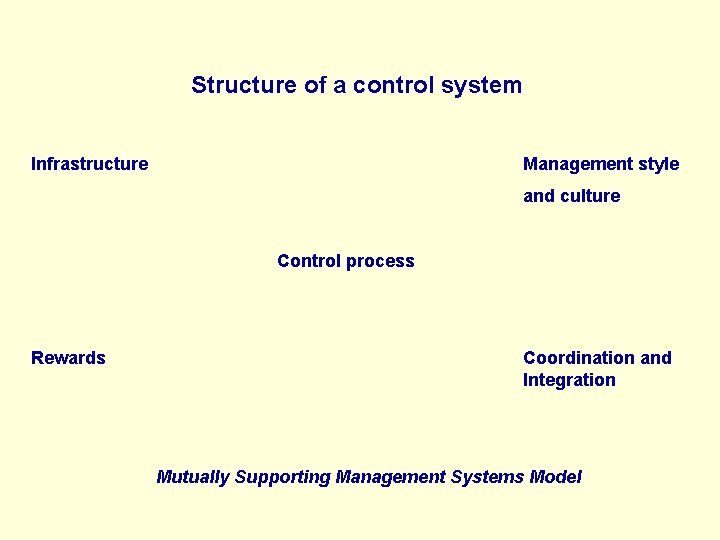
Structure of a control system Infrastructure Management style and culture Control process Rewards Coordination and Integration Mutually Supporting Management Systems Model
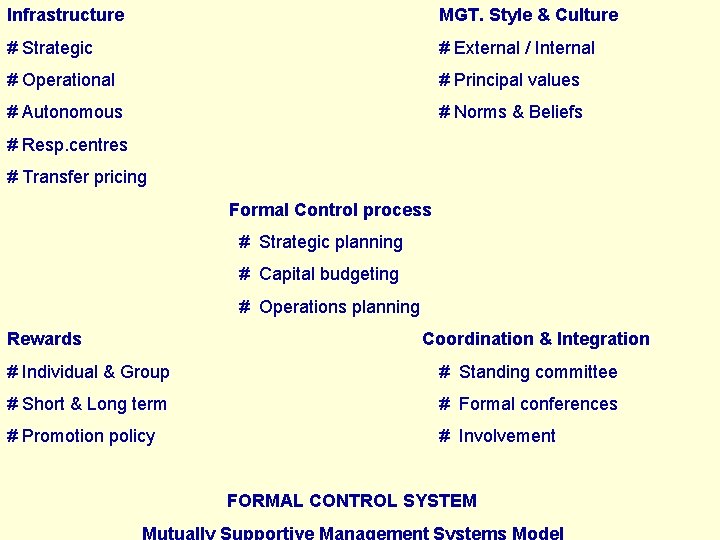
Infrastructure MGT. Style & Culture # Strategic # External / Internal # Operational # Principal values # Autonomous # Norms & Beliefs # Resp. centres # Transfer pricing Formal Control process # Strategic planning # Capital budgeting # Operations planning Rewards Coordination & Integration # Individual & Group # Standing committee # Short & Long term # Formal conferences # Promotion policy # Involvement FORMAL CONTROL SYSTEM Mutually Supportive Management Systems Model
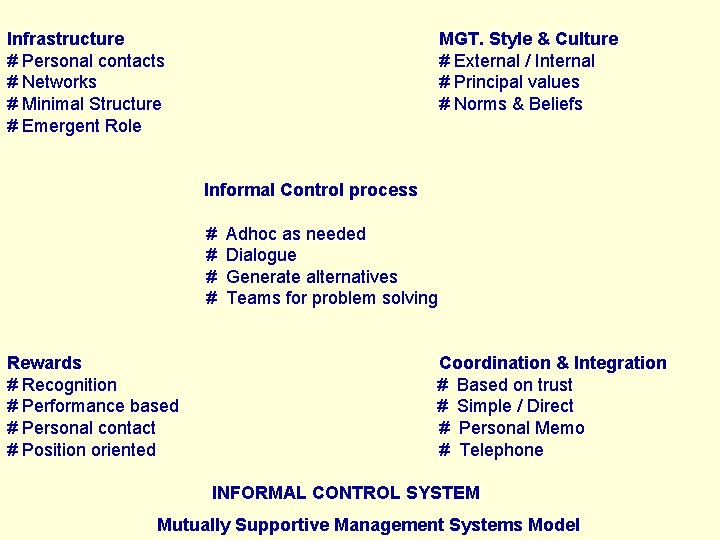
Infrastructure # Personal contacts # Networks # Minimal Structure # Emergent Role MGT. Style & Culture # External / Internal # Principal values # Norms & Beliefs Informal Control process # # Rewards # Recognition # Performance based # Personal contact # Position oriented Adhoc as needed Dialogue Generate alternatives Teams for problem solving Coordination & Integration # Based on trust # Simple / Direct # Personal Memo # Telephone INFORMAL CONTROL SYSTEM Mutually Supportive Management Systems Model
Discussion point : Control systems play an important role in service as well as manufacturing organisations. Do control system play an important role in a hospital ? What steps should the hospital management take to ensure the effective implementation of Management Control Systems ?
Control Systems in Hospital >> Admission procedure and systems >> Routing control >> Access control >> Communication systems >> Visual control >> Appointments control >> Reports control >> Regulations for OPD >> Systems for Laboratory >> Planning control >> Reward system for admin. Staff
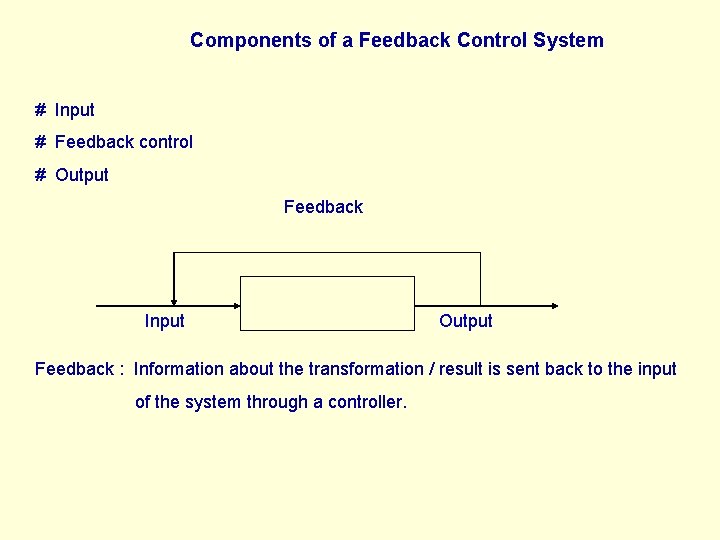
Components of a Feedback Control System # Input # Feedback control # Output Feedback Input Output Feedback : Information about the transformation / result is sent back to the input of the system through a controller.
Two types of feedback controls >> Positive feedback >> Negative feedback Positive feedback : If the new information facilitate and accelerate the transformation process in the same direction, it is positive feedback. The effects are cumulative. Exponential growth or exponential decline. Behaviour >>> Divergent
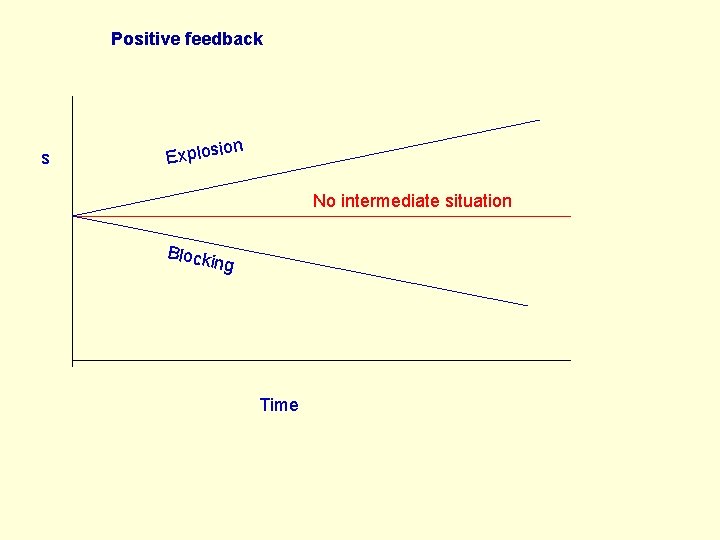
Positive feedback s n io Explos No intermediate situation Block ing Time
Positive feedback: Infinite expansion Running away towards infinity ( or ) Total Blocking of activities Examples : # Chain reaction # Industrial Expansion # Capital on compound interest
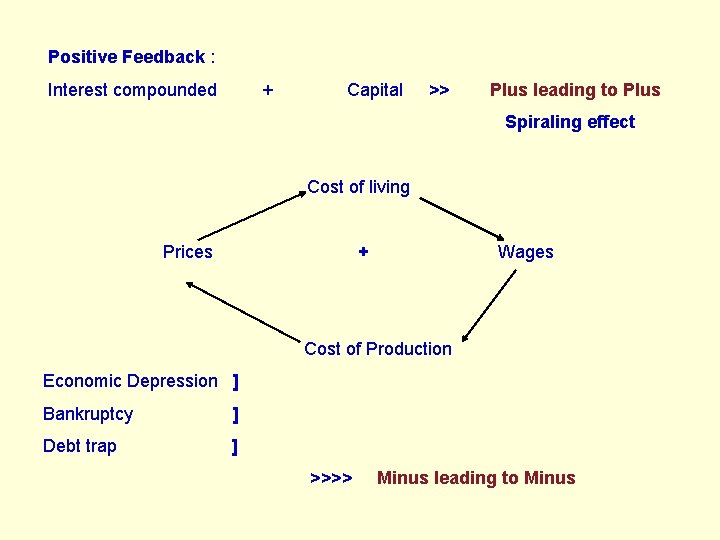
Positive Feedback : Interest compounded + Capital >> Plus leading to Plus Spiraling effect Cost of living Prices + Wages Cost of Production Economic Depression ] Bankruptcy ] Debt trap ] >>>> Minus leading to Minus
Negative feedback : If new information produces a result in the opposite direction, it is negative feedback. The effect stabilises the system. Equilibrium maintained.
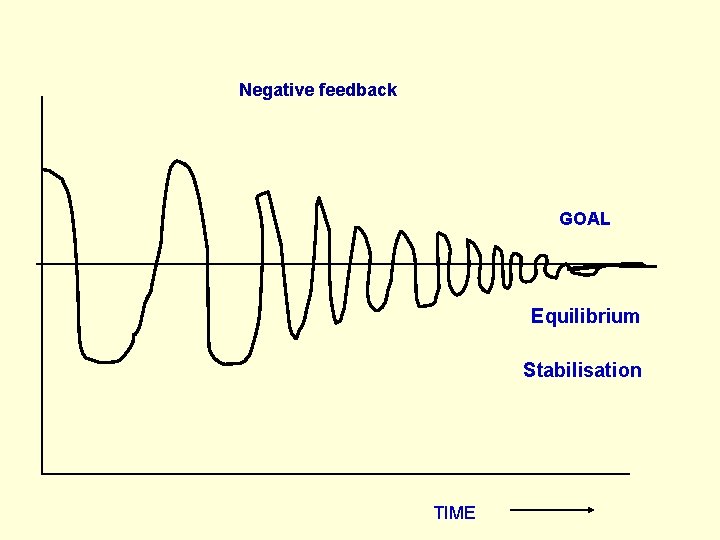
Negative feedback GOAL Equilibrium Stabilisation TIME
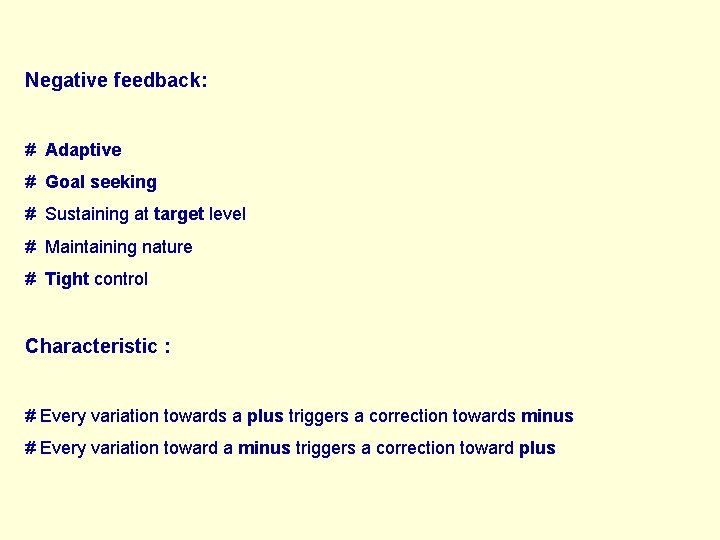
Negative feedback: # Adaptive # Goal seeking # Sustaining at target level # Maintaining nature # Tight control Characteristic : # Every variation towards a plus triggers a correction towards minus # Every variation toward a minus triggers a correction toward plus
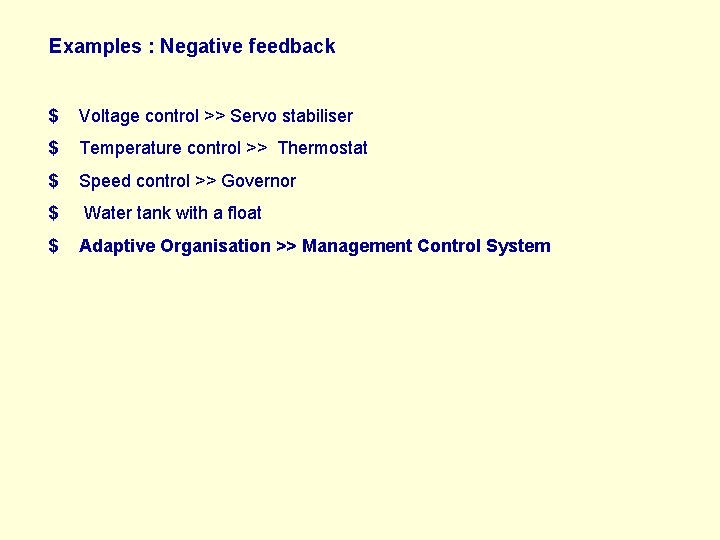
Examples : Negative feedback $ Voltage control >> Servo stabiliser $ Temperature control >> Thermostat $ Speed control >> Governor $ Water tank with a float $ Adaptive Organisation >> Management Control System
Discussion Point : While organizations cannot predict disasters, they can take steps to minimize the magnitude of the disaster. Any example of an organization that faced a disastrous situation and managed it effectively ?
Chrysler automobiles Disconnected odometers Driven around / Sold as new automobiles Severe negative public image Lee Iacocca Extension of warranties Disaster forecasting Disaster preparedness Post disaster actions
Designing Management Controls # A constructive exercise and not a punitive one. Should be viewed fair. # Objectives be measurable. # Number of objectives should be restricted. # Balance among various aspects being controlled. # Accountability to every individual. # Compare projected performance to desired results. # Identify early warning predictors # Take a sample of variables to be controlled # Establish an acceptable range of variation for each variable. # Generate exception reports. # Conduct root cause analysis. # Apply judgment while establishing controls.
Approaches to Management Control Systems 1. Cybernetic approach 2. Contingency approach 3. Strategy and Control system approach
Cybernetic approach Original word >> Kybernetes >> Greek origin Meaning >> Steersman Navigator Helmsman A steersman directs the movement of the ship along the planned course of direction.
Cybernetics deals with the self-regulating principles in a variety of systems. Examples : Human Biological system Machine System Organisations Human brain regulates different body functions. Organisations are also complex systems requiring command control. CYBERNETICS >> Unifying theory of Self-regulation
Cybernetics - Definitions : CYBERNETICS >> Unifying theory of Self-regulation The science of control and communication in the animal and the machine. - Norbert Wiener The science and art of understanding H. Maturana The art of securing efficient operation L. Couffignal The science of effective organisation Stafford Beer Study of organisation, communication and control in complex systems by focusing on feedback mechanism. Griesinger
Cybernetics – Definitions: $ is the study of systems which can be mapped using loops. $ Word derived from greek word ‘PILOT” $ Minimum of one loop providing feedback $ Study of control and communication in animal and machine $ Systems showing self-regulation $ A theory of control systems based on communication ( Transfer of information ) between system and environment and within the system and control (feedback) of the system’s function with regard to environment. Why Cybernetics? When we try to pick up anything by itself, we find it is attached to everything in the universe PARADIGM : One that serves as a pattern or model.
Characteristics of a cybernetic system A. Complex structures : $ Heterogeneous components interacting with each other. B. Mutual Interaction : $ Multiple interactions $ Multiple processes C. Complementary : $ Need for multiple levels of analysis which complement each other. D. Evolvability : $ Tend to evolve and grow in an opportunistic manner rather than in a designed / optimal way. E. Constructivity : $ They increase in size and complexity by building on their existing characteristics and also developing new traits.
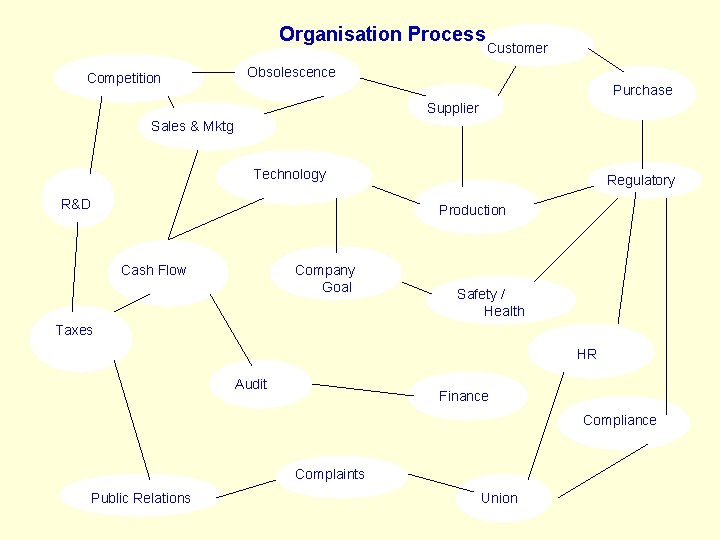
Organisation Process Competition Customer Obsolescence Purchase Supplier Sales & Mktg Technology R&D Regulatory Production Cash Flow Company Goal Safety / Health Taxes HR Audit Finance Compliance Complaints Public Relations Union
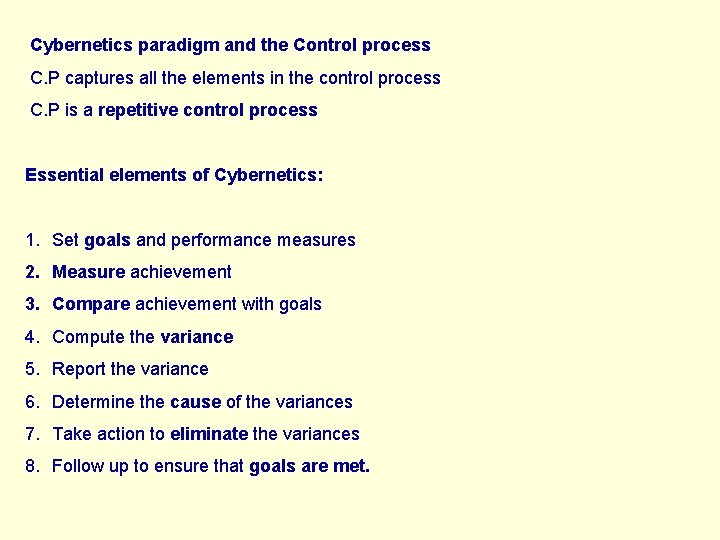
Cybernetics paradigm and the Control process C. P captures all the elements in the control process C. P is a repetitive control process Essential elements of Cybernetics: 1. Set goals and performance measures 2. Measure achievement 3. Compare achievement with goals 4. Compute the variance 5. Report the variance 6. Determine the cause of the variances 7. Take action to eliminate the variances 8. Follow up to ensure that goals are met.
You are the Financial Controller of a company. Enumerate the steps you would take for ensuring control in line with the essential elements of Cybernetics.
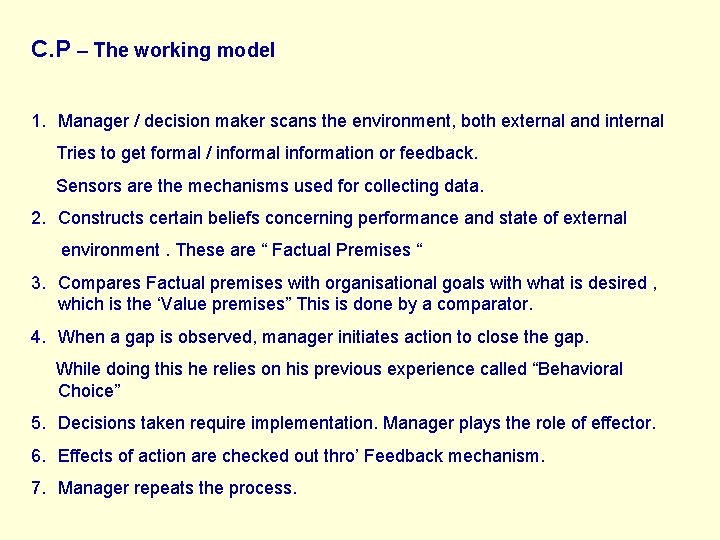
C. P – The working model 1. Manager / decision maker scans the environment, both external and internal Tries to get formal / informal information or feedback. Sensors are the mechanisms used for collecting data. 2. Constructs certain beliefs concerning performance and state of external environment. These are “ Factual Premises “ 3. Compares Factual premises with organisational goals with what is desired , which is the ‘Value premises” This is done by a comparator. 4. When a gap is observed, manager initiates action to close the gap. While doing this he relies on his previous experience called “Behavioral Choice” 5. Decisions taken require implementation. Manager plays the role of effector. 6. Effects of action are checked out thro’ Feedback mechanism. 7. Manager repeats the process.
Control Process / Hierarchy / Communication structure Hierarchy : Relationship between the superior and the subordinates. Goal Congruency : Goals of the subordinate should be congruent to the goals of the superior. Achieving goals : Goals and congruency can be achieved thro’ negotiation , and depends on the style of management and the communication process in the organisation. A. Superior and subordinate meet and negotiate goals, targets & objectives B. Tracking of performance periodically C. Reasons for gaps D. Implement corrective actions E. Review results.
Communication : >> Communication structure need to be open and effective two way. >> Both formal and informal communication systems are essential.
Contingency approach # Appropriateness of any control system depends on the business setting. # Structure and Process are contingent on various internal and external factors. # Focuses on the interaction between the organisation and its environment NEED for contingency approach : 1. Technology : Better utilisation of resources Faster response to changes in environment. Eg; Computers / Internet etc; 2. Orgn. Structure: Complex Organic – keep changing Uncertainty in operating environment. 3. Environment : Need for a fit between external factor and the internal need to change with the environment.
Control variables in Contingency approach 1. Uncertainty 2. Technology & Interdependence 3. Industry / Firm / Unit variables 4. Competitive strategy 5. Mission & Observability factors
Strategy and Control System Approach Management Control system is a tool for implementing company’s strategy. $ Draw up corporate strategies $ Design controls to successfully implement the strategies. Control System for Different strategies A. Strategic Planning : Vertical strategic plan >> For conglomerates Horizontal >> for diversified business B. Budgeting : Single business firm >> Chief executive directly controls Conglomerates >> Business Unit Manager controls C. Incentive and Compensation ; Formula based >> For conglomerates Subjective >> Single business
Impact of Information technology and Control System # Management of large data with ease and efficiency # Cost – benefit advantages # Linking of various departments, thus goal congruence # Data collection and sharing # Faster budgeting process # Production / Quality control # Running and upkeep of machines # Inventory management systems # Finished products distribution and tracking system # Efficient costing tools
Challenges in MCS design $ Ensuring adequate control while leveraging potential for innovation and learning. $ Balancing profit / growth / control / risk $ Delivering short term results while building long-term capabilities. $ Balancing the interests of various stake-holders. $ Minimizing control losses
- Slides: 59