
Management caught between competing views of the organisation
Management: caught between competing views of the organisation Keith Sisson Manchester Industrial Relations Society 17/2/11
Starting points in search of ‘high performance working’ etc ‘permanent restructuring’ acquisition and divestment ‘centralisation’ and ‘decentralisation’ ‘outsourcing’ and ‘insourcing’ universal models of management ‘systems actor’ ‘strategic actor’ ‘agent of capital’
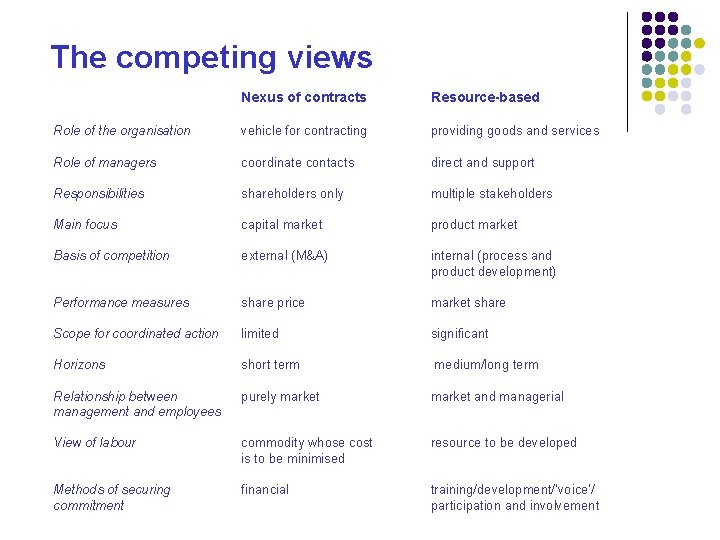
The competing views Nexus of contracts Resource-based Role of the organisation vehicle for contracting providing goods and services Role of managers coordinate contacts direct and support Responsibilities shareholders only multiple stakeholders Main focus capital market product market Basis of competition external (M&A) internal (process and product development) Performance measures share price market share Scope for coordinated action limited significant Horizons short term medium/long term Relationship between management and employees purely market and managerial View of labour commodity whose cost is to be minimised resource to be developed Methods of securing commitment financial training/development/’voice’/ participation and involvement
Why ‘nexus of contract’ thinking so dominant (1): the ‘variety of capitalism’ privileged position for shareholders and an overwhelming emphasis on shareholder value as the key business driver high concentration of institutional share ownership which encourages a focus on short-term profitability as the key index of business performance, rather than long-term market share or added value, relative ease of take-over that reinforces pressure on short-term profitability to maintain share price and encourages expansion by M&A rather than by internal growth a premium on 'financial engineering' as the core organisational competence, the domination of financial management over other functions and ‘numbers driven’ as opposed to ‘issue driven’ planning
Why ‘nexus of contract’ thinking so dominant (2): recent developments deregulation of finance markets in the 1980 s (‘big bang’) ‘light touch regulation’ growth of a global capital market emergence of new investment vehicles (‘hedge funds, ‘private equity groups’, ‘sovereign investment funds’) ‘financialisation’ (ie shift in basis of competition to financial results in the form of current and projected cash returns on investment regardless of product or service)
Wider implications focus on lost cost rather than high quality ‘traditional’ work organisation ‘hollowing-out’ of employment structure traditional model of the employment relationship under threat growing insecurity growing inequality growing poverty assumptions about role of work organisations in human and social capital development in doubt reliance on debt to ensure ‘confident consumers’ (‘house-price Keynesianism’)
Policy issues banking reform a (global) tax on financial transactions role of hedge funds corporate governance ‘flexicurity’ strategic approach to NMW greater transparency more employee ‘voice’ ‘joined-up’ policymaking
Final thoughts The employment relationship has enduring significance Understanding of it cannot be extracted from consideration of the wider political economy – approaches that focus exclusively on the organisation and, narrower still, on the individual ‘psychological contract’ simply don’t cut the mustard. None of the traditional disciplines is in a position to shed much light on unfolding developments and their considerable implications – partly because none of them is centrally concerned with the employment relationship and partly because they are essentially methods- rather than issue-based A focus on the employment relationship, a distinctive multidisciplinary approach grounded in critical social science and a mix of quantitative and qualitative research methods means that employment relations is uniquely qualified to do the job
- Slides: 8