
MANAGEMENT AND ORGANISATIONAL SETUP OF COMMERCIAL BANKS MANAGEMENT
MANAGEMENT AND ORGANISATIONAL SET-UP OF COMMERCIAL BANKS
MANAGEMENT OF COMMERCIAL BANKS �A Banking company, like any other company or corporate body, is an artificial person existing only in the eyes of law. It has separate legal entity with no physical existence of its own. �“Management is that process by which managers create, direct, maintain and operate purposive organisations through systematic, coordinated and cooperative human efforts”.
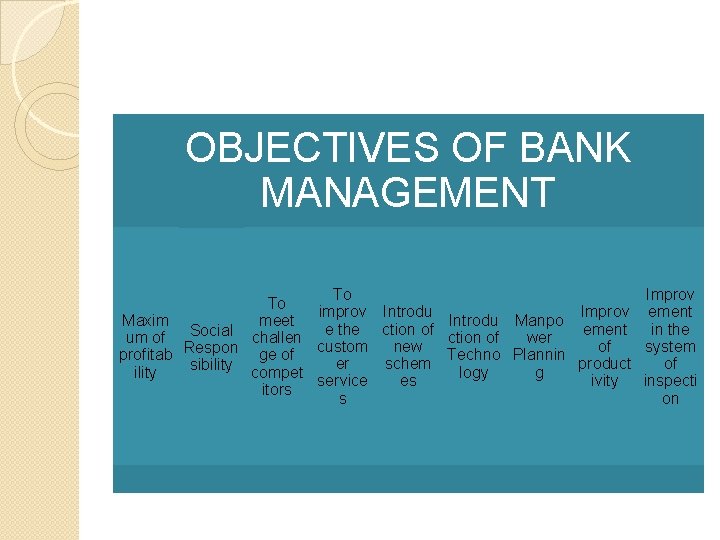
OBJECTIVES OF BANK MANAGEMENT To Improv ement improv Introdu Maxim Introdu Manpo meet e the ction of ement in the um of Social challen ction of wer custom new of system profitab Respon ge of Techno Plannin er schem product of sibility compet ility logy g service es ivity inspecti itors s on

Functions of bank management Planning Organising staffing directing coordinating controlling
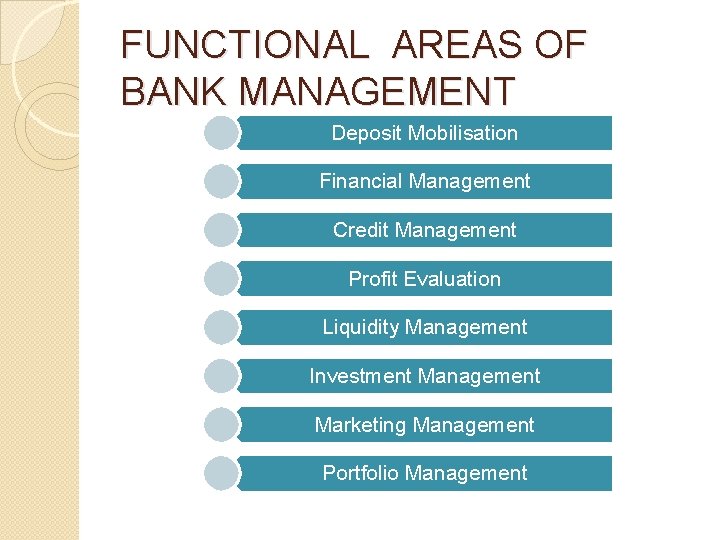
FUNCTIONAL AREAS OF BANK MANAGEMENT Deposit Mobilisation Financial Management Credit Management Profit Evaluation Liquidity Management Investment Management Marketing Management Portfolio Management
ORGANISATIONAL SET-UP OF COMMERCIAL BANKS �“Organizational set up is defined as a system in which individuals and groups operating at different levels perform the tasks assigned to them within the frame work of delegated authority and responsibility which are rationally coordinated to achieve the desired organisational goals”. �An organisational set up consists of people who carry out differentiated tasks which are coordinated to contribute to organization's goals.

Features of Organisational set-up Commercial Banks 1. High Degree of Departmentation a) Top Management 2. Regional or Zonal Offices b) Middle Management c) Branch Management 3. Hierarchical Management
Banking Commission Recommendation on Restructuring Organisational Set-up of Nationalised Banks �Government of India appointed the Banking Commission in Febrauary 1969 under the Chairmanship of Sh R. G. Saraiya to study the organisational structure of the nationalised banks and to make suggestions to remodel the organisational structure to suit the needs of Indian society. The following important recommendations are given by the
Continued…. 1. The organisational structure of all the nationalised banks should be on the lines of that of the State Bank of India. 2. The Commission recommended the constitution of regional boards with statutory powers and responsibilities as in case of SBI 3. The head office of nationalised banks should be main concerned with planning and budgeting of setting up of goals for zonal offices in performing their functions.
4. There should be functional departments at head office level of nationalised bank dealing with budgeting and profit planning, economic research management development, public relations, organisation and methods, legal matters alongwith general departments like control over branches, central accounts. 5. The main function of top executive must be relation to policy formulation.

6. A zonal office should be there to control and guide the 200 to 300 branches. 7. The branch manager should be relieved from day-to-day activities to enable him to devote sufficient time to plan, coordination, control, training, public contacts and business development. 8. There should be separate
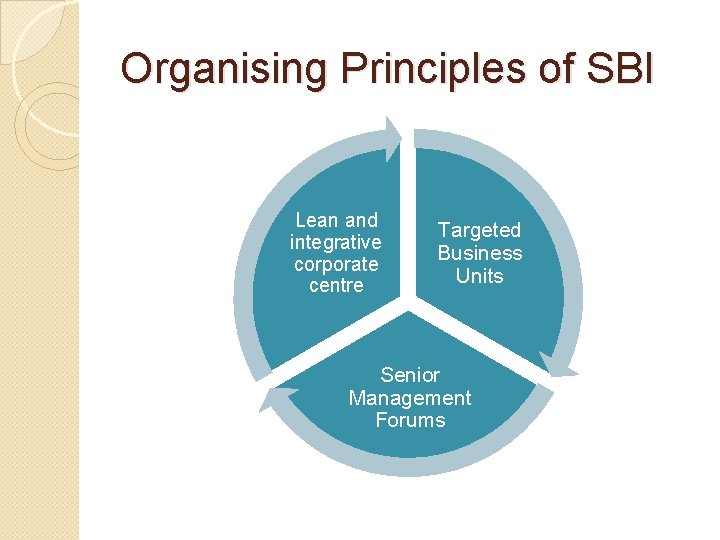
Organising Principles of SBI Lean and integrative corporate centre Targeted Business Units Senior Management Forums
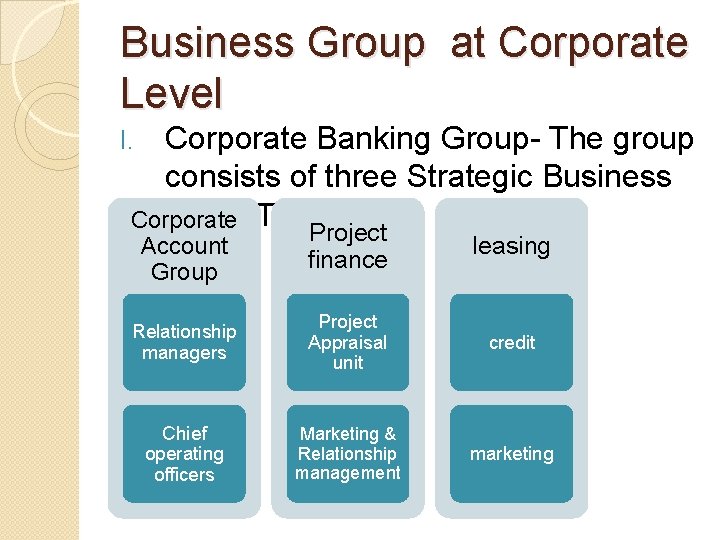
Business Group at Corporate Level Corporate Banking Group- The group consists of three Strategic Business Units. These are: Corporate Project I. leasing Account Group finance Relationship managers Project Appraisal unit credit Chief operating officers Marketing & Relationship management marketing
II. National Banking Group- The National Banking Group serves large and medium sized corporate sector, small industrial agricultural and institutional customers. The 13 Local Head Offices are constituted the Strategic Business Units under this group. Each LHO having two network of branches namely. a) Development and Personal Banking
III. International Banking Group Ø International banking for Indian Customers Ø International banking for Foreign branches IV. Associates and Subsidiaries

THANK YOU
- Slides: 16