
Management and Organisational Behaviour 7 th Edition PART
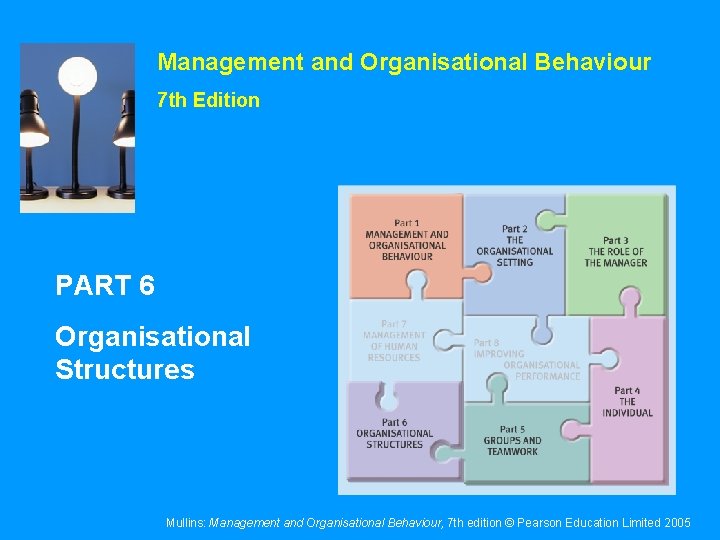
Management and Organisational Behaviour 7 th Edition PART 6 Organisational Structures Mullins: Management and Organisational Behaviour, 7 th edition © Pearson Education Limited 2005
Management and Organisational Behaviour 7 th Edition CHAPTER 15 Organisation Structure and Design Mullins: Management and Organisational Behaviour, 7 th edition © Pearson Education Limited 2005

OHT 15. 2 The meaning of organisational structure Structure: • is the pattern of relationships among positions in the organisation & among members of the organisation • allows the application of the process of management • creates a framework of order & command through which the activities of the organisation can be planned, organised, directed & controlled Mullins: Management and Organisational Behaviour, 7 th edition © Pearson Education Limited 2005
OHT 15. 3 Objectives of structure • The economic & efficient performance of the organisation & the level of resource utilisation • Monitoring the activities of the organisation • Accountability for areas of work undertaken by groups & individual members of the organisation Mullins: Management and Organisational Behaviour, 7 th edition © Pearson Education Limited 2005
OHT 15. 4 Objectives of structure • Co-ordination of different parts of the organisation & different areas of work • Flexibility in order to respond to future demands & developments & to adapt to changing environmental influences • The social satisfaction of members working in the organisation Knight Mullins: Management and Organisational Behaviour, 7 th edition © Pearson Education Limited 2005

OHT 15. 5 Importance of good structure Good organisational structure does not by itself produce good performance. But a poor organisational structure makes good performance impossible, no matter how good the individual managers may be. Drucker The allocation of responsibilities, the grouping of functions, decision making, co-ordination, control & reward are all fundamental requirements for the continual operation of an organisation. The quality of a structure will affect how well these requirements are met. Child Mullins: Management and Organisational Behaviour, 7 th edition © Pearson Education Limited 2005
OHT 15. 6 The human element • The actual operation of the organisation & success in meeting the business objectives will depend on the behaviour of people who work within the structure & who give shape & personality to it • In an IMD survey, the commitment & involvement of employees ranked second only to top management as a key success factor in restructuring Mullins: Management and Organisational Behaviour, 7 th edition © Pearson Education Limited 2005
OHT 15. 7 Argyris – a critic of formal organisations • Argyris argues that formal, bureaucratic organisations restrict individual growth & self fulfillment • In the psychologically healthy person, this causes a feeling of failure, frustration, & conflict • He argues that organisations should provide a more authentic relationship for its members Mullins: Management and Organisational Behaviour, 7 th edition © Pearson Education Limited 2005
OHT 15. 8 The relationship between people & organisations The operation of the organisation & actual working arrangements will be influenced by – • Style of management • Personalities of members • The informal organisation Mullins: Management and Organisational Behaviour, 7 th edition © Pearson Education Limited 2005
OHT 15. 9 Levels of organisation Technical level – involves • specific operations & discrete tasks • the actual job or tasks to be done • the performance of the technical function Managerial level – involves • the co-ordination & integration of work at the technical level Community level – involves • broad objectives & the work of the organisation as a whole Mullins: Management and Organisational Behaviour, 7 th edition © Pearson Education Limited 2005

OHT 15. 10 Figure 15. 1 Interrelated levels of organisation Mullins: Management and Organisational Behaviour, 7 th edition © Pearson Education Limited 2005
OHT 15. 11 Importance of the hierarchy Authority is & is likely to continue to be less acceptable than in the past. Better educated & more independent people expect to be consulted rather than told what to do. Stewart The hierarchy is not dead, it has just changed its form. The trappings of power in the modern workplace may have been toned down, but the boss is still the boss. To confuse informality with the end of the organisational pecking order is a mistake. Jebb Mullins: Management and Organisational Behaviour, 7 th edition © Pearson Education Limited 2005

OHT 15. 12 Figure 15. 2 Examples of purpose & implications for organisational design Source: Reprinted with permission from Richard Lynch, Corporate Strategy, Third edition, Financial Times Prentice Hall (2003), p. 667, with permission from Pearson Education Ltd. Mullins: Management and Organisational Behaviour, 7 th edition © Pearson Education Limited 2005
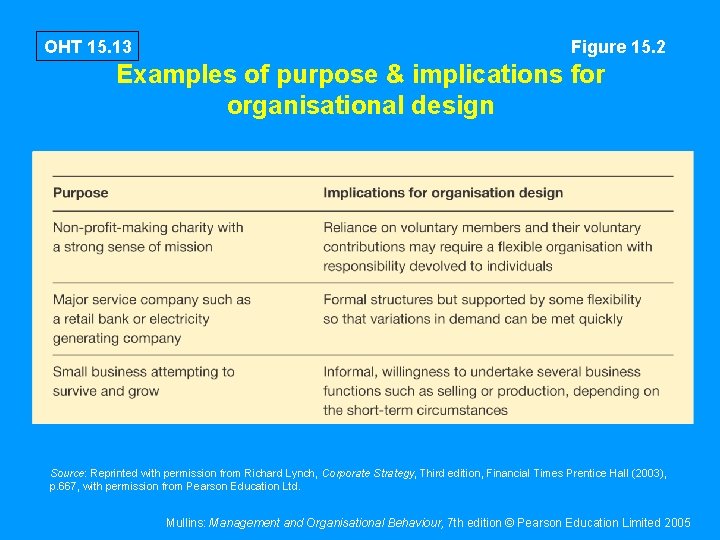
OHT 15. 13 Figure 15. 2 Examples of purpose & implications for organisational design Source: Reprinted with permission from Richard Lynch, Corporate Strategy, Third edition, Financial Times Prentice Hall (2003), p. 667, with permission from Pearson Education Ltd. Mullins: Management and Organisational Behaviour, 7 th edition © Pearson Education Limited 2005
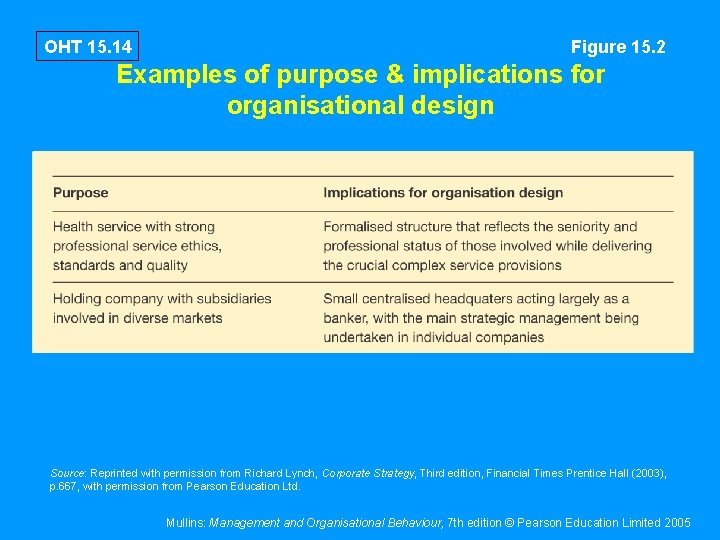
OHT 15. 14 Figure 15. 2 Examples of purpose & implications for organisational design Source: Reprinted with permission from Richard Lynch, Corporate Strategy, Third edition, Financial Times Prentice Hall (2003), p. 667, with permission from Pearson Education Ltd. Mullins: Management and Organisational Behaviour, 7 th edition © Pearson Education Limited 2005
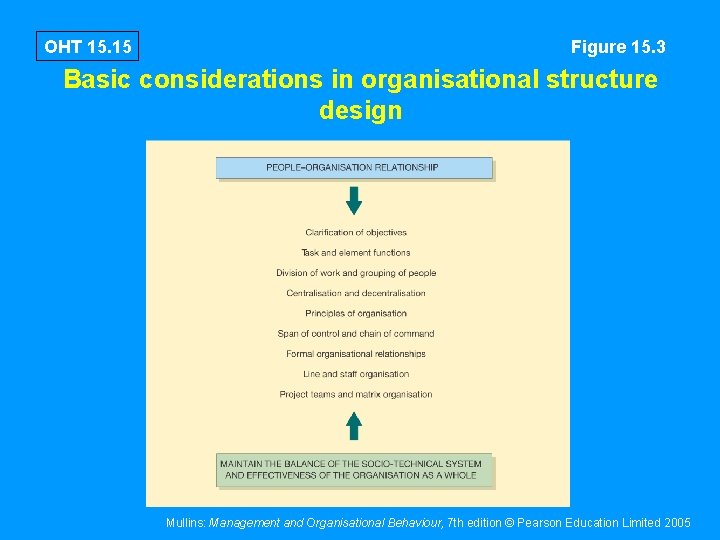
OHT 15. 15 Figure 15. 3 Basic considerations in organisational structure design Mullins: Management and Organisational Behaviour, 7 th edition © Pearson Education Limited 2005
OHT 15. 16 Task functions • • Developing the goods /services Manufacturing the goods / services Marketing the goods / services Financing the organisation Basic activities of the organisation related to the actual completion of the production process & directed towards specific & definable end results. Woodward Mullins: Management and Organisational Behaviour, 7 th edition © Pearson Education Limited 2005
OHT 15. 17 Element functions • Supportive of the task functions • An intrinsic part of the management process • Examples include personnel, planning, management services, public relation, etc. Woodward Mullins: Management and Organisational Behaviour, 7 th edition © Pearson Education Limited 2005
OHT 15. 18 Task & element functions – implications of organisational structure Failure to distinguish between the two types of functions can lead to confusion in the planning of structure & in the relationship between members of the organisation Mullins: Management and Organisational Behaviour, 7 th edition © Pearson Education Limited 2005
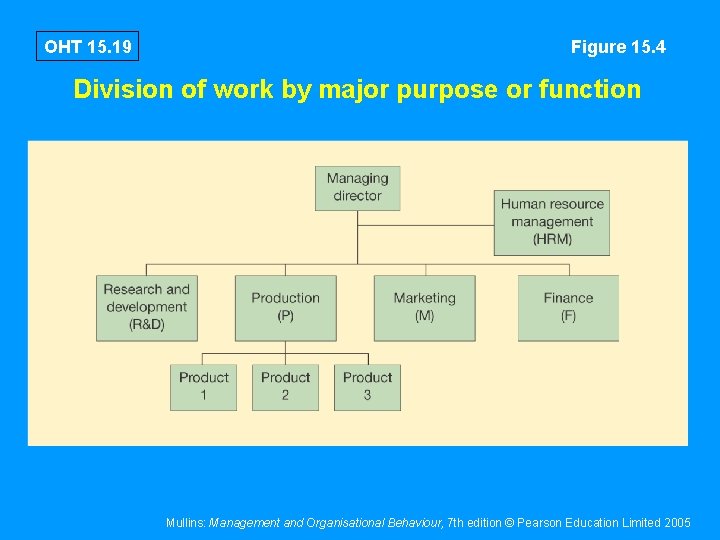
OHT 15. 19 Figure 15. 4 Division of work by major purpose or function Mullins: Management and Organisational Behaviour, 7 th edition © Pearson Education Limited 2005
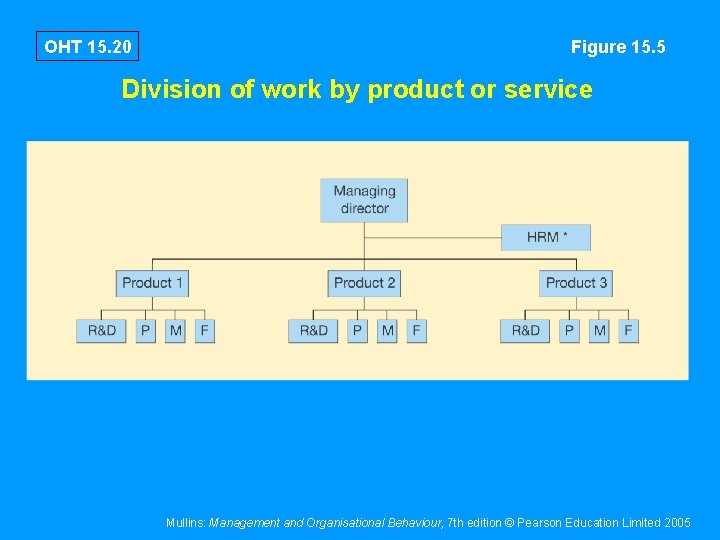
OHT 15. 20 Figure 15. 5 Division of work by product or service Mullins: Management and Organisational Behaviour, 7 th edition © Pearson Education Limited 2005
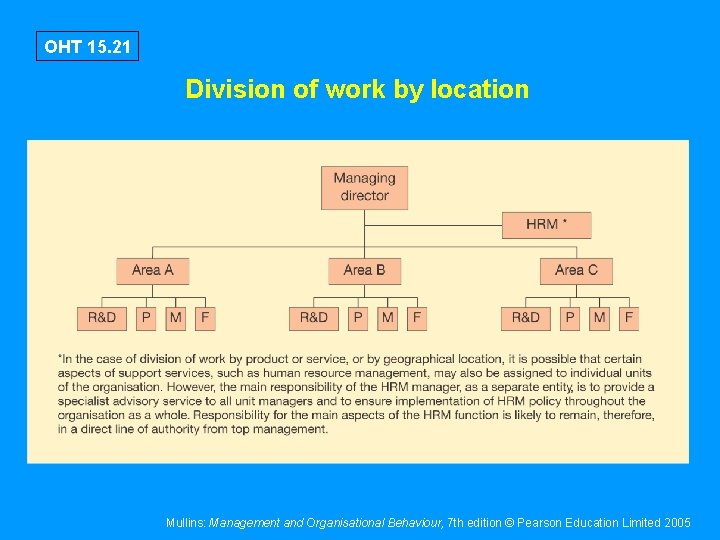
OHT 15. 21 Division of work by location Mullins: Management and Organisational Behaviour, 7 th edition © Pearson Education Limited 2005
OHT 15. 22 Grouping considerations Decisions on the methods of grouping will be based on – • • • The need for co-ordination The identification of clearly-defined divisions of work Economy The process of managing the activities Avoiding conflict The design of work organisation taking into account the nature of staff employed, their interests & job satisfaction Mullins: Management and Organisational Behaviour, 7 th edition © Pearson Education Limited 2005
OHT 15. 23 Centralisation – the advantages • Easier implementation of a common policy for the organisation as a whole • A consistent strategy across the organisation • Prevents sub-units becoming too independent • Improved economies of scale & a reduction in overhead costs • Greater use of specialisation • Improved decision-making Mullins: Management and Organisational Behaviour, 7 th edition © Pearson Education Limited 2005
OHT 15. 24 Decentralisation – the advantages • Enables decisions to be made closer to the operational level of work • Increased responsiveness to local circumstances • Improved level of personal customer service • More in keeping with developments in flatter & more flexible structures Mullins: Management and Organisational Behaviour, 7 th edition © Pearson Education Limited 2005
OHT 15. 25 Decentralisation – the advantages • Support services, such as administration, are more likely to be effective if provided as close as possible to the activities they are intended to serve • Provides opportunities for training & development in management • Usually has an encouraging effect on the motivation & morale of staff Mullins: Management and Organisational Behaviour, 7 th edition © Pearson Education Limited 2005
OHT 15. 26 Principles of organisation • • • Objective Specialisation Co-ordination Authority Responsibility • • • Definition Correspondence Span of control Balance Continuity Mullins: Management and Organisational Behaviour, 7 th edition © Pearson Education Limited 2005
OHT 15. 27 Spans of control The number of subordinates who report directly to a given manager or superior Mullins: Management and Organisational Behaviour, 7 th edition © Pearson Education Limited 2005
OHT 15. 28 Spans of control Factors influencing the span of control – • Nature of the organisation, complexity of work, range of responsibilities, similarity of function • Ability & personal qualities of the manager • Amount of time manager is available to spend on subordinates • Ability & training of subordinates • Effectiveness of co-ordination & nature of communication • Physical location • Length of scalar chain Mullins: Management and Organisational Behaviour, 7 th edition © Pearson Education Limited 2005
OHT 15. 29 Spans of control – width Too wide, it becomes difficult to supervise subordinates effectively & places more stress on the manager & may result in slowness to adapt to change Too narrow, it may present problems of co-ordination & consistency in decision-making & wider communication across the organisational structure Mullins: Management and Organisational Behaviour, 7 th edition © Pearson Education Limited 2005
OHT 15. 30 Chain of command The number of different levels in the structure of the organisation, the chain of hierarchical command Establishes the vertical graduation of authority & responsibility & the framework for superior–subordinate relationships Mullins: Management and Organisational Behaviour, 7 th edition © Pearson Education Limited 2005
OHT 15. 31 Individual authority relationships • Line – flows directly down through the structure • Functional – relationship between people in specialist or advisory positions • Staff – arise from the appointment of personal assistants to senior managers • Lateral – exist between individuals in different departments or sections especially those on the same levels Mullins: Management and Organisational Behaviour, 7 th edition © Pearson Education Limited 2005
OHT 15. 32 Inverted organisations These place customers at the summit and top management at the base Will be accompanied by the devolution of power and delegation to the empowered, self-managing workers near the top of the inverted pyramid Mullins: Management and Organisational Behaviour, 7 th edition © Pearson Education Limited 2005
OHT 15. 33 Matrix organisations The matrix organisation is a combination of – • Functional departments providing the stable base for specialised activities and a permanent location for members • Units that integrate various activities of different functional departments in a project team Mullins: Management and Organisational Behaviour, 7 th edition © Pearson Education Limited 2005
OHT 15. 34 Poorly designed structures Lack of design is – • • Illogical Cruel Wasteful Inefficient Urwick Mullins: Management and Organisational Behaviour, 7 th edition © Pearson Education Limited 2005
OHT 15. 35 Consequences of badly designed structures • • Low motivation & morale Late & inappropriate decisions Conflict & lack of co-ordination Poor response to new opportunities & external change • Rising costs Child Mullins: Management and Organisational Behaviour, 7 th edition © Pearson Education Limited 2005
- Slides: 36