
Management Accounting RELEVANT COSTING Readings Relevant costing http
- Slides: 22
Management Accounting RELEVANT COSTING
Readings §Relevant costing http: //accountingexplained. com/managerial/relevan t-costing/
Incremental Analysis §Incremental analysis is the analysis of financial information for evaluating business decisions. This analysis identifies which expenses will change as a result of a particular decision; these expenses are called relevant costs. Not all expenses change when we make a business decision, so we need to consider the characteristics of each expense in deciding how to calculate relevant costs.
Relevant Costing §Special orders §Make or buy §Add/drop segment §Equipment replacement
Special Orders §Special order pricing is a technique used to calculate the lowest price of a product or service at which a special order may be accepted and below which a special order should be rejected. §Qualitative factors: effect on relationship with existing customers §Quantitative factors: relevant costs (new costs incurred vs. sales price received)
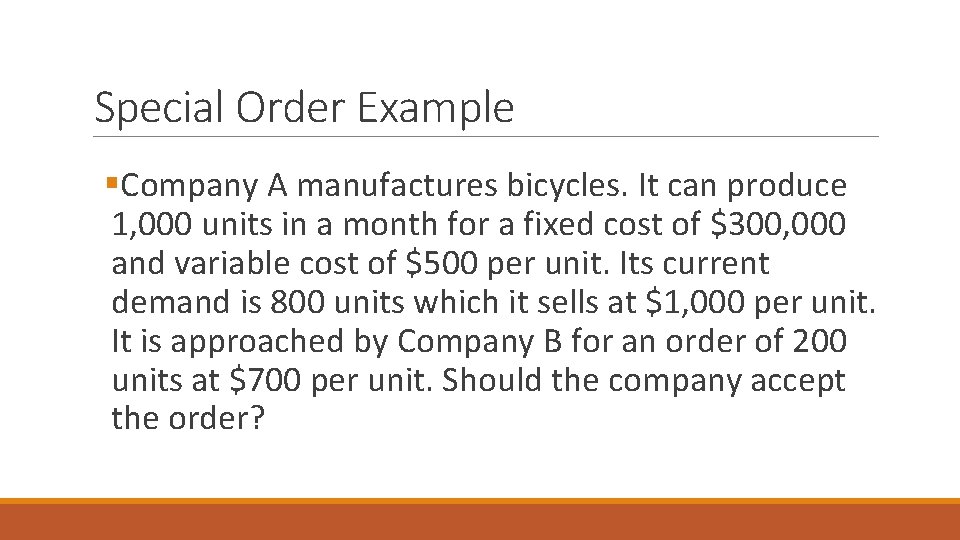
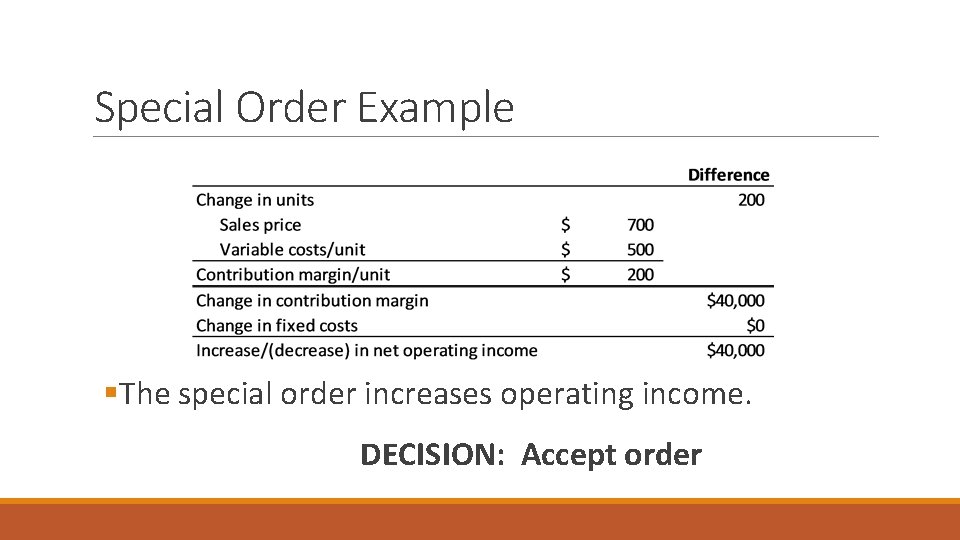
Special Order Example §Company A manufactures bicycles. It can produce 1, 000 units in a month for a fixed cost of $300, 000 and variable cost of $500 per unit. Its current demand is 800 units which it sells at $1, 000 per unit. It is approached by Company B for an order of 200 units at $700 per unit. Should the company accept the order?
Special Order Example §The special order increases operating income. DECISION: Accept order
Make or Buy §A make or buy decision is a judgment made by management whether to make a component internally or buy it from the market. §Qualitative factors: quality control, supplier reliability, effect on customers §Quantitative factors: relevant costs (new costs incurred vs. cost savings)
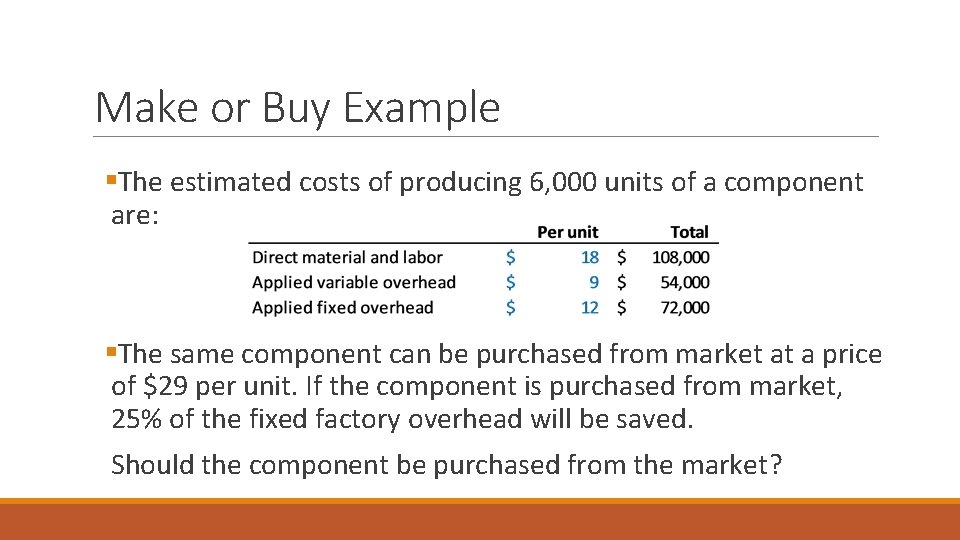
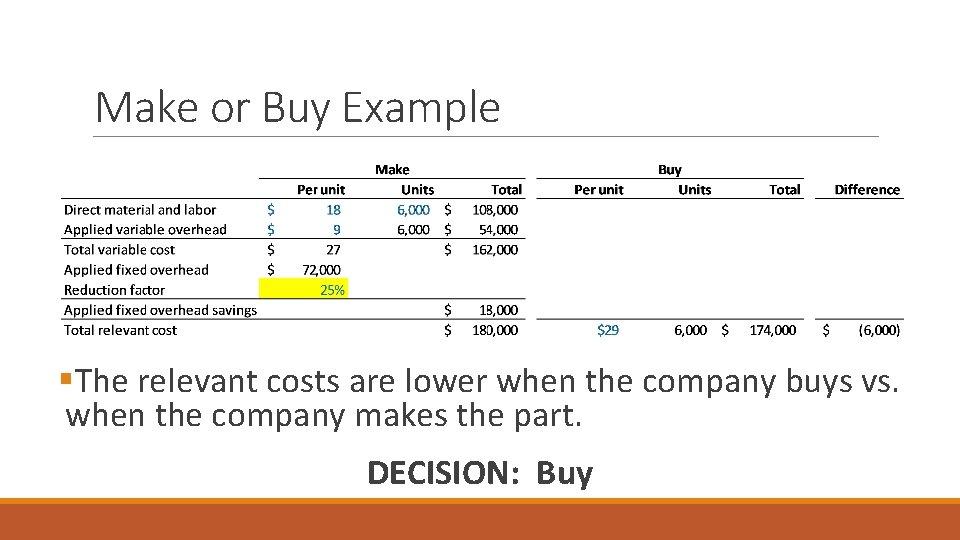
Make or Buy Example §The estimated costs of producing 6, 000 units of a component are: §The same component can be purchased from market at a price of $29 per unit. If the component is purchased from market, 25% of the fixed factory overhead will be saved. Should the component be purchased from the market?
Make or Buy Example §The relevant costs are lower when the company buys vs. when the company makes the part. DECISION: Buy
Add/Drop Segment §We can use incremental analysis to decide whether to add or drop a business segment. §Qualitative factors: effect on customer relationships §Quantitative factors: relevant costs (incremental changes in revenue and expenses, not sunk costs/depreciation or allocated costs)
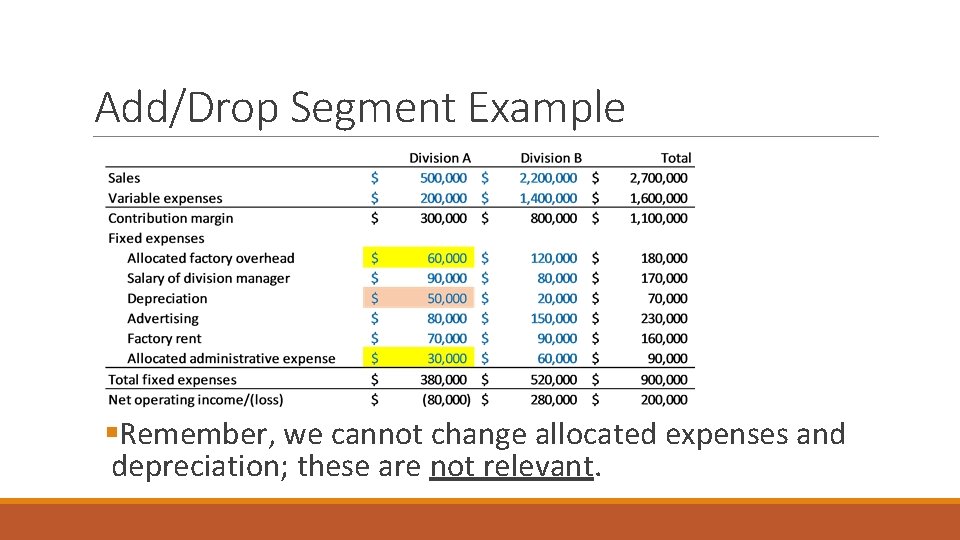
Add/Drop Segment §“Allocated” costs are fixed expenses at the corporate level (not at the segment level) which are allocated to the division level for accounting purposes. However, these total expenses do not change if we add or drop a division, so they are not relevant to decision making.
Add/Drop Segment §Depreciation is the accounting allocation of fixed assets purchases. Depreciation is not relevant to decision making. §The sale of fixed assets is relevant to decision making, because any sales proceeds are additional cash for the company.
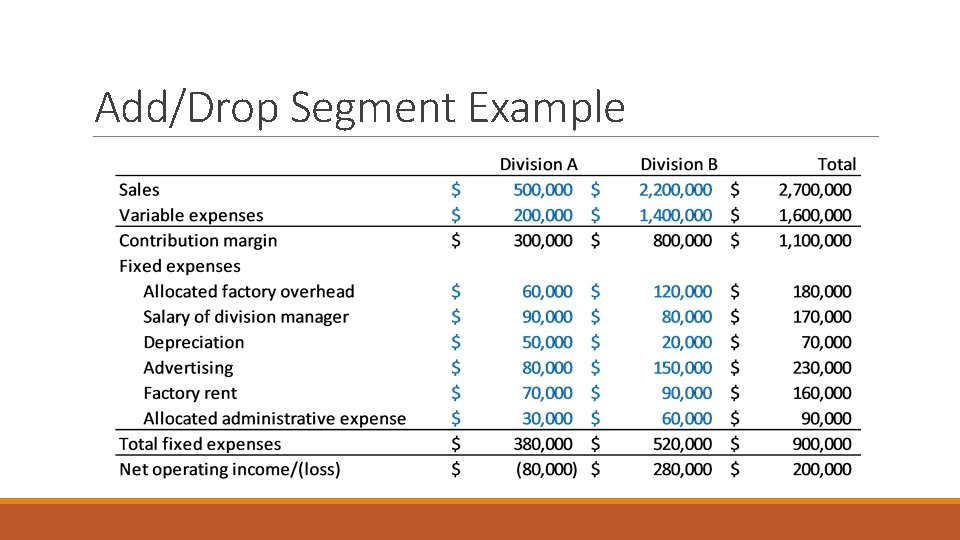
Add/Drop Segment Example
Add/Drop Segment Example §The segment income statement shows a net loss for division A. Should the company drop this segment? We need to perform an incremental cost analysis to find out.
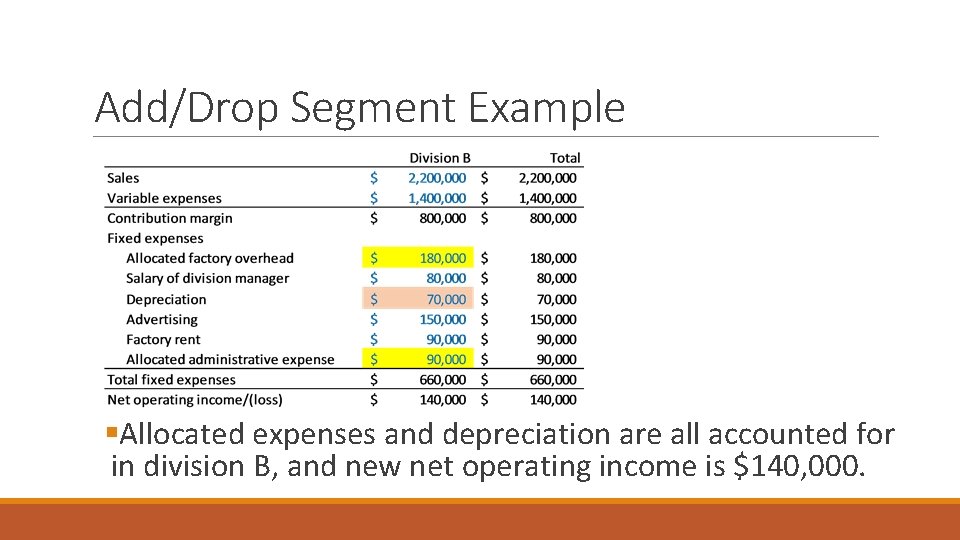
Add/Drop Segment Example §Remember, we cannot change allocated expenses and depreciation; these are not relevant.
Add/Drop Segment Example §Allocated expenses and depreciation are all accounted for in division B, and new net operating income is $140, 000.
Add/Drop Segment Example §What happened? Division A is losing money, but if we drop it, our net operating income decreases. Why? Because only the relevant costs change. We can simplify the analysis by looking at only the relevant costs to evaluate our decision.
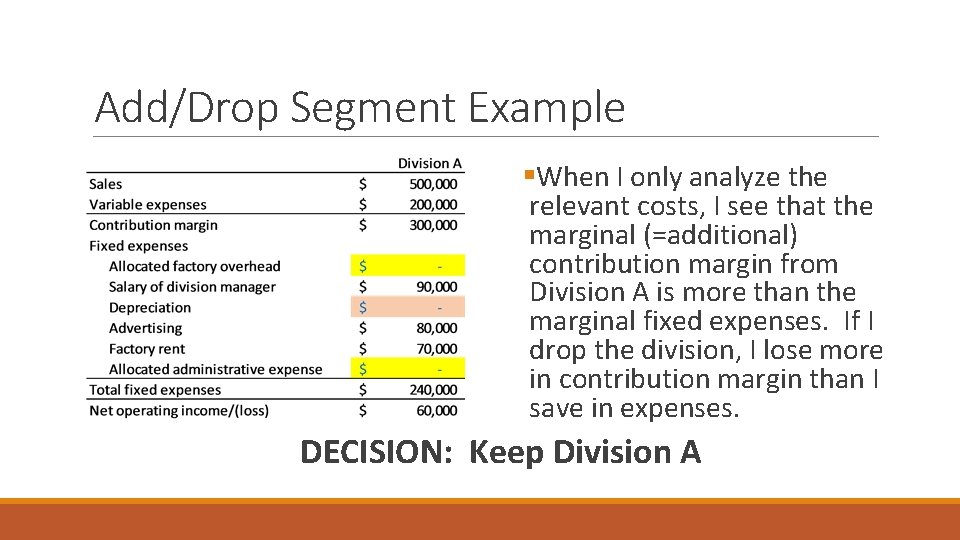
Add/Drop Segment Example §When I only analyze the relevant costs, I see that the marginal (=additional) contribution margin from Division A is more than the marginal fixed expenses. If I drop the division, I lose more in contribution margin than I save in expenses. DECISION: Keep Division A
Equipment Replacement §An equipment replacement decision relates to an analysis of the incremental benefits of the cost of new equipment §Qualitative factors: technological obsolescence §Quantitative factors: relevant costs (incremental cash flows, not sunk costs/depreciation)
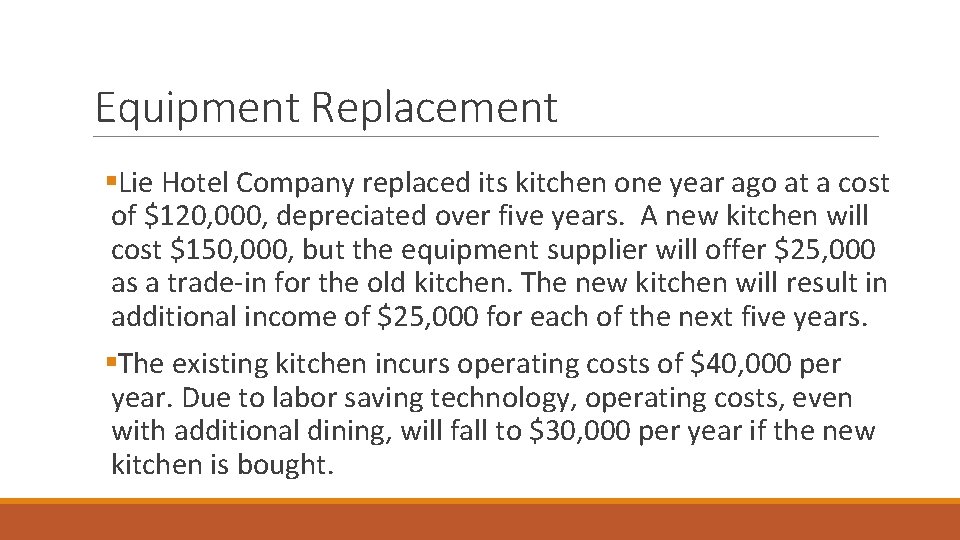
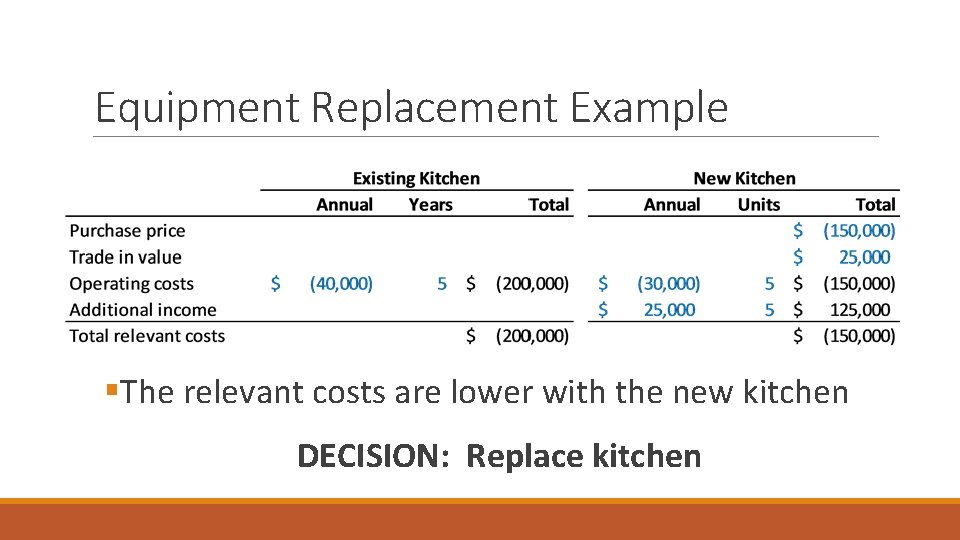
Equipment Replacement §Lie Hotel Company replaced its kitchen one year ago at a cost of $120, 000, depreciated over five years. A new kitchen will cost $150, 000, but the equipment supplier will offer $25, 000 as a trade-in for the old kitchen. The new kitchen will result in additional income of $25, 000 for each of the next five years. §The existing kitchen incurs operating costs of $40, 000 per year. Due to labor saving technology, operating costs, even with additional dining, will fall to $30, 000 per year if the new kitchen is bought.
Equipment Replacement Example §The relevant costs are lower with the new kitchen DECISION: Replace kitchen