
Management Accounting JobProduct Costing PDST Accounting at Senior
Management Accounting Job/Product Costing PDST Accounting at Senior Cycle: A Practical Approach

Overview What is Job Costing? ¡ What is the purpose of Job Costing? ¡ Job Costing v Batch Costing ¡ Direct and Indirect Costs ¡ Key Terminology ¡ l l Overheads Cost allocation Cost apportionment Overhead absorbtion PDST Accounting at Senior Cycle: A Practical Approach
Job Costing - Defined ¡A job costing system is a system of cost accumulation and recording where there is an identifiable activity (job or group of tasks) for which costs may be collected PDST Accounting at Senior Cycle: A Practical Approach
Purpose of Job Costing ¡ Aids • • • planning, cost control and decision making by: Establishing cost (costs are recorded on job cards) Calculating Selling Price Determining profit/loss on jobs PDST Accounting at Senior Cycle: A Practical Approach
Characteristics of Job Costing ¡ Specific order to customer specifications e. g. manufacture of customised furniture ¡ Order is of comparatively short duration ¡ All stages of production within factory easily traced to job PDST Accounting at Senior Cycle: A Practical Approach
Characteristics of Batch Costing ¡ Similar articles made in batches ¡ Similar to job costing ¡ Example – Bakery PDST Accounting at Senior Cycle: A Practical Approach
Total Cost Direct Costs* + Indirect Costs = Total Cost *Total Direct Costs are also known as Prime Cost. PDST Accounting at Senior Cycle: A Practical Approach
Direct Costs ¡ Costs that are directly linked to a product/service/job e. g. Materials, Labour, Direct Expenses (e. g. hire/purchase of special equipment) ¡ Total Direct Costs also known as Prime Cost PDST Accounting at Senior Cycle: A Practical Approach
Indirect Costs ¡ Costs that are not directly linked to the product/service/job, but must be included as part of the cost e. g. light and heat, depreciation etc. ¡ Indirect costs are also known as overheads PDST Accounting at Senior Cycle: A Practical Approach
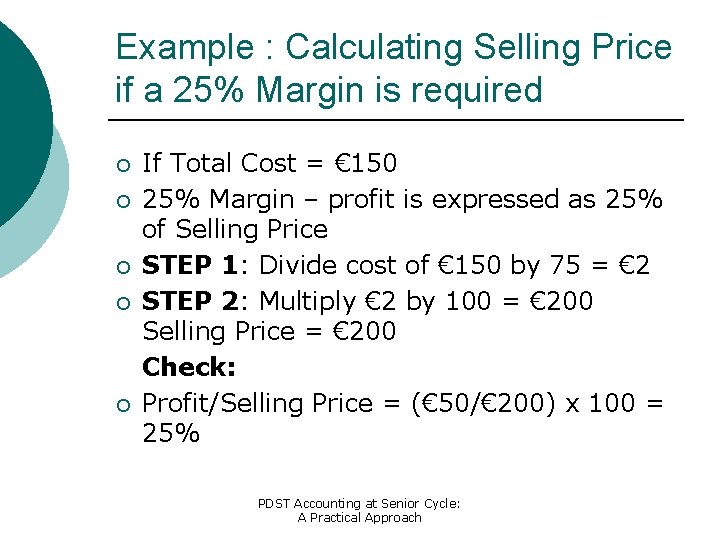
Example : Calculating Selling Price if a 25% Margin is required ¡ ¡ ¡ If Total Cost = € 150 25% Margin – profit is expressed as 25% of Selling Price STEP 1: Divide cost of € 150 by 75 = € 2 STEP 2: Multiply € 2 by 100 = € 200 Selling Price = € 200 Check: Profit/Selling Price = (€ 50/€ 200) x 100 = 25% PDST Accounting at Senior Cycle: A Practical Approach
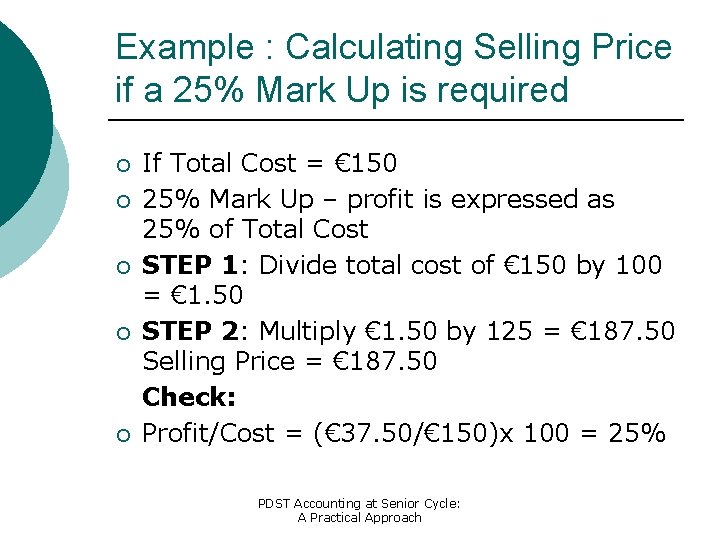
Example : Calculating Selling Price if a 25% Mark Up is required ¡ ¡ ¡ If Total Cost = € 150 25% Mark Up – profit is expressed as 25% of Total Cost STEP 1: Divide total cost of € 150 by 100 = € 1. 50 STEP 2: Multiply € 1. 50 by 125 = € 187. 50 Selling Price = € 187. 50 Check: Profit/Cost = (€ 37. 50/€ 150)x 100 = 25% PDST Accounting at Senior Cycle: A Practical Approach
Overheads: Defined All labour, material and expense costs which cannot be identified as direct costs are termed indirect costs ¡ Indirect materials, indirect labour and indirect expenses are collectively known as overheads ¡ PDST Accounting at Senior Cycle: A Practical Approach
Key Terminology: Cost Allocation Cost centre – identifiable unit in an organisation in respect of which a manager is responsible for costs ¡ Characteristics of cost centres include: homogenous unit, single form of activity, identifiable manager ¡ PDST Accounting at Senior Cycle: A Practical Approach
Cost allocation: Overheads Overhead costs which are clearly identifiable with a a particular cost centre allocated to that cost centre ¡ Indirect labour/materials can usually be allocated to specific cost centres ¡ PDST Accounting at Senior Cycle: A Practical Approach
Cost apportionment Where an overhead is not clearly identifiable with a cost centre, then the overhead needs to be apportioned over all the relevant cost centres ¡ Establish a method of apportioning the overhead ¡ PDST Accounting at Senior Cycle: A Practical Approach
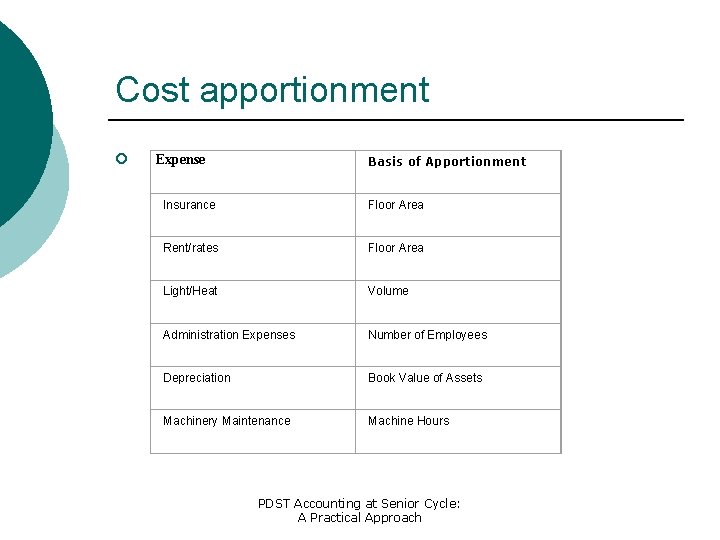
Cost apportionment ¡ Expense Basis of Apportionment Insurance Floor Area Rent/rates Floor Area Light/Heat Volume Administration Expenses Number of Employees Depreciation Book Value of Assets Machinery Maintenance Machine Hours PDST Accounting at Senior Cycle: A Practical Approach
Service Departments exist to support production ¡ Overhead costs from service departments must be apportioned to production cost centres ¡ PDST Accounting at Senior Cycle: A Practical Approach
Overhead Absorption Attributing of overheads to either products or services ¡ Determine base for overhead absorption – Overhead Absorption Rate (OAR) e. g. labour hours, machine hours etc. ¡ PDST Accounting at Senior Cycle: A Practical Approach
Procedure for absorbing overheads 1. All costs allocated and apportioned to the different cost centres ¡ 2. Service department costs are apportioned ¡ 3. To calculate OAR - divide total overhead by base (e. g. labour/machine hours) ¡ PDST Accounting at Senior Cycle: A Practical Approach
Reading Drury, Colin Costing an Introduction (Chapter 4, 5, 6) ¡ Mc. Keon Murray Costing and Budgeting (Section 10) ¡ Luby, Alice Cost and Management Accounting (Chapters 2 and 4) ¡ PDST Accounting at Senior Cycle: A Practical Approach
- Slides: 20