
MANAGEMENT 11 E PLUNKETT ALLEN 9 1 CHAPTER
- Slides: 58
MANAGEMENT 11 E PLUNKETT & ALLEN 9– 1 CHAPTER 9: ORGANIZATIONAL DESIGN, CULTURE, AND CHANGE
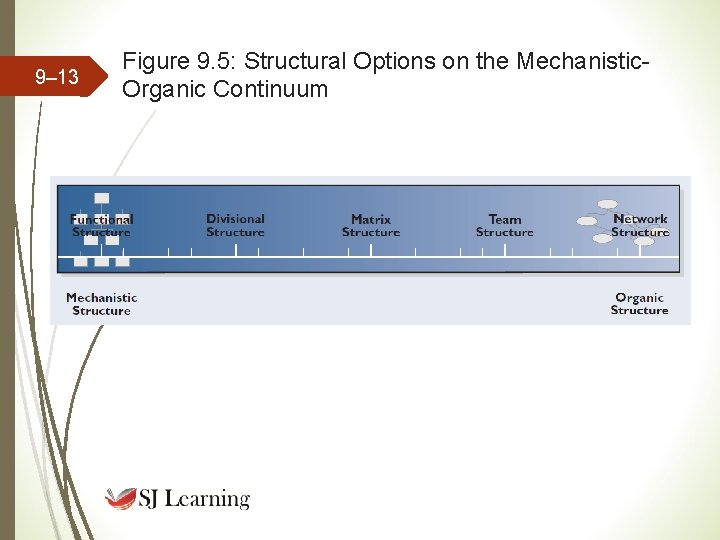
9– 2 Learning Outcomes After reading and studying this chapter, you should be able to: 1. Define organizational design and describe its four objectives 2. Distinguish between mechanistic and organic organizational structures 3. Discuss the influence that contingency factors— organizational strategy, environment, size, age, and technology—have on organizational design 4. Describe the characteristics, advantages, and disadvantages of functional, divisional, matrix, team, and network structural designs 5. Define organizational culture and describe the ways that culture is manifested
9– 3 Learning Outcomes (cont’d) After reading and studying this chapter, you should be able to: 6. Explain the role of managers and employees in creating culture and making a culture effective 7. Define change and identify the kinds of change that can occur in an organization 8. Explain the steps managers can follow to implement planned change 9. Identify the organizational qualities that promote change 10. Explain why people resist change and what managers can do to overcome that resistance 11. Explain why change efforts fail 12. Explain the purpose of an organizational development program
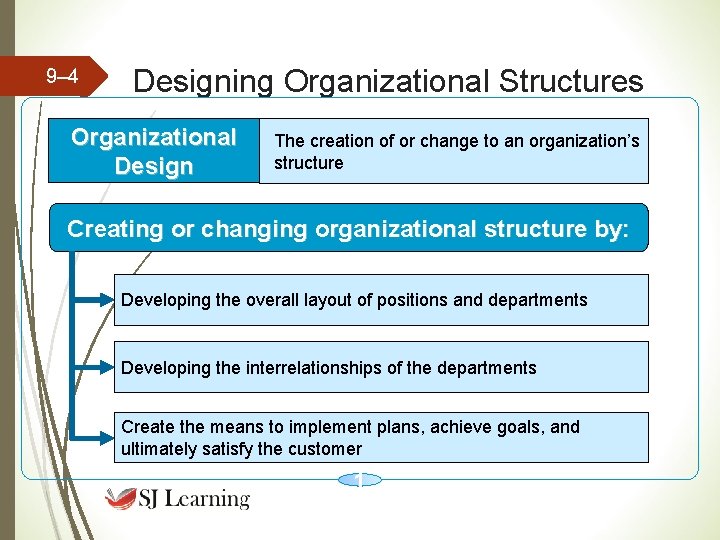
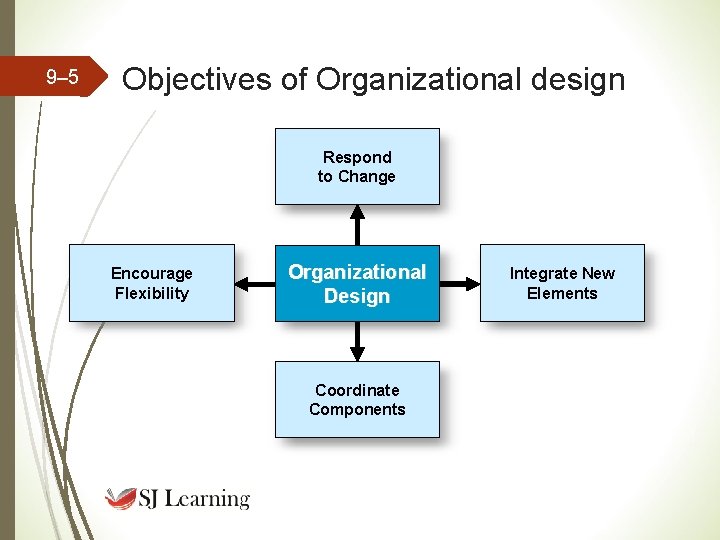
9– 4 Designing Organizational Structures Organizational Design The creation of or change to an organization’s structure Creating or changing organizational structure by: Developing the overall layout of positions and departments Developing the interrelationships of the departments Create the means to implement plans, achieve goals, and ultimately satisfy the customer 1
9– 5 Objectives of Organizational design Respond to Change Encourage Flexibility Organizational Design Coordinate Components Integrate New Elements
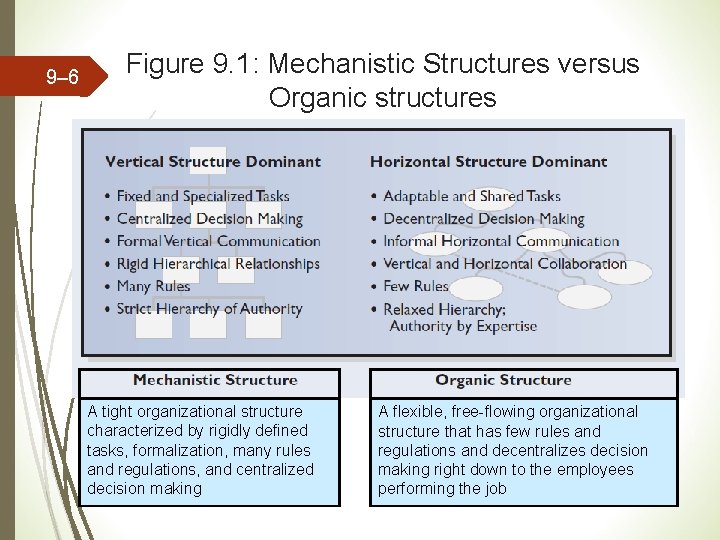
9– 6 Figure 9. 1: Mechanistic Structures versus Organic structures A tight organizational structure characterized by rigidly defined tasks, formalization, many rules and regulations, and centralized decision making A flexible, free-flowing organizational structure that has few rules and regulations and decentralizes decision making right down to the employees performing the job
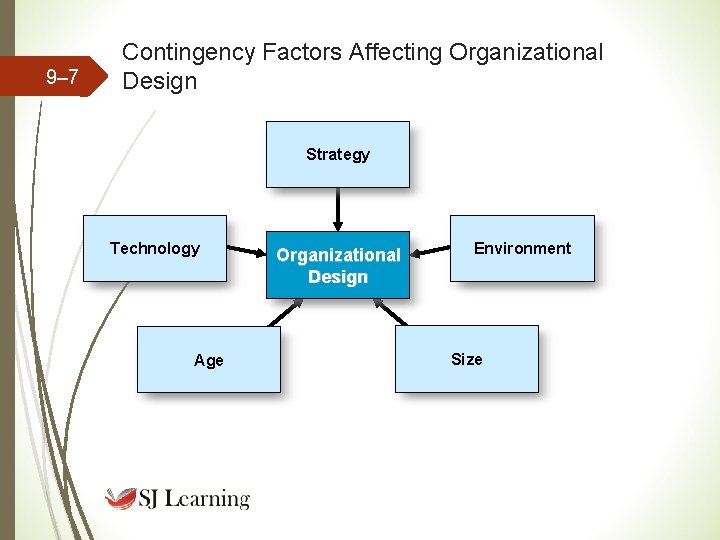
9– 7 Contingency Factors Affecting Organizational Design Strategy Technology Age Organizational Design Environment Size
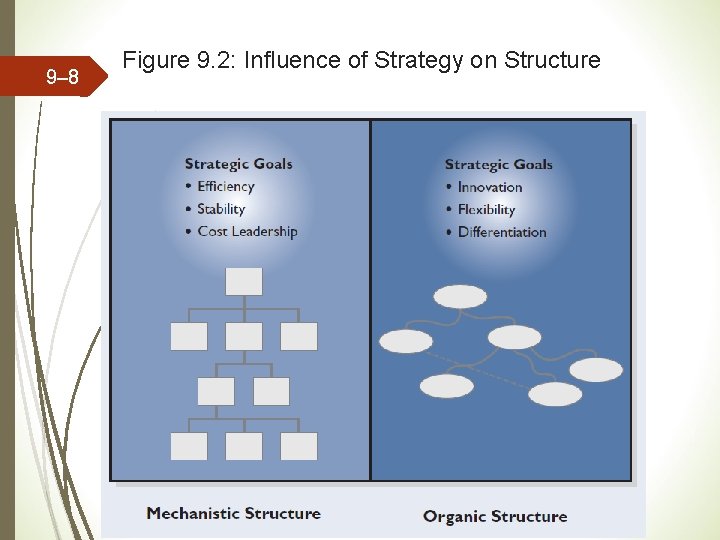
9– 8 Figure 9. 2: Influence of Strategy on Structure
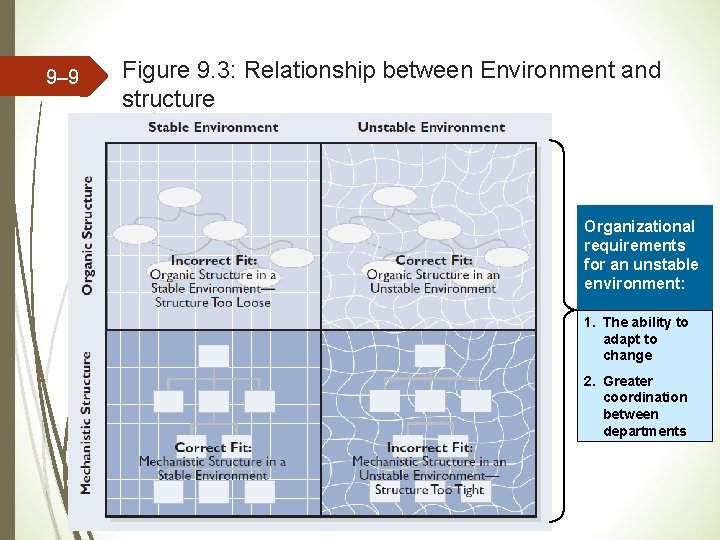
9– 9 Figure 9. 3: Relationship between Environment and structure Organizational requirements for an unstable environment: 1. The ability to adapt to change 2. Greater coordination between departments
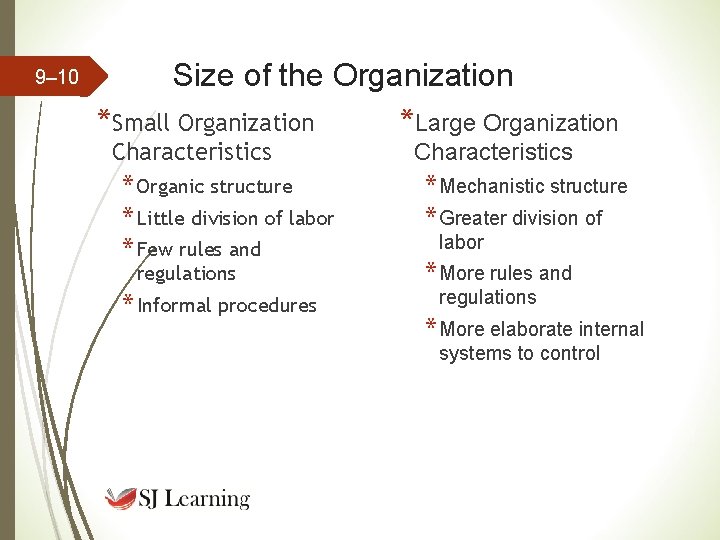
9– 10 Size of the Organization *Small Organization *Large Organization Characteristics * Organic structure * Little division of labor * Few rules and regulations * Informal procedures Characteristics * Mechanistic structure * Greater division of labor * More rules and regulations * More elaborate internal systems to control
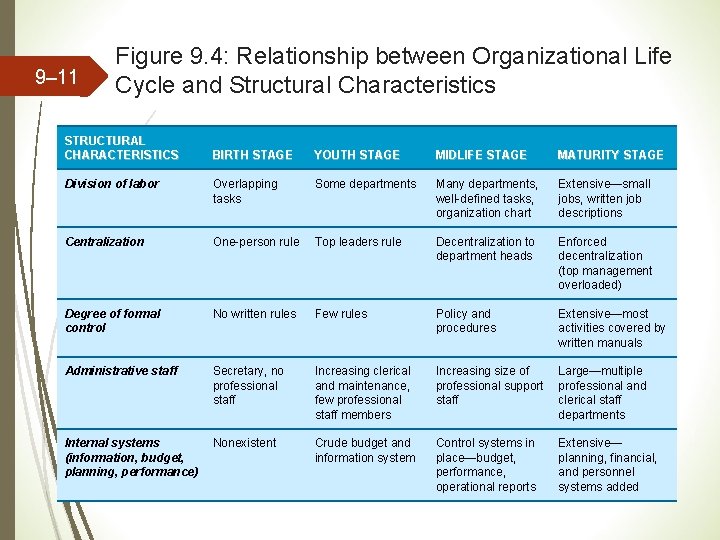
9– 11 Figure 9. 4: Relationship between Organizational Life Cycle and Structural Characteristics STRUCTURAL CHARACTERISTICS BIRTH STAGE YOUTH STAGE MIDLIFE STAGE MATURITY STAGE Division of labor Overlapping tasks Some departments Many departments, well-defined tasks, organization chart Extensive—small jobs, written job descriptions Centralization One-person rule Top leaders rule Decentralization to department heads Enforced decentralization (top management overloaded) Degree of formal control No written rules Few rules Policy and procedures Extensive—most activities covered by written manuals Administrative staff Secretary, no professional staff Increasing clerical and maintenance, few professional staff members Increasing size of professional support staff Large—multiple professional and clerical staff departments Internal systems (information, budget, planning, performance) Nonexistent Crude budget and information system Control systems in place—budget, performance, operational reports Extensive— planning, financial, and personnel systems added
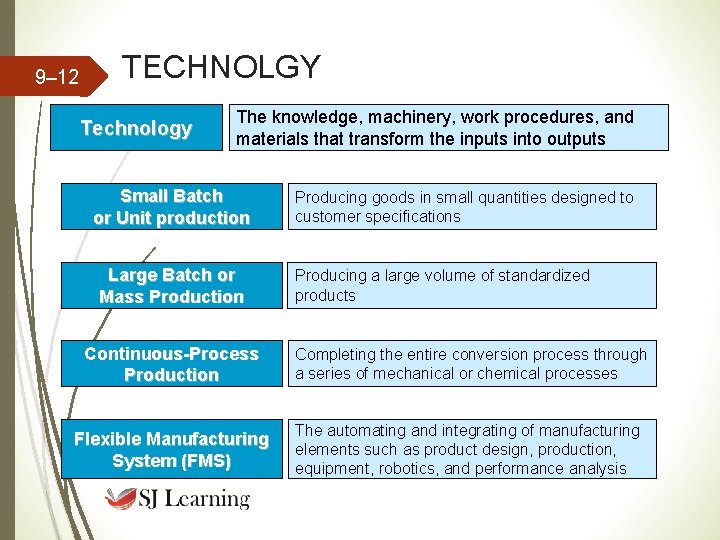
9– 12 TECHNOLGY Technology The knowledge, machinery, work procedures, and materials that transform the inputs into outputs Small Batch or Unit production Large Batch or Mass Production Producing goods in small quantities designed to customer specifications Producing a large volume of standardized products Continuous-Process Production Completing the entire conversion process through a series of mechanical or chemical processes Flexible Manufacturing System (FMS) The automating and integrating of manufacturing elements such as product design, production, equipment, robotics, and performance analysis
9– 13 Figure 9. 5: Structural Options on the Mechanistic. Organic Continuum
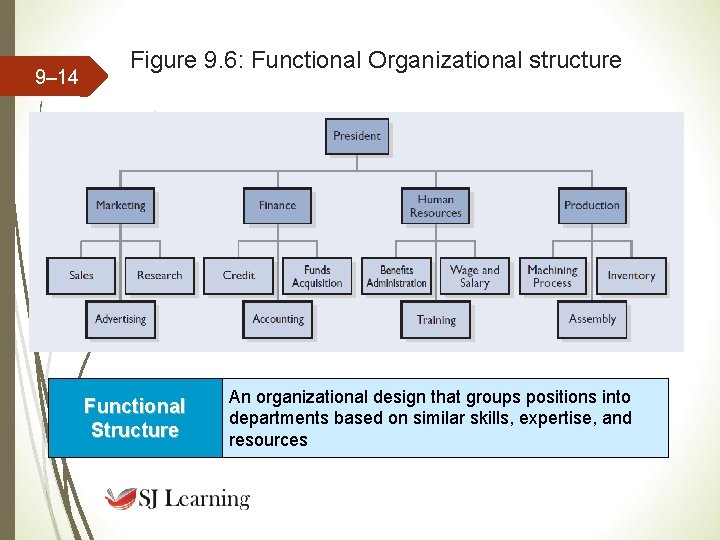
9– 14 Figure 9. 6: Functional Organizational structure Functional Structure An organizational design that groups positions into departments based on similar skills, expertise, and resources
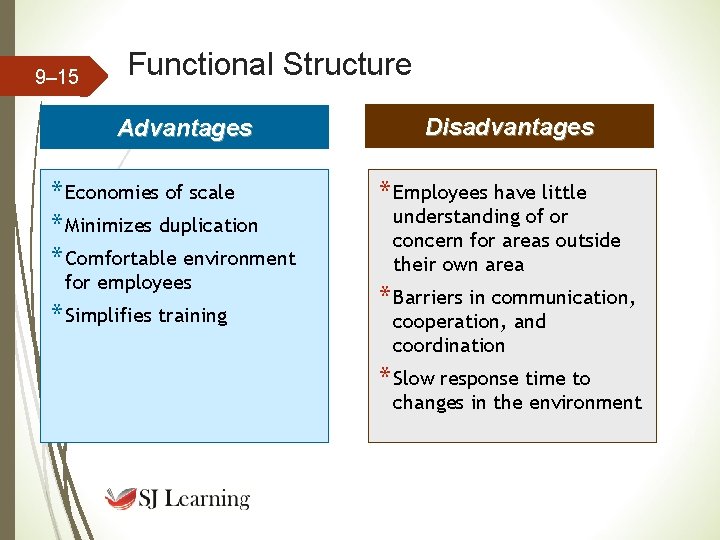
9– 15 Functional Structure Advantages * Economies of scale * Minimizes duplication * Comfortable environment for employees * Simplifies training Disadvantages * Employees have little understanding of or concern for areas outside their own area * Barriers in communication, cooperation, and coordination * Slow response time to changes in the environment
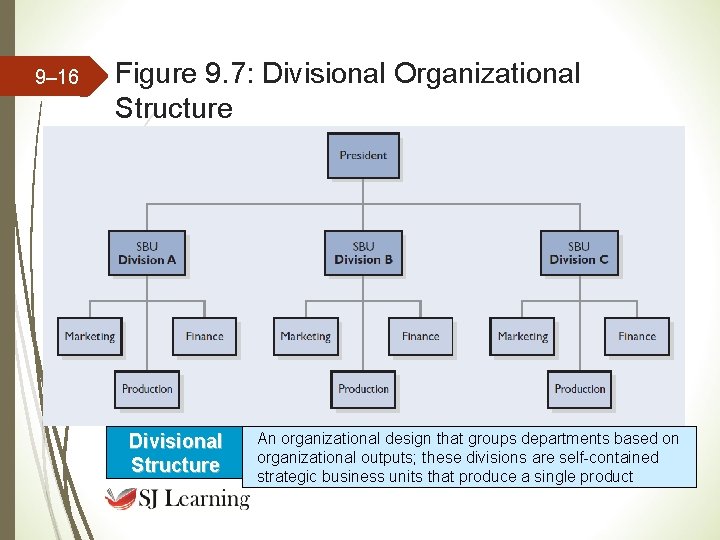
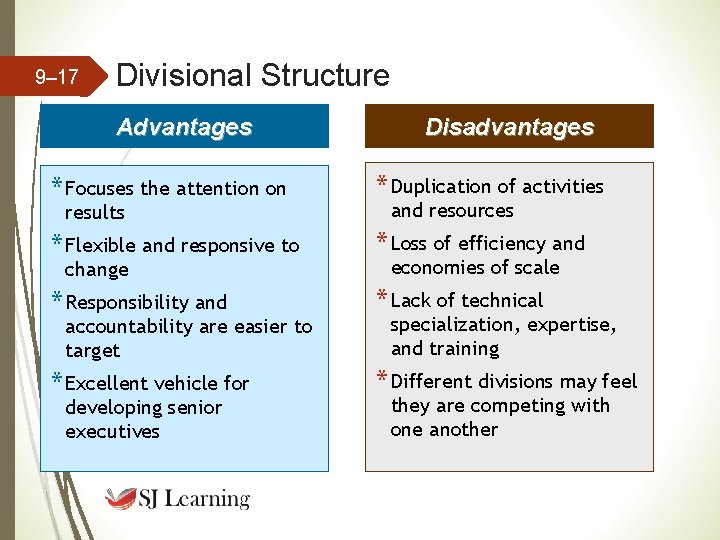
9– 16 Figure 9. 7: Divisional Organizational Structure Divisional Structure An organizational design that groups departments based on organizational outputs; these divisions are self-contained strategic business units that produce a single product
9– 17 Divisional Structure Advantages Disadvantages * Focuses the attention on * Duplication of activities * Flexible and responsive to * Loss of efficiency and * Responsibility and * Lack of technical * Excellent vehicle for * Different divisions may feel results change accountability are easier to target developing senior executives and resources economies of scale specialization, expertise, and training they are competing with one another
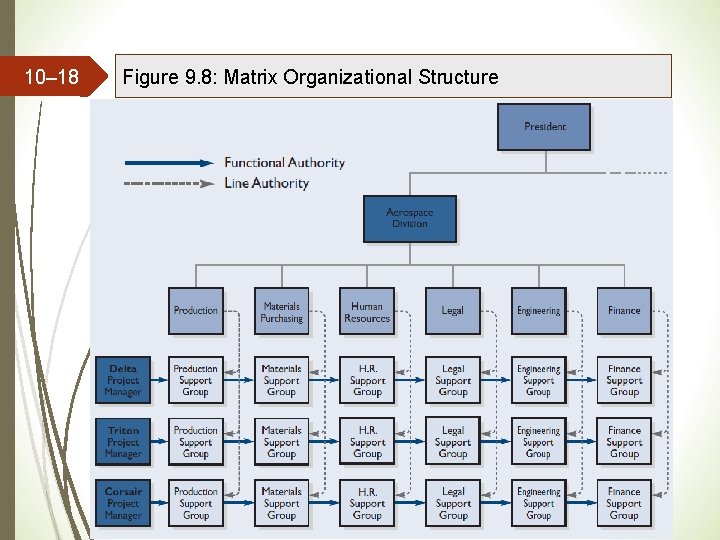
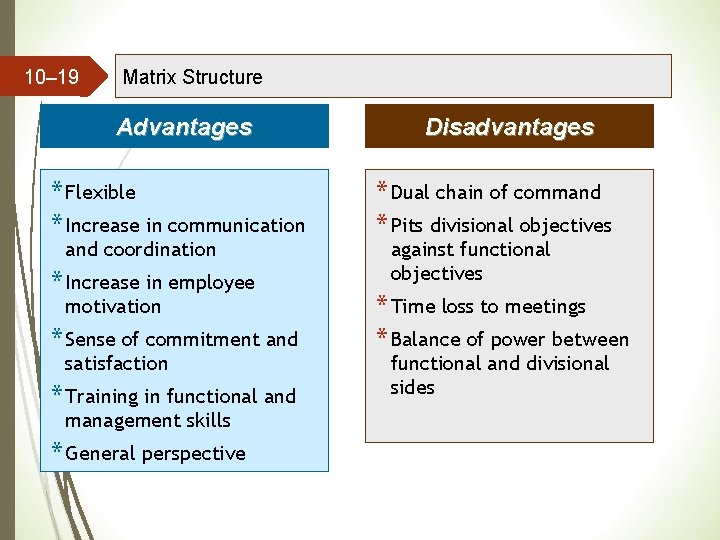
10– 18 Figure 9. 8: Matrix Organizational Structure
10– 19 Matrix Structure Advantages * Flexible * Increase in communication and coordination * Increase in employee motivation * Sense of commitment and satisfaction * Training in functional and management skills * General perspective Disadvantages * Dual chain of command * Pits divisional objectives against functional objectives * Time loss to meetings * Balance of power between functional and divisional sides
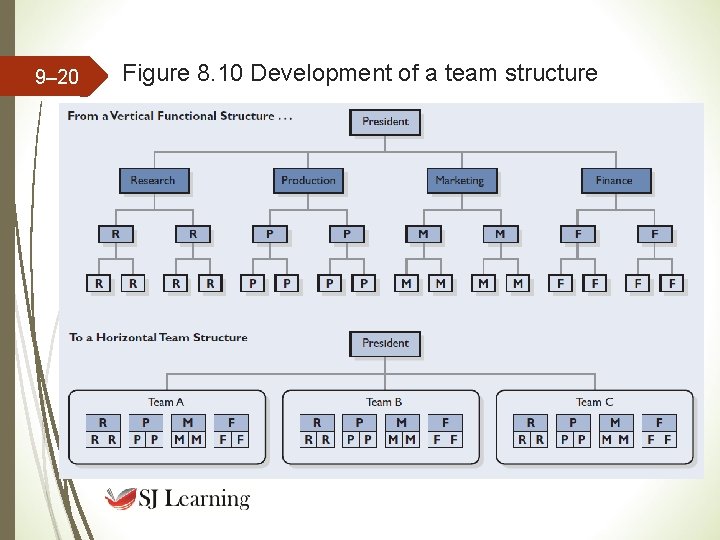
9– 20 Figure 8. 10 Development of a team structure
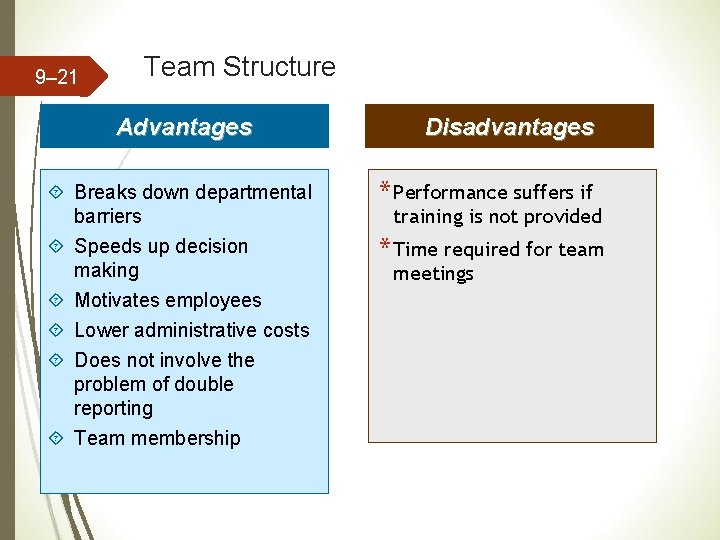
9– 21 Team Structure Advantages Breaks down departmental barriers Speeds up decision making Motivates employees Lower administrative costs Does not involve the problem of double reporting Team membership Disadvantages * Performance suffers if training is not provided * Time required for team meetings
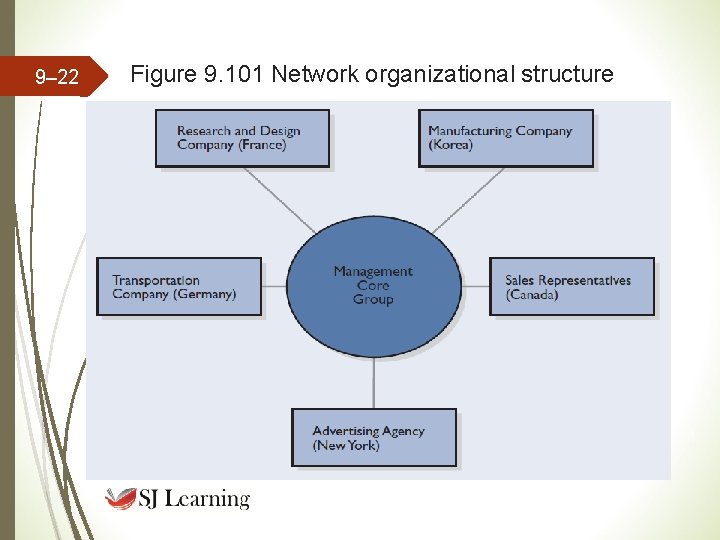
9– 22 Figure 9. 101 Network organizational structure
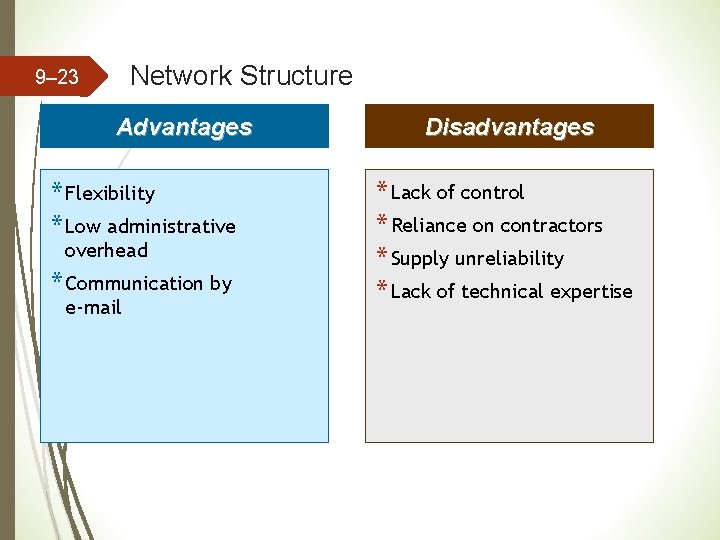
Network Structure 9– 23 Advantages * Flexibility * Low administrative overhead * Communication by e-mail Disadvantages * Lack of control * Reliance on contractors * Supply unreliability * Lack of technical expertise
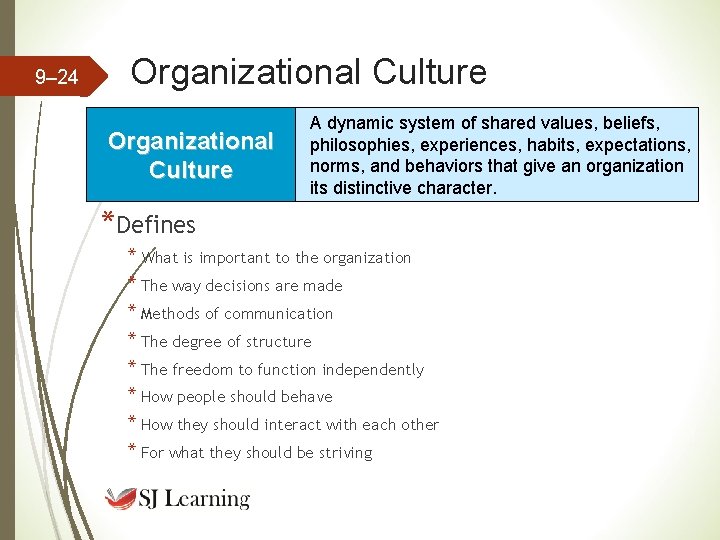
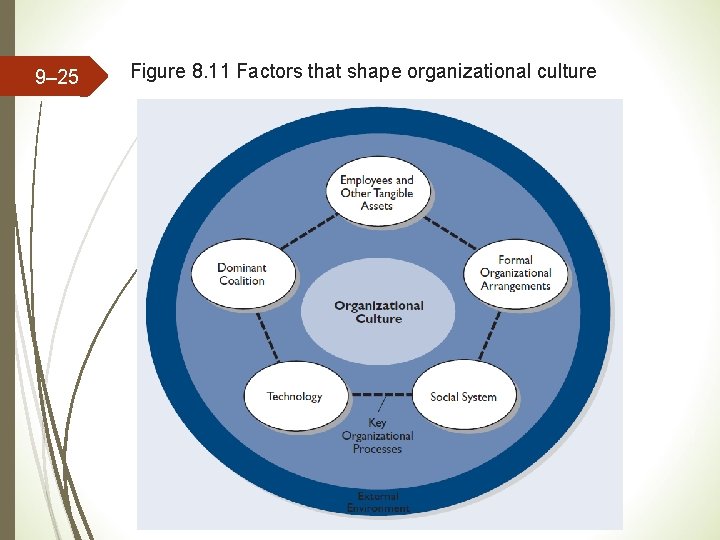
9– 24 Organizational Culture A dynamic system of shared values, beliefs, philosophies, experiences, habits, expectations, norms, and behaviors that give an organization its distinctive character. *Defines * What is important to the organization * The way decisions are made * Methods of communication * The degree of structure * The freedom to function independently * How people should behave * How they should interact with each other * For what they should be striving
9– 25 Figure 8. 11 Factors that shape organizational culture
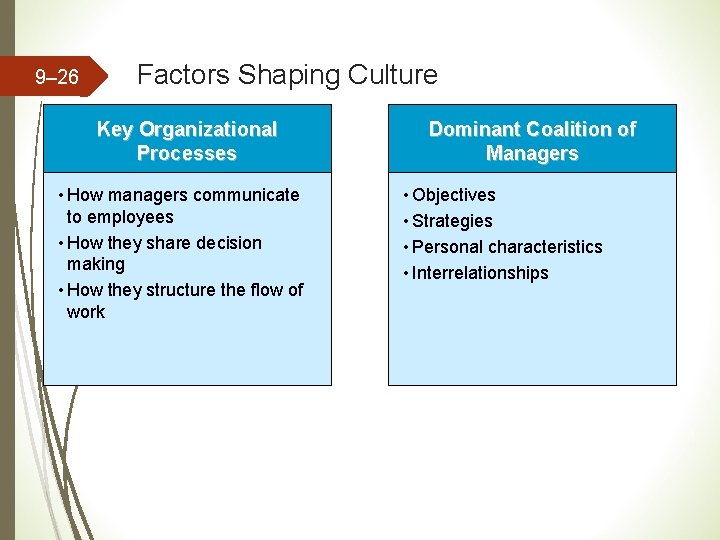
9– 26 Factors Shaping Culture Key Organizational Processes • How managers communicate to employees • How they share decision making • How they structure the flow of work Dominant Coalition of Managers • Objectives • Strategies • Personal characteristics • Interrelationships
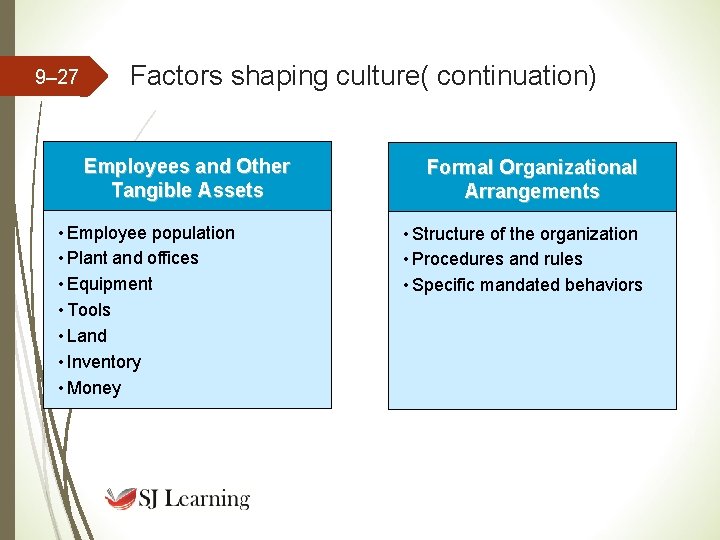
9– 27 Factors shaping culture( continuation) Employees and Other Tangible Assets • Employee population • Plant and offices • Equipment • Tools • Land • Inventory • Money Formal Organizational Arrangements • Structure of the organization • Procedures and rules • Specific mandated behaviors
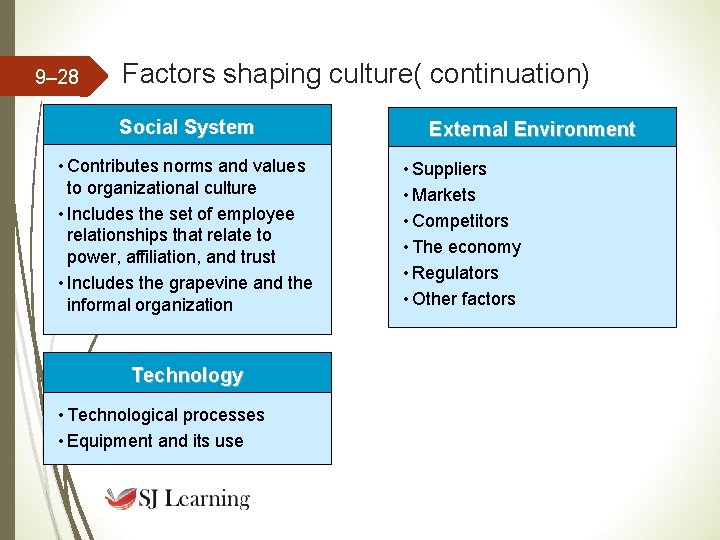
9– 28 Factors shaping culture( continuation) Social System • Contributes norms and values to organizational culture • Includes the set of employee relationships that relate to power, affiliation, and trust • Includes the grapevine and the informal organization Technology • Technological processes • Equipment and its use External Environment • Suppliers • Markets • Competitors • The economy • Regulators • Other factors
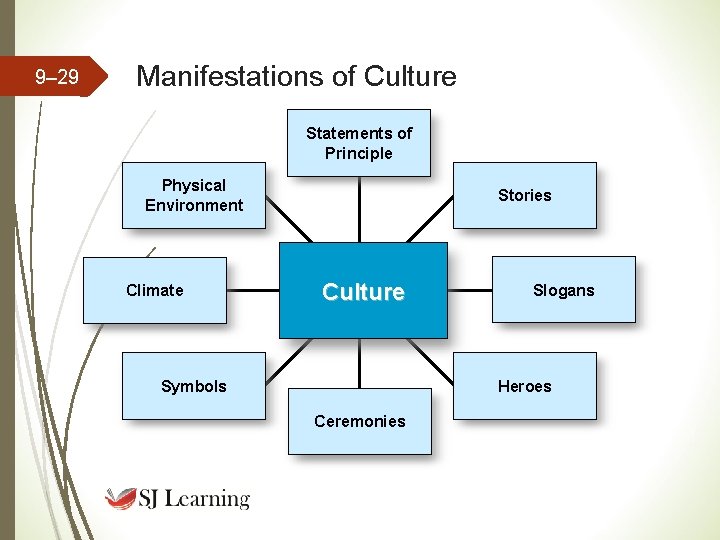
9– 29 Manifestations of Culture Statements of Principle Physical Environment Climate Stories Culture Symbols Slogans Heroes Ceremonies
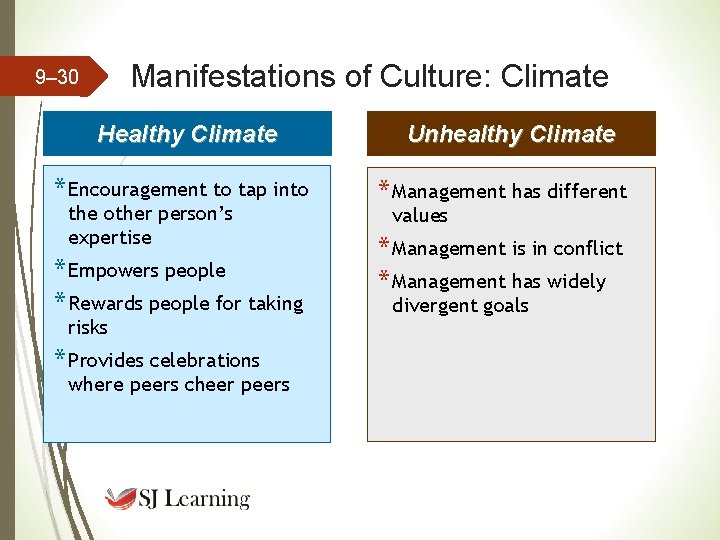
Manifestations of Culture: Climate 9– 30 Healthy Climate * Encouragement to tap into the other person’s expertise * Empowers people * Rewards people for taking risks * Provides celebrations where peers cheer peers Unhealthy Climate * Management has different values * Management is in conflict * Management has widely divergent goals
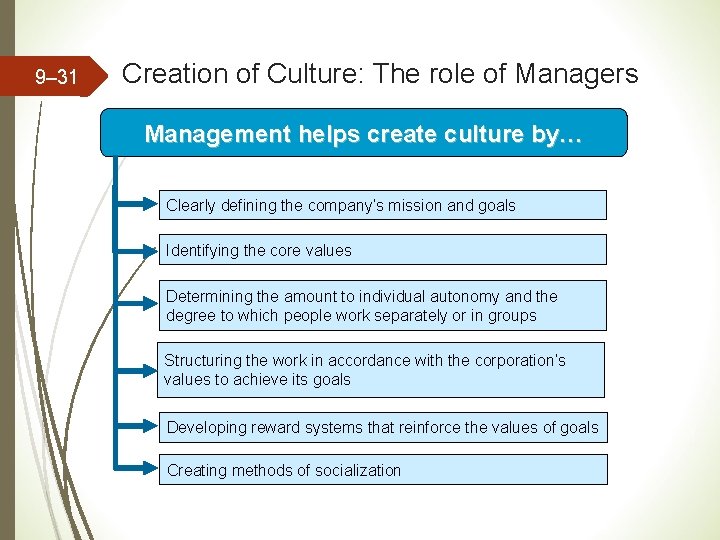
9– 31 Creation of Culture: The role of Managers Management helps create culture by… Clearly defining the company’s mission and goals Identifying the core values Determining the amount to individual autonomy and the degree to which people work separately or in groups Structuring the work in accordance with the corporation’s values to achieve its goals Developing reward systems that reinforce the values of goals Creating methods of socialization
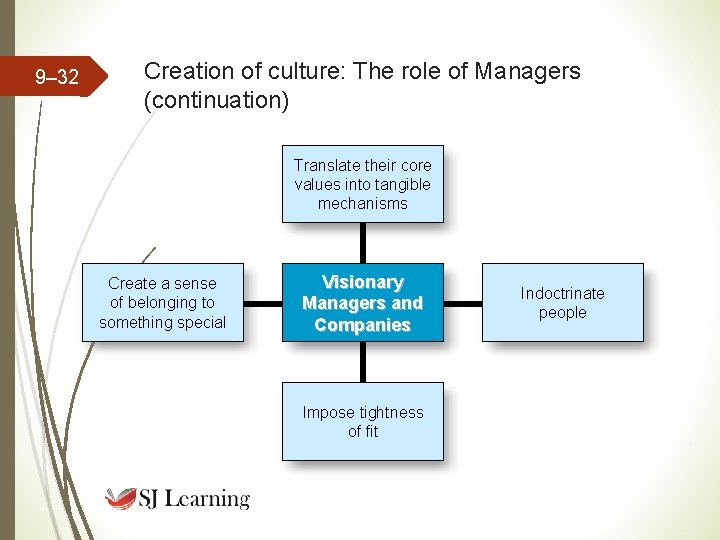
9– 32 Creation of culture: The role of Managers (continuation) Translate their core values into tangible mechanisms Create a sense of belonging to something special Visionary Managers and Companies Impose tightness of fit Indoctrinate people
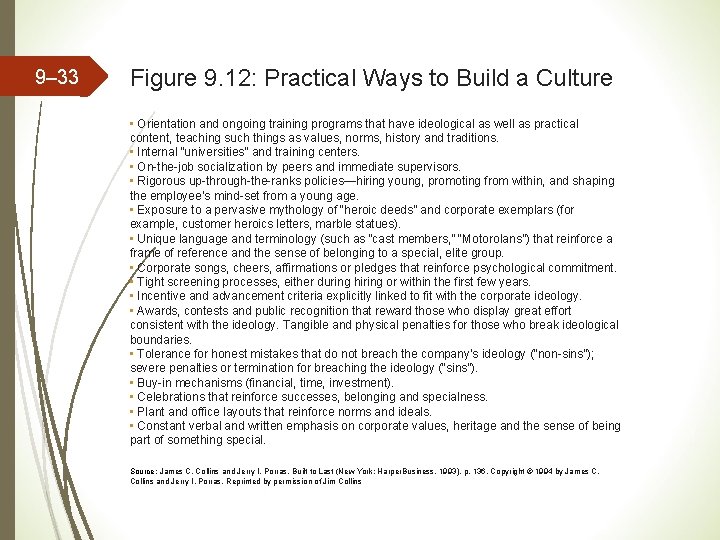
9– 33 Figure 9. 12: Practical Ways to Build a Culture Figure 9. 12 Practical Ways to Build a Culture • Orientation and ongoing training programs that have ideological as well as practical content, teaching such things as values, norms, history and traditions. • Internal “universities” and training centers. • On-the-job socialization by peers and immediate supervisors. • Rigorous up-through-the-ranks policies—hiring young, promoting from within, and shaping the employee’s mind-set from a young age. • Exposure to a pervasive mythology of “heroic deeds” and corporate exemplars (for example, customer heroics letters, marble statues). • Unique language and terminology (such as “cast members, ” “Motorolans”) that reinforce a frame of reference and the sense of belonging to a special, elite group. • Corporate songs, cheers, affirmations or pledges that reinforce psychological commitment. • Tight screening processes, either during hiring or within the first few years. • Incentive and advancement criteria explicitly linked to fit with the corporate ideology. • Awards, contests and public recognition that reward those who display great effort consistent with the ideology. Tangible and physical penalties for those who break ideological boundaries. • Tolerance for honest mistakes that do not breach the company’s ideology (“non-sins”); severe penalties or termination for breaching the ideology (“sins”). • Buy-in mechanisms (financial, time, investment). • Celebrations that reinforce successes, belonging and specialness. • Plant and office layouts that reinforce norms and ideals. • Constant verbal and written emphasis on corporate values, heritage and the sense of being part of something special. Source: James C. Collins and Jerry I. Porras, Built to Last (New York: Harper. Business, 1993), p. 136. Copyright © 1994 by James C. Collins and Jerry I. Porras. Reprinted by permission of Jim Collins
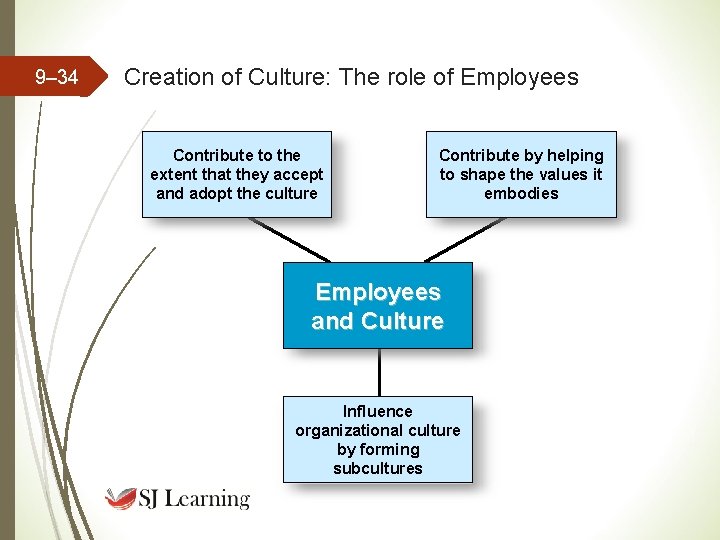
9– 34 Creation of Culture: The role of Employees Contribute to the extent that they accept and adopt the culture Contribute by helping to shape the values it embodies Employees and Culture Influence organizational culture by forming subcultures
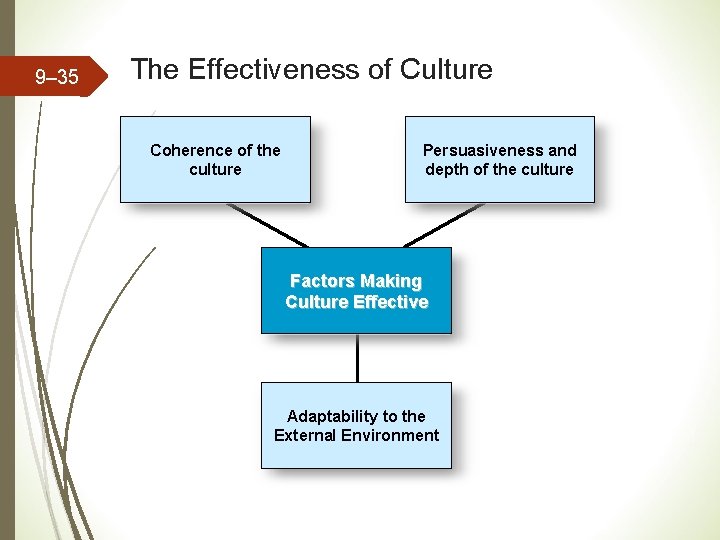
9– 35 The Effectiveness of Culture Coherence of the culture Persuasiveness and depth of the culture Factors Making Culture Effective Adaptability to the External Environment
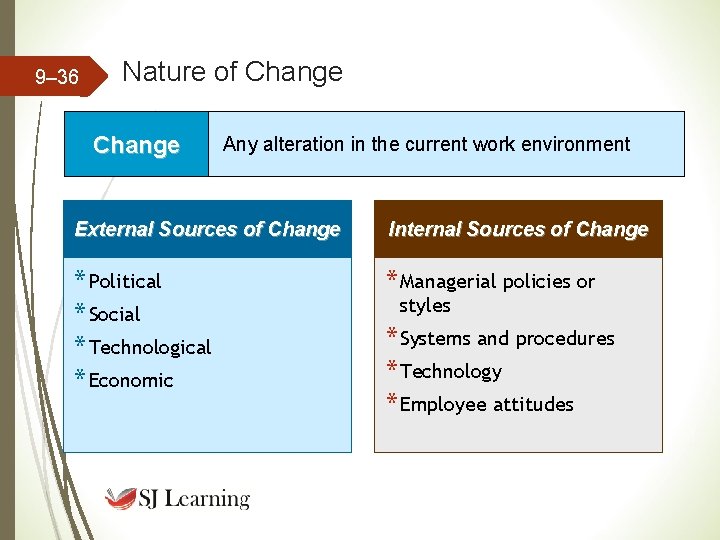
9– 36 Nature of Change Any alteration in the current work environment External Sources of Change Internal Sources of Change * Political * Social * Technological * Economic * Managerial policies or styles * Systems and procedures * Technology * Employee attitudes
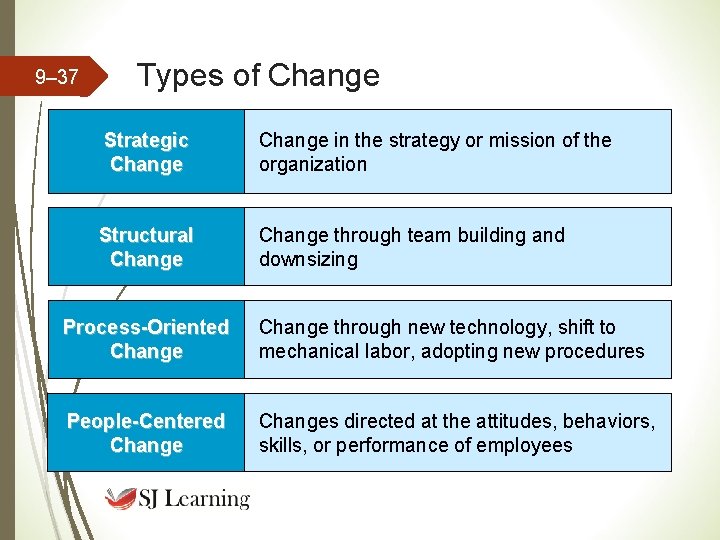
9– 37 Types of Change Strategic Change in the strategy or mission of the organization Structural Change through team building and downsizing Process-Oriented Change through new technology, shift to mechanical labor, adopting new procedures People-Centered Changes directed at the attitudes, behaviors, skills, or performance of employees
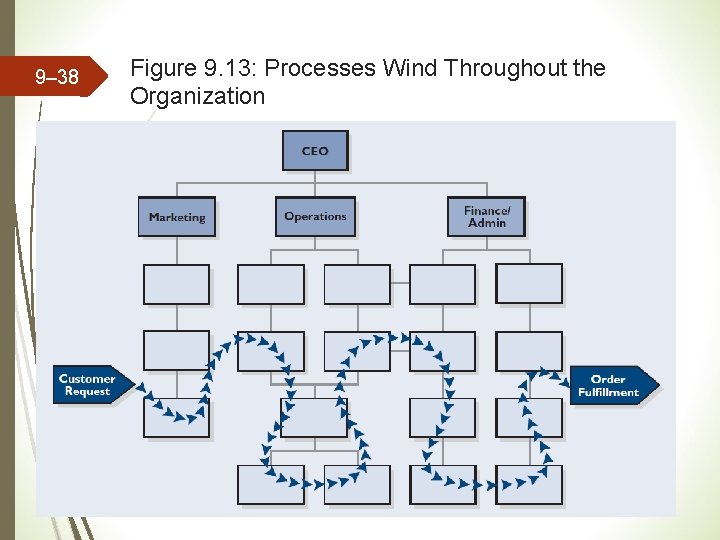
9– 38 Figure 9. 13: Processes Wind Throughout the Organization
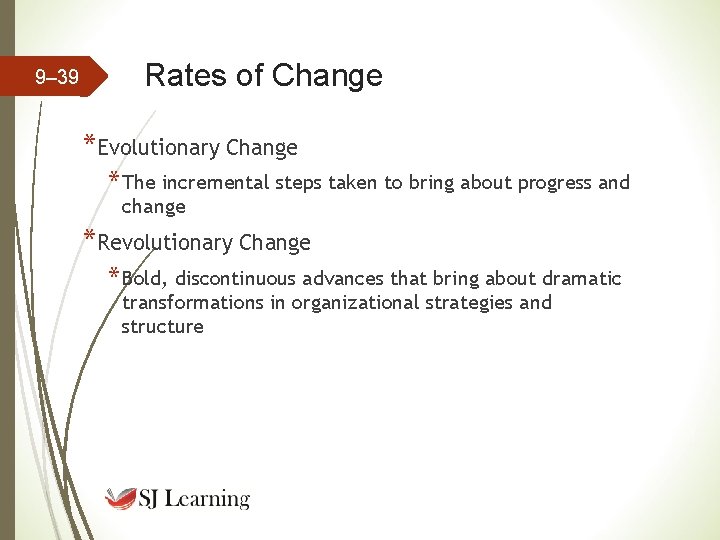
9– 39 Rates of Change *Evolutionary Change * The incremental steps taken to bring about progress and change *Revolutionary Change * Bold, discontinuous advances that bring about dramatic transformations in organizational strategies and structure
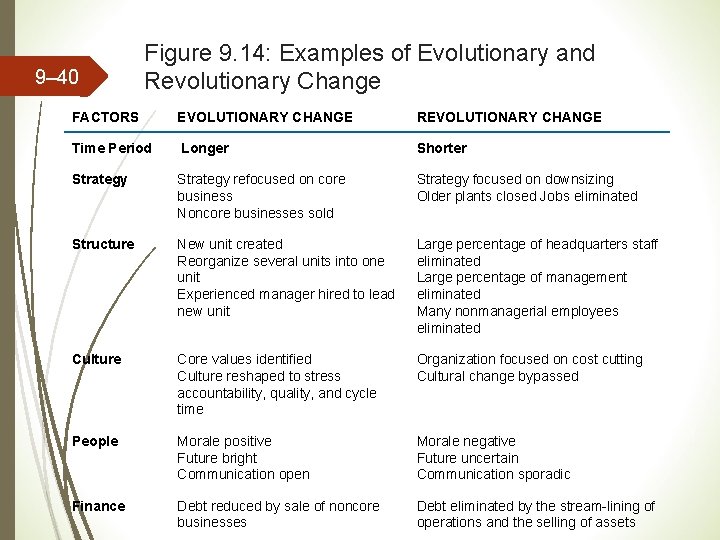
9– 40 Figure 9. 14: Examples of Evolutionary and Revolutionary Change FACTORS EVOLUTIONARY CHANGE REVOLUTIONARY CHANGE Time Period Longer Shorter Strategy refocused on core business Noncore businesses sold Strategy focused on downsizing Older plants closed Jobs eliminated Structure New unit created Reorganize several units into one unit Experienced manager hired to lead new unit Large percentage of headquarters staff eliminated Large percentage of management eliminated Many nonmanagerial employees eliminated Culture Core values identified Culture reshaped to stress accountability, quality, and cycle time Organization focused on cost cutting Cultural change bypassed People Morale positive Future bright Communication open Morale negative Future uncertain Communication sporadic Finance Debt reduced by sale of noncore businesses Debt eliminated by the stream-lining of operations and the selling of assets
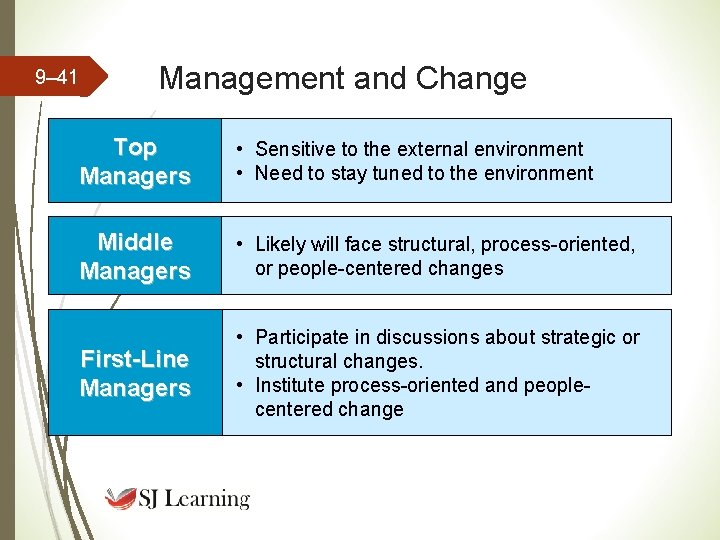
9– 41 Management and Change Top Managers • Sensitive to the external environment • Need to stay tuned to the environment Middle Managers • Likely will face structural, process-oriented, or people-centered changes First-Line Managers • Participate in discussions about strategic or structural changes. • Institute process-oriented and peoplecentered change
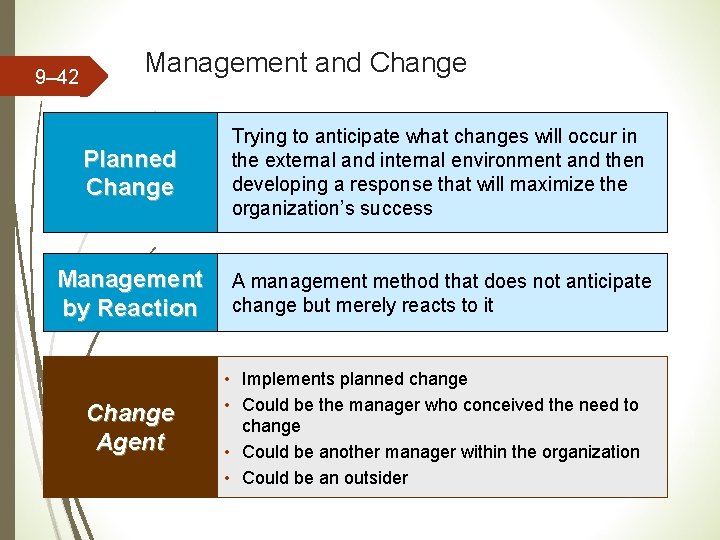
9– 42 Management and Change Planned Change Trying to anticipate what changes will occur in the external and internal environment and then developing a response that will maximize the organization’s success Management by Reaction A management method that does not anticipate change but merely reacts to it Change Agent • Implements planned change • Could be the manager who conceived the need to change • Could be another manager within the organization • Could be an outsider
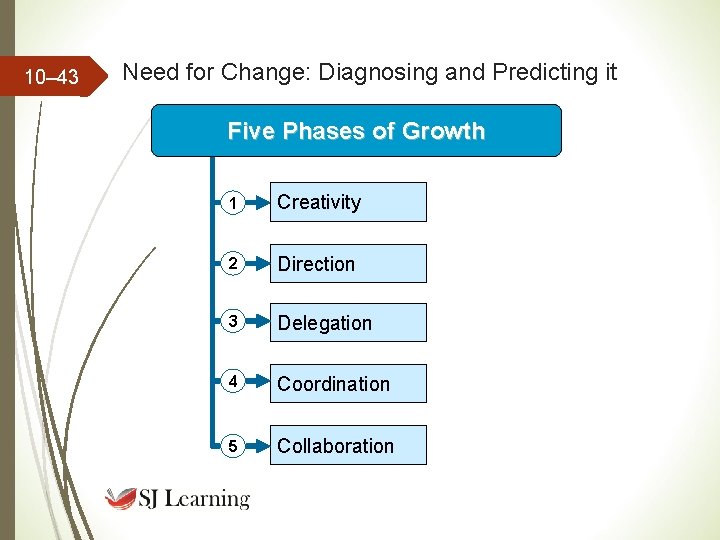
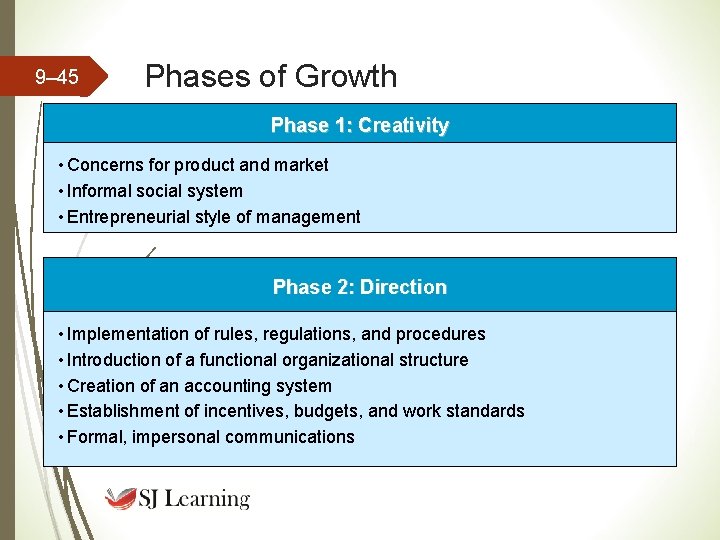
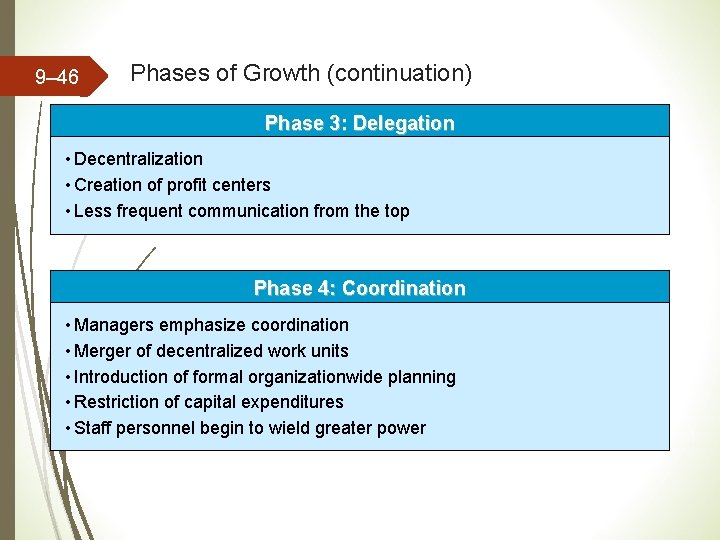
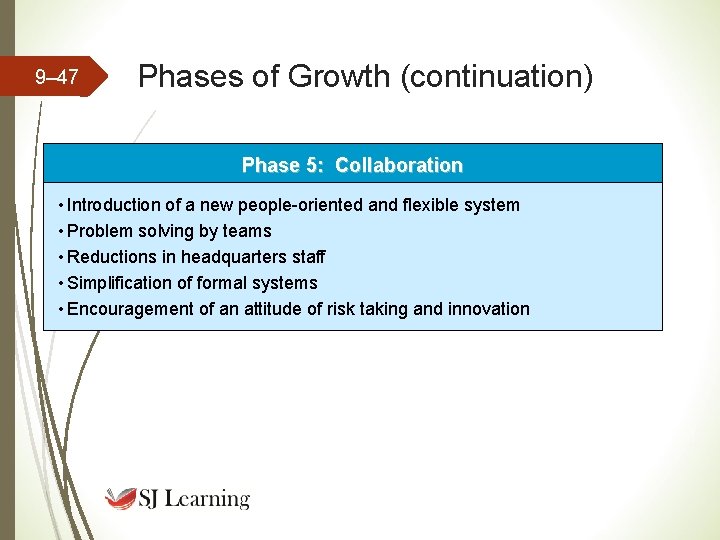
10– 43 Need for Change: Diagnosing and Predicting it Five Phases of Growth 1 Creativity 2 Direction 3 Delegation 4 Coordination 5 Collaboration
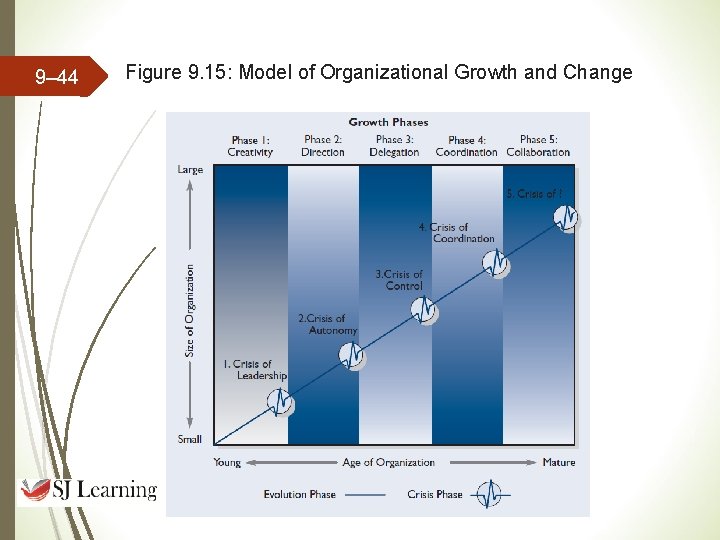
9– 44 Figure 9. 15: Model of Organizational Growth and Change
9– 45 Phases of Growth Phase 1: Creativity • Concerns for product and market • Informal social system • Entrepreneurial style of management Phase 2: Direction • Implementation of rules, regulations, and procedures • Introduction of a functional organizational structure • Creation of an accounting system • Establishment of incentives, budgets, and work standards • Formal, impersonal communications
9– 46 Phases of Growth (continuation) Phase 3: Delegation • Decentralization • Creation of profit centers • Less frequent communication from the top Phase 4: Coordination • Managers emphasize coordination • Merger of decentralized work units • Introduction of formal organizationwide planning • Restriction of capital expenditures • Staff personnel begin to wield greater power
9– 47 Phases of Growth (continuation) Phase 5: Collaboration • Introduction of a new people-oriented and flexible system • Problem solving by teams • Reductions in headquarters staff • Simplification of formal systems • Encouragement of an attitude of risk taking and innovation
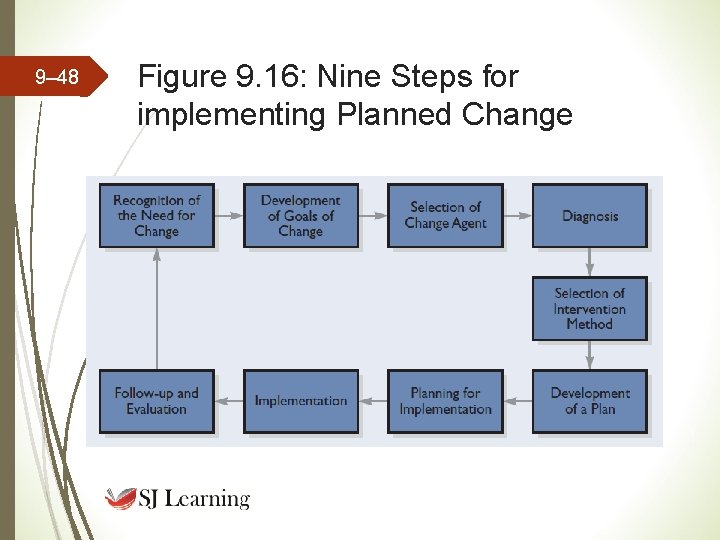
9– 48 Figure 9. 16: Nine Steps for implementing Planned Change
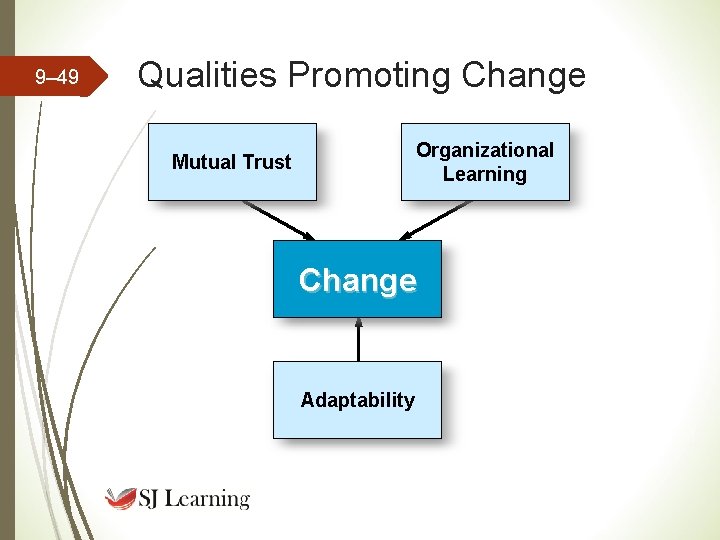
9– 49 Qualities Promoting Change Organizational Learning Mutual Trust Change Adaptability
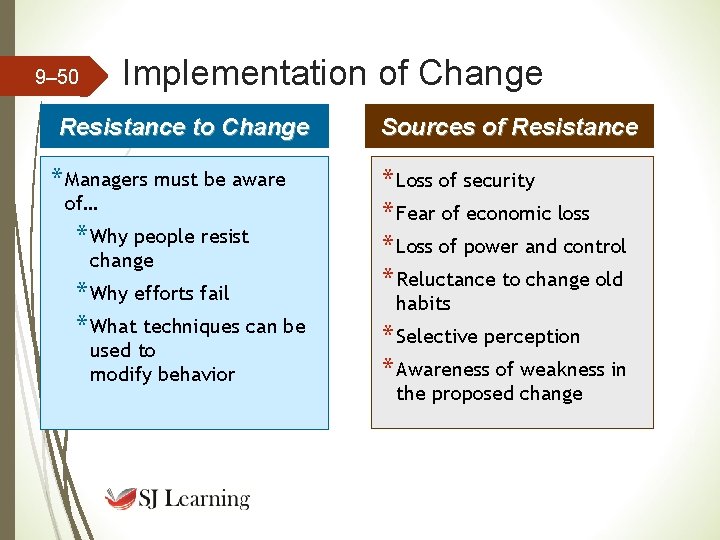
Implementation of Change 9– 50 Resistance to Change * Managers must be aware of… * Why people resist change * Why efforts fail * What techniques can be used to modify behavior Sources of Resistance * Loss of security * Fear of economic loss * Loss of power and control * Reluctance to change old habits * Selective perception * Awareness of weakness in the proposed change
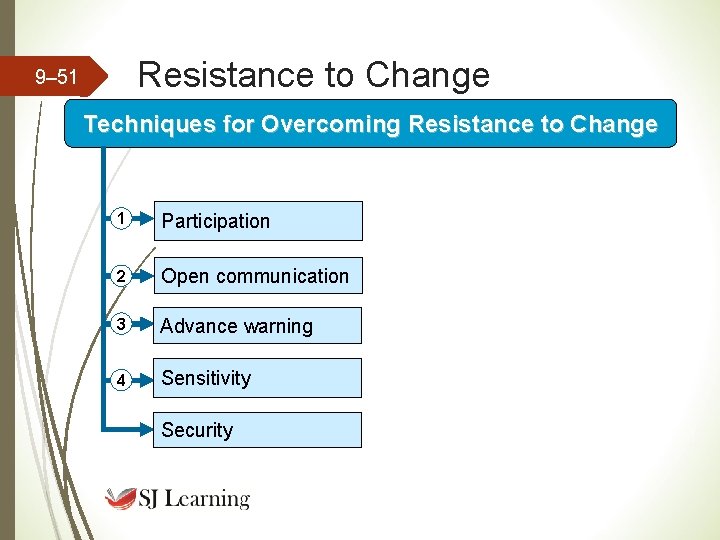
Resistance to Change 9– 51 Techniques for Overcoming Resistance to Change 1 Participation 2 Open communication 3 Advance warning 4 Sensitivity Security
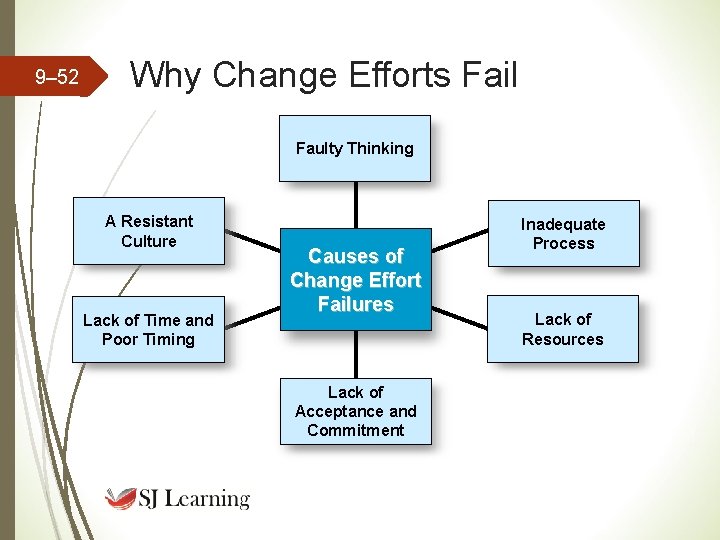
9– 52 Why Change Efforts Fail Faulty Thinking A Resistant Culture Lack of Time and Poor Timing Causes of Change Effort Failures Lack of Acceptance and Commitment Inadequate Process Lack of Resources
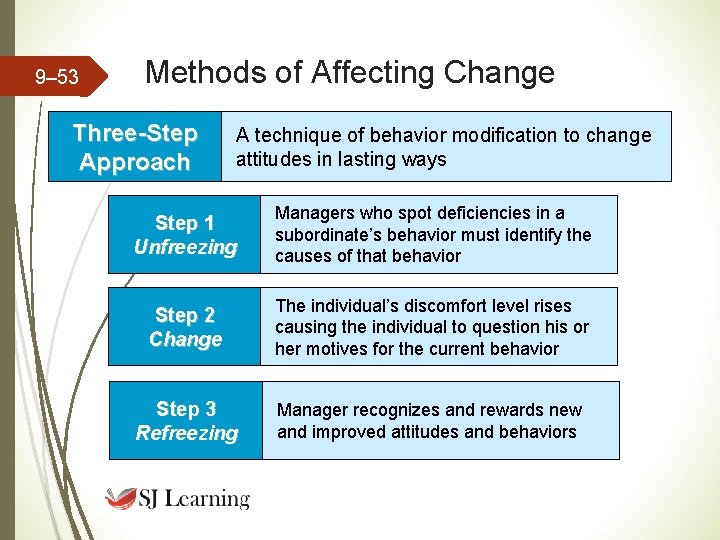
9– 53 Methods of Affecting Change Three-Step Approach A technique of behavior modification to change attitudes in lasting ways Step 1 Unfreezing Managers who spot deficiencies in a subordinate’s behavior must identify the causes of that behavior Step 2 Change The individual’s discomfort level rises causing the individual to question his or her motives for the current behavior Step 3 Refreezing Manager recognizes and rewards new and improved attitudes and behaviors
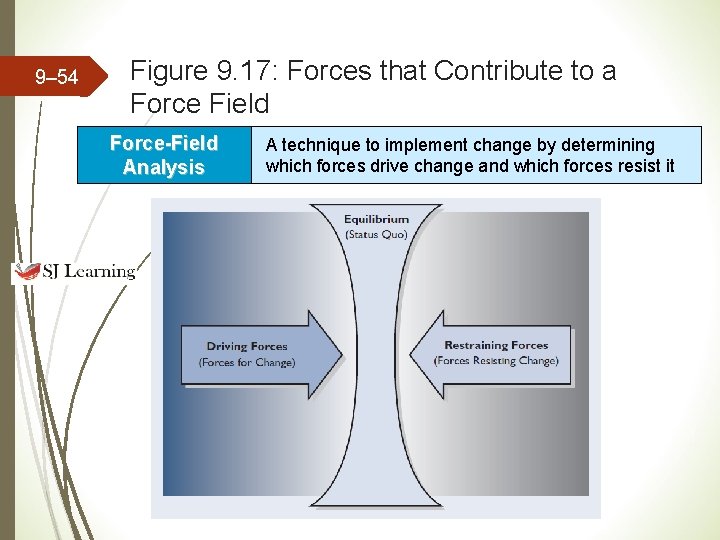
9– 54 Figure 9. 17: Forces that Contribute to a Force Field Force-Field Analysis A technique to implement change by determining which forces drive change and which forces resist it
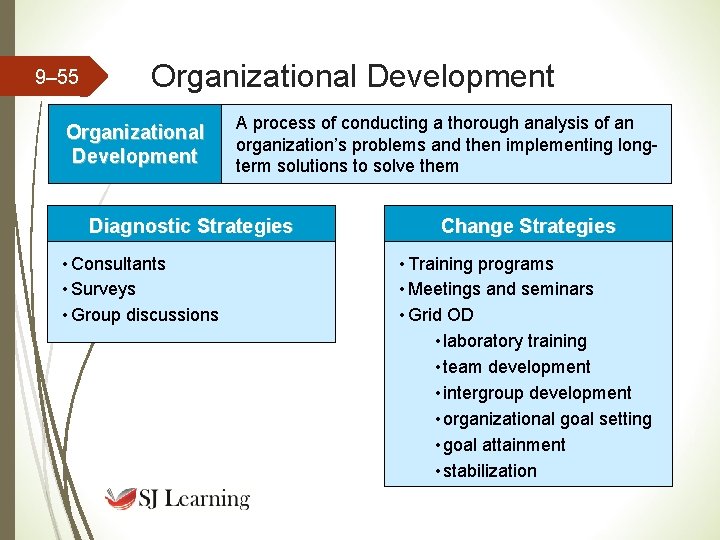
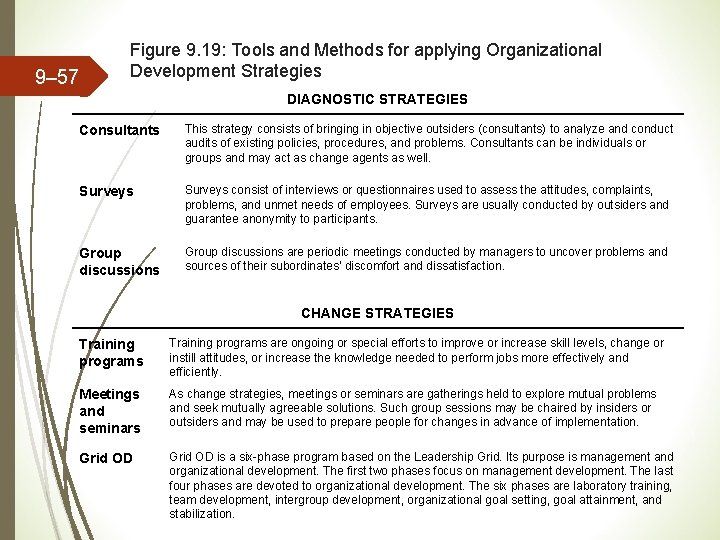
9– 55 Organizational Development A process of conducting a thorough analysis of an organization’s problems and then implementing longterm solutions to solve them Diagnostic Strategies • Consultants • Surveys • Group discussions Change Strategies • Training programs • Meetings and seminars • Grid OD • laboratory training • team development • intergroup development • organizational goal setting • goal attainment • stabilization
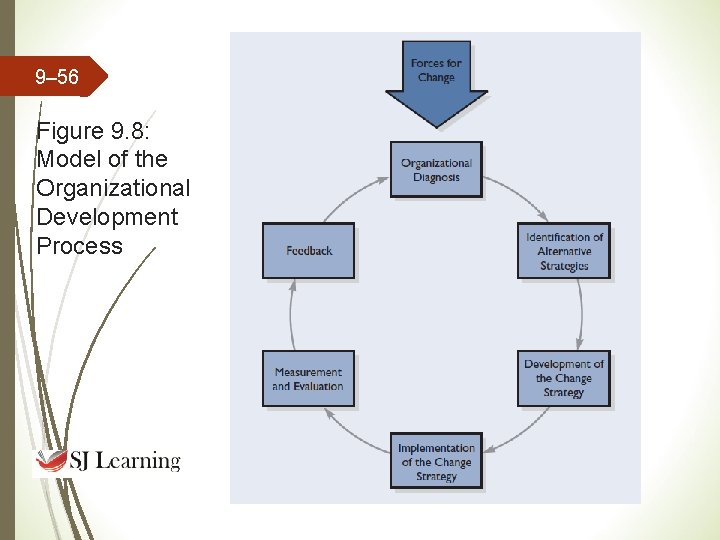
9– 56 Figure 9. 8: Model of the Organizational Development Process
9– 57 Figure 9. 19: Tools and Methods for applying Organizational Development Strategies DIAGNOSTIC STRATEGIES Consultants This strategy consists of bringing in objective outsiders (consultants) to analyze and conduct audits of existing policies, procedures, and problems. Consultants can be individuals or groups and may act as change agents as well. Surveys consist of interviews or questionnaires used to assess the attitudes, complaints, problems, and unmet needs of employees. Surveys are usually conducted by outsiders and guarantee anonymity to participants. Group discussions are periodic meetings conducted by managers to uncover problems and sources of their subordinates’ discomfort and dissatisfaction. CHANGE STRATEGIES Training programs are ongoing or special efforts to improve or increase skill levels, change or instill attitudes, or increase the knowledge needed to perform jobs more effectively and efficiently. Meetings and seminars As change strategies, meetings or seminars are gatherings held to explore mutual problems and seek mutually agreeable solutions. Such group sessions may be chaired by insiders or outsiders and may be used to prepare people for changes in advance of implementation. Grid OD is a six-phase program based on the Leadership Grid. Its purpose is management and organizational development. The first two phases focus on management development. The last four phases are devoted to organizational development. The six phases are laboratory training, team development, intergroup development, organizational goal setting, goal attainment, and stabilization.
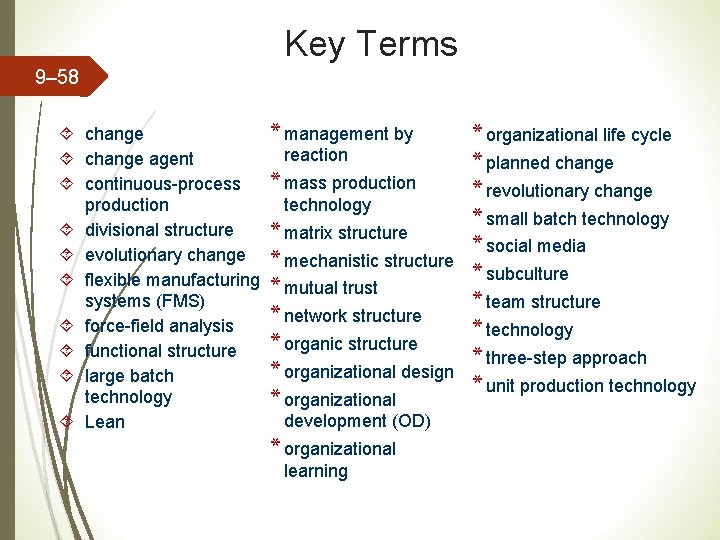
Key Terms 9– 58 change agent continuous-process production divisional structure evolutionary change flexible manufacturing systems (FMS) force-field analysis functional structure large batch technology Lean * management by reaction * mass production technology * matrix structure * mechanistic structure * mutual trust * network structure * organic structure * organizational design * organizational development (OD) * organizational learning * organizational life cycle * planned change * revolutionary change * small batch technology * social media * subculture * team structure * technology * three-step approach * unit production technology