
MANAGEMENT 11 E PLUNKETT ALLEN 4 1 CHAPTER


- Slides: 37
MANAGEMENT 11 E PLUNKETT & ALLEN 4– 1 CHAPTER 4 : PLANNING AND STRATEGY
Learning Outcomes 4– 2 After reading and studying this chapter, you should be able to: 1. Explain the importance of planning 2. Differentiate between strategic, tactical, operational, and contingency plans 3. List and explain the steps in a basic planning process 4. Discuss various ways to make plans effective 5. Distinguish between strategic planning, strategic management, strategy formulation, and strategy implementation
4– 3 Learning Outcomes (cont’d) After reading and studying this chapter, you should be able to: 6. Explain the steps involved in the strategic planning process 7. Explain the formulation of corporate-level strategy, business-level strategy, and functional-level strategy
4– 4 Planning Defined Planning Preparing for tomorrow, today Key Planning Responsibilities of Managers Construct, review, and/or rewrite their organization’s mission. Identify and analyze their available opportunities. Establish the goals they wish to achieve. Identify, analyze, and select the course or courses of action required to reach their goals. Determine resources they will need to achieve their goals.
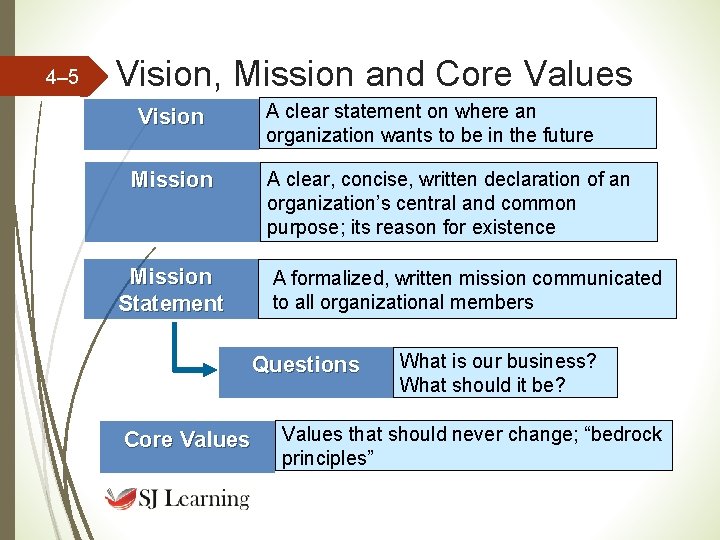
4– 5 Vision, Mission and Core Values Vision Mission Statement A clear statement on where an organization wants to be in the future A clear, concise, written declaration of an organization’s central and common purpose; its reason for existence A formalized, written mission communicated to all organizational members Questions Core Values What is our business? What should it be? Values that should never change; “bedrock principles”
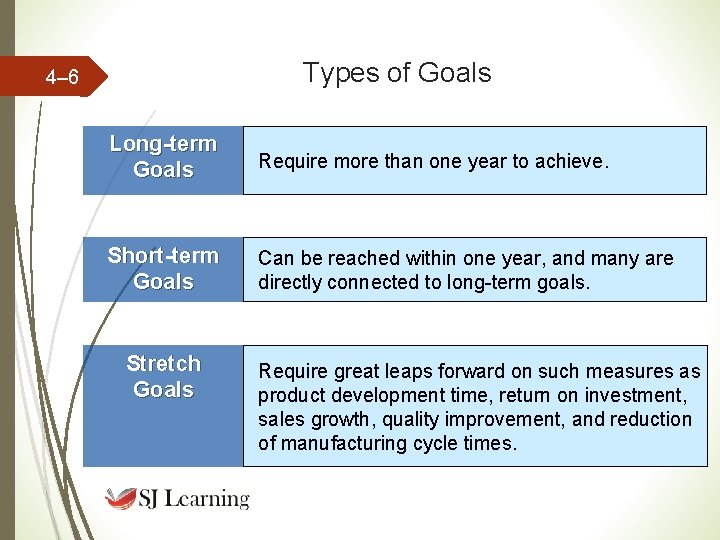
Types of Goals 4– 6 Long-term Goals Require more than one year to achieve. Short-term Goals Can be reached within one year, and many are directly connected to long-term goals. Stretch Goals Require great leaps forward on such measures as product development time, return on investment, sales growth, quality improvement, and reduction of manufacturing cycle times.
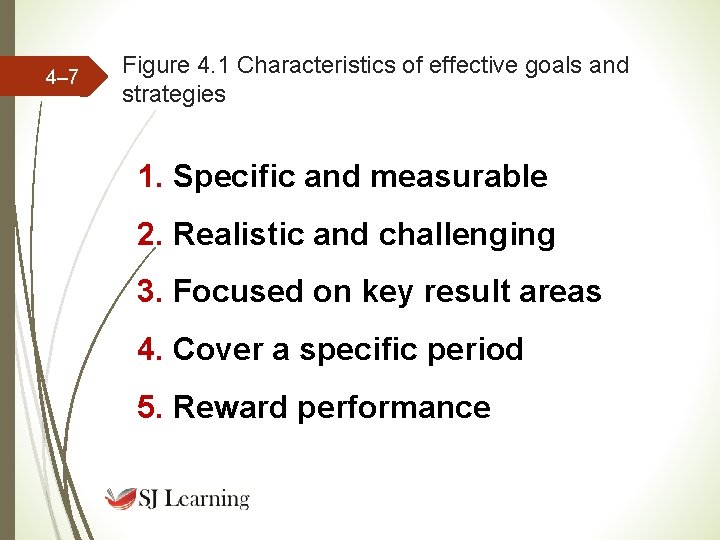
4– 7 Figure 4. 1 Characteristics of effective goals and strategies 1. Specific and measurable 2. Realistic and challenging 3. Focused on key result areas 4. Cover a specific period 5. Reward performance
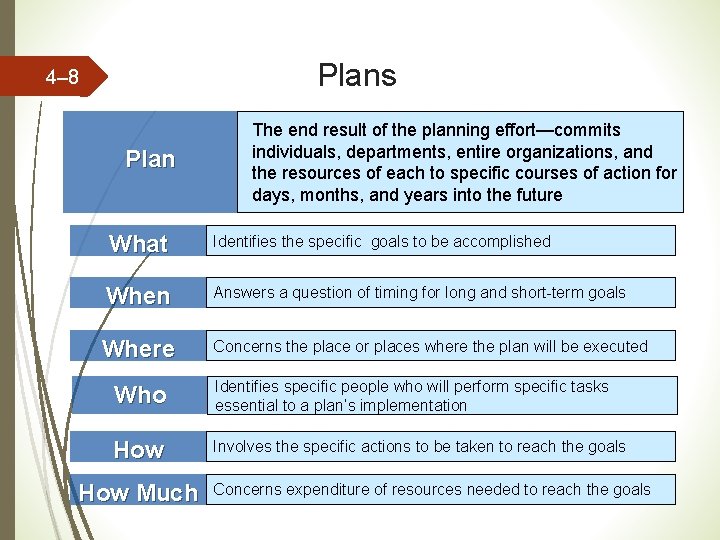
Plans 4– 8 Plan The end result of the planning effort—commits individuals, departments, entire organizations, and the resources of each to specific courses of action for days, months, and years into the future What Identifies the specific goals to be accomplished When Answers a question of timing for long and short-term goals Where Concerns the place or places where the plan will be executed Who Identifies specific people who will perform specific tasks essential to a plan’s implementation How Involves the specific actions to be taken to reach the goals How Much Concerns expenditure of resources needed to reach the goals
4– 9 Strategies and Tactics Strategy Tactic A course of action designed to achieve a long-term goal A course of action created to achieve a short-term goal—an objective
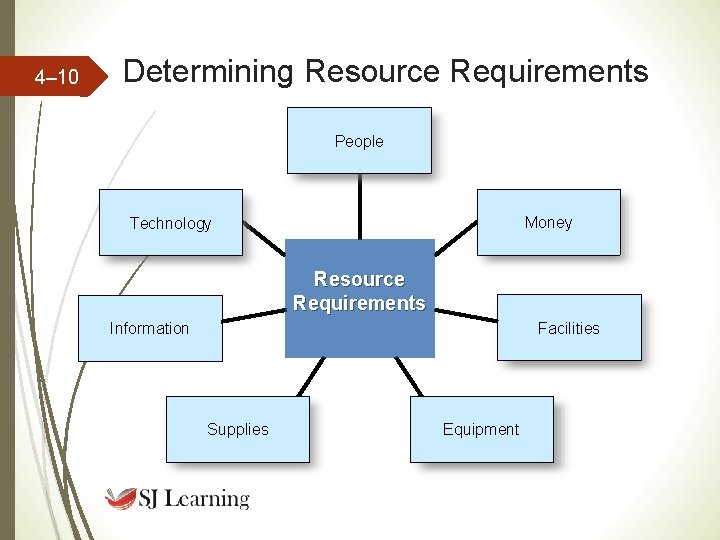
4– 10 Determining Resource Requirements People Money Technology Resource Requirements Facilities Information Supplies Equipment
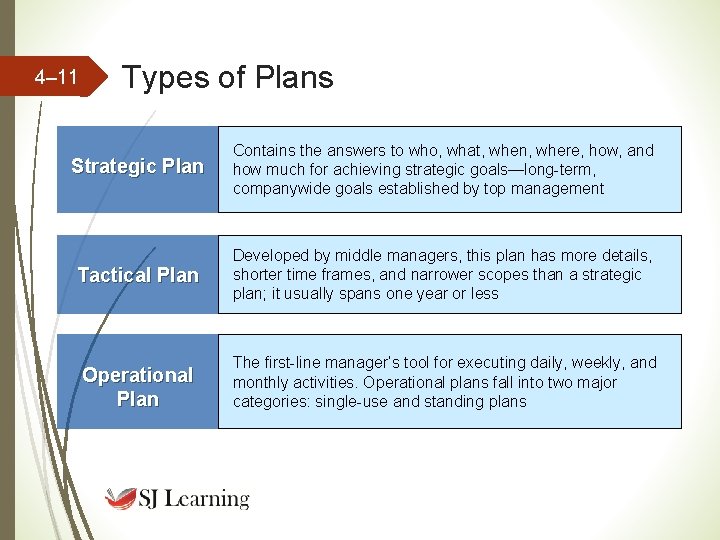
4– 11 Types of Plans Strategic Plan Contains the answers to who, what, when, where, how, and how much for achieving strategic goals—long-term, companywide goals established by top management Tactical Plan Developed by middle managers, this plan has more details, shorter time frames, and narrower scopes than a strategic plan; it usually spans one year or less Operational Plan The first-line manager’s tool for executing daily, weekly, and monthly activities. Operational plans fall into two major categories: single-use and standing plans
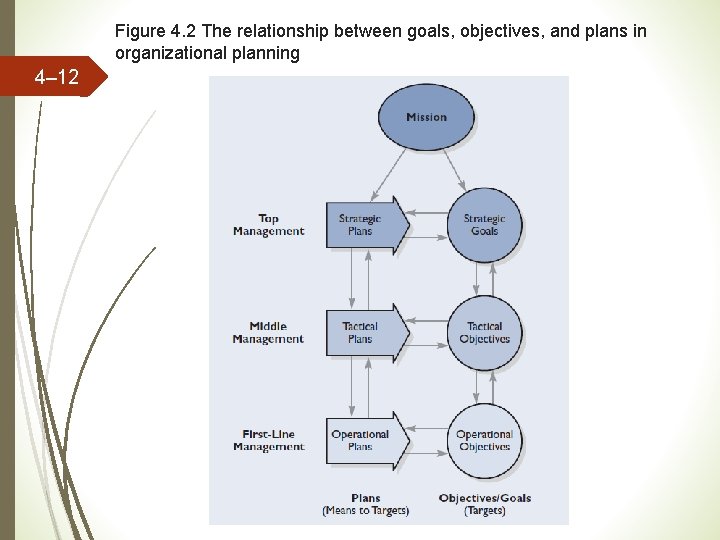
Figure 4. 2 The relationship between goals, objectives, and plans in organizational planning 4– 12
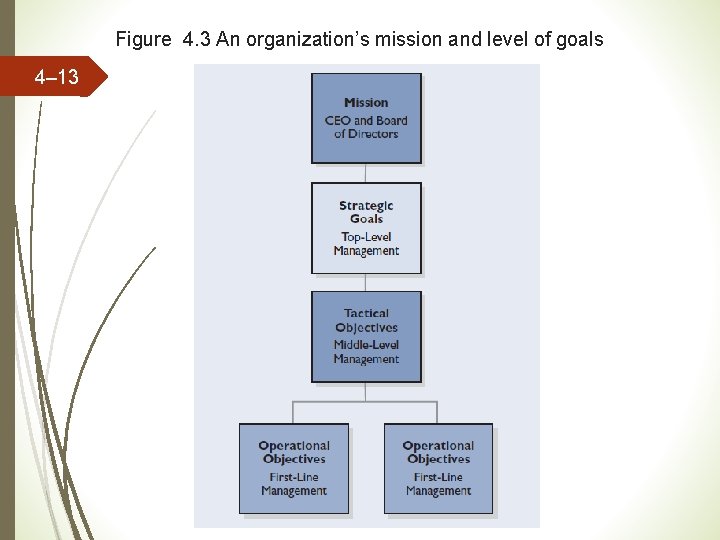
Figure 4. 3 An organization’s mission and level of goals 4– 13
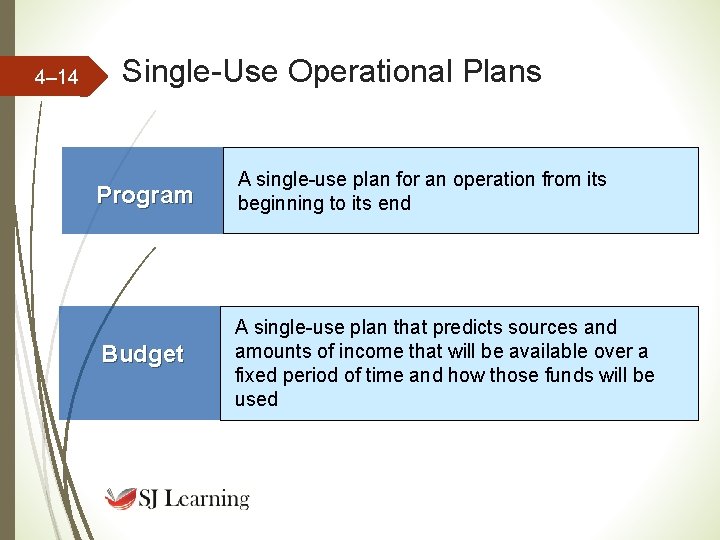
4– 14 Single-Use Operational Plans Program A single-use plan for an operation from its beginning to its end Budget A single-use plan that predicts sources and amounts of income that will be available over a fixed period of time and how those funds will be used
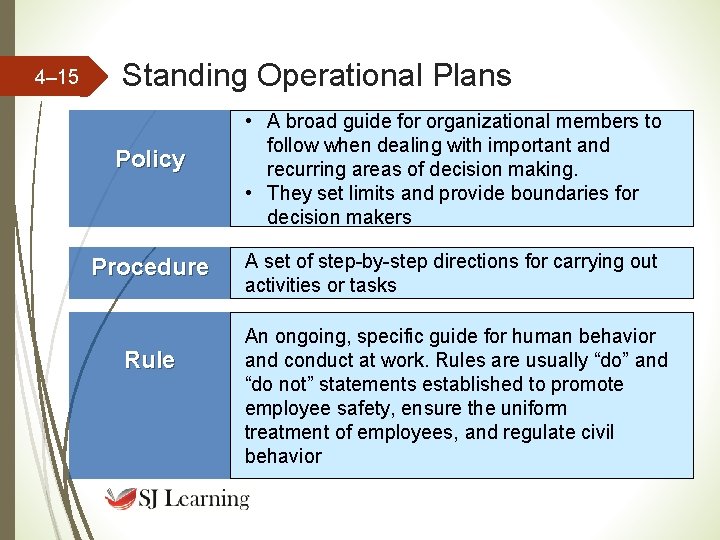
4– 15 Standing Operational Plans Policy Procedure Rule • A broad guide for organizational members to follow when dealing with important and recurring areas of decision making. • They set limits and provide boundaries for decision makers A set of step-by-step directions for carrying out activities or tasks An ongoing, specific guide for human behavior and conduct at work. Rules are usually “do” and “do not” statements established to promote employee safety, ensure the uniform treatment of employees, and regulate civil behavior
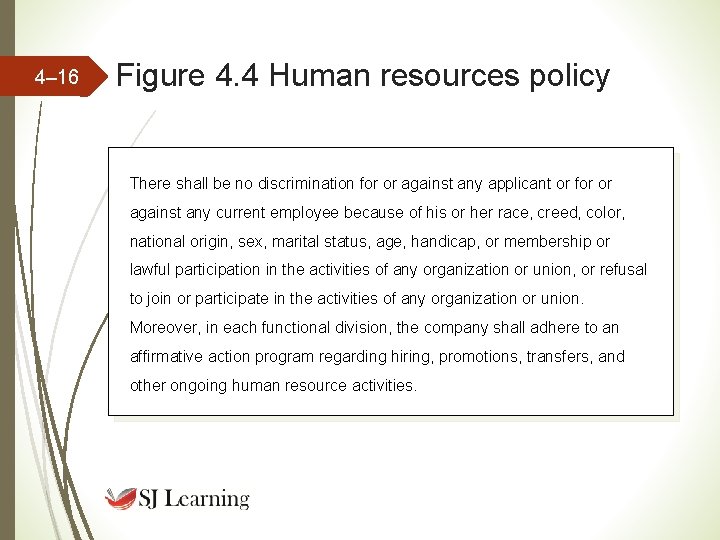
4– 16 Figure 4. 4 Human resources policy There shall be no discrimination for or against any applicant or for or against any current employee because of his or her race, creed, color, national origin, sex, marital status, age, handicap, or membership or lawful participation in the activities of any organization or union, or refusal to join or participate in the activities of any organization or union. Moreover, in each functional division, the company shall adhere to an affirmative action program regarding hiring, promotions, transfers, and other ongoing human resource activities.
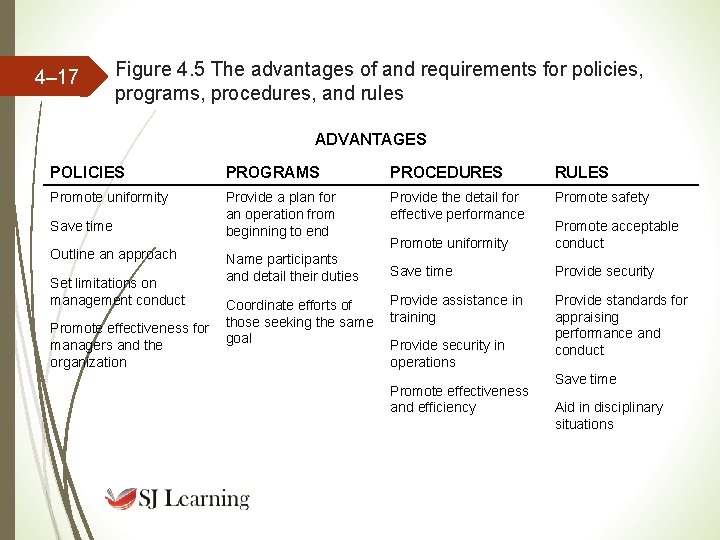
4– 17 Figure 4. 5 The advantages of and requirements for policies, programs, procedures, and rules ADVANTAGES POLICIES PROGRAMS PROCEDURES RULES Promote uniformity Provide a plan for an operation from beginning to end Provide the detail for effective performance Promote safety Save time Outline an approach Set limitations on management conduct Promote effectiveness for managers and the organization Name participants and detail their duties Coordinate efforts of those seeking the same goal Promote uniformity Promote acceptable conduct Save time Provide security Provide assistance in training Provide standards for appraising performance and conduct Provide security in operations Promote effectiveness and efficiency Save time Aid in disciplinary situations
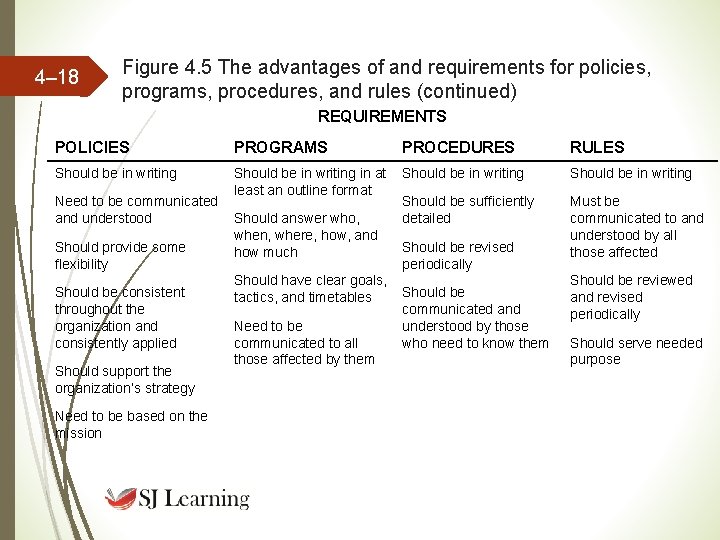
4– 18 Figure 4. 5 The advantages of and requirements for policies, programs, procedures, and rules (continued) REQUIREMENTS POLICIES PROGRAMS PROCEDURES RULES Should be in writing in at least an outline format Should be in writing Should be sufficiently detailed Must be communicated to and understood by all those affected Need to be communicated and understood Should provide some flexibility Should be consistent throughout the organization and consistently applied Should support the organization’s strategy Need to be based on the mission Should answer who, when, where, how, and how much Should have clear goals, tactics, and timetables Need to be communicated to all those affected by them Should be revised periodically Should be communicated and understood by those who need to know them Should be reviewed and revised periodically Should serve needed purpose
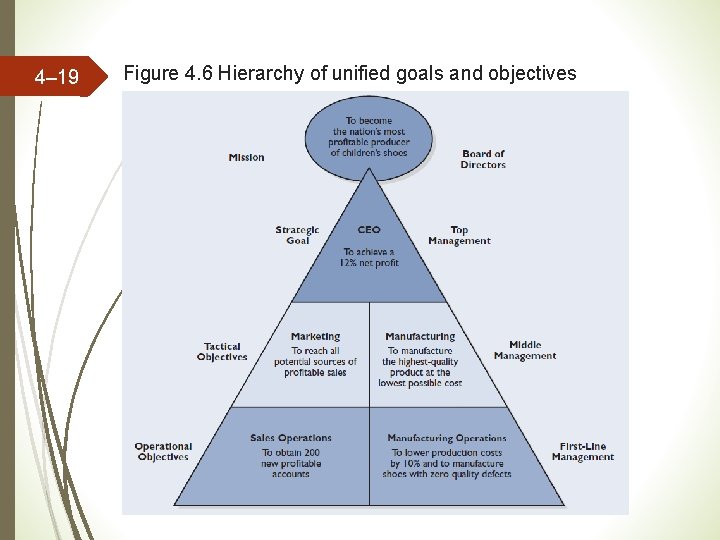
4– 19 Figure 4. 6 Hierarchy of unified goals and objectives
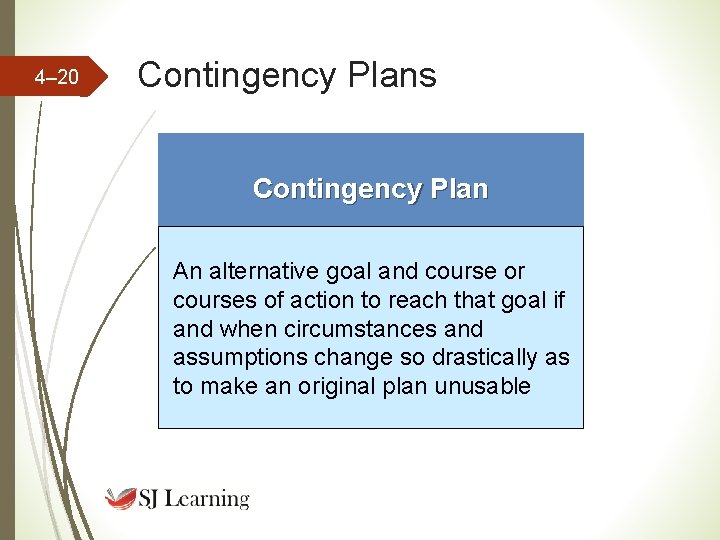
4– 20 Contingency Plans Contingency Plan An alternative goal and course or courses of action to reach that goal if and when circumstances and assumptions change so drastically as to make an original plan unusable
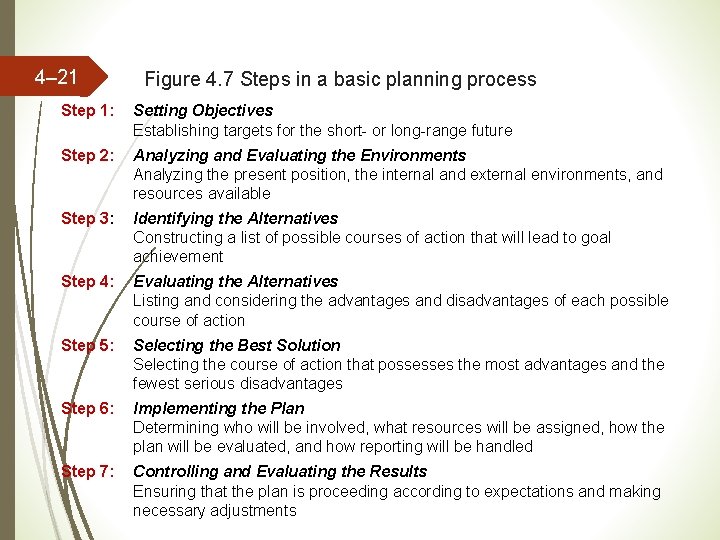
4– 21 Figure 4. 7 Steps in a basic planning process Step 1: Setting Objectives Establishing targets for the short- or long-range future Step 2: Analyzing and Evaluating the Environments Analyzing the present position, the internal and external environments, and resources available Step 3: Identifying the Alternatives Constructing a list of possible courses of action that will lead to goal achievement Step 4: Evaluating the Alternatives Listing and considering the advantages and disadvantages of each possible course of action Step 5: Selecting the Best Solution Selecting the course of action that possesses the most advantages and the fewest serious disadvantages Step 6: Implementing the Plan Determining who will be involved, what resources will be assigned, how the plan will be evaluated, and how reporting will be handled Step 7: Controlling and Evaluating the Results Ensuring that the plan is proceeding according to expectations and making necessary adjustments
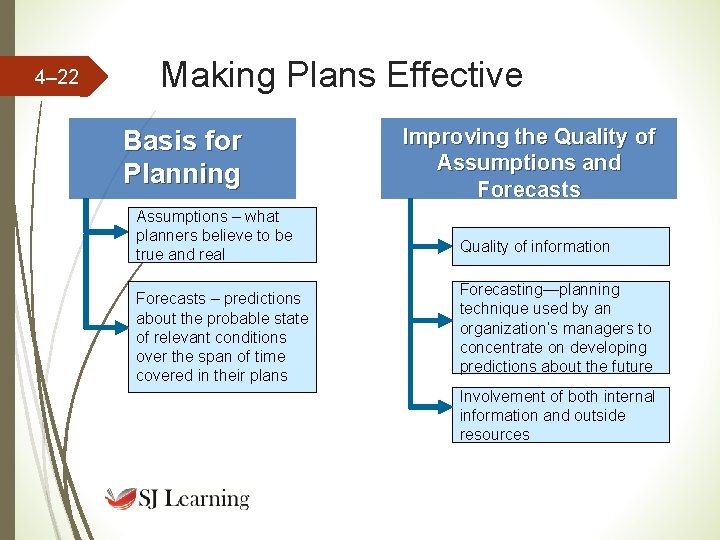
4– 22 Making Plans Effective Basis for Planning Assumptions – what planners believe to be true and real Forecasts – predictions about the probable state of relevant conditions over the span of time covered in their plans Improving the Quality of Assumptions and Forecasts Quality of information Forecasting—planning technique used by an organization’s managers to concentrate on developing predictions about the future Involvement of both internal information and outside resources
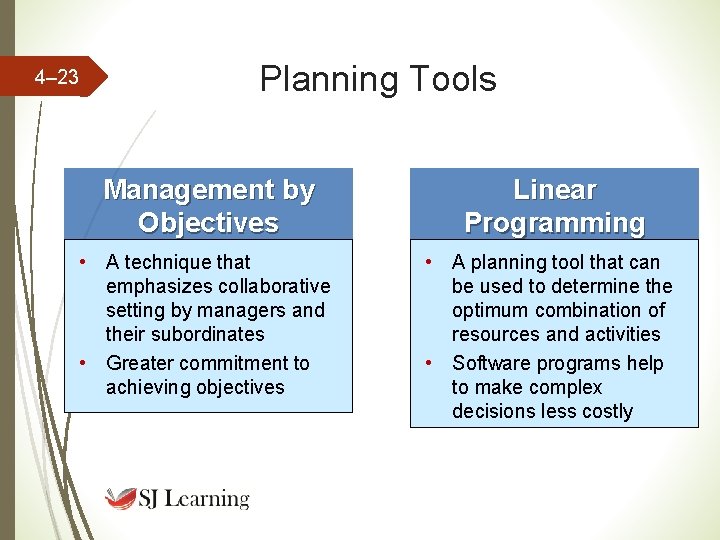
Planning Tools 4– 23 • Management by Objectives (MBO) A technique that emphasizes collaborative setting by managers and their subordinates • Greater commitment to achieving objectives Linear Programming • A planning tool that can be used to determine the optimum combination of resources and activities • Software programs help to make complex decisions less costly
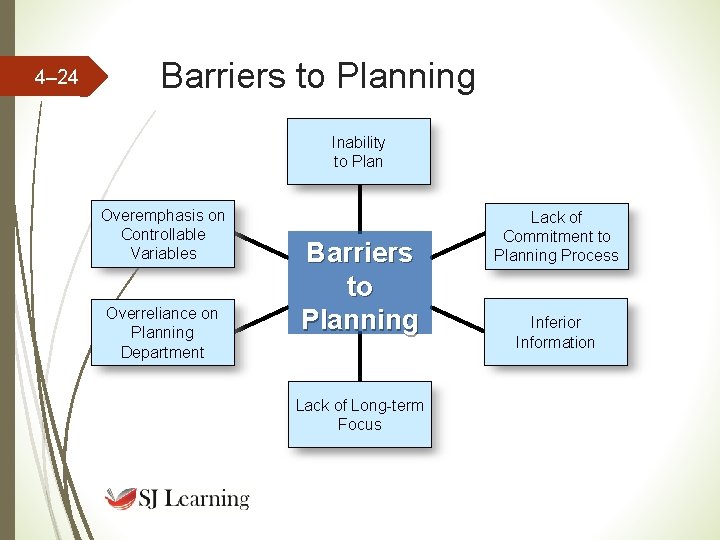
4– 24 Barriers to Planning Inability to Plan Overemphasis on Controllable Variables Overreliance on Planning Department Barriers to Planning Lack of Long-term Focus Lack of Commitment to Planning Process Inferior Information
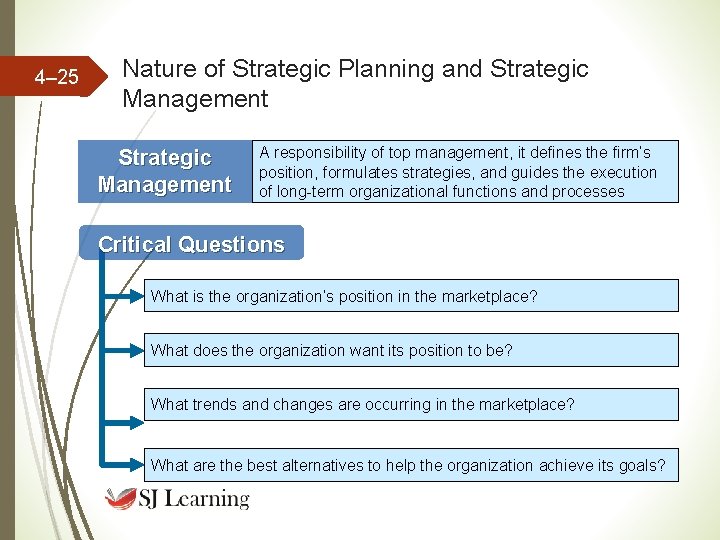
4– 25 Nature of Strategic Planning and Strategic Management A responsibility of top management, it defines the firm’s position, formulates strategies, and guides the execution of long-term organizational functions and processes Critical Questions What is the organization’s position in the marketplace? What does the organization want its position to be? What trends and changes are occurring in the marketplace? What are the best alternatives to help the organization achieve its goals?
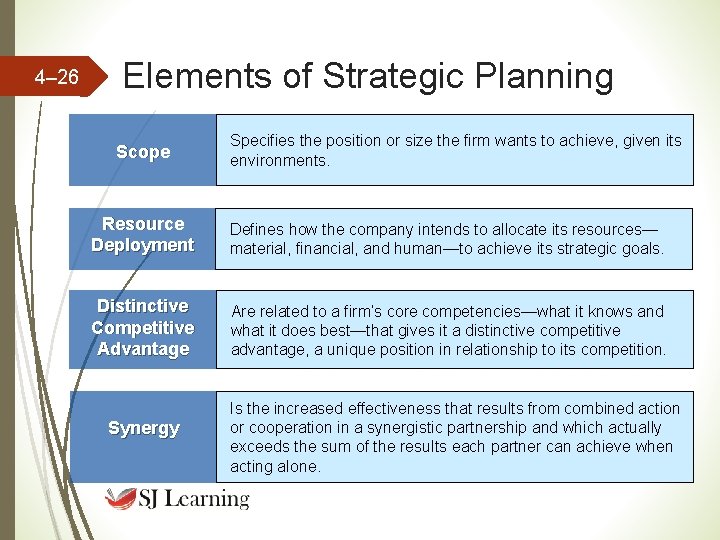
4– 26 Elements of Strategic Planning Scope Specifies the position or size the firm wants to achieve, given its environments. Resource Deployment Defines how the company intends to allocate its resources— material, financial, and human—to achieve its strategic goals. Distinctive Competitive Advantage Are related to a firm’s core competencies—what it knows and what it does best—that gives it a distinctive competitive advantage, a unique position in relationship to its competition. Synergy Is the increased effectiveness that results from combined action or cooperation in a synergistic partnership and which actually exceeds the sum of the results each partner can achieve when acting alone.
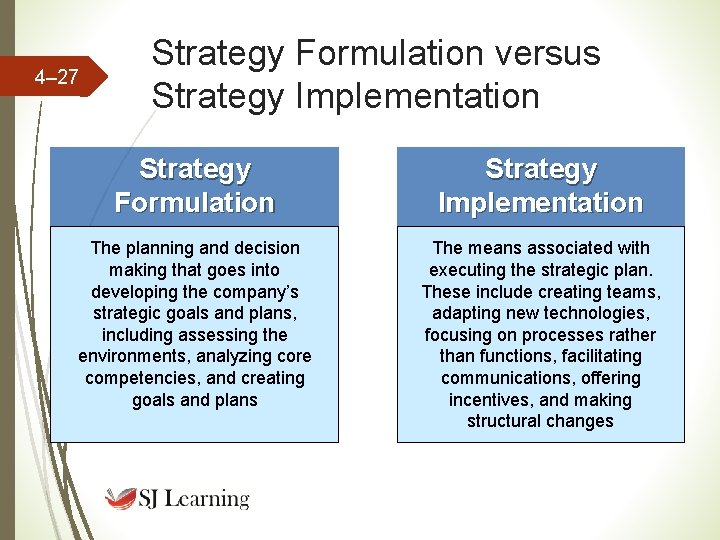
4– 27 Strategy Formulation versus Strategy Implementation Strategy Formulation Strategy Implementation The planning and decision making that goes into developing the company’s strategic goals and plans, including assessing the environments, analyzing core competencies, and creating goals and plans The means associated with executing the strategic plan. These include creating teams, adapting new technologies, focusing on processes rather than functions, facilitating communications, offering incentives, and making structural changes
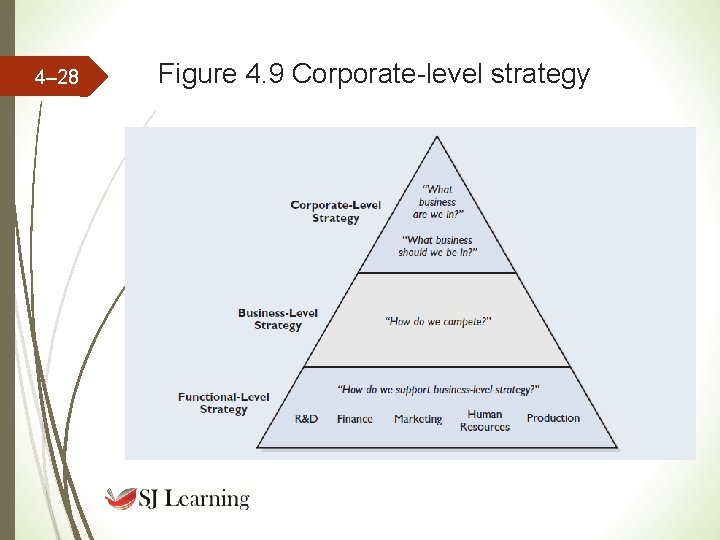
4– 28 Figure 4. 9 Corporate-level strategy
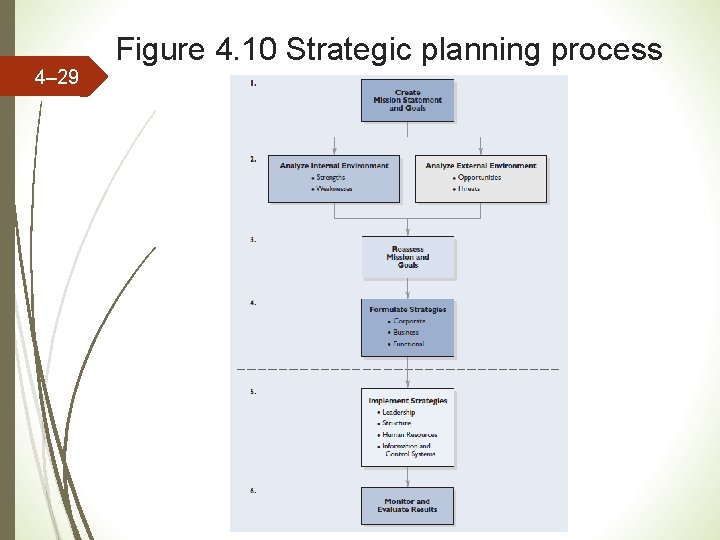
4– 29 Figure 4. 10 Strategic planning process
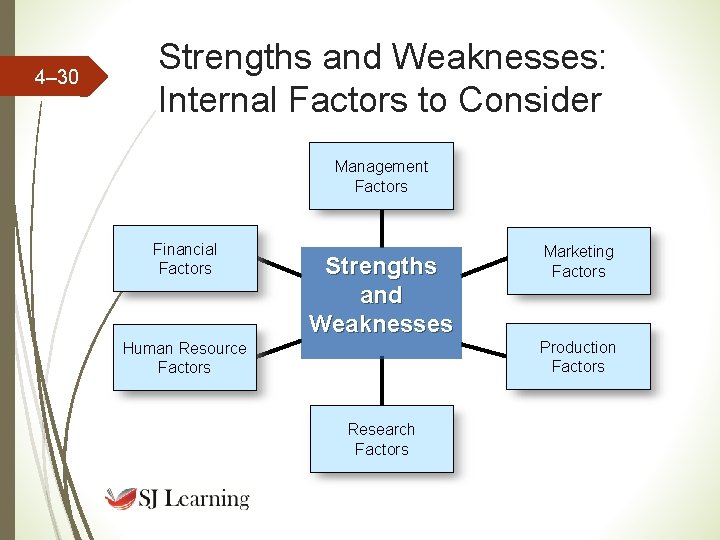
4– 30 Strengths and Weaknesses: Internal Factors to Consider Management Factors Financial Factors Strengths and Weaknesses Marketing Factors Production Factors Human Resource Factors Research Factors
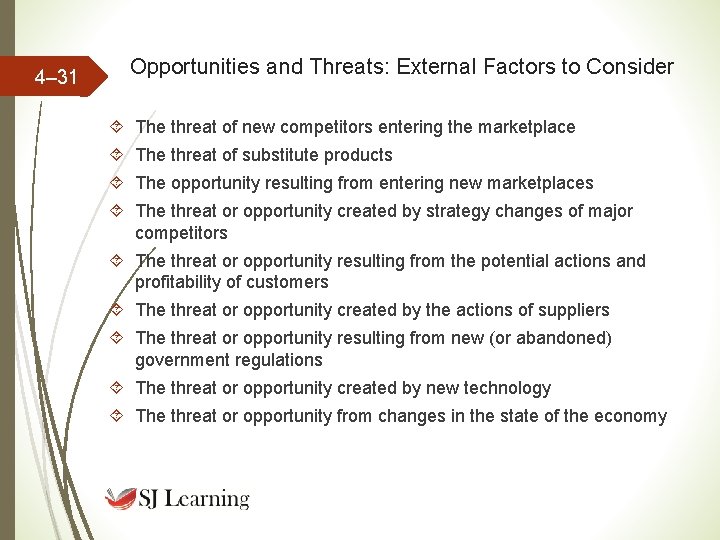
4– 31 Opportunities and Threats: External Factors to Consider The threat of new competitors entering the marketplace The threat of substitute products The opportunity resulting from entering new marketplaces The threat or opportunity created by strategy changes of major competitors The threat or opportunity resulting from the potential actions and profitability of customers The threat or opportunity created by the actions of suppliers The threat or opportunity resulting from new (or abandoned) government regulations The threat or opportunity created by new technology The threat or opportunity from changes in the state of the economy
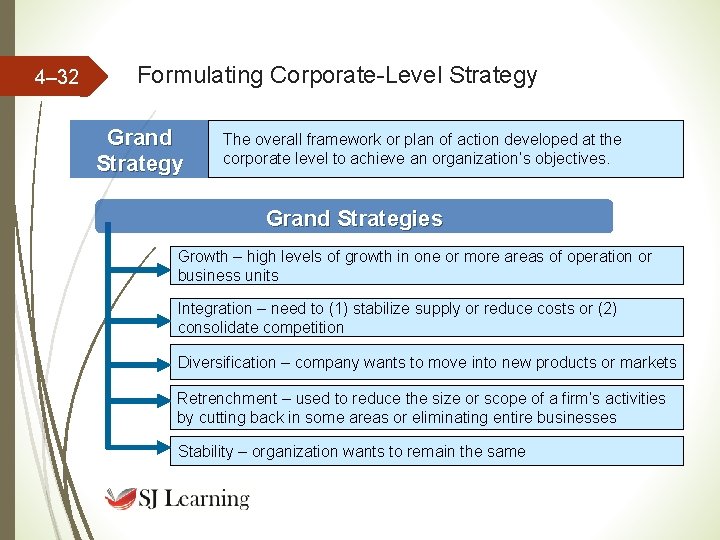
4– 32 Formulating Corporate-Level Strategy Grand Strategy The overall framework or plan of action developed at the corporate level to achieve an organization’s objectives. Grand Strategies Growth – high levels of growth in one or more areas of operation or business units Integration – need to (1) stabilize supply or reduce costs or (2) consolidate competition Diversification – company wants to move into new products or markets Retrenchment – used to reduce the size or scope of a firm’s activities by cutting back in some areas or eliminating entire businesses Stability – organization wants to remain the same
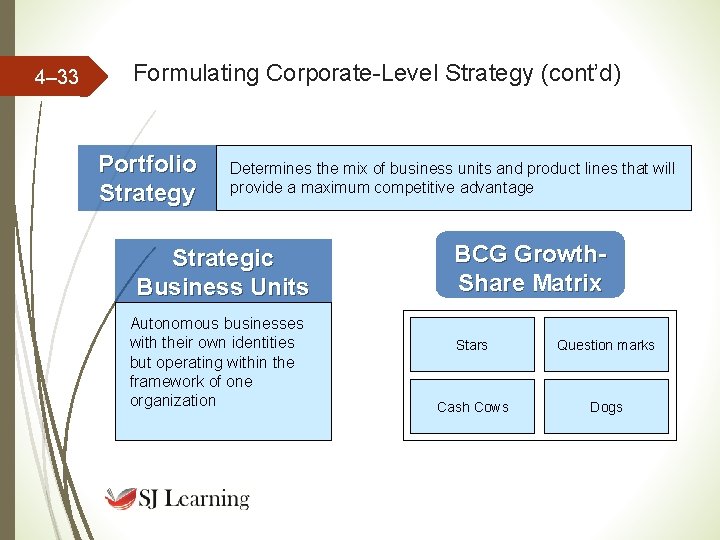
4– 33 Formulating Corporate-Level Strategy (cont’d) Portfolio Strategy Determines the mix of business units and product lines that will provide a maximum competitive advantage Strategic Business Units (SBUs) Autonomous businesses BCG Growth. Share Matrix with their own identities but operating within the framework of one organization Stars Question marks Cash Cows Dogs
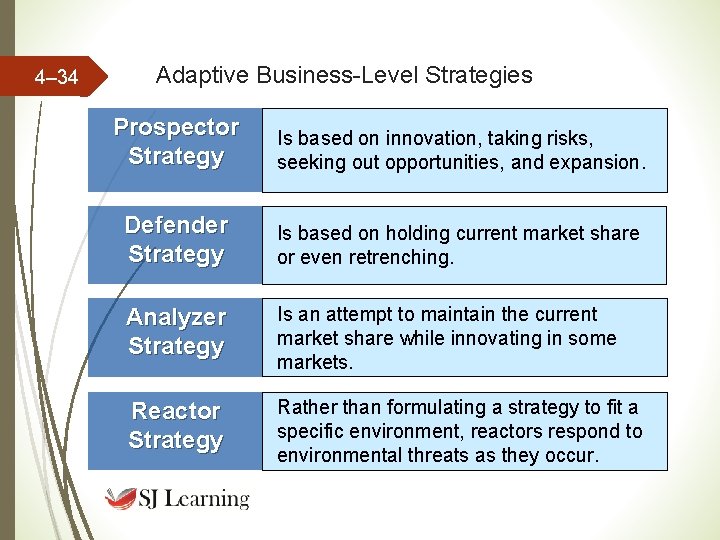
4– 34 Adaptive Business-Level Strategies Prospector Strategy Is based on innovation, taking risks, seeking out opportunities, and expansion. Defender Strategy Is based on holding current market share or even retrenching. Analyzer Strategy Is an attempt to maintain the current market share while innovating in some markets. Reactor Strategy Rather than formulating a strategy to fit a specific environment, reactors respond to environmental threats as they occur.
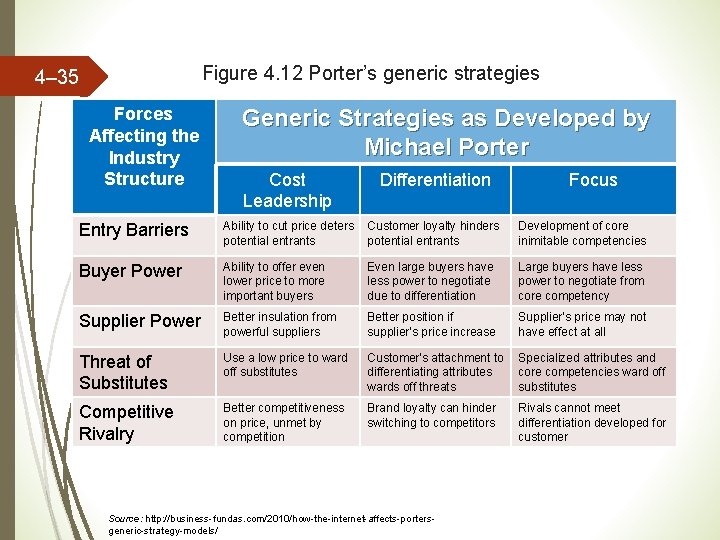
Figure 4. 12 Porter’s generic strategies 4– 35 Forces Affecting the Industry Structure Generic Strategies as Developed by Michael Porter Cost Leadership Differentiation Entry Barriers Ability to cut price deters potential entrants Customer loyalty hinders potential entrants Development of core inimitable competencies Buyer Power Ability to offer even lower price to more important buyers Even large buyers have less power to negotiate due to differentiation Large buyers have less power to negotiate from core competency Supplier Power Better insulation from powerful suppliers Better position if supplier’s price increase Supplier’s price may not have effect at all Threat of Substitutes Use a low price to ward off substitutes Customer’s attachment to differentiating attributes wards off threats Specialized attributes and core competencies ward off substitutes Competitive Rivalry Better competitiveness on price, unmet by competition Brand loyalty can hinder switching to competitors Rivals cannot meet differentiation developed for customer Source: http: //business-fundas. com/2010/how-the-internet-affects-portersgeneric-strategy-models/ Focus
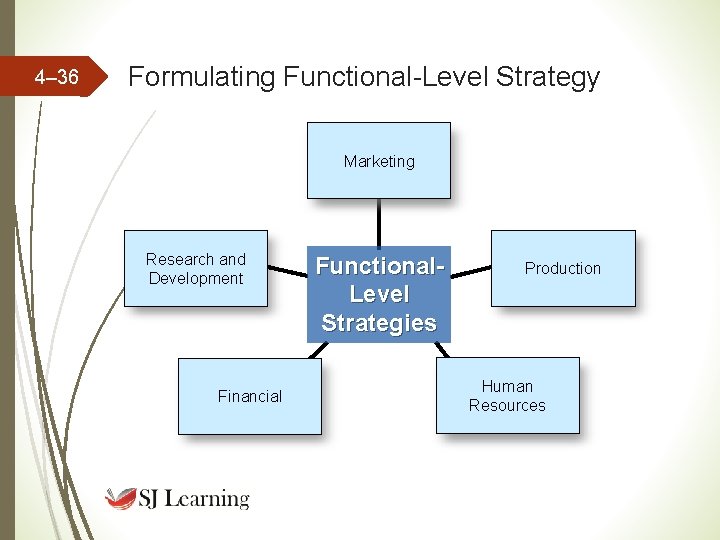
4– 36 Formulating Functional-Level Strategy Marketing Research and Development Financial Functional. Level Strategies Production Human Resources
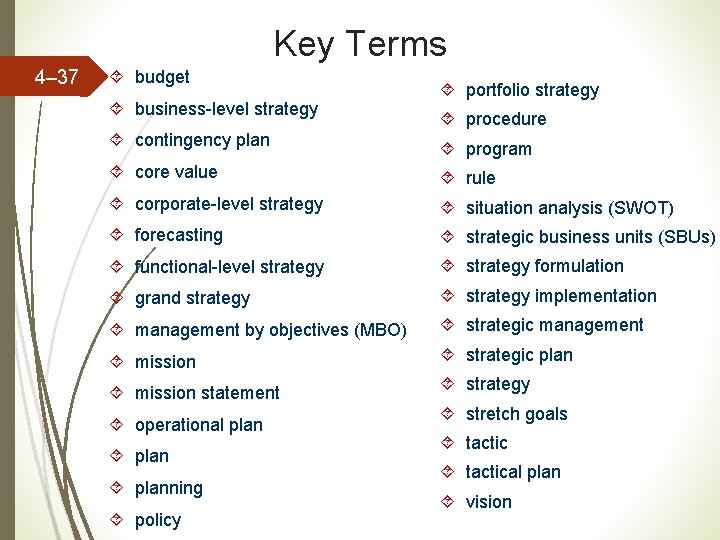
Key Terms 4– 37 budget business-level strategy portfolio strategy procedure contingency plan program core value rule corporate-level strategy situation analysis (SWOT) forecasting strategic business units (SBUs) functional-level strategy formulation grand strategy implementation management by objectives (MBO) strategic management mission strategic plan mission statement strategy operational planning policy stretch goals tactical plan vision