
MANAGEMENT 101 Week 3 Job Design Diversity 926
MANAGEMENT 101 Week 3: Job Design & Diversity (9/26) Professor Payal Sharma
Class Agenda • Lecture: – Job Design: Job Characteristics Model – Diversity: Faultlines and Cultural Values • Video: – Multi-Cultural Team • Takeaways • Next Time
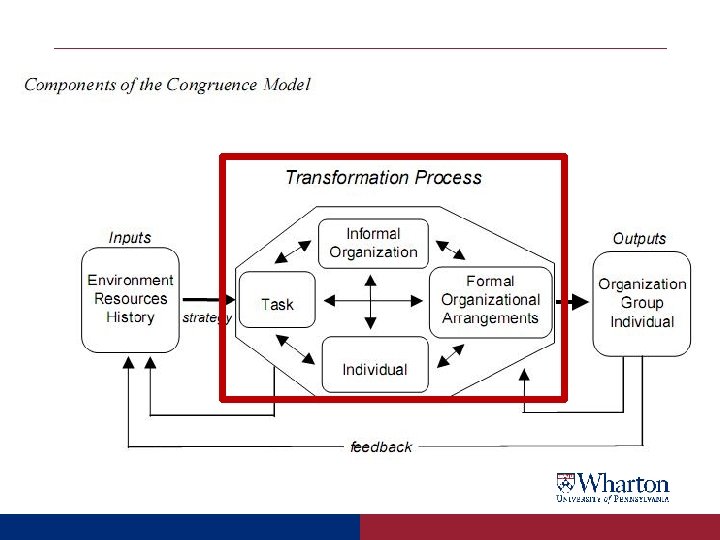
Congruence Model (revisited) • In the transformation process… <examples from reading> • Task refers to the basic and inherent work to be done by the organization and its parts • Individual refers to individuals needs and preferences; perceptions and expectations; background factors • Informal organization refers to leader behaviors and relationships both within and between groups • Fit matters – that is, how are individual needs met by the tasks? • Output refers to individual performance
Intrinsic Motivation • Work that is fully integrated with one’s curiosity and interests – Engaging in work for its own sake. – Work creates its own meaning • “Interesting work” is the top reported need of employees in surveys since 1980 s (Wiley, 1994) – Leads to greatest sense of personal welfare and subjective well-being; intensity of effort and persistence – that is, motivation (Deci & Ryan, 2000)
Job Design Defined • Process by which managers decide how to divide into specific jobs the tasks that have to be performed to provide customers with goods or services • Result is division of labor amongst personnel; reflects critical part of the organizing process • Can reflect concepts of (1) job simplification; (2) job enlargement; and (3) job enrichment • Job Characteristics Model (JCM) is part of job design -- to make jobs more interesting and motivating through enriched and enlarged jobs – hence focus of our class today
Job Characteristics Model 1. Skill variety: variety of different activities in carrying out work, involving use of different worker skills and talents 2. Task identity: completion of a “whole” piece of work; that is, doing a job from beginning to end with visible outcomes • Highest relationship with work performance 3. Task significance: substantial impact on lives of other people – whether in immediate organization or world at large • Skill variety and task significance have stronger relationships with meaningfulness than other psychological states 4. Job autonomy: experiencing freedom, independence, and discretion in scheduling work and carrying it out 5. Job feedback: carrying out work activities provides worker with direct and clear information about performance effectiveness (Faturochman, 1997; Fried & Ferris, 1987)
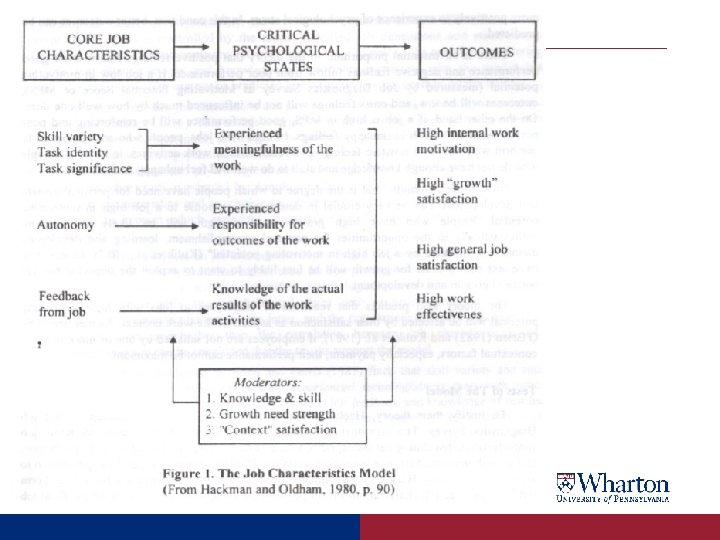
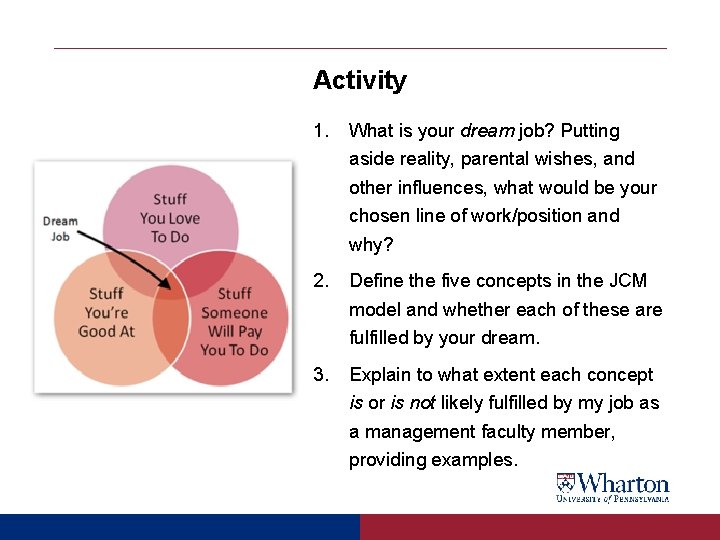
Activity 1. What is your dream job? Putting aside reality, parental wishes, and other influences, what would be your chosen line of work/position and why? 2. Define the five concepts in the JCM model and whether each of these are fulfilled by your dream. 3. Explain to what extent each concept is or is not likely fulfilled by my job as a management faculty member, providing examples.
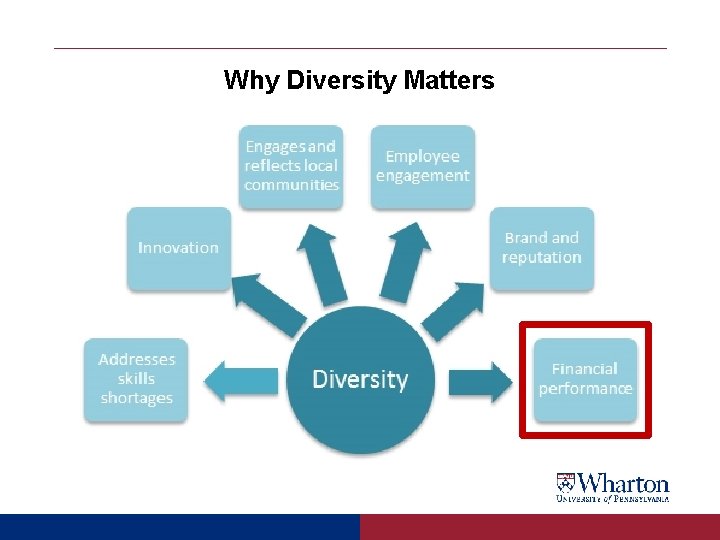
Why Diversity Matters
Building the Business Case "I see three main points to make the business case for diversity: 1. 2. 3. A talent shortage that requires us to seek out and use the full capabilities of all our employees. The need to be like our customers, including the need to understand communicate with them in terms that reflects their concerns. Diverse teams produce better results. This last point is not as easy to sell as the first two-especially to engineers who want the data. What I need is the data, evidence that diverse groups do better. “ - Lew Platt, former CEO of Hewlett Packard, comments to the Diversity Research Network, Stanford Business School, March 18, 1998
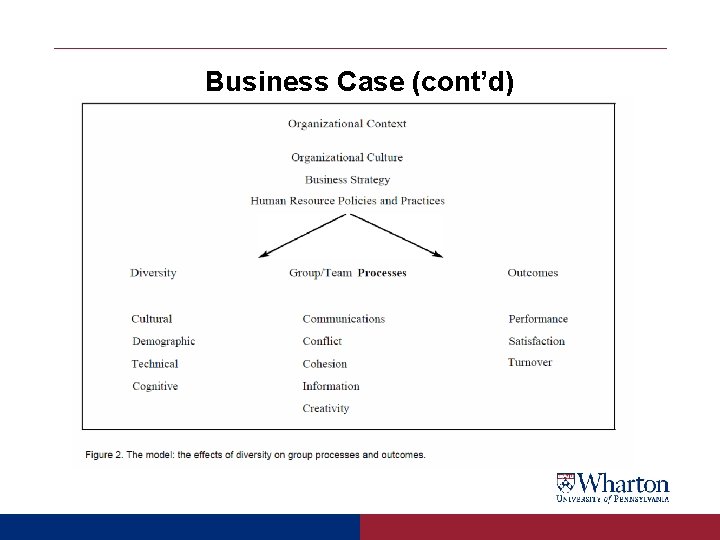
Business Case (cont’d)
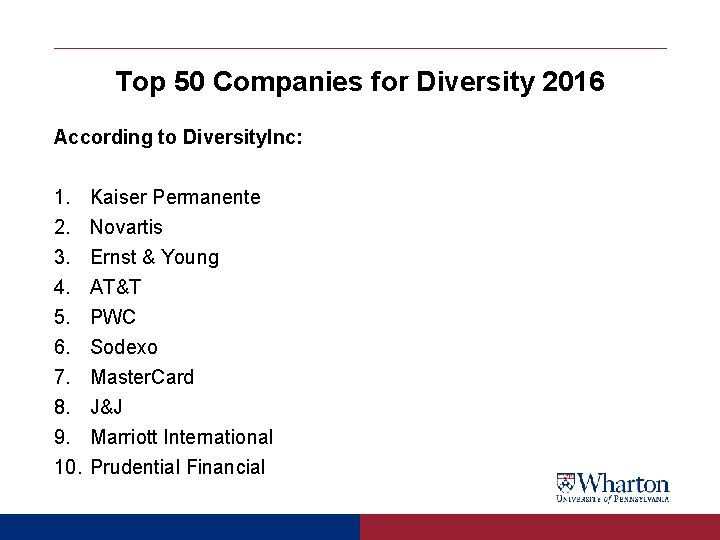
Top 50 Companies for Diversity 2016 According to Diversity. Inc: 1. 2. 3. 4. 5. 6. 7. 8. 9. 10. Kaiser Permanente Novartis Ernst & Young AT&T PWC Sodexo Master. Card J&J Marriott International Prudential Financial
Types of Diversity 1. Surface-level diversity 2. Deep-level diversity
Faultlines Defined • Subgroups or coalitions which emerge naturally within team • When groups fall into two distinct, non-overlapping subgroups and provide a forum for conflict (development of in- versus out-groups) • Typically along various demographic lines although can be driven by surface- OR deep-level diversity
Why Faultlines Matter • Adversely impacts behavioral disintegration (Hambrick, 1994) – Information exchange – Collaborative behavior – Joint decision making • Triggers – Lack of trust between members (Bezrukova et al. , 2007) – Poor team performance (Li & Hambrick, 2005) • Within a faultline, similarity reinforces – Social support, liking, and job satisfaction (Lau & Murnighan, 2005; Phillips, 2003) – Individual-level health (Bezrukova, Spell, & Perry, 2010)
Overcoming Faultlines 1. We’re all in this together! Focus on building superordinate goals and promoting team identification (or perception of a sense of oneness with the team). 2. Create a cross cutting category such as a reward system or task role assignment that cuts across the group (Homan et al. , 2008; Rico et al. , 2012). 3. Find a ‘common enemy’ (Spell & Bezrukova, 2013)
Cultural Values • Defined as interpretative “filters” that guide and indicate individual preferences—and, hence, are logical and important predictors of how people behave in organizational settings (Gelfand, Erez & Aycan, 2007; Kirkman, Lowe & Gibson, 2006). • Due to the globalization of the workforce, there is increasing variance in cultural values that both managers and employees encounter as part of their work experiences (Javidan, Dorfman, Sully de Luque, & House, 2006). • This variance likely affects preferences by leaders and followers for management practices (e. g. , Kirkman, Chen, Farh, Chen & Lowe, 2009).
Hofstede Framework • Power distance: accepting unequal power distributions in organizations and institutions • Implications for: – Managers helping/resolve job stress for employees (Peterson et al. , 1995). – Delegation by managers (Offermann & Hellmann, 1997; Yukl & Fu, 1999) – Employee perceptions of abusive supervision, interactional injustice, and job satisfaction (cf. Martinko et al. , 2013)
Hofstede (cont’d) • Individualism (versus collectivism): preferences to act as individuals rather than members of a group; value placed on social relationships, such that highly collectivistic individuals are more likely to place the welfare of their families, groups, or organizations over their own (Pillai & Meindl, 1998) • Implications for: – Managers preferences for their leaders (Javidan et al. , 2006) – Social loafing and job performance (Earley, 1989)
Hofstede (cont’d) • Masculinity (versus femininity): favoring traditional masculine roles (versus gender equality) and less emphasis on caring and concern for members’ well-being, inclusion, solidarity and cooperation • Implications for: – Entrepreneurship (Steensma et al. , 2000) – Helping behaviors (Tice & Baumeister, 2004)
Hofstede (cont’d) • Uncertainty avoidance: preferences for structured over unstructured situations and ambiguity versus not; reliance on social norms, rules, and procedures to alleviate unpredictability of future events • Implications for: - Employee commitment and identification with/toward organization, manager, and work group (Baker et al. , 2009; Clugston et al. , 2000) - Perceptions of moral values (Maertz, 2004)
Video: Building the Multicultural Team https: //www. youtube. com/watch? v=Ys. JBT 8 V 8 -DM
Discussion Questions 1. Using the language of Hofstede’s framework and drawing on your understanding of the four cultural values, explain why there was ‘misfit’ or misunderstanding between the American manager and each of his team members. That is, provide one example from the video per cultural value. 2. How might this misunderstanding impact the team member’s motivation? Draw on what was evident in the video and project into the future of this team and its members. 3. If you were the American manager, what would you do to ensure your team is motivated, while recognizing the differences that exist in members’ cultural values preferences? Offer two (2) strategies you could implement, again being specific.
Takeaways • Although extrinsic motivators exist and are impactful, understanding how to make work interesting is an even more impactful managerial challenge • The Job Characteristics Model highlights key ways that jobs can be designed to be maximally motivating for employees • Diversity in organizations presents both opportunities and challenges for managers to understand work through • Cultural values indicate variance in preferences for how employees want to be managed and how managers want to manage their employees • There is no ‘one size fits all’ approach with management regarding diversity and motivation issues; awareness, communication and understanding are key
Next Time Week 4 (10/3): Decision-Making and Ethics For lecture: – Reading: See No Evil – Reading: Business As Usual For recitations: – No recitations held next week – Stay tuned for instructions on People Analytics exercise – required for class – Office hours still held
- Slides: 26