
Management 1 Communication Organizational Hierarchy FounderDirector Manager Caregivers


- Slides: 23
Management #1 Communication
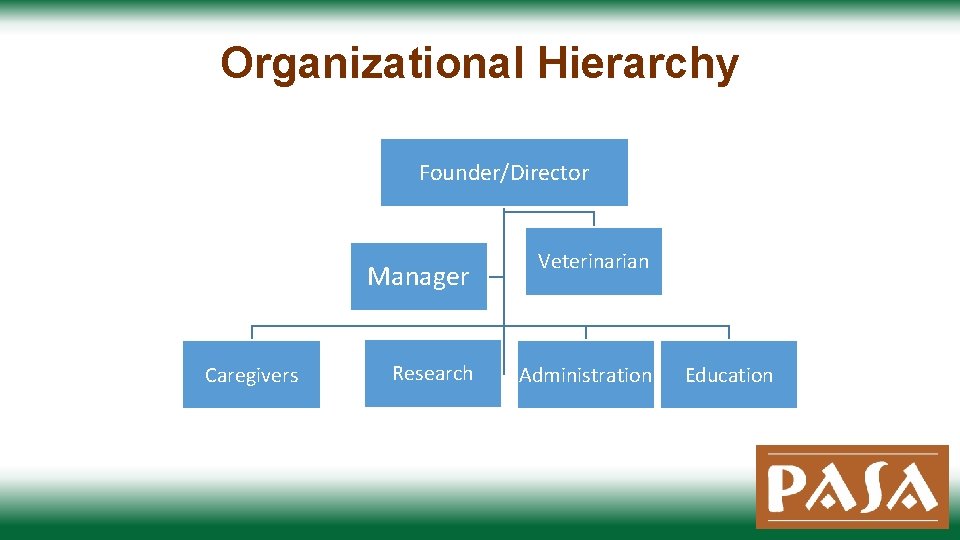
Organizational Hierarchy Founder/Director Manager Caregivers Research Veterinarian Administration Education
Importance of Communication • The monkeys/apes under our care depend on us to share information via record keeping, personal communications, and electronic or other means • Sharing information effectively helps all of us to: • Provide consistent care • Address problems quickly and efficiently • Ensure that the team is up to date
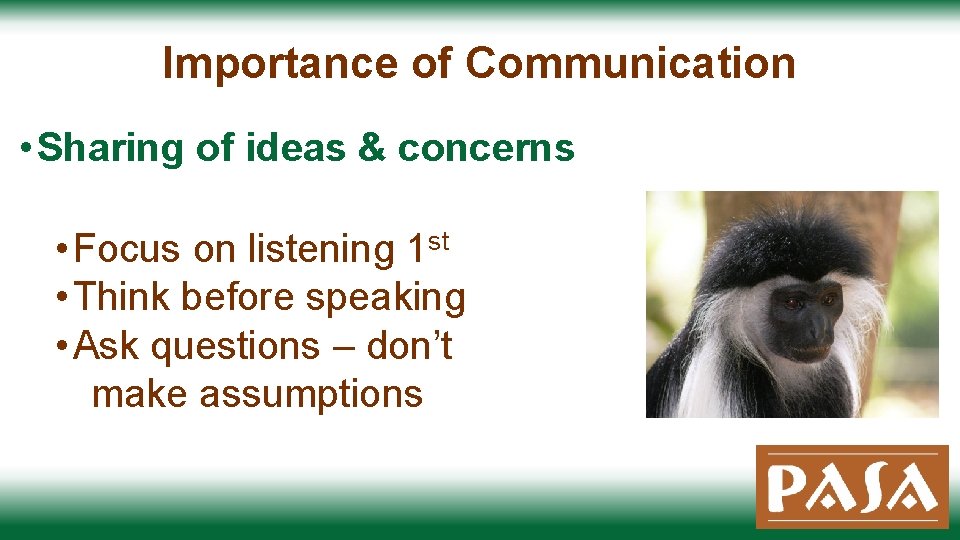
Importance of Communication • Sharing of ideas & concerns • Focus on listening 1 st • Think before speaking • Ask questions – don’t make assumptions
An Effective Team Member • Be attentive during training • Follow directions • Respect the chain of command in your sanctuary
Communication Within the Sanctuary • SOP’s • Standard Operating Procedures • Sanctuary Operating Manuals It is very important to be familiar with these, with their locations within your sanctuary and any updates made to these documents. Be proactive and stay up to date!
Communication Within the Sanctuary • Importance of Regular Meetings • Great place to share ideas/concerns • Practice being open minded • Always be respectful, polite and courteous
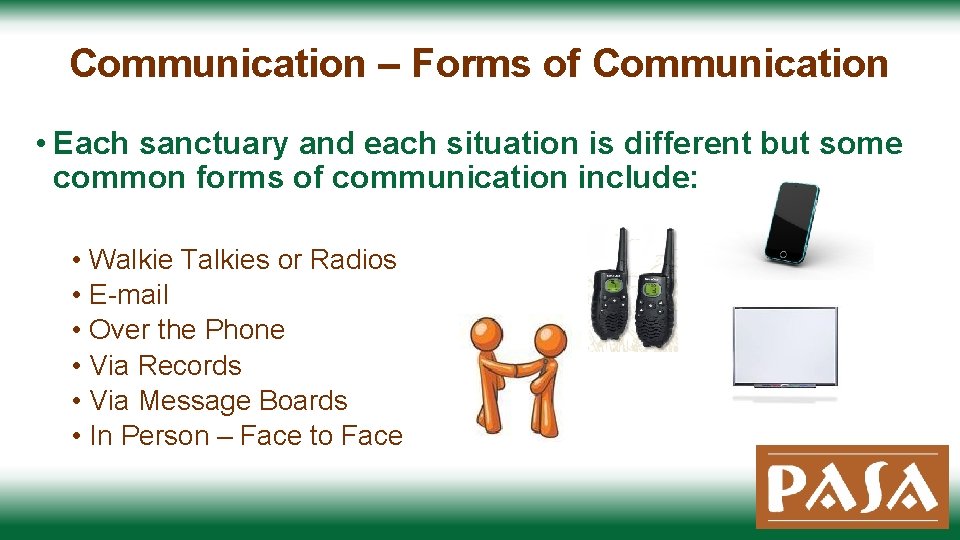
Communication – Forms of Communication • Each sanctuary and each situation is different but some common forms of communication include: • Walkie Talkies or Radios • E-mail • Over the Phone • Via Records • Via Message Boards • In Person – Face to Face
Communication with Co-workers • Go to the source first, don’t make assumptions and ask questions to clarify any issues • Patience and understanding go a long way • Create dialogue, not conflict • Clarify that information was heard and understood by each team member that needs to know the information being shared • Ask for help when needed
Communication with Supervisor Provide timely and professional feedback and accept feedback professionally Speak for yourself and not others
Communication in an Emergency • Please review your sanctuary’s Emergency Response Plan • Pay attention to the chain of communication to follow during an emergency
Working with a Team • Regular communication • Respectful behavior and conversation • Cooperation with all sanctuary teams and their members • veterinary & education team members as well as administrative & research teams
Staff Training & Development Opportunities for: • Learning from others • Sharing knowledge with others • Training others Sometimes involves communication outside of the sanctuary itself
Staff Training & Development • May be available from outside organizations like PASA • May be available online • Consider sending staff to meetings of like-minded organizations • Explore scholarship opportunities
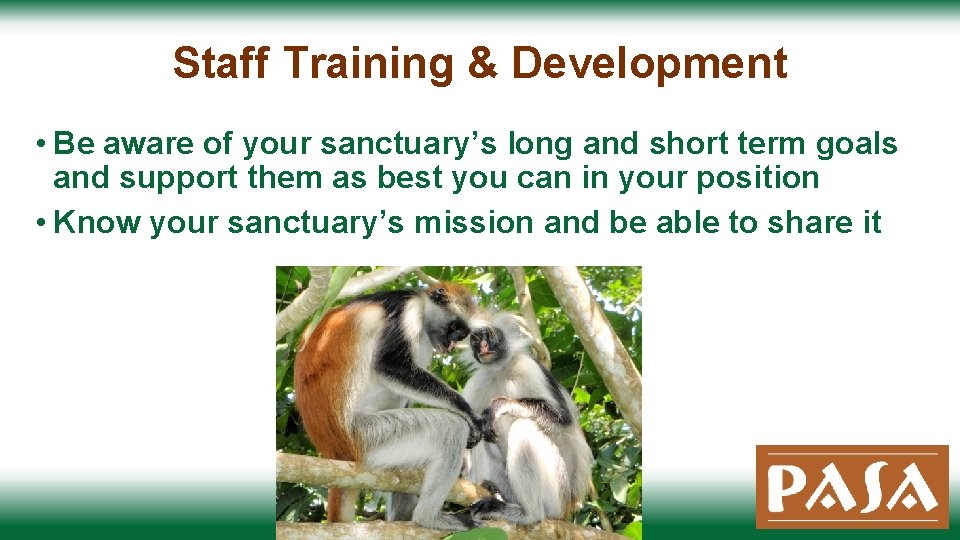
Staff Training & Development • Be aware of your sanctuary’s long and short term goals and support them as best you can in your position • Know your sanctuary’s mission and be able to share it
Sharing Ideas & Concerns • Place a whiteboard in a shared location to share day to day information and suggestions • Consider a suggestion box where people can share ideas • Anonymously if they prefer
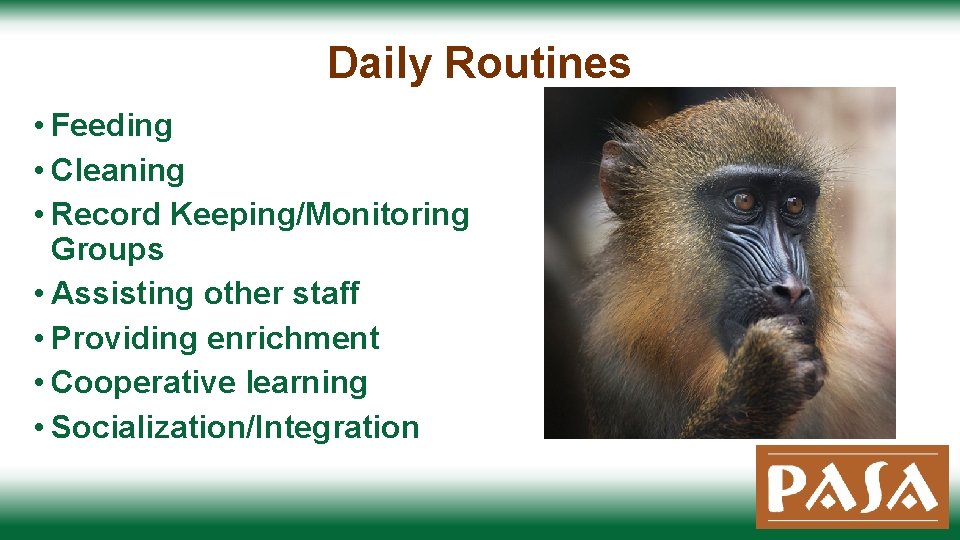
Daily Routines • Feeding • Cleaning • Record Keeping/Monitoring Groups • Assisting other staff • Providing enrichment • Cooperative learning • Socialization/Integration
Scenarios to Consider It is close to the end of a workday, and you will not be at work the following day. You notice a monkey is lethargic and appears ill. • What would you do? • Who would you inform? (If more than one person, list all. ) • How will you inform each person? • What information will you share? • How will you follow up?
Scenarios to Consider You’ve just noticed a break in the fencing of the chimpanzee enclosure: • What would you do? • Who would you inform? (If more than one person, list all. ) • How will you inform each person? • What information will you share? • How will you follow up?
Scenarios to Consider You are making diets for the animals in your care and notice that you are very low on produce: • What would you do? • Who would you inform? (If more than one person, list all. ) • How will you inform each person? • What information will you share? • How will you follow up?
Emergency Scenario to Consider There has been a bad storm/extreme weather and/or an escape – in these emergency situations consider how you would respond both before and after the incidents. • What would you do? • Who would you inform? (If more than one person, list all. ) • How will you inform each person? • What information will you share? • How will you follow up?
Thank you! PASAprimates. org facebook. com/PASAprimates gregg@pasaprimates. org
The PASA Primate Care Training Program is made possible by a generous grant from Fondation Brigitte Bardot.