
Managed Care Models The Benefit vs Cost Balance
Managed Care Models: The Benefit vs. Cost Balance Created by the School of Pharmacy Relations Committee for AMCP Updated: March 2020
Medicare – The Basics • Federal health insurance program administered by the Centers for Medicare & Medicaid Services (CMS) • Program covers individuals: § 65 years of age and older § Under age 65 with qualifying disabilities § Under age 65 with end stage renal disease (ESRD)
Objectives • Identify the types of managed care models • Discuss differences between model types • Differentiate the level of control and cost per model • Explain the concept of pharmacy networks
Managed Care Model Types • Health maintenance organization (HMO) • Preferred provider organization (PPO) • Point-of-service plan (POS) • High-deductible Health Plans (HDHPs)
6
Characteristics of HMOs • “Gatekeeper” principle – Primary care provider (PCP) serves as a gatekeeper and must authorize all medical services – Services not authorized by the PCP usually not covered – Rationale for gatekeeper is to avoid unnecessary expenses • Preferred networks – Plans will only pay for services provided by healthcare providers that they have contracted with – “In-Network” providers – Plans will not pay for “Out-of-Network” providers • Less choice, but lower premiums 7

Characteristics of PPOs • No gatekeeper – Patients can choose their own providers without having to use a designated PCP • Preferred networks with some out-of-network coverage – Patient can see any healthcare practitioner they want, but they are financially incentivized to see in-network providers • E. g. , Patient pays 10% to see in-network vs. 50% to see out-of-network • More choice, but higher premiums 8
Characteristics of POSs • Hybrid of PPO and HMO • Patients can choose their provider § HMO rates for preferred provider (e. g. , gatekeeper PCP) § Costs of out-of-network services determined by providers (NOT contracted rates with health plans) § Providers can collect charges not paid for by the insurance company
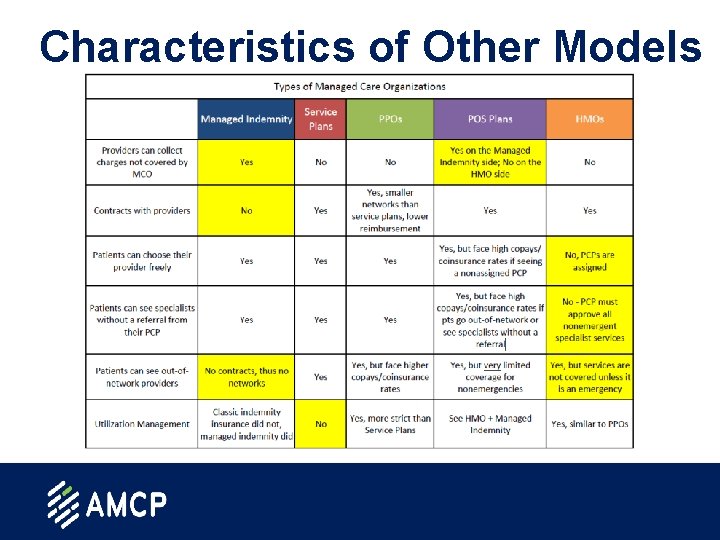
Characteristics of Other Models Table © Steven Kheloussi

Characteristics of HDHPs • High-Deductible Health Plans (HDHPs): § Low premiums § High deductibles (usually several thousands of $) § Typically paired with a PPO o All PPO features apply, except that the patient is responsible for a larger portion of the cost upfront

Employer Decision: Benefit Controls vs. Cost Few Benefit Controls Higher Cost Lower Cost Highly Controlled Benefits

Benefit Control vs. Cost Managed Indemnity LESS control of medical cost and quality Service Plans PPOs POSs HMOs MORE control of medical cost and quality

Pharmacy Networks • Just like with providers, narrow pharmacy networks help control cost § Pharmacies reimbursed less in exchange for more business o Smaller number of pharmacies for patients to go to • Three types of pharmacy networks § Preferred pharmacy networks § Limited pharmacy networks § Neither
Summary • There are many different types of managed care models. • Each model offers a choice to employers who buy these services. • Employers must balance employee choice with cost when choosing. • Plan types are just one way of controlling cost.

Thank you to AMCP member Steven Kheloussi for updating this presentation for 2020

Mission & Vision To improve patient health by ensuring access to high-quality, cost-effective medications and otherapies.
- Slides: 17