
Manage Team Communication Standards This presentation is based
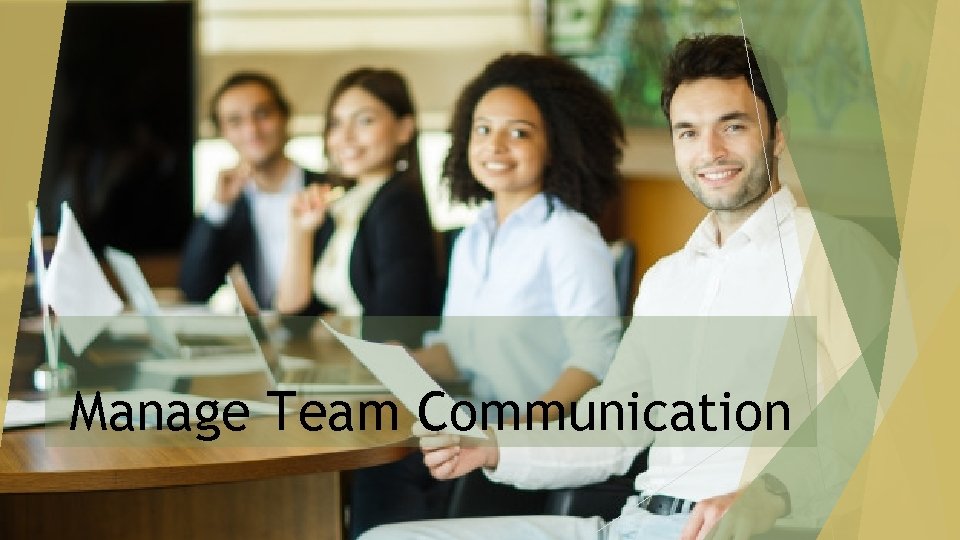
Manage Team Communication
Standards This presentation is based on the competency standards for NVQ Level 4 Language and Communication (LAC 40117) Cluster 3 | Unit | CRICOM 0014 A: Manage team communications Competency Elements: Manage communications with and within teams Content Writer | Alecia Campbell | 2019
Objectives After completing this presentation, the accompanying guide and activities you will be able to: Identify three (3) principles of effective communication Describe at least three (3) different communication styles Demonstrate at least three communication techniques crucial to maintain positive group dynamics Outline at least four (4) criteria to consider in order to select the most appropriate communication methods List at least three (3) features of data management processes including cost-effective, time-effective and ethical means to gather, store and retrieve information Demonstrate use of at least three (3) technologies used to support group communication List at least three (3) roles of team leaders including keeping team members informed, setting expectations Defend the need regular opportunities for open discussion, by proposing at least three (3) best practices Appreciate the need to assign roles and clearly defined responsibilities with 80% accuracy Propose at least three (3) techniques for identifying the informational needs of member of a team Justify the need for confidentially within and among teams, but citing at least three (3) consequences which could occur due to breaches or violation, after doing appropriate research.

Outline Group Communication Definition Purpose Types of groups Advantages & Disadvantages Communication within the team Communication flow Stages of Team development Communication styles Communication amongst teams Local | International | Multicultural Special Scenarios Confidentiality
Manage Team Communications Listen to an overview of this unit by clicking on the icon above.

Group DEFINITION | PURPOSE | TYPES | ADVANTAGES | DISADVANTAGES |
Groups A group may be defined as three or more individuals who affiliate, interact or cooperate in a familial, social, or work context. Groups may be defined by function, e. g. the member of the sales team. Group members may be known by their symbols, such as patches and insignia on a military uniform. Groups may be known by their use of specialized language or jargon. Group members may also be known by their proximity, as in gated communities. Groups may be assigned as is common with teams in the work place.
Types of groups Functional groups - departments or units within a company Micro-groups - small, independent group that has a link, affiliation, or association with a larger group. E. g. local chapter of 4 H club Multi-cultural groups – groups comprised of member from a variety of cultural or ethnic backgrounds International groups – team comprised of members located in difference geographic regions
Why do we form groups? As humans, we are social beings. We naturally form relationships with others. Interpersonal communication occurs between two people, but group interactions may involve two or more individuals. Groups are a primary context for interaction within the business community. Groups may members of diverse backgrounds and skills alongside new members. Groups overlap, and may share common goals, but may also engage in conflict. Groups can be supportive or coercive, and can exert powerful influences over individuals.
Activity | Your Groups List the family and social groups you belong to and interact with on a regular basis—for example, within a 24 -hour period or within a typical week. Please also consider forums, online communities, and websites where you follow threads of discussion or post regularly. Discuss your results with your classmates. List the professional (i. e. , work-related) groups you interact with in order of frequency. Please also consider informal as well as formal groups (e. g. , the regular lunch companions and the colleagues you often share your commute with). Compare your results with those of your classmates. Identify one group to which you no longer belong. List at least one reason why you no longer belong to this group. Compare your results with those of your classmates
Advantages of Groups apply themselves toward reaching aims and accomplishing things The group will most likely have access to much more information than any member possesses. The group can focus multiple attentions and diverse energy on a topic. The group may be more thorough in dealing with a topic than any individual might be. This thoroughness may arise simply because of the number of perspectives represented in the group Synergy—a combined effect greater than the simple sum total of individual contributions—can arise. Sometimes synergy results through enhanced creativity as group members share and build upon each other’s strengths and perspectives.

Disadvantages of groups Members of a group need to decide how to take turns to talk/share, which if not properly organized can need to confusion and wasted time. Members of a group have to share time their together. The larger the group, the less average time person is available and the fewer opportunities each member will likely have to contribute to discussions. communication in groups is generally less intimate than in interpersonal settings. Because there are so many personalities and levels of relationship to consider, people in groups are less inclined to share personal details or express controversial views. group work is more time-consuming than individual or interpersonal effort
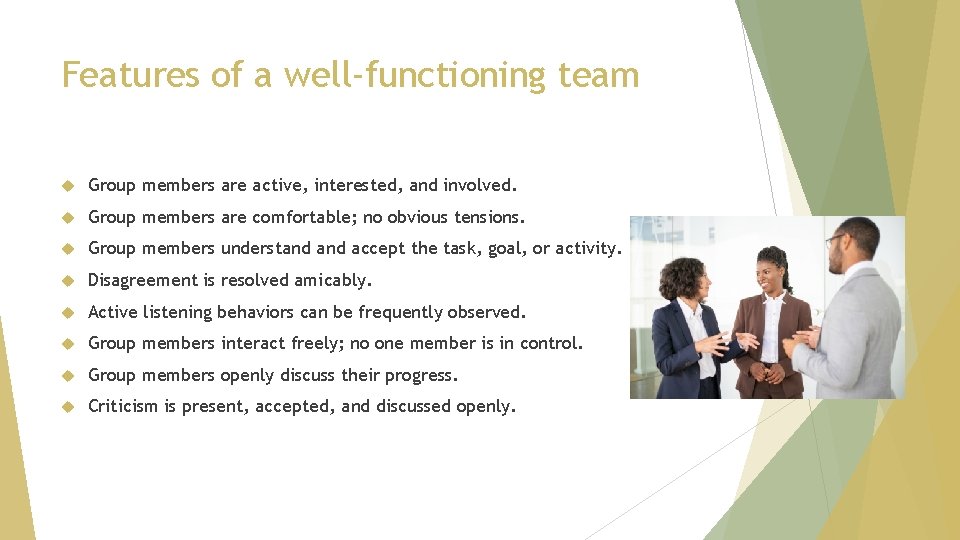
Features of a well-functioning team Group members are active, interested, and involved. Group members are comfortable; no obvious tensions. Group members understand accept the task, goal, or activity. Disagreement is resolved amicably. Active listening behaviors can be frequently observed. Group members interact freely; no one member is in control. Group members openly discuss their progress. Criticism is present, accepted, and discussed openly.
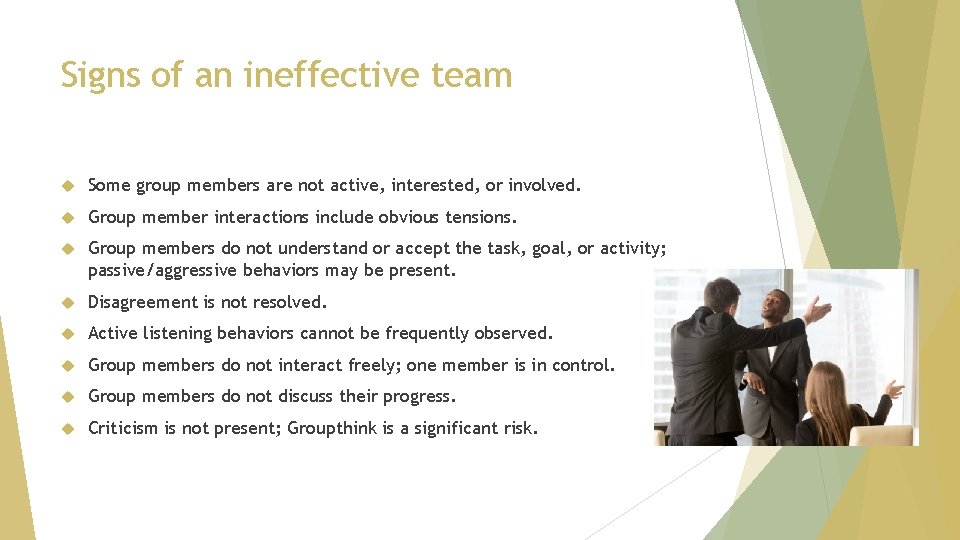
Signs of an ineffective team Some group members are not active, interested, or involved. Group member interactions include obvious tensions. Group members do not understand or accept the task, goal, or activity; passive/aggressive behaviors may be present. Disagreement is not resolved. Active listening behaviors cannot be frequently observed. Group members do not interact freely; one member is in control. Group members do not discuss their progress. Criticism is not present; Groupthink is a significant risk.
Strategies to improve team interactions Encourage every member to contribute, speak, or share their thoughts. Encourage every member to understand their role, and everyone’s roles, and how they complement each other. Encourage interdependence and interaction. Encourage the group to build on their common strengths and skills, celebrating incremental success. Encourage active listing and refrain from interruptions. Encourage group members to assess their collective progress frequently.
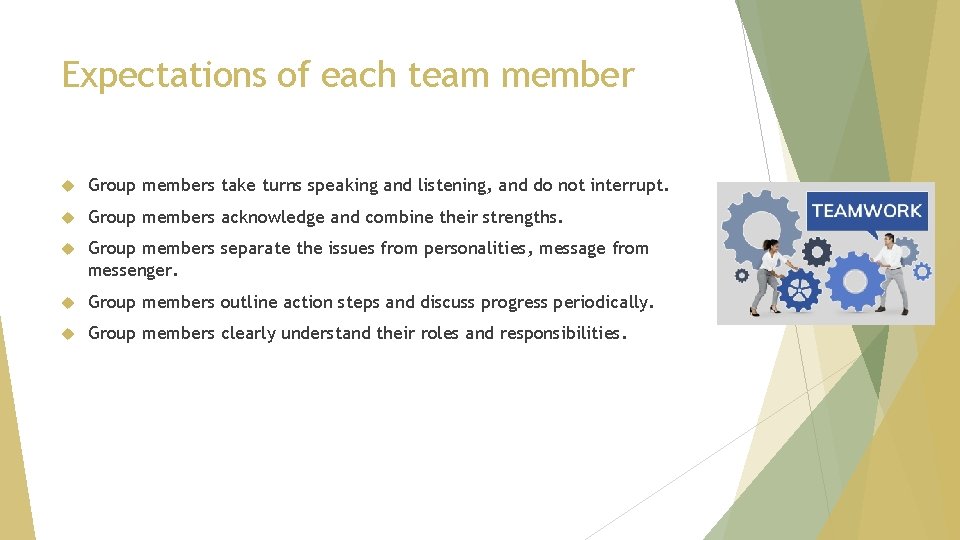
Expectations of each team member Group members take turns speaking and listening, and do not interrupt. Group members acknowledge and combine their strengths. Group members separate the issues from personalities, message from messenger. Group members outline action steps and discuss progress periodically. Group members clearly understand their roles and responsibilities.
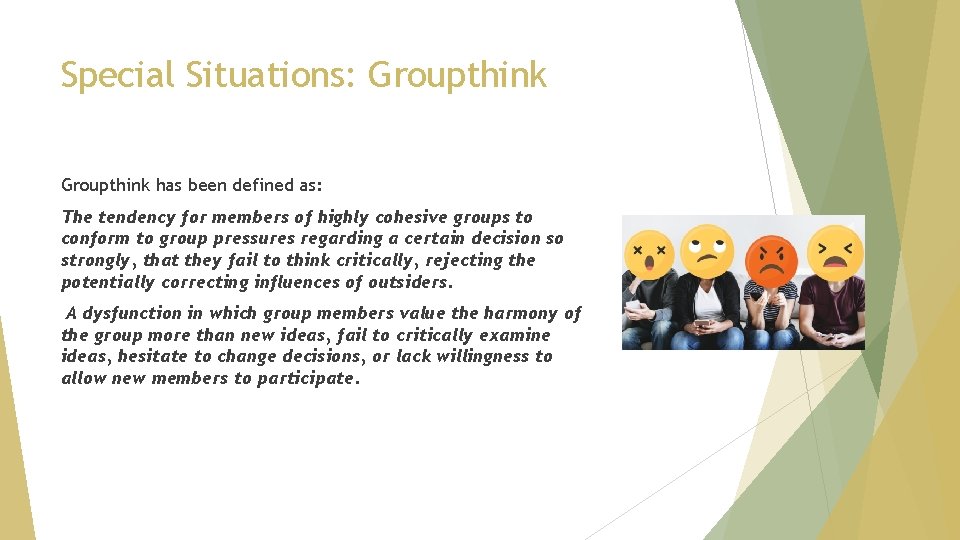
Special Situations: Groupthink has been defined as: The tendency for members of highly cohesive groups to conform to group pressures regarding a certain decision so strongly, that they fail to think critically, rejecting the potentially correcting influences of outsiders. A dysfunction in which group members value the harmony of the group more than new ideas, fail to critically examine ideas, hesitate to change decisions, or lack willingness to allow new members to participate.
Special Situations: Groupthink may sap the creative potential of the members. Too much diversity in outlooks and work styles may act as a barrier to a group, but too little diversity also represents a threat to success. If they too easily adopt and hold onto one viewpoint or course of action, people may fall prey to two dangers. First, they may overlook flaws in their thinking. Second, they may fail to anticipate dangers that they might have been detected with closer scrutiny and longer reflection. Being aware of groupthink can help teams and leaders overcome this common hurdle.
Activity | Group Analysis Identify two groups of which you are or had been a member. Describe how each group determined how to take turns in communicating—or, if you weren’t part of determining this process, how people take turns now; the most controversial view you can recall being expressed in each group; and a task which feel each group performed better than any of its individuals might have done alone.
Communication within the Team Communication Flow | Team Development
Communication flow In a business setting people exchange information and ideas at different levels. This is because people inevitably share information as they work. Communication in an organization flows in different directions: Downward – used by managers to control and provide direction Upward – information/feedback from subordinates to management Lateral – communication among colleagues
Downward Communication Any communication from a executive, management or supervisory level to their direct reports or subordinates is an example of downward communication. This communication is very common and takes the form of meetings, policy documents, memos and even notices posted around the workplace.
Upward Communication starts with the subordinates and flows through to the Head of Department. The Departmental Head gets ideas, suggestions, views, grievances and problems from his subordinates (Junior officers). An effective manager or team lead welcomes and encourages upward communication from his staff.
Lateral/Horizontal communication Horizontal Communication: Takes place between parallel groups in the organization. The nature of interaction may be between: - Subordinates and subordinates. Head of one department and another. Supervisors and Managers. Managing Director and his Departmental Managers etc.
Communication Technology As companies share information there is a wide range of technology they may utilize. These may include: Email Databases Public address systems Projectors and other presentation systems Video conferencing equipment
Activity | Communication Technology in the workplace Demonstrate your familiarity with the following technology in the workplace: Email Public address systems Printers and Photo copy machines Projector Draft a Power. Point presentation outlining the Features of the technologies listed above Examples of how each is used in the workplace Best practices and tips
Group Communication Interpersonal communication occurs between two people, but group communication may involve two or more individuals. Groups are a primary context for interaction within the business community. Groups include a mix of personalities, experience, skillset and knowledge among members. Groups share common goals, but may also engage in conflict. Groups can be supportive or coercive, and can exert powerful influences over individuals. Teams and departments engage in group communication within the groups and with other groups. An understanding of group dynamics is crucial to help to manage communication with teams.
Group Dynamics Groups are dynamic systems, in constant change. Groups grow together and eventually come apart. People join groups and others leave. It is important that all know how to communicate during each of the stages. Groups go through different stages: Forming Storming Norming Performing
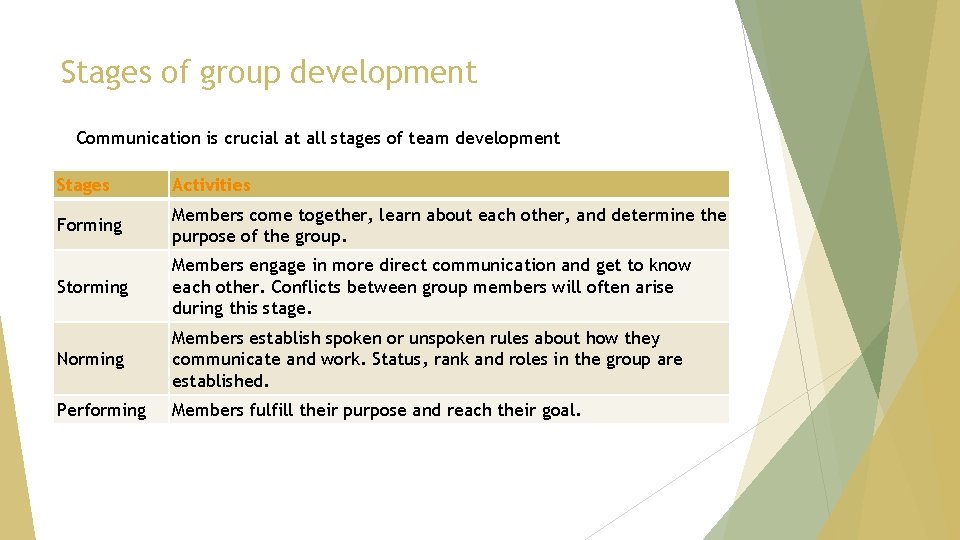
Stages of group development Communication is crucial at all stages of team development Stages Activities Forming Members come together, learn about each other, and determine the purpose of the group. Storming Members engage in more direct communication and get to know each other. Conflicts between group members will often arise during this stage. Norming Members establish spoken or unspoken rules about how they communicate and work. Status, rank and roles in the group are established. Performing Members fulfill their purpose and reach their goal.
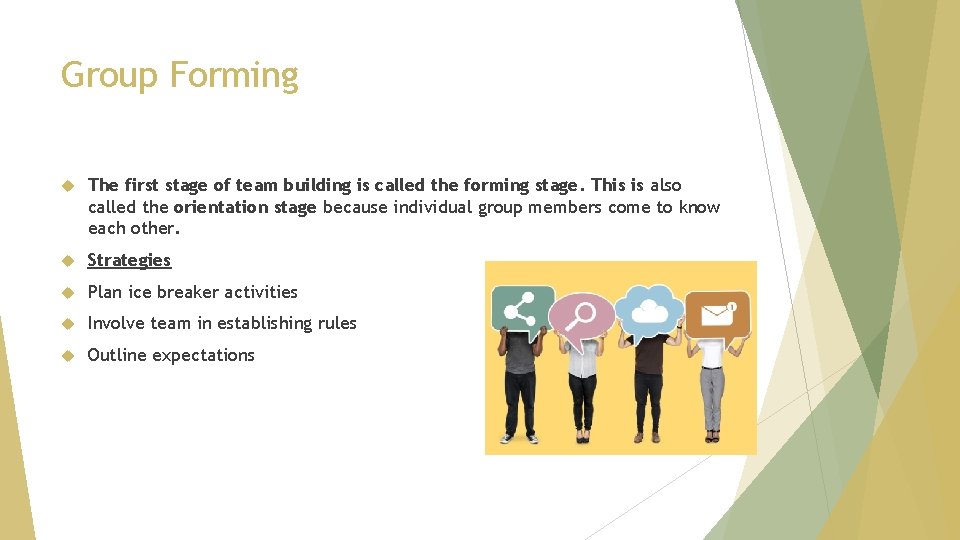
Group Forming The first stage of team building is called the forming stage. This is also called the orientation stage because individual group members come to know each other. Strategies Plan ice breaker activities Involve team in establishing rules Outline expectations
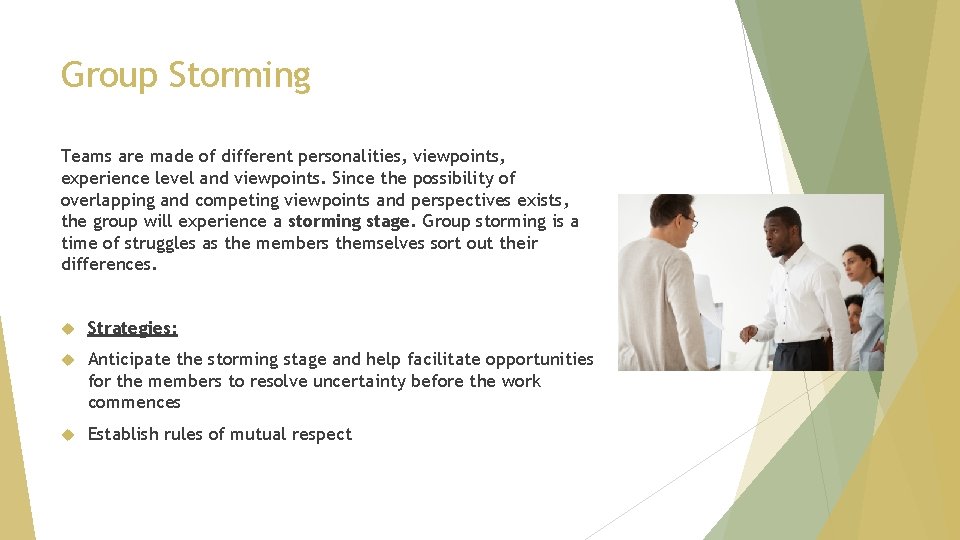
Group Storming Teams are made of different personalities, viewpoints, experience level and viewpoints. Since the possibility of overlapping and competing viewpoints and perspectives exists, the group will experience a storming stage. Group storming is a time of struggles as the members themselves sort out their differences. Strategies: Anticipate the storming stage and help facilitate opportunities for the members to resolve uncertainty before the work commences Establish rules of mutual respect
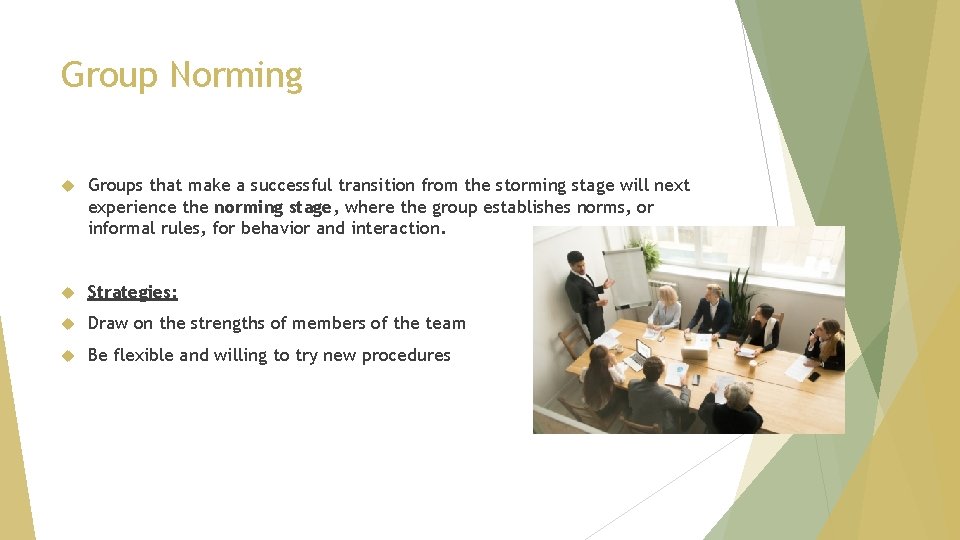
Group Norming Groups that make a successful transition from the storming stage will next experience the norming stage, where the group establishes norms, or informal rules, for behavior and interaction. Strategies: Draw on the strengths of members of the team Be flexible and willing to try new procedures
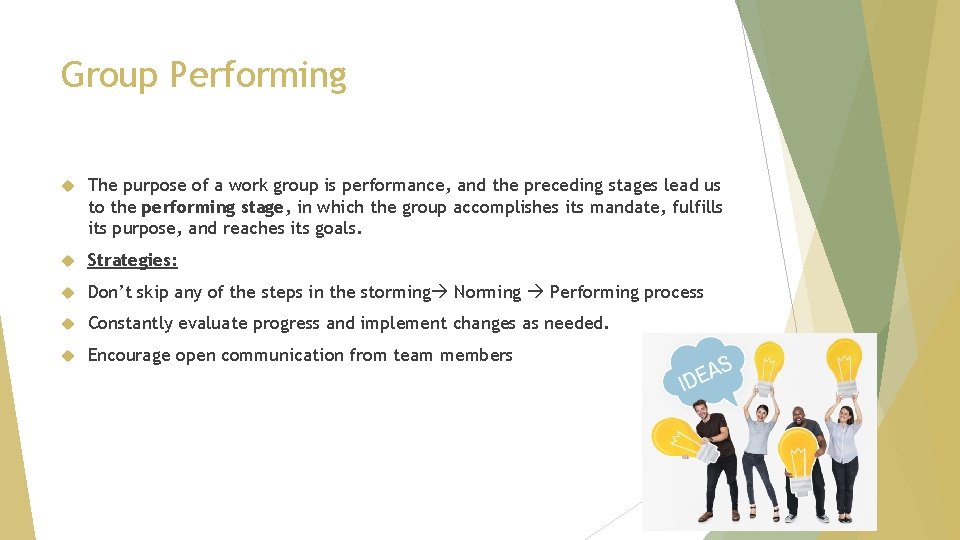
Group Performing The purpose of a work group is performance, and the preceding stages lead us to the performing stage, in which the group accomplishes its mandate, fulfills its purpose, and reaches its goals. Strategies: Don’t skip any of the steps in the storming Norming Performing process Constantly evaluate progress and implement changes as needed. Encourage open communication from team members
Group Adjourning Eventually with all groups, the time has come to move on to new assignments. In the adjourning stage, group members leave the group. The group may cease to exist, or it may be transformed with new members and a new set of goals Strategies: A wise manager anticipates this stage and facilitates the separation with skill and ease. We often close this process with a ritual marking its passing, e. g. a farewell dinner or thank you cards to the departing members. If group breaks up suddenly perhaps due to redundancy or company decision, care is to be taken in communicating options to the team.

Team roles GENERAL | NEGATIVE | POSITIVE
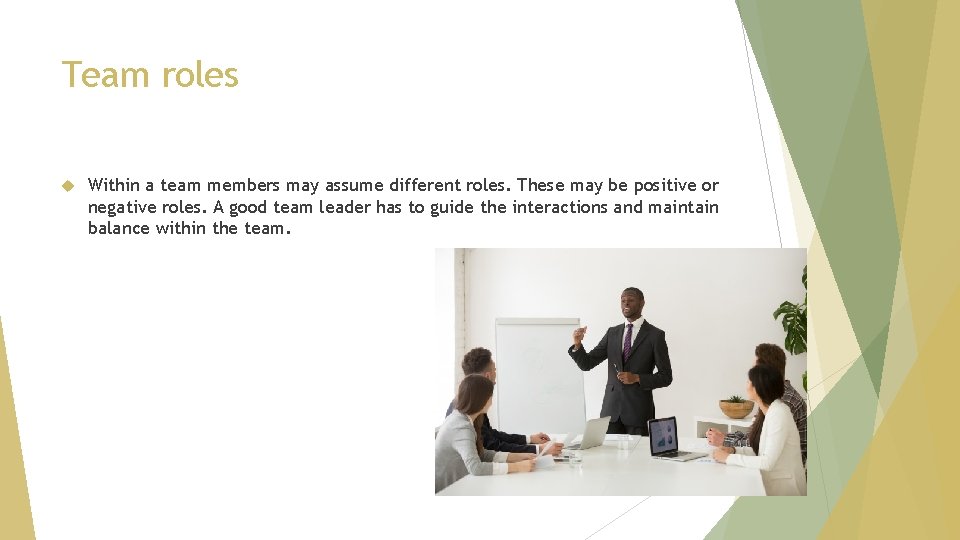
Team roles Within a team members may assume different roles. These may be positive or negative roles. A good team leader has to guide the interactions and maintain balance within the team.
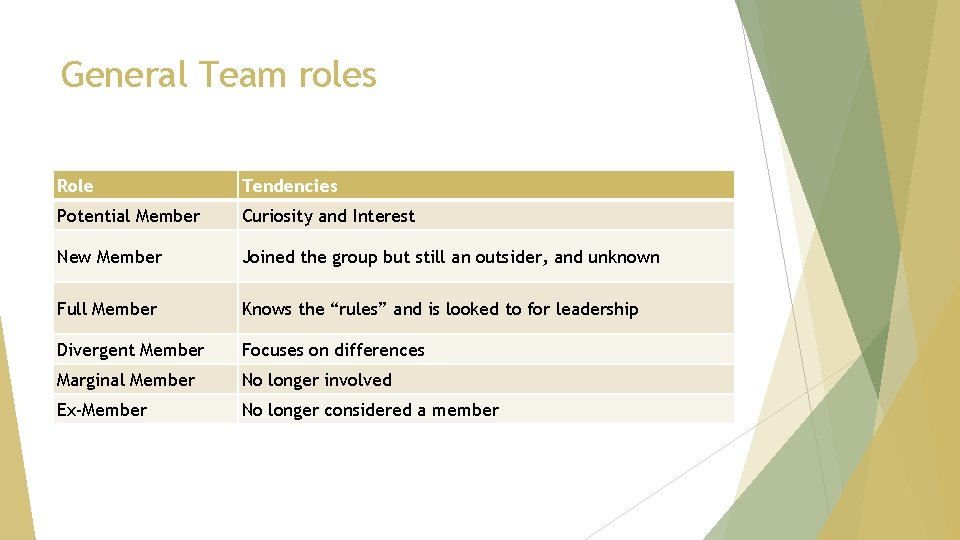
General Team roles Role Tendencies Potential Member Curiosity and Interest New Member Joined the group but still an outsider, and unknown Full Member Knows the “rules” and is looked to for leadership Divergent Member Focuses on differences Marginal Member No longer involved Ex-Member No longer considered a member
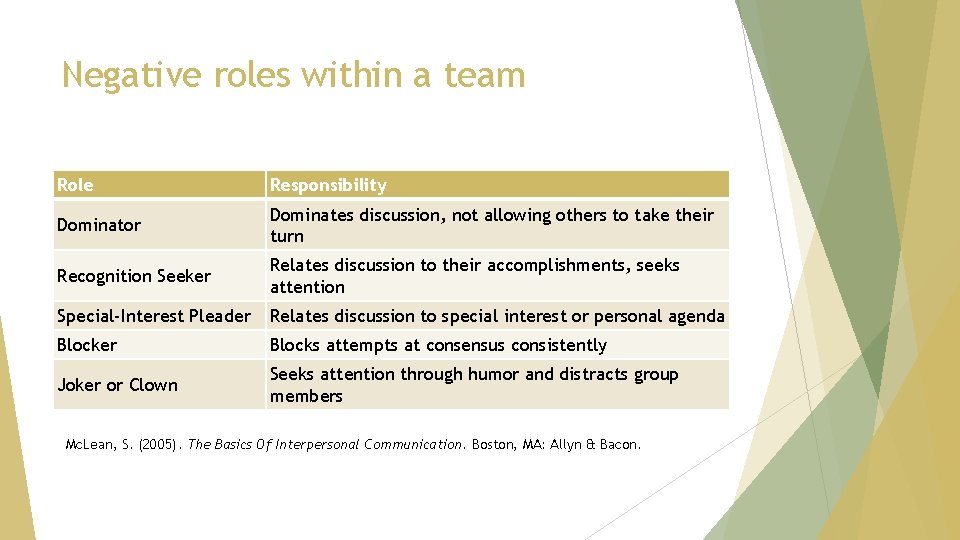
Negative roles within a team Role Responsibility Dominator Dominates discussion, not allowing others to take their turn Recognition Seeker Relates discussion to their accomplishments, seeks attention Special-Interest Pleader Relates discussion to special interest or personal agenda Blocker Blocks attempts at consensus consistently Joker or Clown Seeks attention through humor and distracts group members Mc. Lean, S. (2005). The Basics Of Interpersonal Communication. Boston, MA: Allyn & Bacon.
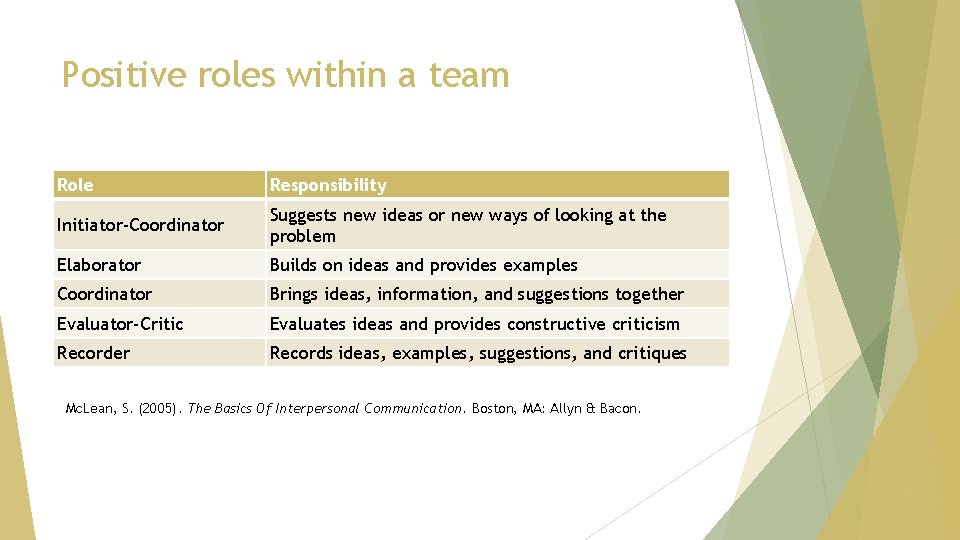
Positive roles within a team Role Responsibility Initiator-Coordinator Suggests new ideas or new ways of looking at the problem Elaborator Builds on ideas and provides examples Coordinator Brings ideas, information, and suggestions together Evaluator-Critic Evaluates ideas and provides constructive criticism Recorder Records ideas, examples, suggestions, and critiques Mc. Lean, S. (2005). The Basics Of Interpersonal Communication. Boston, MA: Allyn & Bacon.
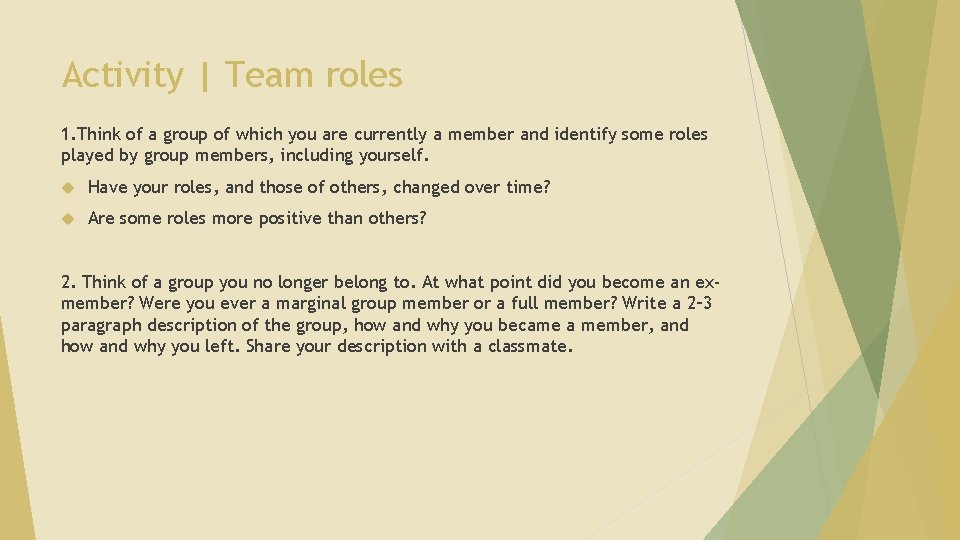
Activity | Team roles 1. Think of a group of which you are currently a member and identify some roles played by group members, including yourself. Have your roles, and those of others, changed over time? Are some roles more positive than others? 2. Think of a group you no longer belong to. At what point did you become an exmember? Were you ever a marginal group member or a full member? Write a 2– 3 paragraph description of the group, how and why you became a member, and how and why you left. Share your description with a classmate.
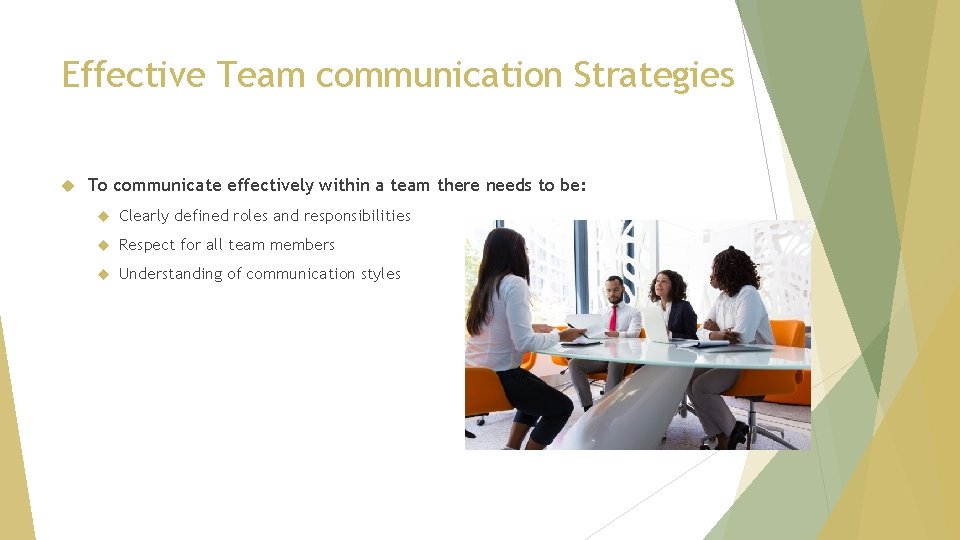
Effective Team communication Strategies To communicate effectively within a team there needs to be: Clearly defined roles and responsibilities Respect for all team members Understanding of communication styles
Communication Styles Everyone has their own preferred style of communicating or interacting with others. Some are considered to be the life of the party talk, others have strong opinions they are not afraid to share while at the other end of the spectrum are those who are introverted, shy individuals. Understanding your own style and that of other will help you become an effective communicator. Communication Styles Passive Aggressive Passive-Aggressive Assertive
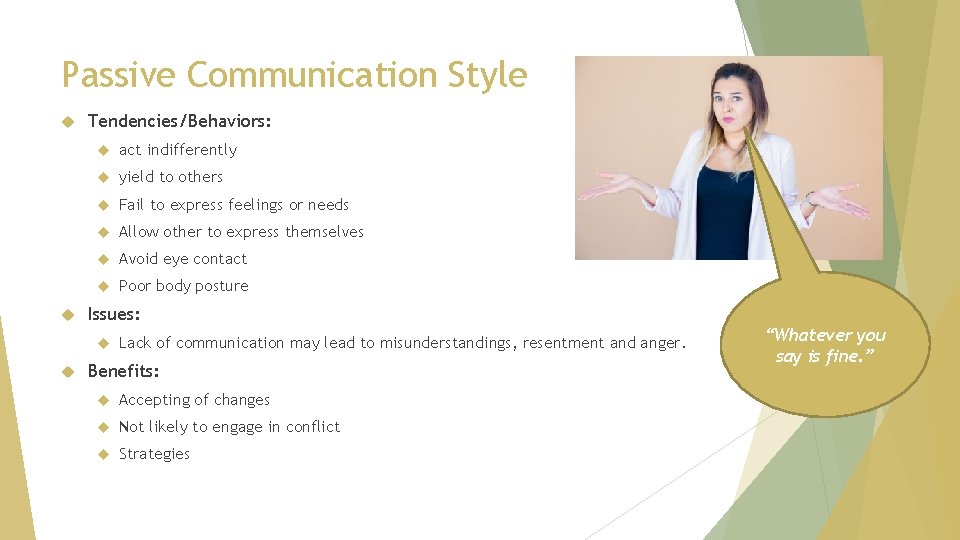
Passive Communication Style Tendencies/Behaviors: act indifferently yield to others Fail to express feelings or needs Allow other to express themselves Avoid eye contact Poor body posture Issues: Lack of communication may lead to misunderstandings, resentment and anger. Benefits: Accepting of changes Not likely to engage in conflict Strategies “Whatever you say is fine. ”
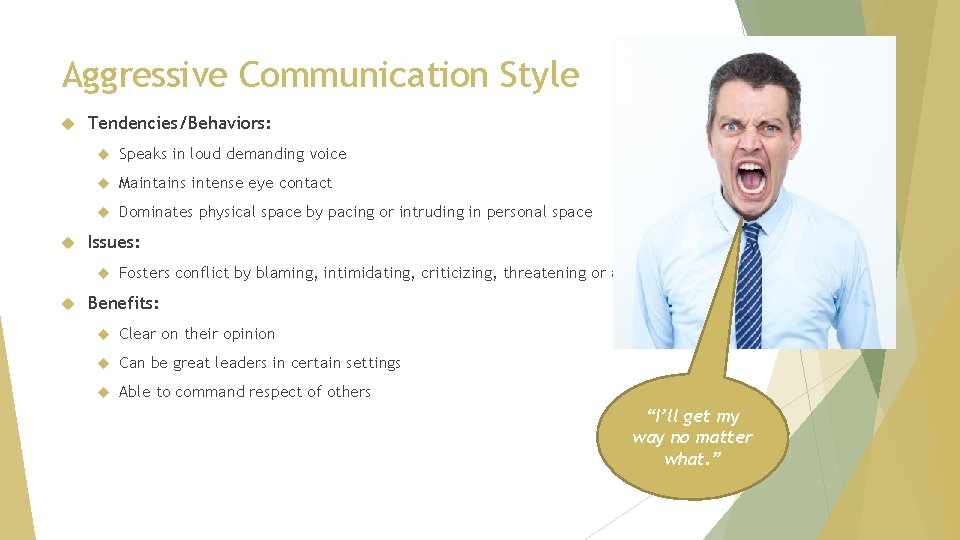
Aggressive Communication Style Tendencies/Behaviors: Speaks in loud demanding voice Maintains intense eye contact Dominates physical space by pacing or intruding in personal space Issues: Fosters conflict by blaming, intimidating, criticizing, threatening or attacking Benefits: Clear on their opinion Can be great leaders in certain settings Able to command respect of others “I’ll get my way no matter what. ”
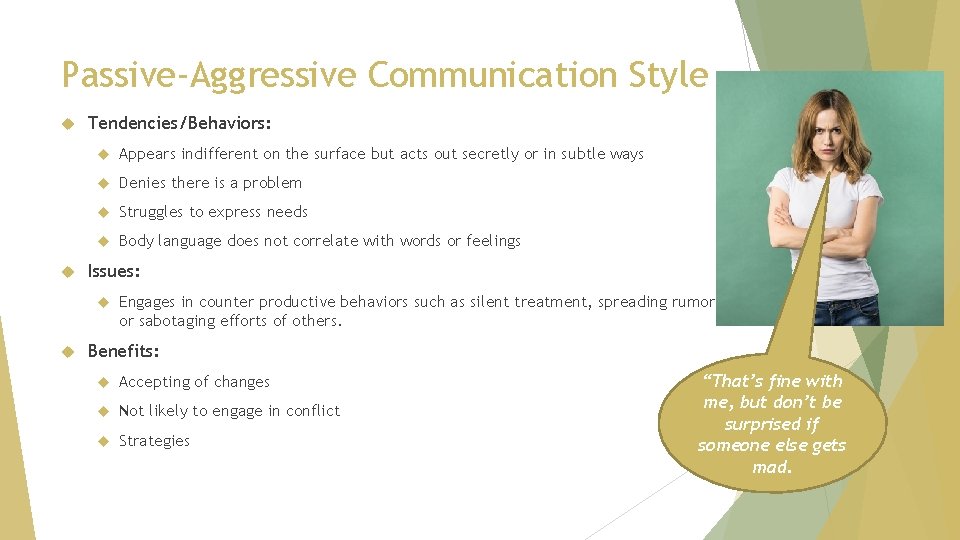
Passive-Aggressive Communication Style Tendencies/Behaviors: Appears indifferent on the surface but acts out secretly or in subtle ways Denies there is a problem Struggles to express needs Body language does not correlate with words or feelings Issues: Engages in counter productive behaviors such as silent treatment, spreading rumors or sabotaging efforts of others. Benefits: Accepting of changes Not likely to engage in conflict Strategies “That’s fine with me, but don’t be surprised if someone else gets mad.
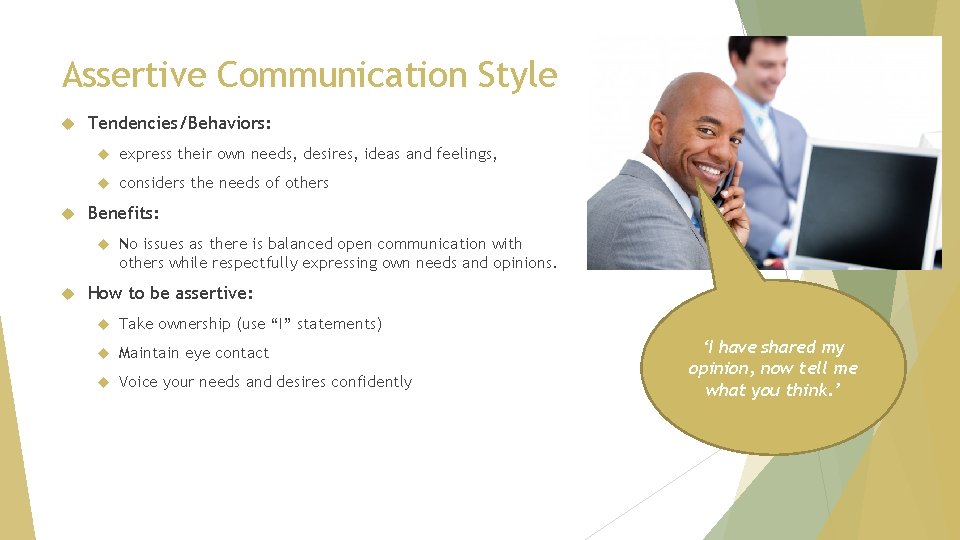
Assertive Communication Style Tendencies/Behaviors: express their own needs, desires, ideas and feelings, considers the needs of others Benefits: No issues as there is balanced open communication with others while respectfully expressing own needs and opinions. How to be assertive: Take ownership (use “I” statements) Maintain eye contact Voice your needs and desires confidently ‘I have shared my opinion, now tell me what you think. ’
Special Situations: Crucial conversations Crucial conversation includes difficult conversations which may arise in the workplace. It is important to know to handle these special conversations as there are consequences is there avoided or handled poorly. Examples: Asking for a raise/promotion Evaluating a peer or subordinate Addressing inappropriate behavior Financial issues Work related conflict
Activity | Difficult conversations within a team Role play with another trainee two scenes showing the wrong way and the recommended way to handle one (1) of the following scenarios: Asking for a raise/promotion Evaluating a peer or subordinate Addressing inappropriate behavior Financial issues Work related conflict
Communication amongst Teams COMMUNICATION CHANNELS | CULTURAL DIVERSITY | SPECIAL CIRCUMSTANCES
Team-to-team communication It is expected for there to be communication with different teams in the same business place. The Human Resources Department has to communicate with the management team and other groups in the workplace. Each department many have been divided into team or units. While each unit is a self-contained team able to execute its designated function, units or teams regularly need to communicate with other teams within the same depart, different department or different locations.
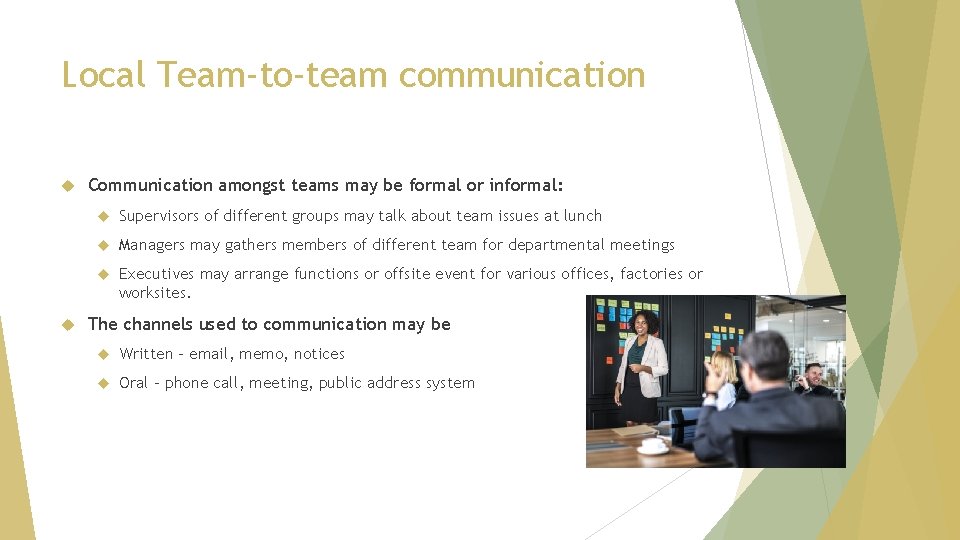
Local Team-to-team communication Communication amongst teams may be formal or informal: Supervisors of different groups may talk about team issues at lunch Managers may gathers members of different team for departmental meetings Executives may arrange functions or offsite event for various offices, factories or worksites. The channels used to communication may be Written – email, memo, notices Oral – phone call, meeting, public address system
Activity | Team to Team Communication Conduct a review of a local company. Determine: Number of locations Number of staff Names of departments throughout the company Number and types of teams in each location Opportunities for team interactions
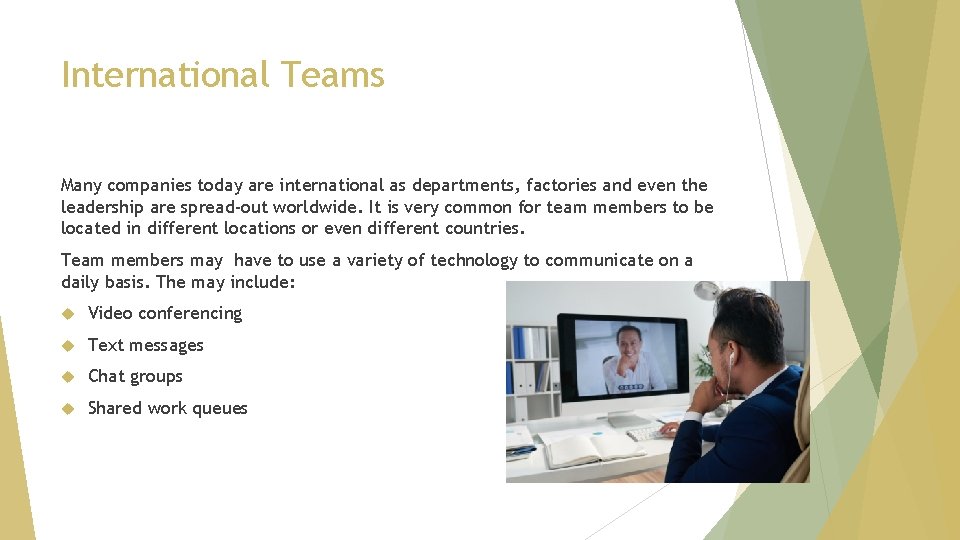
International Teams Many companies today are international as departments, factories and even the leadership are spread-out worldwide. It is very common for team members to be located in different locations or even different countries. Team members may have to use a variety of technology to communicate on a daily basis. The may include: Video conferencing Text messages Chat groups Shared work queues
Special situations : Cultural differences People sometimes assume that learning about other cultures is unnecessary if we simply treat others as we would like to be treated. To test this assumption, try answering the following questions. When receiving a gift from a friend, should you open it immediately, or wait to open it in private? When grocery shopping, should you touch fruits and vegetables to evaluate their freshness? In a conversation with your instructor or your supervisor at work, should you maintain direct eye contact? Write down your answers before reading further. Now let’s explore how these questions might be answered in various cultures.

Intercultural team In Chile, it is good manners to open a gift immediately and express delight and thanks. But in Japan it is a traditional custom to not open a gift in the giver’s presence. In the United States, shoppers typically touch, hold, and even smell fruits and vegetables before buying them. But in northern Europe this is strongly frowned upon. In mainstream North American culture, people are expected to look directly at each other when having a conversation. But a cultural norm for many Native Americans involves keeping one’s eyes lowered as a sign of respect when speaking to an instructor or supervisor.
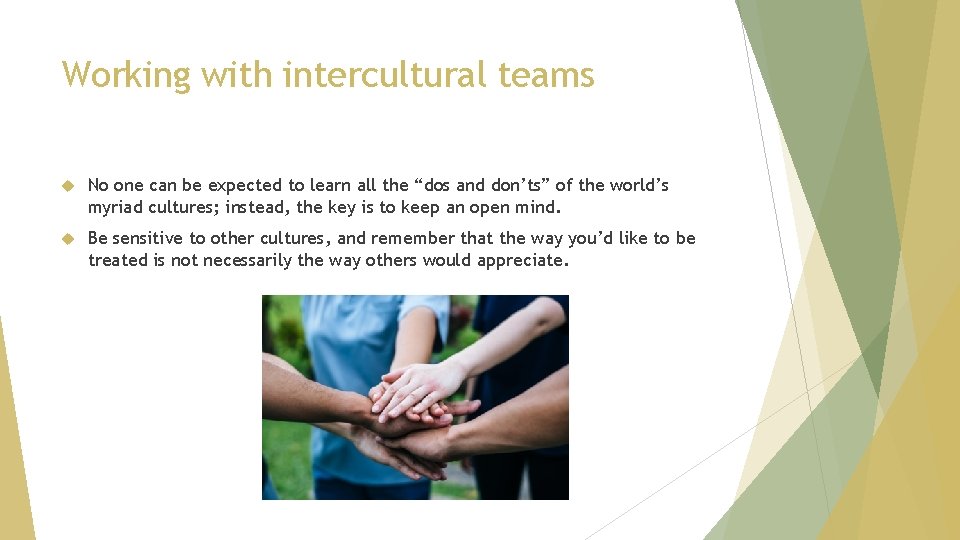
Working with intercultural teams No one can be expected to learn all the “dos and don’ts” of the world’s myriad cultures; instead, the key is to keep an open mind. Be sensitive to other cultures, and remember that the way you’d like to be treated is not necessarily the way others would appreciate.
Activity | International Team Interview a business person in an international company who routinely works with team members in different countries/time zones. Ask about: Comparison between working with local/international co-workers Challenges e. g. language, time zones, cultural etc. Technology used Advantages to working with a virtual team
Special Situation: Confidentiality Maintaining confidentiality in the workplace is important for building and maintaining trust, and for ensuring an open and honest communication between customers, clients and employees.
Need for confidentiality Confidentiality is of paramount importance. It is the employee's responsibility to treat all the information in the workplace with care and caution. An employee should be prudent enough not to disclose any information that the organization considers sensitive and confidential, to a third party, until and unless the employee has consulted and taken permission from his supervisor regarding the same. Also, one should refrain from sharing any personal details with fellow colleagues at work.
Strategies to maintain confidentiality Use of secure passwords to access data Encryption of data prior to submission Use of only secure channels for sensitive information Procedure for storage, retrieval and access to confidential documents Employees required to sign confidentiality and Non-disclosure agreements
Employer Responsibilities Develop policies related to confidentiality Communicate all policies and updates to all the employees, supervisors and managers. Train staff about the confidentiality issues by giving them printouts of the policy or holding meetings and seminars in the office which teach the importance of confidentiality to the employees. Refresher sessions should also be held.
Employee responsibilities An employee should know what files or materials he is permitted to access in the office and he should adhere to that. Under no circumstances should these files be shared or given to unauthorized people. This is because if it reaches the wrong hands, it can be considered as a breach of confidentiality and the employee may even be dismissed for it. Employees should not discuss any business dealings with the clients, outside work.
Activity | Confidentiality Do appropriate research and identify at least (3) consequences if there is a breach of confidentiality in the workplace. Outline the impacts on: Company/employer Employee Clients
Glossary Communication flow. The direction (upward, downward, horizontal) messages travel through the networks in an organization. Group. An aggregate of individuals having some characteristic in common. They may be distinguished from others by appearance, language, socio-economic status or cultural values and practices. Groupthink. The tendency for members of highly cohesive groups to conform to group pressures regarding a certain decision so strongly, that they fail to think critically, rejecting the potentially correcting influences of outsiders. 2. A dysfunction in which group members value the harmony of the group more than new ideas, fail to critically examine ideas, hesitate to change decisions, or lack willingness to allow new members to participate. Small talk. Casual conversation that is often impersonal and superficial, including greetings, comments about the weather, newsworthy events, or trivia. Team. A group whose members have complementary skills and are committed to a common purpose or set of performance goals for which they hold themselves mutually accountable. 2. A special form of group that is characterized by a closeknit relationship, members with different and complementary abilities, and a strong sense of identity.
References Hahn, L. K. , (2009) Survey of Communication Study. Retrieved from https: //en. wikibooks. org/wiki/Survey_of_Communication_Study Stand Up and Speak Out – The Practice and Ethics of Public Speaking. , (n. d. ) Retrieved fromhttps: //saylordotorg. github. io/text_stand-up-speak-out-the-practice-and-ethics-of-public-speaking/index. html An Introduction to Group Communication (n. d. ) Retrieved from: https: //2012 books. lardbucket. org/books/anintroduction-to-group-communication/index. html Mc. Lean, S. (2005). The Basics Of Interpersonal Communication. Boston, MA: Allyn & Bacon.

Photo Credits Unless otherwise cited photos are sourced from https: //www. freepik. com/ which permits private and commercial use as long as the creator/website is attributed.
- Slides: 66