
MANAGE INTOXICATED PERSONS D 1 HBS CL 5
MANAGE INTOXICATED PERSONS D 1. HBS. CL 5. 17 D 1. HSS. CL 4. 07 Slide 1
Subject Elements This unit comprises three Elements: � Determine the level of intoxication � Apply appropriate procedures � Comply with legislation. Slide 2
Assessment for this unit may include: � Oral questions � Written questions � Work projects � Workplace observation of practical skills � Practical exercises � Formal report from supervisor. Slide 3
Element 1: Determine the level of intoxication Slide 4
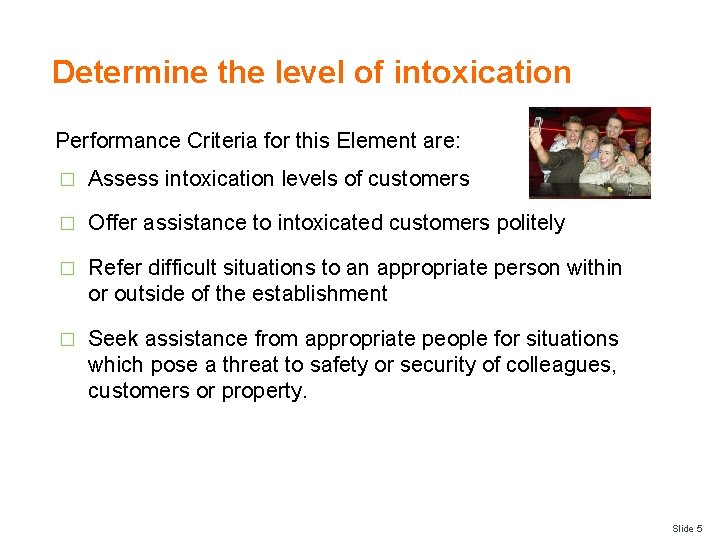
Determine the level of intoxication Performance Criteria for this Element are: � Assess intoxication levels of customers � Offer assistance to intoxicated customers politely � Refer difficult situations to an appropriate person within or outside of the establishment � Seek assistance from appropriate people for situations which pose a threat to safety or security of colleagues, customers or property. Slide 5
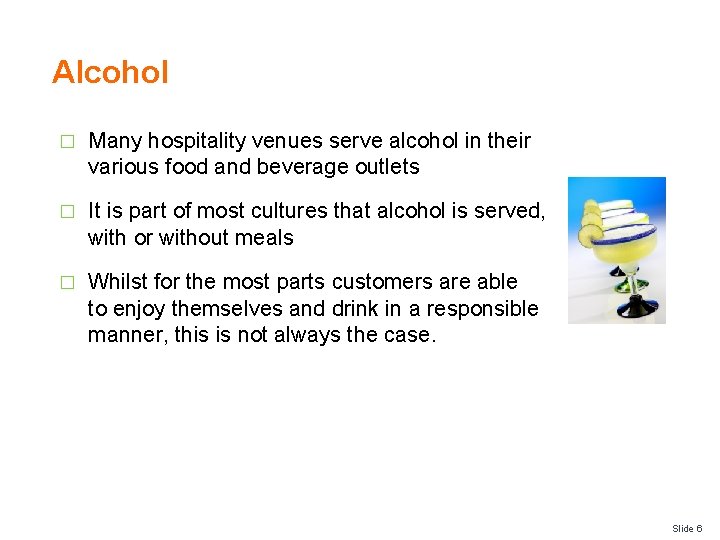
Alcohol � Many hospitality venues serve alcohol in their various food and beverage outlets � It is part of most cultures that alcohol is served, with or without meals � Whilst for the most parts customers are able to enjoy themselves and drink in a responsible manner, this is not always the case. Slide 6
Alcohol The purpose of this subject is to enable hospitality staff to: � Understand the legal implications when serving alcohol � Understand their responsibilities in relation to the service of alcohol � Handle situations where people are intoxicated. Slide 7
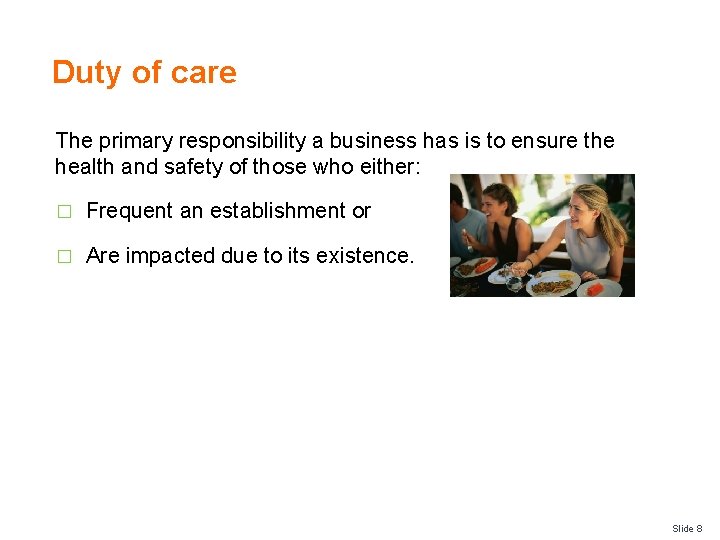
Duty of care The primary responsibility a business has is to ensure the health and safety of those who either: � Frequent an establishment or � Are impacted due to its existence. Slide 8
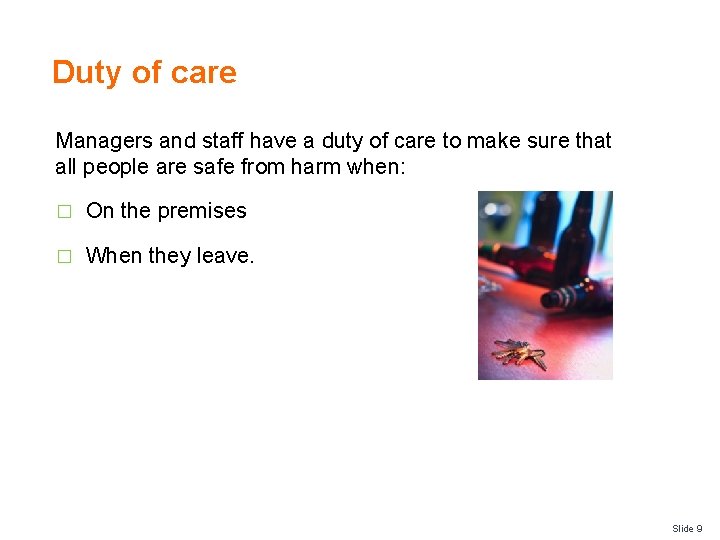
Duty of care Managers and staff have a duty of care to make sure that all people are safe from harm when: � On the premises � When they leave. Slide 9
Duty of care This duty of care is owed to all people in the environment including: � Customers � Owners � Managers � Staff � General Public. Slide 10
Responsible service of alcohol Every organisation must promote the responsible service of alcohol. � What is it? � How do you do it? Slide 11
Responsible service of alcohol Benefits to the business: � Increase to reputation � Reduces fines and liability � Allows a business to remain operational � Increased business and profits as people feel comfortable visiting your establishment � Less likely to have damage to the premises due to breakages, spillage, vomit. Slide 12
Responsible service of alcohol Benefits to the business: � Reduced costs to repair broken items � Create disorder and ruin the ambience of a venue � Reduces staff costs as less staff are required to handle drunk patrons � Reduced liability and insurance � Reduced legal claims. Slide 13
Responsible service of alcohol Benefits to staff: � Less stress for staff � Less potential harm or threatening actions � Enables easier communication with customers � Less work for staff � Creates a safe and harmonious work place for all staff and customers � Increases job satisfaction and security. Slide 14
Responsible service of alcohol Benefits to customers: � Reduces chance of customers hurting themselves or others � Allows the atmosphere and experience of fellow customers to be positive � Reduces violent or threatening behaviour � Reduces crimes and domestic violence � Reduces drink driving which is a leading cause of road and pedestrian accidents. Slide 15
Alcohol � Alcohol is a substance that has become an everyday part of society � However what it is and how it affects the body is often not discussed. Slide 16
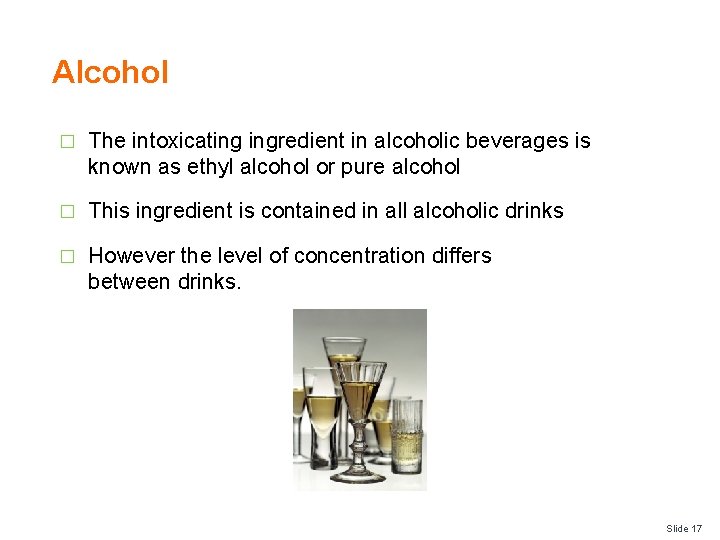
Alcohol � The intoxicating ingredient in alcoholic beverages is known as ethyl alcohol or pure alcohol � This ingredient is contained in all alcoholic drinks � However the level of concentration differs between drinks. Slide 17
Alcohol In order to make measurement as uniform as possible, the agreed convention for standardizing drinks is ‘grams of pure alcohol’. Slide 18
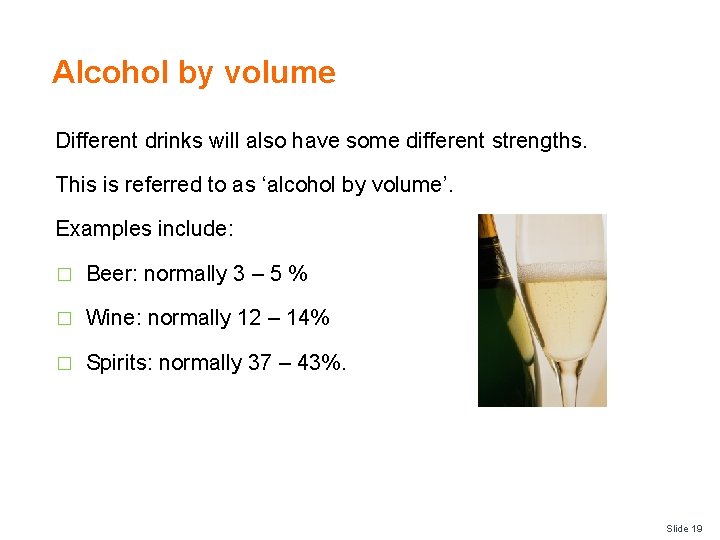
Alcohol by volume Different drinks will also have some different strengths. This is referred to as ‘alcohol by volume’. Examples include: � Beer: normally 3 – 5 % � Wine: normally 12 – 14% � Spirits: normally 37 – 43%. Slide 19
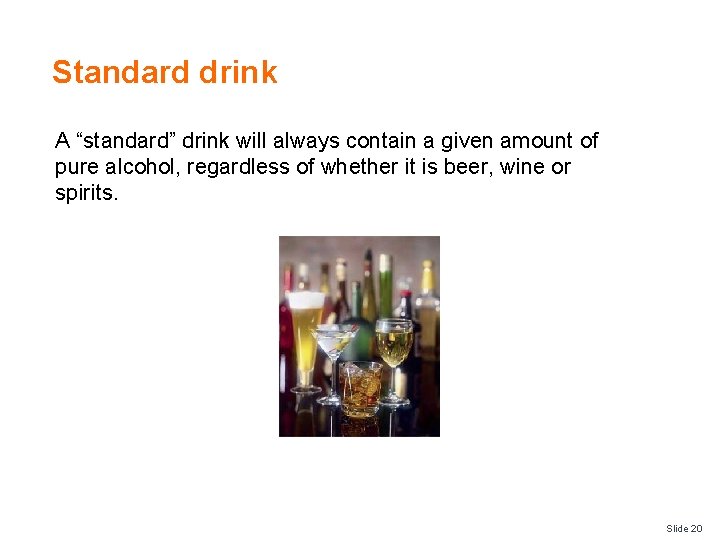
Standard drink A “standard” drink will always contain a given amount of pure alcohol, regardless of whether it is beer, wine or spirits. Slide 20
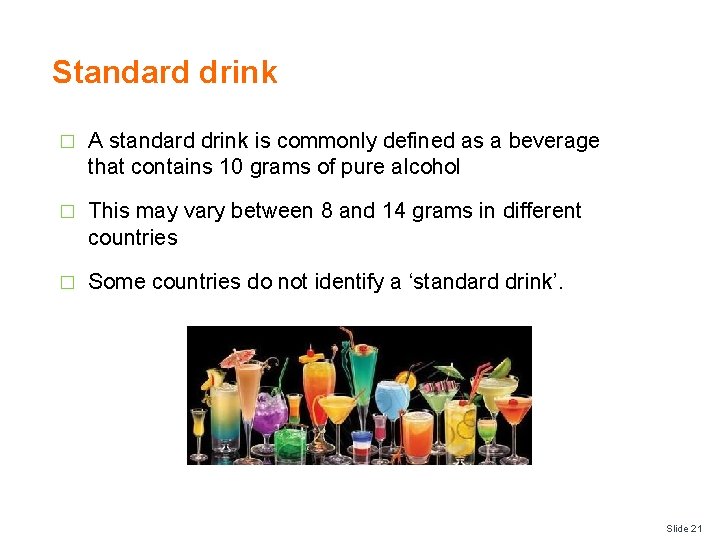
Standard drink � A standard drink is commonly defined as a beverage that contains 10 grams of pure alcohol � This may vary between 8 and 14 grams in different countries � Some countries do not identify a ‘standard drink’. Slide 21
Standard drink As a general rule, a standard drink can be defined as: � 30 mls of sprits � 285 mls of full strength beer � 100 mls of wine. Slide 22
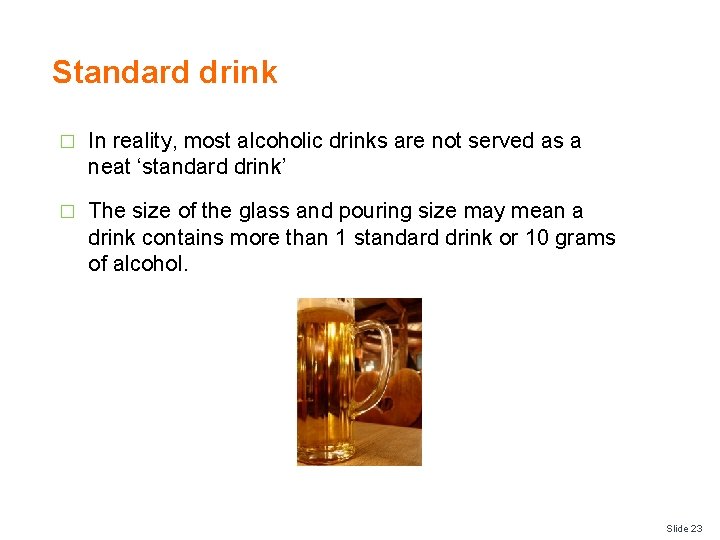
Standard drink � In reality, most alcoholic drinks are not served as a neat ‘standard drink’ � The size of the glass and pouring size may mean a drink contains more than 1 standard drink or 10 grams of alcohol. Slide 23
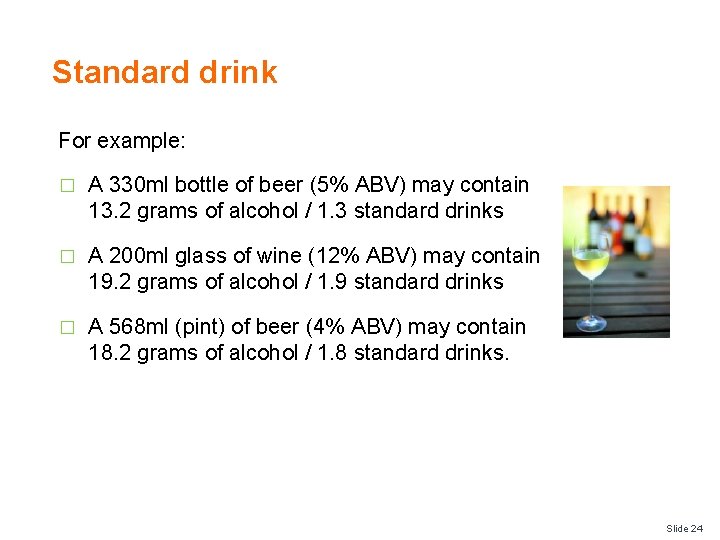
Standard drink For example: � A 330 ml bottle of beer (5% ABV) may contain 13. 2 grams of alcohol / 1. 3 standard drinks � A 200 ml glass of wine (12% ABV) may contain 19. 2 grams of alcohol / 1. 9 standard drinks � A 568 ml (pint) of beer (4% ABV) may contain 18. 2 grams of alcohol / 1. 8 standard drinks. Slide 24
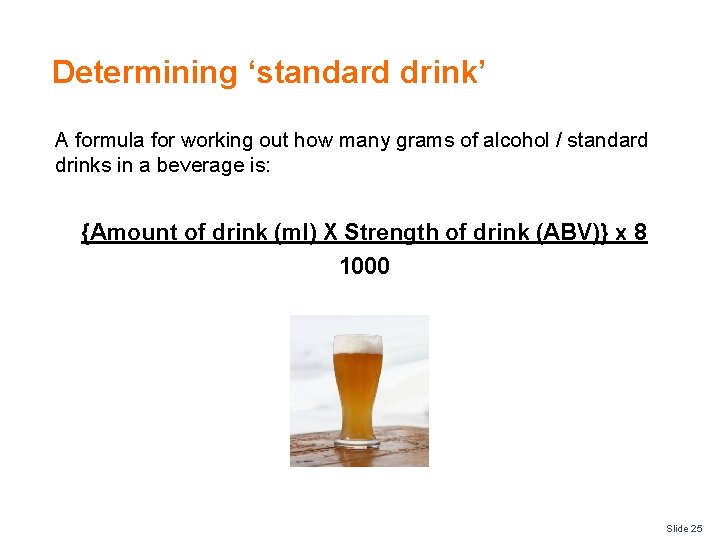
Determining ‘standard drink’ A formula for working out how many grams of alcohol / standard drinks in a beverage is: {Amount of drink (ml) X Strength of drink (ABV)} x 8 1000 Slide 25
Effects of alcohol Many people enjoy visiting hospitality organisations as it provides a chance for people to relax, unwind and enjoy themselves through the provision of good food, beverage and entertainment. � Why do people drink alcohol? � What effects does it have? Slide 26
Effects of alcohol It is still important to remember that alcohol: � Depresses the brain’s functions � Which leads to changes in a person’s behaviour. Slide 27
Effects of alcohol When consumed in an irresponsible manner alcohol can become a: � Dangerous and damaging substance � Which can have serious effects on a person. Slide 28
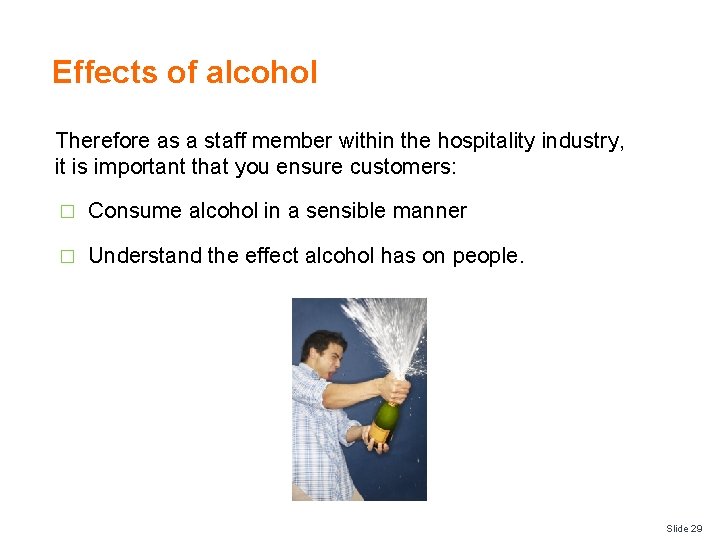
Effects of alcohol Therefore as a staff member within the hospitality industry, it is important that you ensure customers: � Consume alcohol in a sensible manner � Understand the effect alcohol has on people. Slide 29
Alcohol and the body Alcohol entering body � Alcohol, when consumed it is normally swallowed and goes into the stomach � The stomach breaks down food and drink before passing it to the small intestine � � It is then absorbed into the bloodstream The less food eaten, the quicker it is absorbed. Slide 30
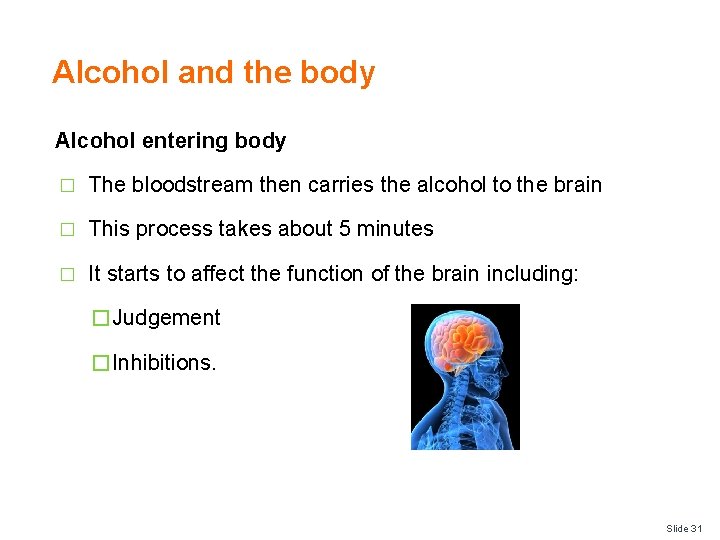
Alcohol and the body Alcohol entering body � The bloodstream then carries the alcohol to the brain � This process takes about 5 minutes � It starts to affect the function of the brain including: � Judgement � Inhibitions. Slide 31
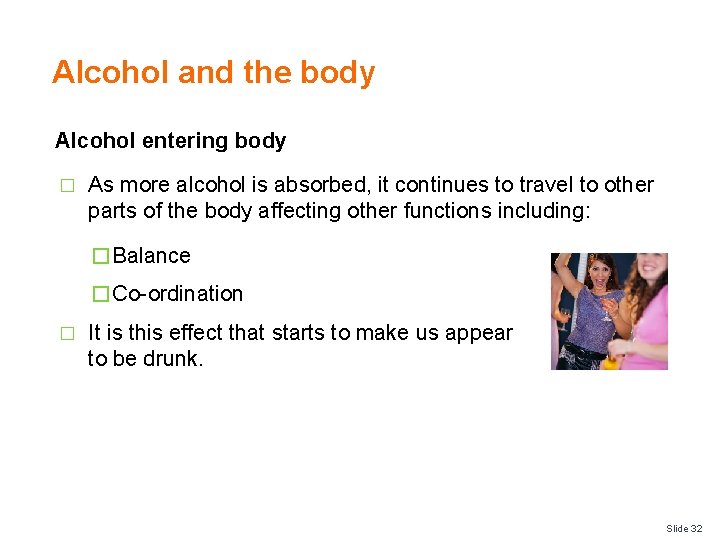
Alcohol and the body Alcohol entering body � As more alcohol is absorbed, it continues to travel to other parts of the body affecting other functions including: � Balance � Co-ordination � It is this effect that starts to make us appear to be drunk. Slide 32
Alcohol and the body Alcohol affects people differently In essence, alcohol affects different people in different ways due to: � Speed of drinking � Strength of drink � Person’s sex � Person’s weight � Amount of food eaten � Tolerance to alcohol. Slide 33
Monitoring intoxication As a staff member, it is important to: � Know the early symptoms of intoxication � Refuse to serve such customers well before they become obviously drunk. Slide 34
Monitoring intoxication As alcohol consumption increases it: � Worsens customer’s physical and mental functioning � Makes them less likely to be able to make decisions about their own well being. This is why it is up to the server to decide who has had enough to drink, not the drinking customer. Slide 35
Intoxication What is intoxication? Different countries will prohibit the sale or supply or alcohol to someone who appears to be intoxicated or drunk. � By what does this mean? � When do you know someone has reached this level? Slide 36
Intoxication What is intoxication? � In summary, “intoxicated” is the body’s response to having alcohol in the human system � This is always hard to identify so what signs exist that may indicate intoxication? Slide 37
Signs of intoxication Loss of coordination � Being clumsy � Eyes seem unfocused or glassy � Bumping into furniture and other people � Staggering � Falling down or tripping over things � Inability to walk in a straight line � Inability to do basic tasks like lifting a glass � Knocking things over. Slide 38
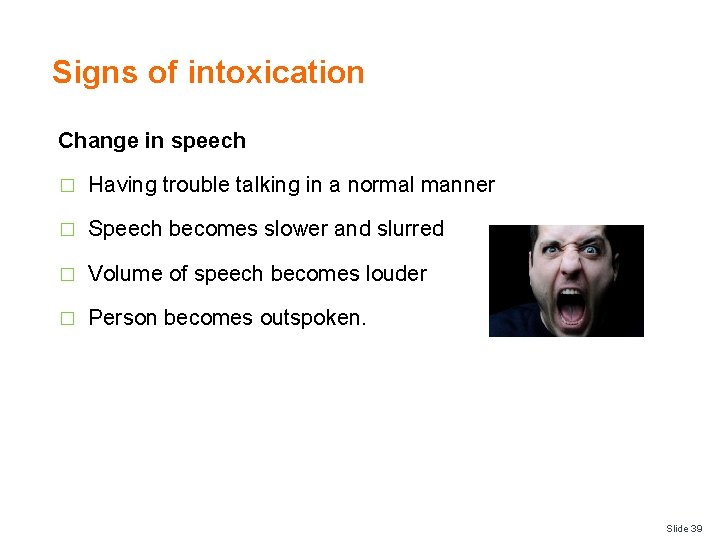
Signs of intoxication Change in speech � Having trouble talking in a normal manner � Speech becomes slower and slurred � Volume of speech becomes louder � Person becomes outspoken. Slide 39
Signs of intoxication Moods, behaviour and conduct � Big changes in mood over time � Personality changes � Becoming isolated from group � Inappropriately affectionate � Extremely outgoing � Wanting to cause arguments � Being over affectionate to strangers. Slide 40
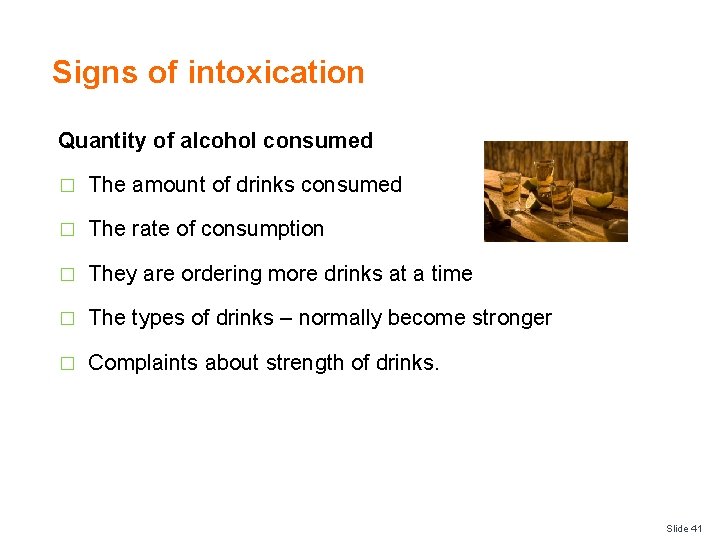
Signs of intoxication Quantity of alcohol consumed � The amount of drinks consumed � The rate of consumption � They are ordering more drinks at a time � The types of drinks – normally become stronger � Complaints about strength of drinks. Slide 41
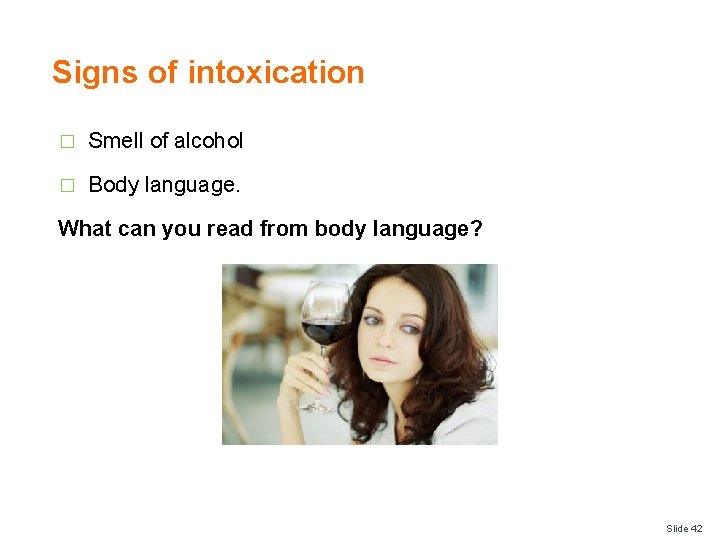
Signs of intoxication � Smell of alcohol � Body language. What can you read from body language? Slide 42
Signs of intoxication Tool to help identify intoxication Coordination Alcohol Smell Unsteady Slurred Speech Eyes Glazed Slide 43
Offering assistance � When it is determined that a person is intoxicated, it is wise for staff to provide assistance where applicable � Just because someone is intoxicated does not mean they need to leave the premises � It is important to remember that each situation must be handled in a professional and discrete manner. Slide 44
Monitoring the environment Staff members must always be aware of the environment and alert to the consumption of alcohol by groups or individual customers within the establishment. Slide 45
Monitoring the environment When monitoring, be aware of: � Types of drinks being ordered � Who is ordering the drinks � Who is consuming the drinks � Rate of consumption. Slide 46
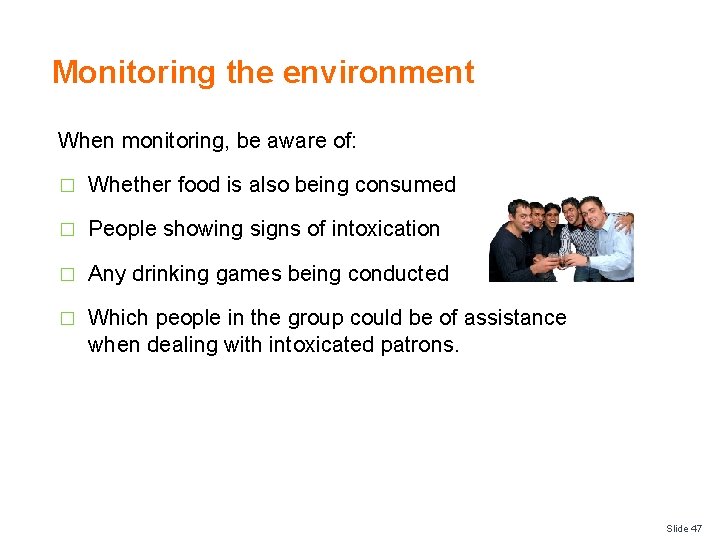
Monitoring the environment When monitoring, be aware of: � Whether food is also being consumed � People showing signs of intoxication � Any drinking games being conducted � Which people in the group could be of assistance when dealing with intoxicated patrons. Slide 47
Offering assistance There a range of suitable alternatives that can be provided depending on the: � Individual situation � Level of intoxication. Slide 48
Offering assistance Types of assistance � Talk to the customer or their friend � Briefly explain your responsibilities � Promoting non-alcoholic drinks � Offer food. Slide 49
Offering assistance Types of assistance � Offering low-alcoholic beverages � Offer water � Slowing down service � Advise other staff. Slide 50
Refer matters to appropriate people It must be remembered, that the health and safety of staff, other customers and the intoxicated person themselves is the primary objective when handling instances involving intoxication. As customers become more intoxicated, the more difficult it may be to handle the situation yourself. Slide 51
Refer matters to appropriate people As a staff member, it is not a requirement for you to place yourself in harm’s way if you feel you cannot handle the situation. You may need to get the assistance from someone: � Inside the organisation � Outside the organisation. Slide 52
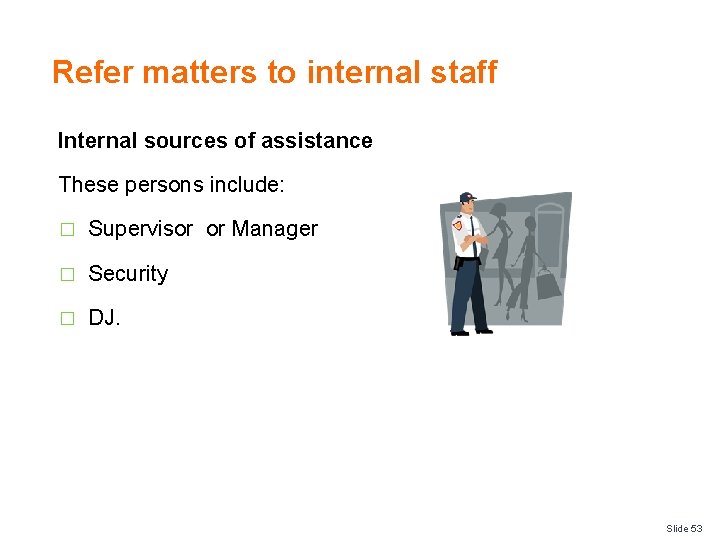
Refer matters to internal staff Internal sources of assistance These persons include: � Supervisor or Manager � Security � DJ. Slide 53
Refer matters to internal staff Contacting internal sources There must be an easy to use communication system to be able to notify appropriate internal people. Systems can include: � Pagers � Signals – verbal or hand � Button � Phone call. Slide 54
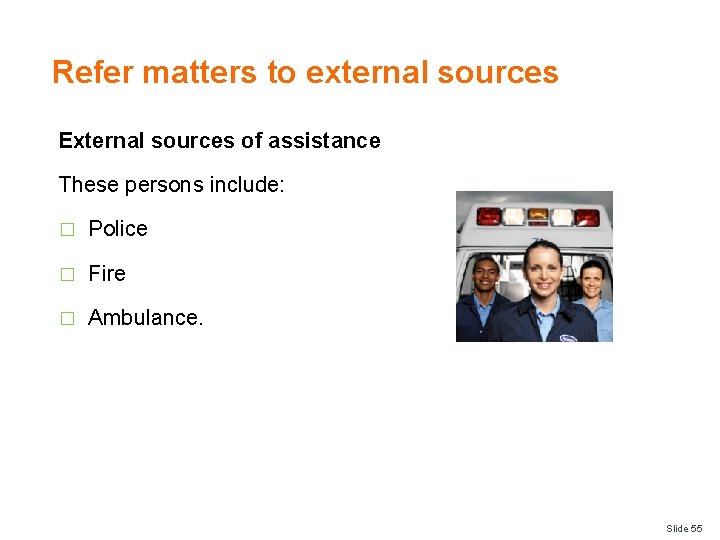
Refer matters to external sources External sources of assistance These persons include: � Police � Fire � Ambulance. Slide 55
Refer matters to external sources Contacting external sources Easy to reach contact details can include: � Special button � Posters with contact numbers � Speed dials � Other methods that are suitable. Slide 56
Element 2: Apply appropriate procedures Slide 57
Apply appropriate procedures Performance Criteria for this Element are: � Analyse situation carefully � Apply procedures appropriate to the situation and in accordance with organizational policy � Explain the position to the customer using appropriate communication skills � Assist the customer to leave the premises if necessary. Slide 58
Establishing a safe venue and atmosphere The manager plays a pivotal role in ensuring the venue is safe for all staff and patrons to enjoy. They have control over: � What will be determined acceptable behaviour and actions within a venue � How it should be run to ensure patrons can enjoy the facility. Slide 59
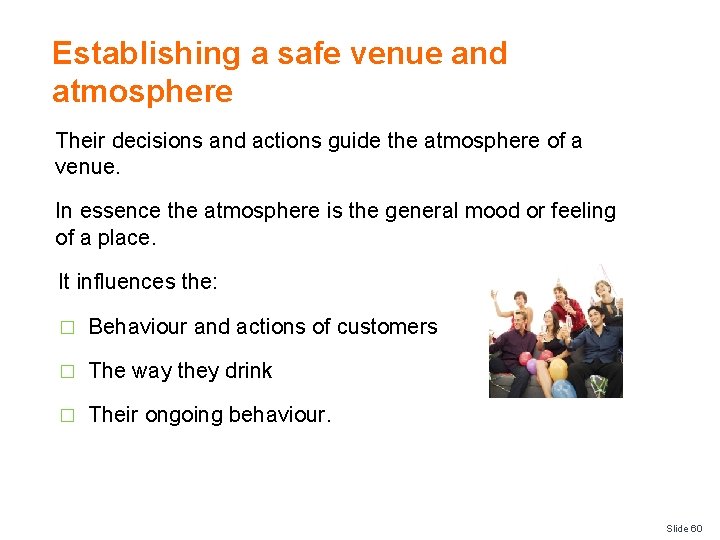
Establishing a safe venue and atmosphere Their decisions and actions guide the atmosphere of a venue. In essence the atmosphere is the general mood or feeling of a place. It influences the: � Behaviour and actions of customers � The way they drink � Their ongoing behaviour. Slide 60
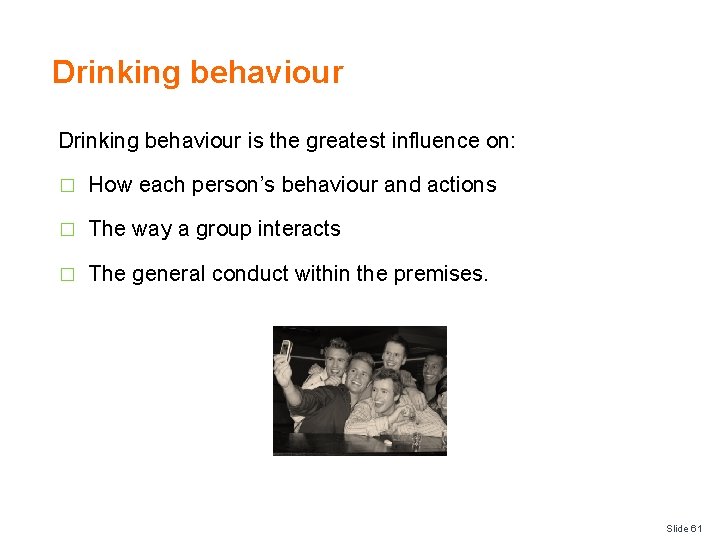
Drinking behaviour is the greatest influence on: � How each person’s behaviour and actions � The way a group interacts � The general conduct within the premises. Slide 61
Drinking behaviour By promoting, encouraging and controlling the drinking behaviour, it will certainly help reduce the risks associated with intoxication. Slide 62
Drinking behaviour depends on three different factors: � The drinker � The environment. Removing or changing any one of these factors will alter the drinking behaviour. Slide 63
Creating the right environment There a number of factors that influence drinking behaviour and the change and degree of problems associated with intoxication. These factors can be: � Positive � Negative. Slide 64
Creating the right environment Positive factors � High levels of cleanliness � Well trained and professional staff � Facilities in operational order � Good security measures � Regular removal or rubbish and waste � Prompt cleaning of tables and removal of dirty bottles, plates and glasses � Adequate and well lit and ventilated toilets. Slide 65
Creating the right environment Positive factors � Non-aggressive security staff � Non-crowding policies � Mix between men and women � Good communication � Good activities � Safe venue layout � Video camera surveillance. Slide 66
Creating the right environment Negative factors � Unsupervised pool tables � TV showing aggressive, offensive, sexual or intoxication-related images � Offensive or sexually explicit music � Congestion � Higher percentage of customers standing � Drunk or underage persons � Vomiting. Slide 67
Creating the right environment Negative factors � Drug dealing or drug use � Drunk customers in the premises � Staff being hostile or aggressive towards patrons � Staff allowing aggression or watching conflict � Staff sending people outside to fight � Late intervention in situations by staff. Slide 68
Creating the right environment Negative factors � Patrons served double at closing time � Served after closing time � Smokiness or lack of ventilation � High level of noise and movement � Lack of bar wiping, table clearing, toilet cleanliness � Openly sexual or sexually competitive activity � In-house promotion on alcohol and “sexy dancing”. Slide 69
Assessing the situation � Once the risks have been addressed and action taken to create the right atmosphere, this does not guarantee problems will not arise � It is vital that not only managers, but all staff constantly assess and monitor the situation as the shift unfolds. Slide 70
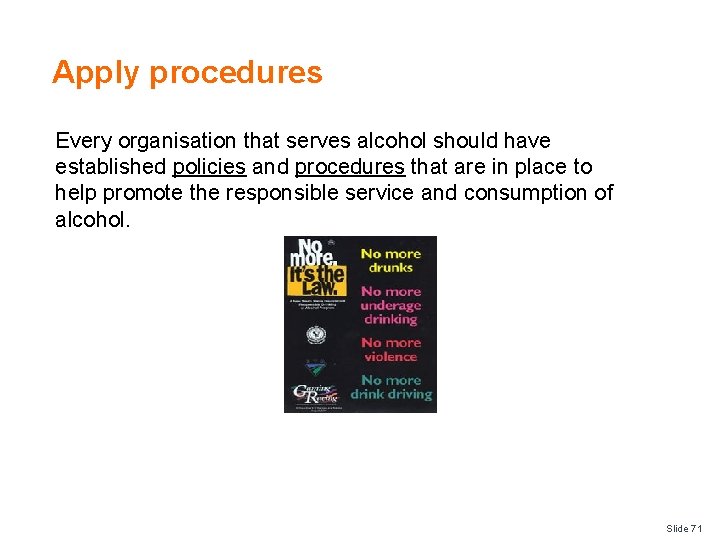
Apply procedures Every organisation that serves alcohol should have established policies and procedures that are in place to help promote the responsible service and consumption of alcohol. Slide 71
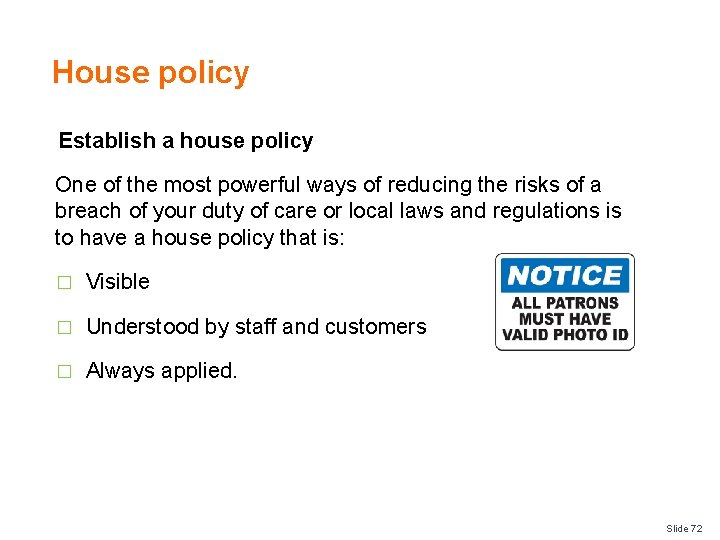
House policy Establish a house policy One of the most powerful ways of reducing the risks of a breach of your duty of care or local laws and regulations is to have a house policy that is: � Visible � Understood by staff and customers � Always applied. Slide 72
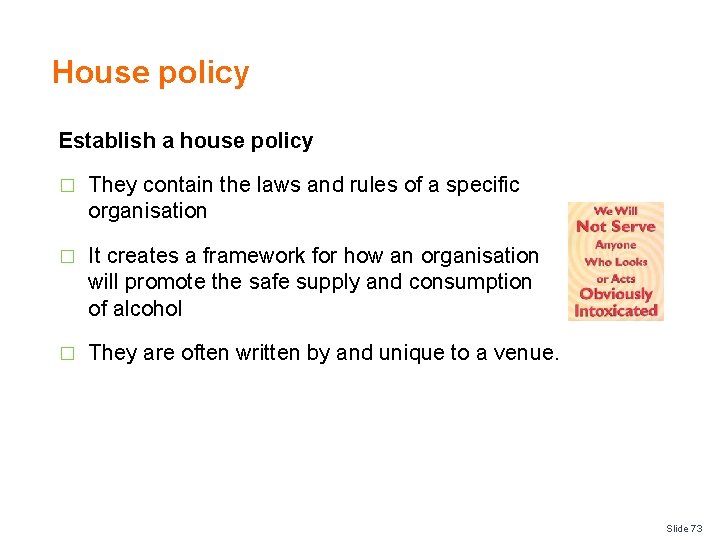
House policy Establish a house policy � They contain the laws and rules of a specific organisation � It creates a framework for how an organisation will promote the safe supply and consumption of alcohol � They are often written by and unique to a venue. Slide 73
House policy Inclusions in a house policy The following, at a minimum, should be included in a house policy: � Expected standards of behaviour of customers � A list of those not to be served alcohol � Limits for cocktails, shots or shooters. Slide 74
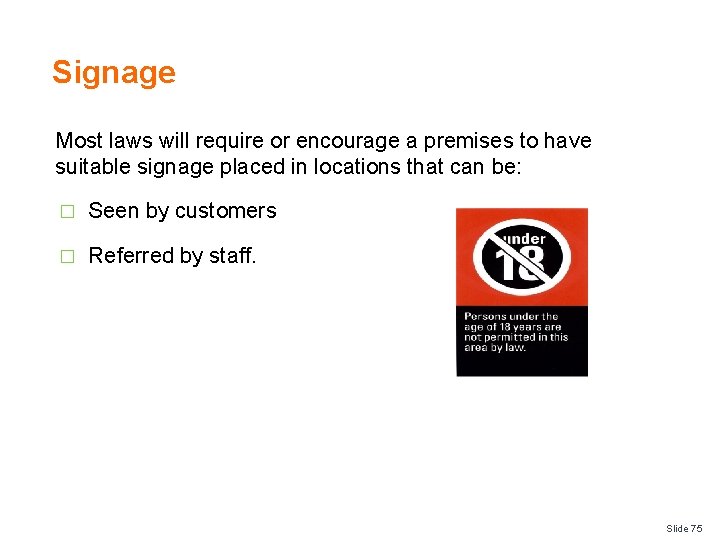
Signage Most laws will require or encourage a premises to have suitable signage placed in locations that can be: � Seen by customers � Referred by staff. Slide 75
Escalation Plan It is wise to have a plan for if things get worse. By having a plan which is understood by all staff members before an incident takes place, there is a clear path of pre-determined: � Responsibilities � Courses of action. Slide 76
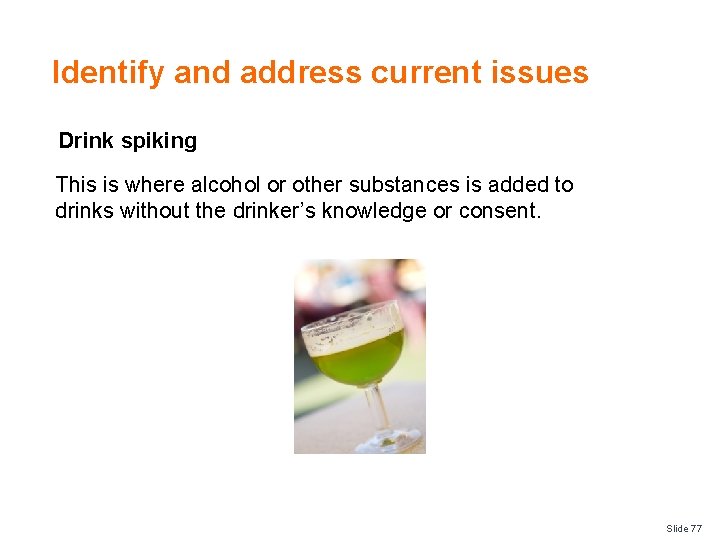
Identify and address current issues Drink spiking This is where alcohol or other substances is added to drinks without the drinker’s knowledge or consent. Slide 77
Identify and address current issues Drink spiking Strategies to avoid drink spiking: � Warn customers not to leave drinks unattended � Have a policy regarding the maximum number of shots per drink � Dispose of unattended drinks � Be suspicious of orders for drinks with added shots of spirits � Look for signs that a person has become suddenly drunk � Take notice of people offering to take the affected person home. Slide 78
Identify and address current issues Binge drinking is a very harmful practice of drinking too much in a short period of time or in one-off episodes. � What can you do to reduce ‘binge drinking’? Slide 79
Identify and address current issues Other issues � What other current issues exist that are related to the consumption of alcohol? � What causes them? � What risks are associated with these issues? � How can you control or eliminate these risks? Slide 80
Steps when handling intoxicated patrons When handling intoxicated persons, there a number of approaches that can be taken, depending on the individual situation and severity of the problem. Regardless of the action taken, it is important for staff to: � Be professional and respectful in their approach � Conduct in a sensitive and discreet manner. Slide 81
Steps when handling intoxicated patrons The following T-A-K-E C-A-R-E steps can help resolve matters involving intoxicated patrons. � Tell early � Avoid put-downs � Keep calm � Ever courteous � Clarify refusal � Alternatives � Report � Echo. Slide 82
Handling complaints � There will always be complaints that will be brought to the attention of staff and management � When alcohol is involved, the number and types of complaints may vary � Some may be logical whilst others unreasonable and resulting from the requests of people who are intoxicated or under the influence of alcohol. Slide 83
Handling complaints Regardless of the complaint, key points to dealing with them include: � Listen carefully to the complaint, without interrupting � Show that you understand � Apologise � Seek a solution. Slide 84
Handling complaints Handling intoxicated complaints � It is important not to remain professional and treat every complaint with respect � Remember, when people are angry, they often throw insults. � Do not take insults personally or retaliate, you have to remain professional � Dealing with complaints requires you to have patience and to keep others around you calm. Slide 85
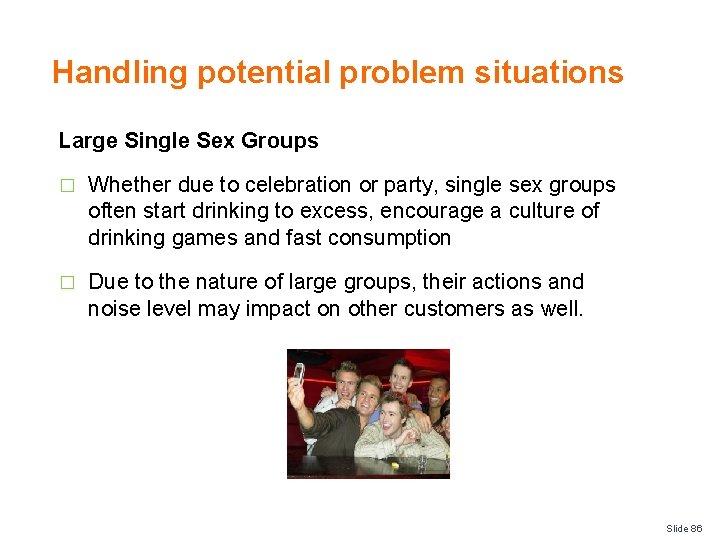
Handling potential problem situations Large Single Sex Groups � Whether due to celebration or party, single sex groups often start drinking to excess, encourage a culture of drinking games and fast consumption � Due to the nature of large groups, their actions and noise level may impact on other customers as well. Slide 86
Handling potential problem situations Large Single Sex Groups Appropriate techniques include: � Distribute house policy with confirmations of large bookings or private functions � Speak with them on arrival � Welcome them and thank them for their patronage � Notify them of expected behaviour. Slide 87
Handling potential problem situations Large Single Sex Groups Appropriate techniques include: � Speak with them in a friendly manner and don’t treat them as a problem, until they do become one � Build up a relationship early on so it’s easier to speak to them later � Set aside a separate area for them, if possible, to avoid upsetting other customers � Identify the leader and make him or her responsible for the group’s behaviour. Slide 88
Handling potential problem situations Large Single Sex Groups Appropriate techniques include: � Watch the amount they are drinking � Speak to individuals at the bar � Make it clear that, if one person causes trouble, they will all have to leave. Slide 89
Handling potential problem situations Domestic argument � Visit the table, ask if all is ok � If it persists and or gets louder, you will need to ask them once again if they are ok � Suggest that this is not the place for their argument. Slide 90
Handling potential problem situations Domestic argument � Let them know that, if they can’t put aside their issues, they will have to leave � Always remain impartial � Depersonalise the situation by stating it is your job, it is house rules, and it is not personal. Slide 91
Handling potential problem situations Games or Sports To help reduce potential problems: � Have a set of house rules for everyone to play by � Put a clear, fair system in place for how to book games and how to determine who plays next � Ensure the area is well staffed to spot any potential problems � Put in place a deposit system so equipment is returned. Slide 92
Asking customers to leave premises Whilst is it unreasonable to ask every patron who is showing even the smallest sign of intoxication to leave, it is essential that a person will be asked to leave who: � Is using or threatening violence � Is disturbing the enjoyment of other patrons � Is disorderly or not abiding by premises rules � Is breaking the law � Is using disgusting, profane or foul language. Slide 93
Asking customers to leave premises Steps when asking someone to leave � Final warning � Notifying friends � Identify transportation � Arrange assistance � Explain why the person is being asked to leave. Slide 94
Asking customers to leave premises Steps when asking someone to leave � Explain transportation options � Follow the person to the door � Ensure the person is safely off the premises � Ensure they are looked after. Slide 95
Asking customers to leave premises Steps when asking someone to leave � There will be times, when a more direct and forceful action is required � The appropriate authorities must undertake this action, whether by police or security. Slide 96
Element 3: Comply with legislation Slide 97
Comply with legislation Performance Criteria for this Element are: � Assess situations � Deal with intoxicated persons appropriately � Deal with underage drinkers � Comply with legislative requirements. Slide 98
Comply with legislation As a manager or a server in an establishment that serves alcohol it is your responsibility that it is done in a manner that: � Maintains the health and safety of all people concerned � Is legal � Promotes responsible service and consumption of alcohol. Slide 99
Legal considerations There a number of actions to ensure a safe and legal operation including: � Establish a house policy � Avoid promotions that encourage irresponsible consumption of alcohol � Train staff in responsible service of alcohol � Identify and address potential difficult situations � Create the right atmosphere. Slide 100
Legal considerations Tips to remember � Identify situations where problems may arise as early as possible � Try to involve the customer by providing options � Treat the customer professionally � Don’t touch the customer, where possible � Take action as early as possible � Follow all house policies, rules and regulations. Slide 101
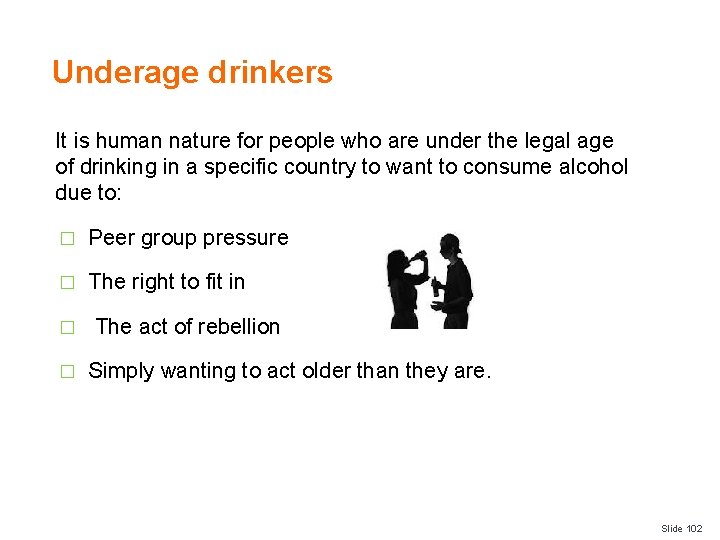
Underage drinkers It is human nature for people who are under the legal age of drinking in a specific country to want to consume alcohol due to: � Peer group pressure � The right to fit in � � The act of rebellion Simply wanting to act older than they are. Slide 102
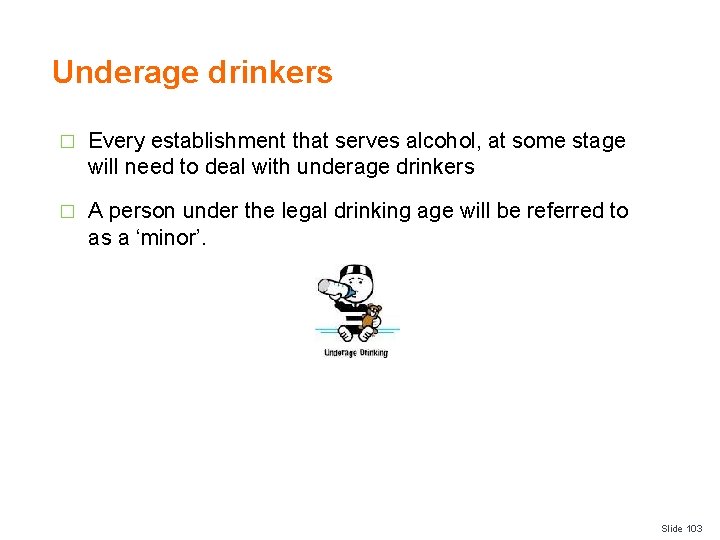
Underage drinkers � Every establishment that serves alcohol, at some stage will need to deal with underage drinkers � A person under the legal drinking age will be referred to as a ‘minor’. Slide 103
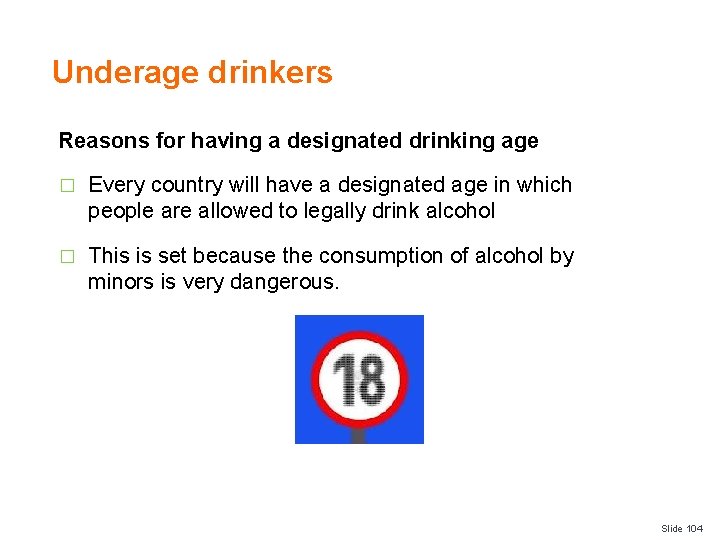
Underage drinkers Reasons for having a designated drinking age � Every country will have a designated age in which people are allowed to legally drink alcohol � This is set because the consumption of alcohol by minors is very dangerous. Slide 104
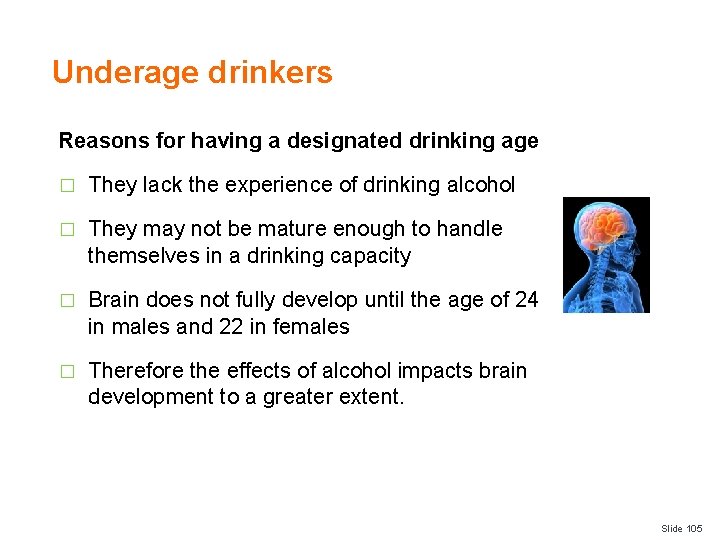
Underage drinkers Reasons for having a designated drinking age � They lack the experience of drinking alcohol � They may not be mature enough to handle themselves in a drinking capacity � Brain does not fully develop until the age of 24 in males and 22 in females � Therefore the effects of alcohol impacts brain development to a greater extent. Slide 105
Underage drinkers Reasons for having a designated drinking age � Their internal organs haven’t fully developed, therefore the effects of alcohol are greater � Minors are more likely to binge drink, which is a major health risk � Minors are most likely to become dependent on alcohol and become heavy drinkers later in life. Slide 106
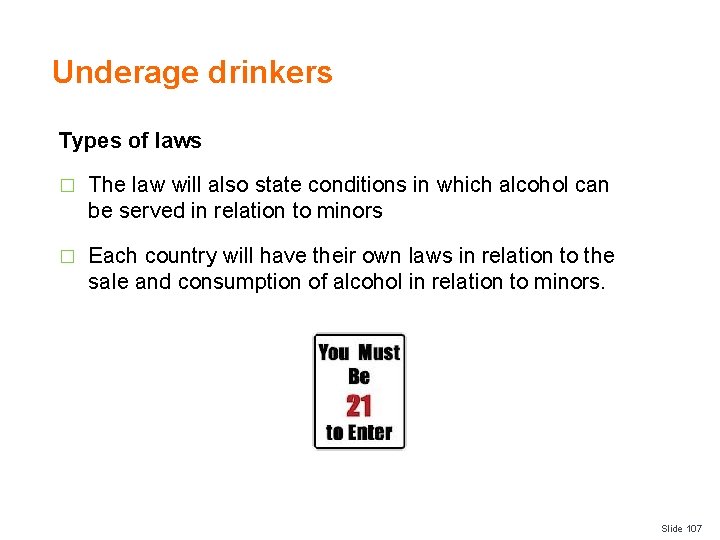
Underage drinkers Types of laws � The law will also state conditions in which alcohol can be served in relation to minors � Each country will have their own laws in relation to the sale and consumption of alcohol in relation to minors. Slide 107
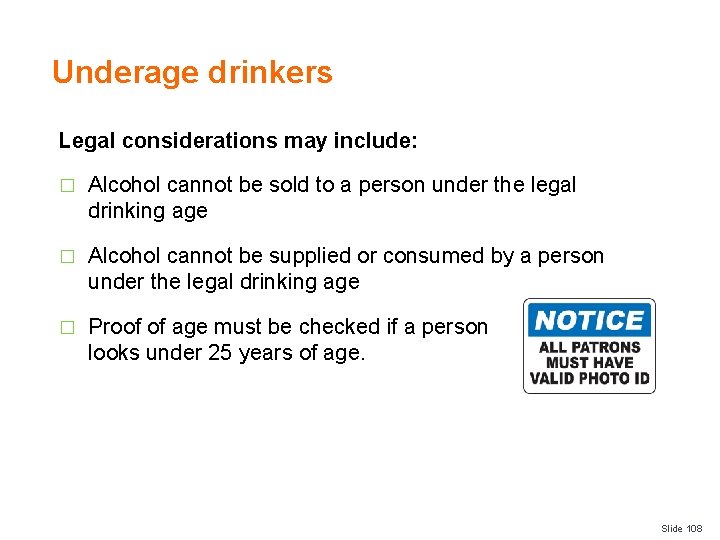
Underage drinkers Legal considerations may include: � Alcohol cannot be sold to a person under the legal drinking age � Alcohol cannot be supplied or consumed by a person under the legal drinking age � Proof of age must be checked if a person looks under 25 years of age. Slide 108
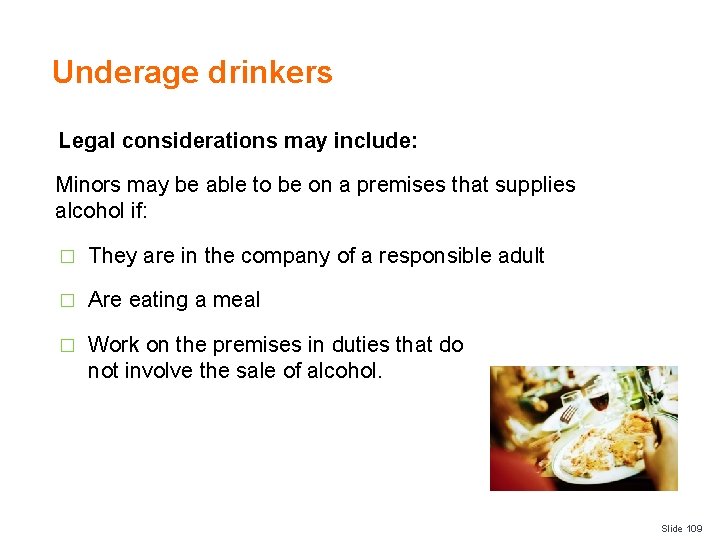
Underage drinkers Legal considerations may include: Minors may be able to be on a premises that supplies alcohol if: � They are in the company of a responsible adult � Are eating a meal � Work on the premises in duties that do not involve the sale of alcohol. Slide 109
Underage drinkers Legal considerations may include: � Some venues may allow a minor to have an alcoholic drink if they are having a meal or with a spouse, parent or guardian � Food containing alcohol may be consumed if below a certain percentage of the entire meal � Minors may not be allowed into areas where their primary product sold is alcohol including bars and night clubs. Slide 110
Strategies to prevent underage drinking Checking upon entry � Many establishments may have staff located at the door to ensure minors are not granted access � If there are no allocated staff, it should be the responsibility of staff to observe new arrivals � This check is also helpful in identifying intoxicated persons entering the venue. Slide 111
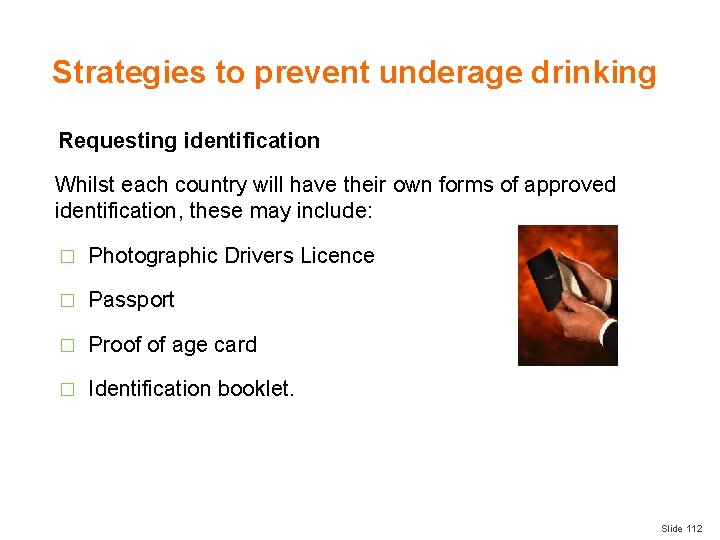
Strategies to prevent underage drinking Requesting identification Whilst each country will have their own forms of approved identification, these may include: � Photographic Drivers Licence � Passport � Proof of age card � Identification booklet. Slide 112
Strategies to prevent underage drinking Checking identification � Always check them in a well lit area � Take the time to examine the identification carefully � Look for any signs that may indicate the identification is not real including: � Alternations of pages � Changing of photos � Changing of date. Slide 113
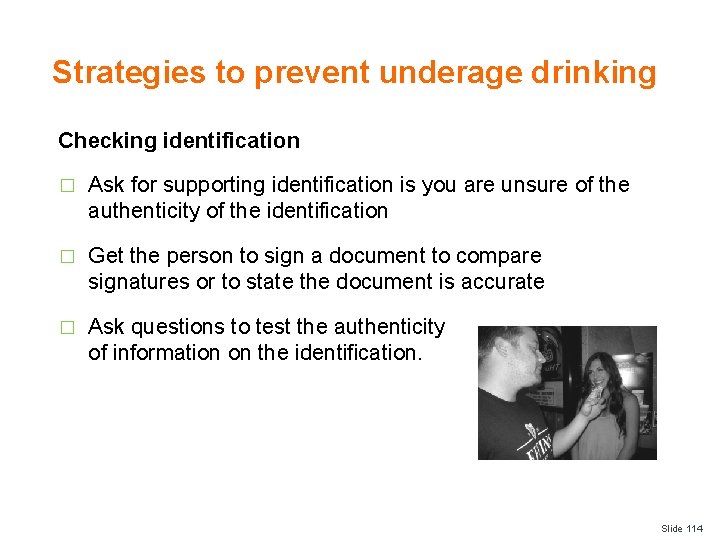
Strategies to prevent underage drinking Checking identification � Ask for supporting identification is you are unsure of the authenticity of the identification � Get the person to sign a document to compare signatures or to state the document is accurate � Ask questions to test the authenticity of information on the identification. Slide 114
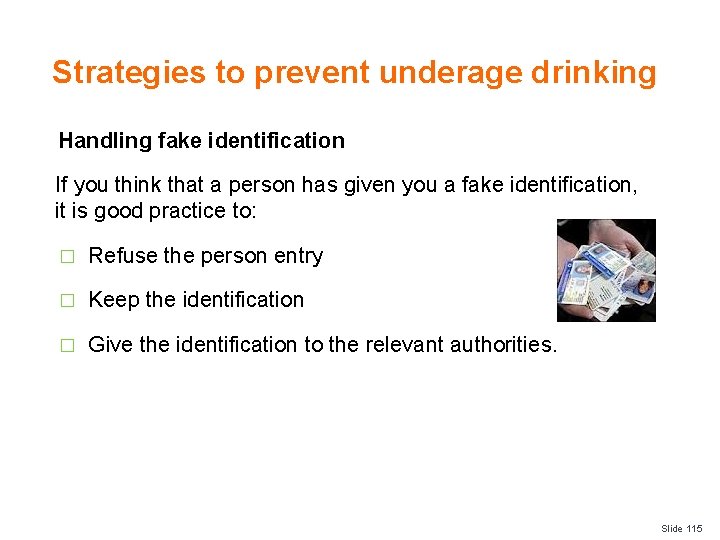
Strategies to prevent underage drinking Handling fake identification If you think that a person has given you a fake identification, it is good practice to: � Refuse the person entry � Keep the identification � Give the identification to the relevant authorities. Slide 115
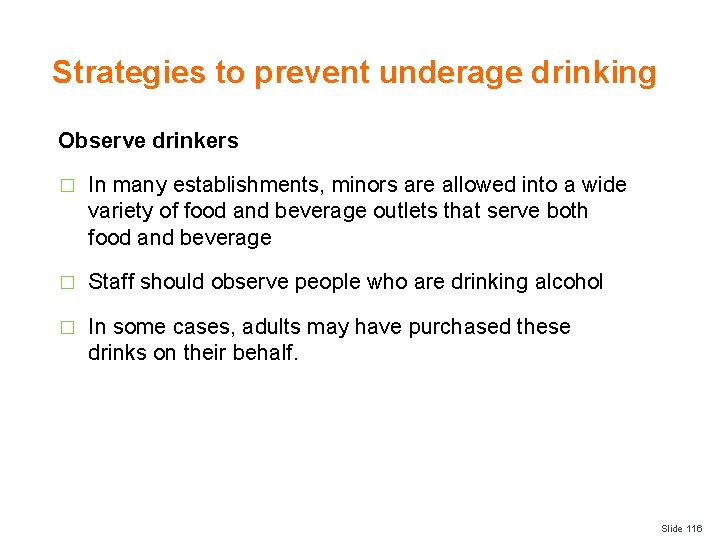
Strategies to prevent underage drinking Observe drinkers � In many establishments, minors are allowed into a wide variety of food and beverage outlets that serve both food and beverage � Staff should observe people who are drinking alcohol � In some cases, adults may have purchased these drinks on their behalf. Slide 116
Complying with laws All businesses that serve food and beverage will have a series of laws in which they must comply. Licensing law is the set of legal rules governing the sale of alcohol in a given jurisdiction. It usually defines who can: � Sell or supply alcohol � When, where and to whom. Slide 117
Complying with laws � Generally the underlying purpose of licensing law is to act as a protection against any potential harm to public order or to public health � This is sometimes stated in the law. Slide 118
Types of laws License to sell � Most countries that have restrictions on who can buy alcohol, will also have restrictions on who can do the selling � In order to sell alcohol, you may have to obtain a permit or license � The license may simply permit you to sell alcohol in general or may have stipulations. Slide 119
Types of laws License to sell Stipulations include: � In which areas of the establishment it may be sold � What may be sold � At what times sales can be made � If alcohol is allowed to be brought into the venue for consumptions. Slide 120
Types of laws Establish policies and procedures � Establish house rules � Place appropriate signs in place � Ensure staff understand � Ensure compliance with policies and procedures. Slide 121
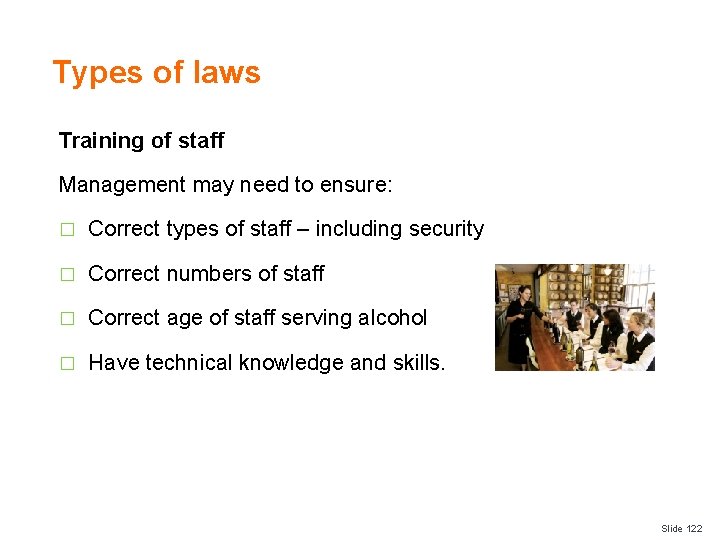
Types of laws Training of staff Management may need to ensure: � Correct types of staff – including security � Correct numbers of staff � Correct age of staff serving alcohol � Have technical knowledge and skills. Slide 122
Types of laws Training of staff Staff may be required to: � Undertake responsible service of alcohol courses � Gain certification in specific courses � Attend regular staff meetings to discuss RSA issues � Understand their responsibilities � Be properly trained and consistently apply their training and knowledge of RSA in the workplace. Slide 123
Types of laws Documentation of systems In order to prove that you are complying with the laws, it is good practice to keep records to show what systems you have in place including: � Training and Training Records � Incident Diary � Refusals Book. Slide 124
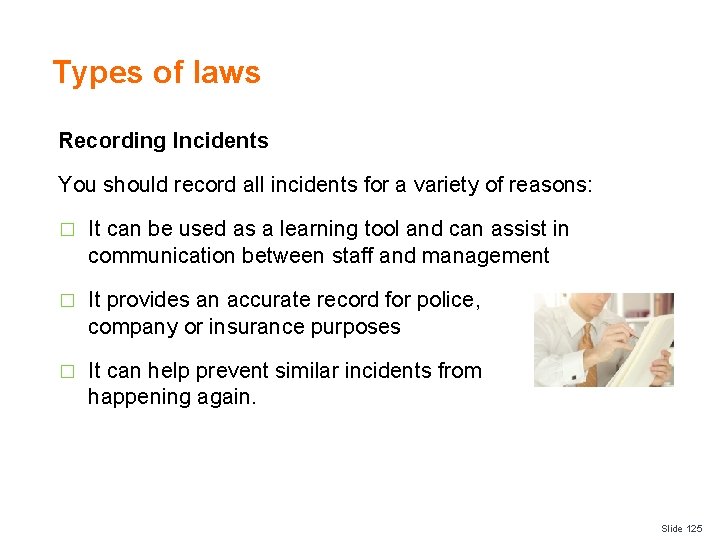
Types of laws Recording Incidents You should record all incidents for a variety of reasons: � It can be used as a learning tool and can assist in communication between staff and management � It provides an accurate record for police, company or insurance purposes � It can help prevent similar incidents from happening again. Slide 125
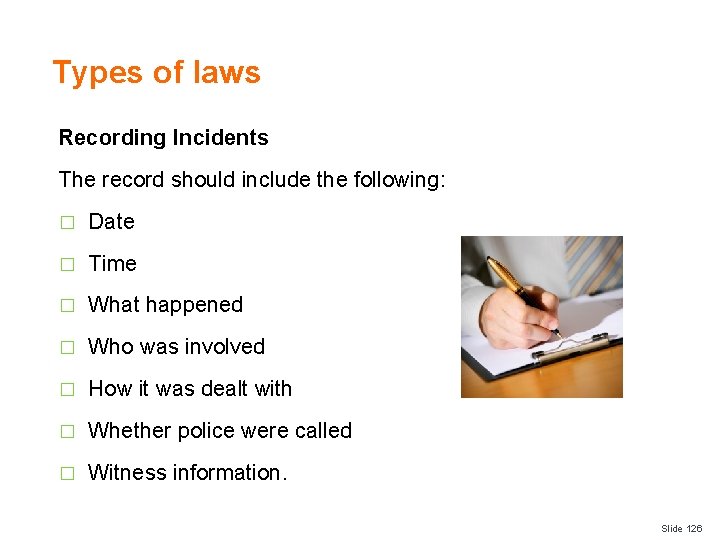
Types of laws Recording Incidents The record should include the following: � Date � Time � What happened � Who was involved � How it was dealt with � Whether police were called � Witness information. Slide 126
Finish: Thank you! Slide 127
- Slides: 127