
Manage Global Teams Effectively lead a geographically dispersed
Manage Global Teams Effectively lead a geographically dispersed and culturally diverse team. Mc. Lean & Company is a research and advisory firm that provides practical solutions to human resources challenges with executable research, tools, and advice that will have a Mc. Lean & Company is a research and advisory firm providing practical solutions to human resources challenges©via executable research, tools and advice that clear and measurable impact on your business. 1997 -2012 Mc. Lean & Company. have a clear and measurable impact on your business. © 1997 - 2012 Mclean & Company. Mc. Lean & Company is a division of Info-Tech Group Mc. Lean & Company is a division of Info-Tech Research Group. Research Inc. Mc. Lean & Company 1
Introduction All of the same management skills apply when leading global teams and colocated teams. However, global teams require heightened cultural awareness and a little more groundwork. This Research Is Designed For: This Research Will Help You: ü Leaders tasked with managing a new global ü Understand how culture impacts global or virtual team (i. e. team members do not know each other). ü Human Resource practitioners tasked with training global team leaders. ü Any one interested in effective global team leadership. teamwork and what to do about it. ü Chart a course to set global team goals. ü Create clear performance expectations and provide effective feedback, from a distance. ü Build trust with and between global team members. ü Empower global team members appropriately. Note: • The information in this solution set will apply to both time-limited (i. e. project) and continuous teams. If different approaches are required, they will be noted. • This set assumes that the team is newly formed and will not address challenges specific to existing teams. See slide 4 to make sure this solution set is right for you. Mc. Lean & Company 2
Executive Summary • Geographic expansion is a top priority for small to mid-sized companies who recognize the importance of new markets for business sustainability. • Because of this expansion, and also due to the increase of computer-mediated communication technologies, global teams are becoming more and more common. • Companies that are effective at global people management and expansion significantly financially outperform those that are ineffective; effective companies have 1. 8 times higher profit growth and a 1. 7 times higher profit margin. • Effective management and training of diverse work teams produce results that are six-times higher than homogenous teams. • However, managing a global team is not the same as managing a local team. A global team requires the leader to dedicate more time and effort into understanding cultural differences, setting the direction, providing clear performance expectations, building trust, and appropriately empowering team members. • Success with trust-building has the highest impact on global team success and should be a primary area of focus for global team leaders. In fact, teams that have high success with trust-building are 3. 3 times more likely to have high team success. • As the manager of a global team, you are responsible for fostering a team culture that encourages frequent communication, eliminates uncertainty, and builds relationships. • This type of team culture will lead to sustainable global team success. Mc. Lean & Company 3
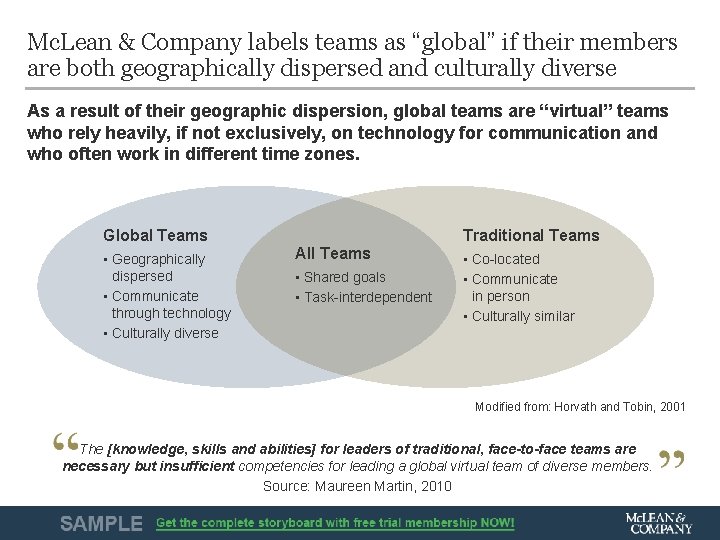
Mc. Lean & Company labels teams as “global” if their members are both geographically dispersed and culturally diverse As a result of their geographic dispersion, global teams are “virtual” teams who rely heavily, if not exclusively, on technology for communication and who often work in different time zones. Global Teams • Geographically dispersed • Communicate through technology • Culturally diverse Traditional Teams All Teams • Shared goals • Task-interdependent • Co-located • Communicate in person • Culturally similar Modified from: Horvath and Tobin, 2001 The [knowledge, skills and abilities] for leaders of traditional, face-to-face teams are necessary but insufficient competencies for leading a global virtual team of diverse members. Source: Maureen Martin, 2010 Mc. Lean & Company 4
Make the Case What’s in this Section: • Understand the business benefits produced by global teams. • Overcome challenges to effective global team management. • Understand the Mc. Lean & Company model for effective global team leadership. Sections: Make the Case Lay the Foundation Set the Direction Set Performance Expectations Build Trust Empower Appropriately Keep the Momentum Appendix Mc. Lean & Company 5
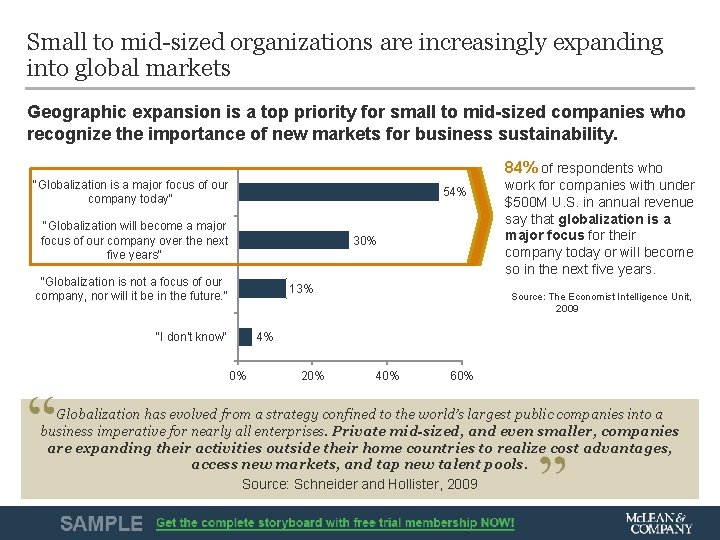
Small to mid-sized organizations are increasingly expanding into global markets Geographic expansion is a top priority for small to mid-sized companies who recognize the importance of new markets for business sustainability. 84% of respondents who "Globalization is a major focus of our company today" 54% "Globalization will become a major focus of our company over the next five years" 30% "Globalization is not a focus of our company, nor will it be in the future. " 13% "I don't know" work for companies with under $500 M U. S. in annual revenue say that globalization is a major focus for their company today or will become so in the next five years. Source: The Economist Intelligence Unit, 2009 4% 0% 20% 40% 60% Globalization has evolved from a strategy confined to the world’s largest public companies into a business imperative for nearly all enterprises. Private mid-sized, and even smaller, companies are expanding their activities outside their home countries to realize cost advantages, access new markets, and tap new talent pools. Source: Schneider and Hollister, 2009 Mc. Lean & Company 6
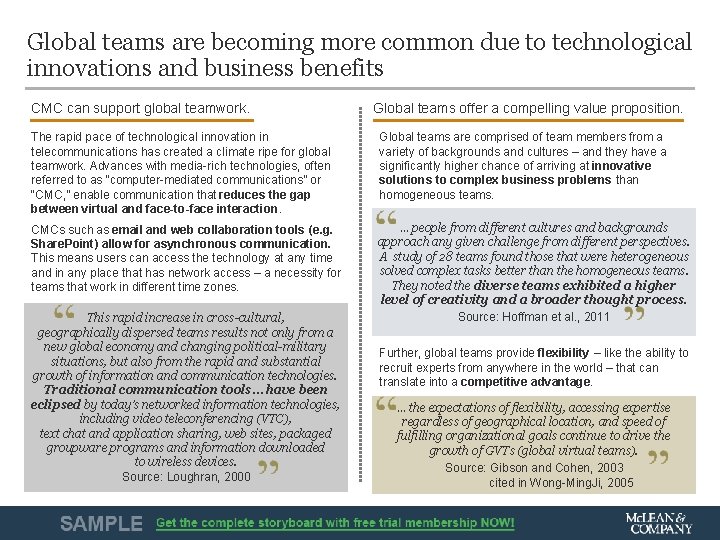
Global teams are becoming more common due to technological innovations and business benefits CMC can support global teamwork. Global teams offer a compelling value proposition. The rapid pace of technological innovation in telecommunications has created a climate ripe for global teamwork. Advances with media-rich technologies, often referred to as “computer-mediated communications” or “CMC, ” enable communication that reduces the gap between virtual and face-to-face interaction. Global teams are comprised of team members from a variety of backgrounds and cultures – and they have a significantly higher chance of arriving at innovative solutions to complex business problems than homogeneous teams. CMCs such as email and web collaboration tools (e. g. Share. Point) allow for asynchronous communication. This means users can access the technology at any time and in any place that has network access – a necessity for teams that work in different time zones. … people from different cultures and backgrounds approach any given challenge from different perspectives. A study of 28 teams found those that were heterogeneous solved complex tasks better than the homogeneous teams. They noted the diverse teams exhibited a higher level of creativity and a broader thought process. Source: Hoffman et al. , 2011 This rapid increase in cross-cultural, geographically dispersed teams results not only from a new global economy and changing political-military situations, but also from the rapid and substantial growth of information and communication technologies. Traditional communication tools… have been eclipsed by today’s networked information technologies, including video teleconferencing (VTC), text chat and application sharing, web sites, packaged groupware programs and information downloaded to wireless devices. Source: Loughran, 2000 Further, global teams provide flexibility – like the ability to recruit experts from anywhere in the world – that can translate into a competitive advantage. … the expectations of flexibility, accessing expertise regardless of geographical location, and speed of fulfilling organizational goals continue to drive the growth of GVTs (global virtual teams). Source: Gibson and Cohen, 2003 cited in Wong-Ming. Ji, 2005 Mc. Lean & Company 7
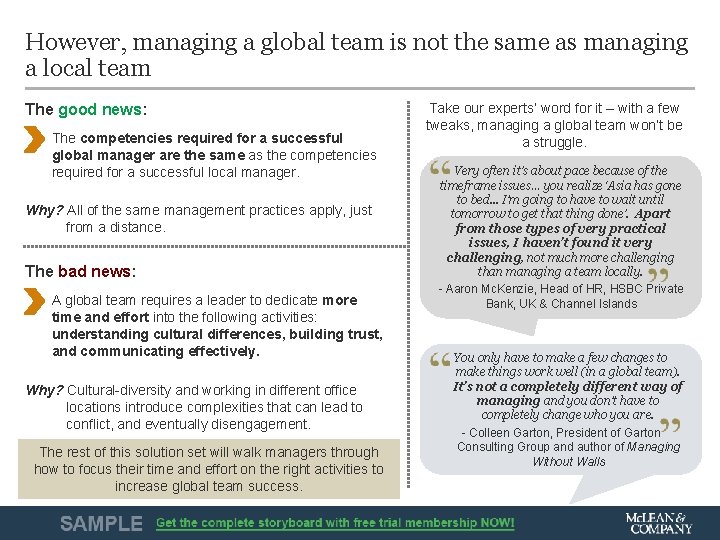
However, managing a global team is not the same as managing a local team The good news: The competencies required for a successful global manager are the same as the competencies required for a successful local manager. Why? All of the same management practices apply, just from a distance. The bad news: A global team requires a leader to dedicate more time and effort into the following activities: understanding cultural differences, building trust, and communicating effectively. Why? Cultural-diversity and working in different office locations introduce complexities that can lead to conflict, and eventually disengagement. The rest of this solution set will walk managers through how to focus their time and effort on the right activities to increase global team success. Take our experts’ word for it – with a few tweaks, managing a global team won’t be a struggle. Very often it’s about pace because of the timeframe issues… you realize ‘Asia has gone to bed. . . I’m going to have to wait until tomorrow to get that thing done’. Apart from those types of very practical issues, I haven’t found it very challenging, not much more challenging than managing a team locally. - Aaron Mc. Kenzie, Head of HR, HSBC Private Bank, UK & Channel Islands You only have to make a few changes to make things work well (in a global team). It’s not a completely different way of managing and you don’t have to completely change who you are. - Colleen Garton, President of Garton Consulting Group and author of Managing Without Walls Mc. Lean & Company 8
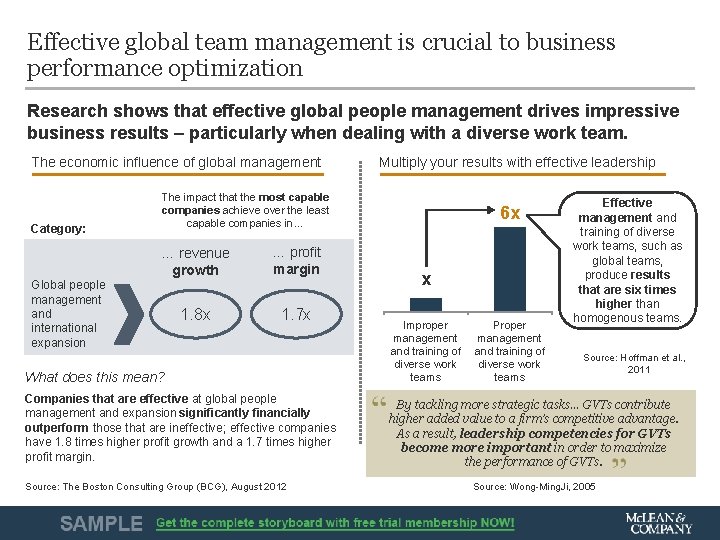
Effective global team management is crucial to business performance optimization Research shows that effective global people management drives impressive business results – particularly when dealing with a diverse work team. The economic influence of global management Category: Multiply your results with effective leadership The impact that the most capable companies achieve over the least capable companies in… … revenue growth … profit margin 1. 8 x 1. 7 x Global people management and international expansion What does this mean? Companies that are effective at global people management and expansion significantly financially outperform those that are ineffective; effective companies have 1. 8 times higher profit growth and a 1. 7 times higher profit margin. Source: The Boston Consulting Group (BCG), August 2012 6 x x Improper management and training of diverse work teams Proper management and training of diverse work teams Effective management and training of diverse work teams, such as global teams, produce results that are six times higher than homogenous teams. Source: Hoffman et al. , 2011 By tackling more strategic tasks… GVTs contribute higher added value to a firm’s competitive advantage. As a result, leadership competencies for GVTs become more important in order to maximize the performance of GVTs. Source: Wong-Ming. Ji, 2005 Mc. Lean & Company 9
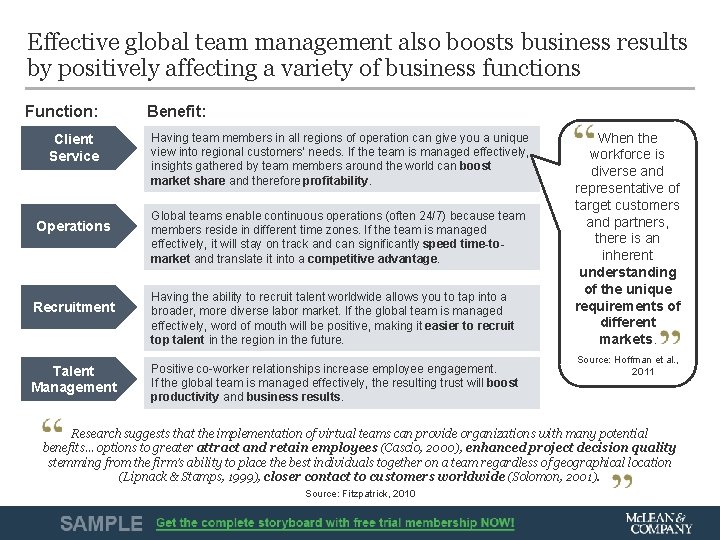
Effective global team management also boosts business results by positively affecting a variety of business functions Function: Client Service Operations Recruitment Talent Management Benefit: Having team members in all regions of operation can give you a unique view into regional customers’ needs. If the team is managed effectively, insights gathered by team members around the world can boost market share and therefore profitability. Global teams enable continuous operations (often 24/7) because team members reside in different time zones. If the team is managed effectively, it will stay on track and can significantly speed time-tomarket and translate it into a competitive advantage. Having the ability to recruit talent worldwide allows you to tap into a broader, more diverse labor market. If the global team is managed effectively, word of mouth will be positive, making it easier to recruit top talent in the region in the future. Positive co-worker relationships increase employee engagement. If the global team is managed effectively, the resulting trust will boost productivity and business results. When the workforce is diverse and representative of target customers and partners, there is an inherent understanding of the unique requirements of different markets. Source: Hoffman et al. , 2011 Research suggests that the implementation of virtual teams can provide organizations with many potential benefits… options to greater attract and retain employees (Cascio, 2000), enhanced project decision quality stemming from the firm’s ability to place the best individuals together on a team regardless of geographical location (Lipnack & Stamps, 1999), closer contact to customers worldwide (Solomon, 2001). Source: Fitzpatrick, 2010 Mc. Lean & Company 10

Mc. Lean & Company Helps HR Professionals To: ü Empower management to applyü HR best practices ü Develop effective talent acquisition & retention strategies ü Build a high performance culture Maintain a progressive set of HR policies & procedures ü Demonstrate the business impact of HR ü Stay abreast of HR trends & technologies Sign up for free trial membership to get practical solutions for your HR challenges "Mc. Lean & Company provides practical research, tools and advice covering the entire spectrum of HR & Leadership issues to ensure you experience measurable, positive results. " • - Rob Garmaise, VP of Customer Experience Toll Free: 1 -877 -281 -0480 hr. mcleanco. com Mc. Lean & Company 11
- Slides: 11