
Mammals Chapter 34 What is a mammal Endothermic
- Slides: 36
Mammals Chapter 34
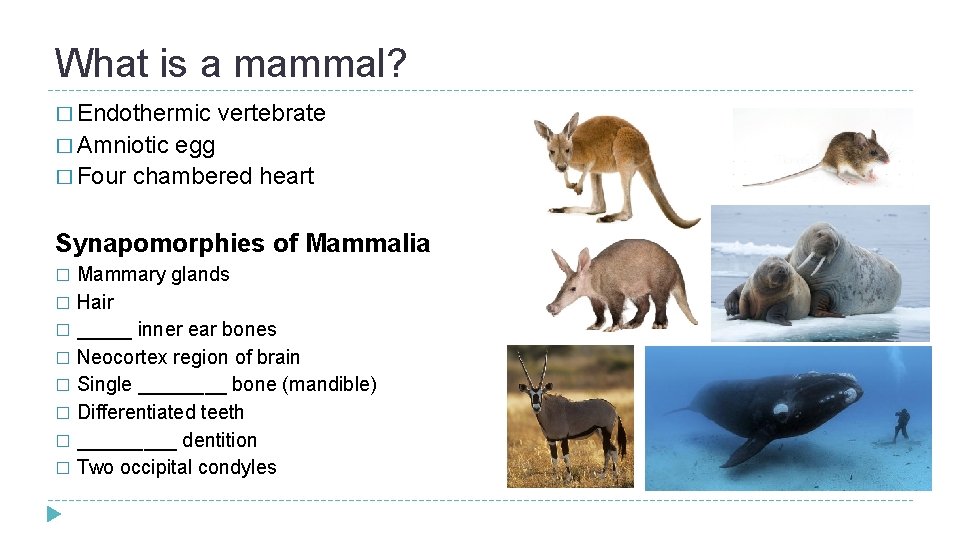
What is a mammal? � Endothermic vertebrate � Amniotic egg � Four chambered heart Synapomorphies of Mammalia Mammary glands � Hair � _____ inner ear bones � Neocortex region of brain � Single ____ bone (mandible) � Differentiated teeth � _____ dentition � Two occipital condyles �
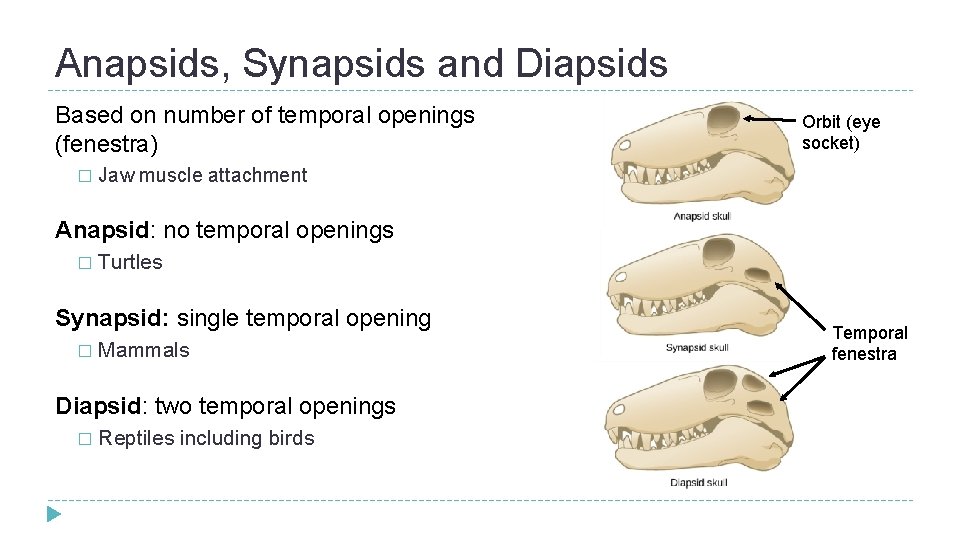
Anapsids, Synapsids and Diapsids Based on number of temporal openings (fenestra) � Orbit (eye socket) Jaw muscle attachment Anapsid: no temporal openings � Turtles Synapsid: single temporal opening � Mammals Diapsid: two temporal openings � Reptiles including birds Temporal fenestra
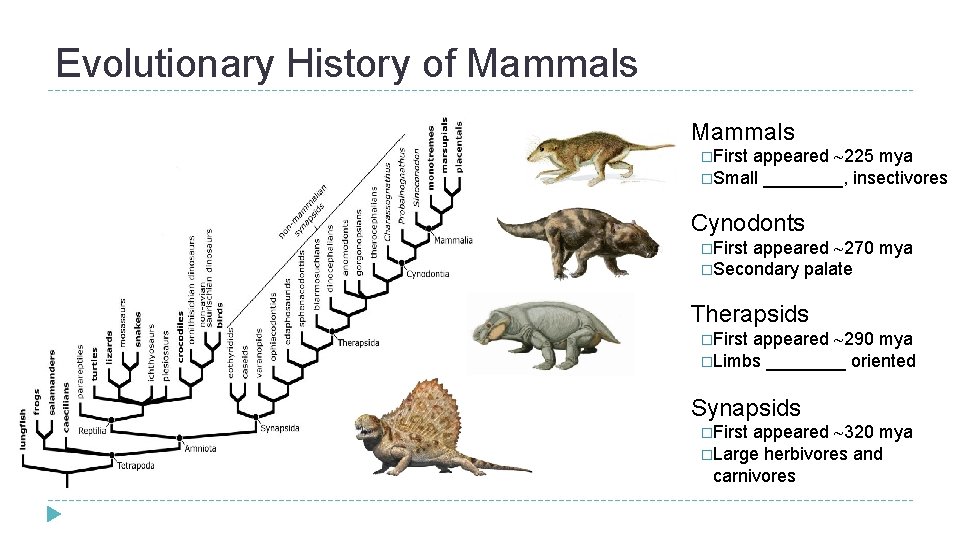
Evolutionary History of Mammals �First appeared ~225 mya �Small ____, insectivores Cynodonts �First appeared ~270 mya �Secondary palate Therapsids �First appeared ~290 mya �Limbs ____ oriented Synapsids �First appeared ~320 mya �Large herbivores and carnivores
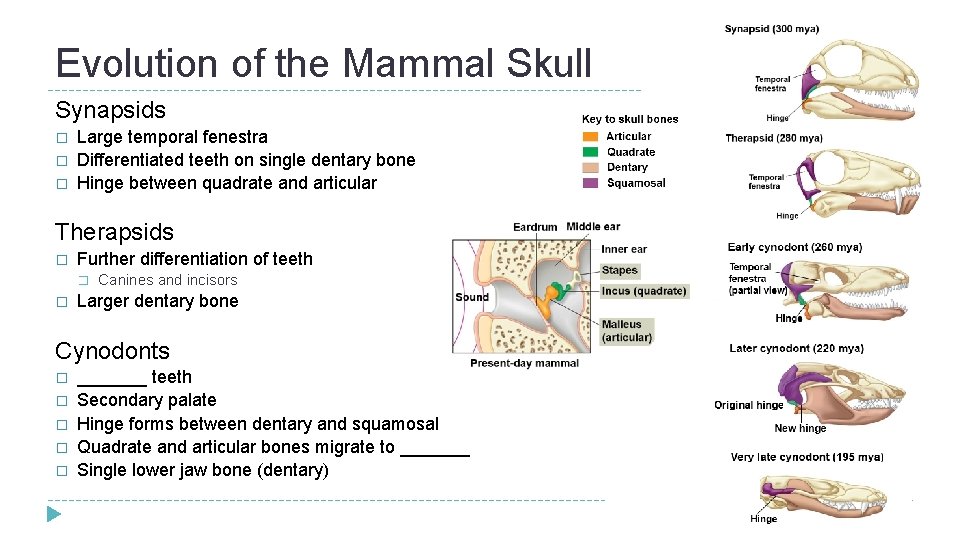
Evolution of the Mammal Skull Synapsids � � � Large temporal fenestra Differentiated teeth on single dentary bone Hinge between quadrate and articular Therapsids � Further differentiation of teeth � � Canines and incisors Larger dentary bone Cynodonts � � � _______ teeth Secondary palate Hinge forms between dentary and squamosal Quadrate and articular bones migrate to _______ Single lower jaw bone (dentary)
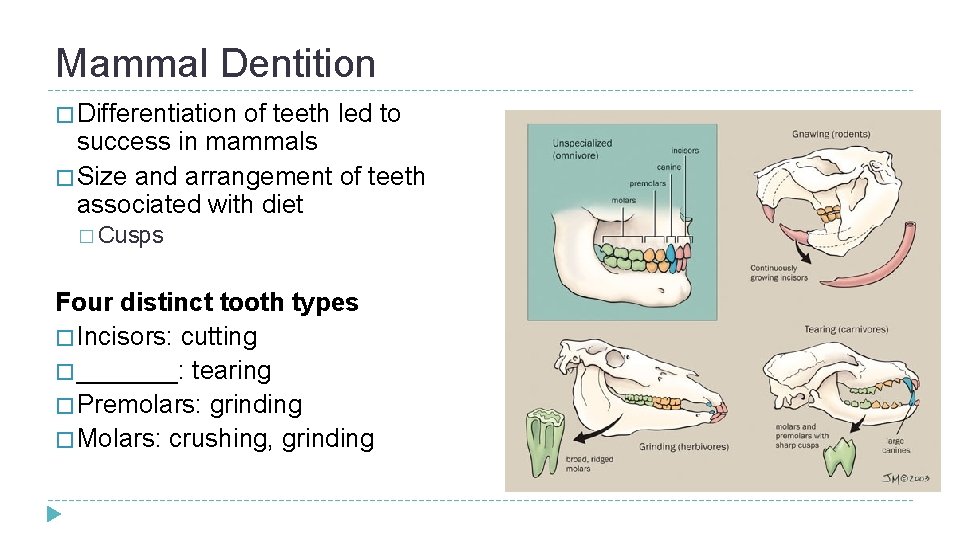
Mammal Dentition � Differentiation of teeth led to success in mammals � Size and arrangement of teeth associated with diet � Cusps Four distinct tooth types � Incisors: cutting � _______: tearing � Premolars: grinding � Molars: crushing, grinding
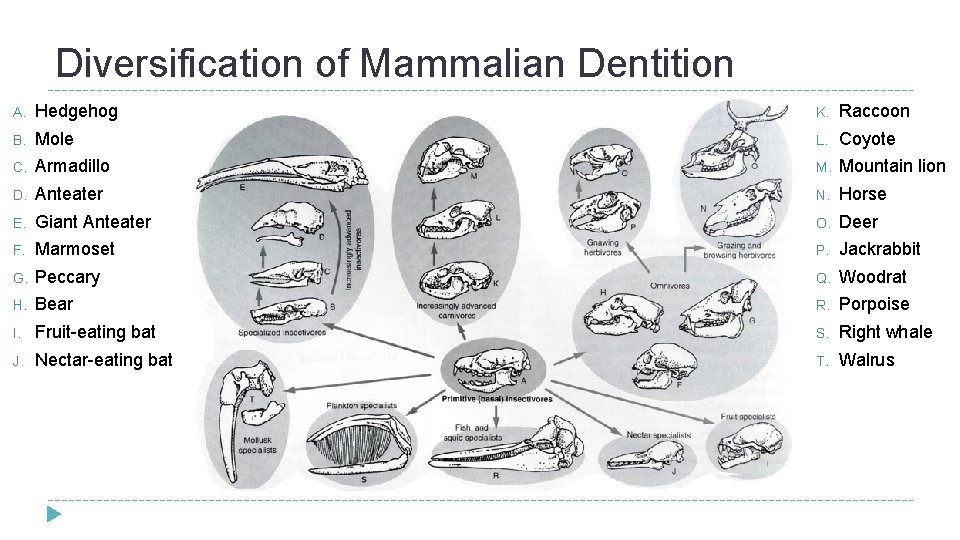
Diversification of Mammalian Dentition A. Hedgehog K. Raccoon B. Mole L. Coyote C. Armadillo M. Mountain lion D. Anteater N. Horse E. Giant Anteater O. Deer F. Marmoset P. Jackrabbit G. Peccary Q. Woodrat H. Bear R. Porpoise I. Fruit-eating bat S. Right whale J. Nectar-eating bat T. Walrus
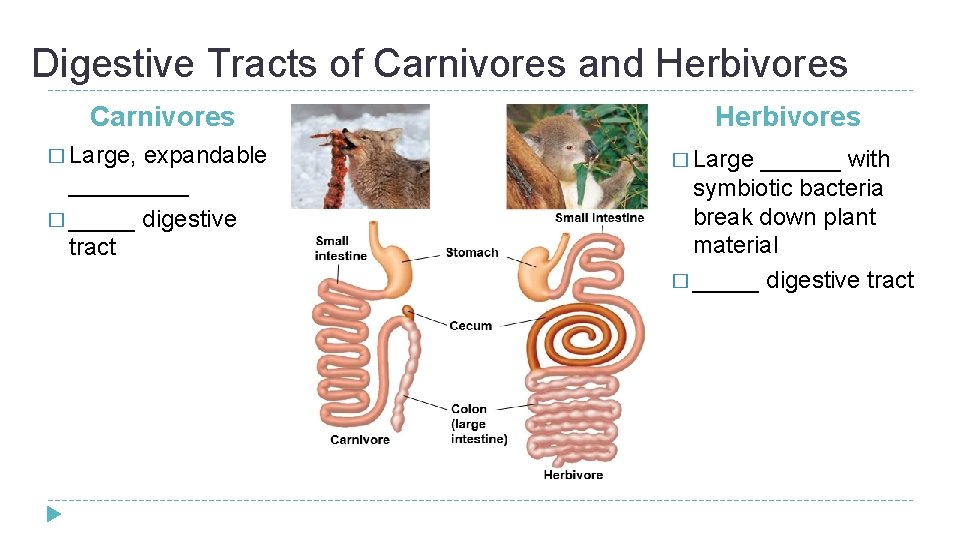
Digestive Tracts of Carnivores and Herbivores Carnivores � Large, expandable _____ � _____ digestive tract Herbivores � Large ______ with symbiotic bacteria break down plant material � _____ digestive tract
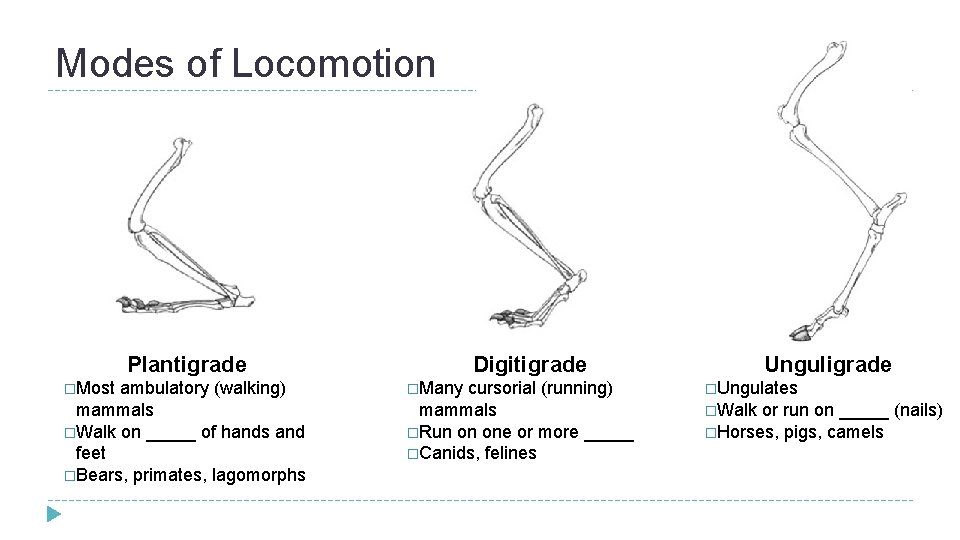
Modes of Locomotion Plantigrade �Most ambulatory (walking) mammals �Walk on _____ of hands and feet �Bears, primates, lagomorphs Digitigrade �Many cursorial (running) mammals �Run on one or more _____ �Canids, felines Unguligrade �Ungulates �Walk or run on _____ (nails) �Horses, pigs, camels
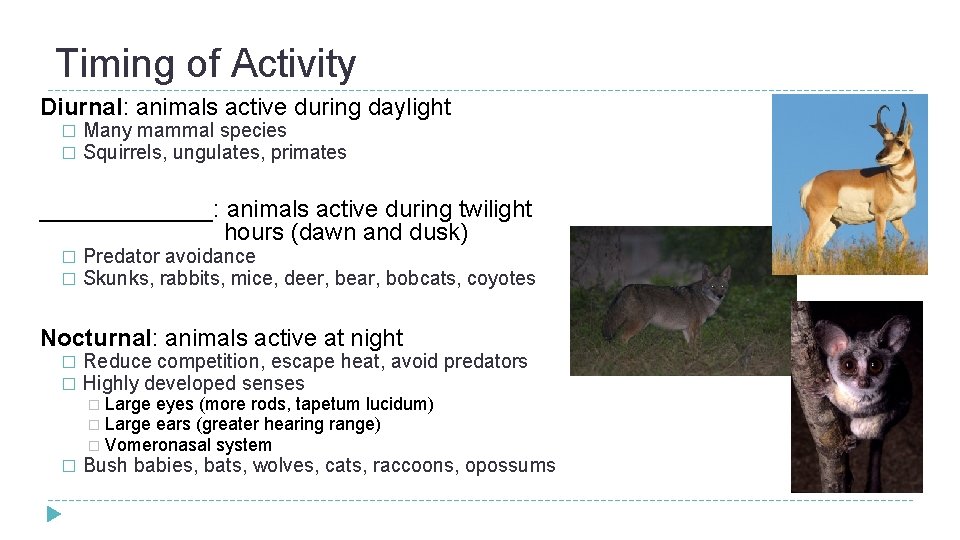
Timing of Activity Diurnal: animals active during daylight � � Many mammal species Squirrels, ungulates, primates _______: animals active during twilight hours (dawn and dusk) � � Predator avoidance Skunks, rabbits, mice, deer, bear, bobcats, coyotes Nocturnal: animals active at night � � Reduce competition, escape heat, avoid predators Highly developed senses � Large eyes (more rods, tapetum lucidum) � Large ears (greater hearing range) � Vomeronasal system � Bush babies, bats, wolves, cats, raccoons, opossums
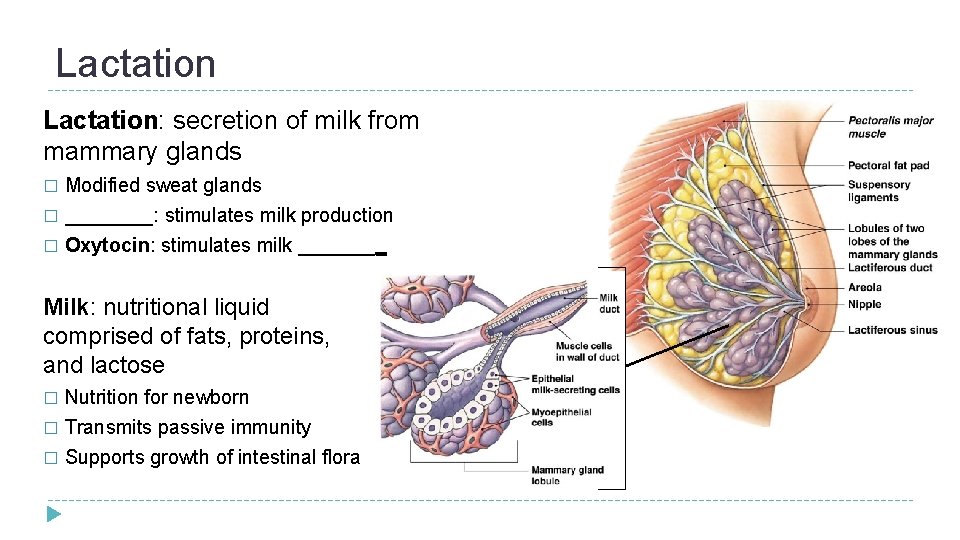
Lactation: secretion of milk from mammary glands Modified sweat glands � ____: stimulates milk production � Oxytocin: stimulates milk ____ � Milk: nutritional liquid comprised of fats, proteins, and lactose Nutrition for newborn � Transmits passive immunity � Supports growth of intestinal flora �
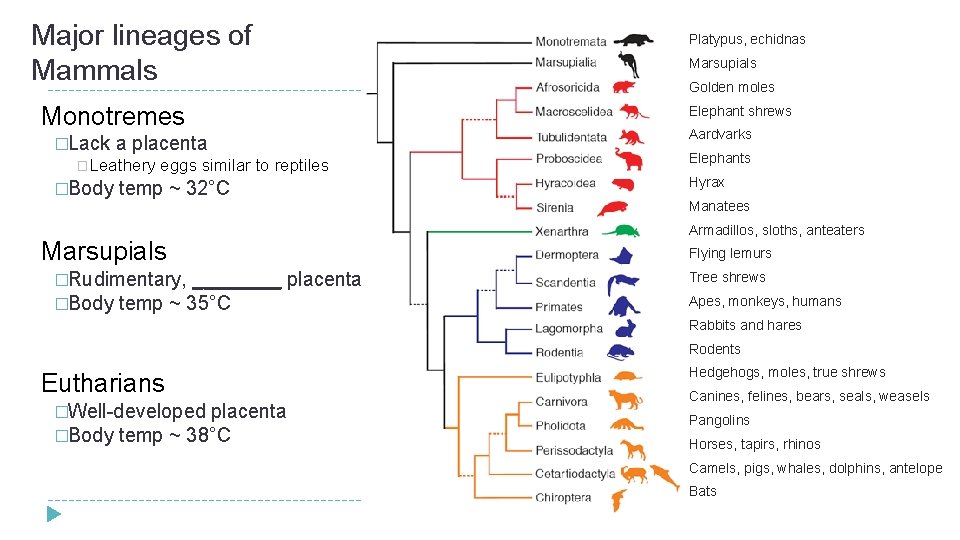
Major lineages of Mammals Monotremes �Lack a placenta � Leathery �Body eggs similar to reptiles temp ~ 32°C Marsupials �Rudimentary, ____ placenta �Body temp ~ 35°C Platypus, echidnas Marsupials Golden moles Elephant shrews Aardvarks Elephants Hyrax Manatees Armadillos, sloths, anteaters Flying lemurs Tree shrews Apes, monkeys, humans Rabbits and hares Rodents Eutharians �Well-developed placenta �Body temp ~ 38°C Hedgehogs, moles, true shrews Canines, felines, bears, seals, weasels Pangolins Horses, tapirs, rhinos Camels, pigs, whales, dolphins, antelope Bats
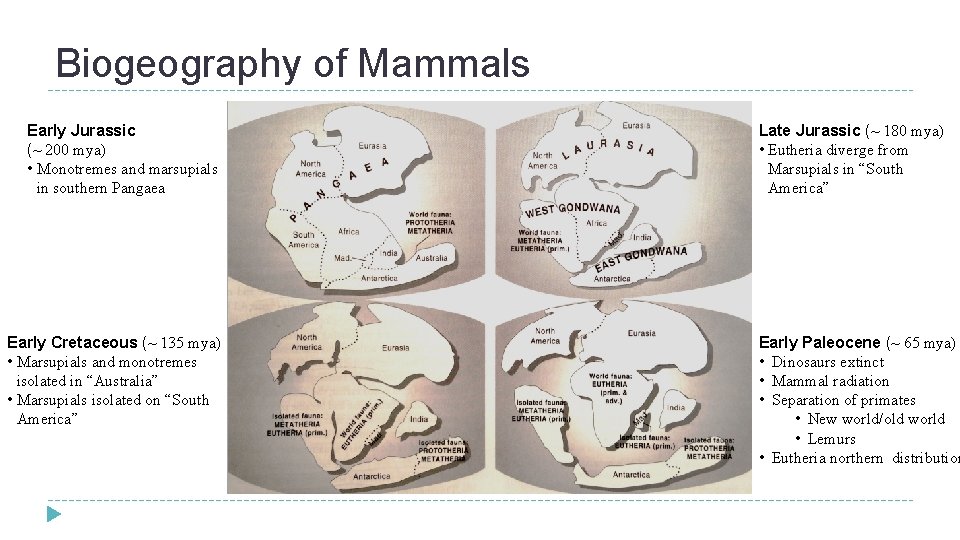
Biogeography of Mammals Early Jurassic (~ 200 mya) • Monotremes and marsupials in southern Pangaea Early Cretaceous (~ 135 mya) • Marsupials and monotremes isolated in “Australia” • Marsupials isolated on “South America” Late Jurassic (~ 180 mya) • Eutheria diverge from Marsupials in “South America” Early Paleocene (~ 65 mya) • Dinosaurs extinct • Mammal radiation • Separation of primates • New world/old world • Lemurs • Eutheria northern distribution
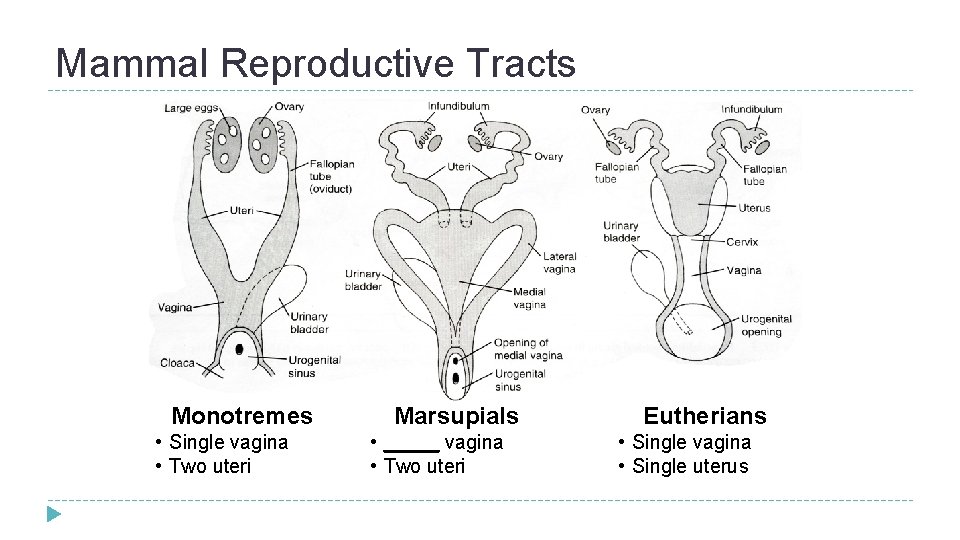
Mammal Reproductive Tracts Monotremes • Single vagina • Two uteri Marsupials • _____ vagina • Two uteri Eutherians • Single vagina • Single uterus
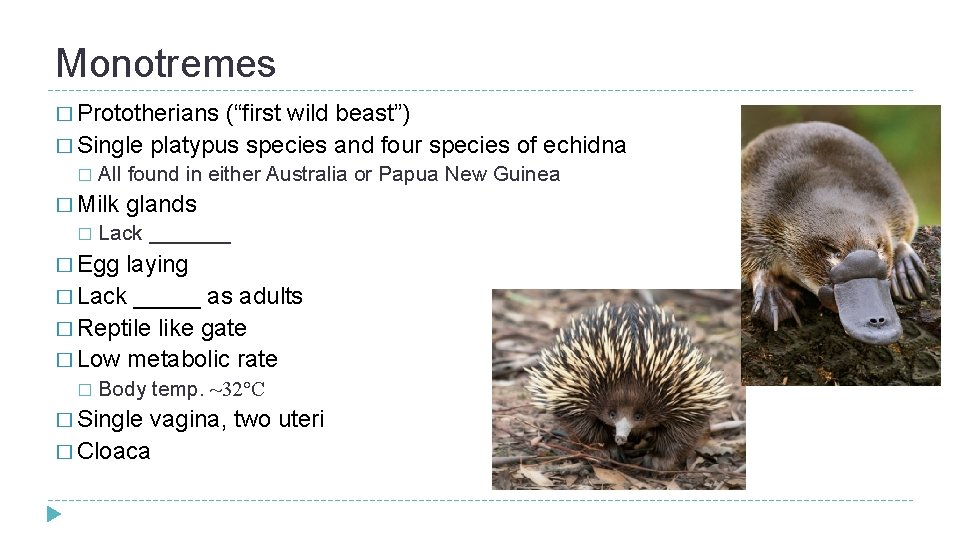
Monotremes � Prototherians (“first wild beast”) � Single platypus species and four species of echidna � All found in either Australia or Papua New Guinea � Milk � glands Lack _______ � Egg laying � Lack _____ as adults � Reptile like gate � Low metabolic rate � Body temp. ~32°C � Single vagina, two uteri � Cloaca
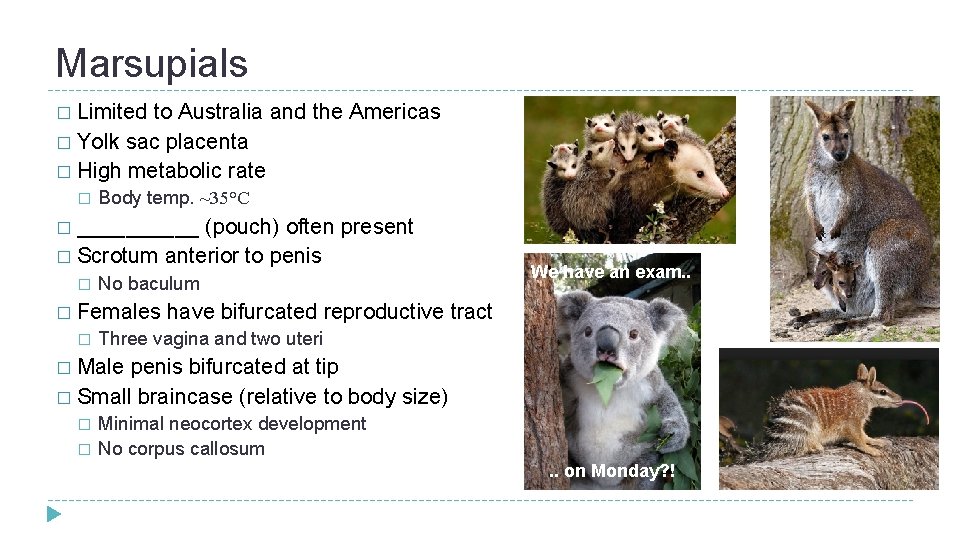
Marsupials � Limited to Australia and the Americas � Yolk sac placenta � High metabolic rate � Body temp. ~35°C � _____ (pouch) often present � Scrotum anterior to penis � No baculum � Females � We have an exam. . have bifurcated reproductive tract Three vagina and two uteri � Male penis bifurcated at tip � Small braincase (relative to body size) � � Minimal neocortex development No corpus callosum. . on Monday? !
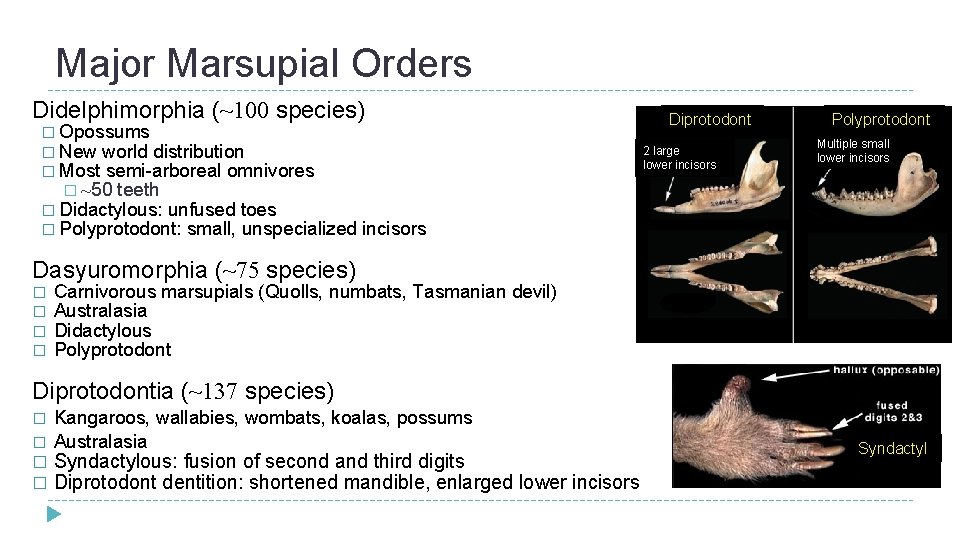
Major Marsupial Orders Didelphimorphia (~100 species) � Opossums � New world distribution � Most semi-arboreal omnivores � ~50 teeth � Didactylous: unfused toes � Polyprotodont: small, unspecialized Diprotodont 2 large lower incisors Polyprotodont Multiple small lower incisors Dasyuromorphia (~75 species) � � Carnivorous marsupials (Quolls, numbats, Tasmanian devil) Australasia Didactylous Polyprotodont Diprotodontia (~137 species) � � Kangaroos, wallabies, wombats, koalas, possums Australasia Syndactylous: fusion of second and third digits Diprotodont dentition: shortened mandible, enlarged lower incisors Syndactyl
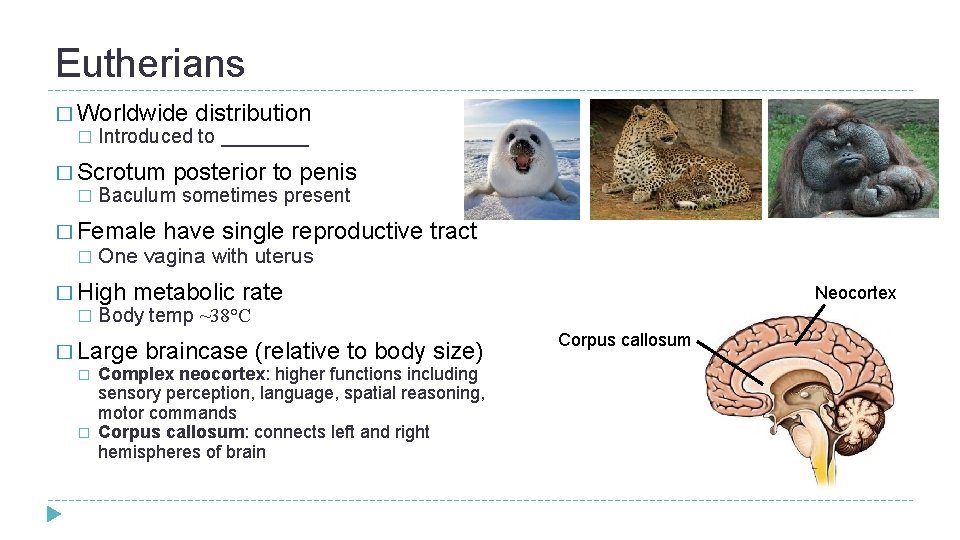
Eutherians � Worldwide � Introduced to ____ � Scrotum � have single reproductive tract One vagina with uterus � High � posterior to penis Baculum sometimes present � Female � distribution metabolic rate Neocortex Body temp ~38°C � Large braincase (relative to body size) � Complex neocortex: higher functions including sensory perception, language, spatial reasoning, motor commands � Corpus callosum: connects left and right hemispheres of brain Corpus callosum
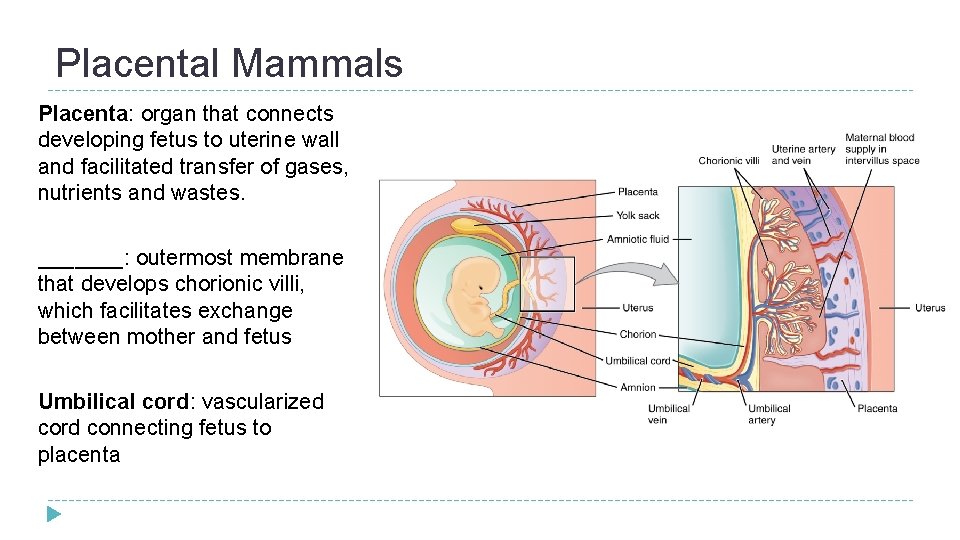
Placental Mammals Placenta: organ that connects developing fetus to uterine wall and facilitated transfer of gases, nutrients and wastes. _______: outermost membrane that develops chorionic villi, which facilitates exchange between mother and fetus Umbilical cord: vascularized cord connecting fetus to placenta
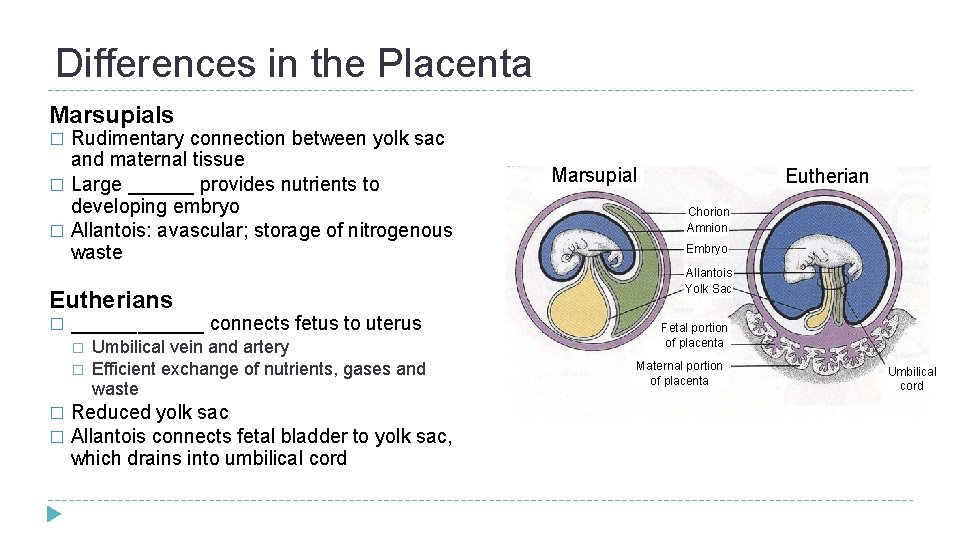
Differences in the Placenta Marsupials Rudimentary connection between yolk sac and maternal tissue � Large ______ provides nutrients to developing embryo � Allantois: avascular; storage of nitrogenous waste � Eutherians � ______ connects fetus to uterus � � Umbilical vein and artery Efficient exchange of nutrients, gases and waste Reduced yolk sac � Allantois connects fetal bladder to yolk sac, which drains into umbilical cord � Marsupial Eutherian Chorion Amnion Embryo Allantois Yolk Sac Fetal portion of placenta Maternal portion of placenta Umbilical cord
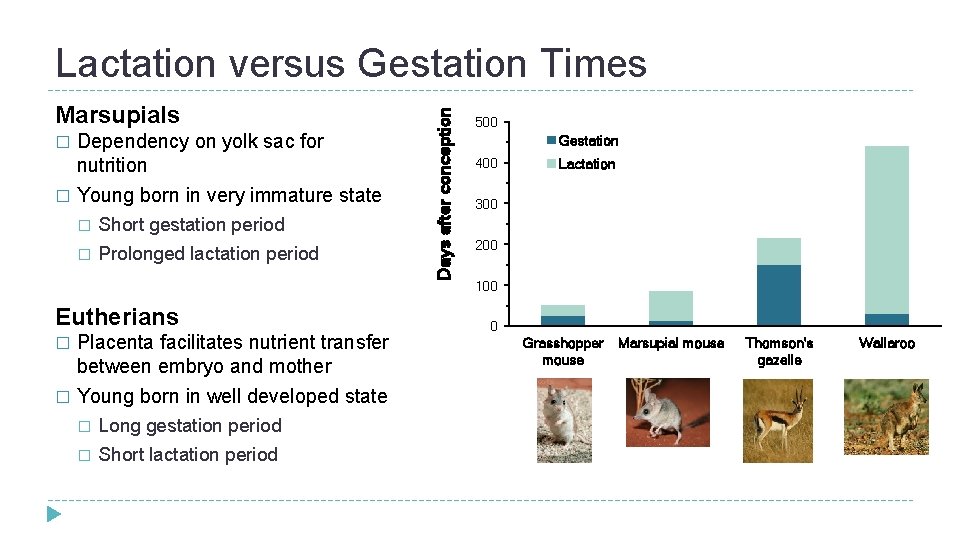
Marsupials Dependency on yolk sac for nutrition � Young born in very immature state � � Short gestation period � Prolonged lactation period Eutherians Placenta facilitates nutrient transfer between embryo and mother � Young born in well developed state � � Long gestation period � Short lactation period Days after conception Lactation versus Gestation Times 500 Gestation 400 Lactation 300 200 100 0 Grasshopper mouse Marsupial mouse Thomson's gazelle Wallaroo
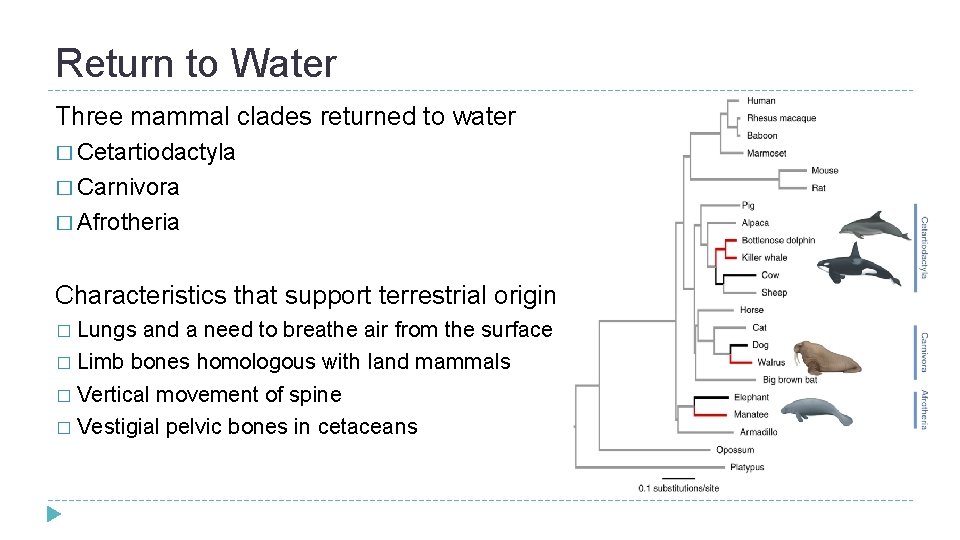
Return to Water Three mammal clades returned to water � Cetartiodactyla � Carnivora � Afrotheria Characteristics that support terrestrial origin � Lungs and a need to breathe air from the surface � Limb bones homologous with land mammals � Vertical movement of spine � Vestigial pelvic bones in cetaceans
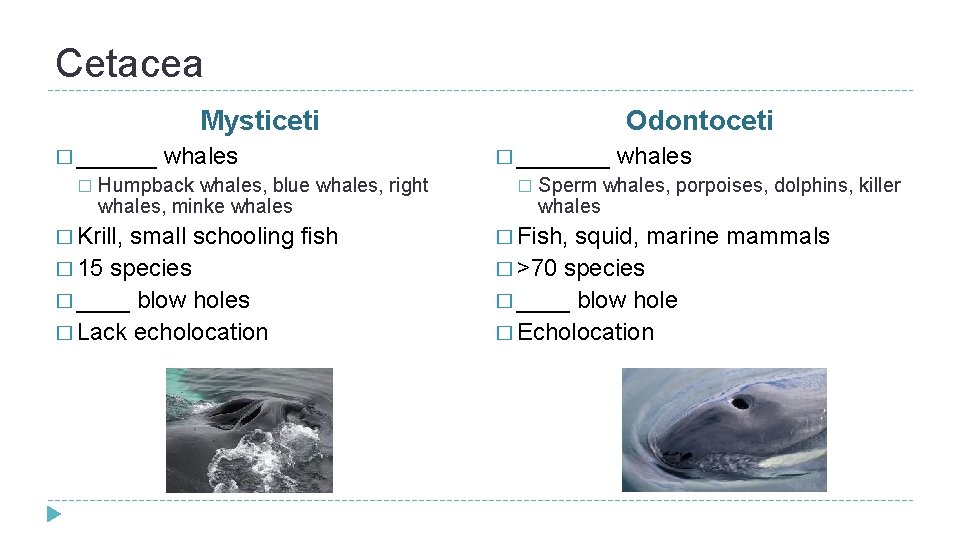
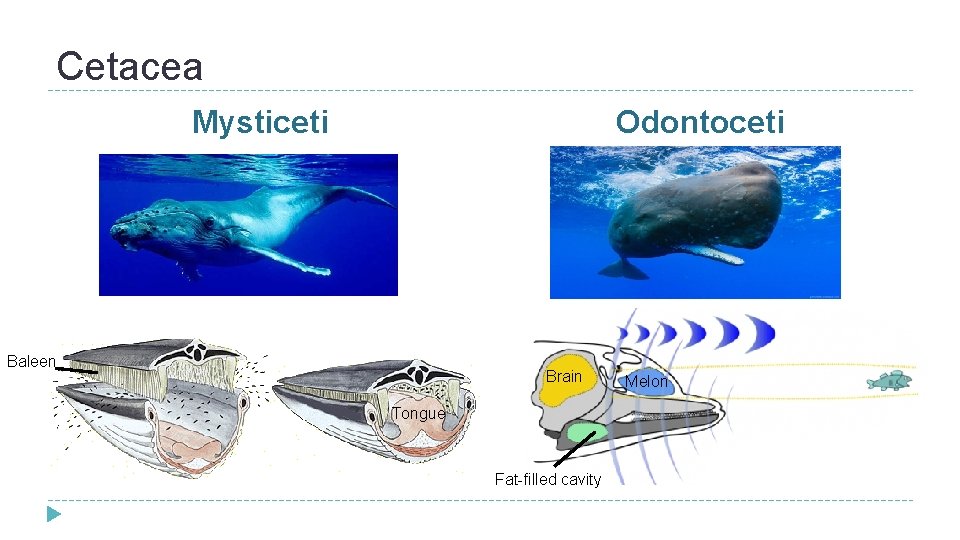
Cetacea Mysticeti � ______ � whales Humpback whales, blue whales, right whales, minke whales � Krill, small schooling fish � 15 species � ____ blow holes � Lack echolocation Odontoceti � _______ � whales Sperm whales, porpoises, dolphins, killer whales � Fish, squid, marine mammals � >70 species � ____ blow hole � Echolocation
Cetacea Mysticeti Odontoceti Baleen Brain Tongue Fat-filled cavity Melon
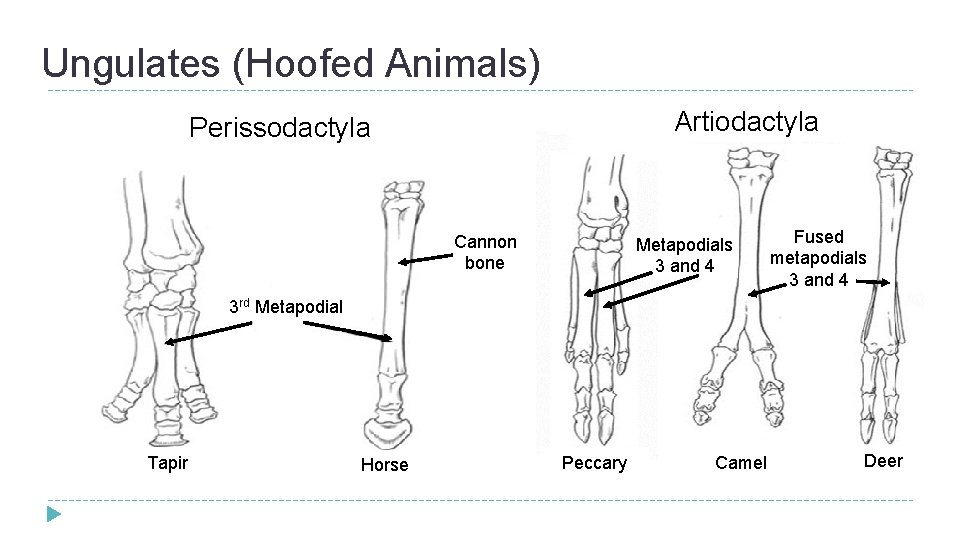
Ungulates (Hoofed Animals) Artiodactyla Perissodactyla Cannon bone Metapodials 3 and 4 Fused metapodials 3 and 4 3 rd Metapodial Tapir Horse Peccary Camel Deer
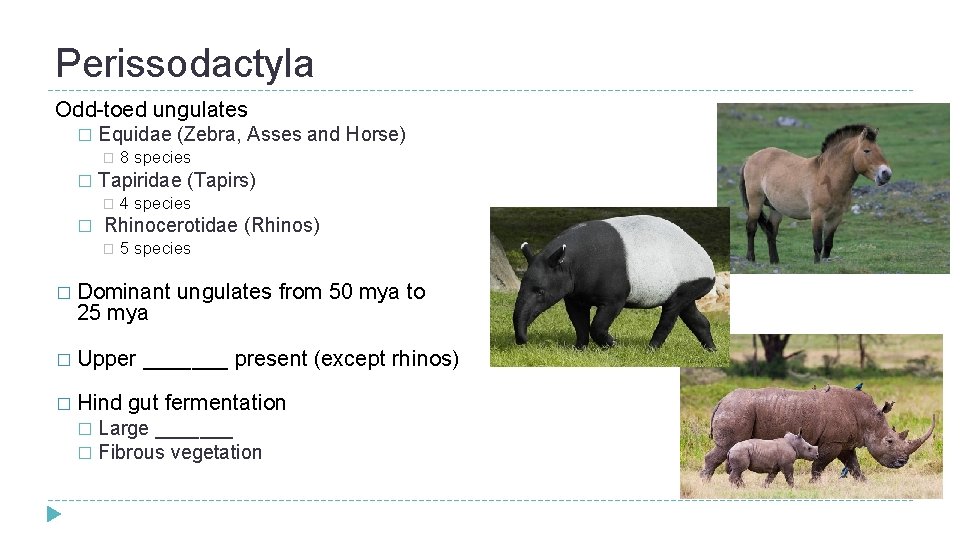
Perissodactyla Odd-toed ungulates � Equidae (Zebra, Asses and Horse) � � Tapiridae (Tapirs) � � 8 species 4 species Rhinocerotidae (Rhinos) � 5 species � Dominant 25 mya � Upper � Hind ungulates from 50 mya to _______ present (except rhinos) gut fermentation Large _______ � Fibrous vegetation �
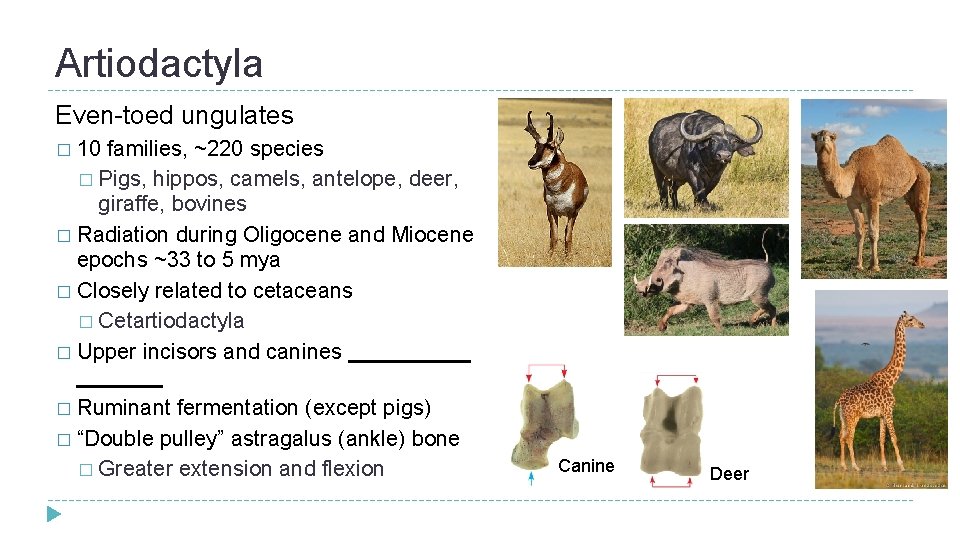
Artiodactyla Even-toed ungulates � 10 families, ~220 species � Pigs, hippos, camels, antelope, deer, giraffe, bovines � Radiation during Oligocene and Miocene epochs ~33 to 5 mya � Closely related to cetaceans � Cetartiodactyla � Upper incisors and canines _______ � Ruminant fermentation (except pigs) � “Double pulley” astragalus (ankle) bone � Greater extension and flexion Canine Deer
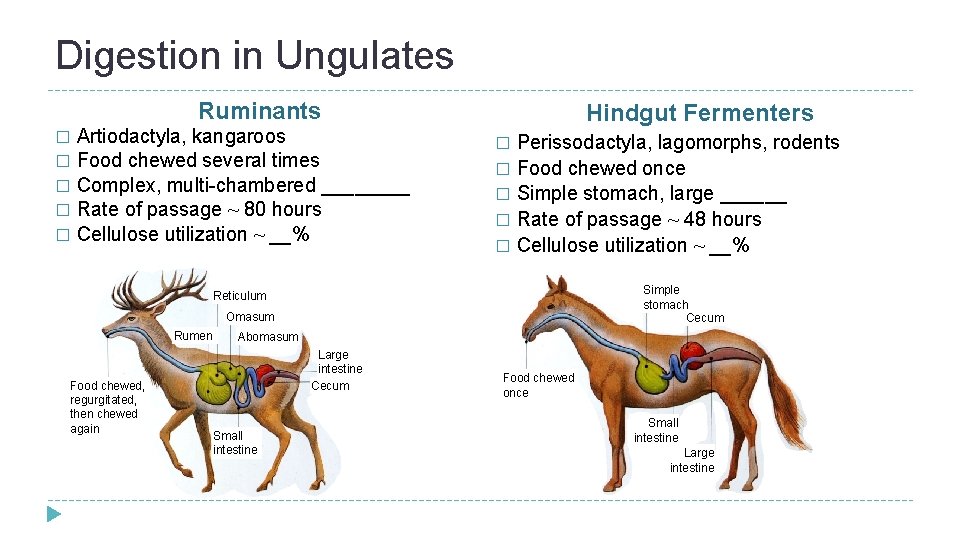
Digestion in Ungulates Ruminants Artiodactyla, kangaroos � Food chewed several times � Complex, multi-chambered ____ � Rate of passage ~ 80 hours � Cellulose utilization ~ __% � Hindgut Fermenters Perissodactyla, lagomorphs, rodents � Food chewed once � Simple stomach, large ______ � Rate of passage ~ 48 hours � Cellulose utilization ~ __% � Simple stomach Cecum Reticulum Omasum Rumen Food chewed, regurgitated, then chewed again Abomasum Large intestine Cecum Small intestine Food chewed once Small intestine Large intestine
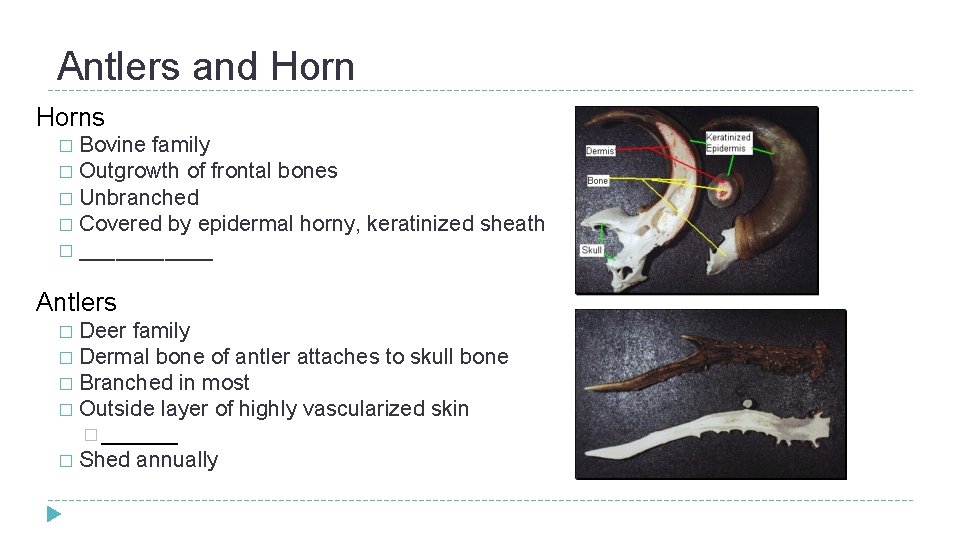
Antlers and Horns � Bovine family � Outgrowth of frontal bones � Unbranched � Covered by epidermal horny, keratinized sheath � ______ Antlers � Deer family � Dermal bone of antler attaches to skull bone � Branched in most � Outside layer of highly vascularized skin � _______ � Shed annually
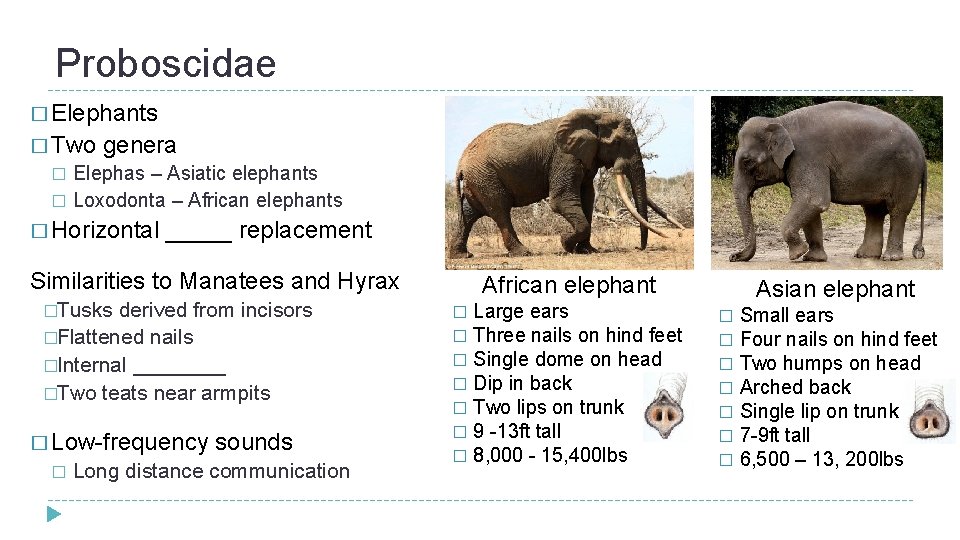
Proboscidae � Elephants � Two genera Elephas – Asiatic elephants � Loxodonta – African elephants � � Horizontal _____ replacement Similarities to Manatees and Hyrax �Tusks derived from incisors �Flattened nails �Internal ____ �Two teats near armpits � Low-frequency � sounds Long distance communication African elephant Large ears � Three nails on hind feet � Single dome on head � Dip in back � Two lips on trunk � 9 -13 ft tall � 8, 000 - 15, 400 lbs � Asian elephant Small ears � Four nails on hind feet � Two humps on head � Arched back � Single lip on trunk � 7 -9 ft tall � 6, 500 – 13, 200 lbs �
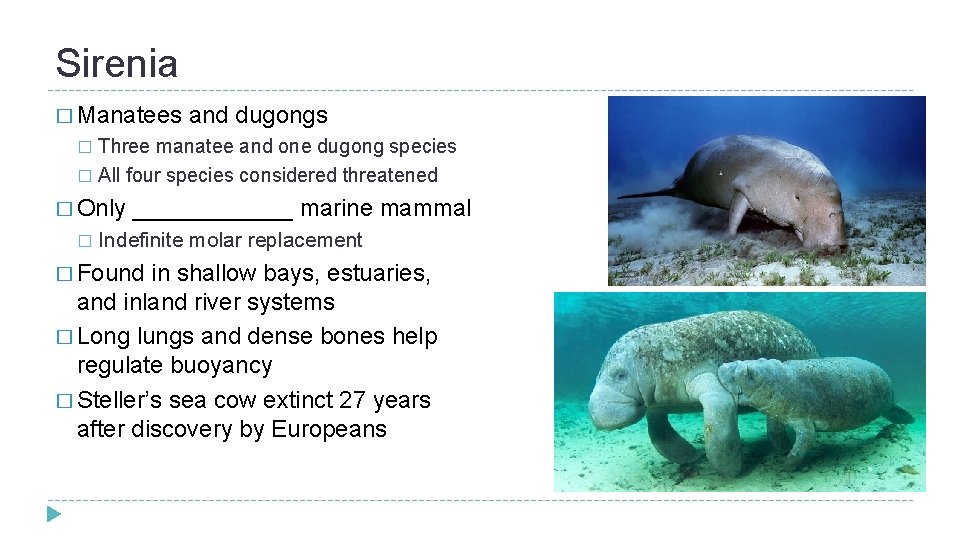
Sirenia � Manatees and dugongs Three manatee and one dugong species � All four species considered threatened � � Only � ______ marine mammal Indefinite molar replacement � Found in shallow bays, estuaries, and inland river systems � Long lungs and dense bones help regulate buoyancy � Steller’s sea cow extinct 27 years after discovery by Europeans
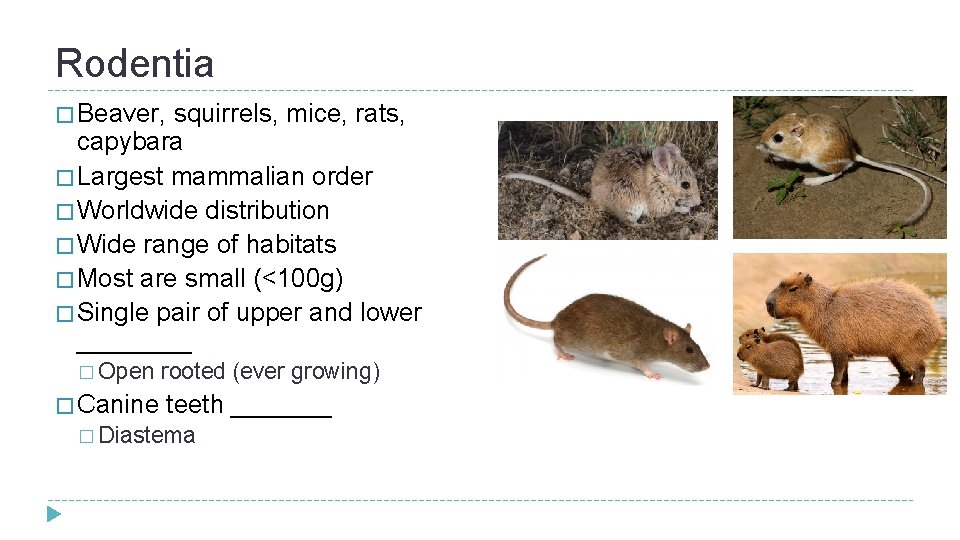
Rodentia � Beaver, squirrels, mice, rats, capybara � Largest mammalian order � Worldwide distribution � Wide range of habitats � Most are small (<100 g) � Single pair of upper and lower ____ � Open � Canine rooted (ever growing) teeth _______ � Diastema
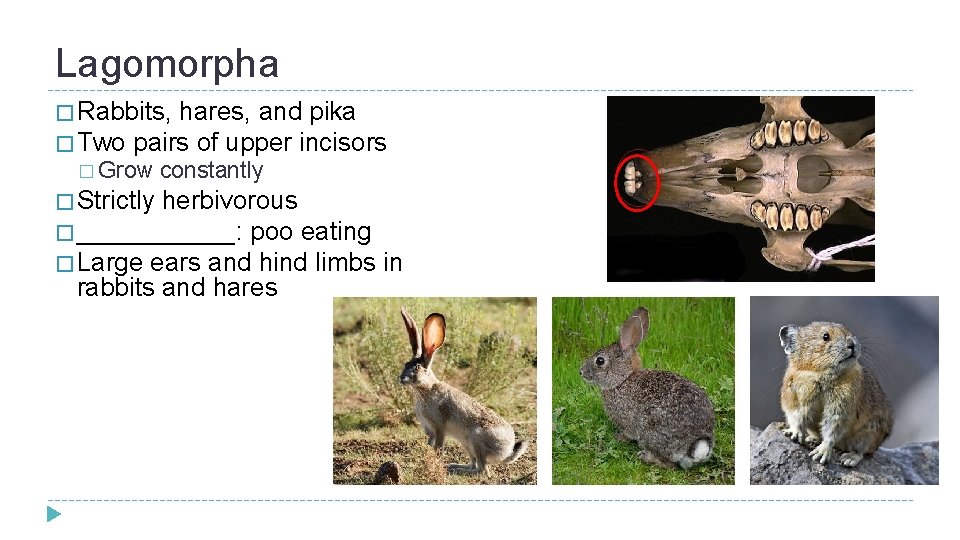
Lagomorpha � Rabbits, hares, and pika � Two pairs of upper incisors � Grow � Strictly constantly herbivorous � ______: poo eating � Large ears and hind limbs in rabbits and hares
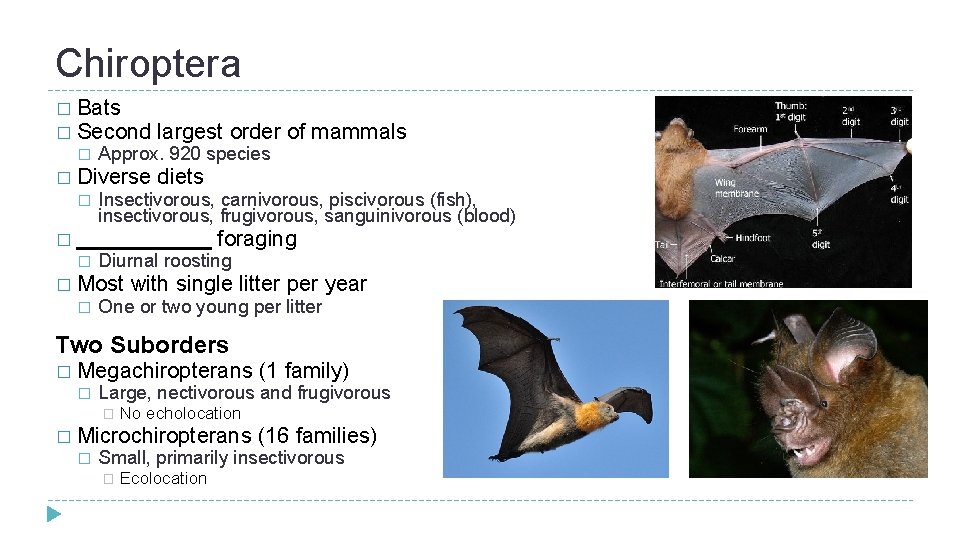
Chiroptera � Bats � Second � Approx. 920 species � Diverse � largest order of mammals diets Insectivorous, carnivorous, piscivorous (fish), insectivorous, frugivorous, sanguinivorous (blood) � ______ � Diurnal roosting � Most � foraging with single litter per year One or two young per litter Two Suborders � Megachiropterans � Large, nectivorous and frugivorous � No echolocation � Microchiropterans � (1 family) (16 families) Small, primarily insectivorous � Ecolocation
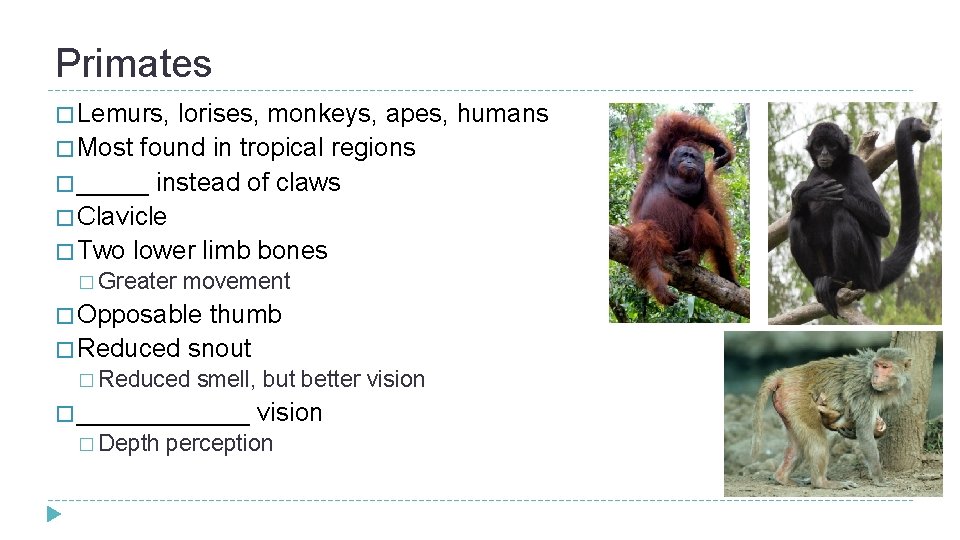
Primates � Lemurs, lorises, monkeys, apes, humans � Most found in tropical regions � _____ instead of claws � Clavicle � Two lower limb bones � Greater movement � Opposable thumb � Reduced snout � Reduced smell, but better vision � ______ � Depth vision perception
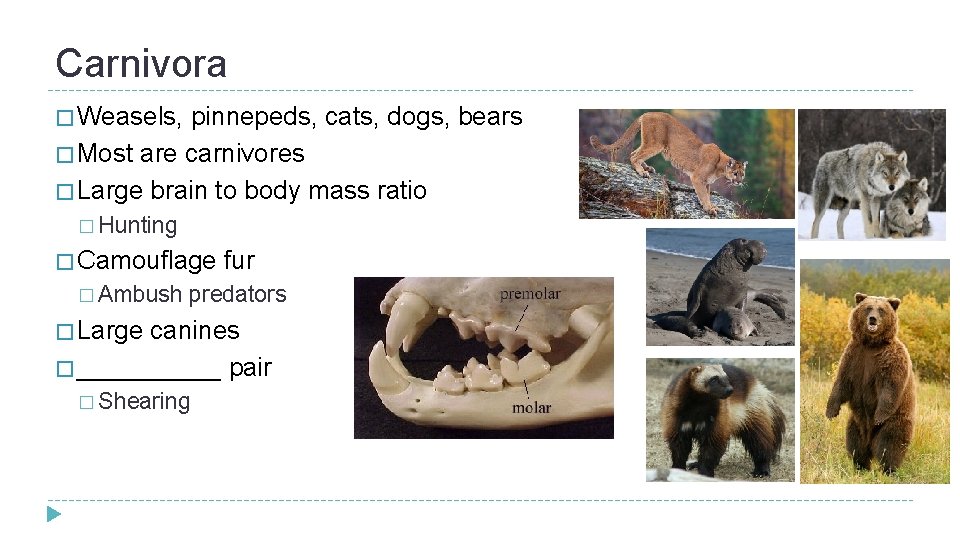
Carnivora � Weasels, pinnepeds, cats, dogs, bears � Most are carnivores � Large brain to body mass ratio � Hunting � Camouflage � Ambush fur predators � Large canines � _____ pair � Shearing