
MALPRESENTATION Dr maysoon sharief LECTURE OVERVIEW Abnormal lie
MALPRESENTATION Dr maysoon sharief

LECTURE OVERVIEW Abnormal lie, malpresentation and malposition n Malpresentation and its management n u breech u face u brow u shoulder u compound

Complication of malpresentation Maternal complication= n 1 -prolong labour 2 -infection 3 -obstructed labour 4 -risk of anasthesia, DVT, fatal pulmonary embolisim n Perinatal mortality and morbidity n Malformation, IUD, prematurity, cod porlapse n
DEFINITIONS n Abnormal lie u where the long axis of the fetus is not lying along the long axis of the mother F LONGITUDINAL OR BREECH) F TRANSVERSE F OBLIQUE F UNSTABLE (MAY BE EITHER CEPHALIC

DEFINITIONS n Malpresentation u where the fetus is lying longitudinally, but presents in any manner other than vertex F BREECH F FACE F BROW F SHOULDER F COMPOUND F CORD

DEFINITIONS n Malposition u where the fetus is lying longitudinally and the vertex is presenting, but it is not in the OA position F OT F OP (LOT, ROT)
aetiology n n n n Ant. Situated placenta Narrow pelvic brim Multiparity Anthropoid , andriod pelvis Diagnosis=flat below umbilicus difficult to pal pate the back sinciput and occiput same level Vaginal examination ant. Fontanelle in the center the suture in oblique
management 1 th stage active management n 2 nd stage forceps, CS n
BREECH PRESENTATION n Definition u where the fetal buttocks or lower extremeties present into the maternal pelvis n Incidence u 15% (30 W) u 3% at term
AETIOLOGY: FLUPP n Fetal u prematurity u multiple u anomalies: often those that restrict the ability of the fetus to assume a vertex presentation u major malformation: hydrocephaly, anencephaly, meningomyemocoele u most common malformation: congenital dislocation of the hip n Liquor u oligohydramnios/polyhydramnios Uterine u anomalies (bicornuate, fibroid) Placenta u praevia Pelvis u contraction, pelvic tumours obstructing birth canal n n n

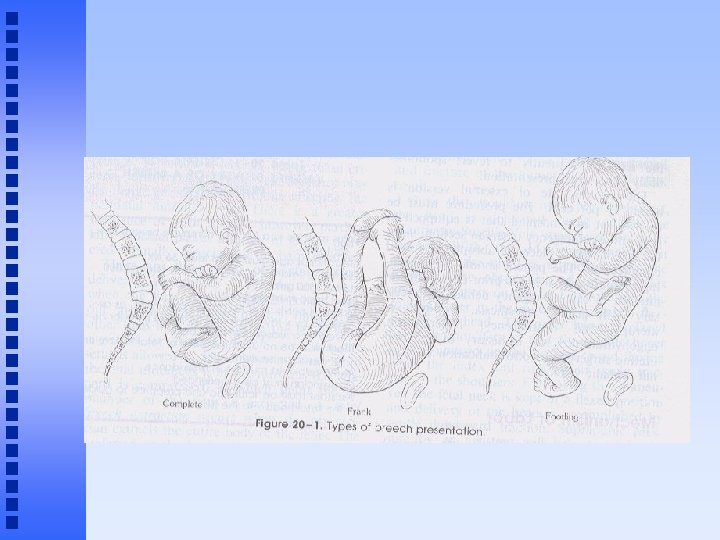
TYPES OF BREECH n n n Frank (breech with extended legs): 65% u both fetal thighs flexed u both lower limbs extended at the knee Complete (fully flexed): 25% u when both fetal thighs and knees are flexed Footling (incomplete): 10% u one or both fetal thighs are extended, and one or both knees or feet lie below the buttocks
THE PROBLEM WITH BEING A BREECH…. . FOUR FOLD INCREASE IN PERINATAL MORTALITY DUE TO…. . (1) problems associated with the malpresentation and (2) problems of asphyxia and trauma due to the malpresentation

PROBLEMS ASSOCIATED WITH THE MALPRESENTATION (1) prematurity and preterm PROM (2) fetal anomalies (3) placenta praevia and abruption
PROBLEMS OF ASPHYXIA AND TRAUMA DUE TO THE MALPRESENTATION (1) cord prolapse (2) entrapment of the fetal head through partly dilated cervix unrecognized disproportion (3) traumatic injuries CNS, intra-abdominal, nerve palsies, muscle injuries (4) extension of fetal arms (nuchal arms)
MANAGEMENT OF BREECH PRESENTATION AT TERM Management options (1) external cephalic version (2) elective caesarean section (3) trial of vaginal delivery
EXTERNAL CEPHALIC VERSION n CONTRAINDICTAIONS: u 3 rd trimester bleeding u uterine anomalies u ROM, oligohydramnios u need for CS for other reasons (placenta praevia, contracted pelvis, hyperextended head) u indicated vaginal delivery (fetal death, anomaly best delivered as breech)
EXTERNAL CEPHALIC VERSION n n SUCCESS u 60 -70% TECHNIQUE u after 36 W u CTG prior u attempt to perform forward somersault u tocolytic u CTG after (8% bradycardia; 5% fetomaternal haemorrhage) u anti D (if Rh negative)
ELECTIVE CAESAREAN SECTION n n n n EFW <2500 g; >3500 g preterm breech hyperextended fetal head palcenta praevia concerns re. fetal well being, including oligohydramnios footling breech u 10% risk of cord prolapse ? complete breech u 5% risk of cord prolapse (c. f. 1% with frank breech) ? all PG breech
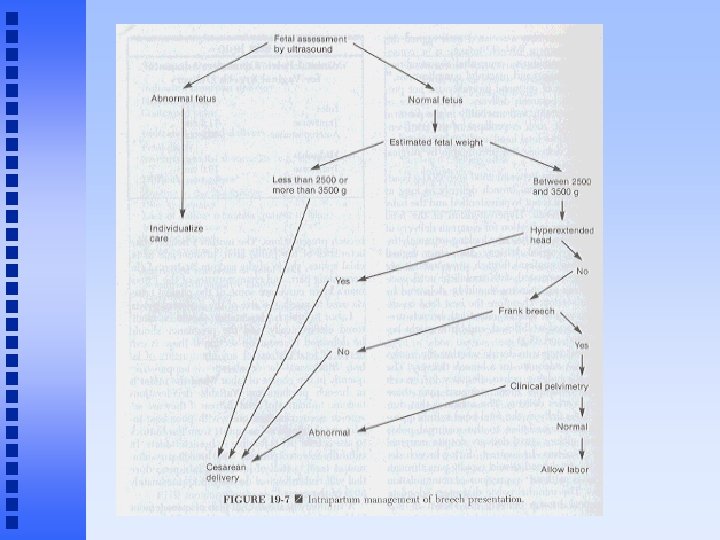
CRITERIA FOR VAGINAL DELIVERY n n n n Frank or complete breech EFW 2500 -3500 g gestational age >36 weeks fetal head must be flexed maternal pelvis must be adequate u judged clinically or by pelvimetry no other maternal or fetal indiaction for CS experienced obstetrician, anaesthetist and paediatrician present at delivery
BREECH EXTRACTION n Where the obstetrician completely removes the entire body from the uterus n ONLY used for operative delivery of the second twin (usually in conjunction with an internal podalic version) or at caesarean section n spontaneous or assisted breech delivery is the only acceptable method for delivering a singleton breech vaginally
FACE PRESENTATION n n Incidence: 0. 2% Mechanics of presentation: u n n Characterized by extreme extension of the fetal head so the face (rather than the skull) presents to the birth canal Aetiology u any factor that favours extension such as fetal goitre, anencephaly u high maternal parity At diagnosis: u 60% mentoanterior u 15% mentotransverse u 25% mentoposterior
DIAGNOSIS Generally diagnosed on vaginal examination in labour n May be confused with breech presentation…REMEMBER n u anus has sphincter tone, the mouth does not u anus is in line with the ischial tuberosities; mouth forms a traingle with the malar prominences
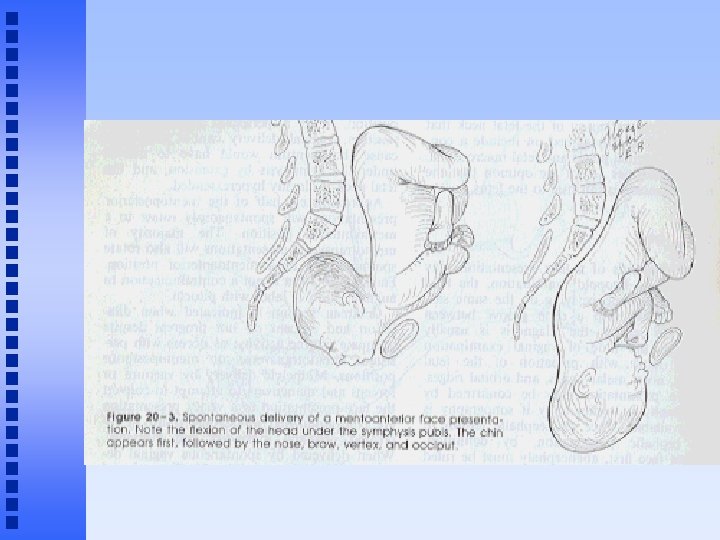
MANAGEMENT n n n Submentobregmatic diameter equals suboccipitobregmatic diameter of vertex presentations labour occurs by internal rotation with the chin delivering under the symphysis, and the head then delivers by FLEXION under the symphysis 60 -80% of face presentations deliver spontaneously (approximately 50% of MP presentations will undergo rotation during labour, and most MT presentations will rotate to MA) if MP or MT doesn’t convert to MA spontaneously, caesarean section is indicated augmentation for poor progress may be used on a face presentation forceps may be used on a MA face presentation
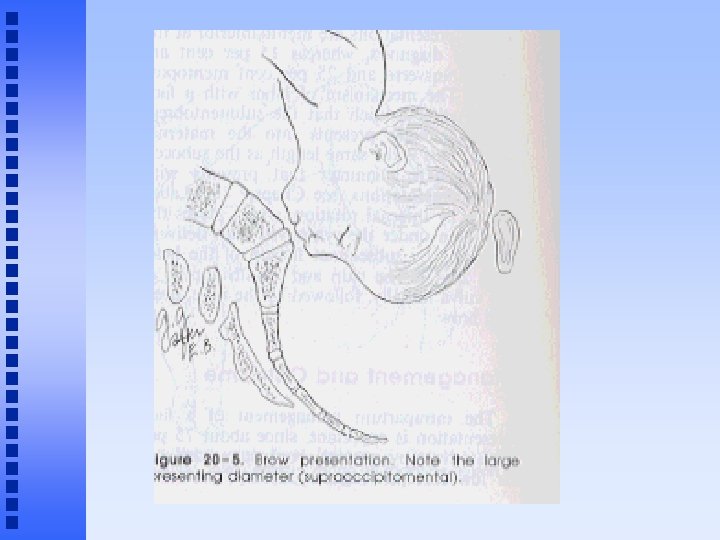
BROW PRESENTATION n n Incidence: 1: 1400 Mechanics of presentation: u head is extended such that attitude is halfway between flexion (vertex) and hyperextension (face) u usually transitional- when the head is in the process of converting from a vertex to a face or vice versa u presenting part is between the facial orbits and anterior fontanelle u supraoccipitomental diameter is presenting 13. 5 cm; cf 9. 5 cm for suboccipitobregmatic (vertex) or submentobregmatic (face)
DIAGNOSIS On vaginal examination, palpate u anterior fonatnelle u orbital ridges u eyes
MANGEMENT IN LABOUR n n n Initially expectant; u 50 -75% will either flex to a vertex, or extend to a face with contractions from behind meeting soft tissue and bony resistance below and will therefore deliver vaginally High incidence of prolonged labour and dysfunctional labour Persistent brow u the diameter is undeliverable vaginally u deliver by caesarean section
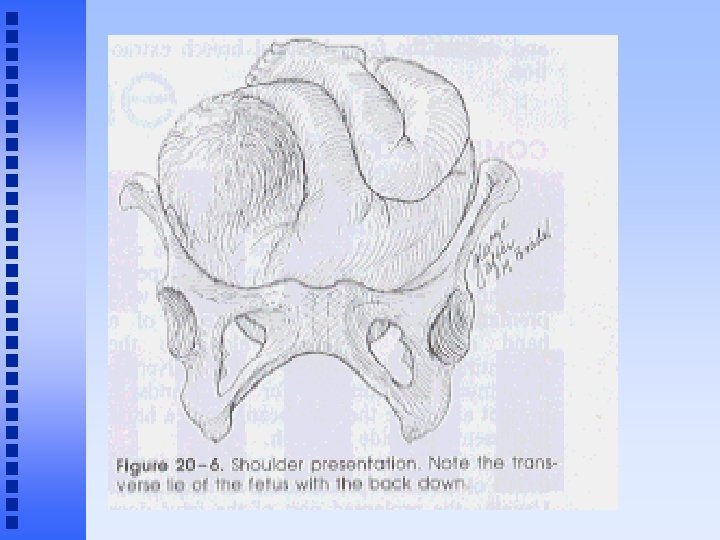
SHOULDER PRESENTATION Incidence: 0. 3% n Mechanics of presentation: n u long axis of the fetus is perpendicular to long axis of mother (ie occurs in transverse lie) u mostly the shoulder presents in a transverse lie, but alternative presentations are F hand arm (may be prolapsed into the vagina) F cord F nil (fetal back is down, and above the level of the inlet)
AETIOLOGY n n n Fetal u prematurity, multiple Liquor u polyhydramnios Uterine u anomaly Placenta u praevia Pelvis u contraction, tumour Parity u high maternal parity (80% of cases occur in women who are para 3 or more)
DIAGNOSIS On abdominal palpation, no fetal pole is presenting to the pelvis, and the head is palpable in either the right or left iliac fossa n on vaginal examination, may palpate ribs, scapula, clavicle n in advanced labour, fetal hand arm may prolapse into the vagina n
MANAGEMENT n Consider ECV prior to labour n if diagnosed in labour, deliver by Caesarean section (as fetal head and trunk would have to enter pelvis at the same time to deliver vaginally) n Caesarean may need to be classical, as lower segment often inadequate

COMPOUND PRESENTATION n n n Incidence: 0. 1% Mechanics of presentation: u When a fetal extremity prolapses alongside the presenting part, and both enter the maternal pelvis at the same time F vertex-hand F breech-hand F vertex-arm-foot Aetiology u Fetal F multiple F premature u Maternal F multiparity
MANGEMENT n n Exclude cord prolapse u occurs in up to 20% of cases Otherwise expectant u mostly doesn’t interfere with normal delivery u vertex-foot: try to gently reposition the lower extremity u if arm prolapses in vertex-hand, wait and see if it moves as head descends; if it converts to shoulder presentation, deliver by CS
SUMMARY Abnormal lie, malpresentation, malposition n Incidence, mechanics, aetiology, diagnosis, management of n u BREECH PRESENTATION u FACE PRESENTATION u BROW PRESENTATION u SHOULDER PRESENTATION u COMPOUND PRESENTATION
- Slides: 39