
MALNUTRITION AND BEHAVIORAL ISSUES HOW DOES MALNUTRITION PLAY
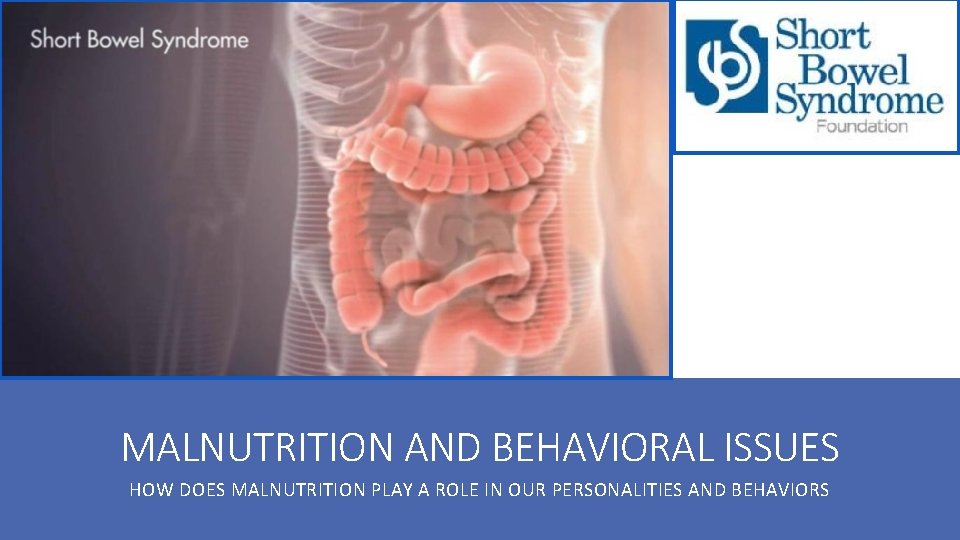
MALNUTRITION AND BEHAVIORAL ISSUES HOW DOES MALNUTRITION PLAY A ROLE IN OUR PERSONALITIES AND BEHAVIORS
DISCLAIMERS AND CONSIDERATIONS ▪ All interview subjects have agreed (both child and adult who completed their interview) have written permission to display photos and personal medical info that relates to this topic. ▪ This was an independent research thesis created in part to help a demographic of patients. ▪ No outside organizations or pharmaceuticals, besides the one I own, and founded (Short Bowel Syndrome Foundation, Inc. ) helped contribute to this project.
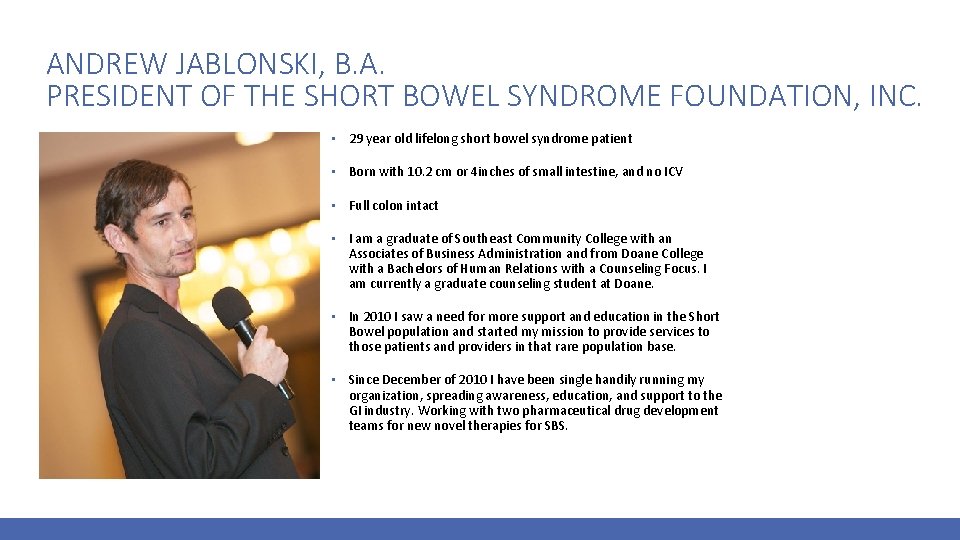
ANDREW JABLONSKI, B. A. PRESIDENT OF THE SHORT BOWEL SYNDROME FOUNDATION, INC. ▪ 29 year old lifelong short bowel syndrome patient ▪ Born with 10. 2 cm or 4 inches of small intestine, and no ICV ▪ Full colon intact ▪ I am a graduate of Southeast Community College with an Associates of Business Administration and from Doane College with a Bachelors of Human Relations with a Counseling Focus. I am currently a graduate counseling student at Doane. ▪ In 2010 I saw a need for more support and education in the Short Bowel population and started my mission to provide services to those patients and providers in that rare population base. ▪ Since December of 2010 I have been single handily running my organization, spreading awareness, education, and support to the GI industry. Working with two pharmaceutical drug development teams for new novel therapies for SBS.
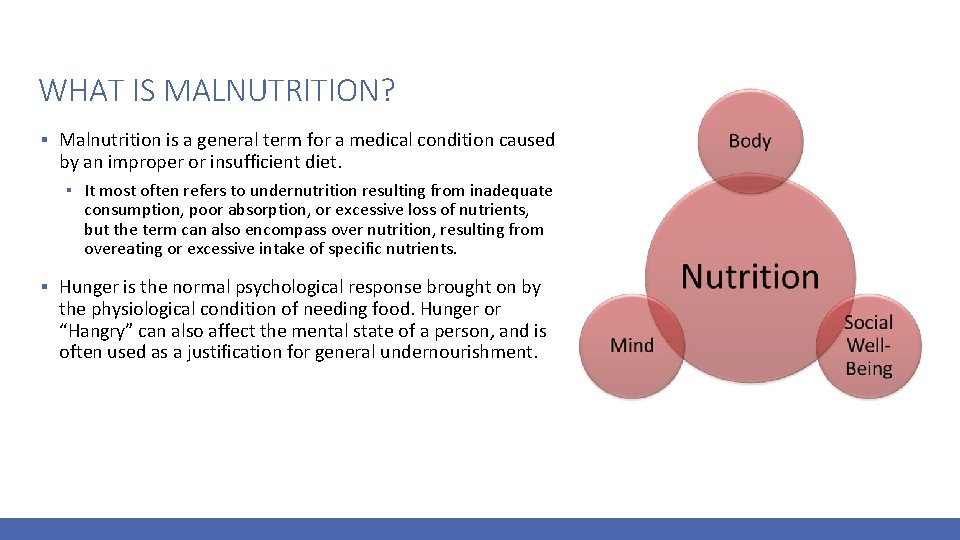
WHAT IS MALNUTRITION? ▪ Malnutrition is a general term for a medical condition caused by an improper or insufficient diet. ▪ It most often refers to undernutrition resulting from inadequate consumption, poor absorption, or excessive loss of nutrients, but the term can also encompass over nutrition, resulting from overeating or excessive intake of specific nutrients. ▪ Hunger is the normal psychological response brought on by the physiological condition of needing food. Hunger or “Hangry” can also affect the mental state of a person, and is often used as a justification for general undernourishment.

WHAT IS NORMAL BEHAVIOR? ▪ Normal behavior for an individual or interpersonal normality, is when behavior is consistent with the most common behavior for that person. ▪ If a person’s “normal” behavior is pleasant but at other times angry and defiant, that is their “normal behavior”. If that is their “normal” behavior, some intervention may be needed to curve the behaviors that are unpleasant, but the behavior as a whole will never go away completely. There will still be times of extreme blowups due to how the person feels both physically and mentally. ▪ Normal is also used to describe individual behavior that conforms to society (conformity).
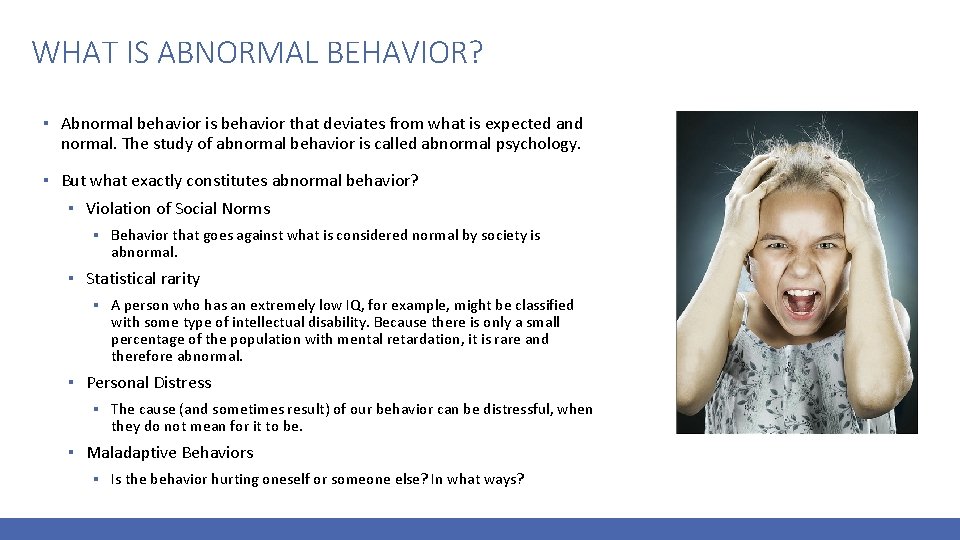
WHAT IS ABNORMAL BEHAVIOR? ▪ Abnormal behavior is behavior that deviates from what is expected and normal. The study of abnormal behavior is called abnormal psychology. ▪ But what exactly constitutes abnormal behavior? ▪ Violation of Social Norms ▪ Behavior that goes against what is considered normal by society is abnormal. ▪ Statistical rarity ▪ A person who has an extremely low IQ, for example, might be classified with some type of intellectual disability. Because there is only a small percentage of the population with mental retardation, it is rare and therefore abnormal. ▪ Personal Distress ▪ The cause (and sometimes result) of our behavior can be distressful, when they do not mean for it to be. ▪ Maladaptive Behaviors ▪ Is the behavior hurting oneself or someone else? In what ways?
COMMON DSM-5 DIAGNOSIS GIVEN TO CHILDREN ▪ Intellectual Disabilities ▪ Speech, Motor, Learning Disabilities ▪ ADHD, Autism ▪ Depression ▪ Major Depressive Episode ▪ Disruptive Mood Dysregulation Disorder ▪ Anxiety ▪ Social and Generalized Anxiety ▪ Attachment & Separation Anxiety ▪ PTSD ▪ Elimination Disorders ▪ Sleep-Wake Disorders ▪ Personality Disorders
MALNUTRITION IN HOSPITALS HOW MALNUTRITION WAS MEASURED BY NURSING STAFF
PERSONALITY DISORDERS EXPERIENCED BY MALNOURISHED PATIENTS ▪ One of the main highlighting concerns that was discovered during research, was that why malnourishment is well documented in the hospital system, it is seriously lacking in psychiatric hospitals and intuitions. ▪ It was discovered during the study that patients of registered mental health nurses, are expected to be at severe risk for malnourishment. (Abayomi & Hackett, 2004) ▪ “Majority of patients were admitted for psychotic or affective illness, 48% and 45% respectively. Data was taken from 112 patients at an acute psychiatric hospital unit”. ▪ This unit was populated by 61 males and 51 females. ▪ Majority were young adults ranging from 18 to 63 years in age, with the average as 39 years. (Abayomi & Hackett, 2004) ▪ Nurses believed that majority of their patients were not at risk for malnutrition: ▪ 62 nurses (56%) believed there was no risk, ▪ 23% had some concern, ▪ 19% thought there was a malnutrition issue to deal with. ▪ It was documented that one ward out of four failed to refer a malnourished patient to a dietician. ” ▪ (Abayomi & Hackett, 2004)
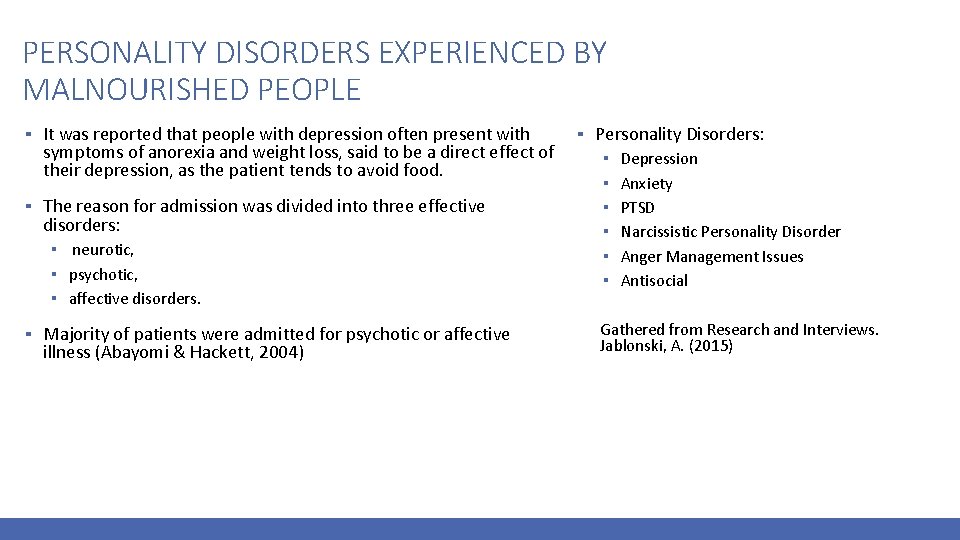
PERSONALITY DISORDERS EXPERIENCED BY MALNOURISHED PEOPLE ▪ It was reported that people with depression often present with ▪ Personality Disorders: symptoms of anorexia and weight loss, said to be a direct effect of ▪ Depression their depression, as the patient tends to avoid food. ▪ The reason for admission was divided into three effective disorders: ▪ neurotic, ▪ psychotic, ▪ affective disorders. ▪ Majority of patients were admitted for psychotic or affective illness (Abayomi & Hackett, 2004) ▪ ▪ ▪ Anxiety PTSD Narcissistic Personality Disorder Anger Management Issues Antisocial Gathered from Research and Interviews. Jablonski, A. (2015)
MENTAL HEALTH OF MOTHERS WHO HAVE MALNOURISHED CHILDREN
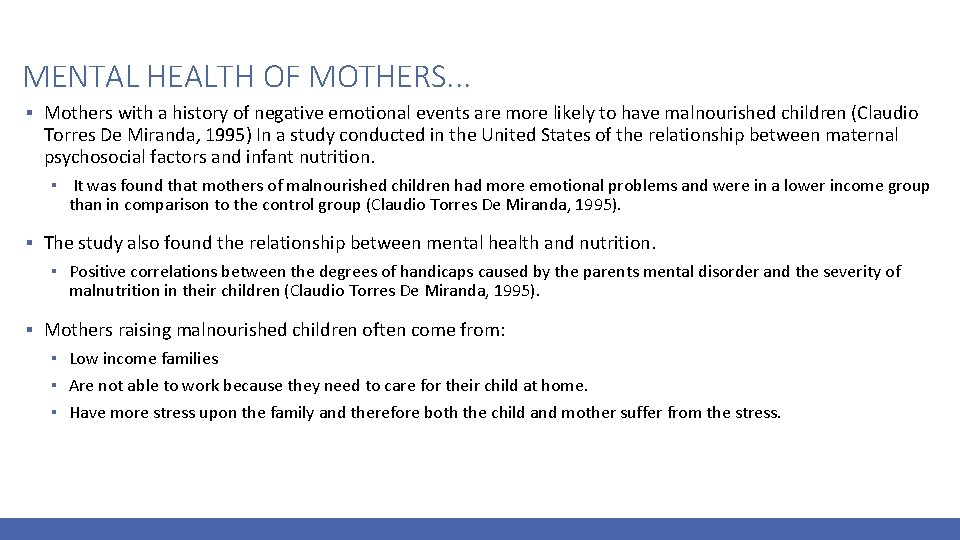
MENTAL HEALTH OF MOTHERS. . . ▪ Mothers with a history of negative emotional events are more likely to have malnourished children (Claudio Torres De Miranda, 1995) In a study conducted in the United States of the relationship between maternal psychosocial factors and infant nutrition. ▪ It was found that mothers of malnourished children had more emotional problems and were in a lower income group than in comparison to the control group (Claudio Torres De Miranda, 1995). ▪ The study also found the relationship between mental health and nutrition. ▪ Positive correlations between the degrees of handicaps caused by the parents mental disorder and the severity of malnutrition in their children (Claudio Torres De Miranda, 1995). ▪ Mothers raising malnourished children often come from: ▪ Low income families ▪ Are not able to work because they need to care for their child at home. ▪ Have more stress upon the family and therefore both the child and mother suffer from the stress.
INTESTINAL FAILURE & BEHAVIORS IN SHORT BOWEL SYNDROME PATIENTS
INTESTINAL FAILURE DEFINED: ▪ Intestinal Failure is a term that has "emerged approximately twenty years ago. It is now a well defined syndrome with clear treatment pathways” Irving, M (2000). ▪ The last five years IF has been the center point in the rare disease industry, with new emerging treatment options: ▪ such as GATTEX, a growth hormone therapy that increases the villus of the intestine allowing for better absorption of nutrients (Irving, 2000). ▪ IF is a condition that can be present in patients with: ▪ Normal ▪ partial dysfunction ▪ dysfunctional length of bowel ▪ It can be complete or partial, acute or temporary, or chronic and permanent describes Irving, going on to describe that ▪ The four major underlining causes of IF are: 1. 2. 3. 4. Short bowel syndrome Crohn's disease Motility disorders Small bowel fistulation (Irving, 2000)
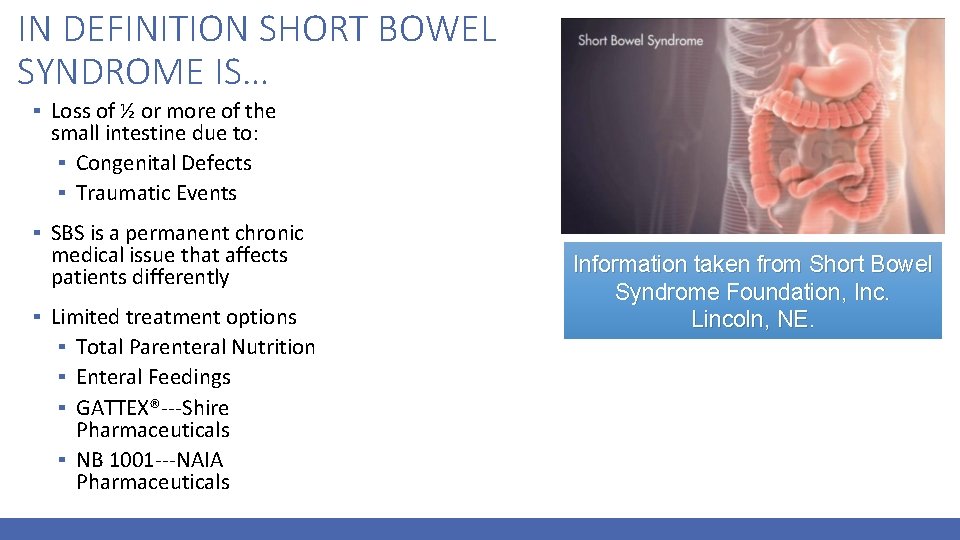
IN DEFINITION SHORT BOWEL SYNDROME IS… ▪ Loss of ½ or more of the small intestine due to: ▪ Congenital Defects ▪ Traumatic Events ▪ SBS is a permanent chronic medical issue that affects patients differently ▪ Limited treatment options ▪ Total Parenteral Nutrition ▪ Enteral Feedings ▪ GATTEX®---Shire Pharmaceuticals ▪ NB 1001 ---NAIA Pharmaceuticals Information taken from Short Bowel Syndrome Foundation, Inc. Lincoln, NE.
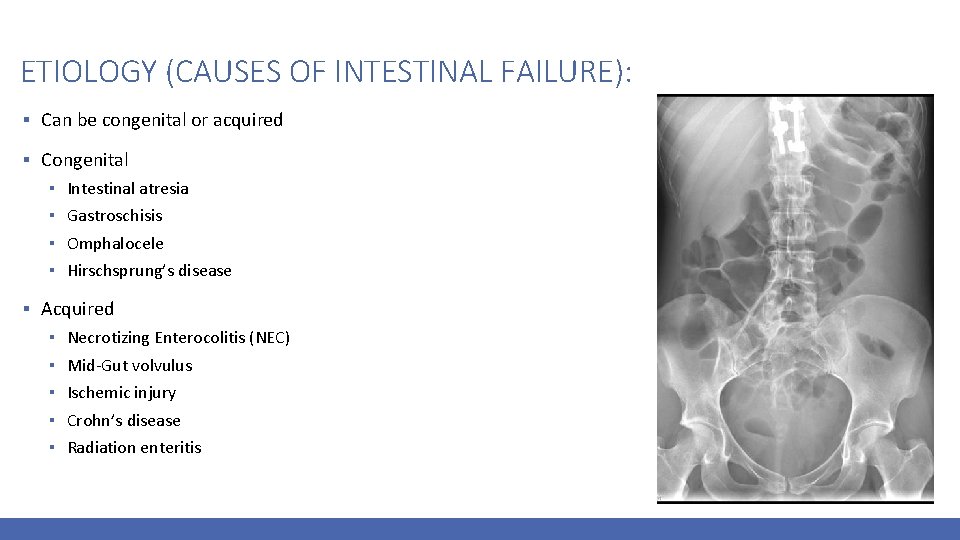
ETIOLOGY (CAUSES OF INTESTINAL FAILURE): ▪ Can be congenital or acquired ▪ Congenital ▪ ▪ Intestinal atresia Gastroschisis Omphalocele Hirschsprung’s disease ▪ Acquired ▪ ▪ ▪ Necrotizing Enterocolitis (NEC) Mid-Gut volvulus Ischemic injury Crohn’s disease Radiation enteritis

INTERVIEW ONE ANDREW VOSS-15 YEARS OLD. INTERVIEW COMPLETED BY JEANNE VOSS, RN
INTERVIEW WITH JEANNE VOSS: ▪ Andrew is 15 years old (14 at time of interview), and he has malnutrition related to malabsorption secondary to a bowel resection due to malrotation of the gut: ▪ secondary to a birth defect related to the overuse of codeine by his birth mother. ▪ He was adopted at birth. ▪ He did not put solid table food in his mouth until age 3. ▪ TPN was birth to age 4. ▪ Enteral feeding 6 months old until present. ▪ ADHD diagnosed in first grade. ▪ Unable to sit in chair during class, poor problem solving ability. ▪ PDD-NOS diagnosed at 3. Poor at dealing with peers in preschool, nonverbal and Generalized Disorder. § Behavioral Issues due to Malnutrition: § Personality Issues: § Anger § Hostility § Anxiety § Depression § Violent to himself and sometimes others § Stress Reliefs § Drumming § Letting it all out: § scream § yell § anger spells His legal name should be Andrew Large (adopted father’s name) but as Jeanne stated. How do you name your SBS son Andrew Large? “It just didn’t fit a 15 year old who weighed 88 lbs.

INTERVIEW TWO DEBBY HANSARD-53 YEARS OLD. INTERVIEW COMPLETED BY DEBBY HANSARD
INTERVIEW TWO: DEBBY HANSARD ▪ 50 year old SBS Trauma Patient who uses GATTEX® ▪ Unlike the previous interview, this subject was not born with any digestive disease or syndrome, nor any neurocognitive disorders. Her initial health event did not occur until 2007. In addition growing up she hit all her major milestones and had no developmental delays. ▪ The subject of the interview stated that emergency trauma surgery on her digestive track is when her life started to change: ▪ Caused by scar tissue strangulating the small intestine. ▪ Trauma was both physical and emotional. ▪ Since her initial surgery in 2007 and an additional two more surgeries, she does believe that there have been some personality changes and behavior changes in her since. ▪ Her husband also told her that he noticed changes in her that were not in her original personality before. (Hansard, 2015) ▪ Before her health event the subject was 170 lbs. ▪ After her diagnosis of Short Bowel Syndrome and Crohn’s Disease she dropped down to 88 lbs. ▪ After starting Total Parenteral Nutrition, she is now 135 and stable (Hansard, 2015). ▪ Hansard today still lives with SBS is 57 years of age, and using GATTEX the first time threw her into a clinical depression state (Hansard, 2015), after starting Advo. Care products she is back on GATTEX and thriving.
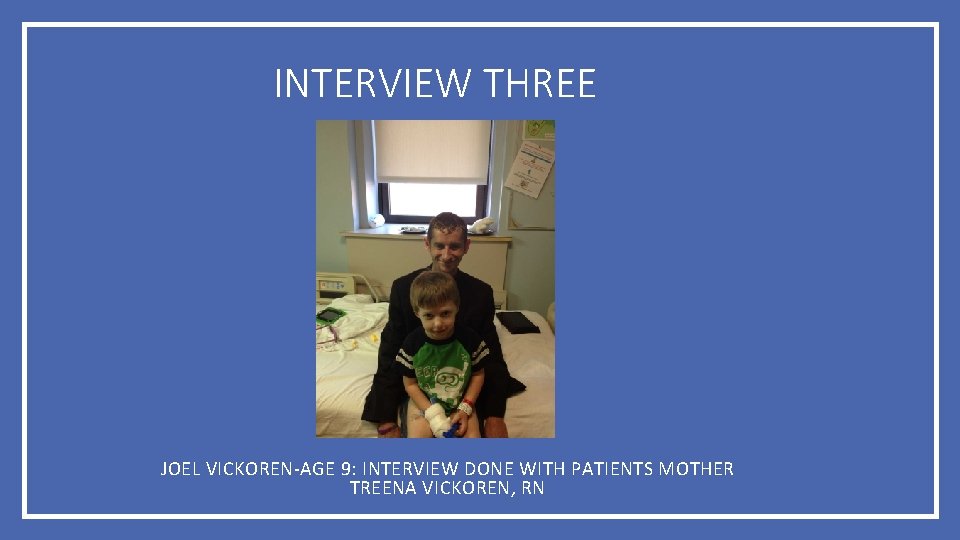
INTERVIEW THREE JOEL VICKOREN-AGE 9: INTERVIEW DONE WITH PATIENTS MOTHER TREENA VICKOREN, RN
INTERVIEW THREE: JOEL VICKOREN ▪ Joel who is 8, lives with IF, including many developmental delays, which transitioned into the school system. ▪ He found little success in the school system, and was then homeschooled by his mom ▪ There has been a lot of poking and prodding in his short seven years alive, and a lots of hospital admissions and surgical procedures. Vickoren believes that this has caused some developmental delays early on such as non-verbal, delay in motor skills, and the need to always be with his mother. ▪ When I first met Joel he was non-verbal and non-motor at age 4. ▪ At age 6, he ran up to me, knowing my name and all. Motor and Vocal skills very much improved.
NUTRITION ISSUES FOR THOSE LIVING WITH CHRONIC ILLNESSES
NUTRITION ISSUES IN CHRONIC ILLNESS ▪ Malnutrition is the insufficient dietary intake of essential nutrients, and protein-energy under-nutrition. ▪ It is a faulty, yet inadequate nutritional status; under nourishment it is characterized by poor dietary intake, poor appetite, muscle atrophy, and weight loss (Kralik, 2010). ▪ The incidence of malnutrition increases with age (Kralik, 2010). ▪ With the increase of the older people in our population, it can be expected that issues regarding poor nutrition will become more noticeable (Kralik, 2010). ▪ Poor nutrition is also a hot topic among communities. ▪ In a research study that accessed the nutritional status of 500 people on admission to discharge from an acute hospital, it was found that 40% of people were “undernourished” and this figure increased to 75% at the time of discharge (Kralik, 2010).
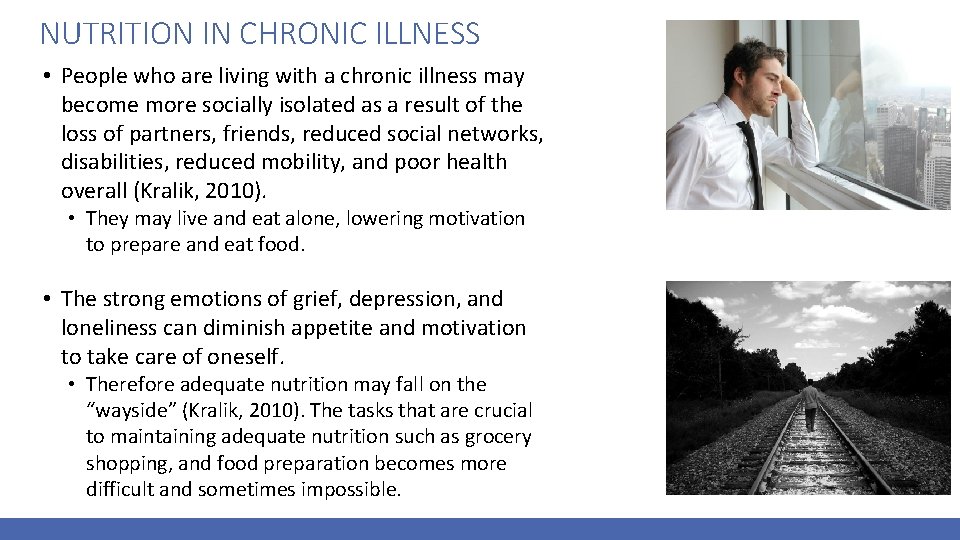
NUTRITION IN CHRONIC ILLNESS • People who are living with a chronic illness may become more socially isolated as a result of the loss of partners, friends, reduced social networks, disabilities, reduced mobility, and poor health overall (Kralik, 2010). • They may live and eat alone, lowering motivation to prepare and eat food. • The strong emotions of grief, depression, and loneliness can diminish appetite and motivation to take care of oneself. • Therefore adequate nutrition may fall on the “wayside” (Kralik, 2010). The tasks that are crucial to maintaining adequate nutrition such as grocery shopping, and food preparation becomes more difficult and sometimes impossible.
BOYS VS. GIRLS WITH MALNUTRITION AND BEHAVIOR CHANGES
BOYS VS. GIRLS WITH MALNUTRITION • Boys are more likely to have chronic conditions and diseases than girls, have more activity restrictions, and more special healthcare needs. • Boys are more likely to have school related disabilities, and non-school disabilities. (Valerie Leiter, 2011) • Boys account for 65% of infants and toddlers with developmental delays, such as motor, speech, and the ability to get along with others (Valerie Leiter, 2011). • Girls prevalence rates do eventually exceed boys, but not until later in adolescence in terms of overall health problems, and specific issues (Valerie Leiter, 2011). • Interviews were conducted to the adult in the household who was most knowledgeable about the child's health. • 46. 7% responded to the interview, excluding 66% as nonresidential phone numbers. Age, Gender, and Race were omitted from the interview. • Many of the respondent's have a diagnosis of Attention Deficit Hyperactive Disorder (ADHD) or Attention Deficit Disorder (ADD). Among other healthcare issues that range across the spectrum from everyday illness to chronic disease (Valerie Leiter, 2011).
BEHAVIOR IN BOYS VS. GIRLS & OUTCOMES ▪ Overall 19% of the children are identified as having a special health care need. ▪ One of the largest gender gaps Leiter explains is in the category of emotional disturbance, three fourths of students in special education who have been labeled with an emotional disturbance have been boys (Valerie Leiter, 2011). ▪ Boys are more likely to be identified through school based referrals ▪ 22. 5% of boys identified as having a special health care need compared to the 16. 2% of girls. ▪ Boys are also more likely to use medications, receive more care than typical, have limitations, received special therapies, or has been labeled as having educational or behavioral problems associated with a chronic condition. ▪ Boys are twice as likely to have reported conduct disorders than girls (Valerie Leiter, 2011) ▪ while girls are more likely to be referred to private therapists. Being placed in this category may have important consequences for the youth’s future (Valerie Leiter, 2011). ▪ More girls than boys are going to college after high school. ▪ Research examines the role that boys overrepresentation in special education may play in shaping boys educational opportunities (Valerie Leiter, 2011).
SCHOOL SUCCESS SPECIAL HEALTH CARE NEEDS ▪ Students have limited school success and have 504’s and IEP’s in place. ▪ Special Health Care Needs ▪ These help the students succeed in school. ▪ Students often have limitations in school that stop them from succeeding in school. ▪ IEP’s and 504’s are often in place to help the students succeed in school and take off the limitations that impede them from success in the classroom. ▪ Teachers often prohibit student success in elementary and middle school.
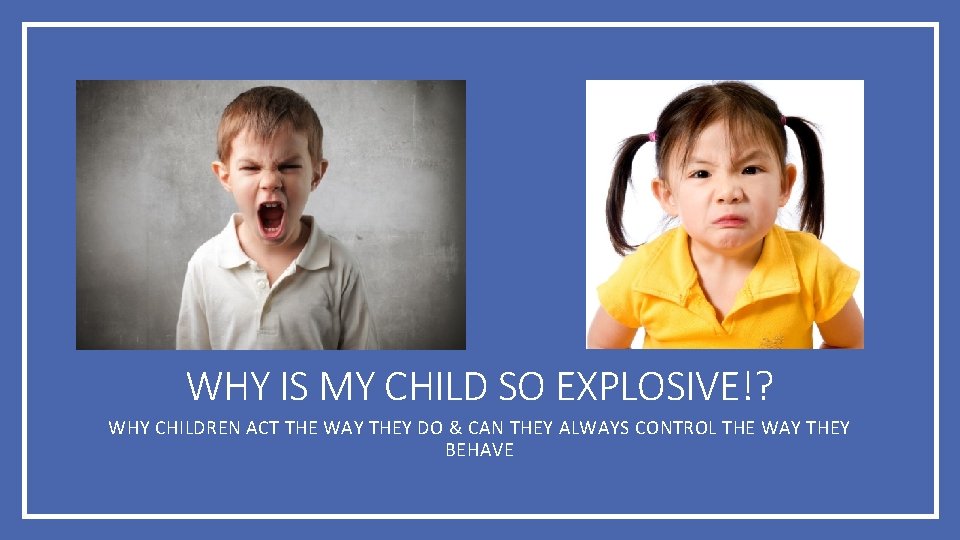
WHY IS MY CHILD SO EXPLOSIVE!? WHY CHILDREN ACT THE WAY THEY DO & CAN THEY ALWAYS CONTROL THE WAY THEY BEHAVE
WAYS CHILDREN OFTEN “ACT OUT” ▪ Manipulative Behaviors ▪ Being Impossible ▪ Stubborn ▪ Out of Control ▪ Willful ▪ Pushing Buttons ▪ Bratty ▪ Getting Adults to “Give In” ▪ Resistant ▪ Getting their way Though research has shown that in the past 50 years or so, that it all comes down to one thing: “Behaviorally challenging kids are challenging because they are lacking the skills to not be challenging”.
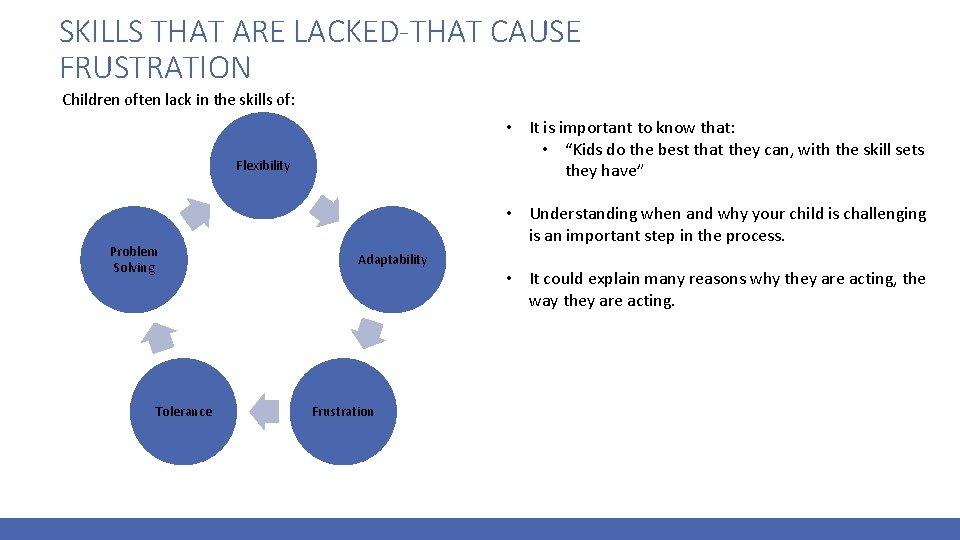
SKILLS THAT ARE LACKED-THAT CAUSE FRUSTRATION Children often lack in the skills of: • It is important to know that: • “Kids do the best that they can, with the skill sets they have” Flexibility Problem Solving Tolerance • Understanding when and why your child is challenging is an important step in the process. Adaptability Frustration • It could explain many reasons why they are acting, the way they are acting.
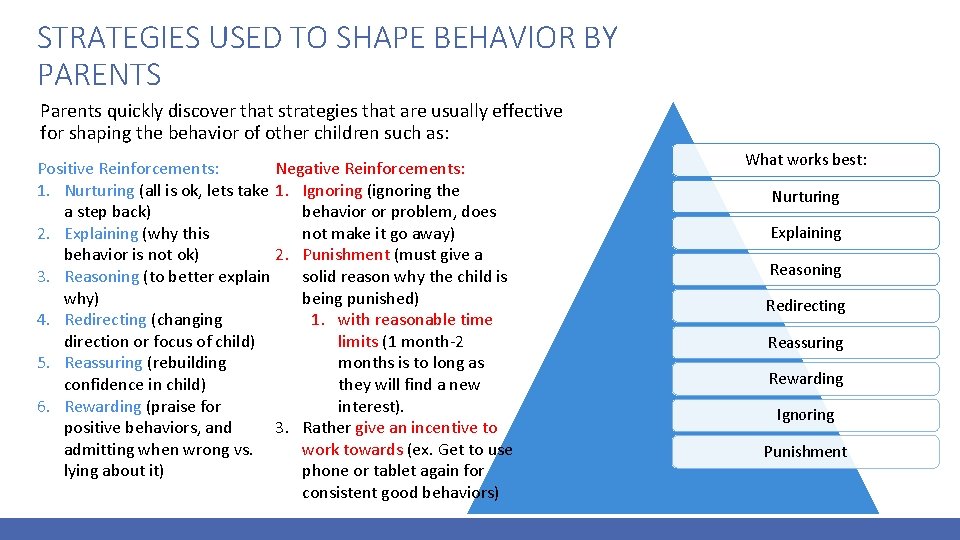
STRATEGIES USED TO SHAPE BEHAVIOR BY PARENTS Parents quickly discover that strategies that are usually effective for shaping the behavior of other children such as: Negative Reinforcements: Positive Reinforcements: 1. Nurturing (all is ok, lets take 1. Ignoring (ignoring the a step back) behavior or problem, does 2. Explaining (why this not make it go away) behavior is not ok) 2. Punishment (must give a 3. Reasoning (to better explain solid reason why the child is why) being punished) 4. Redirecting (changing 1. with reasonable time direction or focus of child) limits (1 month-2 5. Reassuring (rebuilding months is to long as confidence in child) they will find a new 6. Rewarding (praise for interest). positive behaviors, and 3. Rather give an incentive to admitting when wrong vs. work towards (ex. Get to use lying about it) phone or tablet again for consistent good behaviors) What works best: Nurturing Explaining Reasoning Redirecting Reassuring Rewarding Ignoring Punishment
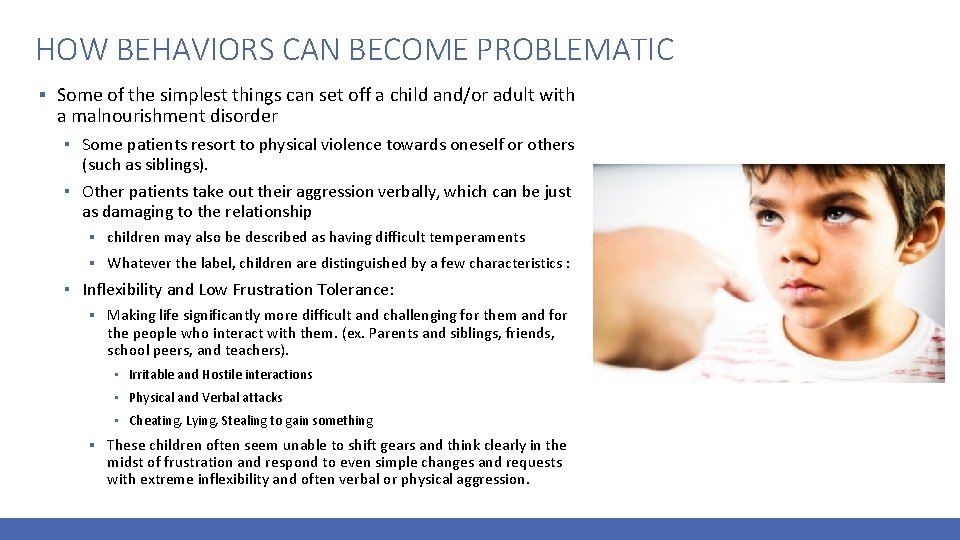
HOW BEHAVIORS CAN BECOME PROBLEMATIC ▪ Some of the simplest things can set off a child and/or adult with a malnourishment disorder ▪ Some patients resort to physical violence towards oneself or others (such as siblings). ▪ Other patients take out their aggression verbally, which can be just as damaging to the relationship ▪ children may also be described as having difficult temperaments ▪ Whatever the label, children are distinguished by a few characteristics : ▪ Inflexibility and Low Frustration Tolerance: ▪ Making life significantly more difficult and challenging for them and for the people who interact with them. (ex. Parents and siblings, friends, school peers, and teachers). ▪ Irritable and Hostile interactions ▪ Physical and Verbal attacks ▪ Cheating, Lying, Stealing to gain something ▪ These children often seem unable to shift gears and think clearly in the midst of frustration and respond to even simple changes and requests with extreme inflexibility and often verbal or physical aggression.
THE SIMPLEST THING MAKES MY CHILD EXPLODE! CASE EXAMPLE: ▪ Axle, age 9, heads into the kitchen to make himself breakfast. He peers into the freezer, removes the container of frozen waffles, and counts six waffles. Thinking to himself, "I'll have three waffles this morning and three tomorrow morning, " Axle toasts his three waffles and sits down to eat. ▪ Moments later, his mother and five-year old brother, Adam, enter the kitchen, and the mother asks Adam what he'd like to eat for breakfast. Adam responds, "Waffles, " and the mother reaches into the freezer for the waffles. Axle, who has been listening intently, explodes. ▪ "He can't have the frozen waffles!" Axle screams, his face suddenly reddening. ▪ "Why not? " asks the mother, her voice and pulse rising, at a loss for an explanation of Axle's behavior. ▪ "I was going to have those waffles tomorrow morning!" Axle screams, jumping out of his chair. ▪ "I'm not telling your brother he can't have waffles!" the mother yells back. ▪ "He can't have them!" screams Axle, now face-to-face with his mother. ▪ The mother, wary of the physical and verbal aggression of which her son is capable during these moments, desperately asks Adam if there's something else he would consider eating. “I want waffles”, Adam whimpers. ▪ Axle, his frustration and agitation at a peak, pushes her mother out of the way, seizes the container of frozen waffles, then slams the freezer door shut, pushes over a kitchen chair, grabs his plate of toasted waffles, and stalks to his room. His brother and mother begin to cry.
HOW THIS TYPE BEHAVIOR AFFECTS THE FAMILY ▪ Axle’s outbursts cause his sibling and mother to be scared of him at times. The extreme volatility and inflexibility require constant vigilance and enormous energy from his mother and father, thereby lessening the attention the parents wish they could devote to Axle’s brother and sister. ▪ His parents frequently argue over the best way to handle the defiant behavior, but agree about the severe strains Axle places on their marriage. ▪ Although he is above average in intelligence, Axle has no close friends. ▪ Children who initially befriend him eventually find his rigid personality difficult to tolerate and will begin to shy away. ▪ Axle’s parents have sought help from countless mental health professionals, most of whom advised them to set firmer limits and be more consistent in managing Axle’s behavior. ▪ Instructing them on how to implement formal behavior management strategies. After eight years of medicine, therapy, advice, sticker charts, time-outs, and reward programs, Axle has changed little since his parents first noticed there was something "different" about his when he was a toddler. ▪ Patients who are malnourished often have bursts or irritability and hostility towards others ▪ Children who display this type of behavior, typically do not want to act that way, but sometimes can not help it due to their chronic condition ▪ Though that is not an excuse for all defiant behavior ▪ When you do not feel well, are fatigued, hungry, or in pain these behaviors become more profound and the child or adult can “snap” over something as simple as a question asked the wrong way or perceived in a wrong way.
HOW TO DISCIPLINE A SPECIAL NEEDS CHILD ▪ When the body is malnourished and one lives with a chronic medical condition, sometimes those children are referred to as: ▪ Developmentally disabled child ▪ Medically disabled child ▪ It is important to note that these children are not always in control of their behaviors and/or emotions ▪ Though behaviors and emotions, when out of control-more often than not-the parent(s) can become emotionally drained themselves, not knowing the best way to discipline their special needs child. Some “old fashioned” techniques no longer work effectively on children. ▪ What experts call "behavior management" is not about punishing or demoralizing your child. ▪ it's a way to set boundaries and communicate expectations in a nurturing, loving way. ▪ Discipline — correcting kids' actions, showing them what's right and wrong, what's acceptable and what's not — is one of the most important ways that all parents can show their kids that they love and care about them.
TIPS AND TRICKS FOR DEALING WITH DIFFICULT BEHAVIORS 1. Be Consistent ▪ Correcting kids is about establishing standards — whether that's setting a morning routine or dinnertime manners — and then teaching them how to meet those expectations. 2. Learn about your child’s condition ▪ Read up on the condition and ask the doctor about anything you don't understand. Also talk to members of your child's care team and other parents (especially those with kids who have similar issues) to help determine if your child's challenging behavior is typical or related to his or her individual challenges 3. Defining Expectations ▪ Establishing rules and discipline are a challenge for any parent. So keep your behavior plan simple and work on one challenge at a time. 4. Use rewards AND consequences ▪ Work within a system that includes rewards (positive reinforcement) for good behavior and natural consequences for bad behavior. Natural consequences are punishments that are directly related to the behavior. For example, if your child is throwing food, you would take away the plate.
TIPS AND TRICKS FOR DEALING WITH DIFFICULT BEHAVIORS 5. Use clear and simple messages ▪ Keep verbal and visual language simple, clear, and consistent. Explain as simply as possible what behaviors you want to see. Consistency is key, so make sure that grandparents, babysitters, siblings, and teachers are all on board with your messages. 6. Offer praise ▪ Encourage accomplishment by reminding your child about what he or she can earn for meeting the goals you've set 7. Establish routines ▪ try to stick to the same routine every day. For example: If your child tends to melt down in the afternoon after school, set a schedule for free time. Maybe he or she needs to have a snack first and then do homework before playtime. 8. Believe in your child ▪ When you believe your child can do something, you empower him or her to reach that goal. The same is true for behavior 9. Have confidence in your abilities ▪ If you set an expectation in line with your child's abilities, and you believe he or she can accomplish it, odds are it will happen. In the meantime, use whatever online, personal, and professional resources you have to help reach your goals.
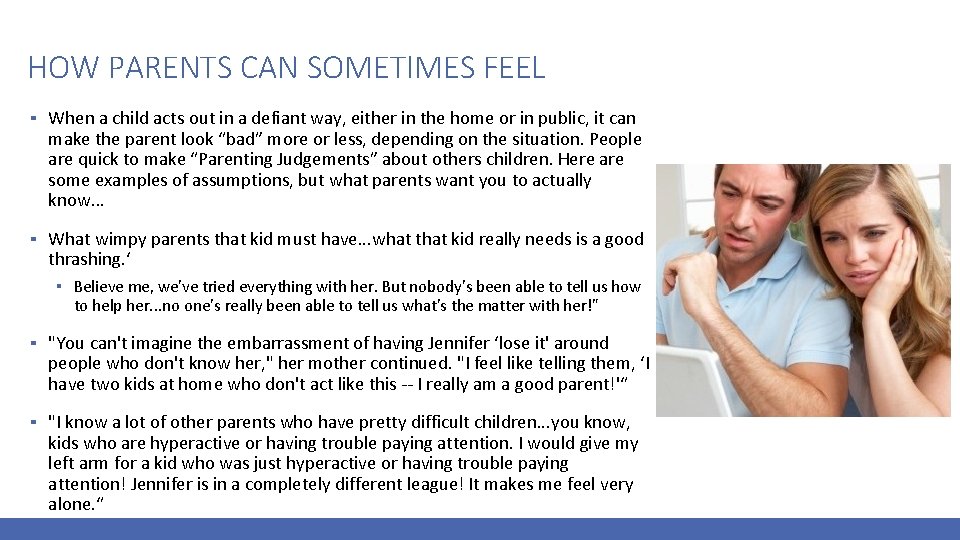
HOW PARENTS CAN SOMETIMES FEEL ▪ When a child acts out in a defiant way, either in the home or in public, it can make the parent look “bad” more or less, depending on the situation. People are quick to make “Parenting Judgements” about others children. Here are some examples of assumptions, but what parents want you to actually know… ▪ What wimpy parents that kid must have. . . what that kid really needs is a good thrashing. ‘ ▪ Believe me, we've tried everything with her. But nobody's been able to tell us how to help her. . . no one's really been able to tell us what's the matter with her!" ▪ "You can't imagine the embarrassment of having Jennifer ‘lose it' around people who don't know her, " her mother continued. "I feel like telling them, ‘I have two kids at home who don't act like this -- I really am a good parent!'“ ▪ "I know a lot of other parents who have pretty difficult children. . . you know, kids who are hyperactive or having trouble paying attention. I would give my left arm for a kid who was just hyperactive or having trouble paying attention! Jennifer is in a completely different league! It makes me feel very alone. “
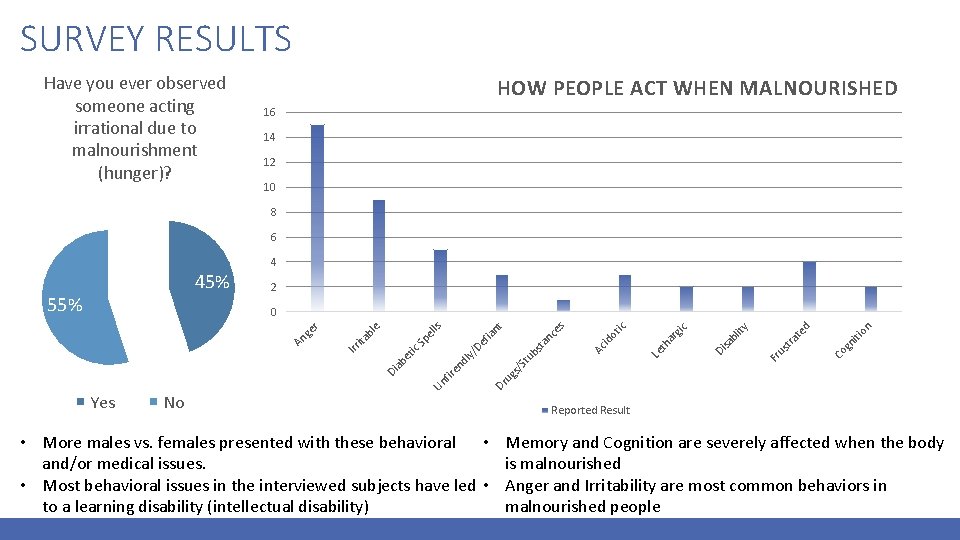
SURVEY RESULTS Have you ever observed someone acting irrational due to malnourishment (hunger)? HOW PEOPLE ACT WHEN MALNOURISHED 16 14 12 10 8 6 45% 55% 4 2 on Co gn iti d us tra te ity bl Di sa gic ar th Le s/ Fr St Ac id ot ic s ce an ub st y/ De dl en Dr ug fir Un No fia el Sp tic ab e Di Yes nt ls e ita bl Irr An ge r 0 • More males vs. females presented with these behavioral • and/or medical issues. • Most behavioral issues in the interviewed subjects have led • to a learning disability (intellectual disability) Reported Result Memory and Cognition are severely affected when the body is malnourished Anger and Irritability are most common behaviors in malnourished people
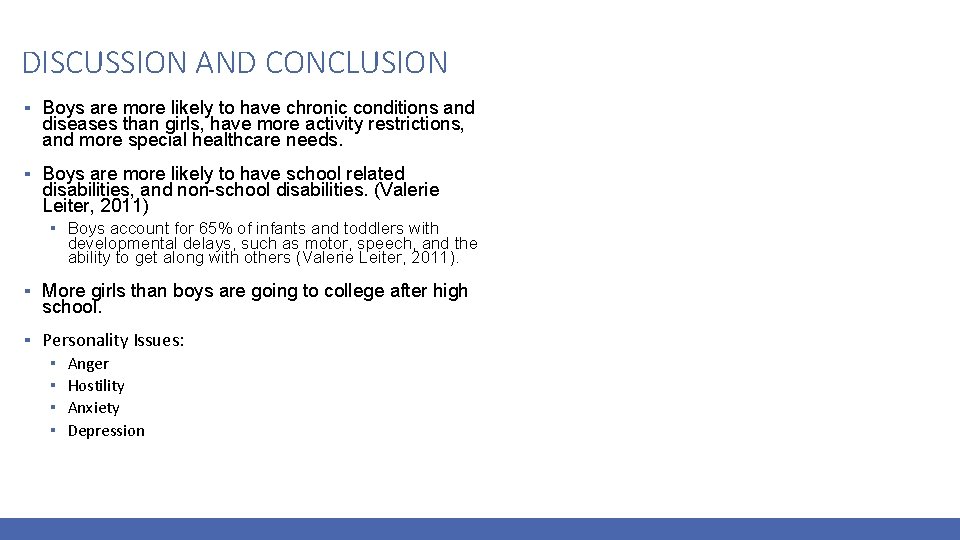
DISCUSSION AND CONCLUSION ▪ Boys are more likely to have chronic conditions and diseases than girls, have more activity restrictions, and more special healthcare needs. ▪ Boys are more likely to have school related disabilities, and non-school disabilities. (Valerie Leiter, 2011) ▪ Boys account for 65% of infants and toddlers with developmental delays, such as motor, speech, and the ability to get along with others (Valerie Leiter, 2011). ▪ More girls than boys are going to college after high school. ▪ Personality Issues: ▪ ▪ Anger Hostility Anxiety Depression
THIS PRESENTATION WAS CREATED AND UPDATED BY: THE SHORT BOWEL SYNDROME FOUNDATION, INC. ANDREW E. JABLONSKI, B. A SLIDES AND CONTENT ARE © AND CAN NOT BE REPRODUCED WITHOUT THE AUTHORS CONSENT
- Slides: 43