
Malleolar fractures Anna Ekman Lena Brauer Learning outcomes
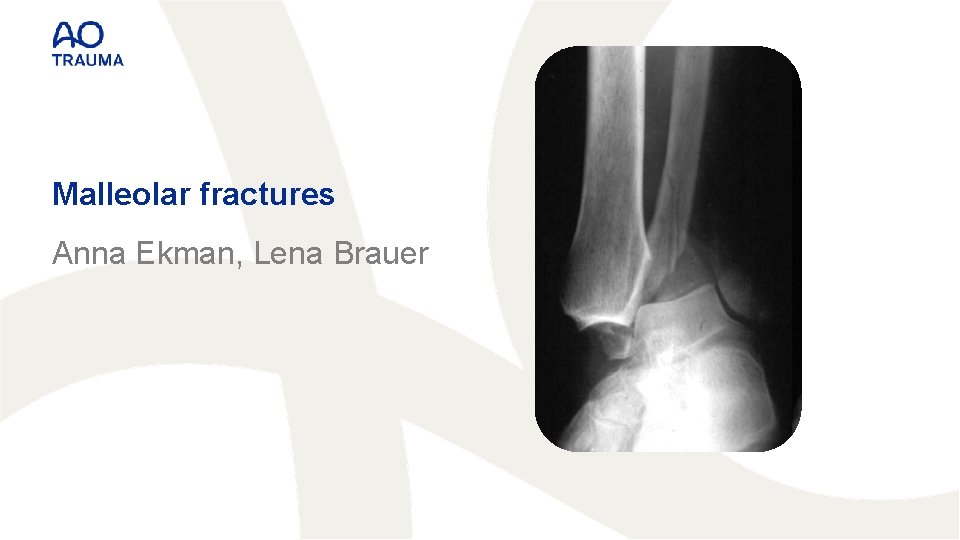
Malleolar fractures Anna Ekman, Lena Brauer
Learning outcomes At the end of this lecture you will be able to: • Describe principles of malleolar fracture classification • Outline indications for nonoperative and surgical treatment • Discuss principles of malleolar fracture fixation

Malleolar fractures • Includes injuries of bones (malleoli) and/or ligaments: 1. Medial malleolus • With deltoid complex 2. Lateral malleolus • With lateral ligaments 2 1
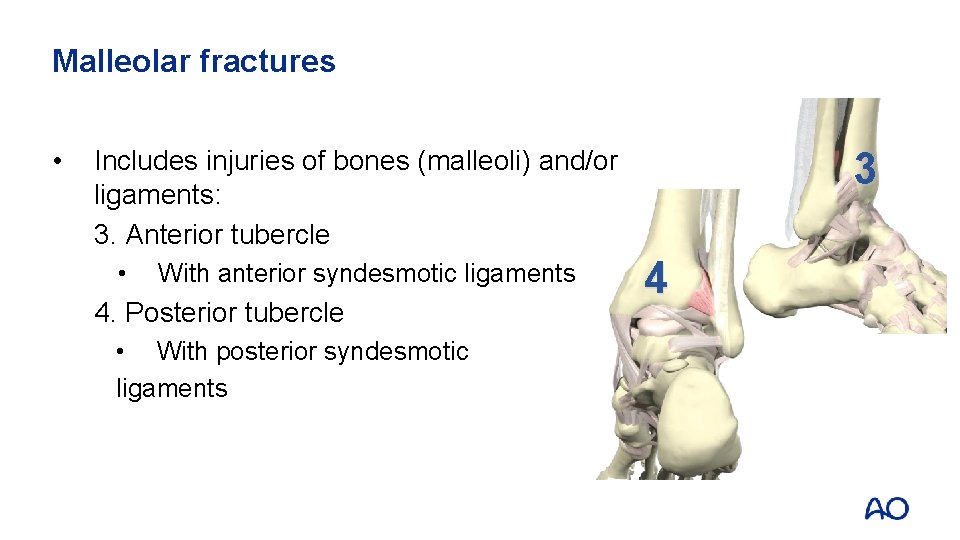
Malleolar fractures • 3 Includes injuries of bones (malleoli) and/or ligaments: 3. Anterior tubercle • With anterior syndesmotic ligaments 4. Posterior tubercle • With posterior syndesmotic ligaments 4

Classification of malleolar fractures AO/OTA Fracture and Dislocation Classification: • Developed by Danis and Weber • Based on the level of fracture of the fibula
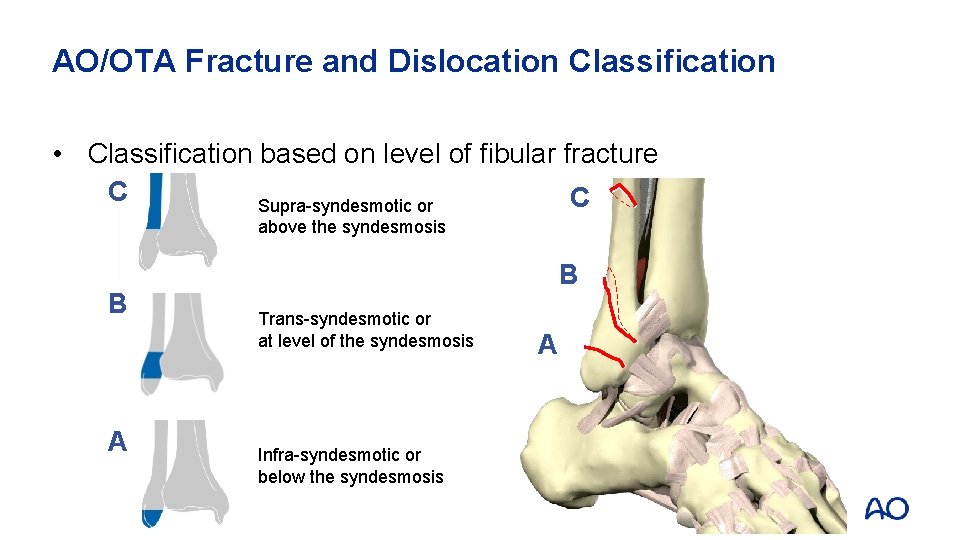
AO/OTA Fracture and Dislocation Classification • Classification based on level of fibular fracture C C Supra-syndesmotic or above the syndesmosis B A B Trans-syndesmotic or at level of the syndesmosis Infra-syndesmotic or below the syndesmosis A
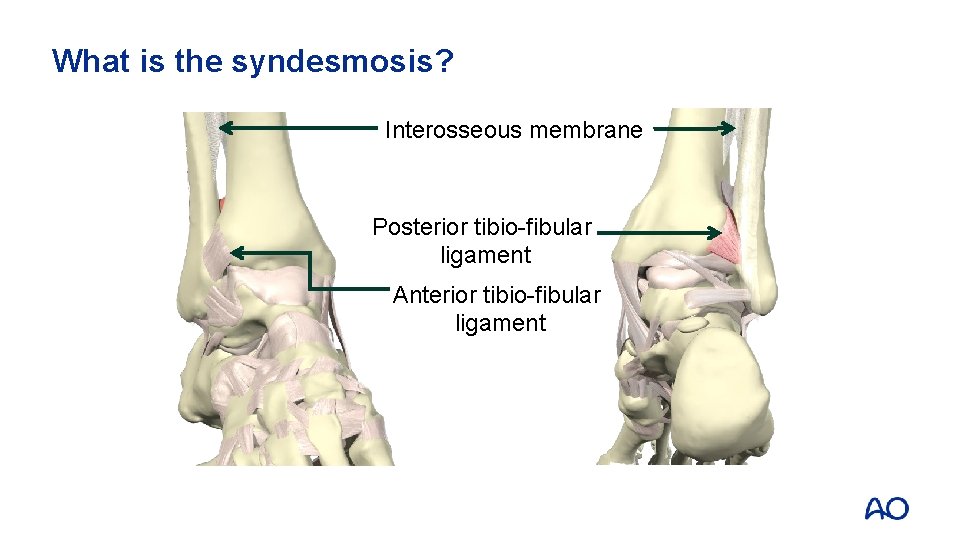
What is the syndesmosis? Interosseous membrane Posterior tibio-fibular ligament Anterior tibio-fibular ligament
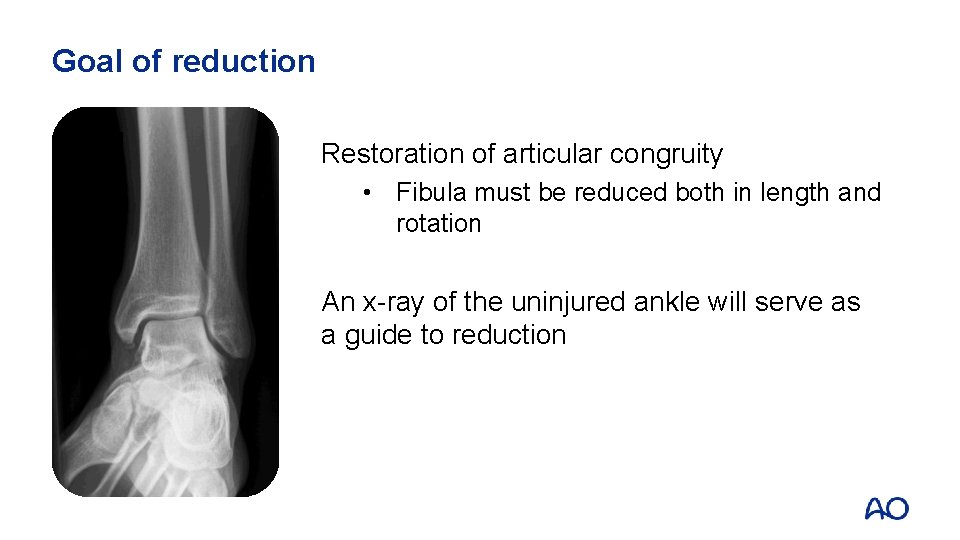
Goal of reduction Restoration of articular congruity • Fibula must be reduced both in length and rotation An x-ray of the uninjured ankle will serve as a guide to reduction
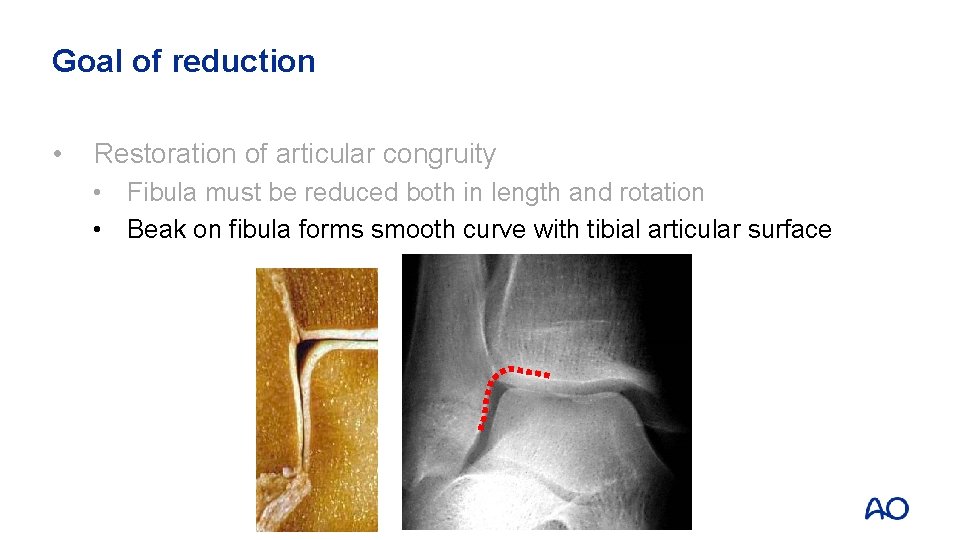
Goal of reduction • Restoration of articular congruity • Fibula must be reduced both in length and rotation • Beak on fibula forms smooth curve with tibial articular surface
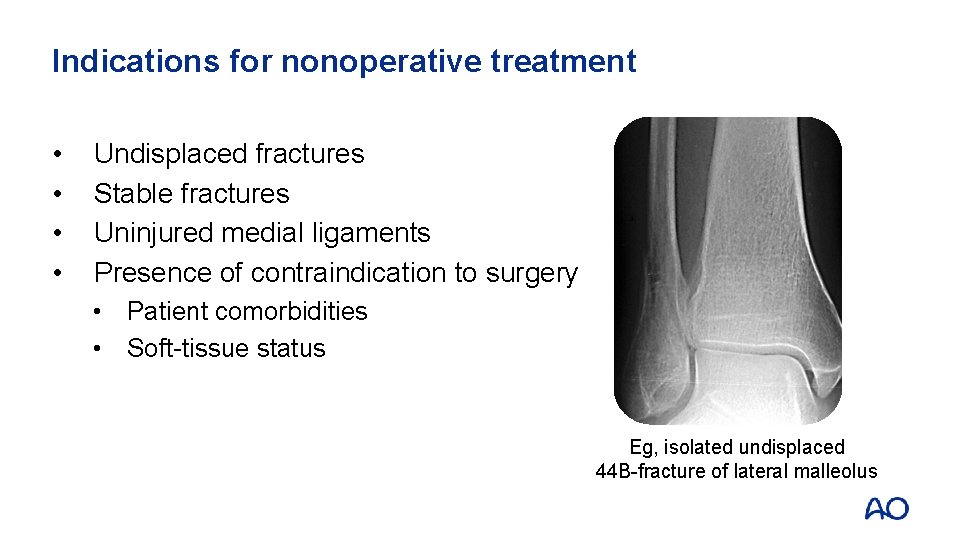
Indications for nonoperative treatment • • Undisplaced fractures Stable fractures Uninjured medial ligaments Presence of contraindication to surgery • Patient comorbidities • Soft-tissue status Eg, isolated undisplaced 44 B-fracture of lateral malleolus
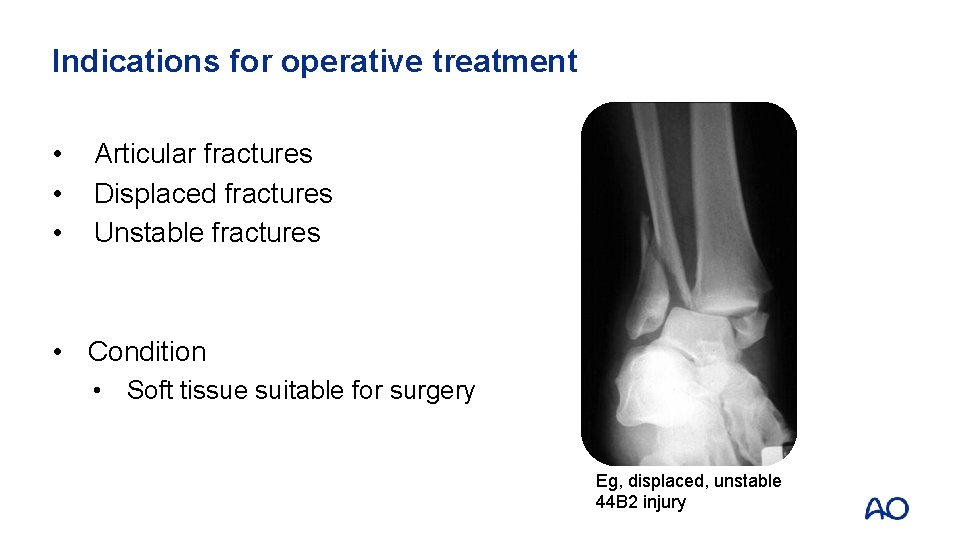
Indications for operative treatment • • • Articular fractures Displaced fractures Unstable fractures • Condition • Soft tissue suitable for surgery Eg, displaced, unstable 44 B 2 injury
Principles of fracture treatment―preop. preparation • Timing of surgery • Patient factors • Status of soft tissue • • Positioning Surgical approach and reduction Implant choice Pitfalls and hazards
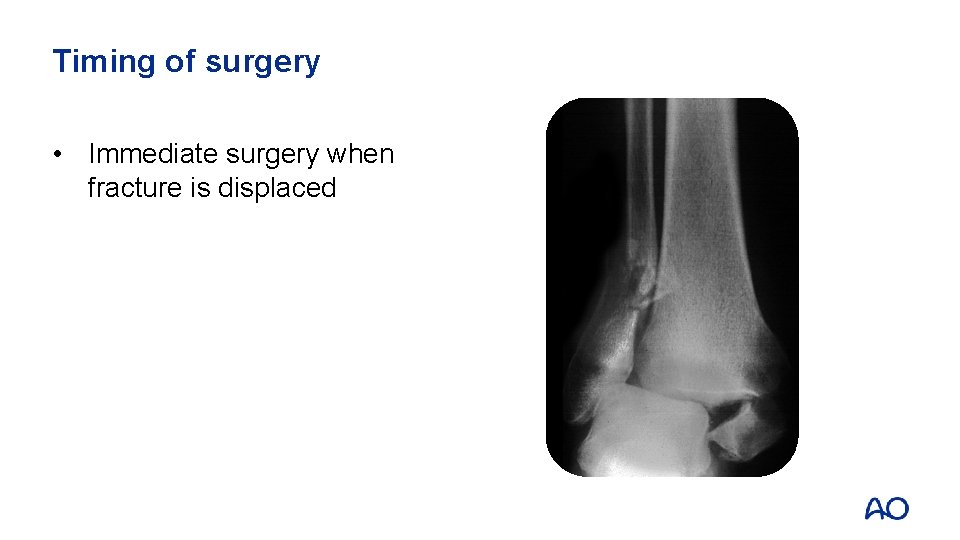
Timing of surgery • Immediate surgery when fracture is displaced
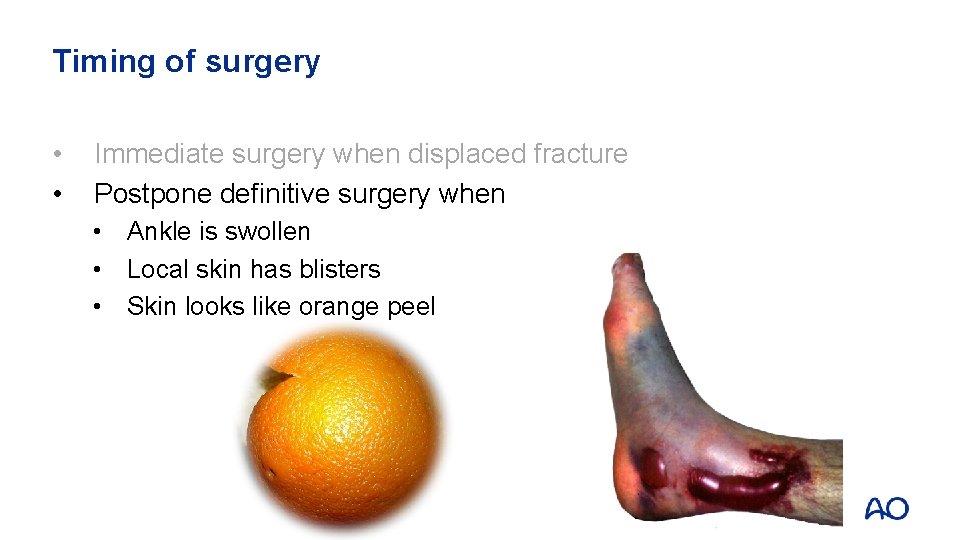
Timing of surgery • • Immediate surgery when displaced fracture Postpone definitive surgery when • Ankle is swollen • Local skin has blisters • Skin looks like orange peel
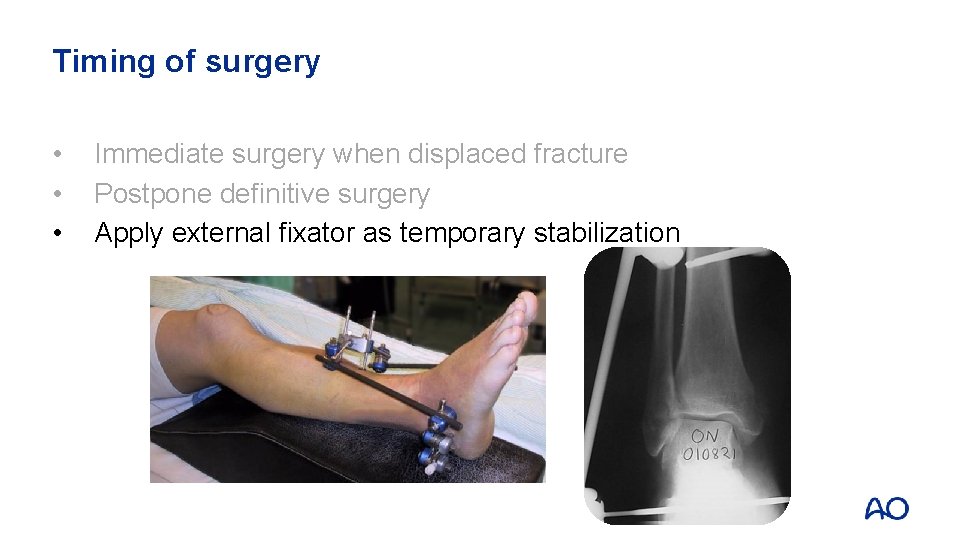
Timing of surgery • • • Immediate surgery when displaced fracture Postpone definitive surgery Apply external fixator as temporary stabilization
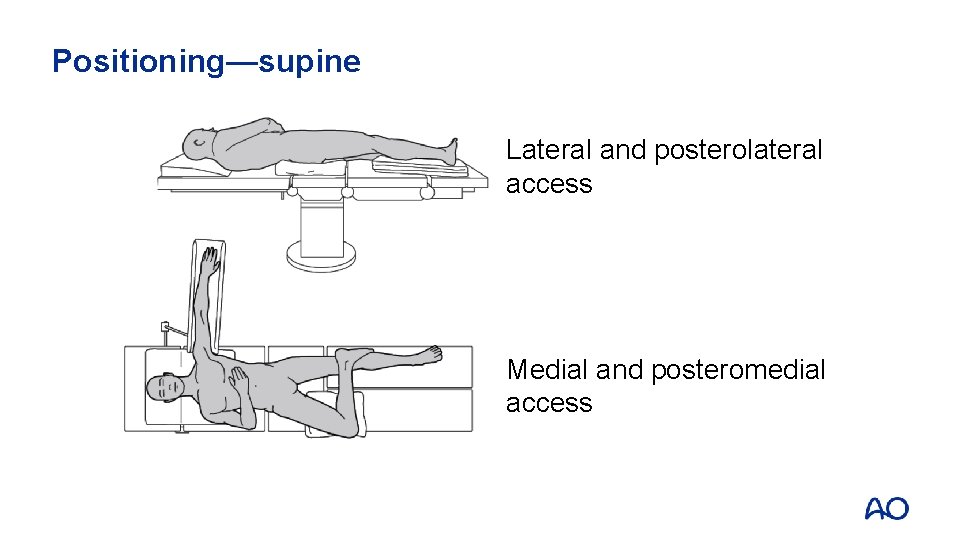
Positioning—supine Lateral and posterolateral access Medial and posteromedial access
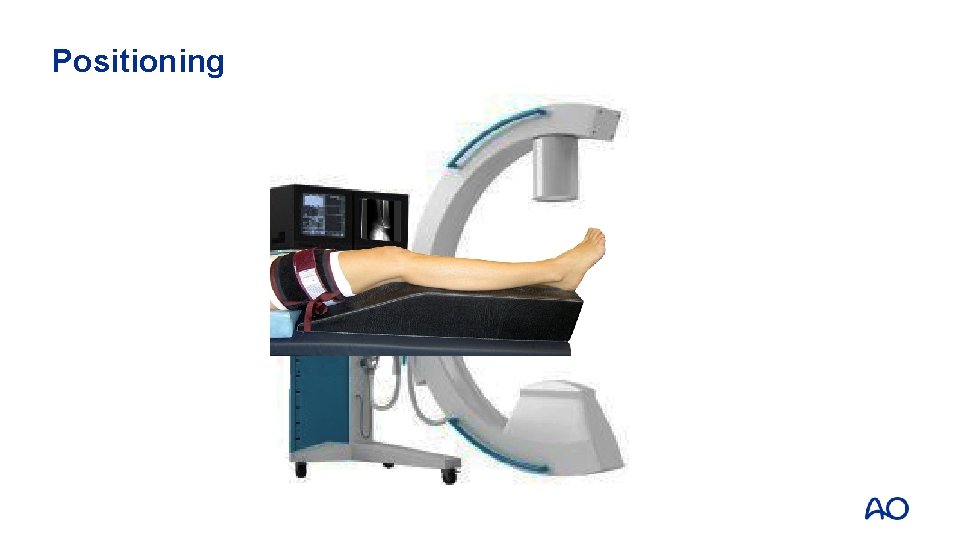
Positioning
Procedure of surgical treatment The surgical procedure follows the following steps: 1. Lateral malleolus 2. Medial malleolus 3. Posterior malleolus 4. Syndesmosis
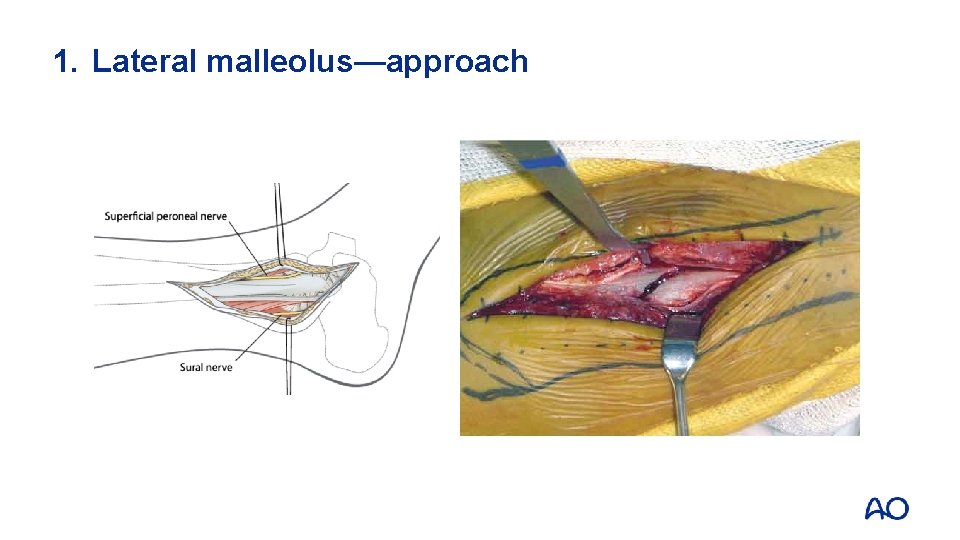
1. Lateral malleolus—approach
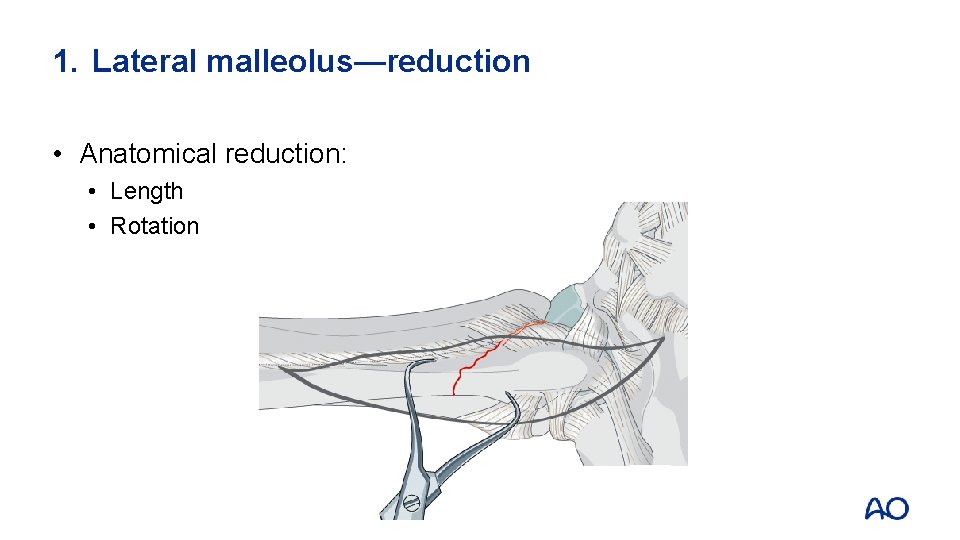
1. Lateral malleolus—reduction • Anatomical reduction: • Length • Rotation
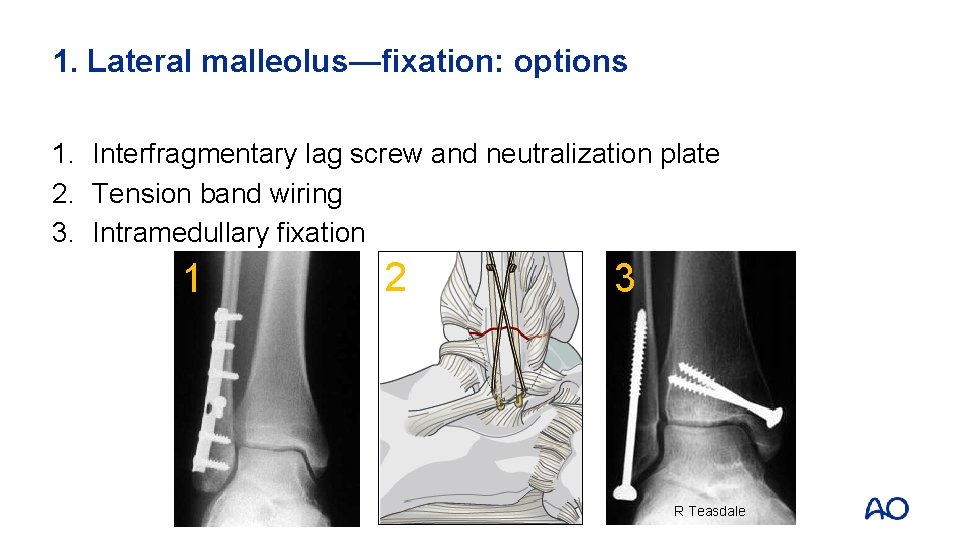
1. Lateral malleolus—fixation: options 1. Interfragmentary lag screw and neutralization plate 2. Tension band wiring 3. Intramedullary fixation 1 2 3 R Teasdale
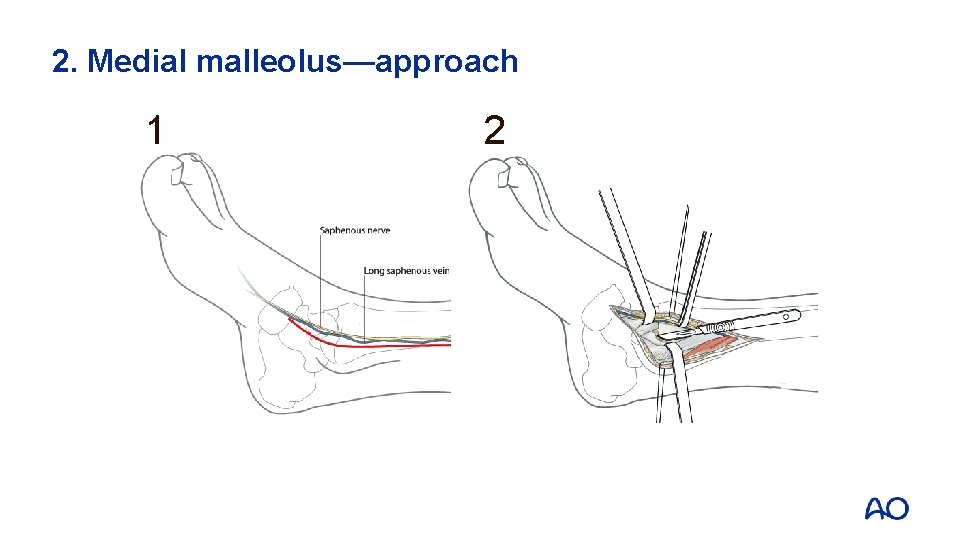
2. Medial malleolus—approach 1 2
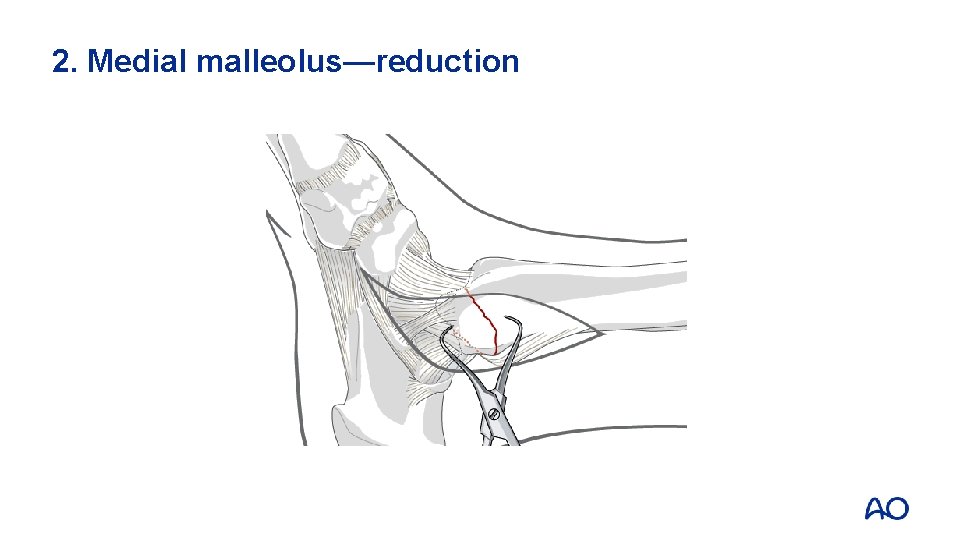
2. Medial malleolus—reduction
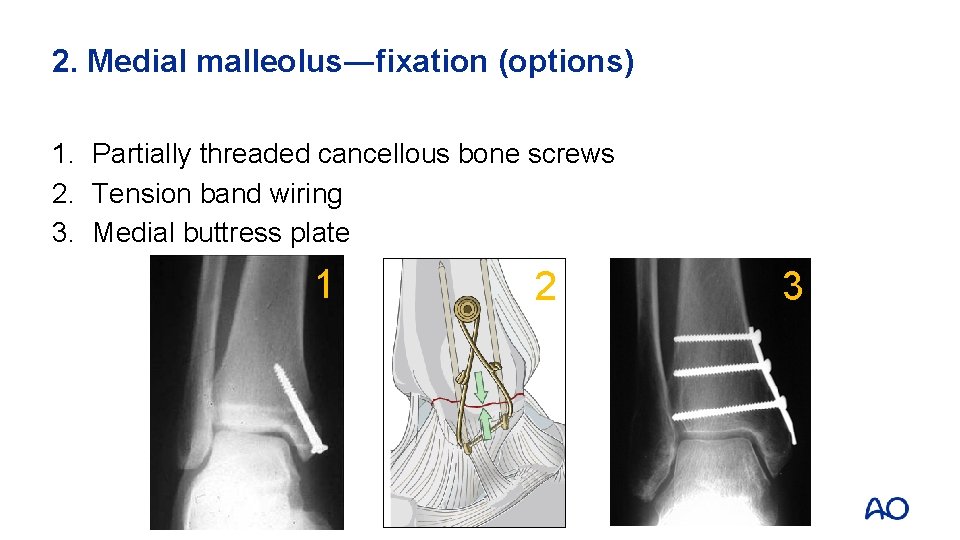
2. Medial malleolus―fixation (options) 1. Partially threaded cancellous bone screws 2. Tension band wiring 3. Medial buttress plate 1 2 3

3. Posterior malleolus—approach and reduction

3. Posterior malleolus—fixation • After fixation of medial and lateral malleoli • When there is posterior subluxation of the talus (1) • When fragment bears more than 20– 25% of articular surface (2) 1 2
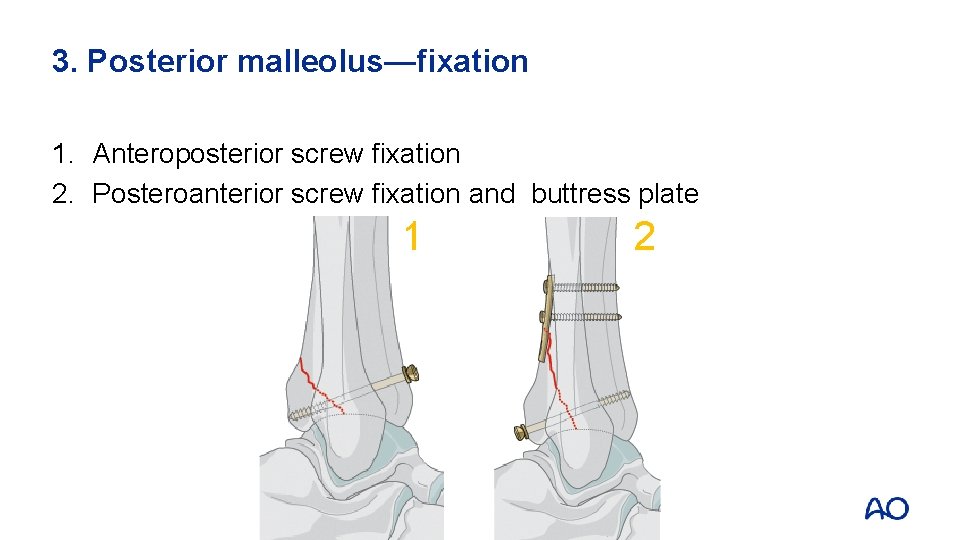
3. Posterior malleolus—fixation 1. Anteroposterior screw fixation 2. Posteroanterior screw fixation and buttress plate 1 2
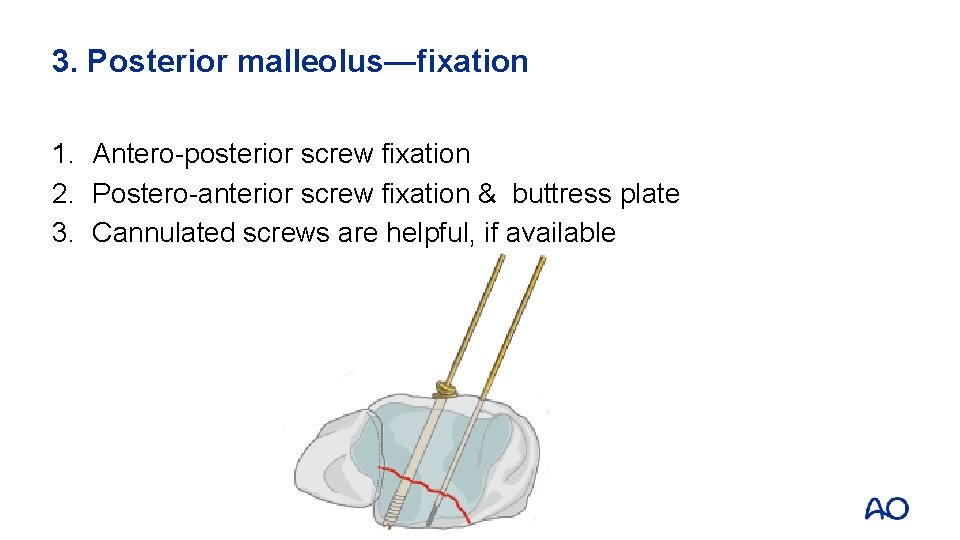
3. Posterior malleolus—fixation 1. Antero-posterior screw fixation 2. Postero-anterior screw fixation & buttress plate 3. Cannulated screws are helpful, if available

4. Syndesmosis―stability testing • Bone hook test
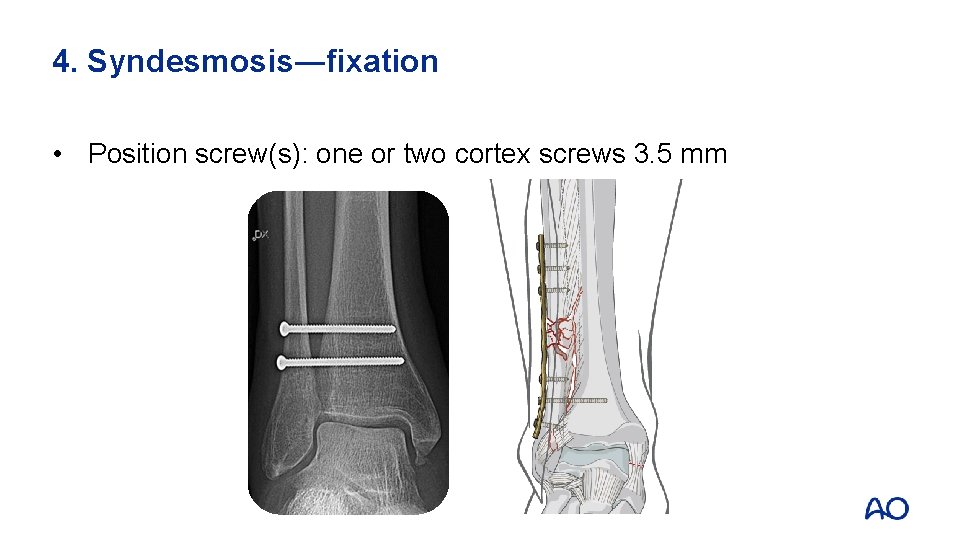
4. Syndesmosis―fixation • Position screw(s): one or two cortex screws 3. 5 mm
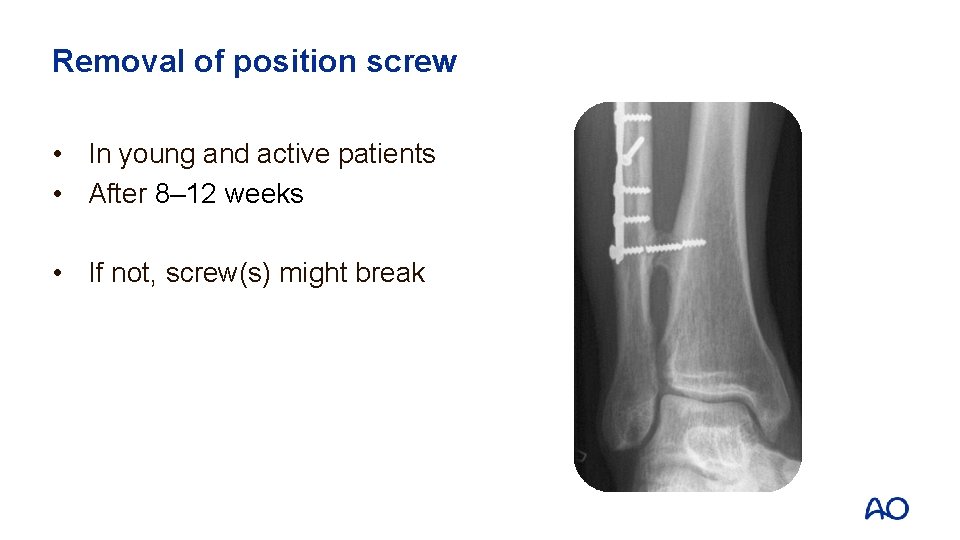
Removal of position screw • In young and active patients • After 8– 12 weeks • If not, screw(s) might break
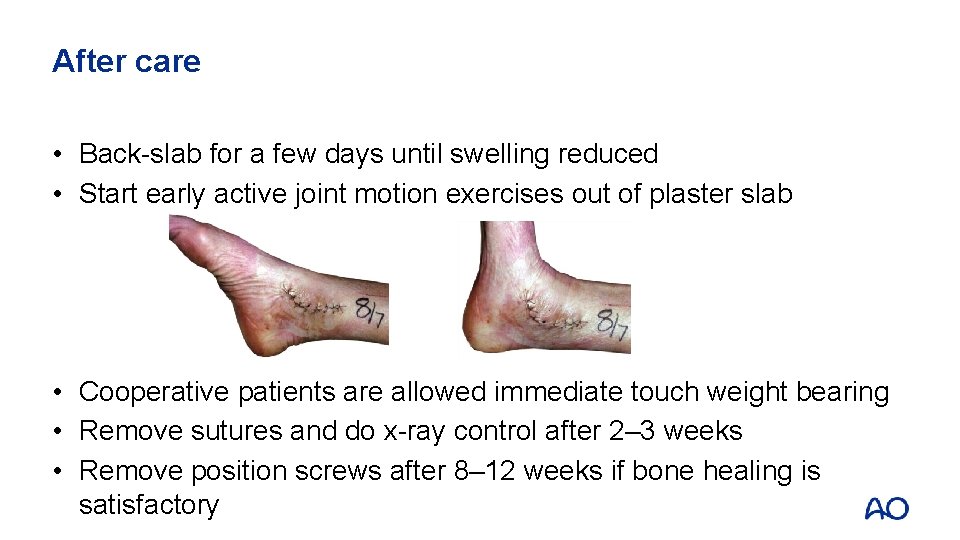
After care • Back-slab for a few days until swelling reduced • Start early active joint motion exercises out of plaster slab • Cooperative patients are allowed immediate touch weight bearing • Remove sutures and do x-ray control after 2– 3 weeks • Remove position screws after 8– 12 weeks if bone healing is satisfactory

Questions
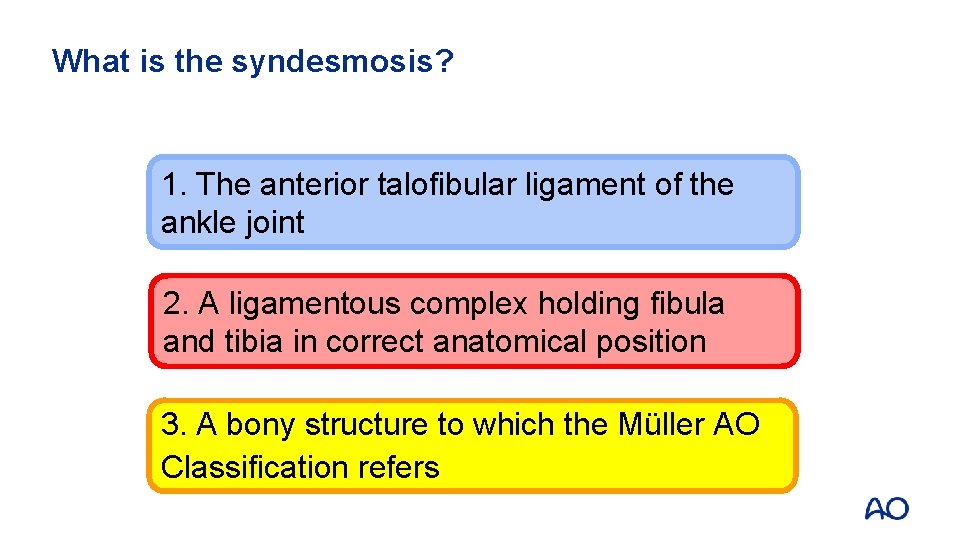
What is the syndesmosis? 1. The anterior talofibular ligament of the ankle joint 2. A ligamentous complex holding fibula and tibia in correct anatomical position 3. A bony structure to which the Müller AO Classification refers
What is the syndesmosis? 1. The anterior talofibular ligament of the ankle joint 2. A ligamentous complex holding fibula and tibia in correct anatomical position 3. A bony structure to which the Müller AO Classification refers
What are the indications for operative treatment? 1. Articular, displaced, and unstable fractures 2. Articular, displaced, and stable fractures 3. Articular, undisplaced, and unstable fractures
What are the indications for operative treatment? 1. Articular, displaced, and unstable fractures 2. Articular, displaced, and stable fractures 3. Articular, undisplaced, and unstable fractures
Which implant is most commonly used for fixation of a lateral malleolar fracture? 1. One third tubular plate and lag screw 2. LC-DCP and lag screw 3. LCP and lag screw
Which implant is most commonly used for fixation of a lateral malleolar fracture? 1. One third tubular plate and lag screw 2. LC-DCP and lag screw 3. LCP and lag screw
Learning outcomes You should now be able to: • Describe principles of malleolar fracture classification • Outline indications for nonoperative and surgical treatment • Discuss principles of malleolar fracture fixation
- Slides: 40