
Malignant pleural mesothelioma This information is from an

- Slides: 23
Malignant pleural mesothelioma This information is from an international website which is intended for healthcare professionals not located in the United States of America (US) and the United Kingdom (UK ). ©Boehringer Ingelheim International Gmb. H 2017. This document and its contents are property of Boehringer Ingelheim (third party sources are indicated) and are, inter alia, protected by copyright law. Complete or partial passing on to third parties as well as copying, reproduction, publication or any other use by third parties is not permitted. Proecdure ID: 5929. Slides last updated: 31 st March 2017.
Malignant pleural mesothelioma Epidemiology This information is from an international website which is intended for healthcare professionals not located in the United States of America (US) and the United Kingdom (UK).
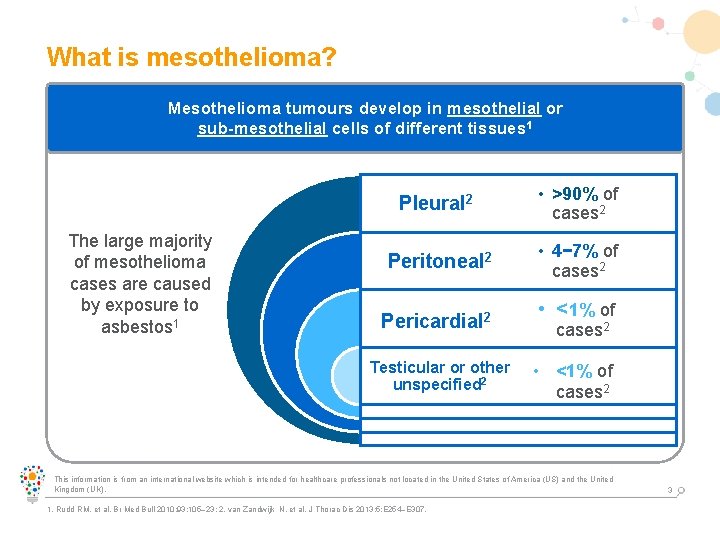
What is mesothelioma? Mesothelioma tumours develop in mesothelial or sub-mesothelial cells of different tissues 1 The large majority of mesothelioma cases are caused by exposure to asbestos 1 Pleural 21 • >90% of cases 2 Peritoneal 2 • 4− 7% of cases 2 Pericardial 21 Testicular or other unspecified 2 • <1% of cases 2 This information is from an international website which is intended for healthcare professionals not located in the United States of America (US) and the United Kingdom (UK). 1. Rudd RM, et al. Br Med Bull 2010; 93: 105– 23; 2. van Zandwijk N, et al. J Thorac Dis 2013; 5: E 254–E 307. 3
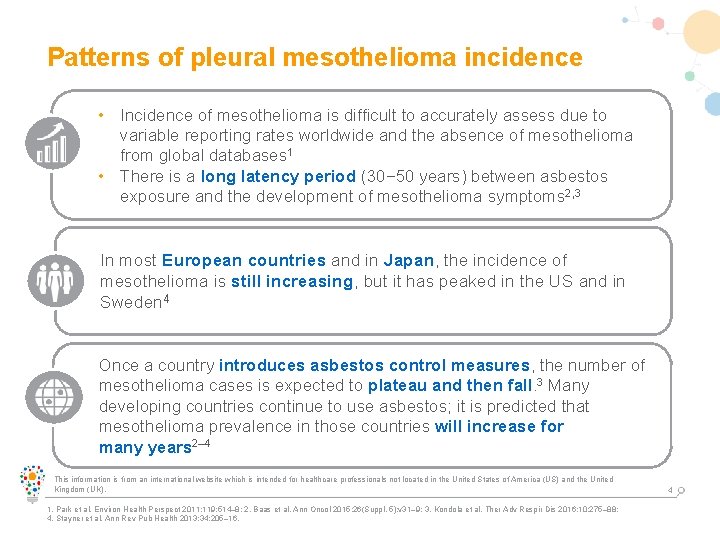
Patterns of pleural mesothelioma incidence • Incidence of mesothelioma is difficult to accurately assess due to variable reporting rates worldwide and the absence of mesothelioma from global databases 1 • There is a long latency period (30− 50 years) between asbestos exposure and the development of mesothelioma symptoms 2, 3 In most European countries and in Japan, the incidence of mesothelioma is still increasing, but it has peaked in the US and in Sweden 4 Once a country introduces asbestos control measures, the number of mesothelioma cases is expected to plateau and then fall. 3 Many developing countries continue to use asbestos; it is predicted that mesothelioma prevalence in those countries will increase for many years 2– 4 This information is from an international website which is intended for healthcare professionals not located in the United States of America (US) and the United Kingdom (UK). 1. Park et al. Environ Health Perspect 2011; 119: 514– 8; 2. Baas et al. Ann Oncol 2015; 26(Suppl. 5): v 31– 9; 3. Kondola et al. Ther Adv Respir Dis 2016; 10: 275– 88; 4. Stayner et al. Ann Rev Pub Health 2013; 34: 205– 16. 4
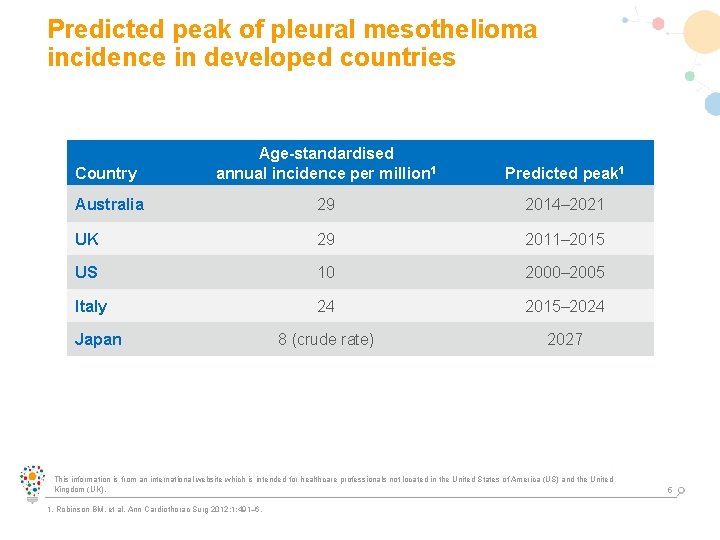
Predicted peak of pleural mesothelioma incidence in developed countries Country Age-standardised annual incidence per million 1 Predicted peak 1 Australia 29 2014– 2021 UK 29 2011– 2015 US 10 2000– 2005 Italy 24 2015– 2024 8 (crude rate) 2027 Japan This information is from an international website which is intended for healthcare professionals not located in the United States of America (US) and the United Kingdom (UK). 1. Robinson BM, et al. Ann Cardiothorac Surg 2012; 1: 491– 6. 5
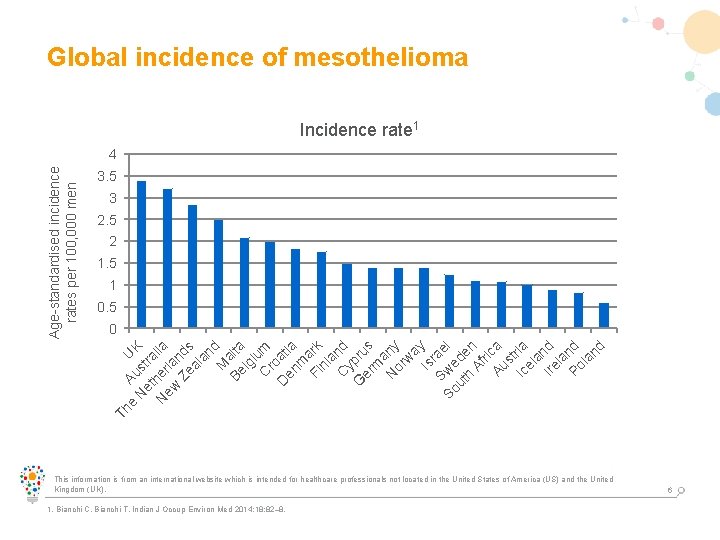
Global incidence of mesothelioma Incidence rate 1 3. 5 3 2. 5 2 1. 5 1 0. 5 0 Th e A U N ust K et ra N her lia ew la Ze nds al an d M Be alta lg iu C m ro D ati en a m Fi ark nl a C nd y G pru er s m a N ny or w a Is y Sw rae So e l ut de h Af n ri Au ca st Ic ria el a Ire nd la Po nd la nd Age-standardised incidence rates per 100, 000 men 4 This information is from an international website which is intended for healthcare professionals not located in the United States of America (US) and the United Kingdom (UK). 1. Bianchi C, Bianchi T. Indian J Occup Environ Med 2014; 18: 82– 8. 6
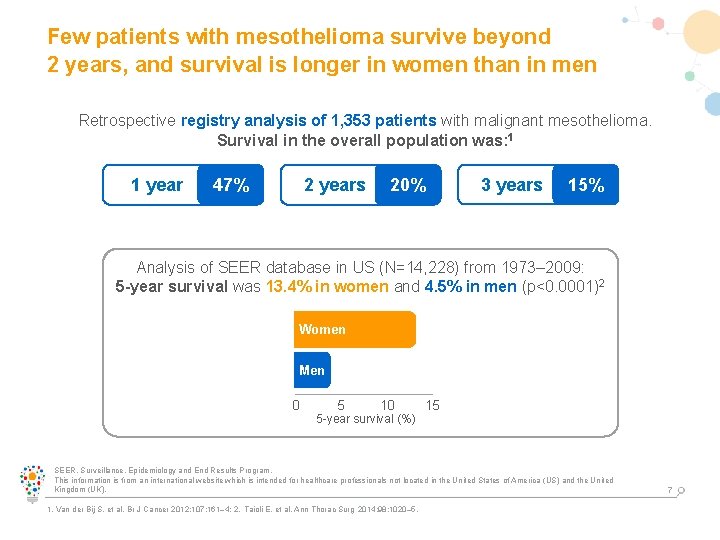
Few patients with mesothelioma survive beyond 2 years, and survival is longer in women than in men Retrospective registry analysis of 1, 353 patients with malignant mesothelioma. Survival in the overall population was: 1 1 year 47% 2 years 3 years 20% 15% Analysis of SEER database in US (N=14, 228) from 1973– 2009: 5 -year survival was 13. 4% in women and 4. 5% in men (p<0. 0001)2 Women Men 0 5 10 5 -year survival (%) 15 SEER, Surveillance, Epidemiology and End Results Program. This information is from an international website which is intended for healthcare professionals not located in the United States of America (US) and the United Kingdom (UK). 1. Van der Bij S, et al. Br J Cancer 2012; 107: 161– 4; 2. Taioli E, et al. Ann Thorac Surg 2014; 98: 1020– 5. 7
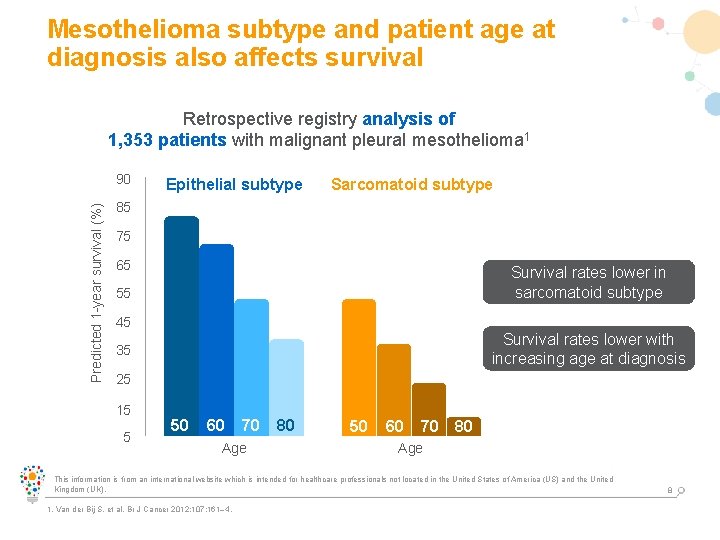
Mesothelioma subtype and patient age at diagnosis also affects survival Retrospective registry analysis of 1, 353 patients with malignant pleural mesothelioma 1 Predicted 1 -year survival (%) 90 Epithelial subtype Sarcomatoid subtype 85 75 65 Survival rates lower in sarcomatoid subtype 55 45 Survival rates lower with increasing age at diagnosis 35 25 15 5 50 60 70 Age 80 50 60 70 80 Age This information is from an international website which is intended for healthcare professionals not located in the United States of America (US) and the United Kingdom (UK). 1. Van der Bij S, et al. Br J Cancer 2012; 107: 161– 4. 8
Malignant pleural mesothelioma Risk factors This information is from an international website which is intended for healthcare professionals not located in the United States of America (US) and the United Kingdom (UK).
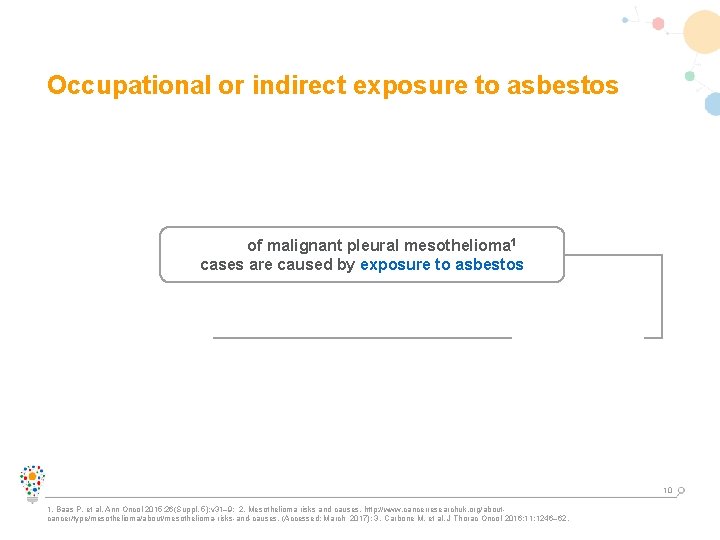
Occupational or indirect exposure to asbestos of malignant pleural mesothelioma 1 cases are caused by exposure to asbestos 10 1. Baas P, et al. Ann Oncol 2015; 26(Suppl. 5): v 31– 9; 2. Mesothelioma risks and causes. http: //www. cancerresearchuk. org/aboutcancer/type/mesothelioma/about/mesothelioma-risks-and-causes. (Accessed: March 2017); 3. Carbone M, et al. J Thorac Oncol 2016; 11: 1246– 62.
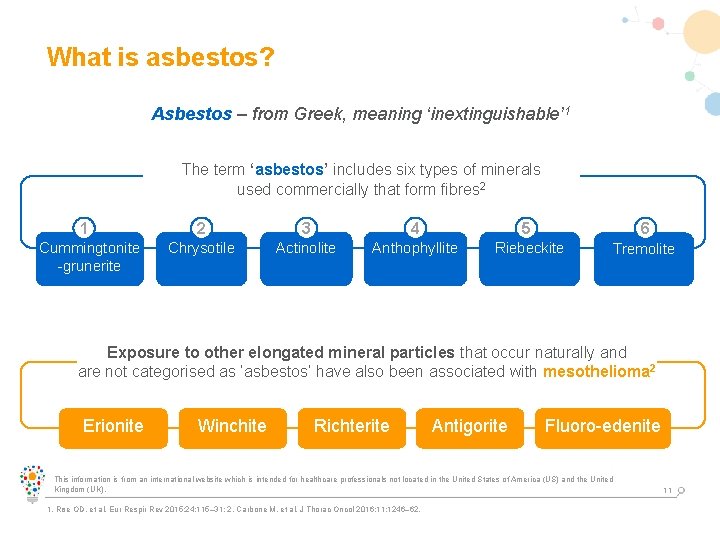
What is asbestos? Asbestos – from Greek, meaning ‘inextinguishable’ 1 The term ‘asbestos’ includes six types of minerals used commercially that form fibres 2 1 Cummingtonite -grunerite 2 3 4 5 6 Chrysotile Actinolite Anthophyllite Riebeckite Tremolite Exposure to other elongated mineral particles that occur naturally and are not categorised as ‘asbestos’ have also been associated with mesothelioma 2 Erionite Winchite Richterite Antigorite Fluoro-edenite This information is from an international website which is intended for healthcare professionals not located in the United States of America (US) and the United Kingdom (UK). 1. Røe OD, et al. Eur Respir Rev 2015; 24: 115– 31; 2. Carbone M, et al. J Thorac Oncol 2016; 11: 1246– 62. 11
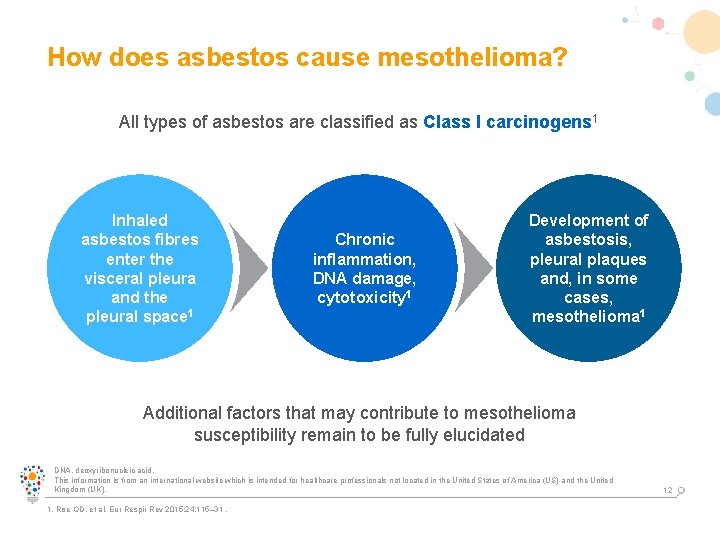
How does asbestos cause mesothelioma? All types of asbestos are classified as Class I carcinogens 1 Inhaled asbestos fibres enter the visceral pleura and the pleural space 1 Chronic inflammation, DNA damage, cytotoxicity 1 Development of asbestosis, pleural plaques and, in some cases, mesothelioma 1 Additional factors that may contribute to mesothelioma susceptibility remain to be fully elucidated DNA, deoxyribonucleic acid. This information is from an international website which is intended for healthcare professionals not located in the United States of America (US) and the United Kingdom (UK). 1. Røe OD, et al. Eur Respir Rev 2015; 24: 115– 31. 12
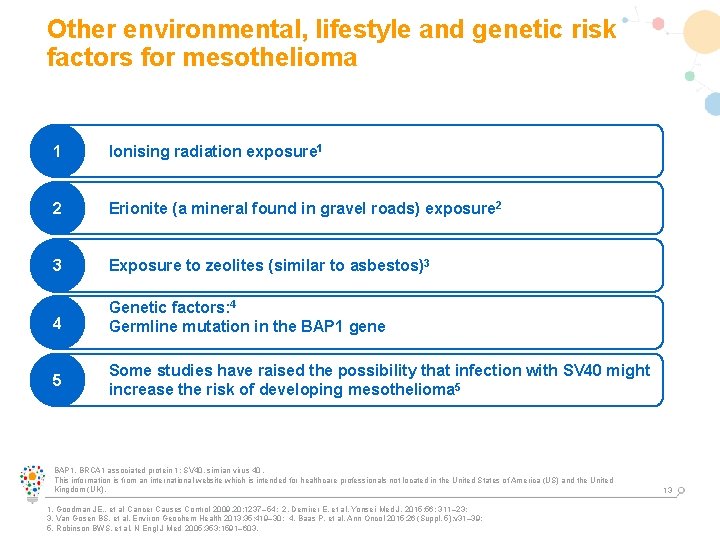
Other environmental, lifestyle and genetic risk factors for mesothelioma 1 Ionising radiation exposure 1 2 Erionite (a mineral found in gravel roads) exposure 2 3 Exposure to zeolites (similar to asbestos)3 4 Genetic factors: 4 Germline mutation in the BAP 1 gene 5 Some studies have raised the possibility that infection with SV 40 might increase the risk of developing mesothelioma 5 BAP 1, BRCA 1 associated protein 1; SV 40, simian virus 40. This information is from an international website which is intended for healthcare professionals not located in the United States of America (US) and the United Kingdom (UK). 1. Goodman JE. , et al Cancer Causes Control 2009, 20: 1237– 54; 2. Demirer E, et al. Yonsei Med J. 2015; 56: 311– 23; 3. Van Gosen BS, et al. Environ Geochem Health 2013; 35: 419– 30; 4. Baas P, et al. Ann Oncol 2015; 26 (Suppl. 5): v 31– 39; 5. Robinson BWS, et al. N Engl J Med 2005; 353: 1591– 603. 13
Malignant pleural mesothelioma Clinical features This information is from an international website which is intended for healthcare professionals not located in the United States of America (US) and the United Kingdom (UK).
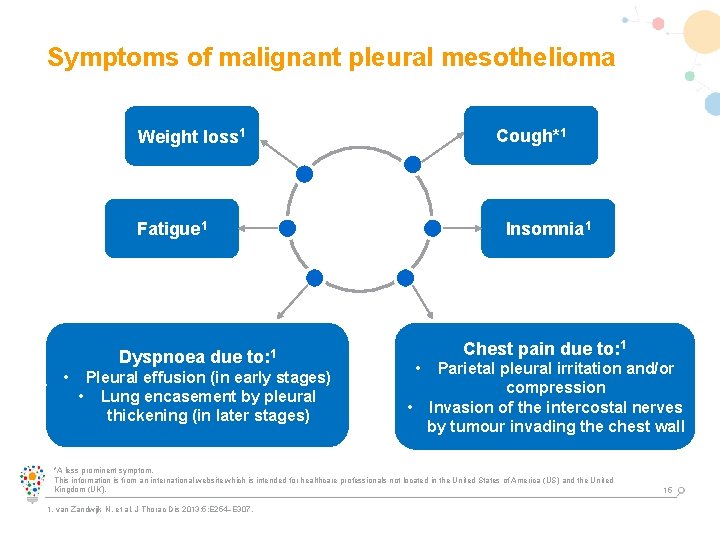
Symptoms of malignant pleural mesothelioma Cough*1 Weight loss 1 Insomnia 1 Fatigue 1 Dyspnoea due to: 1 • Pleural effusion (in early stages) • Lung encasement by pleural thickening (in later stages) Chest pain due to: 1 • Parietal pleural irritation and/or compression • Invasion of the intercostal nerves by tumour invading the chest wall *A less prominent symptom. This information is from an international website which is intended for healthcare professionals not located in the United States of America (US) and the United Kingdom (UK). 1. van Zandwijk N, et al. J Thorac Dis 2013; 5: E 254–E 307. 15
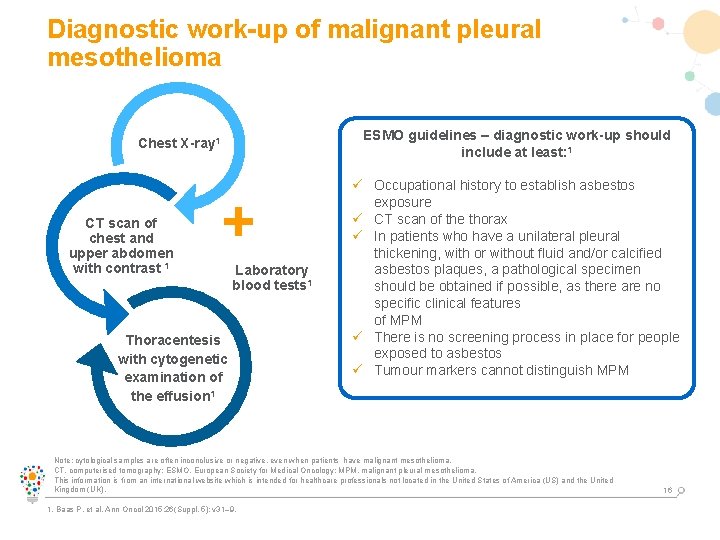
Diagnostic work-up of malignant pleural mesothelioma ESMO guidelines – diagnostic work-up should include at least: 1 Chest X-ray 1 CT scan of chest and upper abdomen with contrast 1 + Laboratory blood tests 1 Thoracentesis with cytogenetic examination of the effusion 1 ü Occupational history to establish asbestos exposure ü CT scan of the thorax ü In patients who have a unilateral pleural thickening, with or without fluid and/or calcified asbestos plaques, a pathological specimen should be obtained if possible, as there are no specific clinical features of MPM ü There is no screening process in place for people exposed to asbestos ü Tumour markers cannot distinguish MPM Note: cytological samples are often inconclusive or negative, even when patients have malignant mesothelioma. CT, computerised tomography; ESMO, European Society for Medical Oncology; MPM, malignant pleural mesothelioma. This information is from an international website which is intended for healthcare professionals not located in the United States of America (US) and the United Kingdom (UK). 1. Baas P, et al. Ann Oncol 2015; 26(Suppl. 5): v 31– 9. 16
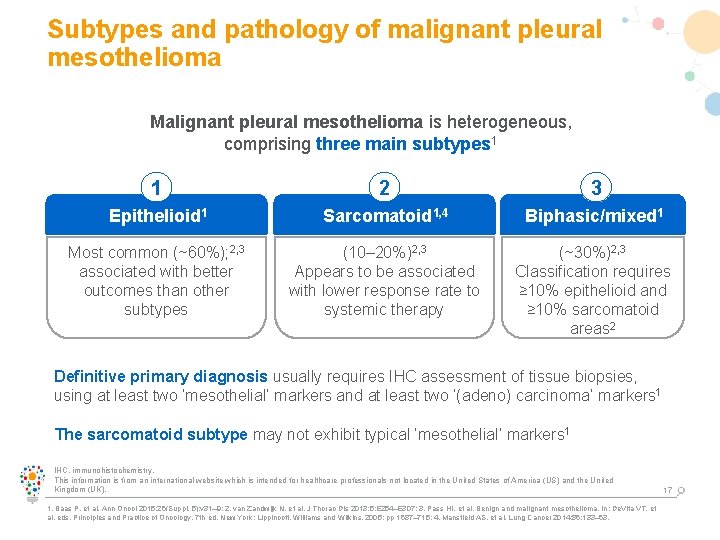
Subtypes and pathology of malignant pleural mesothelioma Malignant pleural mesothelioma is heterogeneous, comprising three main subtypes 1 1 2 3 Epithelioid 1 Sarcomatoid 1, 4 Biphasic/mixed 1 Most common (~60%); 2, 3 associated with better outcomes than other subtypes (10– 20%)2, 3 Appears to be associated with lower response rate to systemic therapy (~30%)2, 3 Classification requires ≥ 10% epithelioid and ≥ 10% sarcomatoid areas 2 Definitive primary diagnosis usually requires IHC assessment of tissue biopsies, using at least two ‘mesothelial’ markers and at least two ‘(adeno) carcinoma’ markers 1 The sarcomatoid subtype may not exhibit typical ‘mesothelial’ markers 1 IHC, immunohistochemistry. This information is from an international website which is intended for healthcare professionals not located in the United States of America (US) and the United Kingdom (UK). 1. Baas P, et al. Ann Oncol 2015; 26(Suppl. 5): v 31– 9; 2. van Zandwijk N, et al. J Thorac Dis 2013; 5: E 254–E 307; 3. Pass HI, et al. Benign and malignant mesothelioma. In: De. Vita VT, et al. eds. Principles and Practice of Oncology. 7 th ed. New York: Lippincott, Williams and Wilkins, 2005; pp 1687– 715; 4. Mansfield AS, et al. Lung Cancer 2014; 86: 133– 63. 17
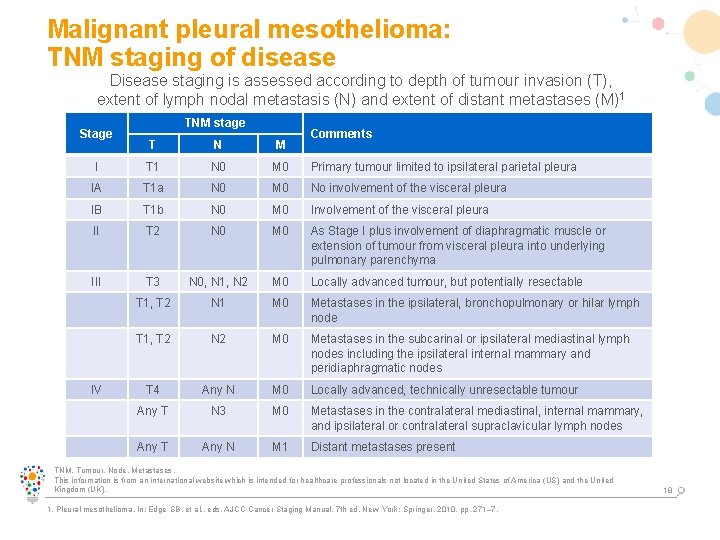
Malignant pleural mesothelioma: TNM staging of disease Disease staging is assessed according to depth of tumour invasion (T), extent of lymph nodal metastasis (N) and extent of distant metastases (M)1 Stage TNM stage Comments T N M I T 1 N 0 M 0 Primary tumour limited to ipsilateral parietal pleura IA T 1 a N 0 M 0 No involvement of the visceral pleura IB T 1 b N 0 M 0 Involvement of the visceral pleura II T 2 N 0 M 0 As Stage I plus involvement of diaphragmatic muscle or extension of tumour from visceral pleura into underlying pulmonary parenchyma III T 3 N 0, N 1, N 2 M 0 Locally advanced tumour, but potentially resectable T 1, T 2 N 1 M 0 Metastases in the ipsilateral, bronchopulmonary or hilar lymph node T 1, T 2 N 2 M 0 Metastases in the subcarinal or ipsilateral mediastinal lymph nodes including the ipsilateral internal mammary and peridiaphragmatic nodes T 4 Any N M 0 Locally advanced, technically unresectable tumour Any T N 3 M 0 Metastases in the contralateral mediastinal, internal mammary, and ipsilateral or contralateral supraclavicular lymph nodes Any T Any N M 1 Distant metastases present IV TNM, Tumour, Node, Metastases. This information is from an international website which is intended for healthcare professionals not located in the United States of America (US) and the United Kingdom (UK). 1. Pleural mesothelioma. In: Edge SB, et al. , eds. AJCC Cancer Staging Manual. 7 th ed. New York: Springer, 2010, pp. 271– 7. 18
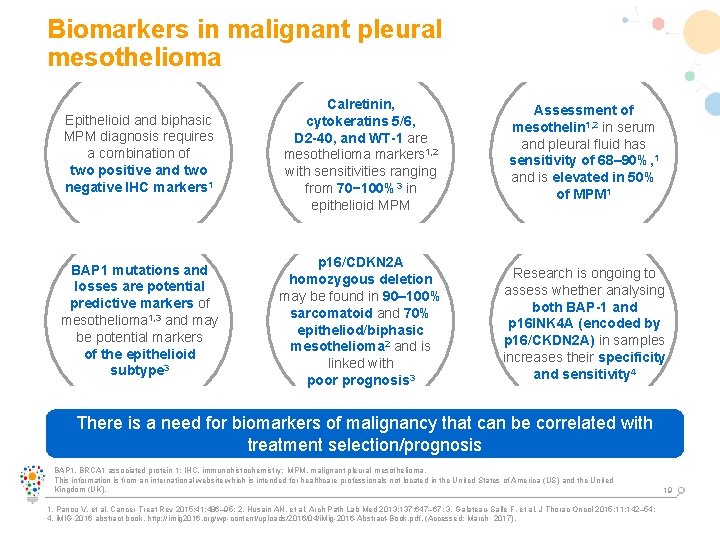
Biomarkers in malignant pleural mesothelioma Epithelioid and biphasic MPM diagnosis requires a combination of two positive and two negative IHC markers 1 Calretinin, cytokeratins 5/6, D 2 -40, and WT-1 are mesothelioma markers 1, 2 with sensitivities ranging from 70− 100%3 in epithelioid MPM Assessment of mesothelin 1, 2 in serum and pleural fluid has sensitivity of 68– 90%, 1 and is elevated in 50% of MPM 1 BAP 1 mutations and losses are potential predictive markers of mesothelioma 1, 3 and may be potential markers of the epithelioid subtype 3 p 16/CDKN 2 A homozygous deletion may be found in 90– 100% sarcomatoid and 70% epitheliod/biphasic mesothelioma 2 and is linked with poor prognosis 3 Research is ongoing to assess whether analysing both BAP-1 and p 16 INK 4 A (encoded by p 16/CKDN 2 A) in samples increases their specificity and sensitivity 4 There is a need for biomarkers of malignancy that can be correlated with treatment selection/prognosis BAP 1, BRCA 1 associated protein 1; IHC, immunohistochemistry; MPM, malignant pleural mesothelioma. This information is from an international website which is intended for healthcare professionals not located in the United States of America (US) and the United Kingdom (UK). 1. Panou V, et al. Cancer Treat Rev 2015; 41: 486– 95; 2. Husain AN, et al. Arch Path Lab Med 2013; 137: 647– 67; 3. Galateau-Salle F, et al. J Thorac Oncol 2015; 11: 142– 54; 4. i. MIG 2016 abstract book. http: // imig 2016. org/wp-content/uploads/2016/04/i. Mig-2016 -Abstract-Book. pdf. (Accessed: March 2017). 19
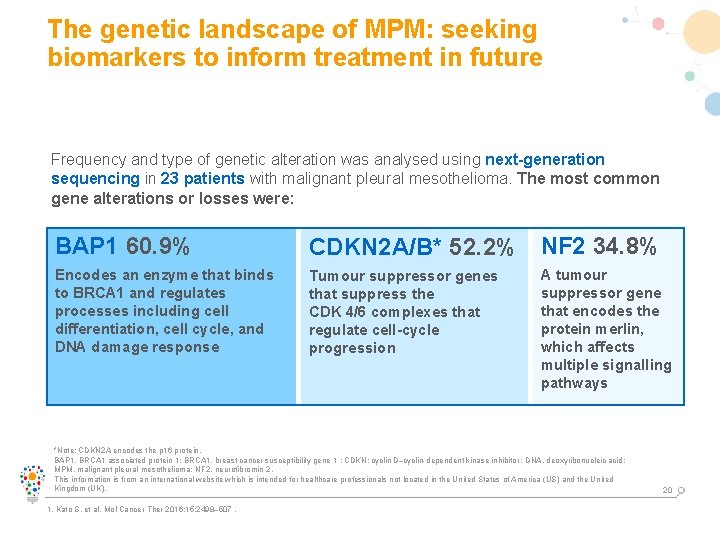
The genetic landscape of MPM: seeking biomarkers to inform treatment in future Frequency and type of genetic alteration was analysed using next-generation sequencing in 23 patients with malignant pleural mesothelioma. The most common gene alterations or losses were: BAP 1 60. 9% CDKN 2 A/B* 52. 2% NF 2 34. 8% Encodes an enzyme that binds to BRCA 1 and regulates processes including cell differentiation, cell cycle, and DNA damage response Tumour suppressor genes that suppress the CDK 4/6 complexes that regulate cell-cycle progression A tumour suppressor gene that encodes the protein merlin, which affects multiple signalling pathways *Note: CDKN 2 A encodes the p 16 protein. BAP 1, BRCA 1 associated protein 1; BRCA 1, breast cancer susceptibility gene 1 ; CDKN: cyclin D–cyclin-dependent kinase inhibitor ; DNA, deoxyribonucleic acid; MPM, malignant pleural mesothelioma; NF 2, neurofibromin 2. This information is from an international website which is intended for healthcare professionals not located in the United States of America (US) and the United Kingdom (UK). 1. Kato S, et al. Mol Cancer Ther 2016; 15: 2498– 507. 20
Malignant pleural mesothelioma Treatment options This information is from an international website which is intended for healthcare professionals not located in the United States of America (US) and the United Kingdom (UK).
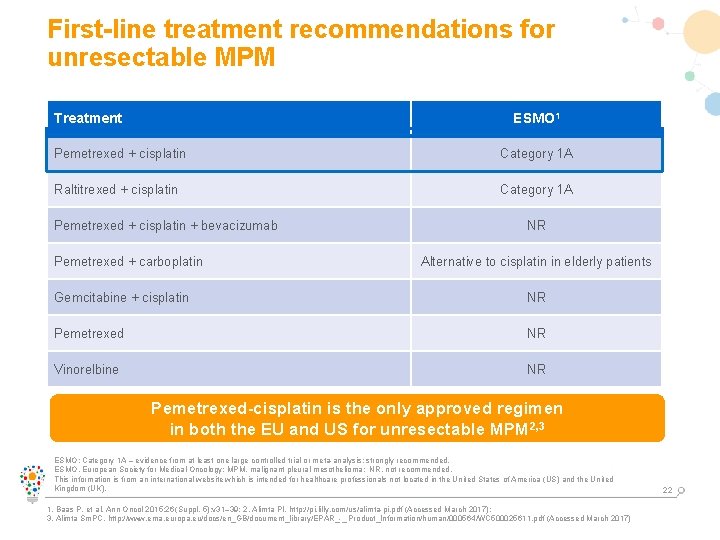
First-line treatment recommendations for unresectable MPM Treatment ESMO 1 Pemetrexed + cisplatin Category 1 A Raltitrexed + cisplatin Category 1 A Pemetrexed + cisplatin + bevacizumab Pemetrexed + carboplatin NR Alternative to cisplatin in elderly patients Gemcitabine + cisplatin NR Pemetrexed NR Vinorelbine NR Pemetrexed-cisplatin is the only approved regimen in both the EU and US for unresectable MPM 2, 3 ESMO: Category 1 A – evidence from at least one large controlled trial or meta-analysis; strongly recommended. ESMO, European Society for Medical Oncology; MPM, malignant pleural mesothelioma; NR, not recommended. This information is from an international website which is intended for healthcare professionals not located in the United States of America (US) and the United Kingdom (UK). 1. Baas P, et al. Ann Oncol 2015; 26(Suppl. 5): v 31– 39; 2. Alimta PI, http: //pi. lilly. com/us/alimta-pi. pdf (Accessed March 2017); 3. Alimta Sm. PC, http: //www. ema. europa. eu/docs/en_GB/document_library/EPAR_-_ Product_Information/human/000564/WC 500025611. pdf (Accessed March 2017) 22
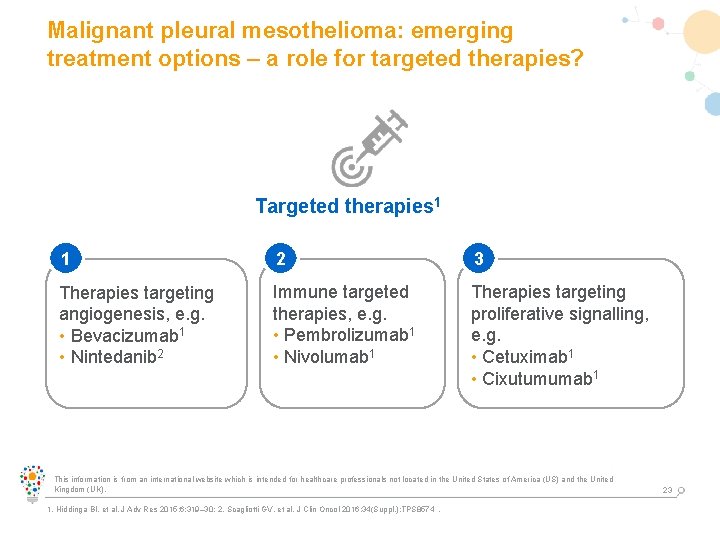
Malignant pleural mesothelioma: emerging treatment options – a role for targeted therapies? Targeted therapies 1 1 2 3 Therapies targeting angiogenesis, e. g. • Bevacizumab 1 • Nintedanib 2 Immune targeted therapies, e. g. • Pembrolizumab 1 • Nivolumab 1 Therapies targeting proliferative signalling, e. g. • Cetuximab 1 • Cixutumumab 1 This information is from an international website which is intended for healthcare professionals not located in the United States of America (US) and the United Kingdom (UK). 1. Hiddinga BI, et al. J Adv Res 2015; 6: 319– 30; 2. Scagliotti GV, et al. J Clin Oncol 2016; 34(Suppl. ): TPS 8574. 23