
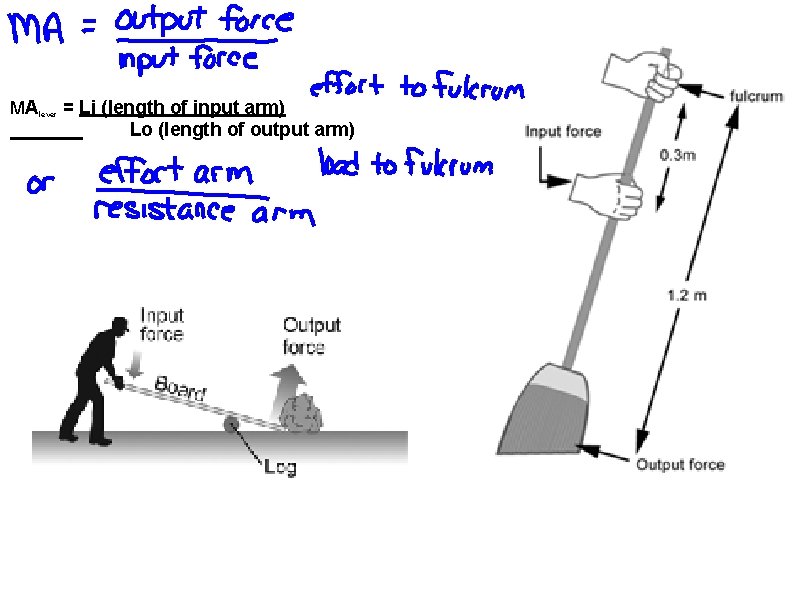
MAlever Li length of input arm Lo length
- Slides: 3
MAlever = Li (length of input arm) Lo (length of output arm)
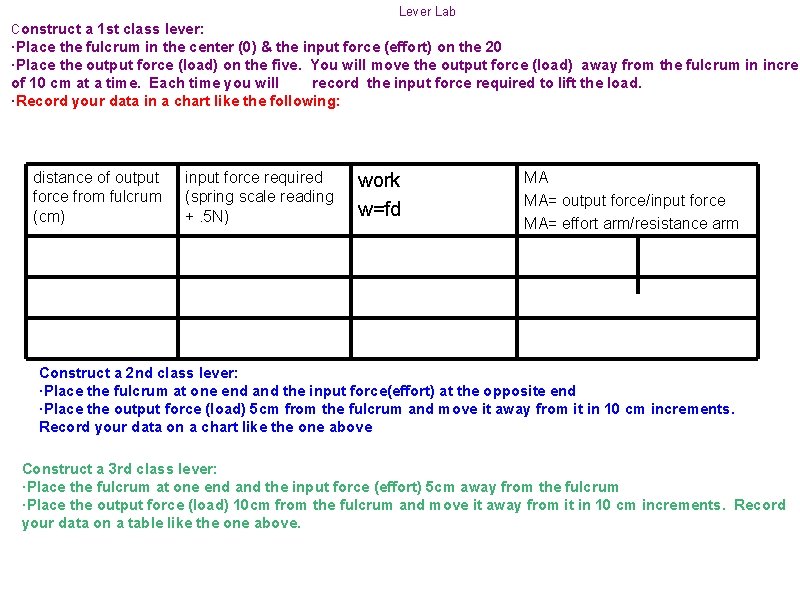
Lever Lab Construct a 1 st class lever: ·Place the fulcrum in the center (0) & the input force (effort) on the 20 ·Place the output force (load) on the five. You will move the output force (load) away from the fulcrum in increm of 10 cm at a time. Each time you will record the input force required to lift the load. ·Record your data in a chart like the following: distance of output force from fulcrum (cm) input force required (spring scale reading +. 5 N) work w=fd MA MA= output force/input force MA= effort arm/resistance arm Construct a 2 nd class lever: ·Place the fulcrum at one end and the input force(effort) at the opposite end ·Place the output force (load) 5 cm from the fulcrum and move it away from it in 10 cm increments. Record your data on a chart like the one above Construct a 3 rd class lever: ·Place the fulcrum at one end and the input force (effort) 5 cm away from the fulcrum ·Place the output force (load) 10 cm from the fulcrum and move it away from it in 10 cm increments. Record your data on a table like the one above.
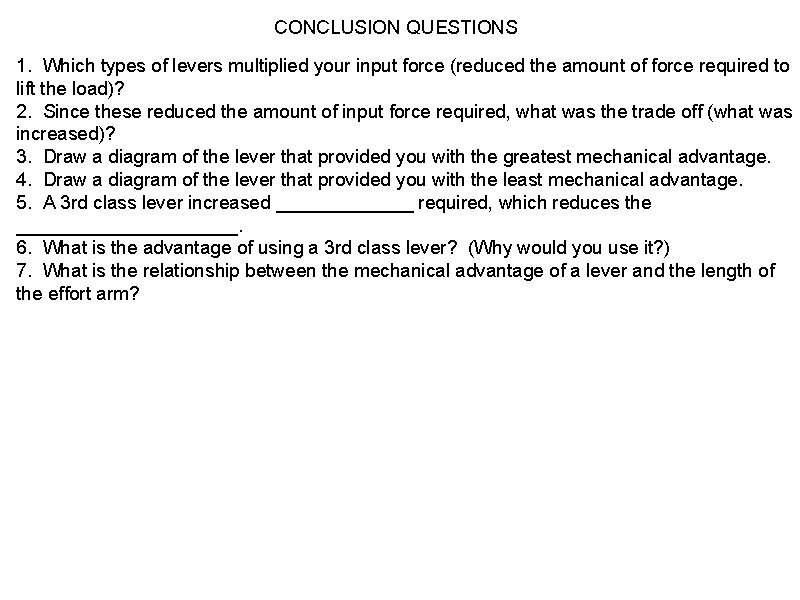
CONCLUSION QUESTIONS 1. Which types of levers multiplied your input force (reduced the amount of force required to lift the load)? 2. Since these reduced the amount of input force required, what was the trade off (what was increased)? 3. Draw a diagram of the lever that provided you with the greatest mechanical advantage. 4. Draw a diagram of the lever that provided you with the least mechanical advantage. 5. A 3 rd class lever increased _______ required, which reduces the ___________. 6. What is the advantage of using a 3 rd class lever? (Why would you use it? ) 7. What is the relationship between the mechanical advantage of a lever and the length of the effort arm?