
Male Sex Organs The hormone testosterone regulates the


































- Slides: 90
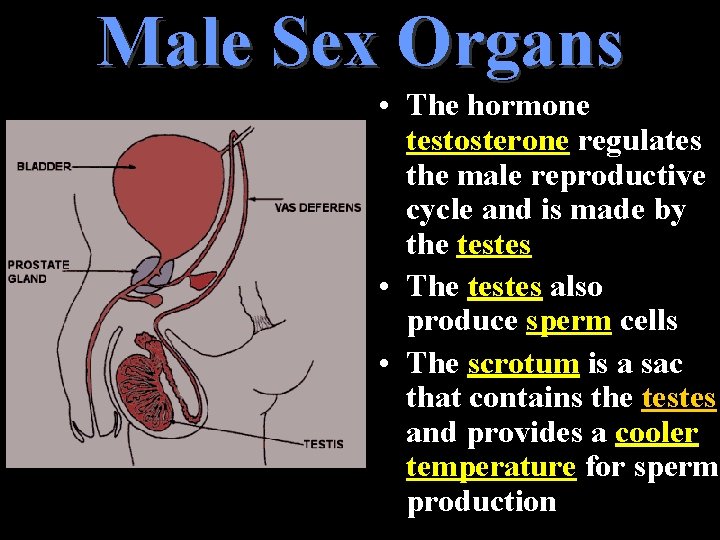
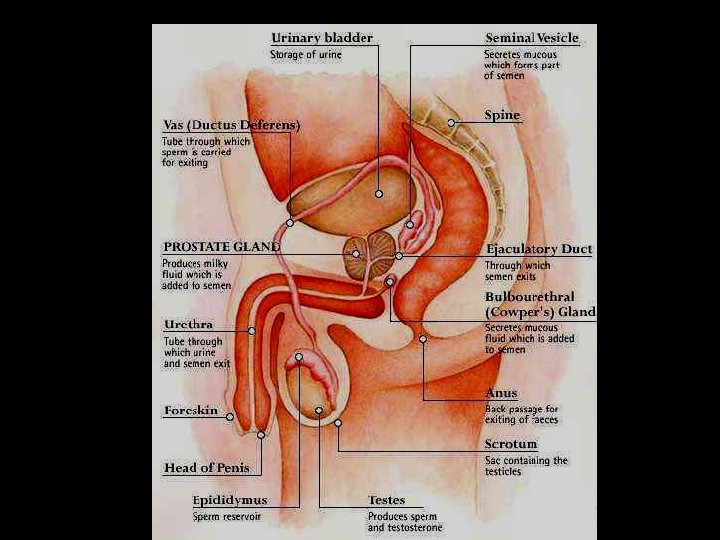
Male Sex Organs • The hormone testosterone regulates the male reproductive cycle and is made by the testes • The testes also produce sperm cells • The scrotum is a sac that contains the testes and provides a cooler temperature for sperm production
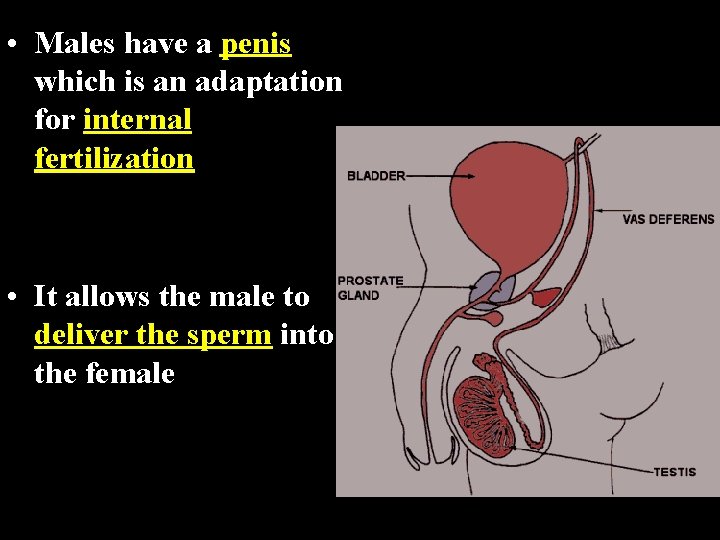
• Males have a penis which is an adaptation for internal fertilization • It allows the male to deliver the sperm into the female
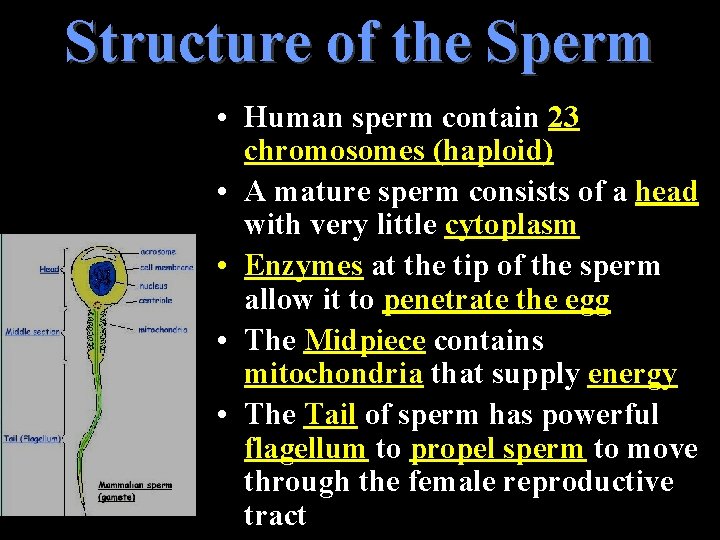
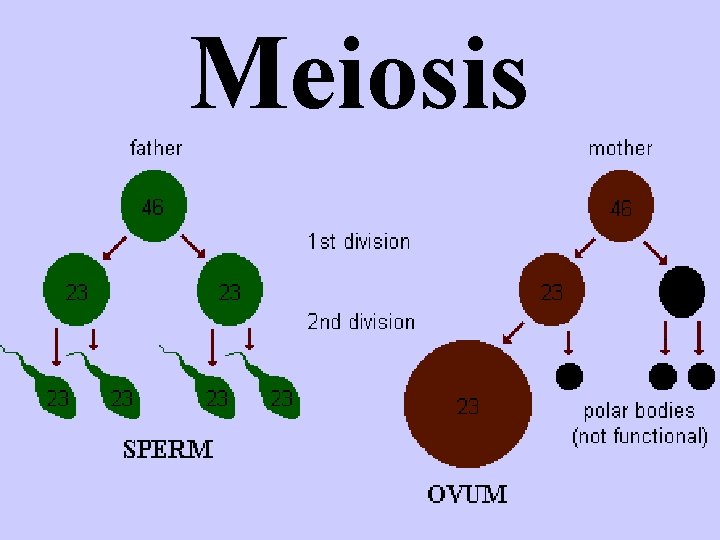
Structure of the Sperm • Human sperm contain 23 chromosomes (haploid) • A mature sperm consists of a head with very little cytoplasm • Enzymes at the tip of the sperm allow it to penetrate the egg • The Midpiece contains mitochondria that supply energy • The Tail of sperm has powerful flagellum to propel sperm to move through the female reproductive tract
Delivery of Sperm • Urethra passes through the penis and carries sperm out of body • During intercourse blood flow to the penis increases, causing the penis to become erect • About 3. 5 ml of semen is released which contains 300 -400 million sperm • Few ever reach the egg • Fertilization requires a high sperm count • Males with fewer than 20 million sperm/ml are considered sterile • Sperm survive only 48 hours
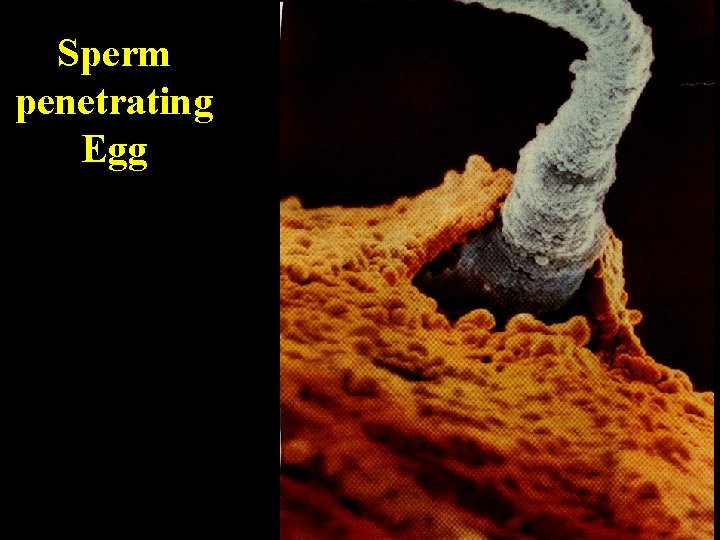
Sperm penetrating Egg
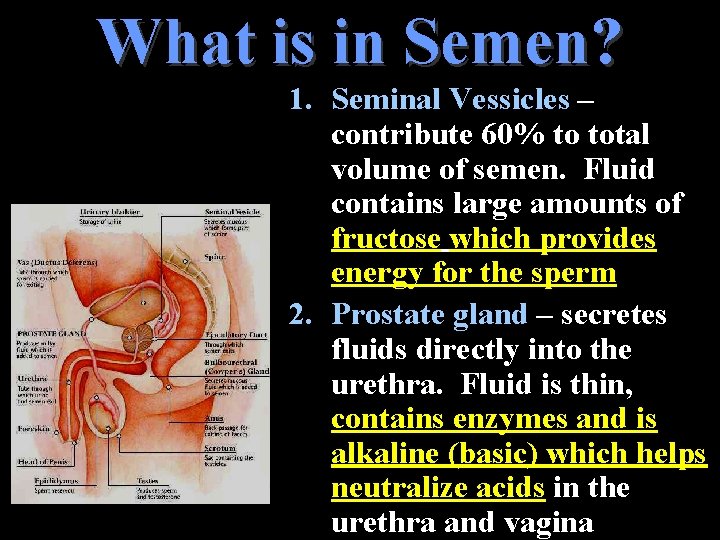
What is in Semen? 1. Seminal Vessicles – contribute 60% to total volume of semen. Fluid contains large amounts of fructose which provides energy for the sperm 2. Prostate gland – secretes fluids directly into the urethra. Fluid is thin, contains enzymes and is alkaline (basic) which helps neutralize acids in the urethra and vagina
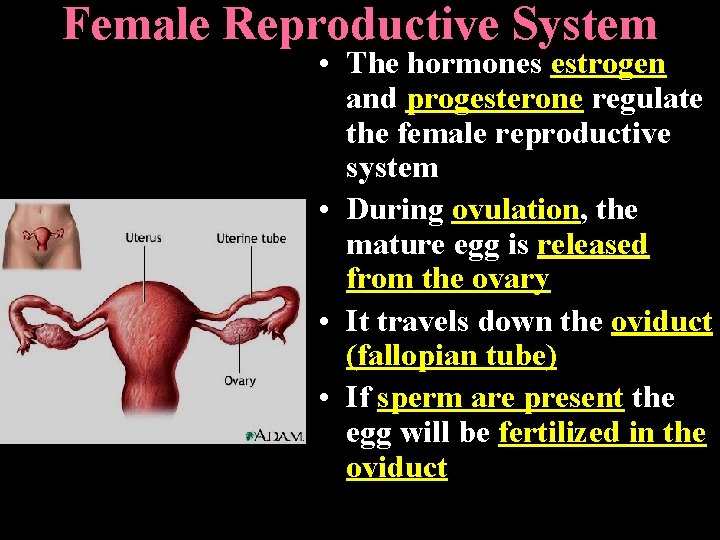
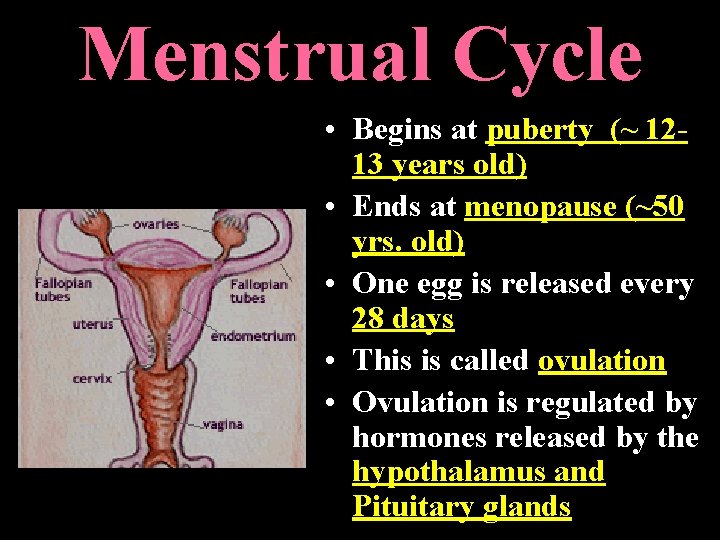
Female Reproductive System • The hormones estrogen and progesterone regulate the female reproductive system • During ovulation, the mature egg is released from the ovary • It travels down the oviduct (fallopian tube) • If sperm are present the egg will be fertilized in the oviduct
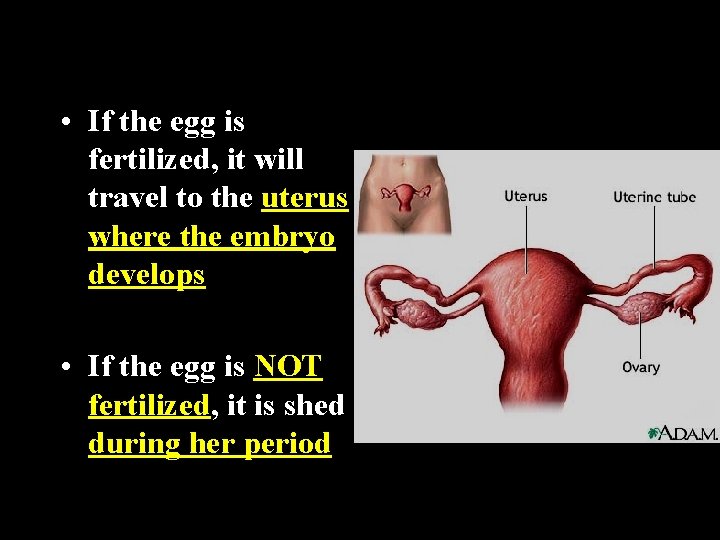
• If the egg is fertilized, it will travel to the uterus where the embryo develops • If the egg is NOT fertilized, it is shed during her period
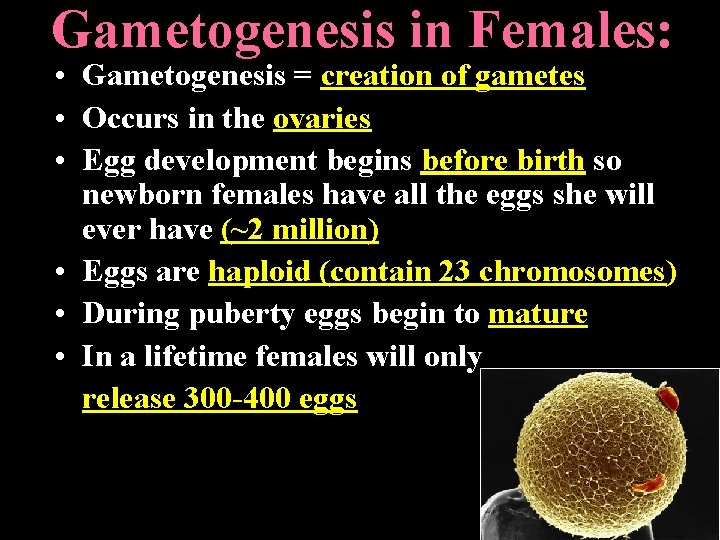
Gametogenesis in Females: • Gametogenesis = creation of gametes • Occurs in the ovaries • Egg development begins before birth so newborn females have all the eggs she will ever have (~2 million) • Eggs are haploid (contain 23 chromosomes) • During puberty eggs begin to mature • In a lifetime females will only release 300 -400 eggs
Meiosis
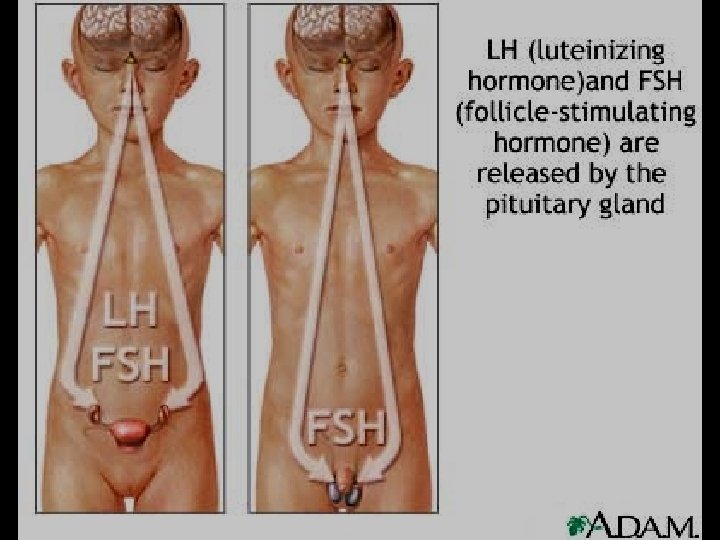
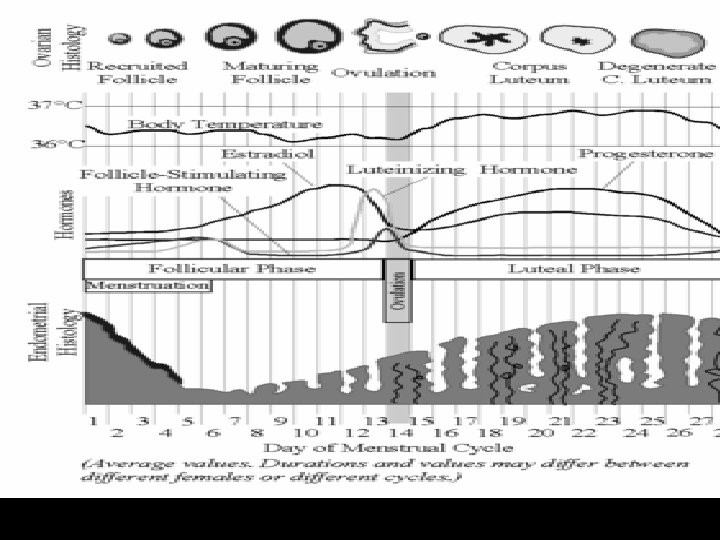
Menstrual Cycle • Begins at puberty (~ 1213 years old) • Ends at menopause (~50 yrs. old) • One egg is released every 28 days • This is called ovulation • Ovulation is regulated by hormones released by the hypothalamus and Pituitary glands
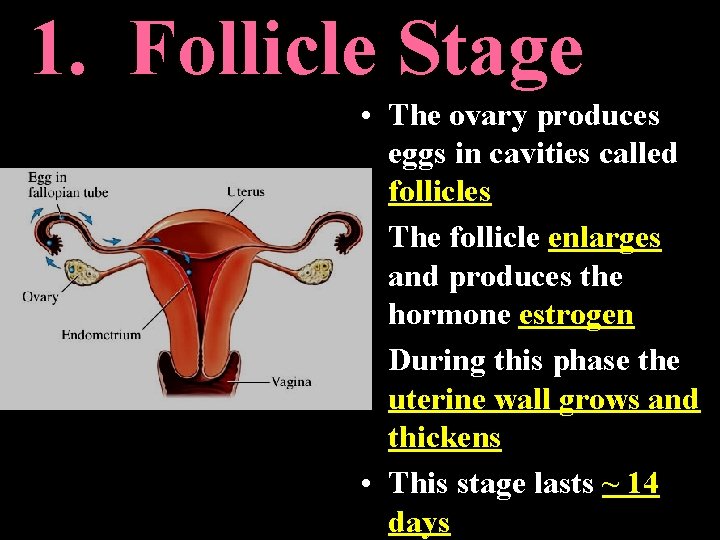
1. Follicle Stage • The ovary produces eggs in cavities called follicles • The follicle enlarges and produces the hormone estrogen • During this phase the uterine wall grows and thickens • This stage lasts ~ 14 days
2. Ovulation Stage • During this stage, the egg is released from the follicle and travels through the oviduct (fallopian tube)
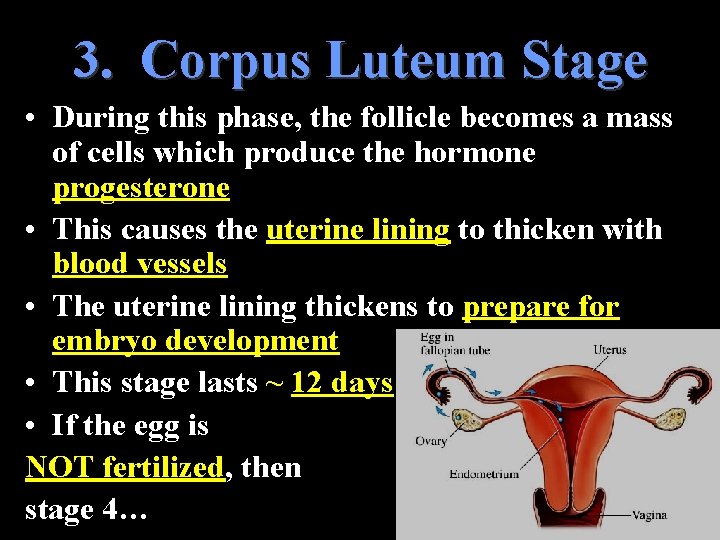
3. Corpus Luteum Stage • During this phase, the follicle becomes a mass of cells which produce the hormone progesterone • This causes the uterine lining to thicken with blood vessels • The uterine lining thickens to prepare for embryo development • This stage lasts ~ 12 days • If the egg is NOT fertilized, then stage 4…
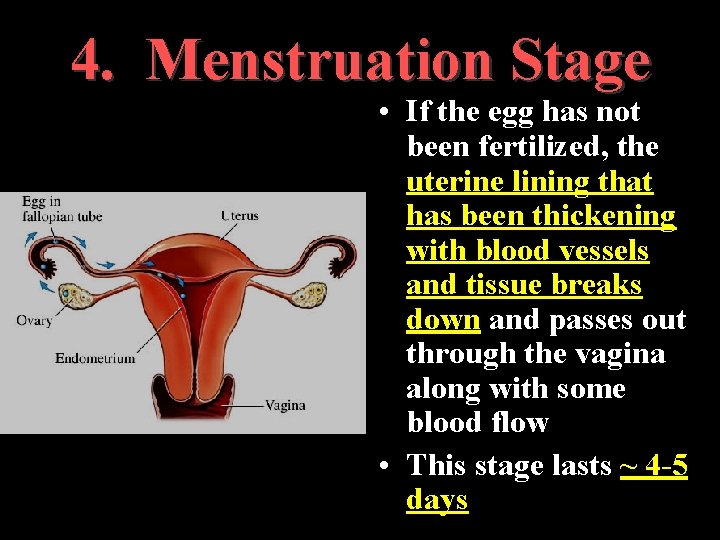
4. Menstruation Stage • If the egg has not been fertilized, the uterine lining that has been thickening with blood vessels and tissue breaks down and passes out through the vagina along with some blood flow • This stage lasts ~ 4 -5 days
Fertilization • Fertilization is the fusion of gametes (sperm and egg) • It occurs in the oviduct (fallopian tubes) • A human’s gestation period is ~ 9 months after fertilization
Do all animals have the same gestation periods? • • • Human – 266 days Camel – 406 days Cat - 62 days Dog – 62 days Dolphin – 276 days Elephant – 640 days Squirrel – 44 days Pig – 113 days Lion – 108 days Kangaroo – 40 days Horse - 337 days Giraffe – 400 days
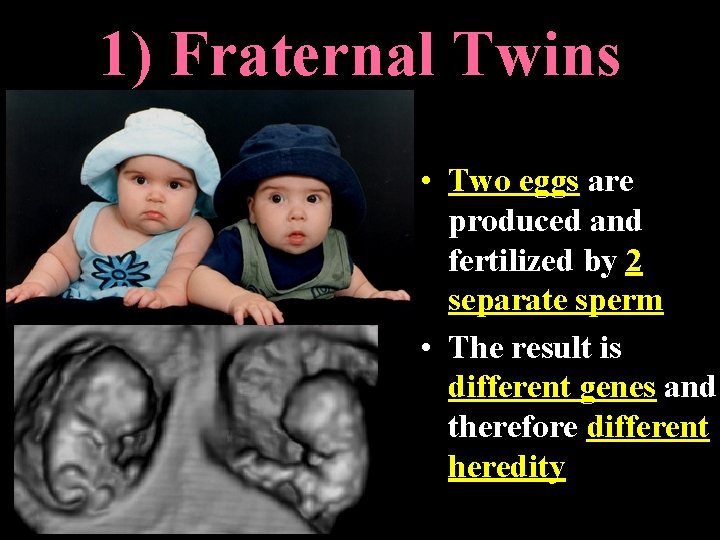
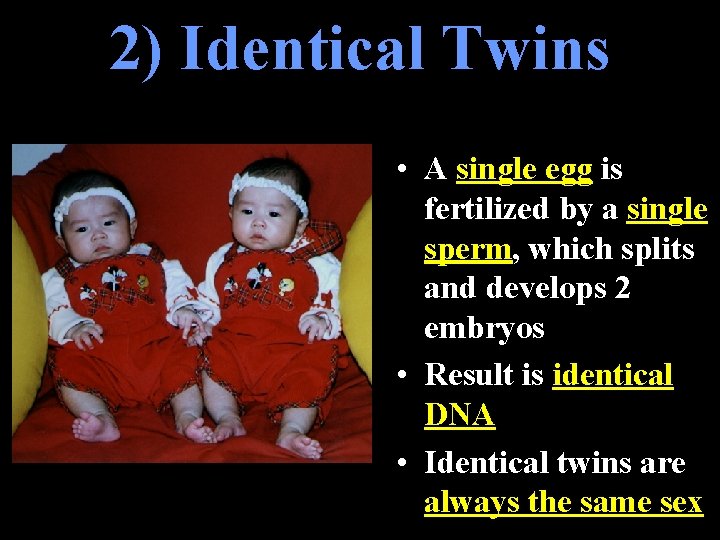
There are 2 types of twins: • Fraternal Twins • Identical Twins
1) Fraternal Twins • Two eggs are produced and fertilized by 2 separate sperm • The result is different genes and therefore different heredity
2) Identical Twins • A single egg is fertilized by a single sperm, which splits and develops 2 embryos • Result is identical DNA • Identical twins are always the same sex
Twins
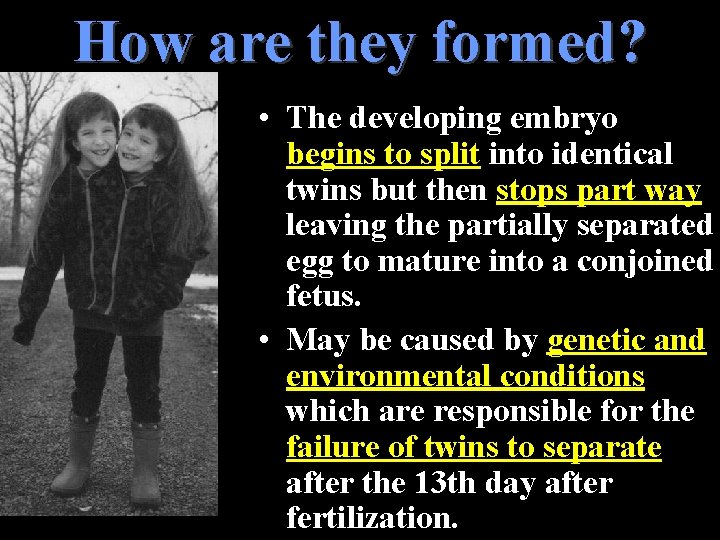
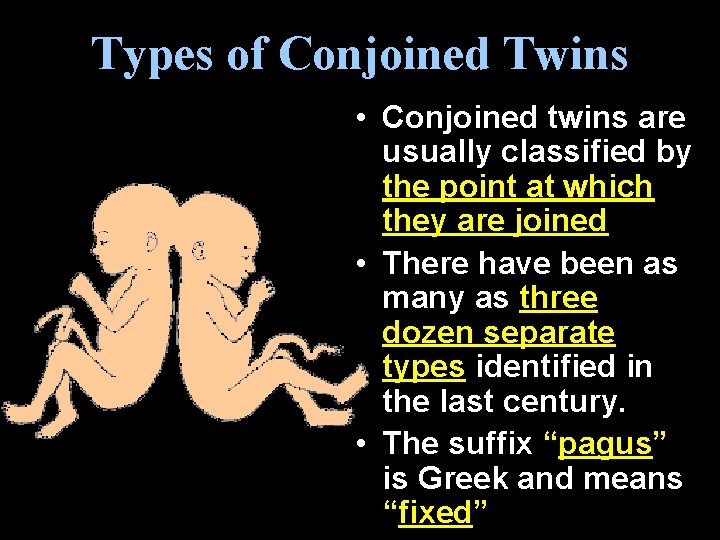
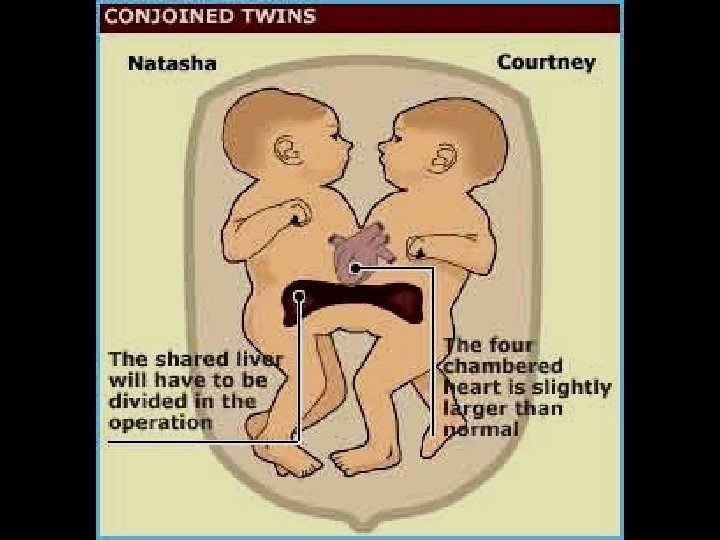
How are they formed? • The developing embryo begins to split into identical twins but then stops part way leaving the partially separated egg to mature into a conjoined fetus. • May be caused by genetic and environmental conditions which are responsible for the failure of twins to separate after the 13 th day after fertilization.
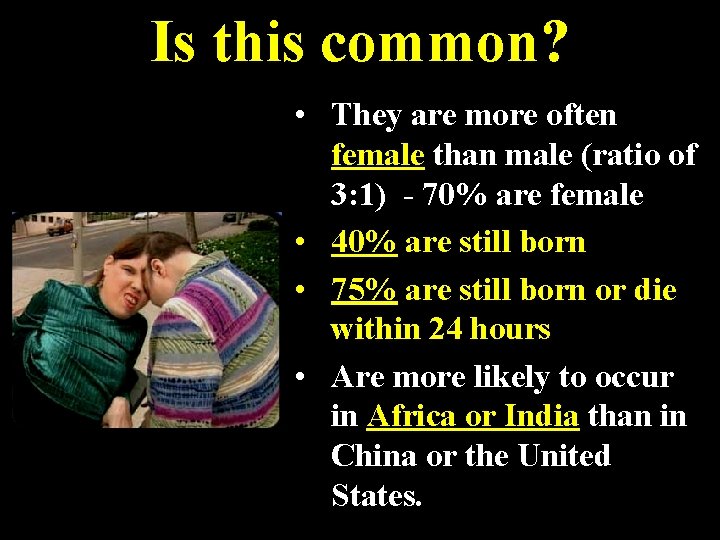
Is this common? • They are more often female than male (ratio of 3: 1) - 70% are female • 40% are still born • 75% are still born or die within 24 hours • Are more likely to occur in Africa or India than in China or the United States.
Types of Conjoined Twins • Conjoined twins are usually classified by the point at which they are joined • There have been as many as three dozen separate types identified in the last century. • The suffix “pagus” is Greek and means “fixed”
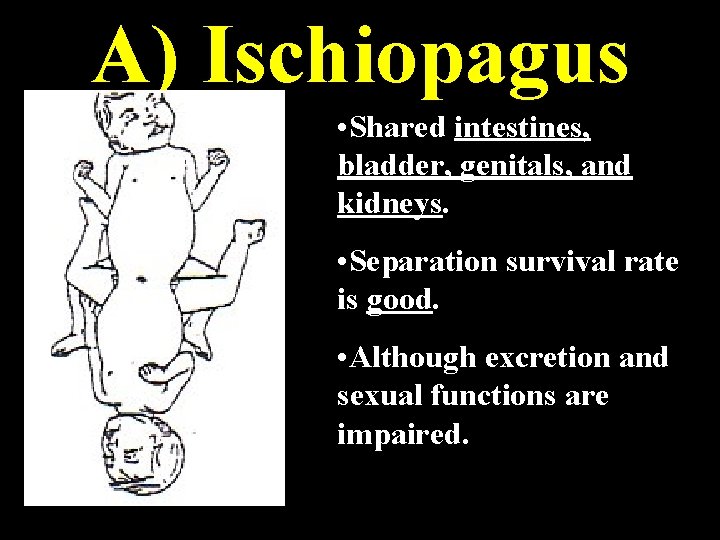
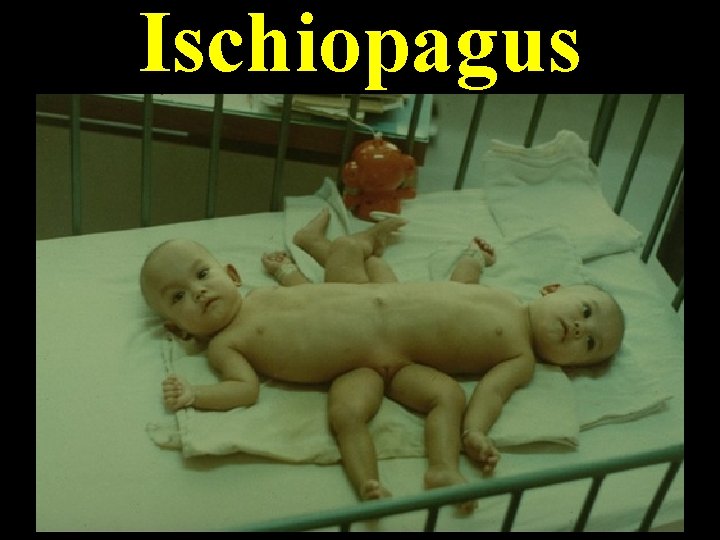
A) Ischiopagus • Shared intestines, bladder, genitals, and kidneys. • Separation survival rate is good. • Although excretion and sexual functions are impaired.
Ischiopagus
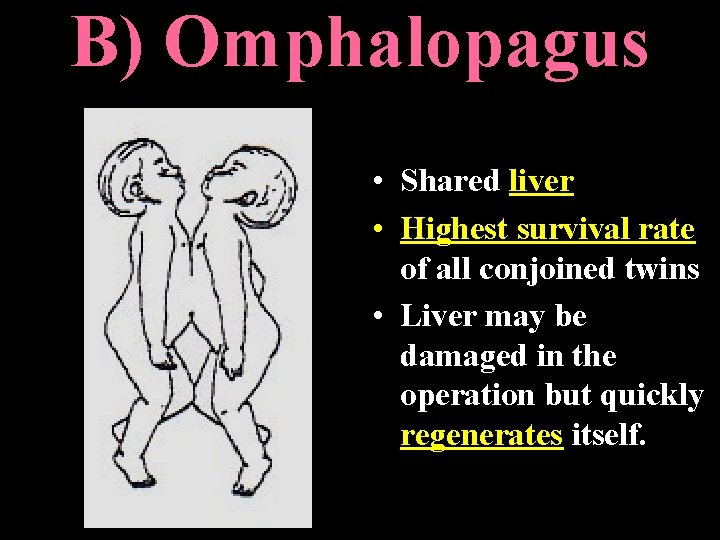
B) Omphalopagus • Shared liver • Highest survival rate of all conjoined twins • Liver may be damaged in the operation but quickly regenerates itself.
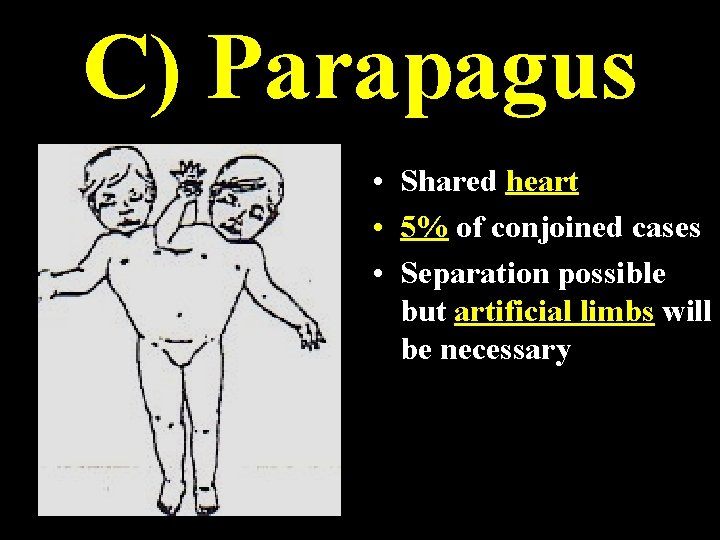
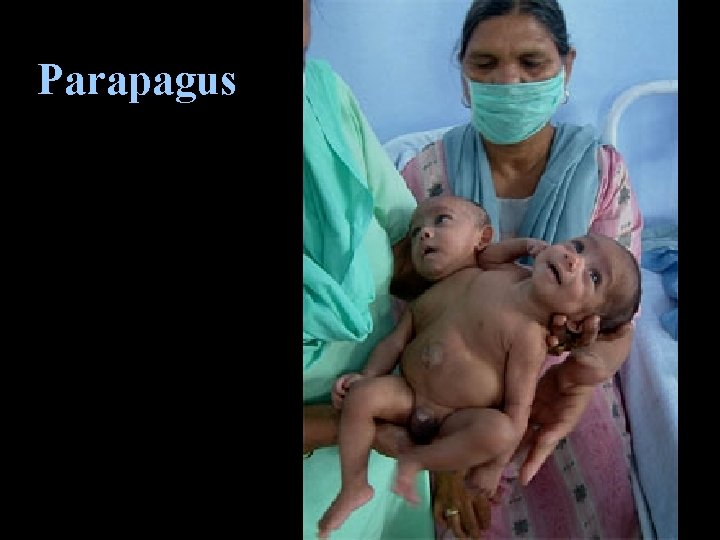
C) Parapagus • Shared heart • 5% of conjoined cases • Separation possible but artificial limbs will be necessary
Parapagus
Zygote Formation • After fertilization occurs, the fertilized egg is called a ZYGOTE • The zygote begins to go through mitosis (cell division) creating the many cells that will form the embryo • As this occurs, the zygote moves towards the UTERUS • This is where the embryo develops
Differentiation • During the first part of pregnancy, the DNA will instruct the cells to differentiate • This will allow the cells to become different parts of the embryo • After two months the embryo is called a FETUS • Since the organs are forming in the first trimester (first 3 months of pregnancy) the mother’s actions can impact the developing embryo
Differentiation
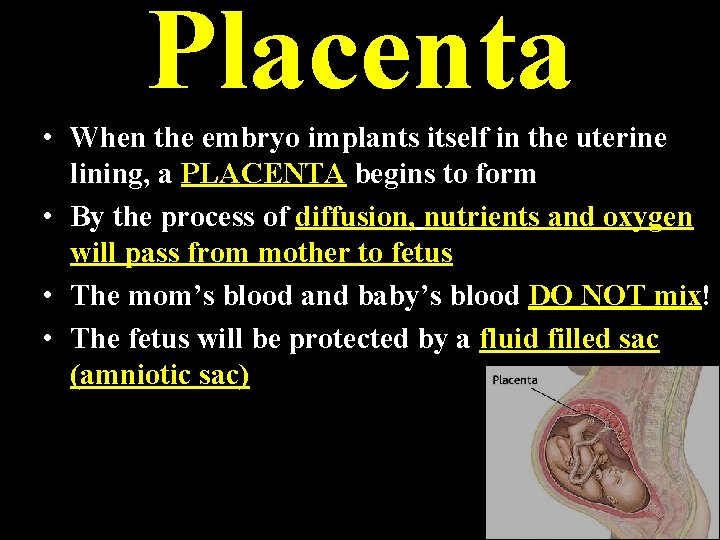
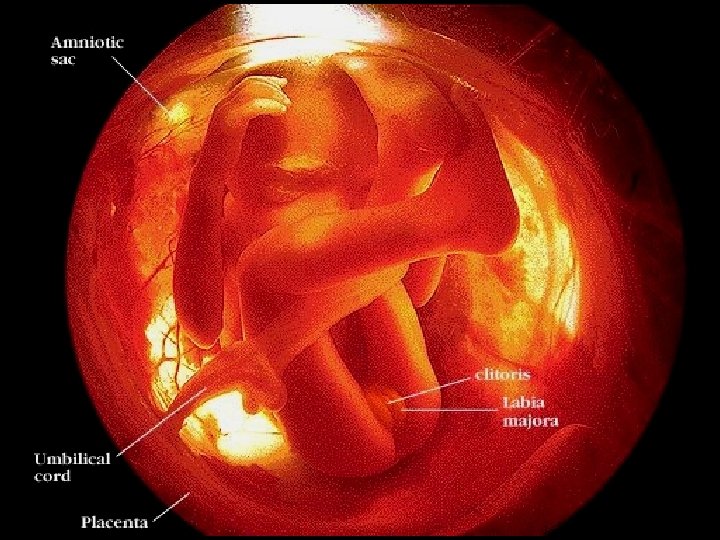
Placenta • When the embryo implants itself in the uterine lining, a PLACENTA begins to form • By the process of diffusion, nutrients and oxygen will pass from mother to fetus • The mom’s blood and baby’s blood DO NOT mix! • The fetus will be protected by a fluid filled sac (amniotic sac)
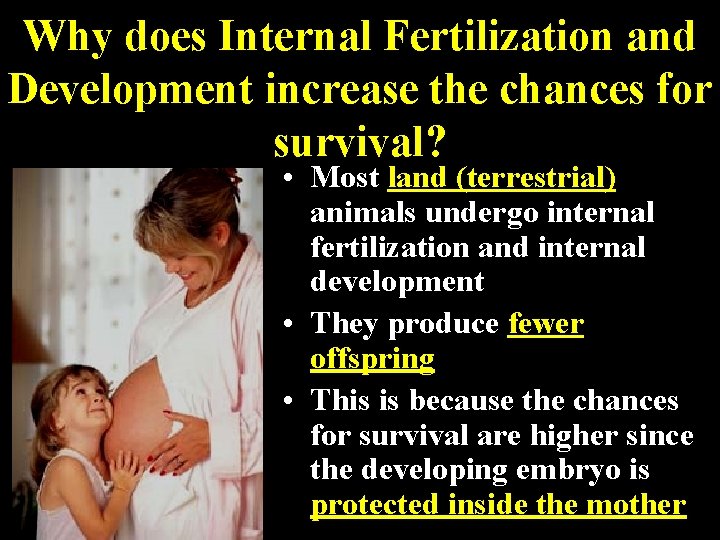
Why does Internal Fertilization and Development increase the chances for survival? • Most land (terrestrial) animals undergo internal fertilization and internal development • They produce fewer offspring • This is because the chances for survival are higher since the developing embryo is protected inside the mother
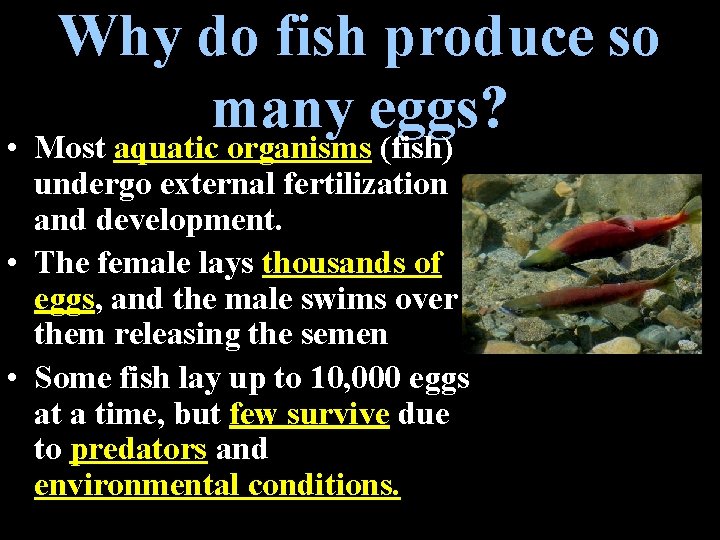
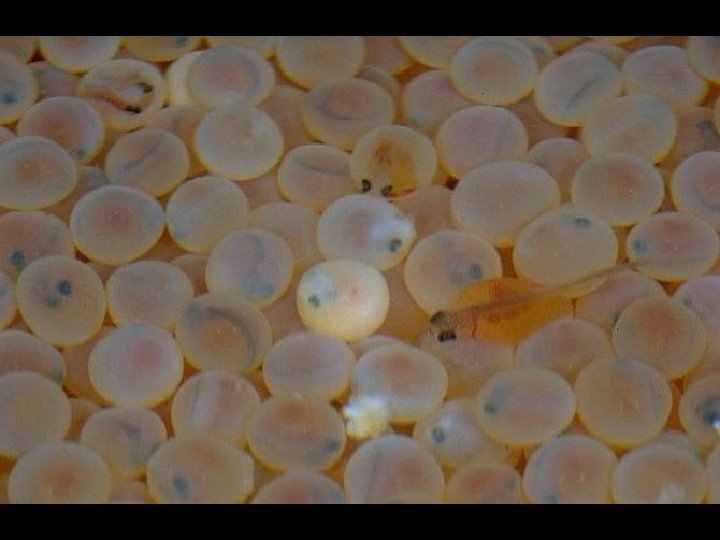
Why do fish produce so many eggs? • Most aquatic organisms (fish) undergo external fertilization and development. • The female lays thousands of eggs, and the male swims over them releasing the semen • Some fish lay up to 10, 000 eggs at a time, but few survive due to predators and environmental conditions.
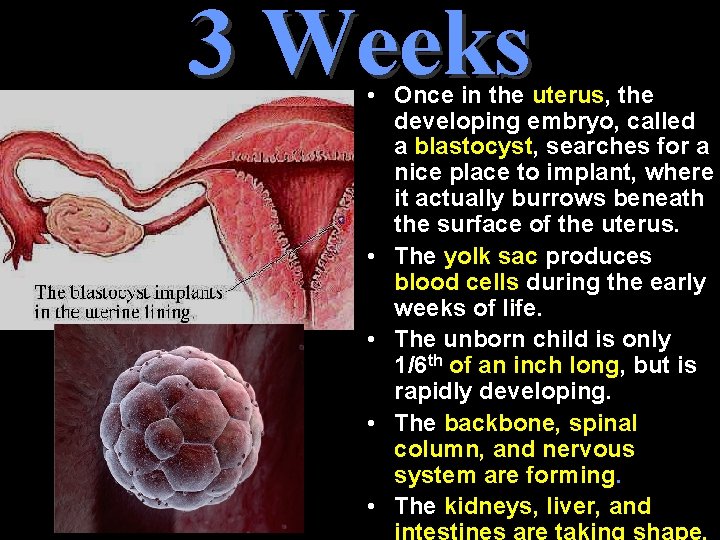
3 Weeks • Once in the uterus, the developing embryo, called a blastocyst, searches for a nice place to implant, where it actually burrows beneath the surface of the uterus. • The yolk sac produces blood cells during the early weeks of life. • The unborn child is only 1/6 th of an inch long, but is rapidly developing. • The backbone, spinal column, and nervous system are forming. • The kidneys, liver, and
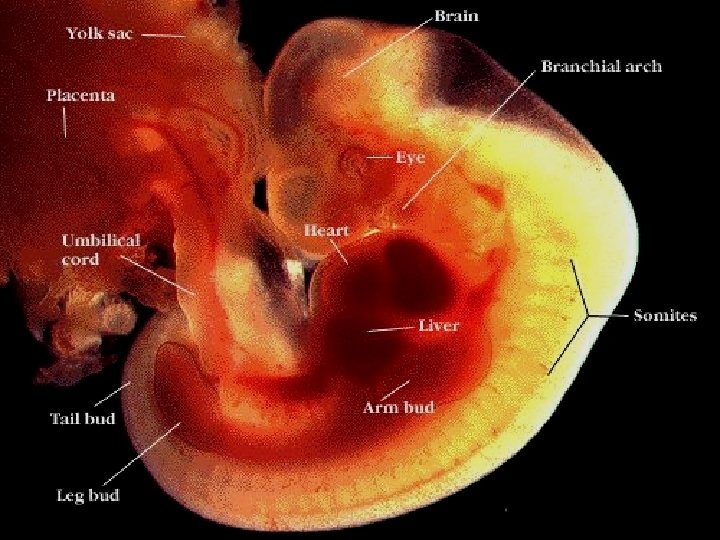
4 -5 Weeks • • 4 weeks - The embryo produces hormones which stop the mother's menstrual cycle. 5 weeks - Embryo is the size of a raisin. – By day 21, the embryo's tiny heart has begun beating. – The neural tube enlarges into three parts, soon to become a very complex brain. – The placenta begins functioning. – The spine and spinal cord grows faster than the rest of the body at this stage
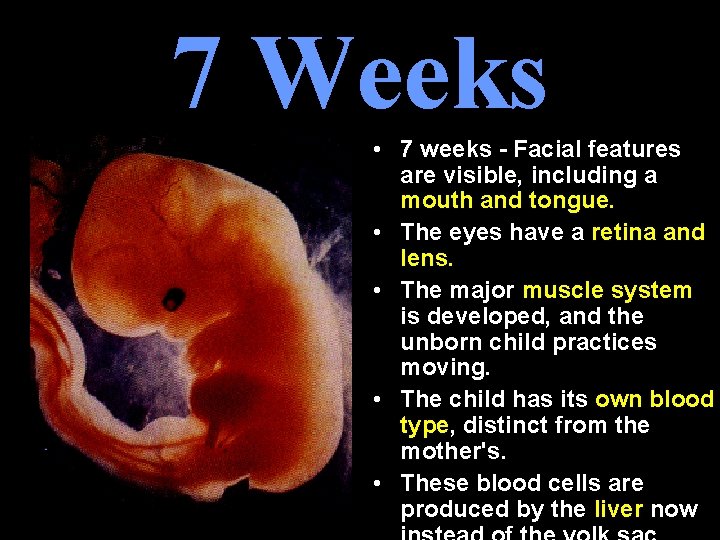
7 Weeks • 7 weeks - Facial features are visible, including a mouth and tongue. • The eyes have a retina and lens. • The major muscle system is developed, and the unborn child practices moving. • The child has its own blood type, distinct from the mother's. • These blood cells are produced by the liver now
8 Weeks • 8 weeks - The unborn child, called a fetus at this stage, is about half an inch long. • The tiny person is protected by the amniotic sac, filled with fluid. • Inside, the child swims and moves gracefully. • The arms and legs have lengthened, and fingers can be seen. • The toes will develop in the next few days. • Brain waves can be
10 Weeks • The heart is almost completely developed and very much resembles that of a newborn baby. • Twenty tiny baby teeth are forming in the gums.
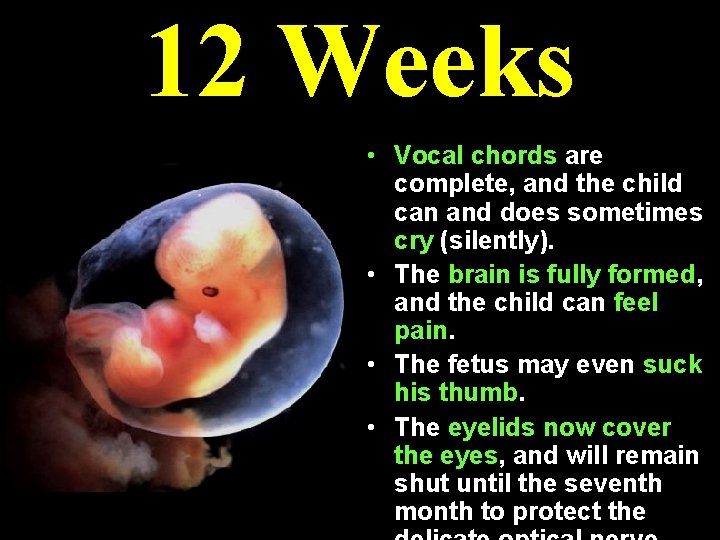
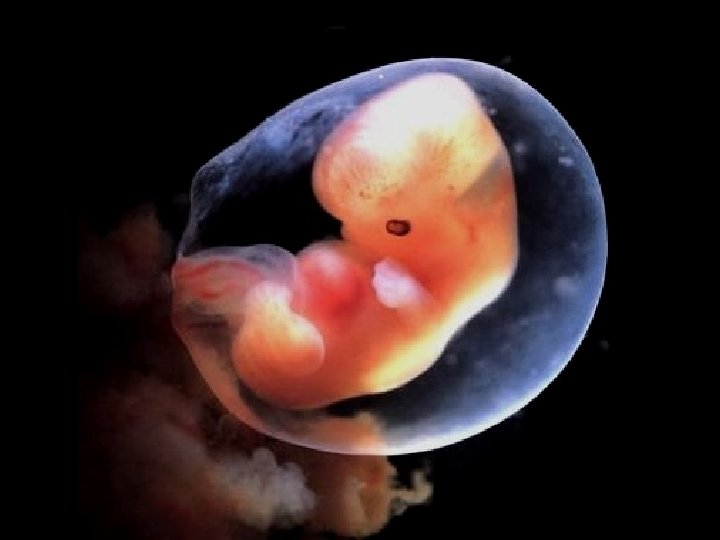
12 Weeks • Vocal chords are complete, and the child can and does sometimes cry (silently). • The brain is fully formed, and the child can feel pain. • The fetus may even suck his thumb. • The eyelids now cover the eyes, and will remain shut until the seventh month to protect the
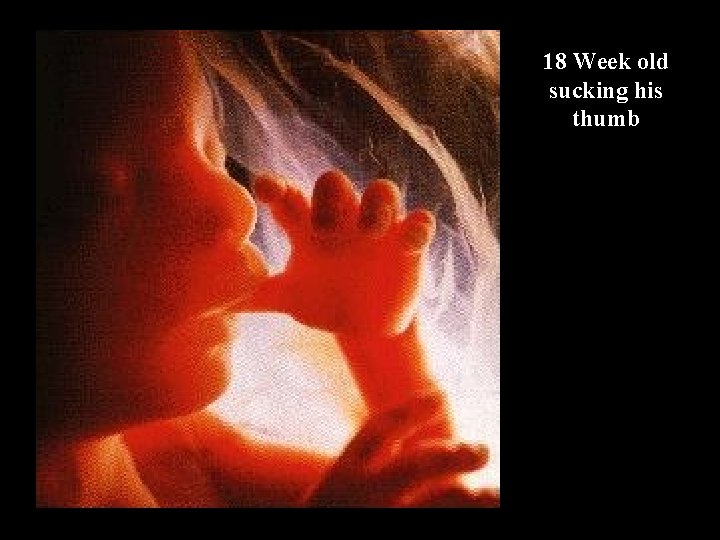
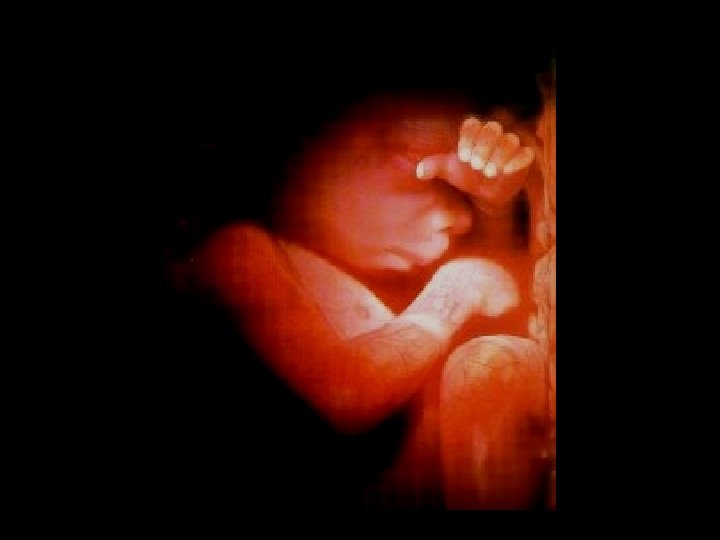
18 Week old sucking his thumb
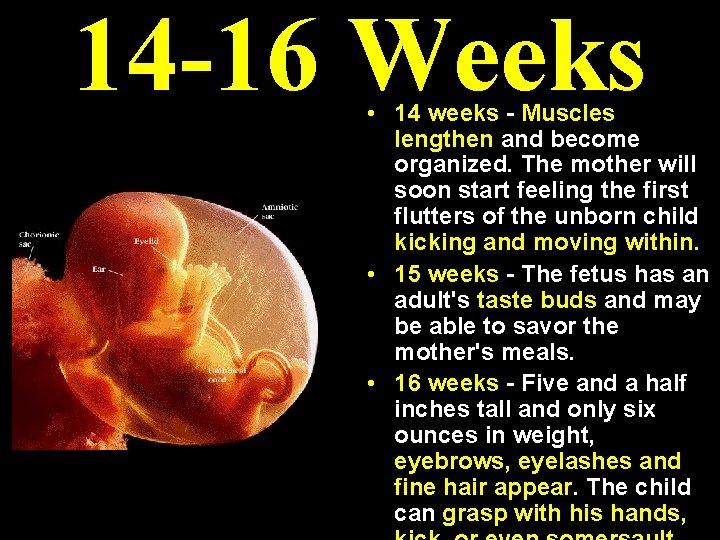
14 -16 Weeks • 14 weeks - Muscles lengthen and become organized. The mother will soon start feeling the first flutters of the unborn child kicking and moving within. • 15 weeks - The fetus has an adult's taste buds and may be able to savor the mother's meals. • 16 weeks - Five and a half inches tall and only six ounces in weight, eyebrows, eyelashes and fine hair appear. The child can grasp with his hands,
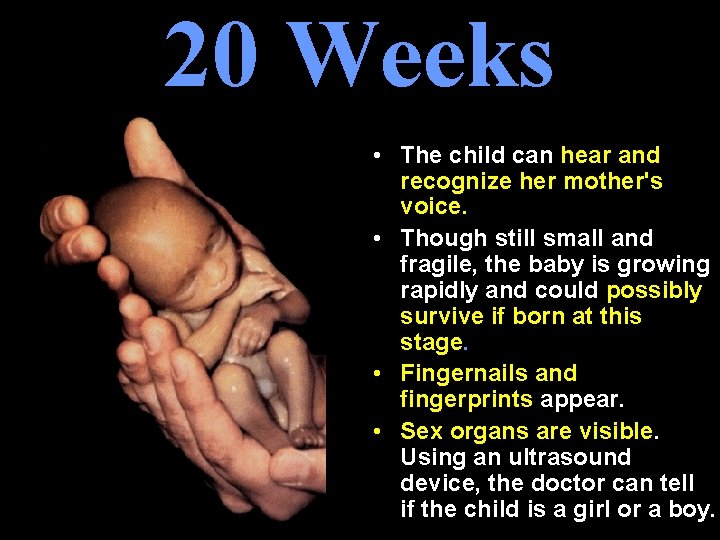
20 Weeks • The child can hear and recognize her mother's voice. • Though still small and fragile, the baby is growing rapidly and could possibly survive if born at this stage. • Fingernails and fingerprints appear. • Sex organs are visible. Using an ultrasound device, the doctor can tell if the child is a girl or a boy.
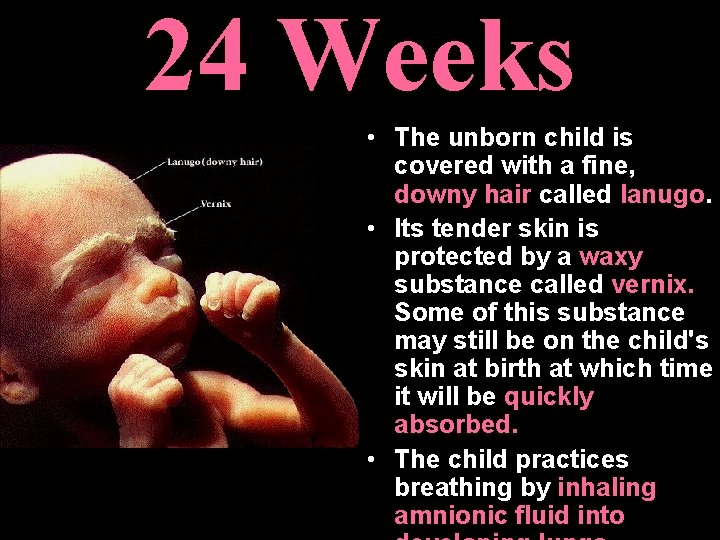
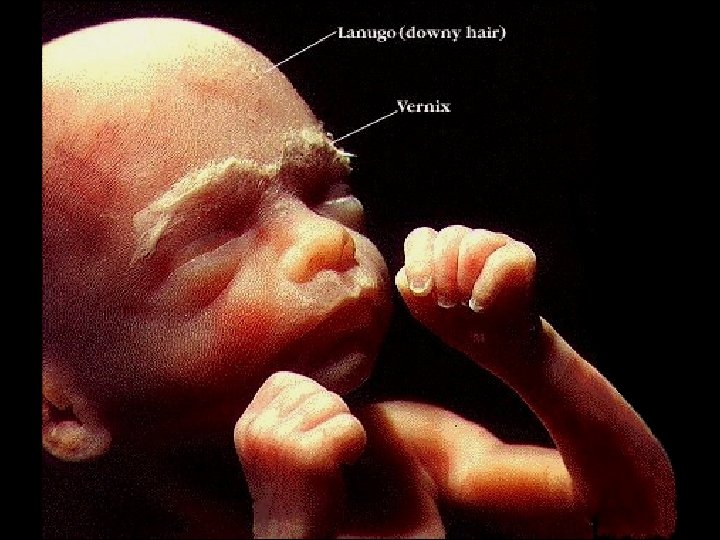
24 Weeks • The unborn child is covered with a fine, downy hair called lanugo. • Its tender skin is protected by a waxy substance called vernix. Some of this substance may still be on the child's skin at birth at which time it will be quickly absorbed. • The child practices breathing by inhaling amnionic fluid into
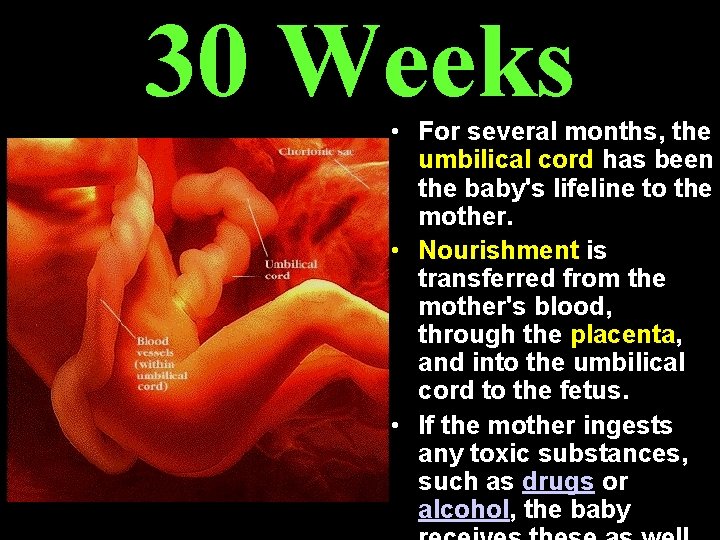
30 Weeks • For several months, the umbilical cord has been the baby's lifeline to the mother. • Nourishment is transferred from the mother's blood, through the placenta, and into the umbilical cord to the fetus. • If the mother ingests any toxic substances, such as drugs or alcohol, the baby
32 Weeks • The fetus sleeps 90 -95% of the day, and sometimes experiences REM sleep, an indication of dreaming
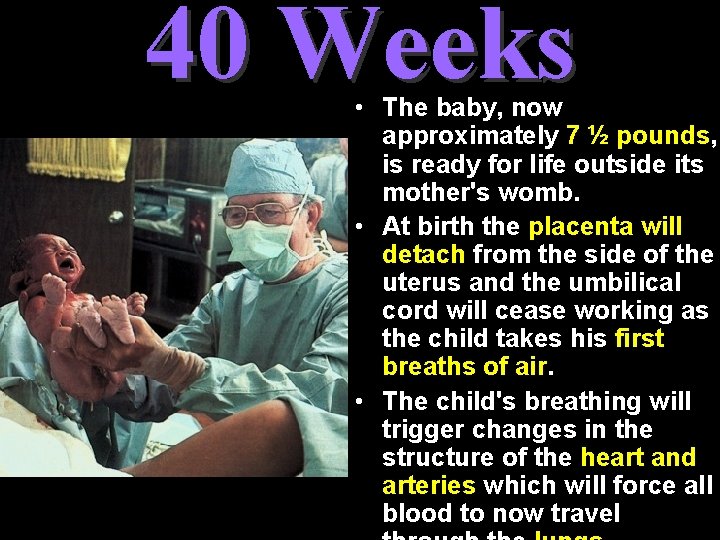
40 Weeks • The baby, now approximately 7 ½ pounds, is ready for life outside its mother's womb. • At birth the placenta will detach from the side of the uterus and the umbilical cord will cease working as the child takes his first breaths of air. • The child's breathing will trigger changes in the structure of the heart and arteries which will force all blood to now travel
Abby and Brittany Conjoined Twins https: //www. youtube. com/watch? v=K 57 Ic. N 9 DWXo