
Male Reproductive System Lecture Objectives Describe the peritoneal
Male Reproductive System
Lecture Objectives • Describe the peritoneal foldings on the pelvic viscera in the male. • Describe the male genital organs. • Describe the relationship, blood supply, innervation, and lymph drainage of all the above.
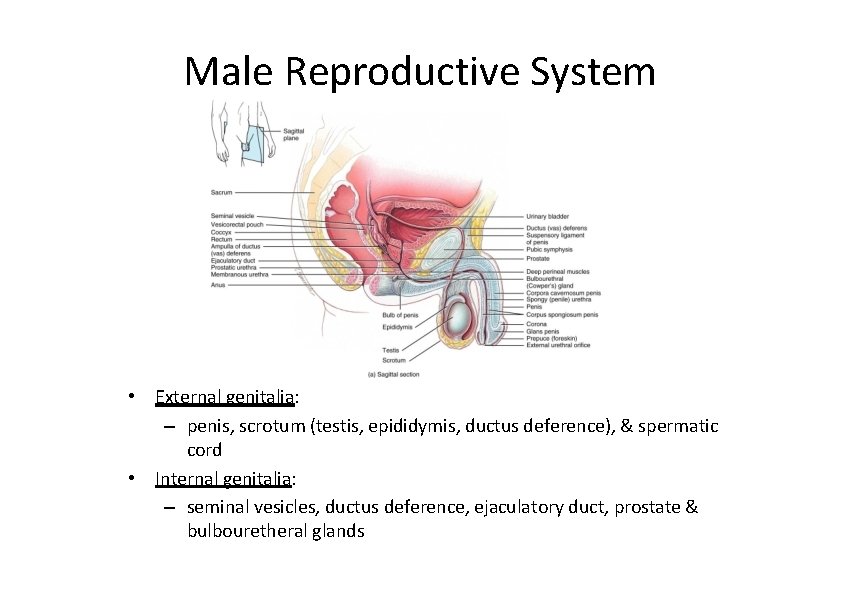
Male Reproductive System • External genitalia: – penis, scrotum (testis, epididymis, ductus deference), & spermatic cord • Internal genitalia: – seminal vesicles, ductus deference, ejaculatory duct, prostate & bulbouretheral glands
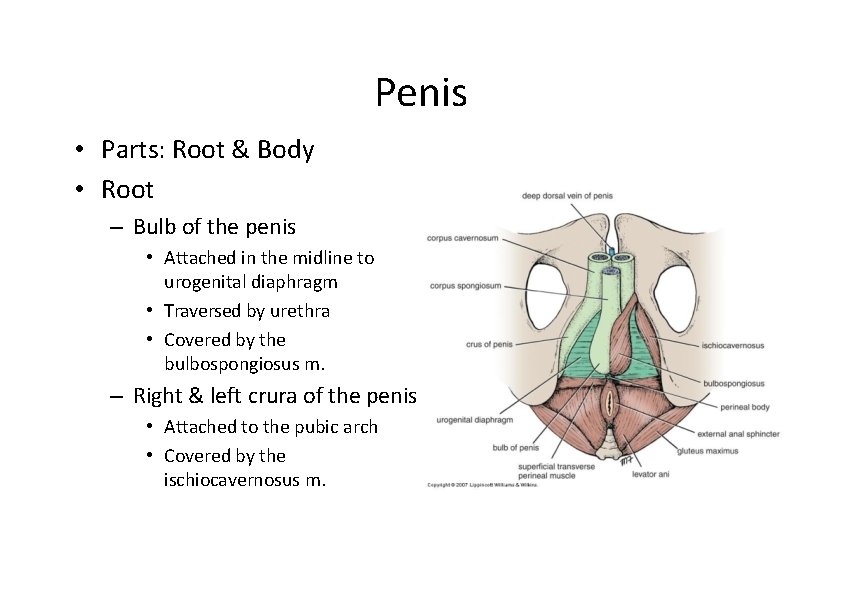
Penis • Parts: Root & Body • Root – Bulb of the penis • Attached in the midline to urogenital diaphragm • Traversed by urethra • Covered by the bulbospongiosus m. – Right & left crura of the penis • Attached to the pubic arch • Covered by the ischiocavernosus m.
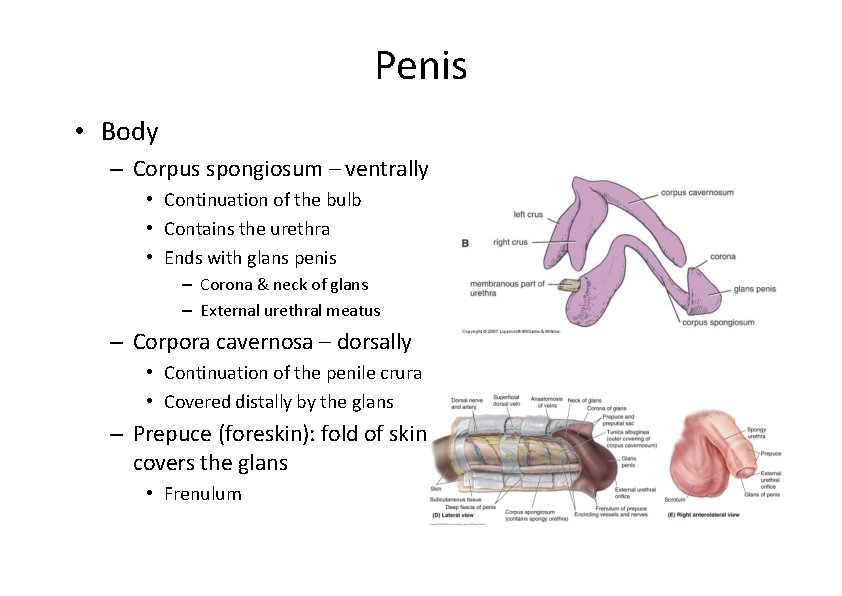
Penis • Body – Corpus spongiosum – ventrally • Continuation of the bulb • Contains the urethra • Ends with glans penis – Corona & neck of glans – External urethral meatus – Corpora cavernosa – dorsally • Continuation of the penile crura • Covered distally by the glans – Prepuce (foreskin): fold of skin covers the glans • Frenulum
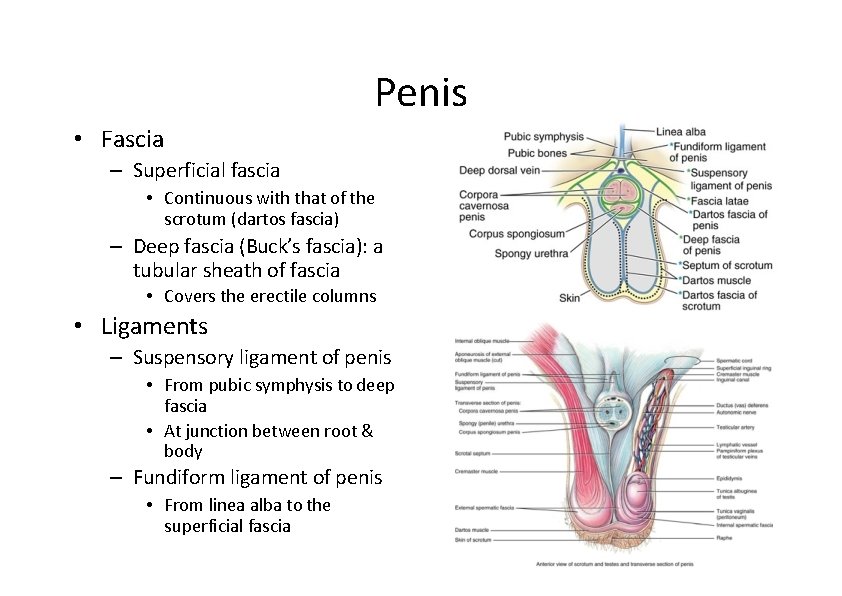
Penis • Fascia – Superficial fascia • Continuous with that of the scrotum (dartos fascia) – Deep fascia (Buck’s fascia): a tubular sheath of fascia • Covers the erectile columns • Ligaments – Suspensory ligament of penis • From pubic symphysis to deep fascia • At junction between root & body – Fundiform ligament of penis • From linea alba to the superficial fascia
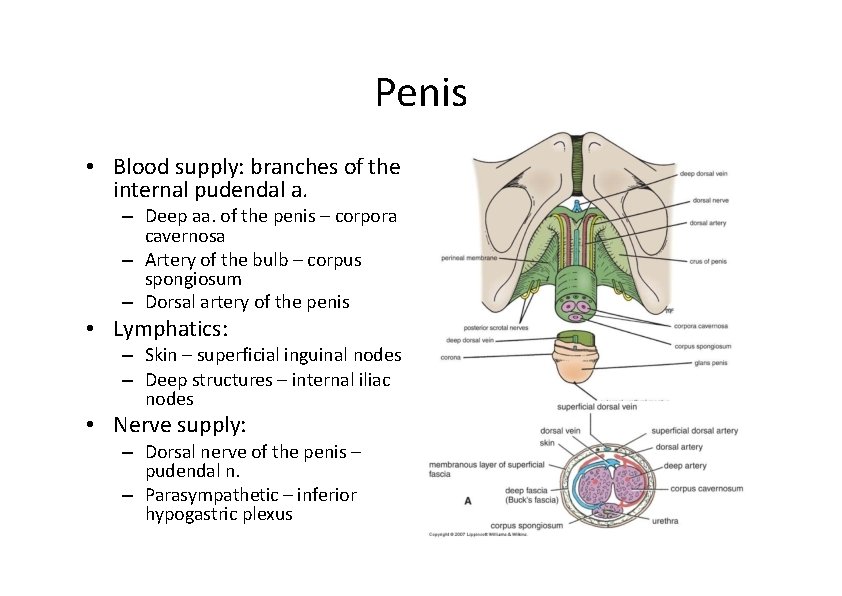
Penis • Blood supply: branches of the internal pudendal a. – Deep aa. of the penis – corpora cavernosa – Artery of the bulb – corpus spongiosum – Dorsal artery of the penis • Lymphatics: – Skin – superficial inguinal nodes – Deep structures – internal iliac nodes • Nerve supply: – Dorsal nerve of the penis – pudendal n. – Parasympathetic – inferior hypogastric plexus
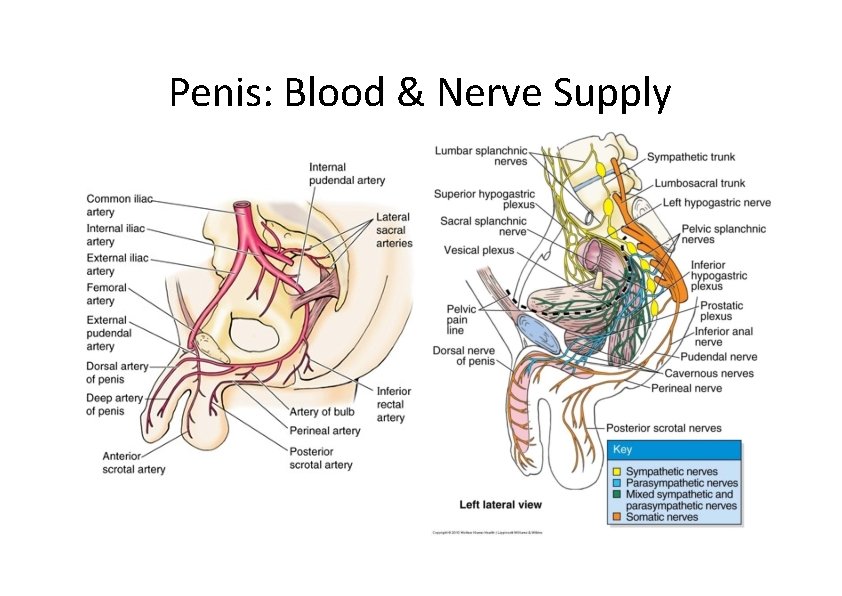
Penis: Blood & Nerve Supply
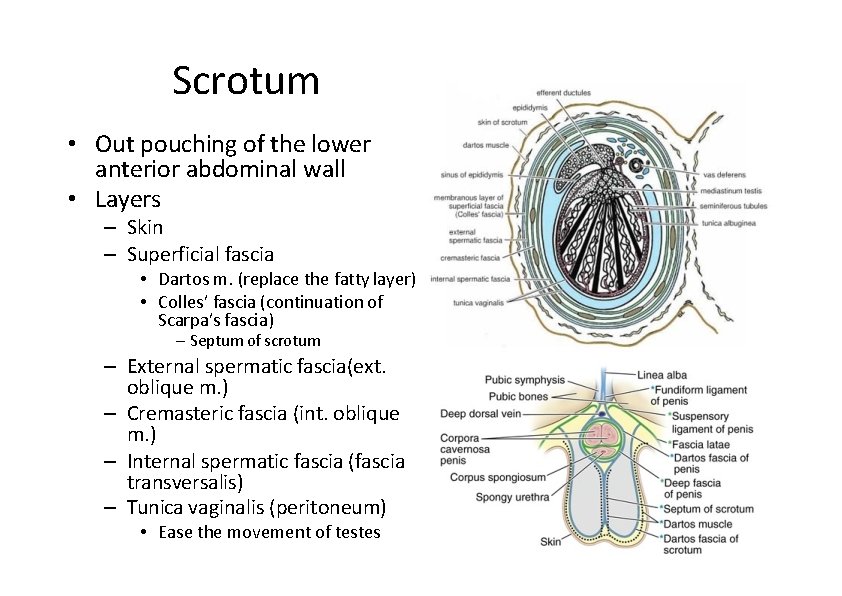
Scrotum • Out pouching of the lower anterior abdominal wall • Layers – Skin – Superficial fascia • Dartos m. (replace the fatty layer) • Colles’ fascia (continuation of Scarpa’s fascia) – Septum of scrotum – External spermatic fascia(ext. oblique m. ) – Cremasteric fascia (int. oblique m. ) – Internal spermatic fascia (fascia transversalis) – Tunica vaginalis (peritoneum) • Ease the movement of testes
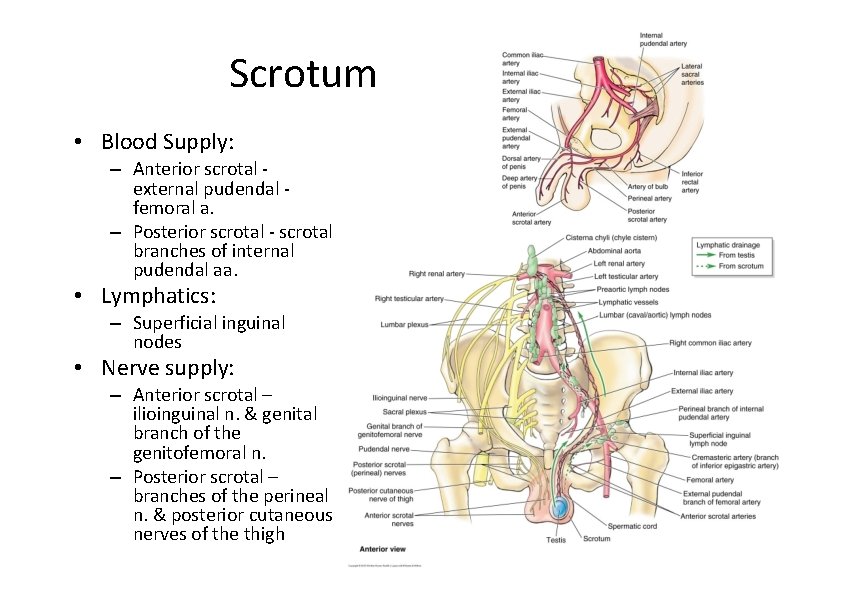
Scrotum • Blood Supply: – Anterior scrotal ‐ external pudendal ‐ femoral a. – Posterior scrotal ‐ scrotal branches of internal pudendal aa. • Lymphatics: – Superficial inguinal nodes • Nerve supply: – Anterior scrotal – ilioinguinal n. & genital branch of the genitofemoral n. – Posterior scrotal – branches of the perineal n. & posterior cutaneous nerves of the thigh
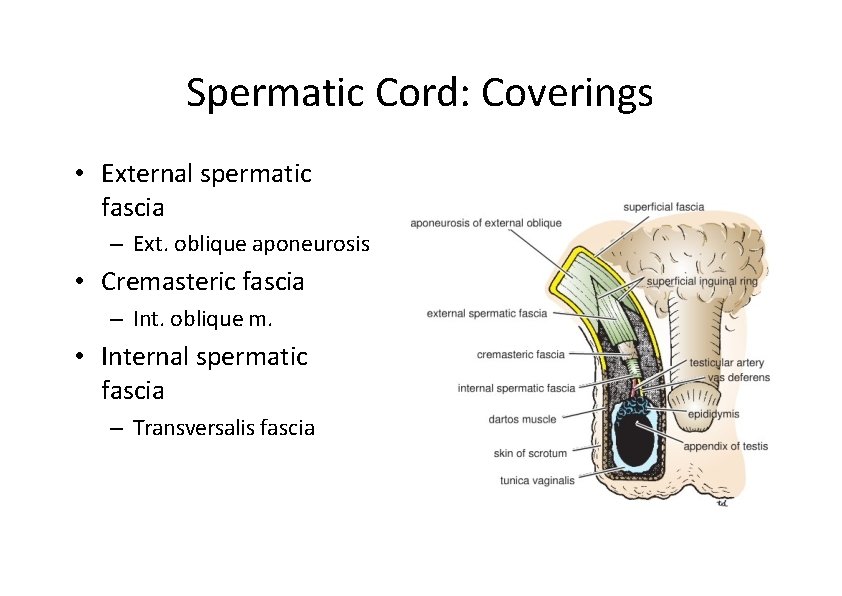
Spermatic Cord: Coverings • External spermatic fascia – Ext. oblique aponeurosis • Cremasteric fascia – Int. oblique m. • Internal spermatic fascia – Transversalis fascia
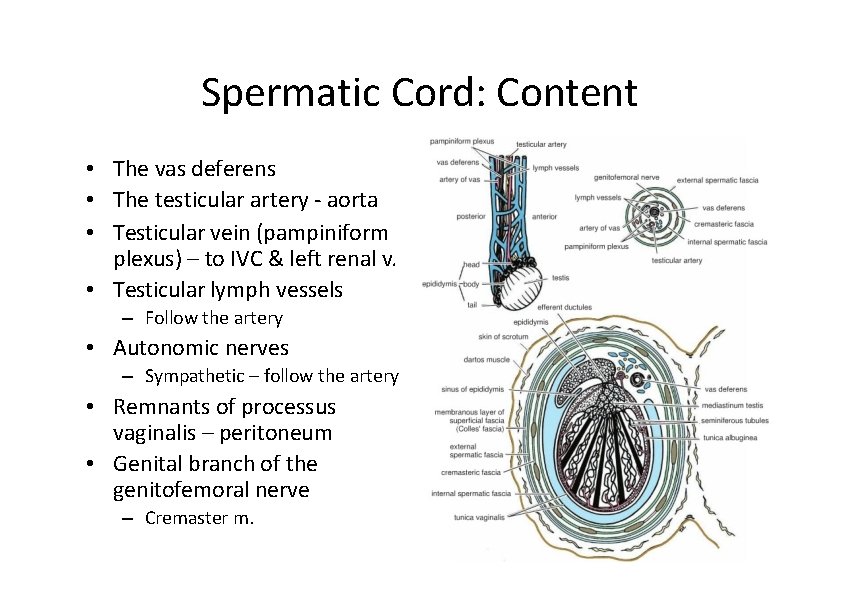
Spermatic Cord: Content • The vas deferens • The testicular artery ‐ aorta • Testicular vein (pampiniform plexus) – to IVC & left renal v. • Testicular lymph vessels – Follow the artery • Autonomic nerves – Sympathetic – follow the artery • Remnants of processus vaginalis – peritoneum • Genital branch of the genitofemoral nerve – Cremaster m.
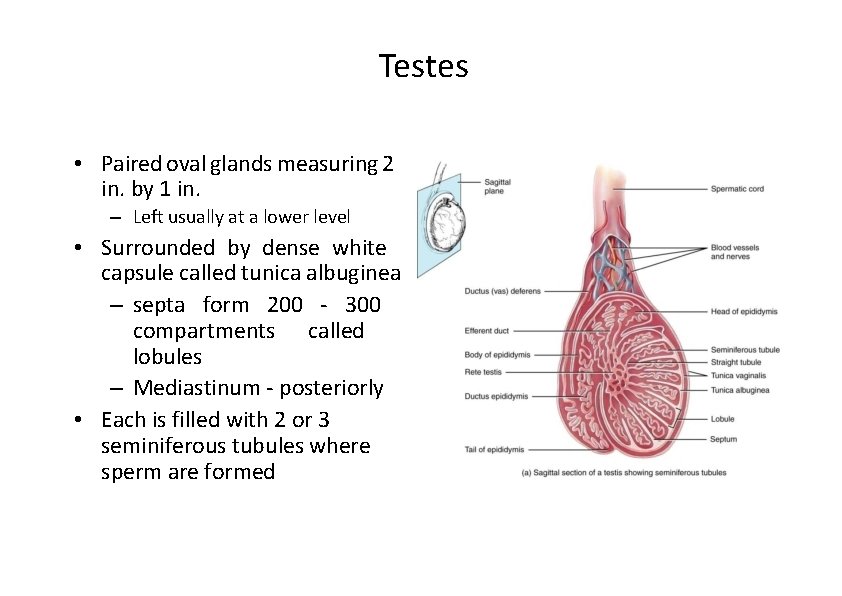
Testes • Paired oval glands measuring 2 in. by 1 in. – Left usually at a lower level • Surrounded by dense white capsule called tunica albuginea – septa form 200 ‐ 300 compartments called lobules – Mediastinum ‐ posteriorly • Each is filled with 2 or 3 seminiferous tubules where sperm are formed
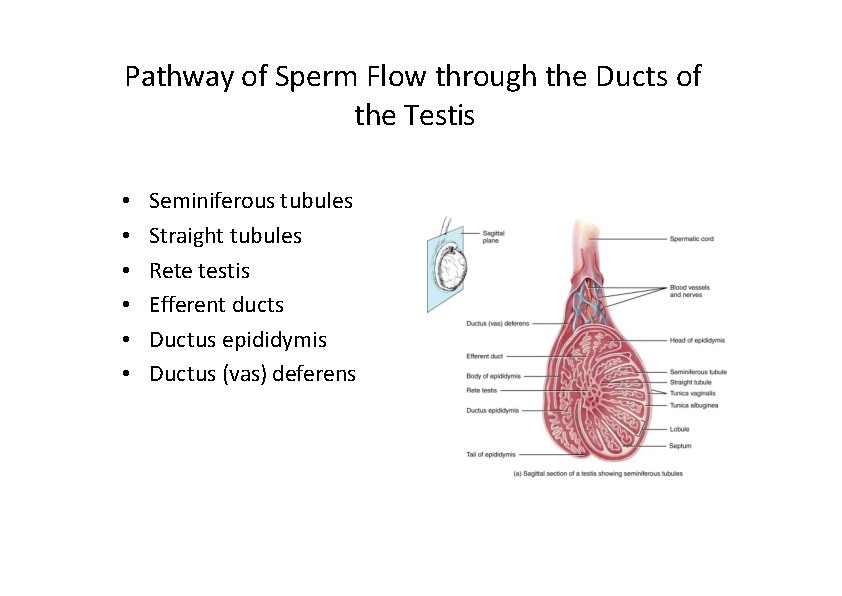
Pathway of Sperm Flow through the Ducts of the Testis • • • Seminiferous tubules Straight tubules Rete testis Efferent ducts Ductus epididymis Ductus (vas) deferens
Temperature Regulation of Testes • Sperm survival requires 3 degrees lower temperature than core body temperature • Mechanisms of regulating temperature – Dartos muscle causes wrinkling of scrotal wall – Cremaster muscle in spermatic cord • Elevates testes on exposure to cold & during arousal • Warmth reverses the process – Countercurrent heat exchange • Pampiniform plexus & the branches of the testicular aa.
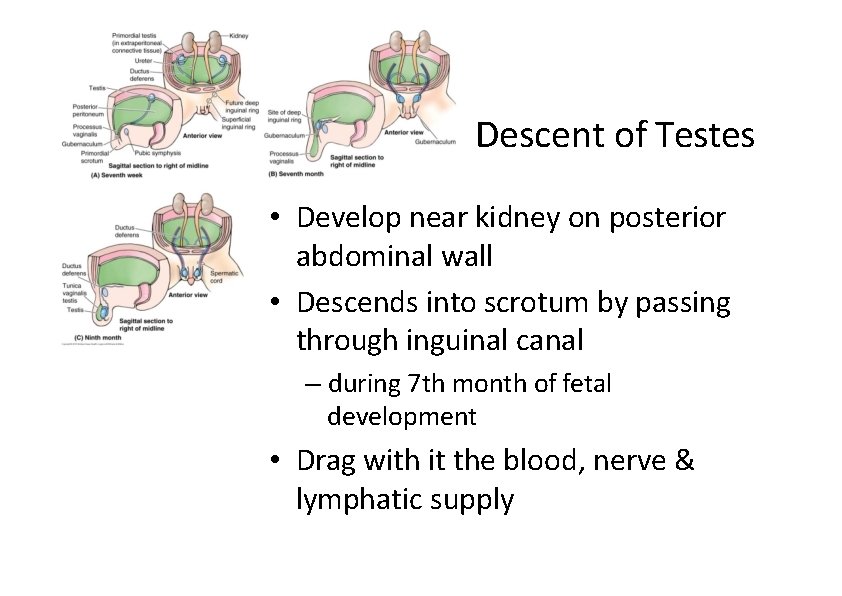
Descent of Testes • Develop near kidney on posterior abdominal wall • Descends into scrotum by passing through inguinal canal – during 7 th month of fetal development • Drag with it the blood, nerve & lymphatic supply
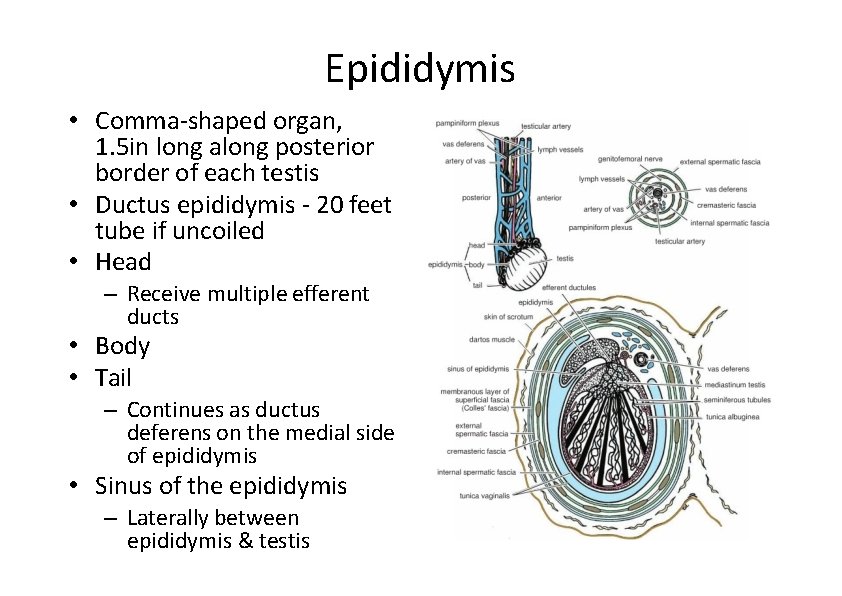
Epididymis • Comma‐shaped organ, 1. 5 in long along posterior border of each testis • Ductus epididymis ‐ 20 feet tube if uncoiled • Head – Receive multiple efferent ducts • Body • Tail – Continues as ductus deferens on the medial side of epididymis • Sinus of the epididymis – Laterally between epididymis & testis
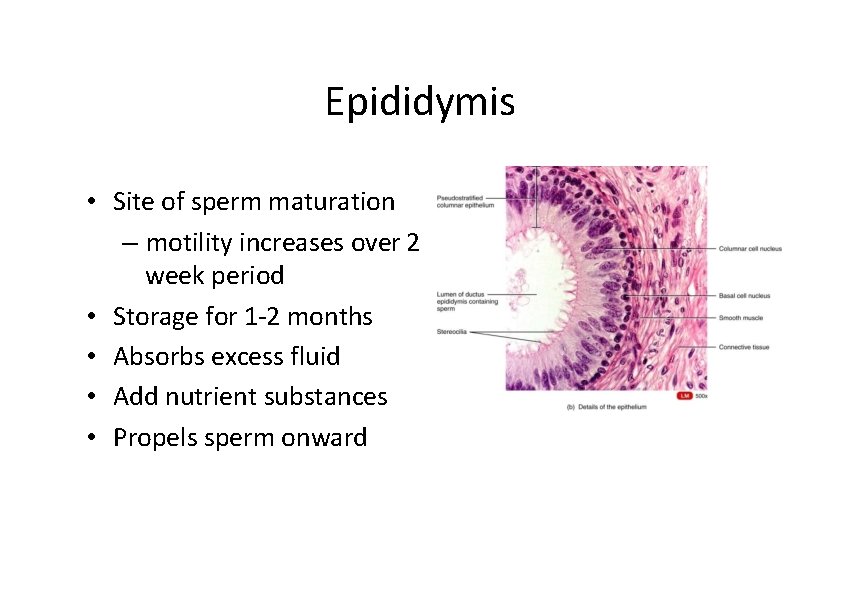
Epididymis • Site of sperm maturation – motility increases over 2 week period • Storage for 1‐ 2 months • Absorbs excess fluid • Add nutrient substances • Propels sperm onward
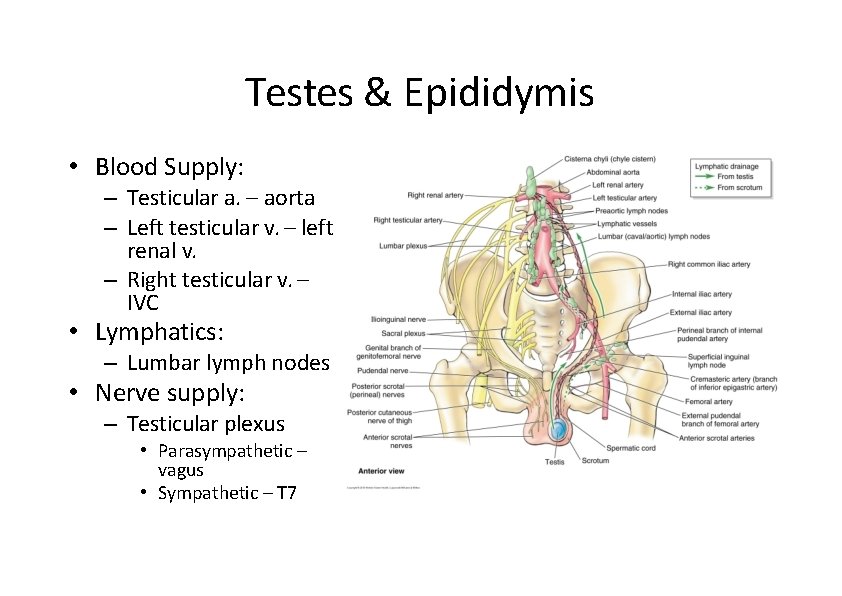
Testes & Epididymis • Blood Supply: – Testicular a. – aorta – Left testicular v. – left renal v. – Right testicular v. – IVC • Lymphatics: – Lumbar lymph nodes • Nerve supply: – Testicular plexus • Parasympathetic – vagus • Sympathetic – T 7
Ductus (Vas) Deferens • Pathway of 18 inch muscular tube – ascends along medial side of epididymis – passes up through spermatic cord and inguinal ligament – reaches posterior surface of urinary bladder – empties into prostatic urethra with seminal vesicle • Lined with pseudostratified columnar epithelium & covered with heavy coating of muscle – convey sperm along through peristaltic contractions – stored sperm remain viable for several months • Blood supply: – Branches from the vesicle arteries – Veins drain into the testicular or prostatic veins
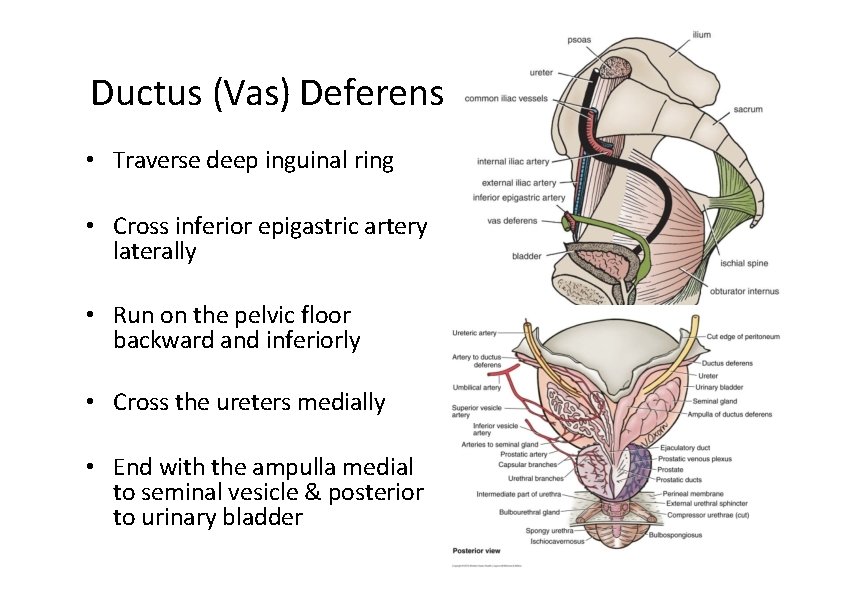
Ductus (Vas) Deferens • Traverse deep inguinal ring • Cross inferior epigastric artery laterally • Run on the pelvic floor backward and inferiorly • Cross the ureters medially • End with the ampulla medial to seminal vesicle & posterior to urinary bladder
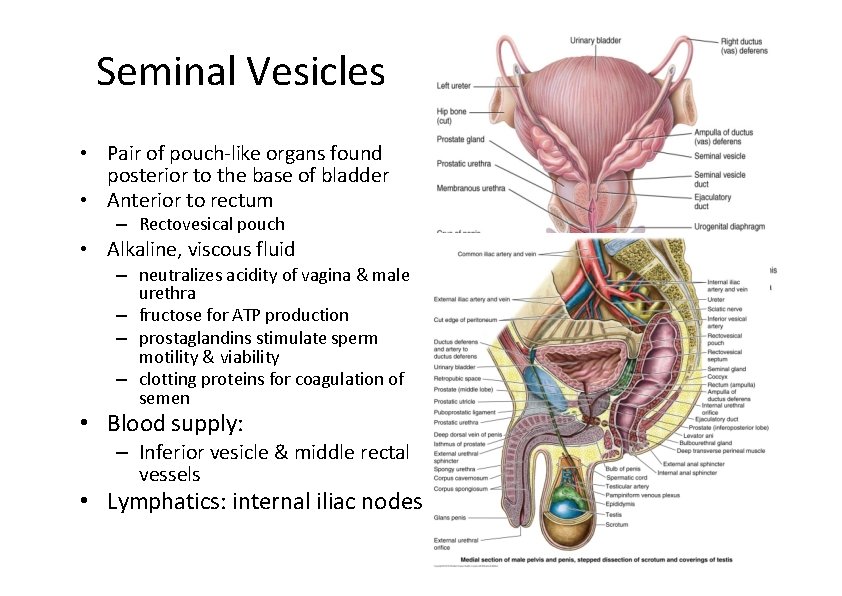
Seminal Vesicles • Pair of pouch‐like organs found posterior to the base of bladder • Anterior to rectum – Rectovesical pouch • Alkaline, viscous fluid – neutralizes acidity of vagina & male urethra – fructose for ATP production – prostaglandins stimulate sperm motility & viability – clotting proteins for coagulation of semen • Blood supply: – Inferior vesicle & middle rectal vessels • Lymphatics: internal iliac nodes Posterior View
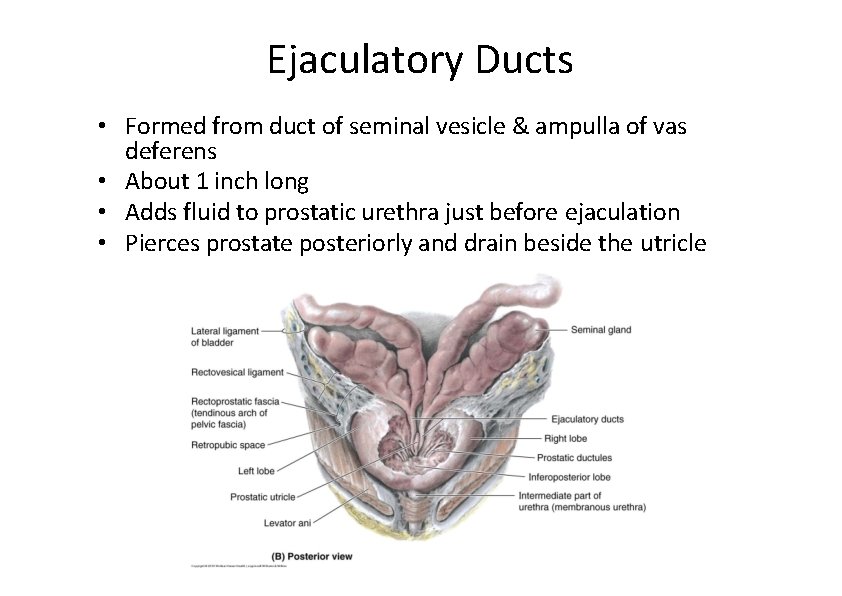
Ejaculatory Ducts • Formed from duct of seminal vesicle & ampulla of vas deferens • About 1 inch long • Adds fluid to prostatic urethra just before ejaculation • Pierces prostate posteriorly and drain beside the utricle
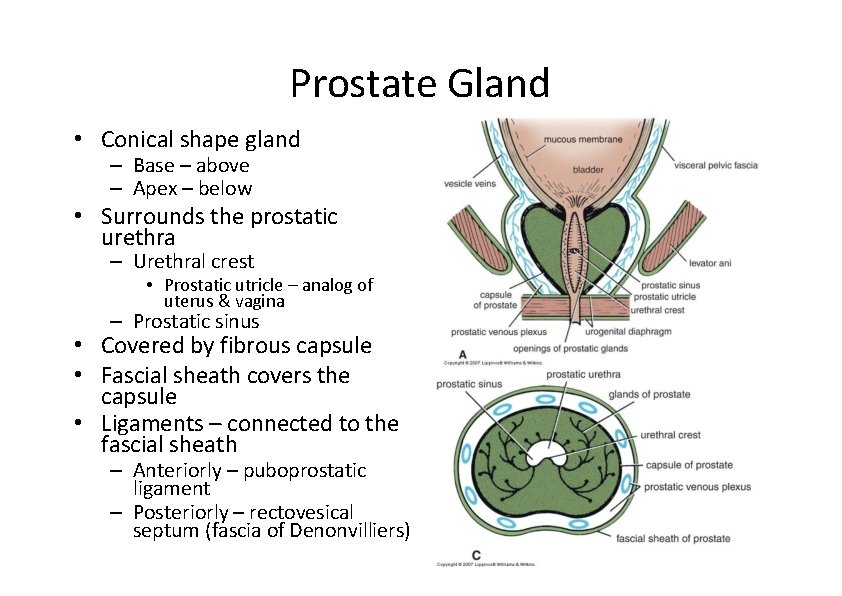
Prostate Gland • Conical shape gland – Base – above – Apex – below • Surrounds the prostatic urethra – Urethral crest • Prostatic utricle – analog of uterus & vagina – Prostatic sinus • Covered by fibrous capsule • Fascial sheath covers the capsule • Ligaments – connected to the fascial sheath – Anteriorly – puboprostatic ligament – Posteriorly – rectovesical septum (fascia of Denonvilliers)
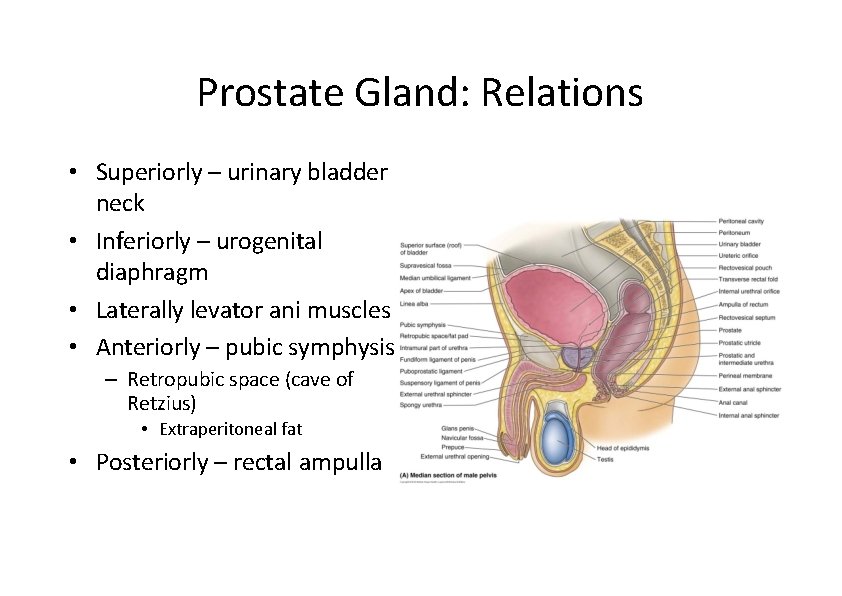
Prostate Gland: Relations • Superiorly – urinary bladder neck • Inferiorly – urogenital diaphragm • Laterally levator ani muscles • Anteriorly – pubic symphysis – Retropubic space (cave of Retzius) • Extraperitoneal fat • Posteriorly – rectal ampulla
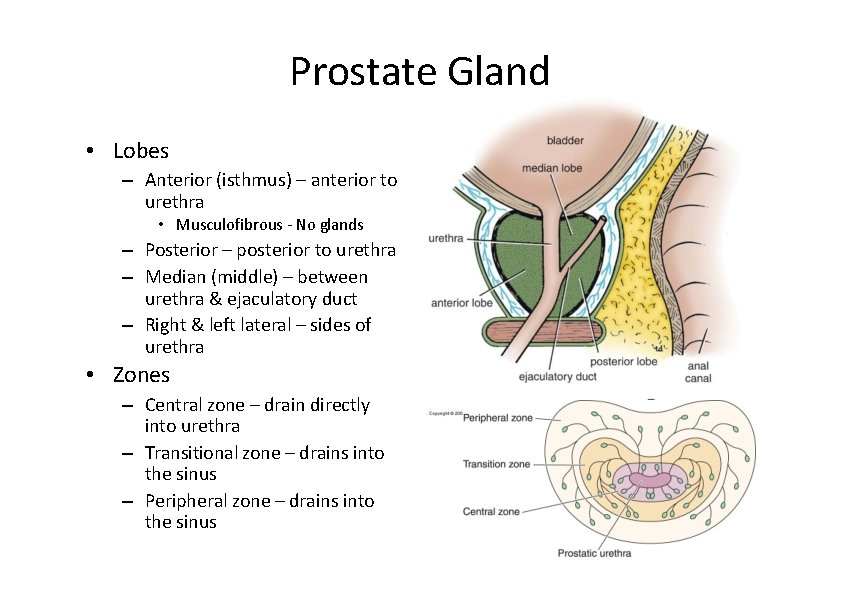
Prostate Gland • Lobes – Anterior (isthmus) – anterior to urethra • Musculofibrous ‐ No glands – Posterior – posterior to urethra – Median (middle) – between urethra & ejaculatory duct – Right & left lateral – sides of urethra • Zones – Central zone – drain directly into urethra – Transitional zone – drains into the sinus – Peripheral zone – drains into the sinus
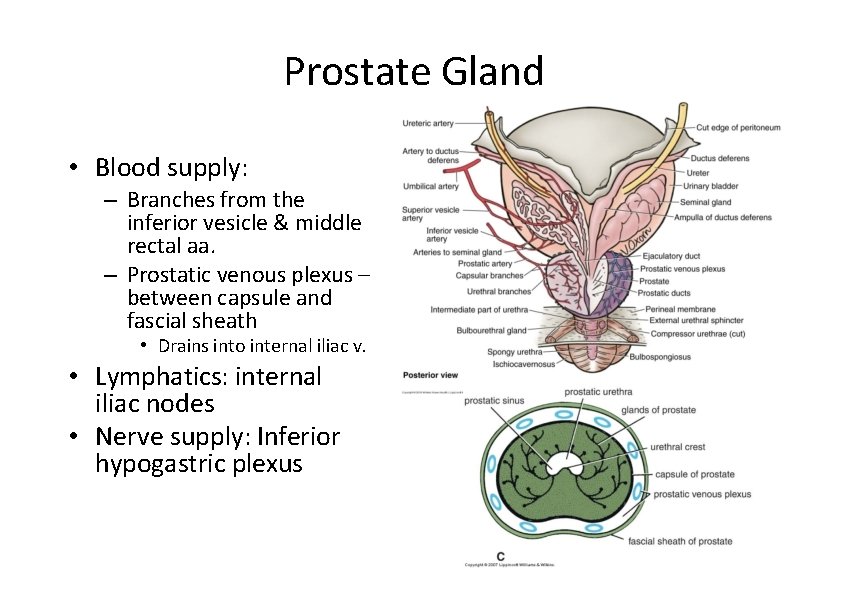
Prostate Gland • Blood supply: – Branches from the inferior vesicle & middle rectal aa. – Prostatic venous plexus – between capsule and fascial sheath • Drains into internal iliac v. • Lymphatics: internal iliac nodes • Nerve supply: Inferior hypogastric plexus
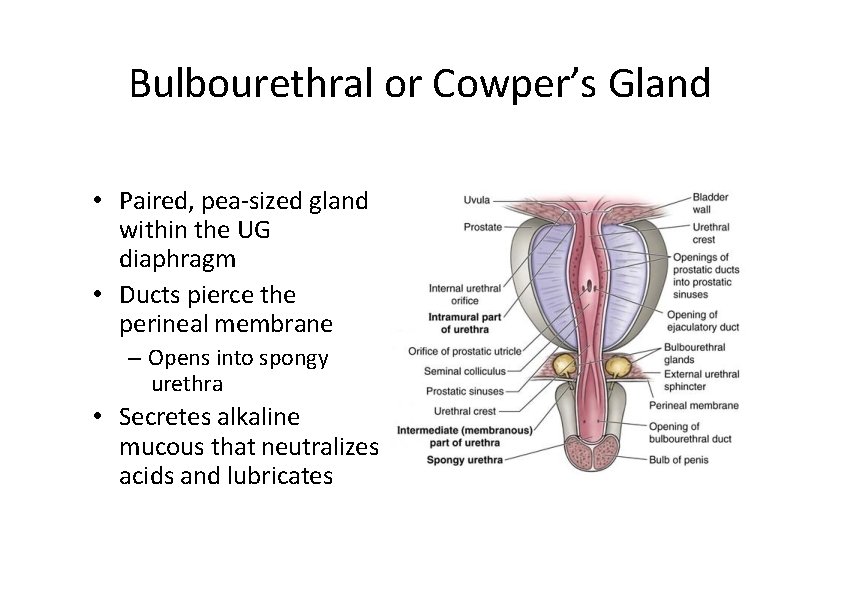
Bulbourethral or Cowper’s Gland • Paired, pea‐sized gland within the UG diaphragm • Ducts pierce the perineal membrane – Opens into spongy urethra • Secretes alkaline mucous that neutralizes acids and lubricates
Semen • Mixture of sperm & seminal fluid – glandular secretions and fluid of seminiferous tubules – slightly alkaline, milky appearance, sticky – contains nutrients, clotting proteins & antibiotic seminal plasmin • Typical ejaculate is 2. 5 to 5 ml in volume • Normal sperm count is 50 to 150 million/ml – actions of many are needed for one to enter • Coagulates within 5 minutes ‐‐ reliquefies in 15 due to enzymes produced by the prostate gland • Semen analysis‐‐‐‐bad news if show lack of forward motility, low count or abnormal shapes
Erection & Ejaculation • Erection – sexual stimulation dilates the arteries supplying the penis – blood enters the penis compressing the veins so that the blood is trapped. – parasympathetic reflex causes erection • Ejaculation – muscle contractions close sphincter at base of bladder and move fluids through ductus deferens, seminal vesicles, & ejaculatory ducts – ischiocavernousus & bulbospongiosus complete the job
- Slides: 30