
MALE EXTERNAL GENITAL ORGANS DR DEEPANSHU SHUKLA INTRODUCTION

- Slides: 45
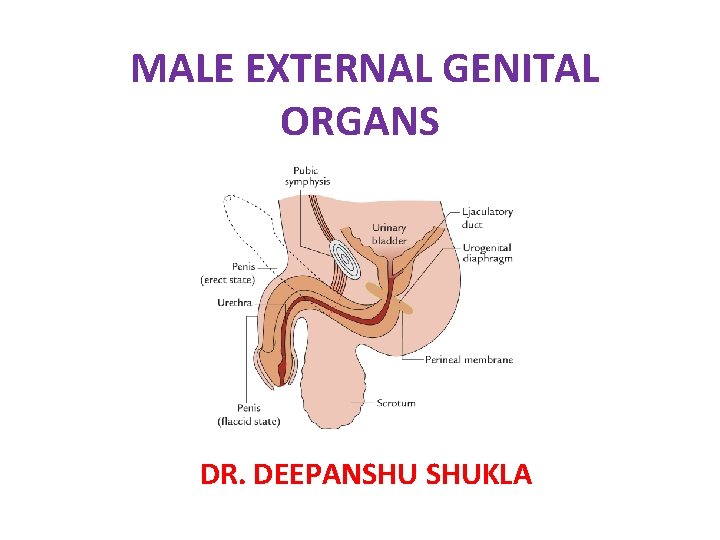
MALE EXTERNAL GENITAL ORGANS DR. DEEPANSHU SHUKLA
INTRODUCTION • The male genital organs are classified into two types— external and internal. • From surgical and clinical point of view, the male external genital organs include the following structures: 1. Penis. 2. Scrotum. 3. Testes. 4. Epididymis. 5. Spermatic cords.
PENIS • The penis is the male organ of copulation and is traversed by the urethra, which provides passage for both urine and semen. • PARTS= 1. Root or radix, an attached portion. 2. Body or corpus, a free pendulous portion.
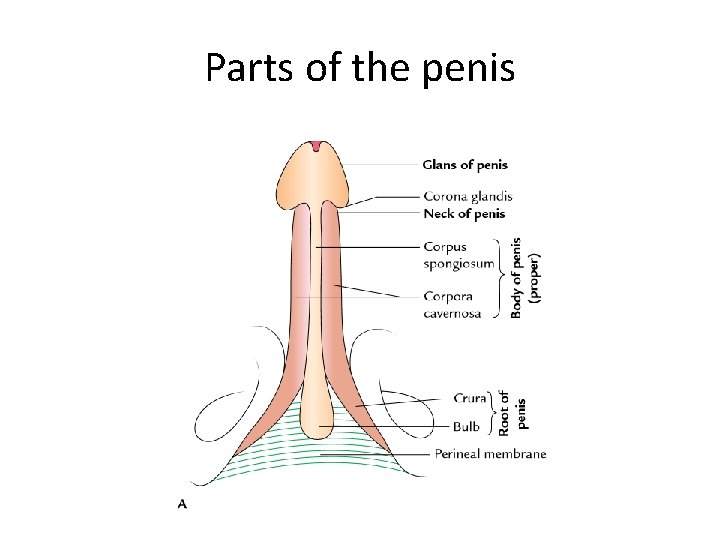
Parts of the penis
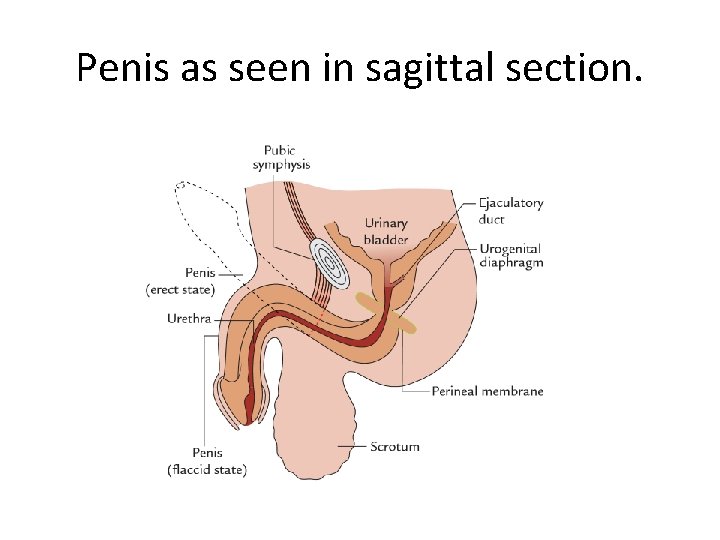
Penis as seen in sagittal section.
Root (Radix) • The root of the penis is situated in the superficial perineal pouch and is attached to the inferior aspect of the urogenital diaphragm. • It comprises three masses of erectile tissue, viz. two crura (right and left) and the bulb of the penis.
Body (Corpus) • The body of the penis is the free pendulous portion and lies in front of scrotum. • It becomes continuous with the root of the penis. • For convenience of study and proper understanding the body of penis is further divided into three parts: 1. body proper, 2. neck, and 3. glans penis
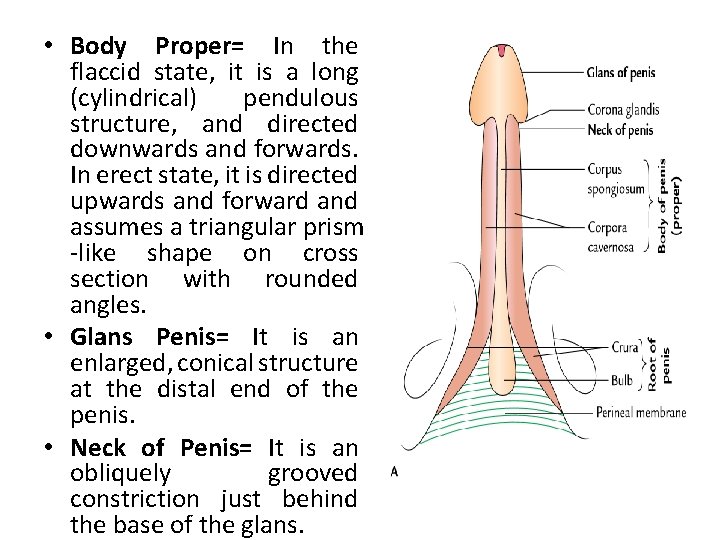
• Body Proper= In the flaccid state, it is a long (cylindrical) pendulous structure, and directed downwards and forwards. In erect state, it is directed upwards and forward and assumes a triangular prism -like shape on cross section with rounded angles. • Glans Penis= It is an enlarged, conical structure at the distal end of the penis. • Neck of Penis= It is an obliquely grooved constriction just behind the base of the glans.
STRUCTURE • It is composed of three elongated masses of erectile tissue, which are capable of considerable enlargement when engorged with blood during an erection. • The three erectile tissue masses include: 1. two corpora cavernosa and 2. one corpus spongiosum
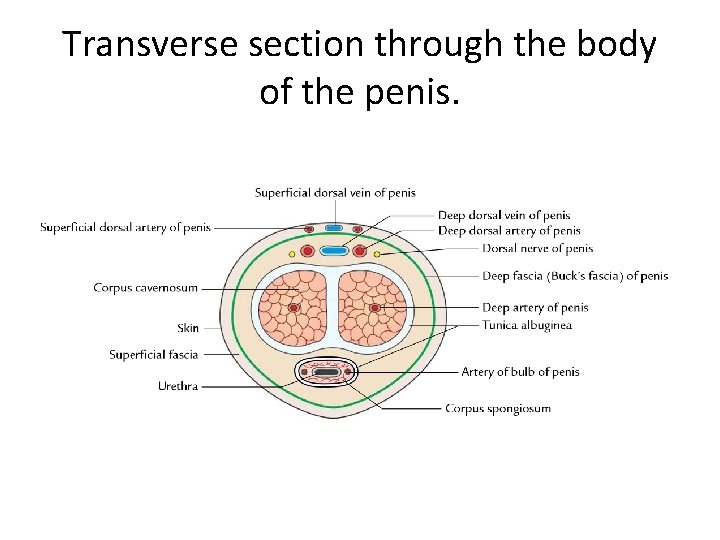
Corpora Cavernosa • The two corpora cavernosa form the greater part of the body of penis. • The two corpora cavernosa, throughout their length, lay in close apposition with one another and are surrounded by a common fibrous envelope called the tunica albuginea.
Transverse section through the body of the penis.
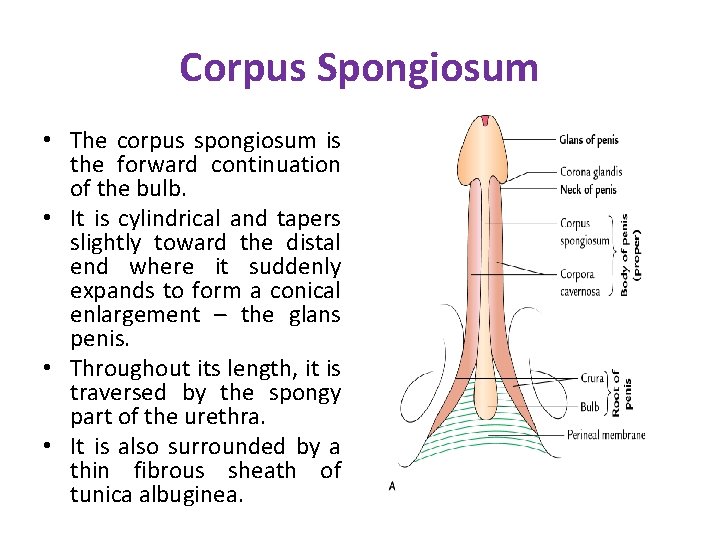
Corpus Spongiosum • The corpus spongiosum is the forward continuation of the bulb. • It is cylindrical and tapers slightly toward the distal end where it suddenly expands to form a conical enlargement – the glans penis. • Throughout its length, it is traversed by the spongy part of the urethra. • It is also surrounded by a thin fibrous sheath of tunica albuginea.
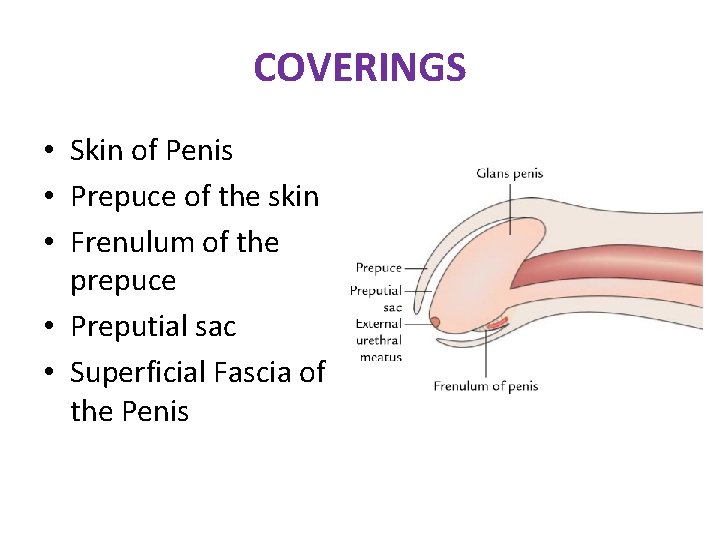
COVERINGS • Skin of Penis • Prepuce of the skin • Frenulum of the prepuce • Preputial sac • Superficial Fascia of the Penis
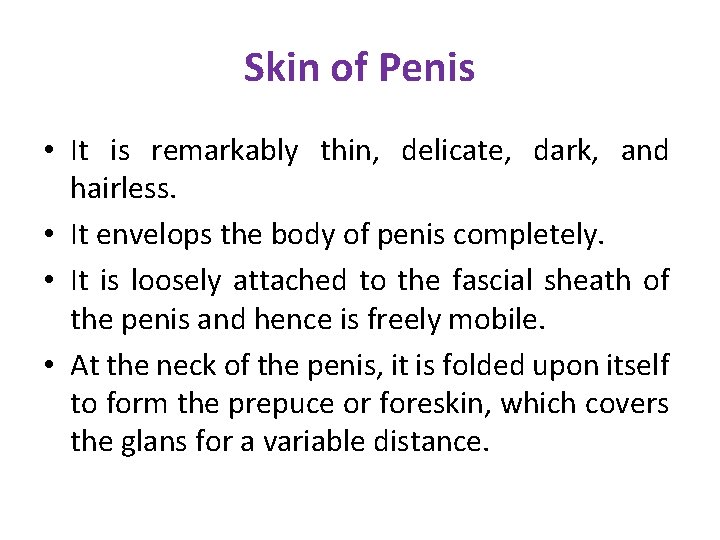
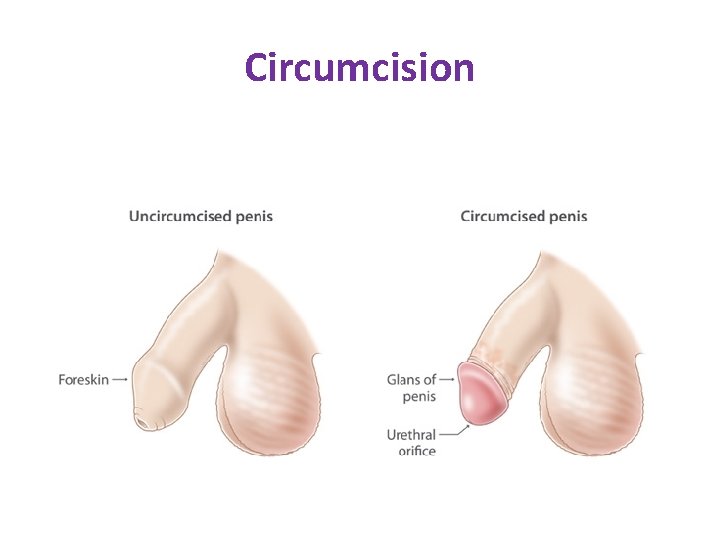
Skin of Penis • It is remarkably thin, delicate, dark, and hairless. • It envelops the body of penis completely. • It is loosely attached to the fascial sheath of the penis and hence is freely mobile. • At the neck of the penis, it is folded upon itself to form the prepuce or foreskin, which covers the glans for a variable distance.
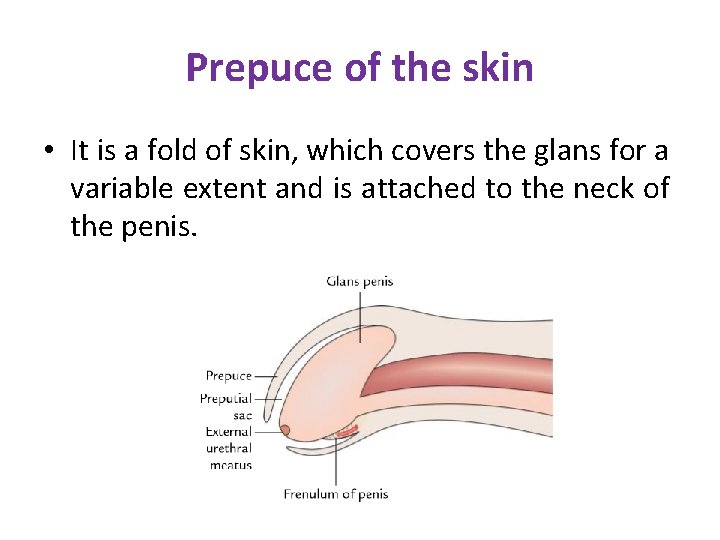
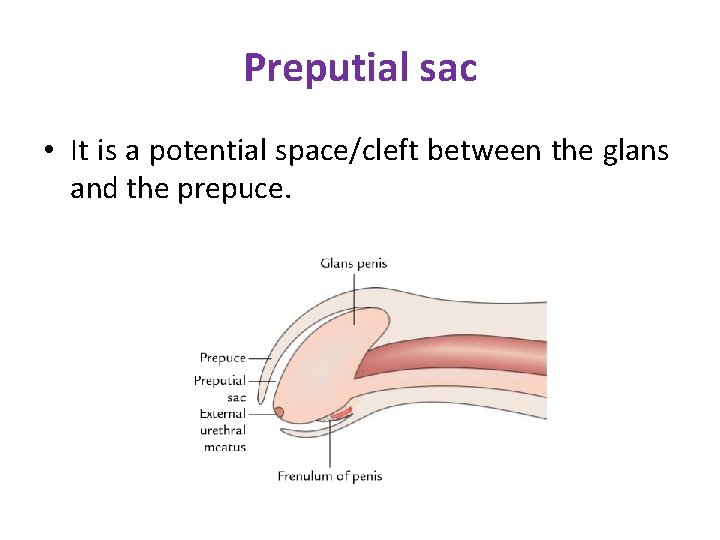
Prepuce of the skin • It is a fold of skin, which covers the glans for a variable extent and is attached to the neck of the penis.
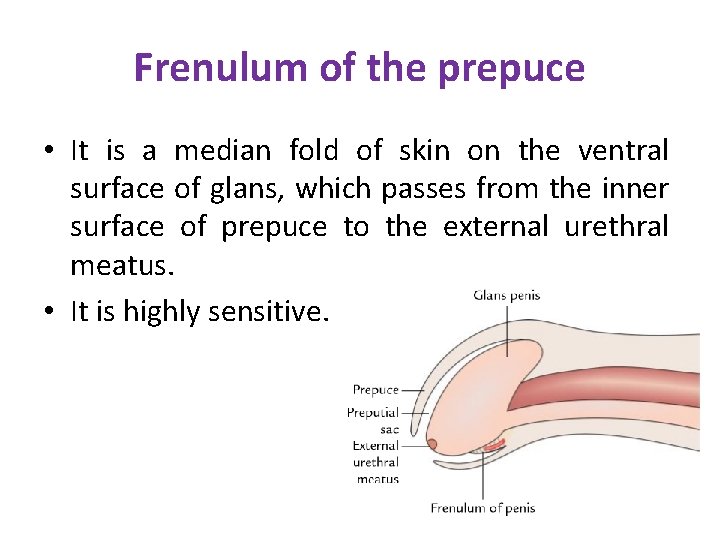
Frenulum of the prepuce • It is a median fold of skin on the ventral surface of glans, which passes from the inner surface of prepuce to the external urethral meatus. • It is highly sensitive.
Preputial sac • It is a potential space/cleft between the glans and the prepuce.
Superficial Fascia of the Penis • It consists of two layers—superficial and deep. • The superficial layer is devoid of fat and consists of loose areolar tissue. • It may contain few muscle fibres—the peripenic muscle. • The deep layer in the lower part of the anterior abdominal wall is condensed and forms the fascia of penis termed deep fascia of the penis or Buck’s fascia. • It surrounds both corpora cavernosa and corpus spongiosum, but does not extend beyond the neck of penis.
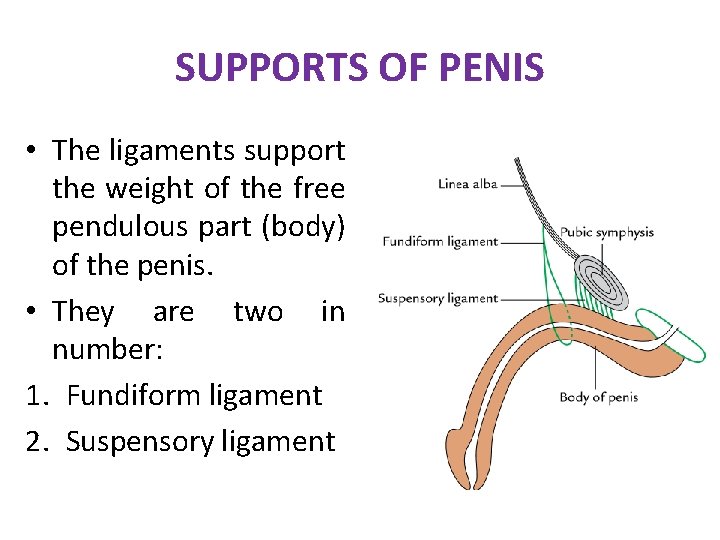
SUPPORTS OF PENIS • The ligaments support the weight of the free pendulous part (body) of the penis. • They are two in number: 1. Fundiform ligament 2. Suspensory ligament
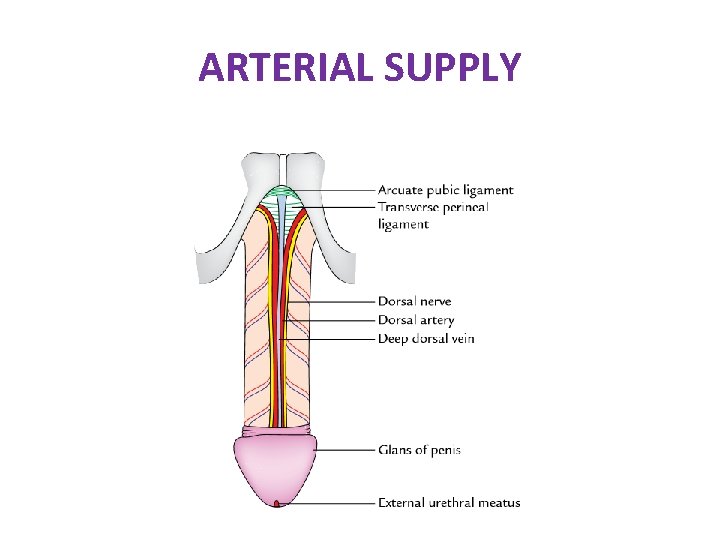
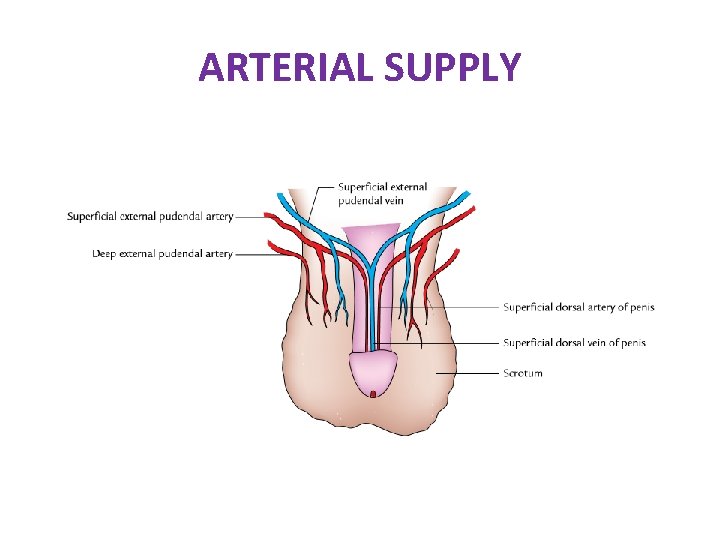
ARTERIAL SUPPLY • The penis is supplied by the following four pairs of arteries: 1. Deep arteries of the penis. 2. Dorsal arteries of the penis. 3. Arteries of the bulb. 4. Superficial dorsal arteries of penis.
ARTERIAL SUPPLY
ARTERIAL SUPPLY
VENOUS DRAINAGE 1. Superficial dorsal vein of the penis. 2. Deep dorsal vein of the penis.
NERVE SUPPLY 1. • • 2. • 3. • • • Sensory innervation: Dorsal nerve of penis. Ilioinguinal nerve. Motor innervation: pudendal nerve. Autonomic innervation: The autonomic nerves of the penis are derived from the pelvic (inferior hypogastric) plexus via the prostatic plexus. The sympathetic nerves are vasoconstrictor while parasympathetic fibres are vasodilator. The parasympathetic fibres (nervi erigentes) are derived from S 2, S 3, and S 4 spinal segments. The autonomic fibres are distributed through the pudendal nerve.
Lymphatic Drainage • Lymphatics from Glans- into deep inguinal nodes also called gland of Cloquet. • Lymphatics from the rest of Penis- into the superficial inguinal lymph nodes.
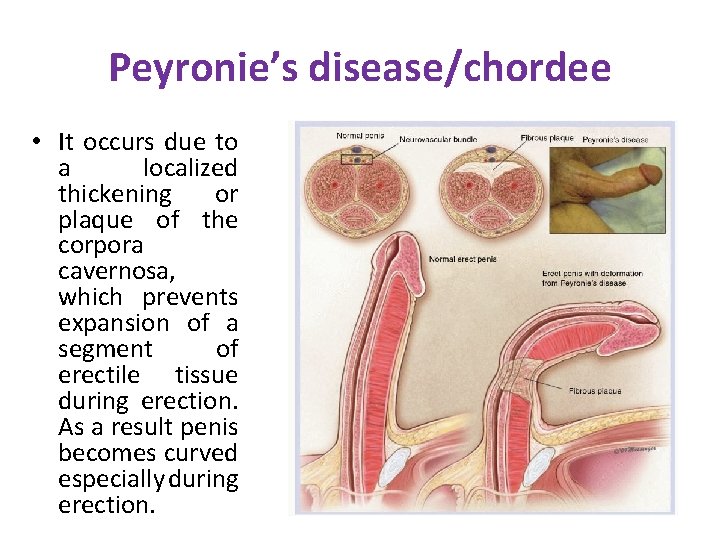
Peyronie’s disease/chordee • It occurs due to a localized thickening or plaque of the corpora cavernosa, which prevents expansion of a segment of erectile tissue during erection. As a result penis becomes curved especially during erection.
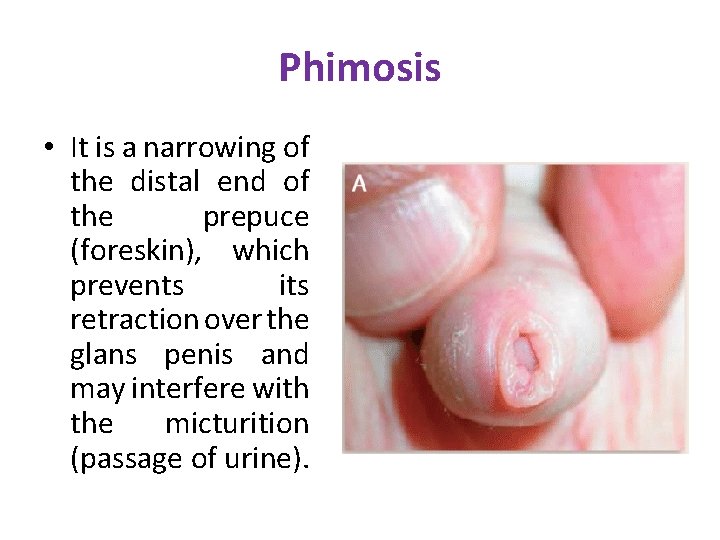
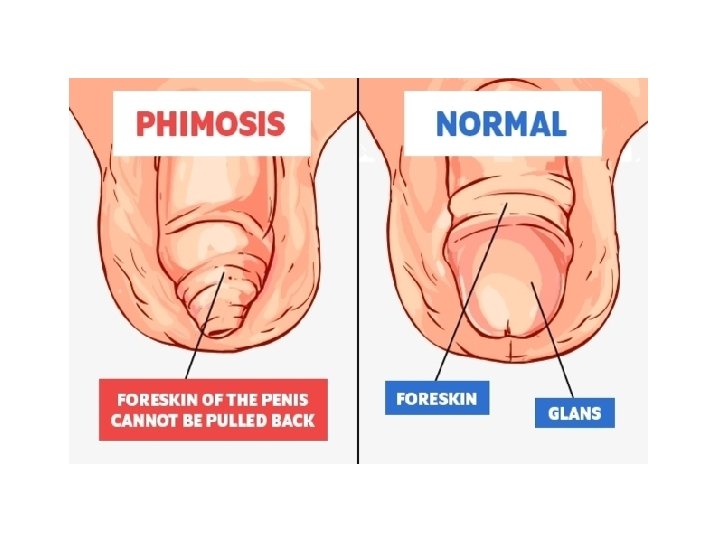
Phimosis • It is a narrowing of the distal end of the prepuce (foreskin), which prevents its retraction over the glans penis and may interfere with the micturition (passage of urine).
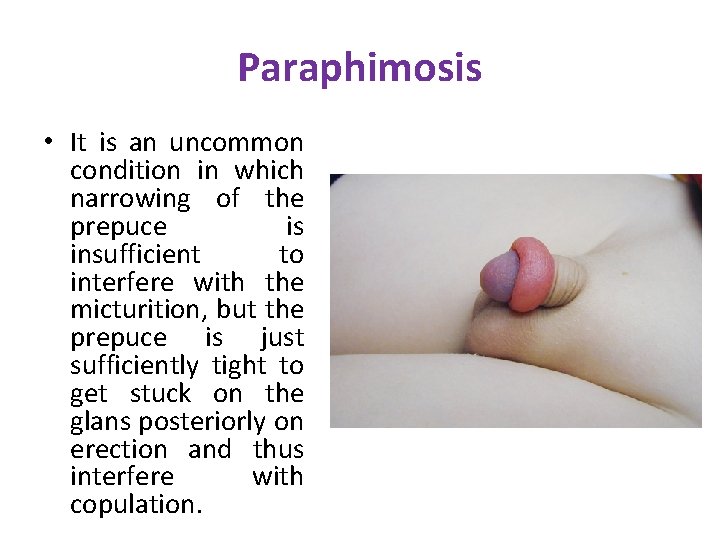
Paraphimosis • It is an uncommon condition in which narrowing of the prepuce is insufficient to interfere with the micturition, but the prepuce is just sufficiently tight to get stuck on the glans posteriorly on erection and thus interfere with copulation.
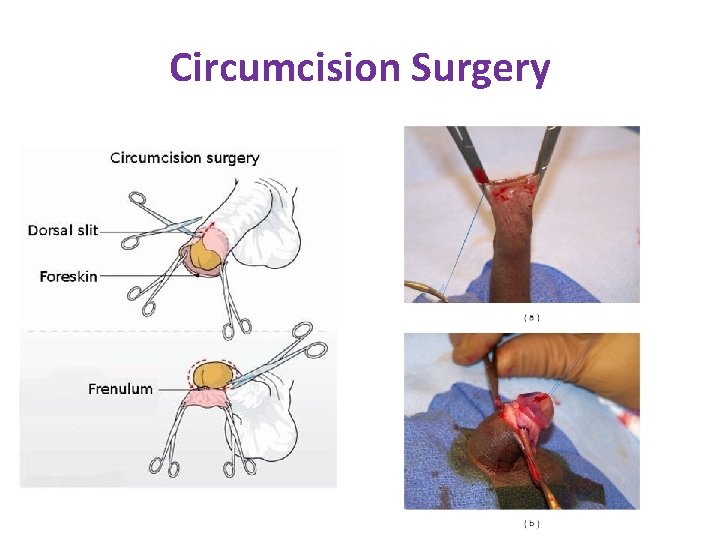
Circumcision • It is the surgical removal of the prepuce (foreskin of the penis). In children and adults, the circumcision is sometimes required to relieve the patient from a tightly constricting prepuce (phimosis). The ritual of circumcision for religious reasons is one of the oldest operative procedures in the world.
Circumcision
Circumcision Surgery
SCROTUM • The scrotum (L. scrotum = bag) is a large pendulous sac of skin located below and behind the penis. • It is considered as an out-pouching of the lower part of the anterior abdominal wall. • It contains the following structures: 1. Testes. 2. Epididymis. 3. Lower parts of the spermatic cords.
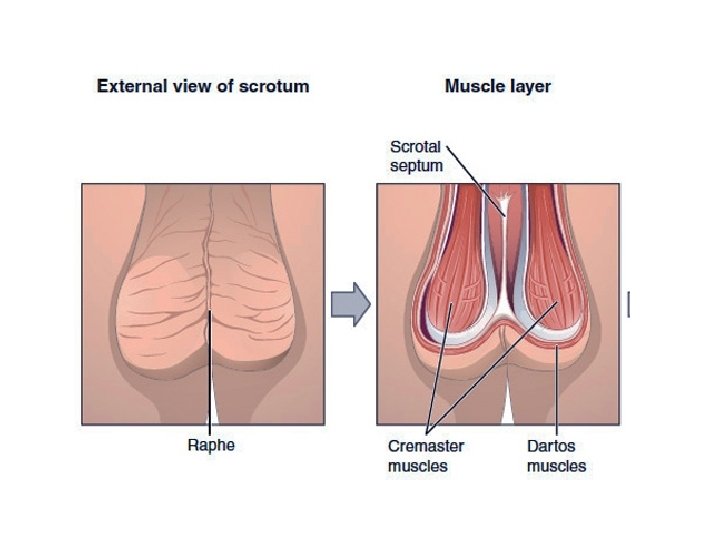
EXTERNAL FEATURES 1. The scrotum is divided into right and left halves by a median ridge or raphe, which indicates the line of fusion of the two halves of the scrotum. This ridge is continued forward in the midline to the undersurface of the penis and backward in the midline of the perineum to the anus. 2. The skin is rugose (corrugated) and dark in colour. The rugosity of the skin occurs due to the presence of subcutaneous dartos muscle. 3. The left half of the scrotum hangs lower than the right half, because the left spermatic cord is longer than the right spermatic cord.
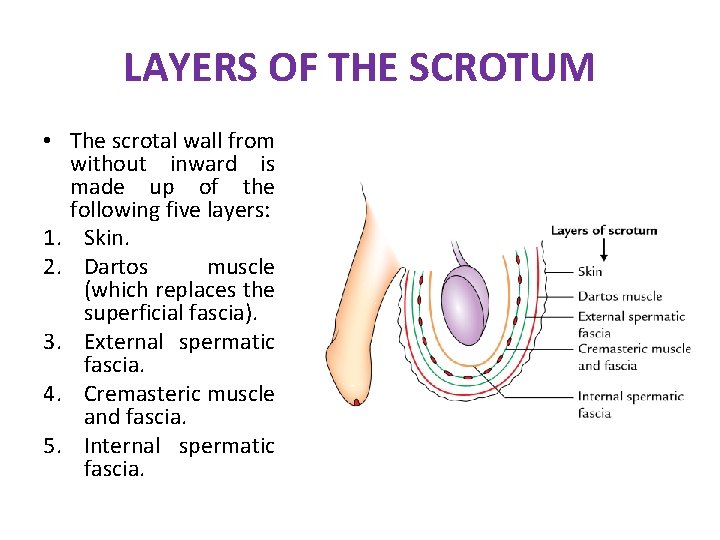
LAYERS OF THE SCROTUM • The scrotal wall from without inward is made up of the following five layers: 1. Skin. 2. Dartos muscle (which replaces the superficial fascia). 3. External spermatic fascia. 4. Cremasteric muscle and fascia. 5. Internal spermatic fascia.
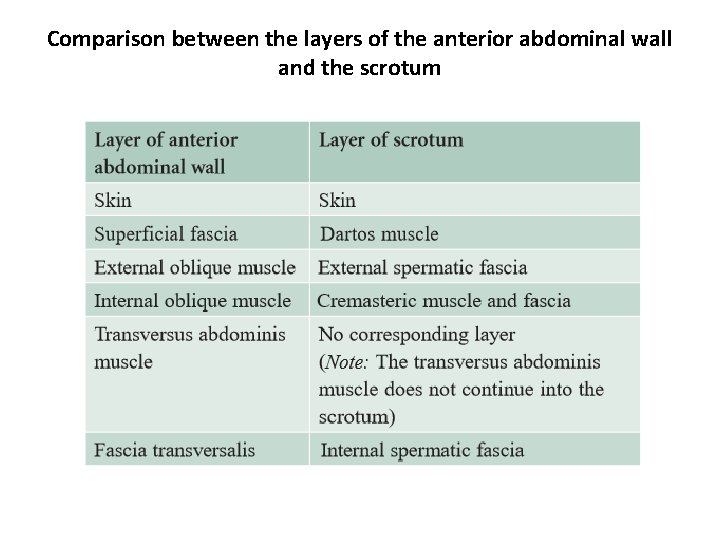
Comparison between the layers of the anterior abdominal wall and the scrotum
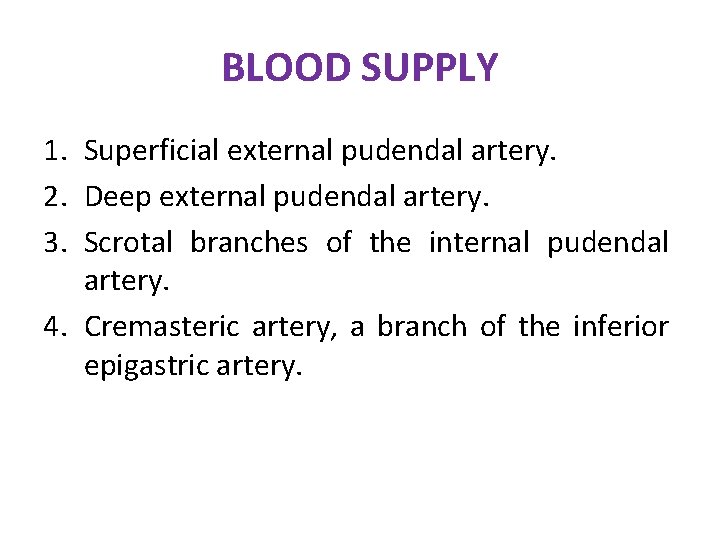
BLOOD SUPPLY 1. Superficial external pudendal artery. 2. Deep external pudendal artery. 3. Scrotal branches of the internal pudendal artery. 4. Cremasteric artery, a branch of the inferior epigastric artery.
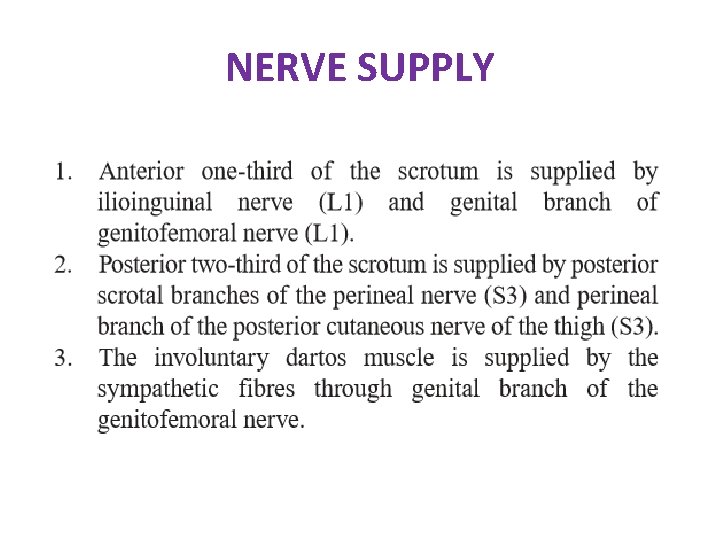
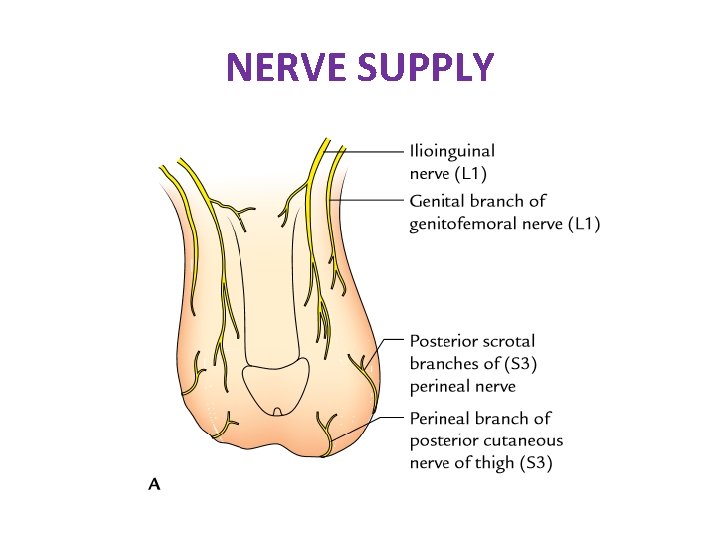
NERVE SUPPLY
NERVE SUPPLY
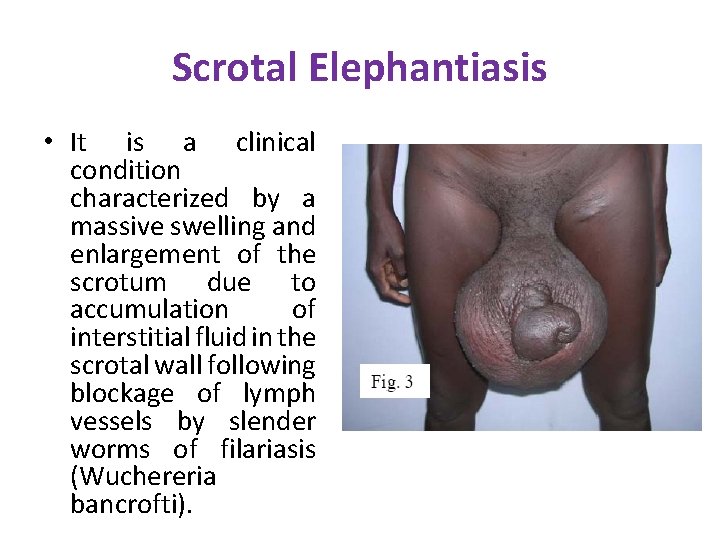
Scrotal Elephantiasis • It is a clinical condition characterized by a massive swelling and enlargement of the scrotum due to accumulation of interstitial fluid in the scrotal wall following blockage of lymph vessels by slender worms of filariasis (Wuchereria bancrofti).
THANK YOU