
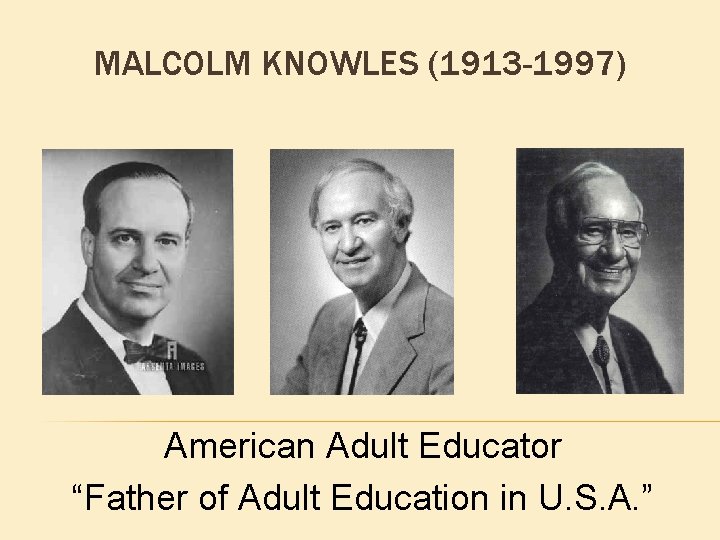
MALCOLM KNOWLES 1913 1997 American Adult Educator Father
- Slides: 31
MALCOLM KNOWLES (1913 -1997) American Adult Educator “Father of Adult Education in U. S. A. ”
KNOWLES: OVERVIEW � Born in Montana (1913) � Attended Harvard on Scholarship (1930 -1934) � Served in Navy (1943 -1946) � Spent 60 Years in the Field of Education � Completed His Education with a Ph. D. in Education � Published 18 Books & Over 230 Articles � Received Many Awards � Died at the age of 84 (1997) � Remembered as “The Father of Adult Education” 2
KNOWLES: EDUCATION � Harvard University: B. A. in Education (1934) � University of Chicago: M. A. in Education (1949) � University of Chicago: Ph. D. in Education (1960) 3
KNOWLES: PROFESSIONAL LIFE State Administrator at NYA (Boston 1934 -1940) � Director of Adult Ed. YMCA (Boston 1940 -1943) � Drafted & Served in Navy (1943 -1946) � Director of Adult Ed. YMCA (Chicago 1946 -1951) � Exec. Director of Adult Ed. Assoc. of USA (19511959) � Assoc. Professor Adult Ed. At Boston Univ. (19591973) � Professor of Adult Ed. At NC State Univ. (1974 -1979) � Professor at Fielding Graduate Univ. (1979 -1991) � Professor at the University of Arkansas (1991 -1997) � Published 18 Books and over 230 Articles � 4
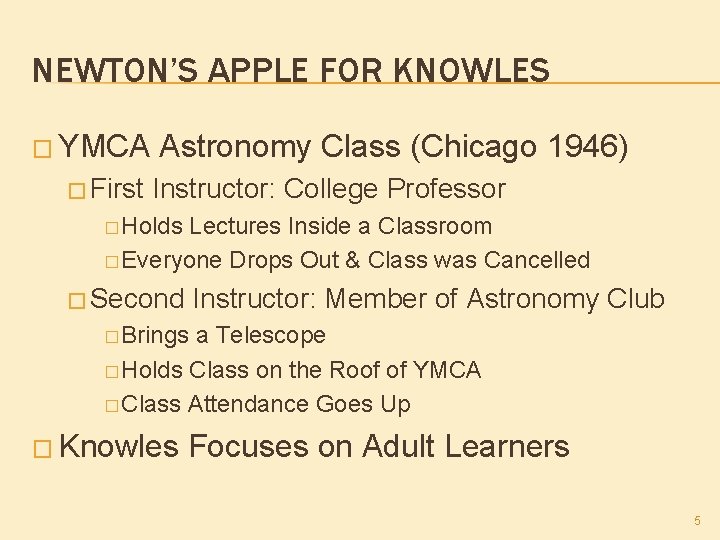
NEWTON’S APPLE FOR KNOWLES � YMCA Astronomy Class (Chicago 1946) � First Instructor: College Professor � Holds Lectures Inside a Classroom � Everyone Drops Out & Class was Cancelled � Second Instructor: Member of Astronomy Club � Brings a Telescope � Holds Class on the Roof of YMCA � Class Attendance Goes Up � Knowles Focuses on Adult Learners 5
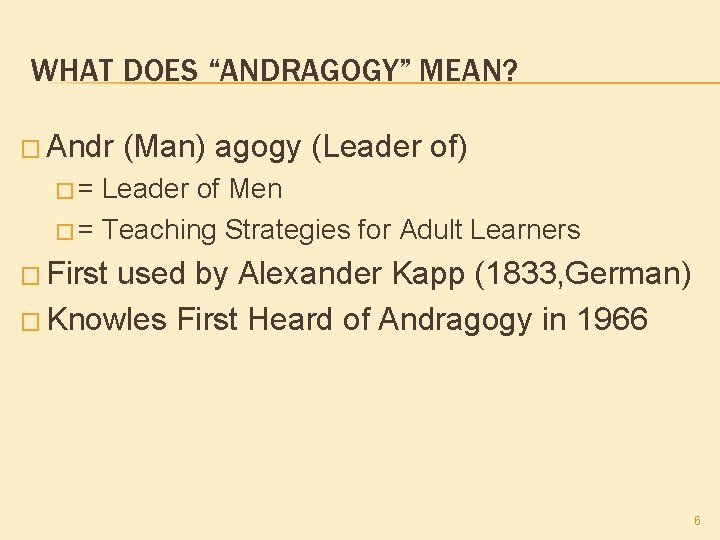
WHAT DOES “ANDRAGOGY” MEAN? � Andr (Man) agogy (Leader of) � = Leader of Men � = Teaching Strategies for Adult Learners � First used by Alexander Kapp (1833, German) � Knowles First Heard of Andragogy in 1966 6
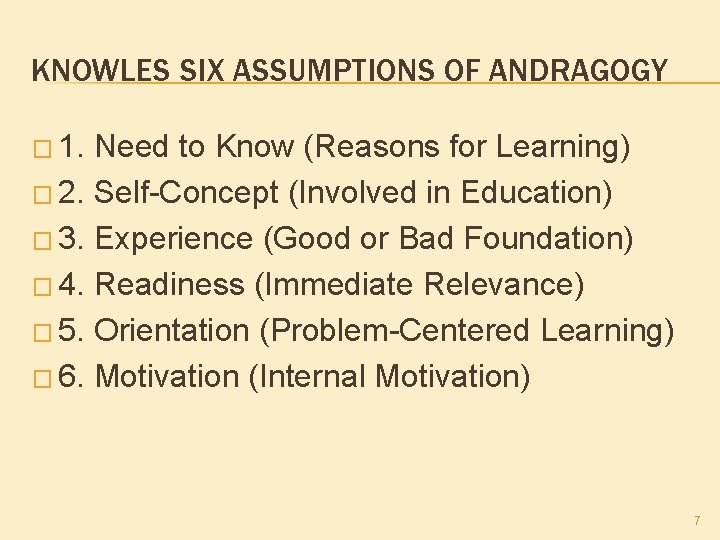
KNOWLES SIX ASSUMPTIONS OF ANDRAGOGY � 1. Need to Know (Reasons for Learning) � 2. Self-Concept (Involved in Education) � 3. Experience (Good or Bad Foundation) � 4. Readiness (Immediate Relevance) � 5. Orientation (Problem-Centered Learning) � 6. Motivation (Internal Motivation) 7
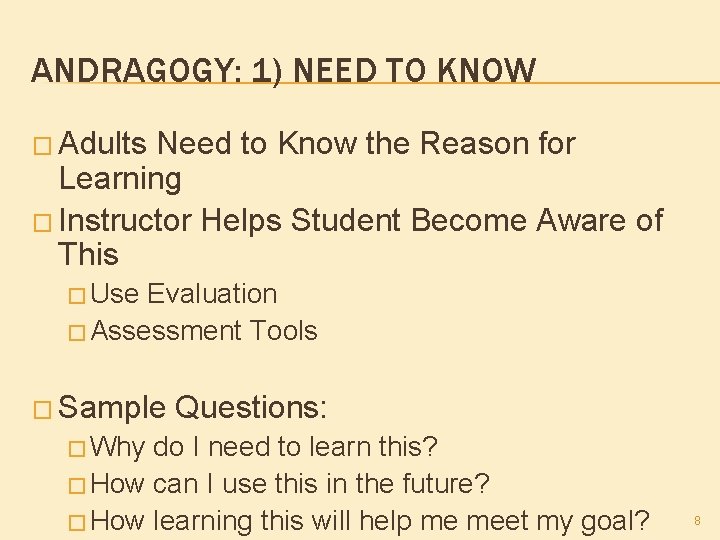
ANDRAGOGY: 1) NEED TO KNOW � Adults Need to Know the Reason for Learning � Instructor Helps Student Become Aware of This � Use Evaluation � Assessment Tools � Sample Questions: � Why do I need to learn this? � How can I use this in the future? � How learning this will help me meet my goal? 8
ANDRAGOGY: 2) SELF-CONCEPT � Adults Prefer to be Self-Directed � Be Responsible for Educational Decisions � Adults Resent Teacher-Dependent Role � Examples: � Be Involved in Course Planning � Be Involved in Course Evaluation � Be Involved in Instructor Evaluation 9
ANDRAGOGY: 3) EXPERIENCE � Experience is a Good Foundation for Learning � Experience Creates Positive or Negative Bias � Examples of Opportunities to Share Experience: � Group Projects and Activities � Interactive Discussions � Reflective Activities 10
ANDRAGOGY: 4) READINESS � Adults Become “Ready to Learn” � Immediate Relevance to Job or Personal Life � Examples: � Job Promotion: Learning New Skills � Going overseas: Learning a New Language 11
ANDRAGOGY: 5) LEARNING ORIENTATION � Adults Have Problem Centered Orientation � Learning Should Address Real-Life Problems � Examples: � Having a Deaf Child: Learn Sign Language � To Write a Letter: Learn Computer Skills (Knowles) 12
ANDRAGOGY: 6) MOTIVATION � Adults Learn Better With Internal Motivation � Examples: � Desire for a better quality of life � Desire for a satisfying job � Personal Ego 13
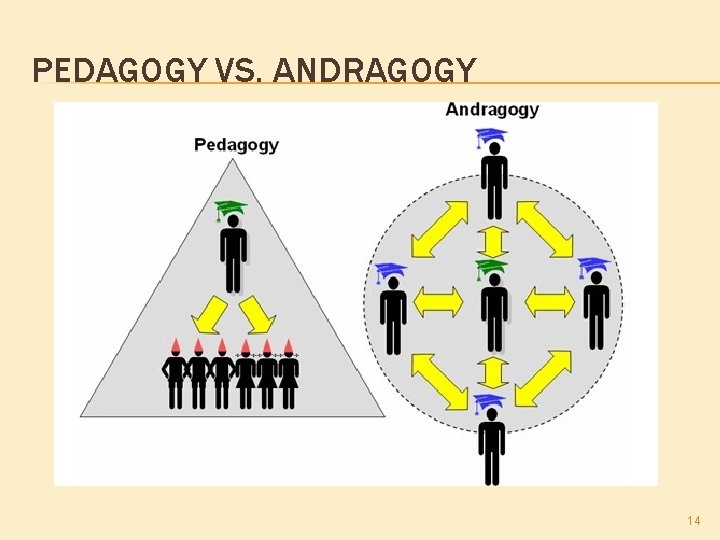
PEDAGOGY VS. ANDRAGOGY 14
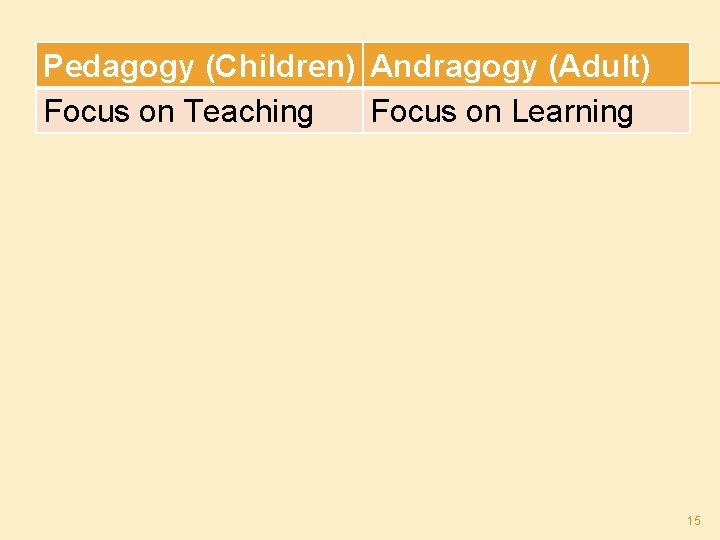
Pedagogy (Children) Andragogy (Adult) Focus on Teaching Focus on Learning 15
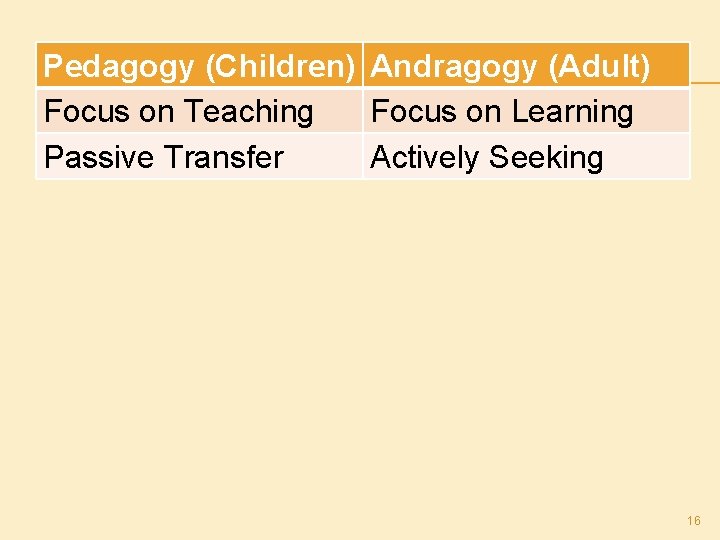
Pedagogy (Children) Andragogy (Adult) Focus on Teaching Focus on Learning Passive Transfer Actively Seeking 16
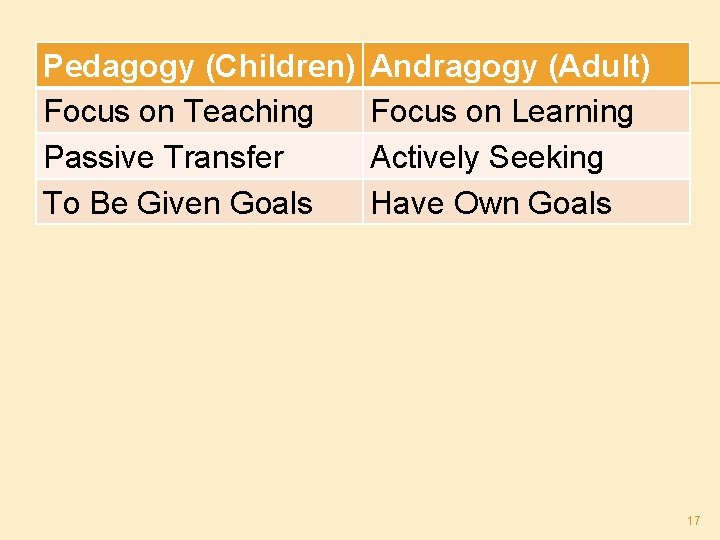
Pedagogy (Children) Focus on Teaching Passive Transfer To Be Given Goals Andragogy (Adult) Focus on Learning Actively Seeking Have Own Goals 17
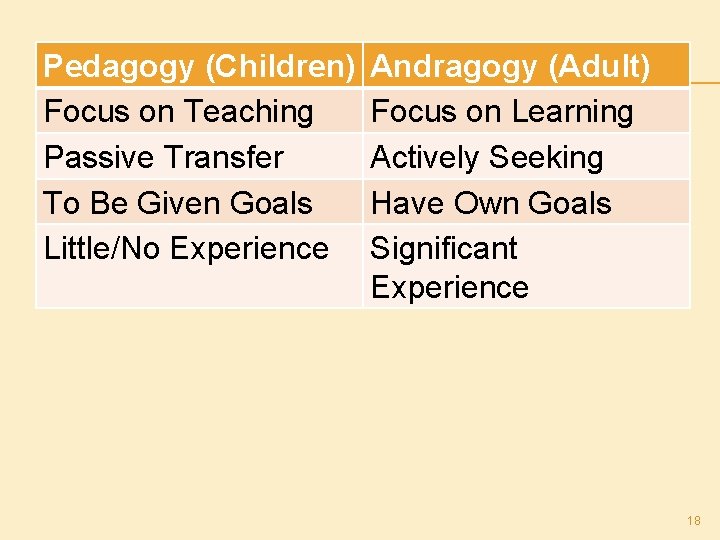
Pedagogy (Children) Focus on Teaching Passive Transfer To Be Given Goals Little/No Experience Andragogy (Adult) Focus on Learning Actively Seeking Have Own Goals Significant Experience 18
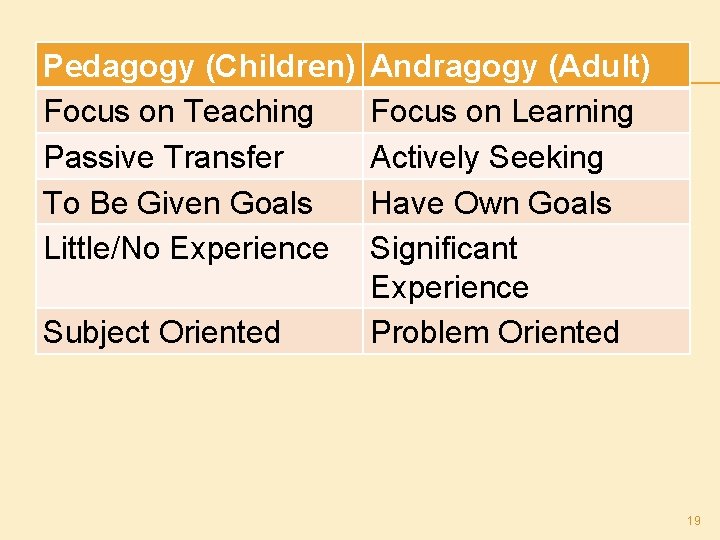
Pedagogy (Children) Focus on Teaching Passive Transfer To Be Given Goals Little/No Experience Subject Oriented Andragogy (Adult) Focus on Learning Actively Seeking Have Own Goals Significant Experience Problem Oriented 19
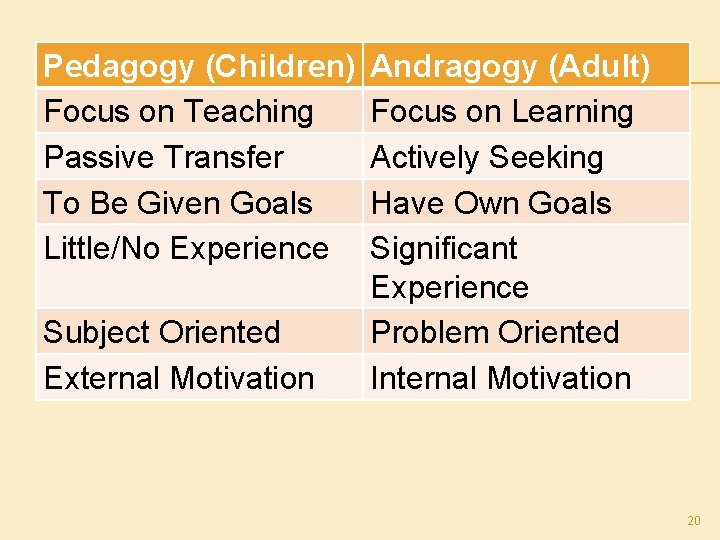
Pedagogy (Children) Focus on Teaching Passive Transfer To Be Given Goals Little/No Experience Subject Oriented External Motivation Andragogy (Adult) Focus on Learning Actively Seeking Have Own Goals Significant Experience Problem Oriented Internal Motivation 20
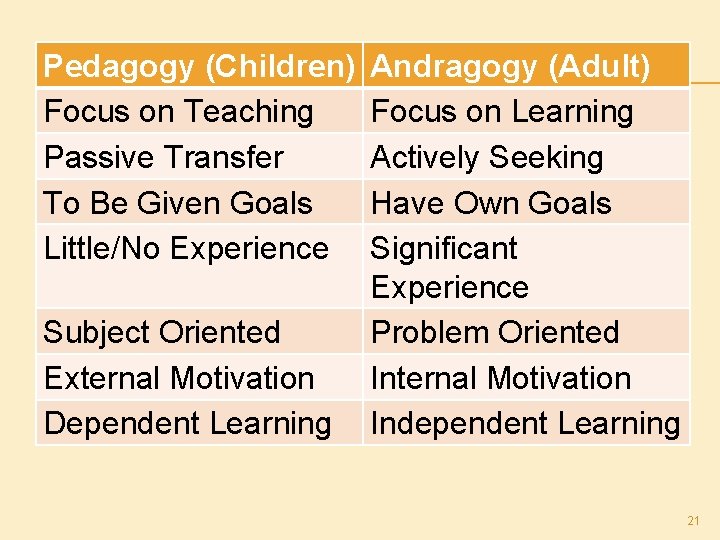
Pedagogy (Children) Focus on Teaching Passive Transfer To Be Given Goals Little/No Experience Subject Oriented External Motivation Dependent Learning Andragogy (Adult) Focus on Learning Actively Seeking Have Own Goals Significant Experience Problem Oriented Internal Motivation Independent Learning 21
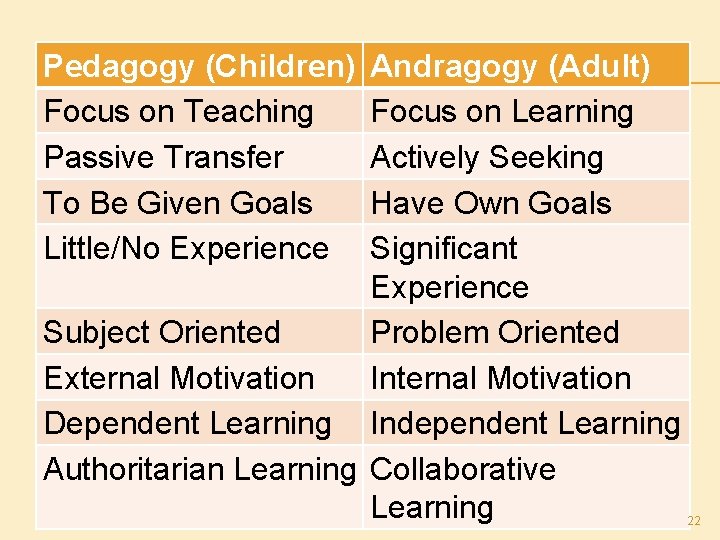
Pedagogy (Children) Focus on Teaching Passive Transfer To Be Given Goals Little/No Experience Andragogy (Adult) Focus on Learning Actively Seeking Have Own Goals Significant Experience Subject Oriented Problem Oriented External Motivation Internal Motivation Dependent Learning Independent Learning Authoritarian Learning Collaborative Learning 22
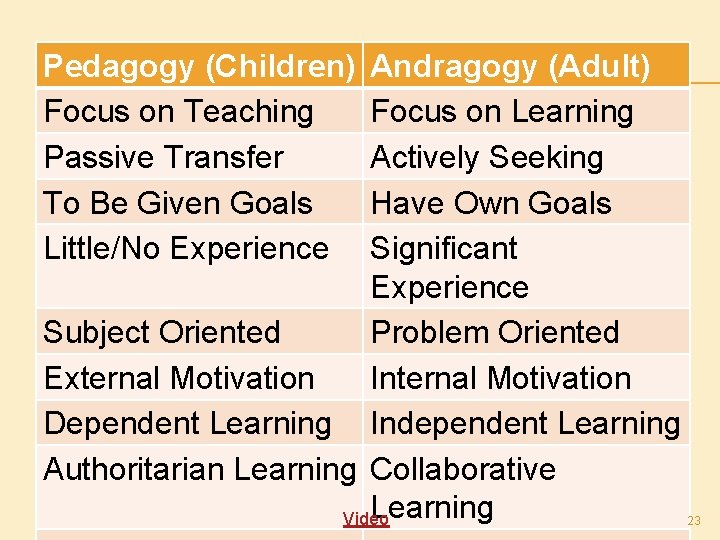
Pedagogy (Children) Focus on Teaching Passive Transfer To Be Given Goals Little/No Experience Andragogy (Adult) Focus on Learning Actively Seeking Have Own Goals Significant Experience Subject Oriented Problem Oriented External Motivation Internal Motivation Dependent Learning Independent Learning Authoritarian Learning Collaborative Learning Video 23
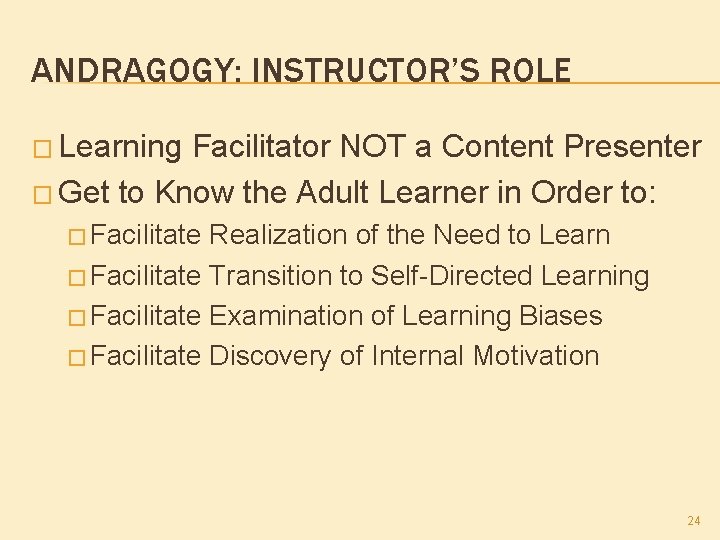
ANDRAGOGY: INSTRUCTOR’S ROLE � Learning Facilitator NOT a Content Presenter � Get to Know the Adult Learner in Order to: � Facilitate Realization of the Need to Learn � Facilitate Transition to Self-Directed Learning � Facilitate Examination of Learning Biases � Facilitate Discovery of Internal Motivation 24
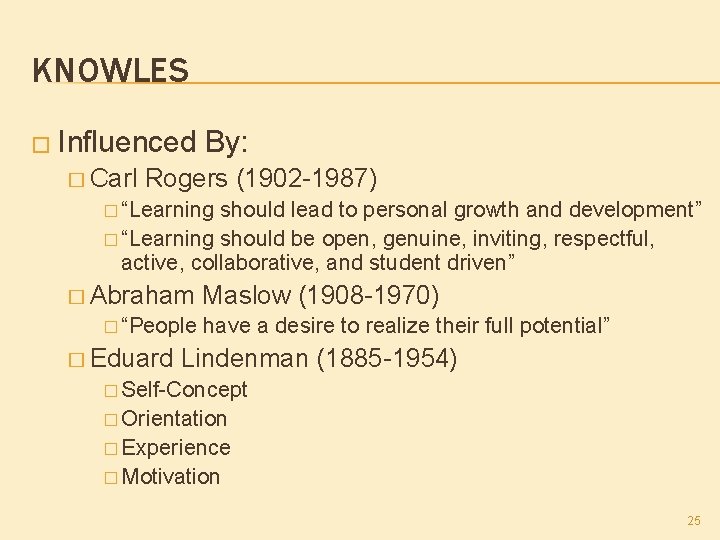
KNOWLES � Influenced By: � Carl Rogers (1902 -1987) � “Learning should lead to personal growth and development” � “Learning should be open, genuine, inviting, respectful, active, collaborative, and student driven” � Abraham Maslow (1908 -1970) � “People have a desire to realize their full potential” � Eduard Lindenman (1885 -1954) � Self-Concept � Orientation � Experience � Motivation 25
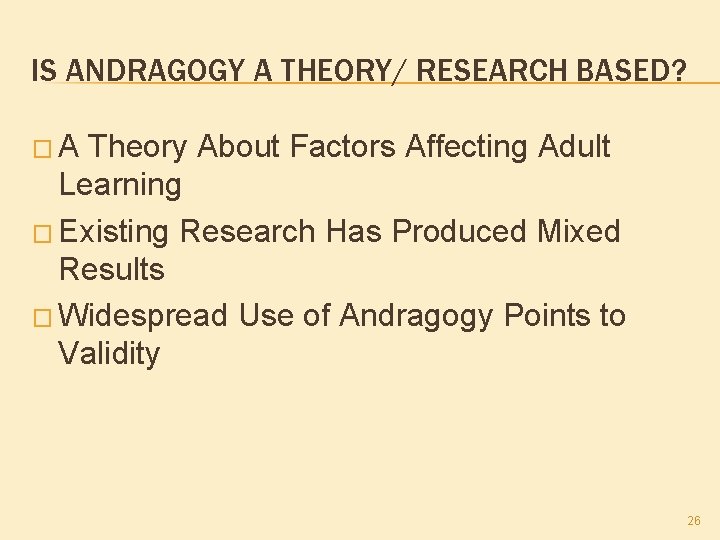
IS ANDRAGOGY A THEORY/ RESEARCH BASED? � A Theory About Factors Affecting Adult Learning � Existing Research Has Produced Mixed Results � Widespread Use of Andragogy Points to Validity 26
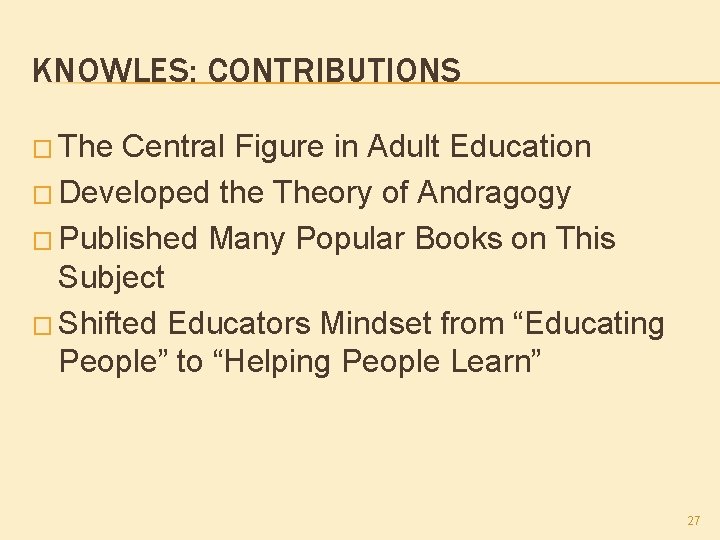
KNOWLES: CONTRIBUTIONS � The Central Figure in Adult Education � Developed the Theory of Andragogy � Published Many Popular Books on This Subject � Shifted Educators Mindset from “Educating People” to “Helping People Learn” 27
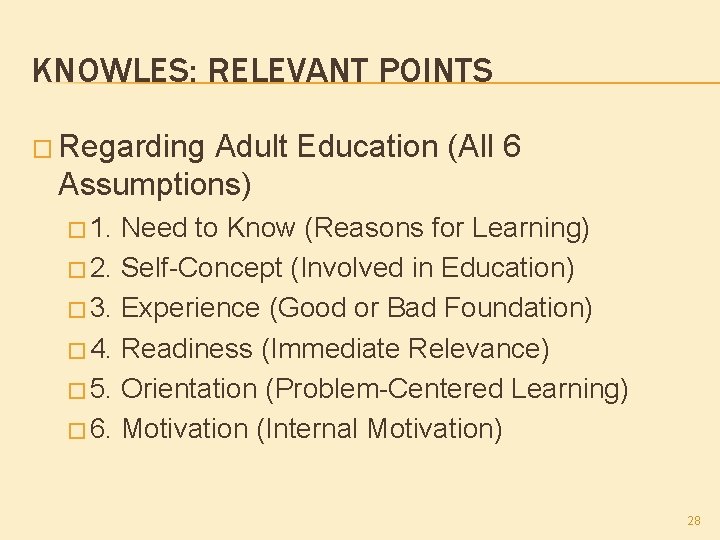
KNOWLES: RELEVANT POINTS � Regarding Adult Education (All 6 Assumptions) � 1. Need to Know (Reasons for Learning) � 2. Self-Concept (Involved in Education) � 3. Experience (Good or Bad Foundation) � 4. Readiness (Immediate Relevance) � 5. Orientation (Problem-Centered Learning) � 6. Motivation (Internal Motivation) 28
QUOTES BY KNOWLES � “We will learn no matter what! Learning is as natural as rest or play” � “Lifelong learning is a process in which individuals take the initiative, with or without the help of others” � “Adults need to know why they need to learn something before learning it” 29
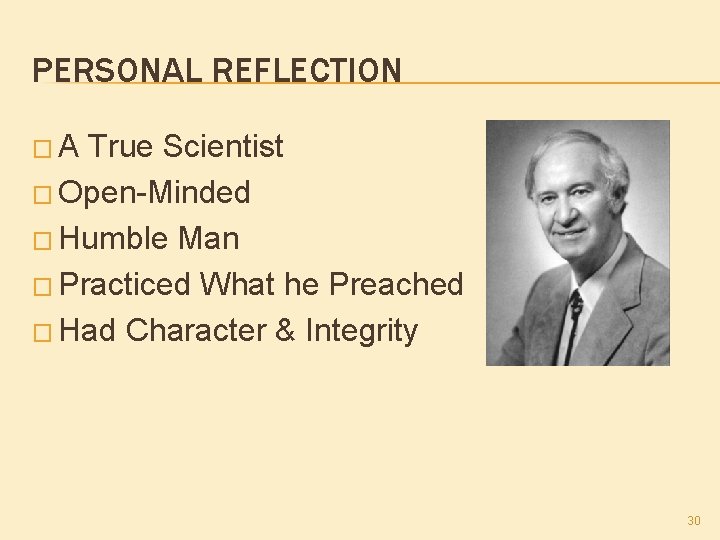
PERSONAL REFLECTION � A True Scientist � Open-Minded � Humble Man � Practiced What he Preached � Had Character & Integrity 30
REFERENCES � � � � Medsker, K. L. , & Holdsworth, K. M. (2001). Models and strategies for training design, 319 -337. Merriam, S. B. (2001). Andragogy and self‐directed learning: Pillars of adult learning theory. New directions for adult and continuing education, 2001(89), 314. Smith, M. K. (2002). Malcolm Knowles, informal adult education, self-direction andragogy. Infed, the Encyclopedia of informal education. Malcolm Knowles (11/17/13). [Online] Available: http: //infed. org/mobi/malcolmknowles-informal-adult-education-self-direction-andragogy/ Eduard Lindenman (11/17/13). [Online] Available: http: //en. wikipedia. org/wiki/Eduard_C. _Lindeman Unitarian Universalism (11/17/13). [Online] Available: http: //www. uua. org/beliefs/principles/282070. shtml Malcolm Knowles by Patricia Farley (11/17/13). [Online] Available: http: //www. docstoc. com/docs/132507466/Malcolm-Knowles-Adult-Learning. Theory 31