
Malaysian Studies 3 CONSTITUTION SPECIAL PROVISIONS Outline National

- Slides: 24
Malaysian Studies 3 CONSTITUTION: SPECIAL PROVISIONS
Outline • • • National Language Religion Fundamental Liberties Article 153 Citizenship
National Language • Most important factor in determining the true identity of a nation. • Malay language has been the lingua franca since the 15 th century with the Kingdom of Malacca. • Malay Language was made the official language of the country (Article 152 for official means). • It is a symbol of nationalism and unity of the country
National Language • The language issue cannot be used by any parties or individuals as a mean to attract votes. • In other words, it cannot be questioned or debated publicly. • One can be accused under the Sedition Act (Akta Hasutan) 1948
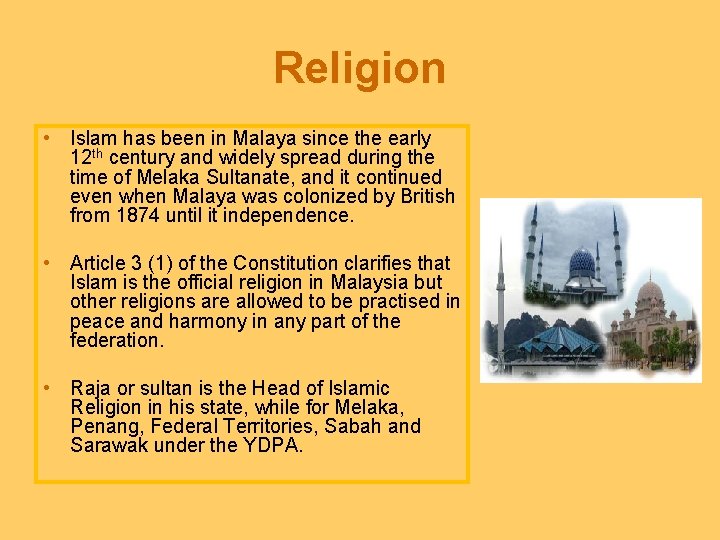
Religion • Islam has been in Malaya since the early 12 th century and widely spread during the time of Melaka Sultanate, and it continued even when Malaya was colonized by British from 1874 until it independence. • Article 3 (1) of the Constitution clarifies that Islam is the official religion in Malaysia but other religions are allowed to be practised in peace and harmony in any part of the federation. • Raja or sultan is the Head of Islamic Religion in his state, while for Melaka, Penang, Federal Territories, Sabah and Sarawak under the YDPA.
• The National Council for Islamic Affairs was established by the Conference of Rulers on 17 th October 1968. Its scopes of duties are: i. to advise on any matters raised by the Conference of Rulers, the state governments and the State Religious Councils. ii. to advise the Conference of Rulers, the state governments and the State Religious Councils on matters related to Islamic law, Islamic education and other matters pertaining to Islam.
• Each state has its own Islamic Religious Council to advise the ruler on Islamic affairs. • Article 12 of the Federal Constitution confers power on the Federation to enact law for the provision of financial assistance for Yayasan Islam or financing Islamic religious education to Muslims.
• Matters that are placed under the authority of the state legislature: i. Islamic laws and personal and family law ii. Malay customs iii. Waqaf iv. Fitrah v. Zakat vi. Baitulmal vii. Mosques viii. Syariah courts ix. Creation and punishment of offences by persons professing the religion of Islam against precepts of Islam x. Control of propagating doctrines and beliefs among persons professing the religion of Islam
Fundamental Liberties a) Freedom of worship • Every person has the right to practice a religion. • However, the state and federal laws have the rights to control and obstruct any development of beliefs other than Islam among the Muslims. • A person under 18 can't be asked to participate in a religious ceremony other than his own. • A person can't be asked to pay whatsoever tax other than for the used of his religion. • Groups of the same religion have the rights to organize religious business inclusive of setting up a foundation and owning property
Fundamental Liberties b) Personal freedom • A person cannot have his life taken away or his freedom destroyed except as required by the law. • Has a freedom to speak, to assemble and to form unions/associations, and • Freedom from abuse of law, speak, assemble, to form unions, exile and restriction of movement. • Freedom of worship • Equal in education • Right to own property
Fundamental Liberties c) Economic freedom • Freedom from slavery and forced labour, • Freedom to own property, and • Freedom to form associations
Article 153 v. Refers to : ü the rights of Malays ü the position of indigenous people in Sabah and Sarawak ü The privilege such as on: a. Education • scholarship, assistance, specialties in course. b. Civil service c. Economy • license for business and trade, etc
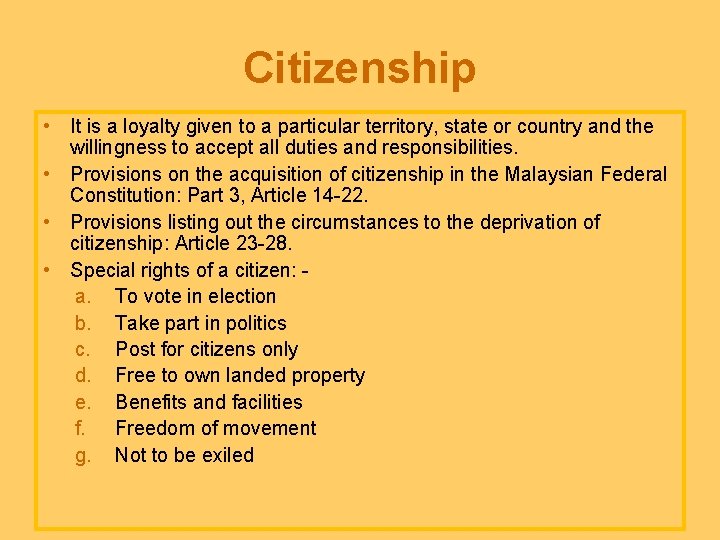
Citizenship • It is a loyalty given to a particular territory, state or country and the willingness to accept all duties and responsibilities. • Provisions on the acquisition of citizenship in the Malaysian Federal Constitution: Part 3, Article 14 -22. • Provisions listing out the circumstances to the deprivation of citizenship: Article 23 -28. • Special rights of a citizen: a. To vote in election b. Take part in politics c. Post for citizens only d. Free to own landed property e. Benefits and facilities f. Freedom of movement g. Not to be exiled
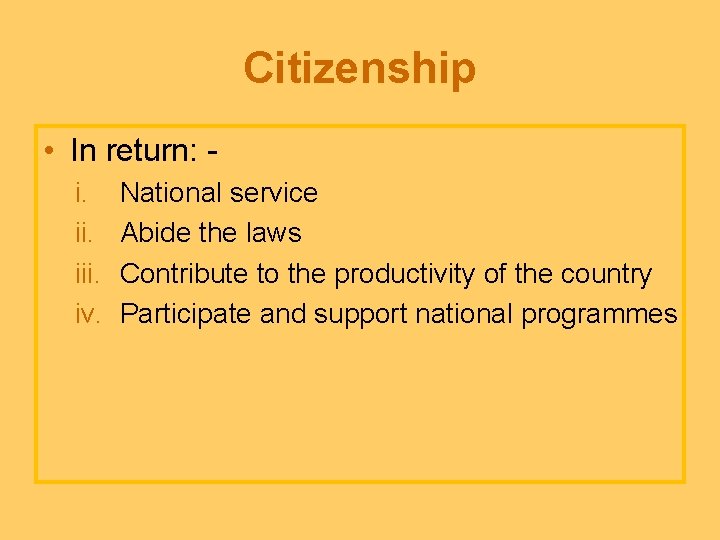
Citizenship • In return: i. iii. iv. National service Abide the laws Contribute to the productivity of the country Participate and support national programmes
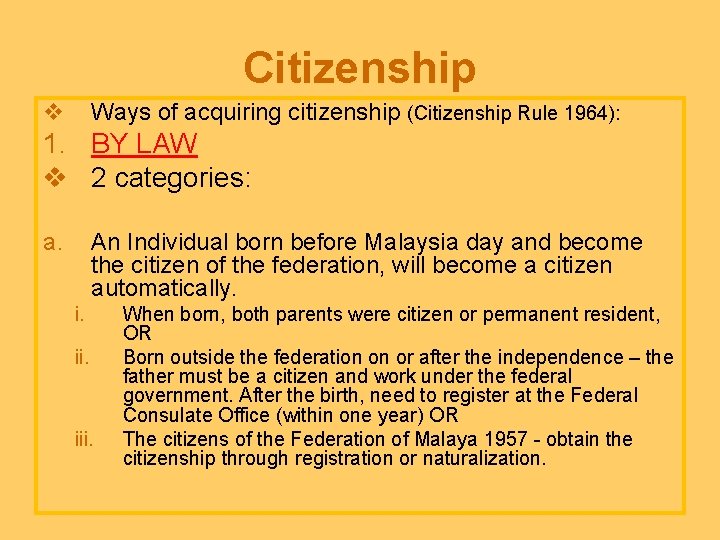
Citizenship v Ways of acquiring citizenship (Citizenship Rule 1964): 1. BY LAW v 2 categories: a. An Individual born before Malaysia day and become the citizen of the federation, will become a citizen automatically. i. ii. iii. When born, both parents were citizen or permanent resident, OR Born outside the federation on or after the independence – the father must be a citizen and work under the federal government. After the birth, need to register at the Federal Consulate Office (within one year) OR The citizens of the Federation of Malaya 1957 - obtain the citizenship through registration or naturalization.
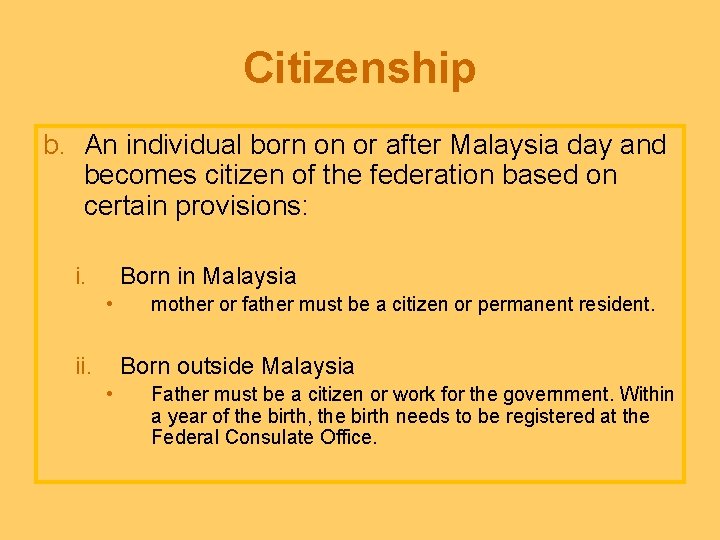
Citizenship b. An individual born on or after Malaysia day and becomes citizen of the federation based on certain provisions: i. Born in Malaysia • ii. mother or father must be a citizen or permanent resident. Born outside Malaysia • Father must be a citizen or work for the government. Within a year of the birth, the birth needs to be registered at the Federal Consulate Office.
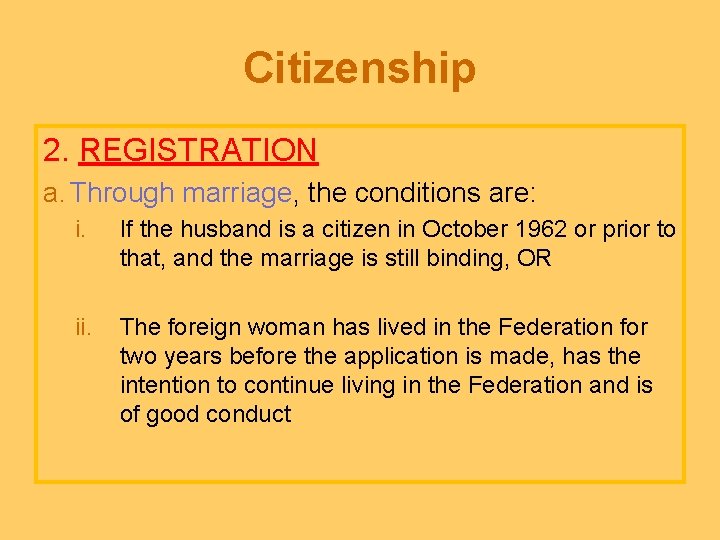
Citizenship 2. REGISTRATION a. Through marriage, the conditions are: i. If the husband is a citizen in October 1962 or prior to that, and the marriage is still binding, OR ii. The foreign woman has lived in the Federation for two years before the application is made, has the intention to continue living in the Federation and is of good conduct
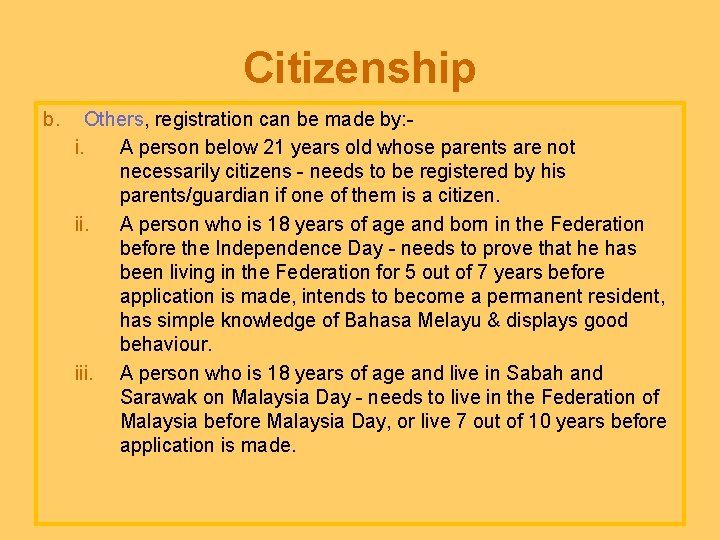
Citizenship b. Others, registration can be made by: i. A person below 21 years old whose parents are not necessarily citizens - needs to be registered by his parents/guardian if one of them is a citizen. ii. A person who is 18 years of age and born in the Federation before the Independence Day - needs to prove that he has been living in the Federation for 5 out of 7 years before application is made, intends to become a permanent resident, has simple knowledge of Bahasa Melayu & displays good behaviour. iii. A person who is 18 years of age and live in Sabah and Sarawak on Malaysia Day - needs to live in the Federation of Malaysia before Malaysia Day, or live 7 out of 10 years before application is made.
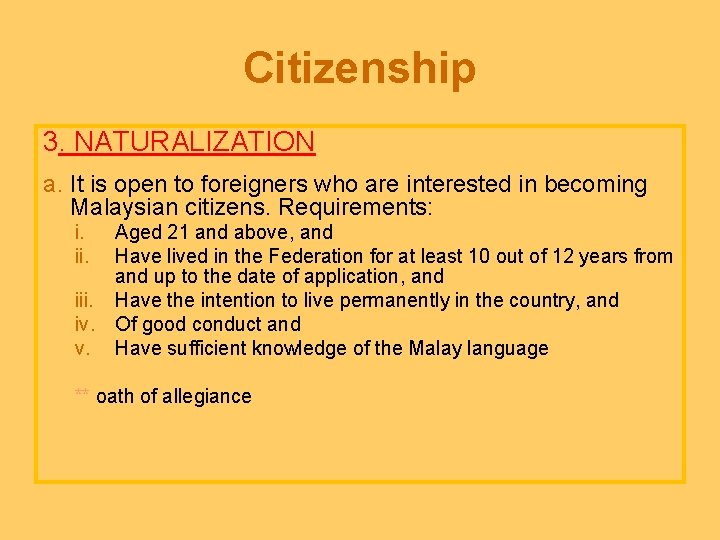
Citizenship 3. NATURALIZATION a. It is open to foreigners who are interested in becoming Malaysian citizens. Requirements: i. iii. iv. v. Aged 21 and above, and Have lived in the Federation for at least 10 out of 12 years from and up to the date of application, and Have the intention to live permanently in the country, and Of good conduct and Have sufficient knowledge of the Malay language ** oath of allegiance
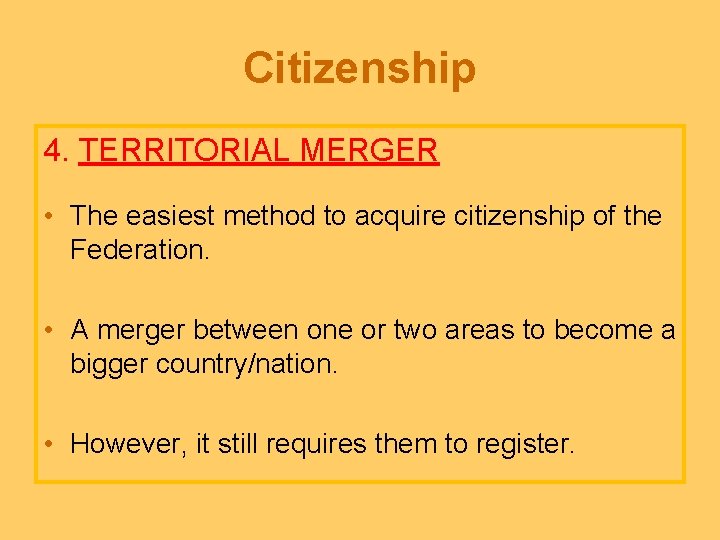
Citizenship 4. TERRITORIAL MERGER • The easiest method to acquire citizenship of the Federation. • A merger between one or two areas to become a bigger country/nation. • However, it still requires them to register.
Citizenship v Loss of citizenship: a. RENUNCIATION: – 21 years old and above, voluntarily surrenders the citizenship. b. REVOCATION: – Violated any laws and prohibited action according to the following: i. He has become a citizen of another country. ii. He is enjoying all the rights and facilities in another country, whereas those rights are given only to the citizens of those countries, for example, he participates in the foreign country’s elections or possesses a foreign passport.
Citizenship iii. A woman becomes the citizen of a foreign country through marriage with a man from the country concerned. iv. Acts negatively showing he is no longer loyal to Malaysia. v. Has business or ties with a hostile country. vi. Has been sentenced in a state within a period of five years after becoming a citizen of the Federation, with a jail sentence of not less than 23 month or fine not less than RM 5, 000, 00. vii. Gives services to another country without permission
Citizenship viii. Lives continuously for five years in a foreign country unless he is on service with or on behalf of the Malaysian government. ix. The citizenship has been falsely obtained. x. A foreign woman who acquired her citizenship status through marriage, is divorced from the husband, except in the case of divorce where the husband has passed away. *** Citizenship is a special status, not immune from any withdrawal
Thank You.