
MAKING WAVES CANADA Instructor Manual Pilot Program School
![Pilot Program: School Year 2012 -2013 Progress Report Term: ____ Dear [student’s full name],](https://slidetodoc.com/presentation_image_h2/32d548d7584b6d6110025d15b11ba9f3/image-28.jpg "Pilot Program: School Year 2012 -2013 Progress Report Term: ____ Dear [student’s full name],")
- Slides: 65
MAKING WAVES CANADA Instructor Manual Pilot Program School Year 2012 -2013
Pilot Program: School Year 2012 -2013 Table of Contents About Us. ……………………………………………………… 4 Purpose. ……………………………………………………… 5 Intake Process …………………………………………………. 6 Intake Form…………………………………………………… 9 Skills List ……………………………………………………… 11 Notes from the first lesson………………………………………… 14 Student Strengths, Goal-Setting and Risk Assessment Form. ………………… 15 Goal Adjustment and Ongoing Communication with Families. …………………. 20 How to Write a Progress Report. ………………………………………. 21 Award System. …………………………………. 24 Award Visuals. …………………………………. . 25 Award and Progress Report Template. …………………. 26 Information about Specific Disabilities. ………………… 29 Attention Deficit Hyperactivity Disorder. …………………. . 29 Autism Spectrum Disorder. ……………………………………. . 30 Cerebral Palsy. ……………………………………. . 31 Global Developmental Delay. …………………………………. 32 Developmental Disability or Intellectual Disability. …………………. ……. 33 Genetic Syndromes ………………………… 34 Hearing Impairment…………………………. . 35 Learning Disabilities………………………… 36 Neuromuscular disorders/ diseases…………………… 37 Psychological disability…………………………. . 38 Speech/ Language Impairment………………………… 39 Spina Bifida…………………………. …………… 40 Visual Impairment………………………… 41 Approaching Challenging Behavior. …………………………………… 42 Supporting Students with Communication Challenges. ………………… 47
Pilot Program: School Year 2012 -2013 Instructor Resources. ………………………………… 49 First Aid. ………………………………… 49 How to Structure Time in Lessons. …………………. . 51 Home to Pool Connections. …………………………………. …. 53 Games to practice getting wet. …………………. 54 Simple games to play throughout the lesson. ………………… 55 Visuals to use with students. …………………………………. . 56 Award & Progress Report Example. …………………. . . 61 About the Authors. …………………………………. 62 References …………………………………. . 63
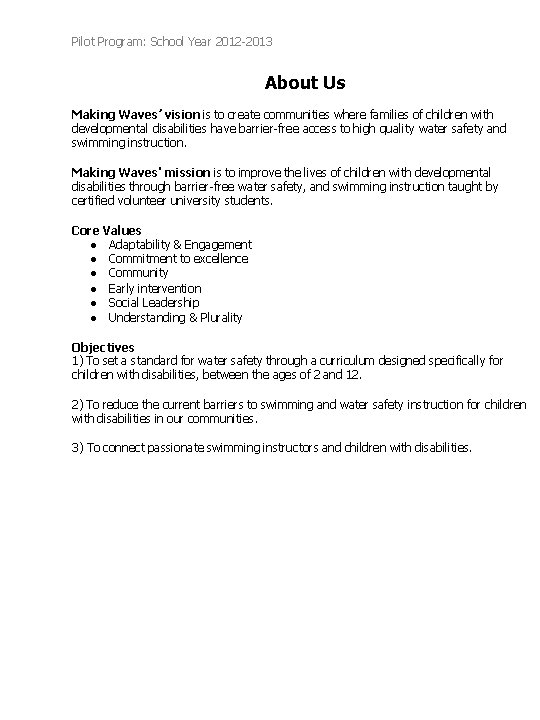
Pilot Program: School Year 2012 -2013 About Us Making Waves’ vision is to create communities where families of children with developmental disabilities have barrier-free access to high quality water safety and swimming instruction. Making Waves' mission is to improve the lives of children with developmental disabilities through barrier-free water safety, and swimming instruction taught by certified volunteer university students. Core Values ● Adaptability & Engagement ● Commitment to excellence ● Community ● Early intervention ● Social Leadership ● Understanding & Plurality Objectives 1) To set a standard for water safety through a curriculum designed specifically for children with disabilities, between the ages of 2 and 12. 2) To reduce the current barriers to swimming and water safety instruction for children with disabilities in our communities. 3) To connect passionate swimming instructors and children with disabilities.
Pilot Program: School Year 2012 -2013 Purpose The purpose of this “Instructor Manual” is to increase both instructors’ and students access to water safety and swimming instruction. It provides instructors with relevant resources to support teaching and learning. In order to embrace the unique qualities of each student, this manual encourages instructors to be flexible and creative in their teaching approach. Another aim of this manual is to establish consistency between Making Wav chapters across Canada. Instructors will share a common language for teaching wat safety and swimming to children with disabilities. This lays the groundwork to set u the most productive instructional environments across chapters. This manual is a work in progress and relies on the collaboration of instructors t revise it regularly in order to keep the information accurate and relevant.
Pilot Program: School Year 2012 -2013 Intake Process NOTE: the numbers and letters below correspond to the numbers and letters on th intake form. 1. Meet & Greet Begin by introducing yourself first to the child, then to the family. Be sure to make note of the parent/guardians names so that you can address them throughout the term in a professional manner. Provide a quick blurb about yourself so that they can get to know you as a person. For example, what you are studying in school, your experience teaching swimming and/or working with kids, etc. Seeing as you will be working wi the family for the next six to eight weeks, it is imperative to establish both a work relationship as well as a personal relationship in order to gain trust from both the child and the family. Before you move on to the consultation section on the intake form, read the philosophy section aloud. All information must be covered, and in order for it to be completely understood by the parents, please read it word for word. 2. Consultation A) Once you’ve introduced yourself and gone through your background, you can begin the initial consultation. This is meant to gain any and all information about the chil experience in and around water, what the family hopes to achieve from the term, and any behavioural concerns and what to do if they arise. The questions, in the correc order of how to ask them, are listed on the intake form. When determining who to direct the questions towards, use your judgment based on the specific needs of the child. However, be sure to acknowledge both the child and the family, and attempt to direct all questions first to the child, following up with more information with the family. For example, ask the child if they’ve ever been swimming before, subsequent inquiring from the family about how much time the child spends in and around water. B) The section on supplementary questions, listed on the intake form, will provide you with any additional information that can possibly affect the success of your lessons each week. This information is crucial for the safety of you, your child, and the rest of t pool patrons. Therefore it is extremely important to get answers for these questions. If there is any other information that the family gives you, please take note of it in t section. C) Inquire about the family's goals for the outcome of the swimming term. You will use this as a guide to creating your focus areas to work on, as well as the specific goals you will be attempting to achieve for the child’s progress report. The questions to be asked are on the intake form, however feel free to ask any other questions you believe may be relevant. Be sure to direct the questions to both the child and the family, and inquire what the child wants to learn, as well as what the family is hoping they will achieve.
Pilot Program: School Year 2012 -2013 D) This is Making Waves policy to be read to the family. All information must be covered, and in order for it to be completely understood by the family, please read word for word. In water assessment You have now completed the intake form, and are ready to enter the water. This form will become an invaluable resource for you when setting goals, as well as information to be used by any substitute instructors. At this point, you are responsible for learning the following information provided below. The intake form is complete, and there is no further information provided on the intake form to guide you in leading your first lesson. Therefore, it’s vital that you rememb this last part of the in water assessment to successfully teach your first lesson. The first part of the lesson is a continued evaluation of the child’s capabilities. As one of the core values of Making Waves is water safety, please ensure that you abide by this as soon as you and your child leave the child’s family. Once you and your child ha safely entered the water, go through the following steps in the order given. It is important to ask your child, and not to force anything on a child who is hesitant, until you begin to gain their trust. 1. Entering the water 2. Blowing bubbles 3. Putting their face in the water 4. Assisted front float, back float, front swim, back swim 5. Jumping in the water - assisted and unassisted 6. Unassisted front float, back float, front swim, back swim 7. Roll-over float 8. Front crawl basics (arms with a flutter board, with kicking, unassisted, etc) 9. Treading water This in water assessment may take up to 10 minutes. Once you have a grasp on their strengths and weaknesses, you can continue working with your child in the water. you have just met your child and were unable to plan out your lesson, there may room for games, starting to gain one another’s trust, or developing their skills. For games and other ideas, please refer to the instructor resource section. At home -follow up from first day Upon arriving at home after the first day, complete the online portion of the intake assessment. Here, you will take note of your child’s strengths, while also rating the level of risk your child is at in terms of safety. The three categories to rate your child a high, medium and low risk. Descriptions of each rating will be provided for you as you fill out the online portion. These may overlap, so remember that this is only estimate.
Pilot Program: School Year 2012 -2013 Finally, the last part of the Intake Assessment is statement of the goals you will be focusing on with the child, based on what you currently believe is achievable in a term. This will be a combination of the family’s goals for their child, as well as the next steps you foresee based on the results of the in-water assessment. There are no mandatory skills that you are required to work on, so you can choose the skills for the child as you see fit. The list of the possible skills is included in the skills section.
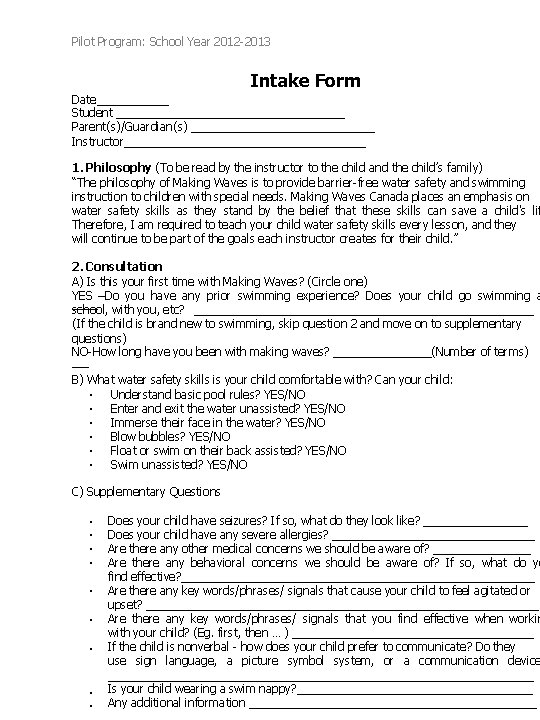
Pilot Program: School Year 2012 -2013 Intake Form Date______ Student __________________ Parent(s)/Guardian(s) ______________ Instructor___________________ 1. Philosophy (To be read by the instructor to the child and the child’s family) “The philosophy of Making Waves is to provide barrier-free water safety and swimming instruction to children with special needs. Making Waves Canada places an emphasis on water safety skills as they stand by the belief that these skills can save a child's lif Therefore, I am required to teach your child water safety skills every lesson, and they will continue to be part of the goals each instructor creates for their child. ” 2. Consultation A) Is this your first time with Making Waves? (Circle one) YES –Do you have any prior swimming experience? Does your child go swimming a school, with you, etc? __________________________ (If the child is brand new to swimming, skip question 2 and move on to supplementary questions) NO-How long have you been with making waves? ________(Number of terms) B) What water safety skills is your child comfortable with? Can your child: • Understand basic pool rules? YES/NO • Enter and exit the water unassisted? YES/NO • Immerse their face in the water? YES/NO • Blow bubbles? YES/NO • Float or swim on their back assisted? YES/NO • Swim unassisted? YES/NO C) Supplementary Questions • • • Does your child have seizures? If so, what do they look like? ________ Does your child have any severe allergies? ________________ Are there any other medical concerns we should be aware of? ________ Are there any behavioral concerns we should be aware of? If so, what do yo find effective? ___________________________ Are there any key words/phrases/ signals that cause your child to feel agitated or upset? ______________________________ Are there any key words/phrases/ signals that you find effective when workin with your child? (Eg. first, then … ) ___________________ If the child is nonverbal - how does your child prefer to communicate? Do they use sign language, a picture symbol system, or a communication device _________________________________ Is your child wearing a swim nappy? __________________ Any additional information ______________________
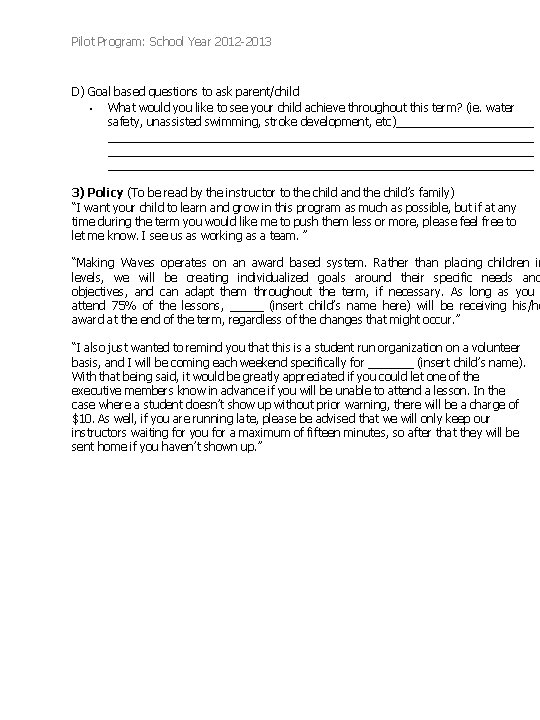
Pilot Program: School Year 2012 -2013 D) Goal based questions to ask parent/child • What would you like to see your child achieve throughout this term? (ie. water safety, unassisted swimming, stroke development, etc)_______________________________________________________ 3) Policy (To be read by the instructor to the child and the child’s family) “I want your child to learn and grow in this program as much as possible, but if at any time during the term you would like me to push them less or more, please feel free to let me know. I see us as working as a team. ” “Making Waves operates on an award based system. Rather than placing children in levels, we will be creating individualized goals around their specific needs and objectives, and can adapt them throughout the term, if necessary. As long as you attend 75% of the lessons, _____ (insert child’s name here) will be receiving his/he award at the end of the term, regardless of the changes that might occur. ” “I also just wanted to remind you that this is a student run organization on a volunteer basis, and I will be coming each weekend specifically for _______ (insert child’s name). With that being said, it would be greatly appreciated if you could let one of the executive members know in advance if you will be unable to attend a lesson. In the case where a student doesn’t show up without prior warning, there will be a charge of $10. As well, if you are running late, please be advised that we will only keep our instructors waiting for you for a maximum of fifteen minutes, so after that they will be sent home if you haven’t shown up. ”
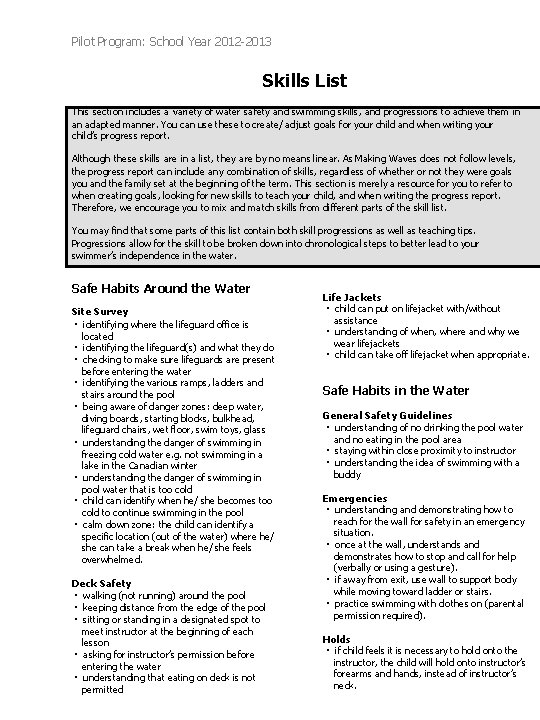
Pilot Program: School Year 2012 -2013 Skills List This section includes a variety of water safety and swimming skills, and progressions to achieve them in an adapted manner. You can use these to create/ adjust goals for your child and when writing your child’s progress report. Although these skills are in a list, they are by no means linear. As Making Waves does not follow levels, the progress report can include any combination of skills, regardless of whether or not they were goals you and the family set at the beginning of the term. This section is merely a resource for you to refer to when creating goals, looking for new skills to teach your child, and when writing the progress report. Therefore, we encourage you to mix and match skills from different parts of the skill list. You may find that some parts of this list contain both skill progressions as well as teaching tips. Progressions allow for the skill to be broken down into chronological steps to better lead to your swimmer’s independence in the water. Safe Habits Around the Water Site Survey • identifying where the lifeguard office is located • identifying the lifeguard(s) and what they do • checking to make sure lifeguards are present before entering the water • identifying the various ramps, ladders and stairs around the pool • being aware of danger zones: deep water, diving boards, starting blocks, bulkhead, lifeguard chairs, wet floor, swim toys, glass • understanding the danger of swimming in freezing cold water e. g. not swimming in a lake in the Canadian winter • understanding the danger of swimming in pool water that is too cold • child can identify when he/ she becomes too cold to continue swimming in the pool • calm down zone: the child can identify a specific location (out of the water) where he/ she can take a break when he/ she feels overwhelmed. Deck Safety • walking (not running) around the pool • keeping distance from the edge of the pool • sitting or standing in a designated spot to meet instructor at the beginning of each lesson • asking for instructor’s permission before entering the water • understanding that eating on deck is not permitted Life Jackets • child can put on lifejacket with/without assistance • understanding of when, where and why we wear lifejackets • child can take off lifejacket when appropriate. Safe Habits in the Water General Safety Guidelines • understanding of no drinking the pool water and no eating in the pool area • staying within close proximity to instructor • understanding the idea of swimming with a buddy Emergencies • understanding and demonstrating how to reach for the wall for safety in an emergency situation. • once at the wall, understands and demonstrates how to stop and call for help (verbally or using a gesture). • if away from exit, use wall to support body while moving toward ladder or stairs. • practice swimming with clothes on (parental permission required). Holds • if child feels it is necessary to hold onto the instructor, the child will hold onto instructor’s forearms and hands, instead of instructor’s neck.
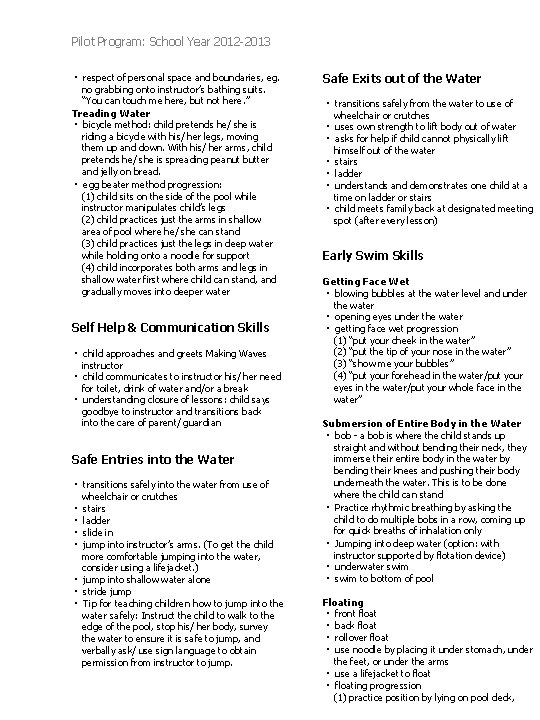
Pilot Program: School Year 2012 -2013 • respect of personal space and boundaries, eg. no grabbing onto instructor’s bathing suits. “You can touch me here, but not here. ” Treading Water • bicycle method: child pretends he/ she is riding a bicycle with his/ her legs, moving them up and down. With his/ her arms, child pretends he/ she is spreading peanut butter and jelly on bread. • egg beater method progression: (1) child sits on the side of the pool while instructor manipulates child’s legs (2) child practices just the arms in shallow area of pool where he/ she can stand (3) child practices just the legs in deep water while holding onto a noodle for support (4) child incorporates both arms and legs in shallow water first where child can stand, and gradually moves into deeper water Self Help & Communication Skills • child approaches and greets Making Waves instructor • child communicates to instructor his/ her need for toilet, drink of water and/or a break • understanding closure of lessons: child says goodbye to instructor and transitions back into the care of parent/ guardian Safe Entries into the Water • transitions safely into the water from use of wheelchair or crutches • stairs • ladder • slide in • jump into instructor’s arms. (To get the child more comfortable jumping into the water, consider using a lifejacket. ) • jump into shallow water alone • stride jump • Tip for teaching children how to jump into the water safely: Instruct the child to walk to the edge of the pool, stop his/ her body, survey the water to ensure it is safe to jump, and verbally ask/ use sign language to obtain permission from instructor to jump. Safe Exits out of the Water • transitions safely from the water to use of wheelchair or crutches • uses own strength to lift body out of water • asks for help if child cannot physically lift himself out of the water • stairs • ladder • understands and demonstrates one child at a time on ladder or stairs • child meets family back at designated meeting spot (after every lesson) Early Swim Skills Getting Face Wet • blowing bubbles at the water level and under the water • opening eyes under the water • getting face wet progression (1) “put your cheek in the water” (2) “put the tip of your nose in the water” (3) “show me your bubbles” (4) “put your forehead in the water/put your eyes in the water/put your whole face in the water” Submersion of Entire Body in the Water • bob - a bob is where the child stands up straight and without bending their neck, they immerse their entire body in the water by bending their knees and pushing their body underneath the water. This is to be done where the child can stand • Practice rhythmic breathing by asking the child to do multiple bobs in a row, coming up for quick breaths of inhalation only • Jumping into deep water (option: with instructor supported by flotation device) • underwater swim • swim to bottom of pool Floating • front float • back float • rollover float • use noodle by placing it under stomach, under the feet, or under the arms • use a lifejacket to float • floating progression (1) practice position by lying on pool deck,
Pilot Program: School Year 2012 -2013 making a big star with arms and legs spread out (2) hold child’s armpits with one hand at the same time push their head on your shoulder with your other hand, explaining that it’s “like a pillow” (3) hold child’s armpits with both hands and tell them to spread their arms and legs out like a big star and to push their stomach up to the sky (4) start out holding the child’s armpits and slowly move your grasp out to their fingertips until they are unassisted Basic Kicking on Front and Back • kicking off the side of the pool, either by sitting on stairs or sitting on the pool edge; • child holds onto the wall with their face in the water • using a flutter board or other buoyant object Gliding • front glide • back glide Front Swim • Front Swim (aka “doggy paddle”): the most basic type of swimming on your front before front crawl. Child swims on his/ her front with his/ her face in the water, kicking, and arms still. Arms can be placed in front of the child or by his/ her side. To breathe, child does doggy paddle to lift his/her head out of the water and take a breath. • Front swim progression: (1) kicks while holding onto instructor’s arms for support (2) kicks while blowing bubbles, with face in the water (still supported by instructor) (3) kicks while blowing bubbles, with face in the water, with support from instructor only to take a breath (4) kicks while blowing bubbles, lifting face up to take a breathe, with no support from instructor Back Swim • Back swim: the most basic type of swimming on your back before back crawl. Child swims on his back, keeps his hair and ears in the water, with arms by the side and kicks legs up and down • Back swim progression: (1) swimming on back with feet at the surface (making splashes) with support from the instructor (2) swimming on back with feet at the surface (making splashes) with support from a flotation device (blocks or a flutter board) (3) swimming on back with feet at the surface (making splashes) without any support Stroke Development Students who have achieved everything up to this point may continue to progress in stroke development, such as learning basic front crawl and back crawl. Making Waves is an early intervention program for children with disabilities, with the main goal being to teach children how to support themselves in the water to avoid drowning. Therefore, you will not be trained on how to teach the more advanced strokes of front crawl, back crawl, elementary backstroke, breaststroke, or butterfly as the cut off age of 12 years old implies that there will be few students at this advanced level. However, if you have a child who has mastered front swim and back swim independently, and they are ready to start learning these higher-level strokes, we encourage you to teach them these strokes based on your knowledge. If you don’t feel comfortable teaching any of these strokes, approach your chapter's executive team for additional resources, which could include guidance from an instructor on the club who is certified from a levels-based swimming program, or information on other programs in your chapters town/city that offer affordable swimming lessons and teach advanced swimming skills.
Pilot Program: School Year 2012 -2013 Notes from the first lesson Following this initial lesson, you will enter your student’s strengths and goals using the “Student Strengths, Goal-Setting and Risk Assessment. ” To prepare for this, you ma find it helpful to write down some notes in response to the questions that follow. Please note that this form is optional; it is provided as a tool to help instructors transfer observations of the first lesson onto the online form. ● What can your student do in and around the pool? ● What do you want to focus on in your work with this student? _____________________________________________________________________________ _____________________________________________________________________________ _______________________________________
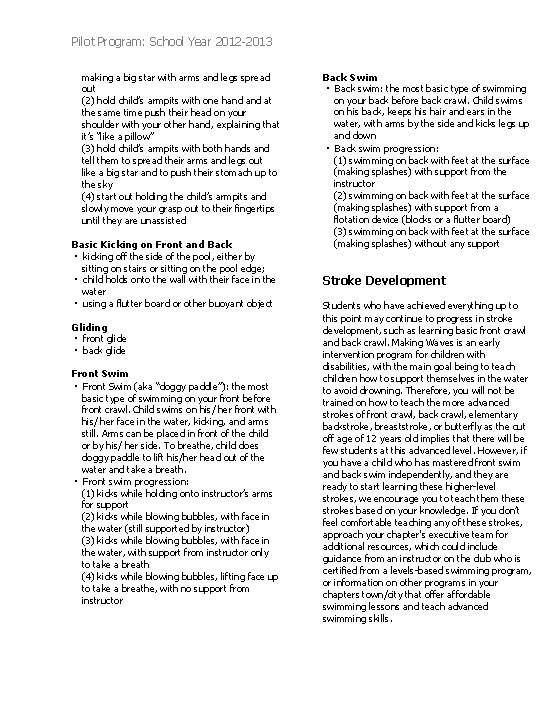
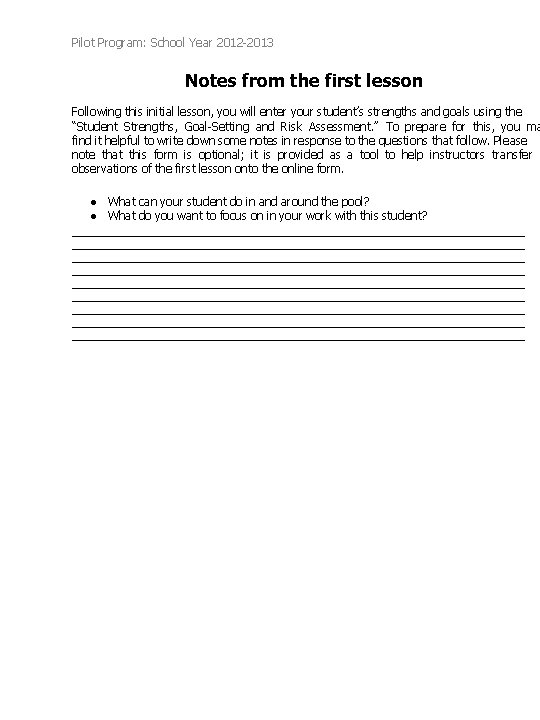
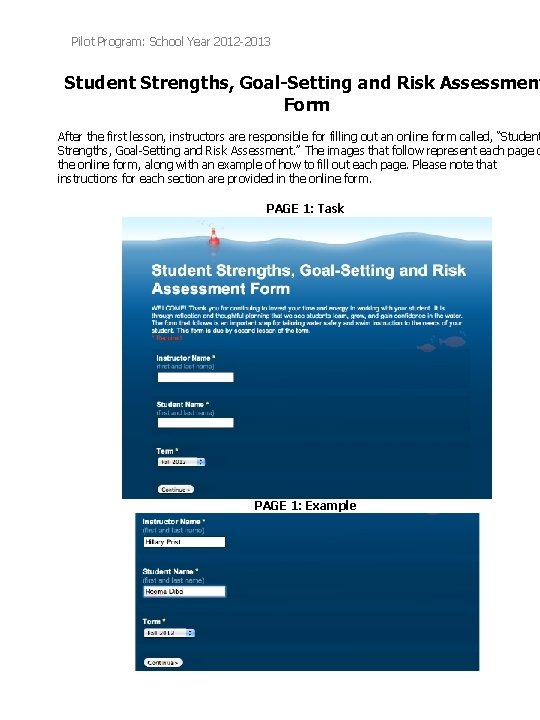
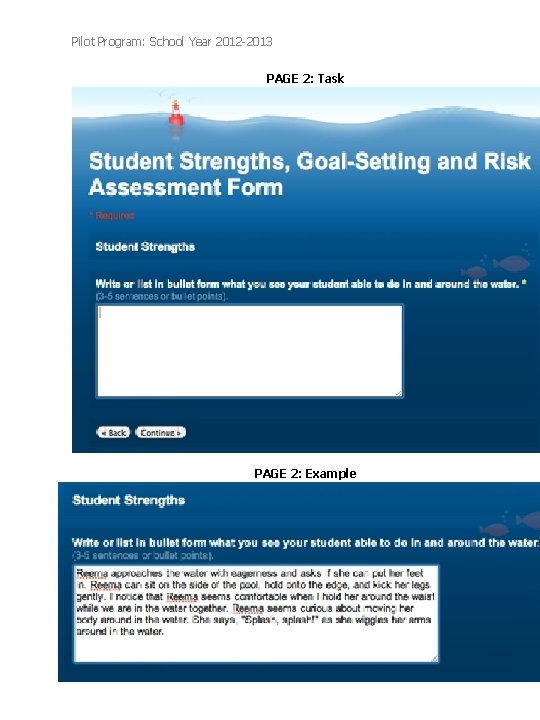
Pilot Program: School Year 2012 -2013 Student Strengths, Goal-Setting and Risk Assessment Form After the first lesson, instructors are responsible for filling out an online form called, “Student Strengths, Goal-Setting and Risk Assessment. ” The images that follow represent each page o the online form, along with an example of how to fill out each page. Please note that instructions for each section are provided in the online form. PAGE 1: Task PAGE 1: Example
Pilot Program: School Year 2012 -2013 PAGE 2: Task PAGE 2: Example
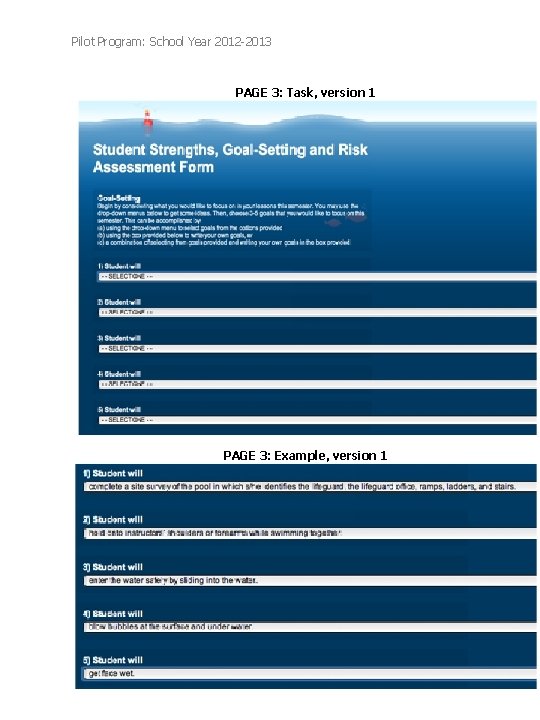
Pilot Program: School Year 2012 -2013 PAGE 3: Task, version 1 PAGE 3: Example, version 1
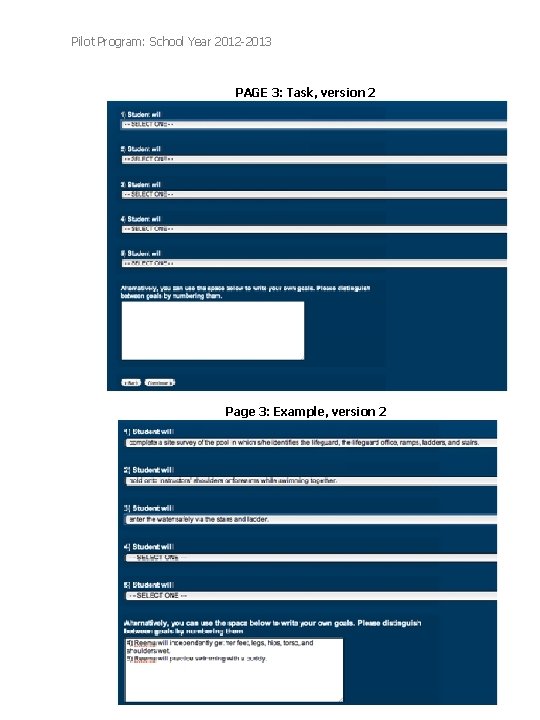
Pilot Program: School Year 2012 -2013 PAGE 3: Task, version 2 Page 3: Example, version 2
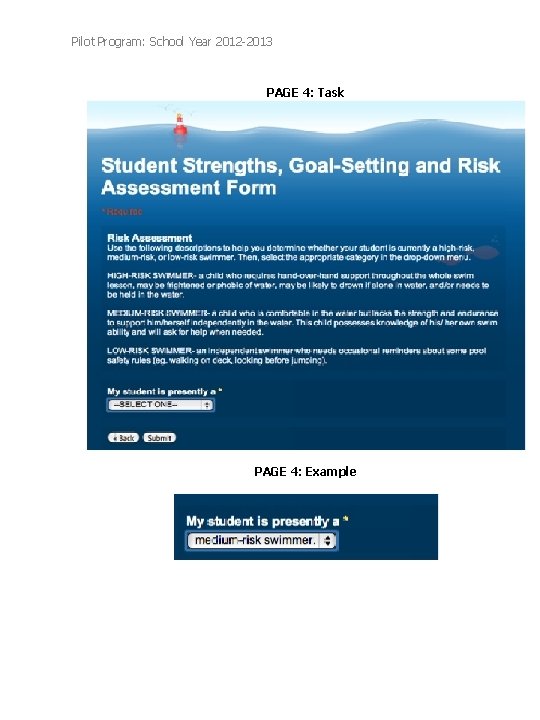
Pilot Program: School Year 2012 -2013 PAGE 4: Task PAGE 4: Example
Pilot Program: School Year 2012 -2013 Goal Adjustment and Ongoing Communication with Families Goals for students will be recorded on the online form entitled Student Strengths, Goals, and Risk Assessment. Your goals for your student may change as your studen progresses, and as you get to know them better. In this section, we will explain how to adapt goals to best meet your students’ individual needs and how to discuss your students’ progress with families. Generally, there are two situations where goal adaptation needs to occur. 1. You may have overestimated the child’s abilities and set a goal that is no achievable in a term. This may be because the child is physically unable to complete the goal, or because you personally set a goal that is too high. 2. You may have underestimated in your initial assessment and set a goal th was too easily achieved. If you overestimate your child’s ability and set a goal that is not realistically achievable within the term, you may need to break the goal into multiple smaller goals that will eventually lead to the original goal. This way, the child can still experience success at the end of the term. If you underestimated the child’s ability by setting goal that was too easily achieved, then you need to create new goals to challenge the child. As part of tracking students’ progress, it will be important for you to check-in with the family after each lesson. This is an opportunity to share what you and yo student worked on during that lesson, and what progress was made. You may also use this time to talk with the family about your goals for your student, including adjustments that have been made to the goals, and to suggest ways the family ca help their child achieve the goals. (See the section “Home to Pool Connections” in the Instructor Resources section for specific ideas). This process of tracking students’ progress will prove useful when you write your student’s Progress Report at the end of the semester.
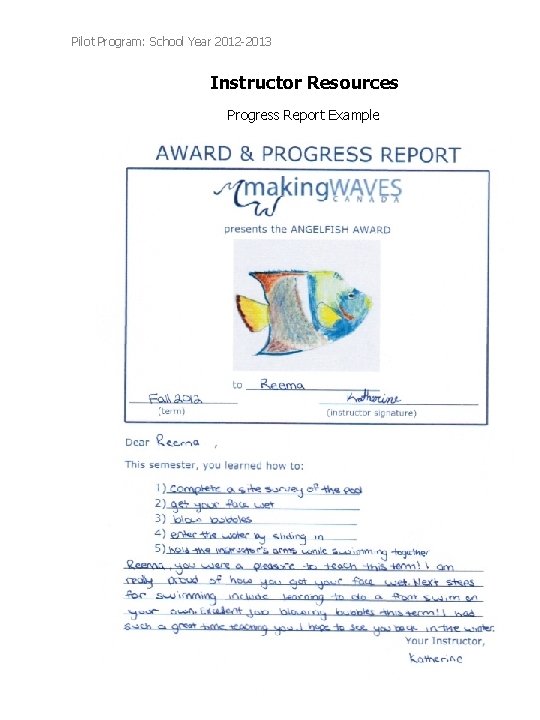
Pilot Program: School Year 2012 -2013 How to Write a Progress Report At the end of every term you will create a Progress Report for your child. T Progress Report is a similar concept to a report card, however it is not based on a pass/fail grading system. It will focus on what has been worked on during the term what has been accomplished, and goals that should be continued to be worked on future terms An example of a Progress Report can be found in the Instructor Resources section of this document. It contains a list of skills the student achieved. The narrative is written directly to the child commenting on their progress and accomplishments, well as skills to work on for the future. If a child has not accomplished the swimming goals during the term, the Progress Report can also be used to describe the child’s behaviours and experiences in the water. Whether you write about behaviour experience, or achievement, the Progress Report should reflect the initial assessmen you created at the beginning of the session, as well as the goals created throughout the session. This is to show the family that you have been working on the set goals, a constantly moving in a positive direction. The narrative portion should be the main focus of the Progress Report. common structure is the hamburger format. Top bun: Introduction - include the child’s name and something positive specifically about the child and/or their term overall Cheese: Include skills they accomplished or improved on Patty: Include skills they need to continue working on for next term, and how exactly they would improve those skills Second cheese: Include more skills they accomplished or improved on Bottom bun: Conclusion - include your positive experience with them and/or wish them good luck/great summer/winter break. Below are several examples of Progress Reports created by Making Wav instructors for you to look at and get ideas from. Remember that each progress report should be unique to the child. Please note that all progress reports are encouraged to be handwritten, as it reflects a more personal connection to the child. Examples: 1. Reema, you have come a long way this term. You can now blow bubbles with your whole face in the water for five whole seconds! Great effort on your front swim, b continue working on kicking and putting your face in the water at the same time. Excellent job on your getting the rings from the bottom of the pool all by yourself! I had so much fun teaching you this term and playing in the water, and I hope to see y back next term.
Pilot Program: School Year 2012 -2013 2. Charlotte, you were splendid to work with! Over the course of this term you hav become more comfortable in the water and pool environment. You can now identify the danger zones, lifeguards, and different methods of exiting the water - outstanding job! We worked hard on doing a bob, which is when you submerge your entire body in the water. To improve, always remember to blow bubbles whenever your face is under water. Amazing work on your jumps! It has been a pleasure teaching you, and I hope you have a fabulous summer. 3. Katherine, you were a pleasure to work with this term! You worked hard on you front swim, and as a result you can kick and blow bubbles at the same time. Great job! To continue improving your front swim, keep practicing putting your eyes in the water when blowing bubbles. Excellent work on your safe entries into the water! You put in a great effort this term, and I can’t wait to work with you in the future. Here is a bank list of phrases that you can use on your Progress Report. These can be used as a tool for creating your Progress Report but they should not be overused. Remember that the Progress Report needs to be personalized to the child. ● ● ● ● Throughout this session, Hillary has increased her comfort level in the water. Charlotte was an absolute joy to work with this session! Reema has learned various survivor skills this session. For example. . . Matthew showed splendid effort this session. Katherine was able to overcome her fear of treading water by mastering the bike riding technique. Seeing Will’s enthusiasm in the water has always been the highlight of my weeks! Thea was always so positive, and continued pushing herself without giving up. Nick has improved a lot this session but he needs to keep working on putting his face in the water. Congratulations Ben! You achieved all of your initial goals this session. Some goals you can keep working on include front crawl and back crawl. Alex was never afraid to try new things. Jessica was very nervous around water at the beginning of the term, but made amazing progress. Caitlin worked really hard on developing her skills, and will only continue to improve in the next term! John came in with a great water safety background, which made teaching him a new stroke and strength skills an absolute dream! Aidan became much more comfortable with myself and the water throughout the term, but needs to remember to trust his flotation devices and not always grab on to his swimming buddy. Keegan and I weren’t able to make as much progress as we’d hoped when i came to his floats and glides, but our lessons were non-stop giggle fests and can’t wait until next term to keep trying!
Pilot Program: School Year 2012 -2013 ● Even though this term was Alice’s first time in the water, she was able to ge over her initial fear. She is great at recognizing water safety skills, and is on her way to an awesome back float!
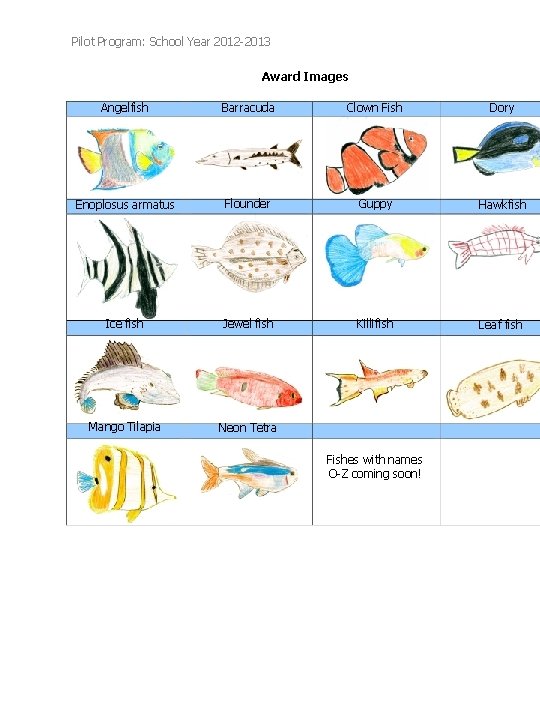
Pilot Program: School Year 2012 -2013 Award System Unlike many swimming programs that use a level- based or pass/ fail system, Maki Waves Canada uses an award system. This method of recognition ensures that we recognize our students’ progress. Given our students’ individual strengths and needs, it is unrealistic to establish a level system based on predetermined, standardized requirements. Additionally, our program is focused on strengths-based goal setting with each family, and therefore each student’s goals and achievements will differ from one another. In our award system, each student will receive an award at the end of the term provided they meet the following 2 criteria: (1) attend 75% of the lessons each term (2) maintain a positive attitude, including putting forth strong effort Our goal is for all students to obtain an award each term. Students will come away from the swimming term feeling recognized for their progress and proud of t accomplishments. The award distinction the child receives is based on the number of terms the child has completed with Making Waves. The award distinctions are names of fish, organized by letters of the alphabet A-Z. As an example, if this were the child’s first term with Making Waves, s/he would achieve the “Angelfish” award; if this is the child’s second term, s/he will achieve the “Barracuda” award. Below, you will find a complete listing of the fi and the images that will appear on the students’ awards. Note on “grandfathering” children into the award system: For the first term w implement the award system, all children will start with the Angelfish award. This means that children who have participated in previous terms at Making Waves will not have their prior experience carried over into the award system. For pilot year 2012 -2013, Executive Teams may choose to either: 1) Use the one-page award & progress report template (p. 26) or, 2) Use the duo of award and progress report page (p. 27 -28).
Pilot Program: School Year 2012 -2013 Award Images Angelfish Barracuda Clown Fish Dory Enoplosus armatus Flounder Guppy Hawkfish Ice fish Jewel fish Killifish Leaf fish Mango Tilapia Neon Tetra Fishes with names O-Z coming soon!
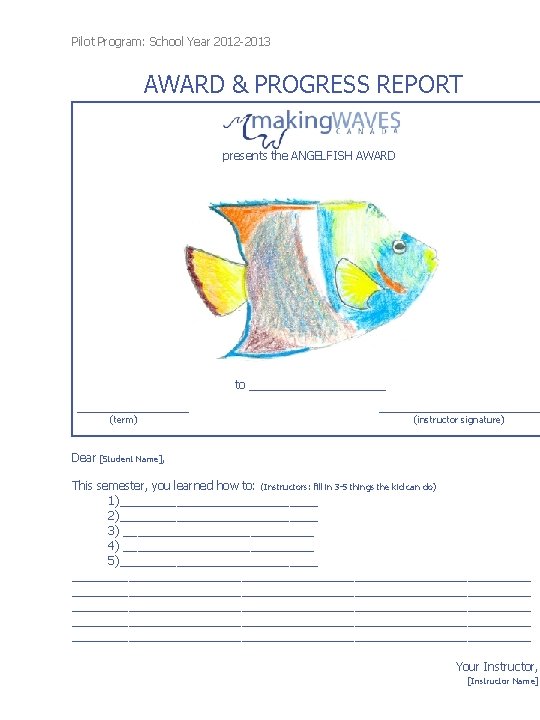
Pilot Program: School Year 2012 -2013 AWARD & PROGRESS REPORT presents the ANGELFISH AWARD to ___________ (term) _____________ (instructor signature) Dear [Student Name], This semester, you learned how to: (Instructors: fill in 3 -5 things the kid can do) 1)______________ 2)______________ 3) ______________ 4) ______________ 5)__________________________________________________________________________________________________ Your Instructor, [Instructor Name]
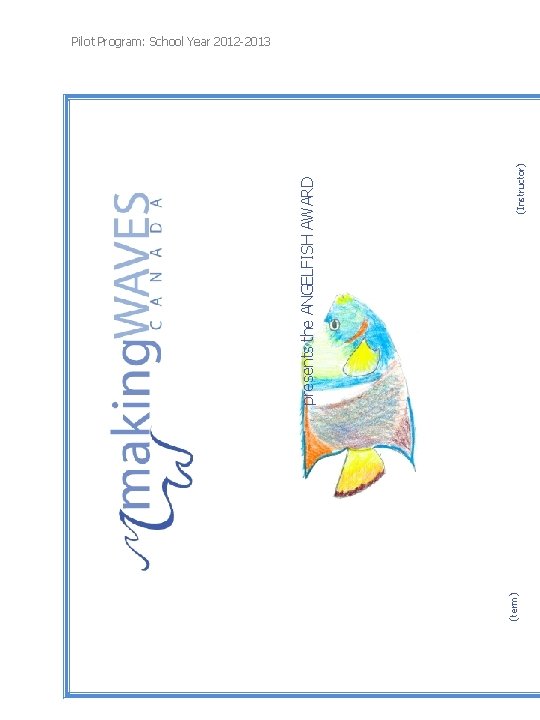
(term) __________ (Instructor) presents the ANGELFISH AWARD Pilot Program: School Year 2012 -2013
Pilot Program: School Year 2012 -2013 Progress Report Term: ____ Dear [student’s full name], CONGRATULATIONS on a successful term of Making Waves water safety and swim lessons! 1)______________ 2)______________ 3) ______________ 4) ______________ 5)______________ This semester, you learned how to: (Instructors: fill in 3 -5 things the kid can do) ______________________________________________ ______________________________________________ _______________________ Your instructor, [Instructor’s full name]
Pilot Program: School Year 2012 -2013 Information about Specific Disabilities* (*for references, see p. 63) The purpose of this section is to provide you with background information ab specific disabilities and some relevant terminology. The disability labels included in this section reflect the disabilities represented at Making Waves chapters across Canada. This is by no means a comprehensive list of disabilities. In this section, you will find definitions of specific disabilities, lists of characteristics, and, in some cases, general tips for working with a child with the specific disability mentioned. It is important to note that a person with a particular disability may no have all of the characteristics listed. Use the information provided to inform your thinking about the child with whom you work, and also be sure to generate your own holistic understandings of your student. Attention Deficit Hyperactivity Disorder (ADHD) Definition: “A neurobehavioral disorder that affects the child's ability to regulate activity level (hyperactivity), inhibit behavior (impulsivity), and/or concentrate on tasks (inattention) to a greater degree than for most kids his age or developmental level” (The Learning Disability Institute, Inc. , 2007). Characteristics of ADHD ● ● ● difficulty staying focused easily distracted forgetful difficulty with organization does not seem to listen when spoken to difficulty following instructions fidgets squirms talks incessantly constant motion impatient struggles with impulse control Relationship to learning disability: ADHD is not a learning disability but may affect how a child learns and processes information.
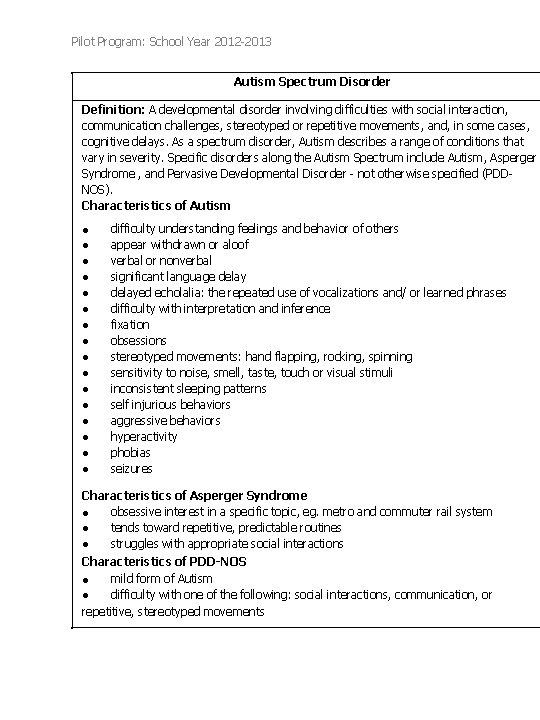
Pilot Program: School Year 2012 -2013 Autism Spectrum Disorder Definition: A developmental disorder involving difficulties with social interaction, communication challenges, stereotyped or repetitive movements, and, in some cases, cognitive delays. As a spectrum disorder, Autism describes a range of conditions that vary in severity. Specific disorders along the Autism Spectrum include Autism, Asperger Syndrome , and Pervasive Developmental Disorder - not otherwise specified (PDDNOS). Characteristics of Autism ● ● ● ● difficulty understanding feelings and behavior of others appear withdrawn or aloof verbal or nonverbal significant language delayed echolalia: the repeated use of vocalizations and/ or learned phrases difficulty with interpretation and inference fixation obsessions stereotyped movements: hand flapping, rocking, spinning sensitivity to noise, smell, taste, touch or visual stimuli inconsistent sleeping patterns self injurious behaviors aggressive behaviors hyperactivity phobias seizures Characteristics of Asperger Syndrome obsessive interest in a specific topic, eg. metro and commuter rail system ● tends toward repetitive, predictable routines ● struggles with appropriate social interactions ● Characteristics of PDD-NOS mild form of Autism ● difficulty with one of the following: social interactions, communication, or ● repetitive, stereotyped movements
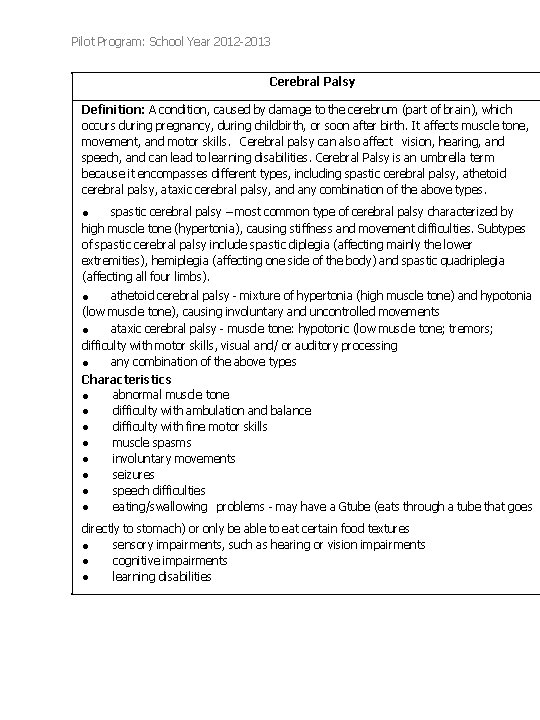
Pilot Program: School Year 2012 -2013 Cerebral Palsy Definition: A condition, caused by damage to the cerebrum (part of brain), which occurs during pregnancy, during childbirth, or soon after birth. It affects muscle tone, movement, and motor skills. Cerebral palsy can also affect vision, hearing, and speech, and can lead to learning disabilities. Cerebral Palsy is an umbrella term because it encompasses different types, including spastic cerebral palsy, athetoid cerebral palsy, ataxic cerebral palsy, and any combination of the above types. spastic cerebral palsy – most common type of cerebral palsy characterized by ● high muscle tone (hypertonia), causing stiffness and movement difficulties. Subtypes of spastic cerebral palsy include spastic diplegia (affecting mainly the lower extremities), hemiplegia (affecting one side of the body) and spastic quadriplegia (affecting all four limbs). athetoid cerebral palsy - mixture of hypertonia (high muscle tone) and hypotonia ● (low muscle tone), causing involuntary and uncontrolled movements ataxic cerebral palsy - muscle tone: hypotonic (low muscle tone; tremors; ● difficulty with motor skills, visual and/ or auditory processing any combination of the above types ● Characteristics abnormal muscle tone ● difficulty with ambulation and balance ● difficulty with fine motor skills ● muscle spasms ● involuntary movements ● ● seizures speech difficulties ● eating/swallowing problems - may have a Gtube (eats through a tube that goes ● directly to stomach) or only be able to eat certain food textures sensory impairments, such as hearing or vision impairments ● cognitive impairments ● learning disabilities ●
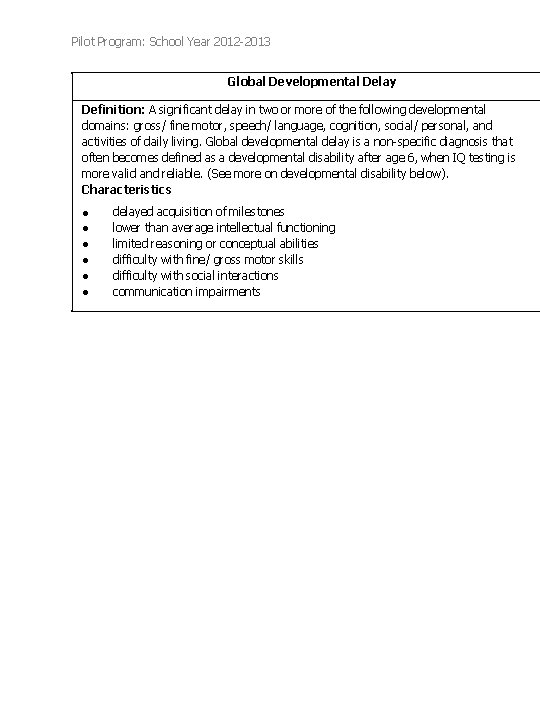
Pilot Program: School Year 2012 -2013 Global Developmental Delay Definition: A significant delay in two or more of the following developmental domains: gross/ fine motor, speech/ language, cognition, social/ personal, and activities of daily living. Global developmental delay is a non-specific diagnosis that often becomes defined as a developmental disability after age 6, when IQ testing is more valid and reliable. (See more on developmental disability below). Characteristics ● ● ● delayed acquisition of milestones lower than average intellectual functioning limited reasoning or conceptual abilities difficulty with fine/ gross motor skills difficulty with social interactions communication impairments
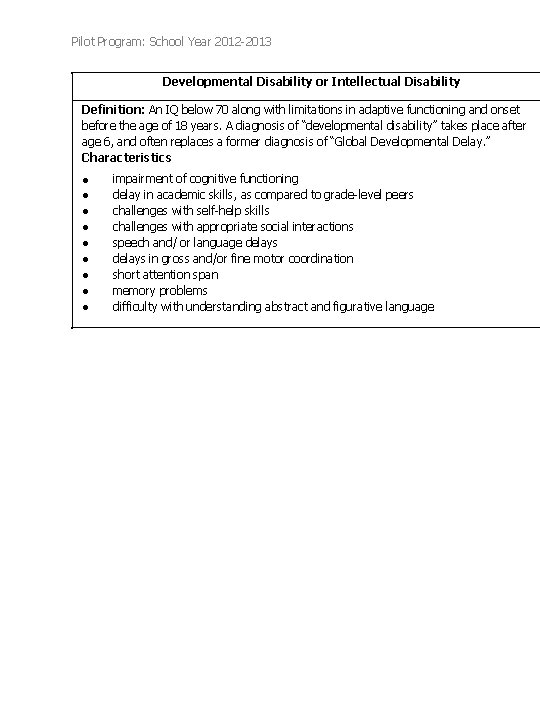
Pilot Program: School Year 2012 -2013 Developmental Disability or Intellectual Disability Definition: An IQ below 70 along with limitations in adaptive functioning and onset before the age of 18 years. A diagnosis of “developmental disability” takes place after age 6, and often replaces a former diagnosis of “Global Developmental Delay. ” Characteristics ● ● ● ● ● impairment of cognitive functioning delay in academic skills, as compared to grade-level peers challenges with self-help skills challenges with appropriate social interactions speech and/ or language delays in gross and/or fine motor coordination short attention span memory problems difficulty with understanding abstract and figurative language
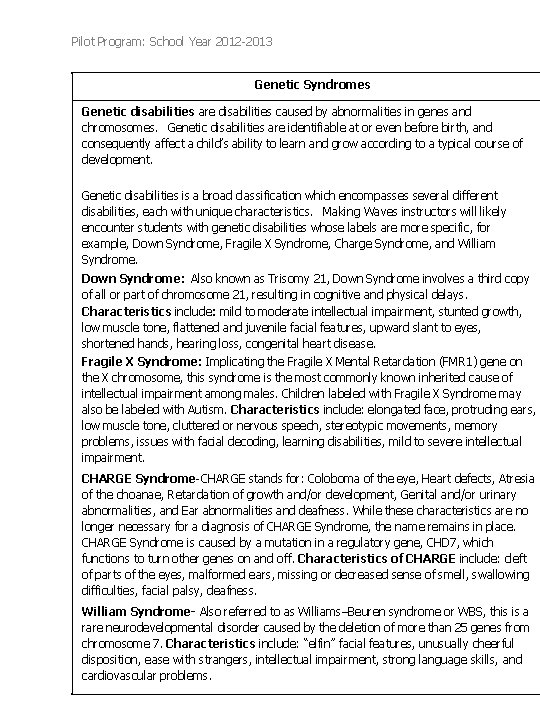
Pilot Program: School Year 2012 -2013 Genetic Syndromes Genetic disabilities are disabilities caused by abnormalities in genes and chromosomes. Genetic disabilities are identifiable at or even before birth, and consequently affect a child’s ability to learn and grow according to a typical course of development. Genetic disabilities is a broad classification which encompasses several different disabilities, each with unique characteristics. Making Waves instructors will likely encounter students with genetic disabilities whose labels are more specific, for example, Down Syndrome, Fragile X Syndrome, Charge Syndrome, and William Syndrome. Down Syndrome: Also known as Trisomy 21, Down Syndrome involves a third copy of all or part of chromosome 21, resulting in cognitive and physical delays. Characteristics include: mild to moderate intellectual impairment, stunted growth, low muscle tone, flattened and juvenile facial features, upward slant to eyes, shortened hands, hearing loss, congenital heart disease. Fragile X Syndrome: Implicating the Fragile X Mental Retardation (FMR 1) gene on the X chromosome, this syndrome is the most commonly known inherited cause of intellectual impairment among males. Children labeled with Fragile X Syndrome may also be labeled with Autism. Characteristics include: elongated face, protruding ears, low muscle tone, cluttered or nervous speech, stereotypic movements, memory problems, issues with facial decoding, learning disabilities, mild to severe intellectual impairment. CHARGE Syndrome-CHARGE stands for: Coloboma of the eye, Heart defects, Atresia of the choanae, Retardation of growth and/or development, Genital and/or urinary abnormalities, and Ear abnormalities and deafness. While these characteristics are no longer necessary for a diagnosis of CHARGE Syndrome, the name remains in place. CHARGE Syndrome is caused by a mutation in a regulatory gene, CHD 7, which functions to turn other genes on and off. Characteristics of CHARGE include: cleft of parts of the eyes, malformed ears, missing or decreased sense of smell, swallowing difficulties, facial palsy, deafness. William Syndrome- Also referred to as Williams–Beuren syndrome or WBS, this is a rare neurodevelopmental disorder caused by the deletion of more than 25 genes from chromosome 7. Characteristics include: “elfin” facial features, unusually cheerful disposition, ease with strangers, intellectual impairment, strong language skills, and cardiovascular problems.
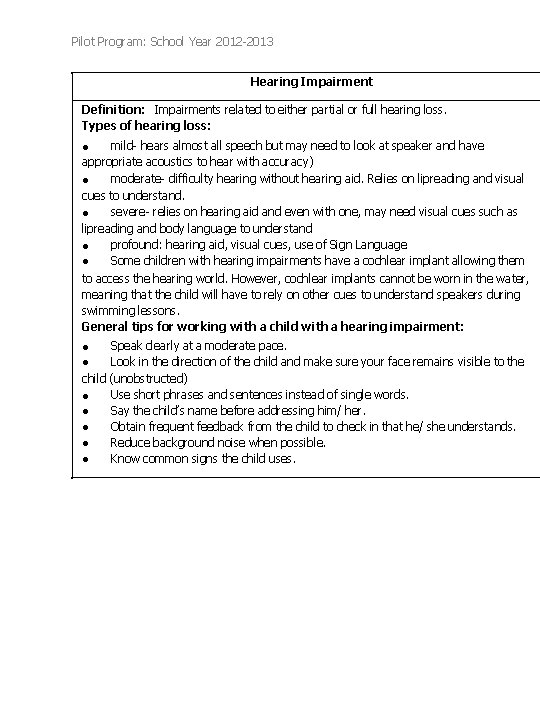
Pilot Program: School Year 2012 -2013 Hearing Impairment Definition: Impairments related to either partial or full hearing loss. Types of hearing loss: mild- hears almost all speech but may need to look at speaker and have ● appropriate acoustics to hear with accuracy) moderate- difficulty hearing without hearing aid. Relies on lipreading and visual ● cues to understand. severe- relies on hearing aid and even with one, may need visual cues such as ● lipreading and body language to understand profound: hearing aid, visual cues, use of Sign Language ● Some children with hearing impairments have a cochlear implant allowing them ● to access the hearing world. However, cochlear implants cannot be worn in the water, meaning that the child will have to rely on other cues to understand speakers during swimming lessons. General tips for working with a child with a hearing impairment: Speak clearly at a moderate pace. ● Look in the direction of the child and make sure your face remains visible to the ● child (unobstructed) Use short phrases and sentences instead of single words. ● Say the child’s name before addressing him/ her. ● Obtain frequent feedback from the child to check in that he/ she understands. ● Reduce background noise when possible. ● Know common signs the child uses. ●
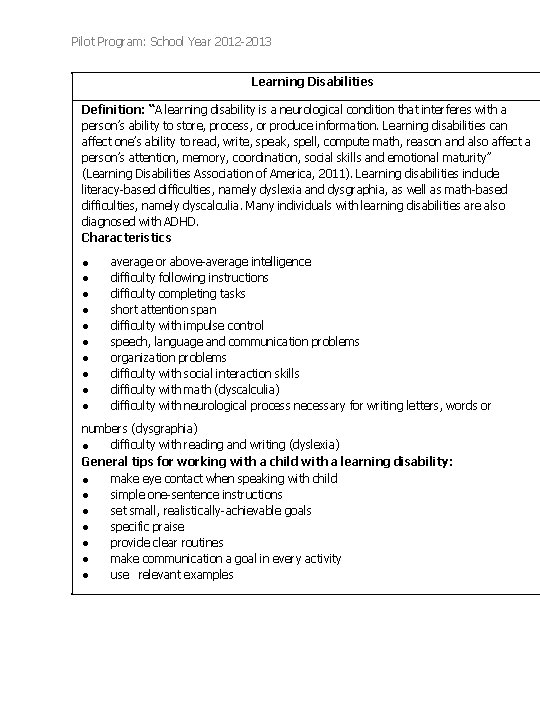
Pilot Program: School Year 2012 -2013 Learning Disabilities Definition: “A learning disability is a neurological condition that interferes with a person’s ability to store, process, or produce information. Learning disabilities can affect one’s ability to read, write, speak, spell, compute math, reason and also affect a person’s attention, memory, coordination, social skills and emotional maturity” (Learning Disabilities Association of America, 2011). Learning disabilities include literacy-based difficulties, namely dyslexia and dysgraphia, as well as math-based difficulties, namely dyscalculia. Many individuals with learning disabilities are also diagnosed with ADHD. Characteristics ● ● ● ● ● average or above-average intelligence difficulty following instructions difficulty completing tasks short attention span difficulty with impulse control speech, language and communication problems organization problems difficulty with social interaction skills difficulty with math (dyscalculia) difficulty with neurological process necessary for writing letters, words or numbers (dysgraphia) difficulty with reading and writing (dyslexia) ● General tips for working with a child with a learning disability: make eye contact when speaking with child ● simple one-sentence instructions ● set small, realistically-achievable goals ● specific praise ● provide clear routines ● make communication a goal in every activity ● use relevant examples ●
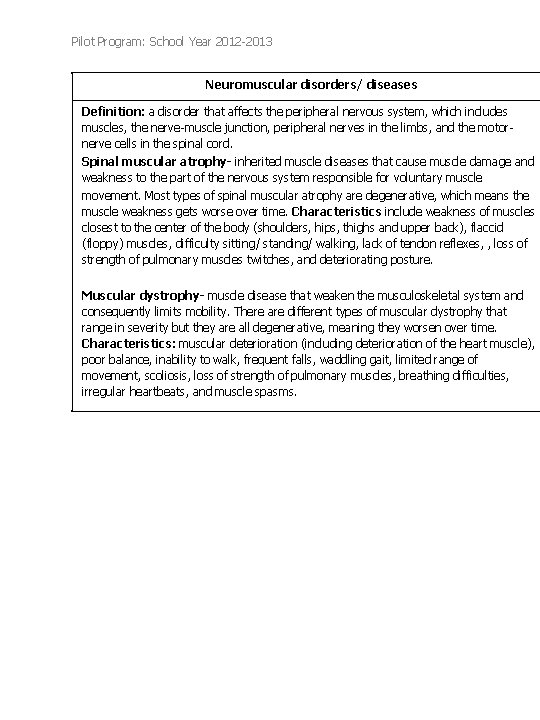
Pilot Program: School Year 2012 -2013 Neuromuscular disorders/ diseases Definition: a disorder that affects the peripheral nervous system, which includes muscles, the nerve-muscle junction, peripheral nerves in the limbs, and the motornerve cells in the spinal cord. Spinal muscular atrophy- inherited muscle diseases that cause muscle damage and weakness to the part of the nervous system responsible for voluntary muscle movement. Most types of spinal muscular atrophy are degenerative, which means the muscle weakness gets worse over time. Characteristics include weakness of muscles closest to the center of the body (shoulders, hips, thighs and upper back), flaccid (floppy) muscles, difficulty sitting/ standing/ walking, lack of tendon reflexes, , loss of strength of pulmonary muscles twitches, and deteriorating posture. Muscular dystrophy- muscle disease that weaken the musculoskeletal system and consequently limits mobility. There are different types of muscular dystrophy that range in severity but they are all degenerative, meaning they worsen over time. Characteristics: muscular deterioration (including deterioration of the heart muscle), poor balance, inability to walk, frequent falls, waddling gait, limited range of movement, scoliosis, loss of strength of pulmonary muscles, breathing difficulties, irregular heartbeats, and muscle spasms.
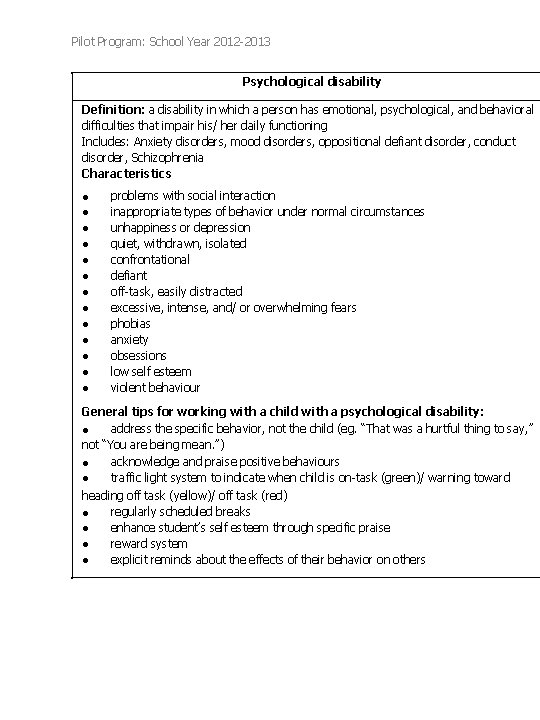
Pilot Program: School Year 2012 -2013 Psychological disability Definition: a disability in which a person has emotional, psychological, and behavioral difficulties that impair his/ her daily functioning Includes: Anxiety disorders, mood disorders, oppositional defiant disorder, conduct disorder, Schizophrenia Characteristics ● ● ● ● problems with social interaction inappropriate types of behavior under normal circumstances unhappiness or depression quiet, withdrawn, isolated confrontational defiant off-task, easily distracted excessive, intense, and/ or overwhelming fears phobias anxiety obsessions low self esteem violent behaviour General tips for working with a child with a psychological disability: address the specific behavior, not the child (eg. “That was a hurtful thing to say, ” ● not “You are being mean. ”) acknowledge and praise positive behaviours ● traffic light system to indicate when child is on-task (green)/ warning toward ● heading off task (yellow)/ off task (red) regularly scheduled breaks ● enhance student’s self esteem through specific praise ● reward system ● explicit reminds about the effects of their behavior on others ●
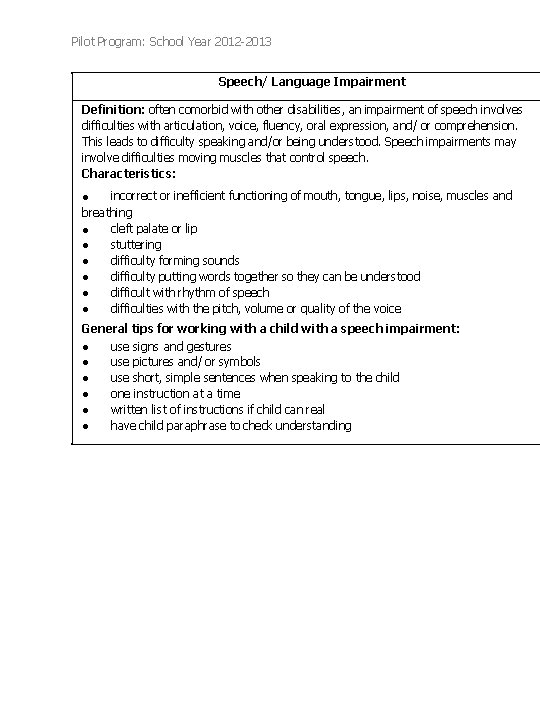
Pilot Program: School Year 2012 -2013 Speech/ Language Impairment Definition: often comorbid with other disabilities, an impairment of speech involves difficulties with articulation, voice, fluency, oral expression, and/ or comprehension. This leads to difficulty speaking and/or being understood. Speech impairments may involve difficulties moving muscles that control speech. Characteristics: incorrect or inefficient functioning of mouth, tongue, lips, noise, muscles and ● breathing cleft palate or lip ● ● stuttering difficulty forming sounds ● difficulty putting words together so they can be understood ● difficult with rhythm of speech ● difficulties with the pitch, volume or quality of the voice ● General tips for working with a child with a speech impairment: ● use signs and gestures use pictures and/ or symbols ● use short, simple sentences when speaking to the child ● ● one instruction at a time written list of instructions if child can real ● have child paraphrase to check understanding ●
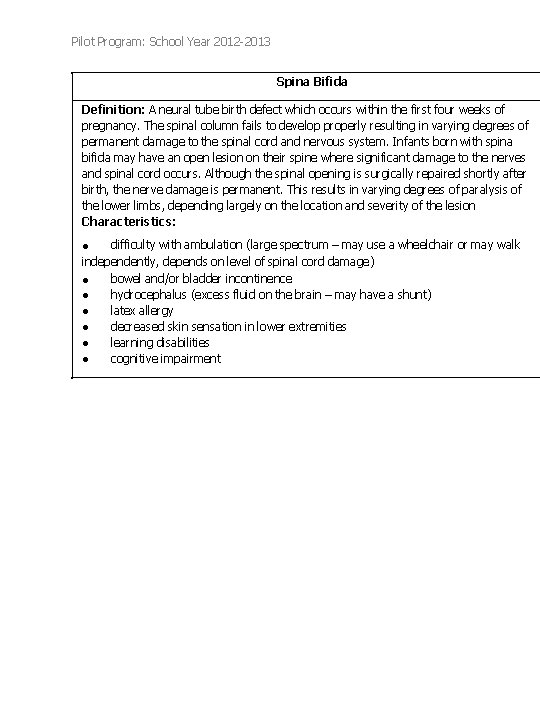
Pilot Program: School Year 2012 -2013 Spina Bifida Definition: A neural tube birth defect which occurs within the first four weeks of pregnancy. The spinal column fails to develop properly resulting in varying degrees of permanent damage to the spinal cord and nervous system. Infants born with spina bifida may have an open lesion on their spine where significant damage to the nerves and spinal cord occurs. Although the spinal opening is surgically repaired shortly after birth, the nerve damage is permanent. This results in varying degrees of paralysis of the lower limbs, depending largely on the location and severity of the lesion Characteristics: difficulty with ambulation (large spectrum – may use a wheelchair or may walk ● independently, depends on level of spinal cord damage) bowel and/or bladder incontinence ● hydrocephalus (excess fluid on the brain – may have a shunt) ● latex allergy ● decreased skin sensation in lower extremities ● learning disabilities ● cognitive impairment ●
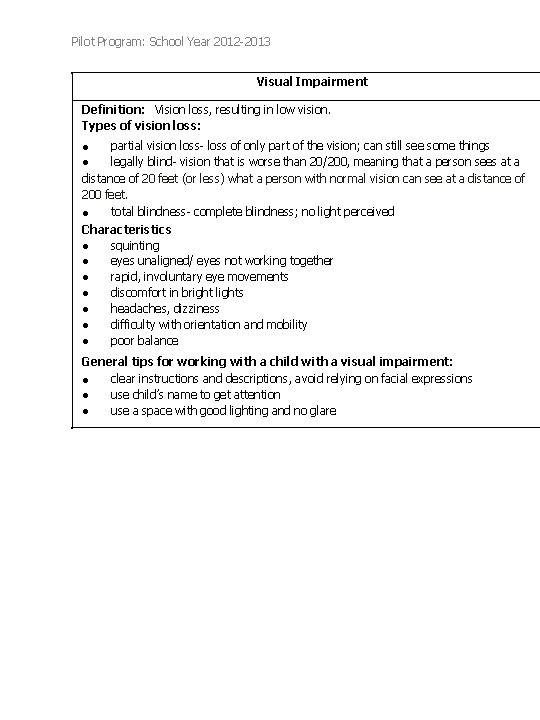
Pilot Program: School Year 2012 -2013 Visual Impairment Definition: Vision loss, resulting in low vision. Types of vision loss: partial vision loss- loss of only part of the vision; can still see some things ● legally blind- vision that is worse than 20/200, meaning that a person sees at a ● distance of 20 feet (or less) what a person with normal vision can see at a distance of 200 feet. total blindness- complete blindness; no light perceived ● Characteristics ● squinting eyes unaligned/ eyes not working together ● rapid, involuntary eye movements ● discomfort in bright lights ● headaches, dizziness ● difficulty with orientation and mobility ● poor balance ● General tips for working with a child with a visual impairment: clear instructions and descriptions, avoid relying on facial expressions ● use child’s name to get attention ● use a space with good lighting and no glare ●
Pilot Program: School Year 2012 -2013 Approaching Challenging Behavior It is important to remember that all behavior is communication. When a child’s behavio strikes you as challenging, it can be helpful to think about the function of the behavior, that is, ask yourself, “why might the child be acting this way? ” Your observations of the child as well as conversations with the parents of the child may help you to understand the purpose of the child’s behavior. Then, brainstorm possible alternatives to the behavior, in effect, more functional and safe actions or experiences that could replace the problem behavior. Below, find 1) a non-comprehensive list of challenging behaviors you may encounter 2) a more thorough analysis of each challenging behavior listed, including what the function of the behavior may be, and 2 -3 possible solutions for addressing these behaviors. 1) List of Challenging Behaviors You May Encounter ● ● ● ● ● Aggression toward instructor or other students Temper tantrum/ meltdown/ crisis Eloping (i. e. running away) Shyness and reluctance to leave parent Resistance to getting in the water Refusal to get out of water Drinking the water Holding onto instructor too tightly Off-task/ distracted behavior 2) Ways to Understand Address Challenging Behavior Aggressive behavior, eg. kicking instructor or pushing other children Understand there any number of reasons a child might act aggressively. A child may be seeking sensory input or may be experiencing sensory overload. The child may feel threatened or may be afraid. It can be helpful to imagine the possibilities for why the child may be acting aggressively as you plan how you will respond to this. Possible solutions ● designate a safe area for the child to swim with you, perhaps somewhere away from other children, and remind the child that he is safe with you.
Pilot Program: School Year 2012 -2013 channel kicking into kicking legs in the water. This could be done by making a game out of it by saying something like, “Show me your angry kicks! Can you do your angry kicks while I count until 20? ” ● Give the child a break from the water and do dryland exercises (eg. jumping jacks, windmill arms, etc. ) to release energy and to refocus. Aggressive behavior, eg. kicking instructor or pushing other children Temper tantrum/ meltdown/ crisis ● Understand that temper tantrums, meltdowns and crises can occur because a child’s basic needs are not being met. For example, a child may be hungry, tired, or ill. A child may feel unheard, misunderstood, frightened, anxious, or overwhelmed, leading to these types of behaviors. Possible solutions Identify a soothing object, song, or phrase that can be used to bring the child down from this escalated state. ● Validate the child’s feelings while also trying to calm him/ her down. Try phrases such as, “You’re okay, ” or “You’re safe. ” Try to avoid addressing the problematic behavior while the child is still agitated. ● Once the child has calmed down, speak with him about alternative solutions when he feels this way and how he will let you know. ● Eloping, i. e. running away Understand the function of this particular behavior is often escape. The child may feel uncomfortable, intimidated, or even threatened by the expectations placed on him/ her. Possible solutions Learn more about the child’s interests and preferences. What motivates him/ her? Draw upon these interests to make lessons more dynamic and interesting. ● In the moment: retrieve the child and bring child back to the area where he/ she should be. Avoid admonishing the child, as paying attention to this issue can reinforce it. Once at the desired location, resume activities and ●
Pilot Program: School Year 2012 -2013 provide the child with positive feedback for appropriate/ expected behavior (eg. “I like how you are keeping your body safe in the pool. ”) Eloping, i. e. running away Shyness and reluctance to leave parent Understand new experiences can feel intimidating, overwhelming and scary for children. A child’s prior experiences with water and with immersing himself in environments with many other children can shape how a child approaches the experience of swim lessons. Possible solutions Include the parent in lessons, by inviting them to walk their children to the pool entrance and watch from the side of the pool. Gradually increase the parent’s distance from the side of the pool over the course of lessons. ● Make a puppet (out of a bathing cap!) or bring along another prop that will engage the child and thus serve as a connector between you and the child. ● Resistance to getting in the water Understand children may feel overwhelmed and over stimulated by the pool environment. Children may also feel afraid of the water, especially depending upon their prior experiences with swimming and bathing. Children may also feel anxious about the routine and expectations once they get into the water. Possible solutions: Engage in water familiarization and water play activities prior to pool entry. Consider using buckets, sponges, watering cans, toy boats, rubber ducks, etc. ● Identify features of pool environment that help to keep us safe, such as lifeguards, the First Aid Center, and stairs/ ladders to enter into the pool safely. ● Present the child with a clear sequence (orally and visually) of what he/she will do: go down ladder, hold onto wall, reach for instructor’s hands, hold instructor’s hands, swim with instructor. ●
Pilot Program: School Year 2012 -2013 Refusing to get out of the water Understand that transitions can be hard for children. The moment they feel adapted to one particular activity, it is time to move or change. Transitions can feel frustrating and even daunting for children because they do not know what to expect following the transition. Possible solutions: Implement a specific routine for getting out of the water, something that will be the same each week and hence predictable for the child. ● Give the child a choice (or the illusion thereof): we can get out of the pool by counting to 10 or by counting to 15. We can get out of the pool by singing the ABCs or Row, Row Your Boat. ● Invent a game or a “challenge” where the winner has to get out of the pool first. Draw upon the child’s imagination and specific interests to motivate them in this objective. ● Holding onto instructor too tightly Understand that children may feel hesitant or afraid in the water and will hence latch onto an instructor in order to feel secure. Possible solutions: Make use of tot dots, water tables, kiddie pools, zero depth entries, stairs, or ladders to help children feel comfortable in the water. ● Teach children to hold onto instructor’s shoulders, first, forearms next, and hands, eventually. Practice this before entering the water and reinforce once in the pool. ● Drinking the pool water Understand that the child may be communicating that he/ she is thirsty. The child may also enjoy the sensory experience of how the water feels in his mouth or on his face. The child may also be playing, thinking that drinking the water in the pool is fun (in the same way children spit water at each other for fun). Possible solutions:
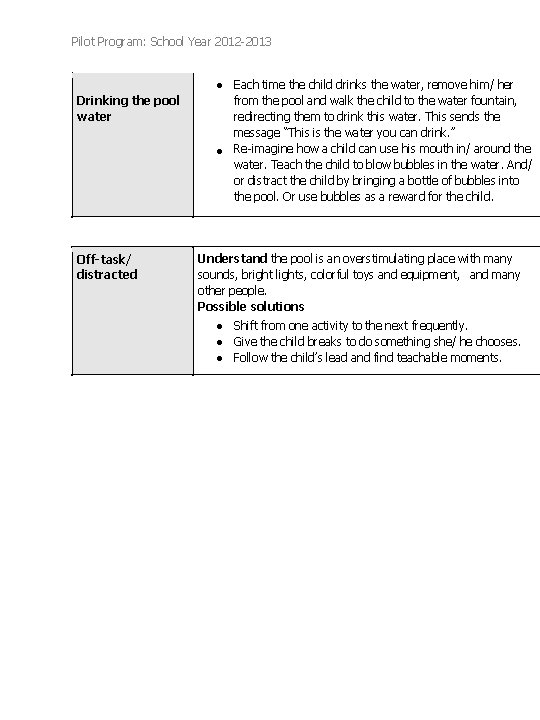
Pilot Program: School Year 2012 -2013 Each time the child drinks the water, remove him/ her from the pool and walk the child to the water fountain, redirecting them to drink this water. This sends the message “This is the water you can drink. ” ● Re-imagine how a child can use his mouth in/ around the water. Teach the child to blow bubbles in the water. And/ or distract the child by bringing a bottle of bubbles into the pool. Or use bubbles as a reward for the child. ● Drinking the pool water Off-task/ distracted Understand the pool is an overstimulating place with many sounds, bright lights, colorful toys and equipment, and many other people. Possible solutions ● ● ● Shift from one activity to the next frequently. Give the child breaks to do something she/ he chooses. Follow the child’s lead and find teachable moments.
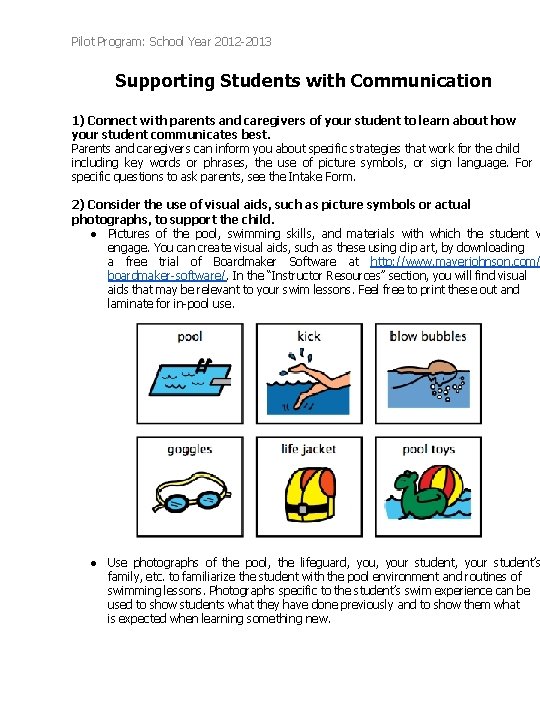
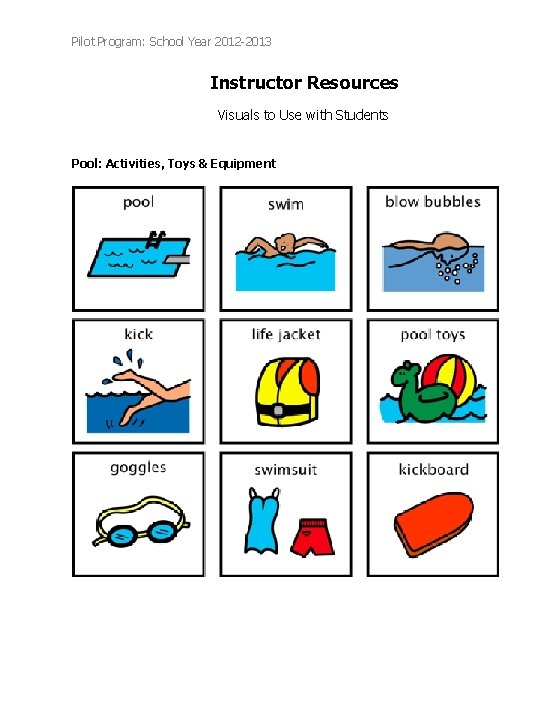
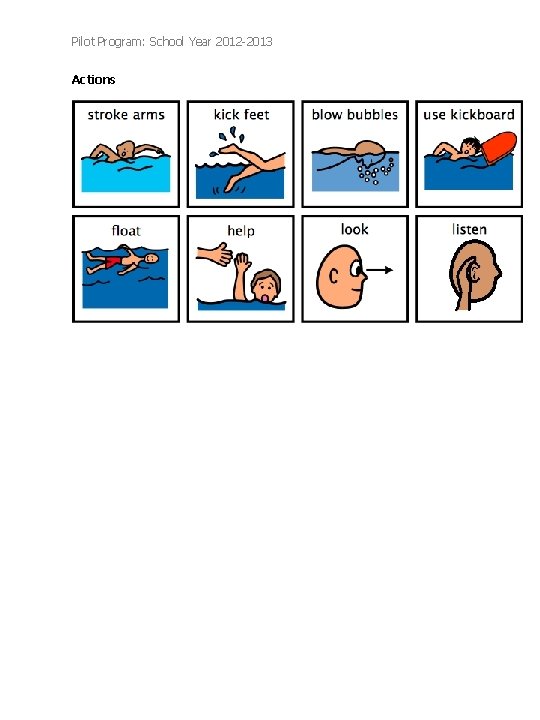
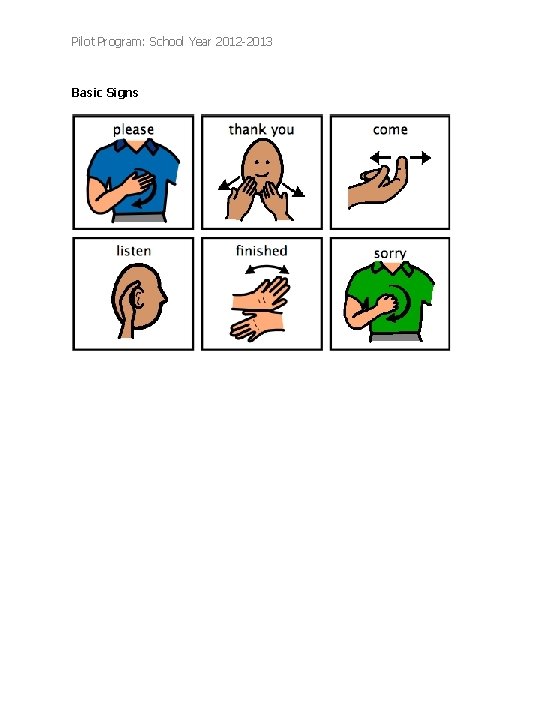
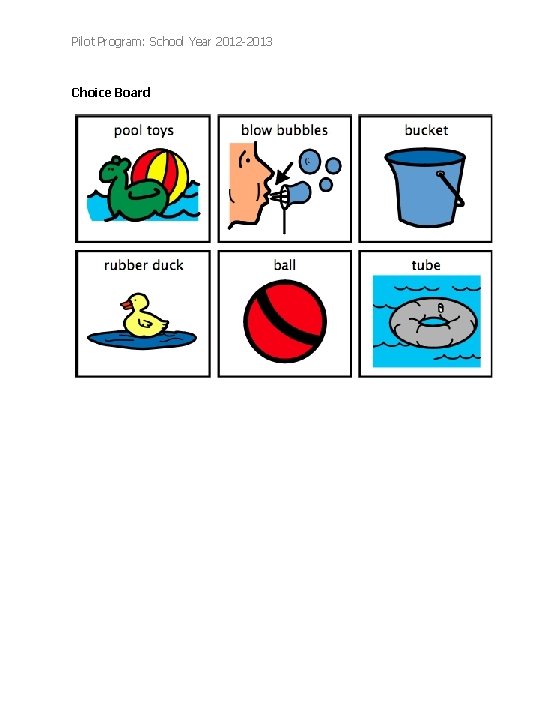
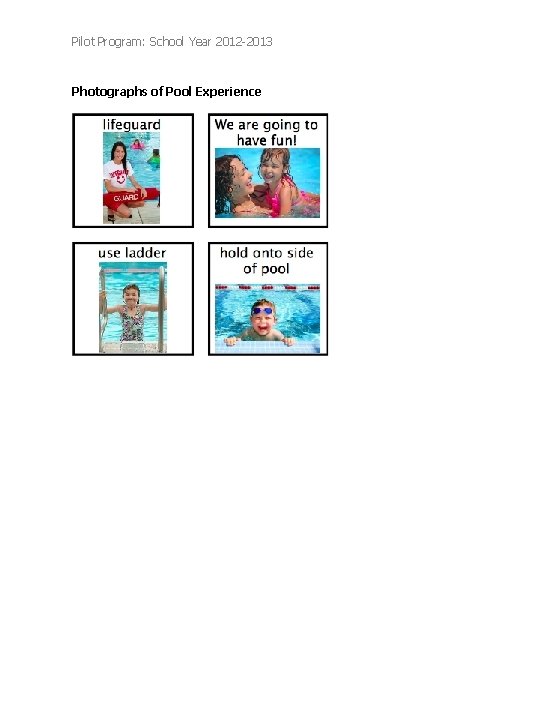
Pilot Program: School Year 2012 -2013 Supporting Students with Communication 1) Connect with parents and caregivers of your student to learn about how your student communicates best. Parents and caregivers can inform you about specific strategies that work for the child including key words or phrases, the use of picture symbols, or sign language. For specific questions to ask parents, see the Intake Form. 2) Consider the use of visual aids, such as picture symbols or actual photographs, to support the child. ● Pictures of the pool, swimming skills, and materials with which the student w engage. You can create visual aids, such as these using clip art, by downloading a free trial of Boardmaker Software at http: //www. mayerjohnson. com/ boardmaker-software/. In the “Instructor Resources” section, you will find visual aids that may be relevant to your swim lessons. Feel free to print these out and laminate for in-pool use. ● Use photographs of the pool, the lifeguard, your student, your student’s family, etc. to familiarize the student with the pool environment and routines of swimming lessons. Photographs specific to the student’s swim experience can be used to show students what they have done previously and to show them what is expected when learning something new.
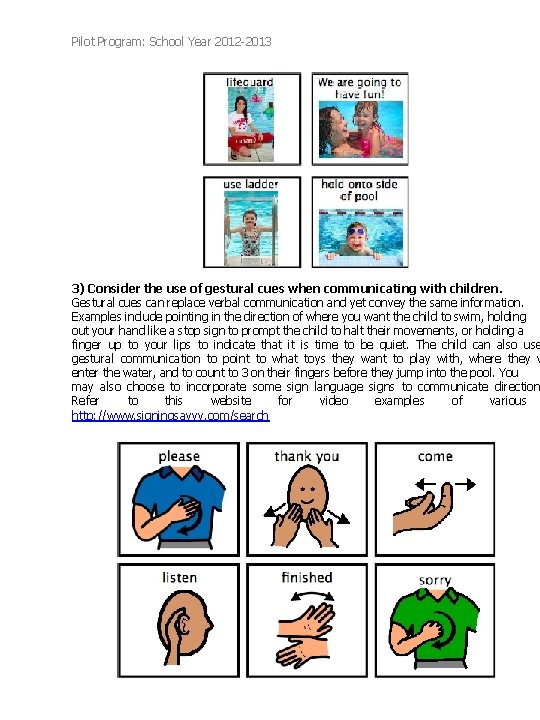
Pilot Program: School Year 2012 -2013 3) Consider the use of gestural cues when communicating with children. Gestural cues can replace verbal communication and yet convey the same information. Examples include pointing in the direction of where you want the child to swim, holding out your hand like a stop sign to prompt the child to halt their movements, or holding a finger up to your lips to indicate that it is time to be quiet. The child can also use gestural communication to point to what toys they want to play with, where they w enter the water, and to count to 3 on their fingers before they jump into the pool. You may also choose to incorporate some sign language signs to communicate direction Refer to this website for video examples of various http: //www. signingsavvy. com/search
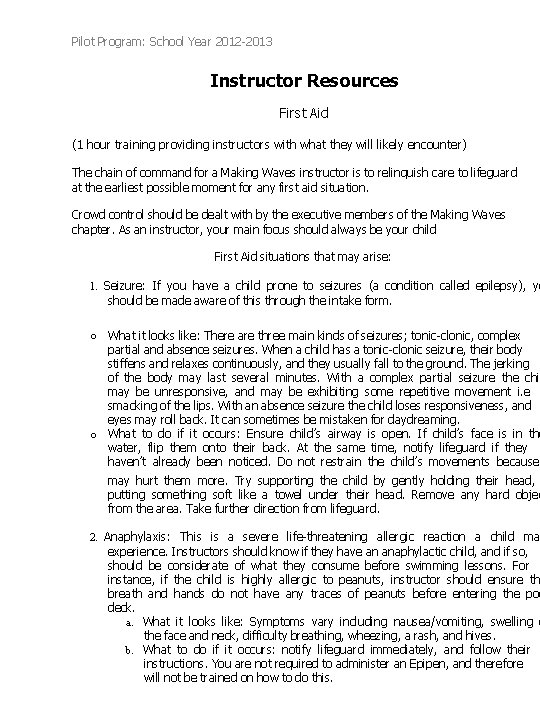
Pilot Program: School Year 2012 -2013 Instructor Resources First Aid (1 hour training providing instructors with what they will likely encounter) The chain of command for a Making Waves instructor is to relinquish care to lifeguard at the earliest possible moment for any first aid situation. Crowd control should be dealt with by the executive members of the Making Waves chapter. As an instructor, your main focus should always be your child First Aid situations that may arise: 1. Seizure: If you have a child prone to seizures (a condition called epilepsy), yo should be made aware of this through the intake form. What it looks like: There are three main kinds of seizures; tonic-clonic, complex partial and absence seizures. When a child has a tonic-clonic seizure, their body stiffens and relaxes continuously, and they usually fall to the ground. The jerking of the body may last several minutes. With a complex partial seizure the chi may be unresponsive, and may be exhibiting some repetitive movement i. e smacking of the lips. With an absence seizure the child loses responsiveness, and eyes may roll back. It can sometimes be mistaken for daydreaming. ○ What to do if it occurs: Ensure child’s airway is open. If child’s face is in the water, flip them onto their back. At the same time, notify lifeguard if they haven’t already been noticed. Do not restrain the child’s movements because ○ may hurt them more. Try supporting the child by gently holding their head, putting something soft like a towel under their head. Remove any hard objec from the area. Take further direction from lifeguard. 2. Anaphylaxis: This is a severe life-threatening allergic reaction a child ma experience. Instructors should know if they have an anaphylactic child, and if so, should be considerate of what they consume before swimming lessons. For instance, if the child is highly allergic to peanuts, instructor should ensure th breath and hands do not have any traces of peanuts before entering the poo deck. a. What it looks like: Symptoms vary including nausea/vomiting, swelling o the face and neck, difficulty breathing, wheezing, a rash, and hives. b. What to do if it occurs: notify lifeguard immediately, and follow their instructions. You are not required to administer an Epipen, and therefore will not be trained on how to do this.
Pilot Program: School Year 2012 -2013 3. Child swallowing water: First teach your child how to blow bubbles. If child does not understand how to blow bubbles, teach them to close their mouth when their head goes underwater. Continue working on alternative ways of communicating the concept of blowing bubbles to your child throughout the term. If child is still swallowing a lot of water, limit the number of times you ask your child to p their face in the water. 4. Child vomits in the water: Notify a lifeguard on duty immediately and remove child from the water. 5. Lips turning blue: Take the child out of the water, wrap them in a towel, and notify the child’s family. 6. General falls on deck: Pick the child up/ let them get up on their own, ask lifeguards to get you ice, and notify the child’s family.
Pilot Program: School Year 2012 -2013 Instructor Resources How to Structure Time in Lessons Making Waves lessons vary in duration depending on the chapter. Typically, lessons las between 30 and 45 minutes. Lesson structure will vary depending on each student’s unique modes of learning. It is recommended to keep the structure of lessons consistent and predictable so that students become adjusted to the routines and so tha they are aware of the expectations. The example that follows provides a snapshot of how you might structure your time for a 35 -minute lesson. This lesson is based on a typical lesson, and is therefore not representative of the lesson structure for the first day. I. Introduction (4 minutes) -Instructor, student and student’s family greet each other and check-in briefly. -Instructor engages student in a brief site survey by asking the student what s/he notices around the pool (eg. lifeguard, ramp, stairs, ladder, location to meet up with family at the end of the lesson). -Student asks and obtains instructor’s permission to enter the water. -Student practices entering the water safely, using the ladder, with instructor coaching. II. Warm-up (3 minutes) -Instructor reminds student of safe way to hold onto instructor (by instructor’s forearms) and student practices this. -Instructor and student sing “The Kids in the Pool” (to the tune of “The Wheels on the Bus”) to engage student in a variety of actions to warm-up the body and increase bodily awareness in the water. III. Kicking practice (8 minutes) -Student kicks legs by sitting at the edge of the pool, with instructor coaching. -Student kicks legs by holding onto the side of the pool, with instructor coaching. -Student kicks legs while holding onto instructor’s forearms, with instructor coaching. IV. Game: kicking (2 minutes) -Instructor and student play “Red Light, Green Light” to practice kicking legs at a variety of speeds. V. Life jacket practice (8 minutes)
Pilot Program: School Year 2012 -2013 -Student practices exiting the pool stairs safely, with instructor coaching, to retrieve life jacket. -Student puts on life jacket, with instructor assistance. -Student re-enters the water safely, with instructor coaching. -Student practices floating on back and kicking with life jacket on. -Student exits the pool again to take off life jacket and return it to the appropriate spot. VI. Game: getting face wet (3 minutes) -Instructor engages student in a game “Can you put your _______ in the water? ” to help student practice getting his/ her face wet. Student practices getting cheeks, nose and mouth wet. VII. Choice time (3 minutes) -Instructor provides student with a choice for the end of the lesson: jumping into the pool, floating with a noodle, or floating on a floating pool mat. VIII. Closing (4 minutes) -Student puts away materials from choice time. -Student exits the water safely using the ladder and waiting his/ her turn as other students exit from their lessons. -Student and instructor return to the meeting spot and check in with family about the lesson. -Instructor, student, and student’s family say goodbye and confirm lesson for the following week.
Pilot Program: School Year 2012 -2013 Instructor Resources Home to Pool Connections Swimming lessons are a great way for children to learn swimming skills in a safe environment. To make learning more effective, you as an instructor are encouraged to talk to parents about swimming skills they can practice at home with their children. You are also encouraged to talk to them safe practices in the pool. Weekly lessons, alo with at home practice, and some pool practice with the family, will benefit the child and will help them in the path of mastering swimming. Below is a list of some skills students can practice with their family in their home. ● ● ● To develop blowing bubbles in the pool, children can practice blowing air through a straw. They can also blow toys across the bath, and put their chin in the bath to blow bubbles. To help with putting their face in the pool, children can splash water on the face at home, and put their faces in during a bath. They can also use water fountains by putting faces up to the water. To help with submerging the head under the water, parents can pour water over the child’s head in the bath time using a watering can first, and then a bucket. To help with kicking technique, children can practice keeping their legs straig and pointing their toes when kicking off the side of the bed or on a chair. To practice climbing in and out of the pool using a ladder, children can climb up and down ladders at the playground. Children can practice putting bathing suit on and taking it off independently. They can also practice putting goggles and bathing caps on. To help with water comfort, children can wear a bathing suit into the bathtub or shower! You may use points directly from this list and discuss them with parents or you ma create your own home to pool connections. Communication with the parents is the key for effective teaching and should occur after every lesson.
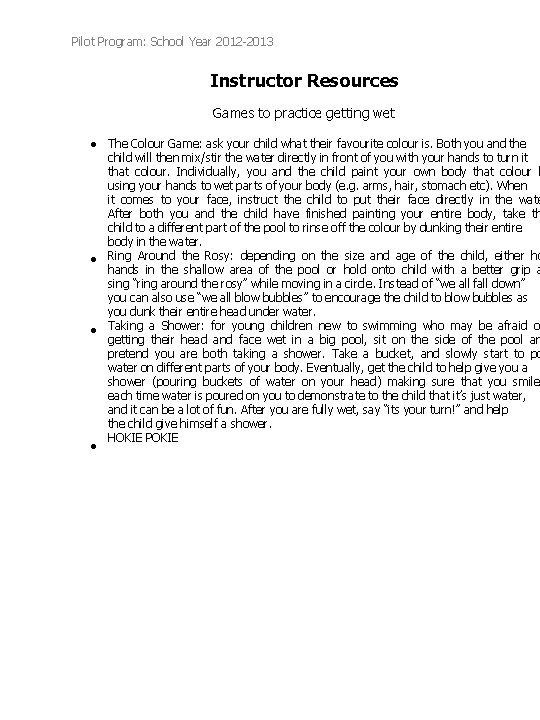
Pilot Program: School Year 2012 -2013 Instructor Resources Games to practice getting wet The Colour Game: ask your child what their favourite colour is. Both you and the child will then mix/stir the water directly in front of you with your hands to turn it that colour. Individually, you and the child paint your own body that colour b using your hands to wet parts of your body (e. g. arms, hair, stomach etc). When it comes to your face, instruct the child to put their face directly in the wate After both you and the child have finished painting your entire body, take th child to a different part of the pool to rinse off the colour by dunking their entire body in the water. ● Ring Around the Rosy: depending on the size and age of the child, either ho hands in the shallow area of the pool or hold onto child with a better grip a sing “ring around the rosy” while moving in a circle. Instead of “we all fall down” you can also use “we all blow bubbles” to encourage the child to blow bubbles as you dunk their entire head under water. ● Taking a Shower: for young children new to swimming who may be afraid o getting their head and face wet in a big pool, sit on the side of the pool an pretend you are both taking a shower. Take a bucket, and slowly start to po water on different parts of your body. Eventually, get the child to help give you a shower (pouring buckets of water on your head) making sure that you smile each time water is poured on you to demonstrate to the child that it’s just water, and it can be a lot of fun. After you are fully wet, say “its your turn!” and help the child give himself a shower. HOKIE POKIE ● ●
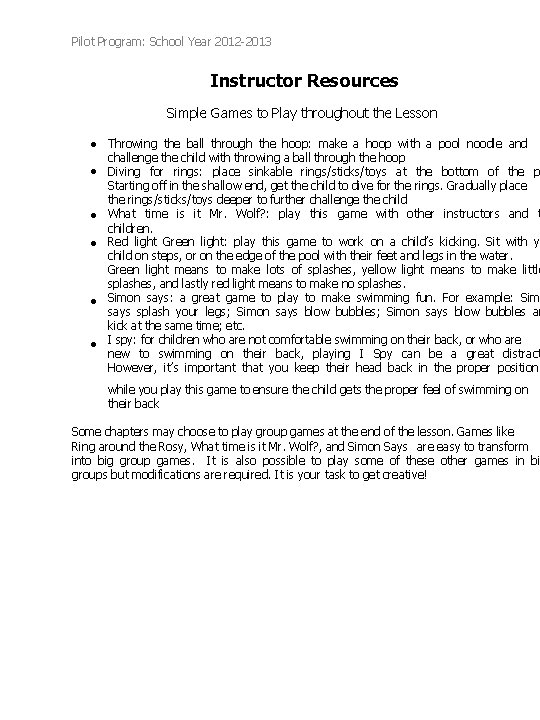
Pilot Program: School Year 2012 -2013 Instructor Resources Simple Games to Play throughout the Lesson ● ● ● Throwing the ball through the hoop: make a hoop with a pool noodle and challenge the child with throwing a ball through the hoop Diving for rings: place sinkable rings/sticks/toys at the bottom of the p Starting off in the shallow end, get the child to dive for the rings. Gradually place the rings/sticks/toys deeper to further challenge the child What time is it Mr. Wolf? : play this game with other instructors and t children. Red light Green light: play this game to work on a child’s kicking. Sit with yo child on steps, or on the edge of the pool with their feet and legs in the water. Green light means to make lots of splashes, yellow light means to make little splashes, and lastly red light means to make no splashes. Simon says: a great game to play to make swimming fun. For example: Sim says splash your legs; Simon says blow bubbles an kick at the same time; etc. I spy: for children who are not comfortable swimming on their back, or who are new to swimming on their back, playing I Spy can be a great distract However, it’s important that you keep their head back in the proper position while you play this game to ensure the child gets the proper feel of swimming on their back Some chapters may choose to play group games at the end of the lesson. Games like Ring around the Rosy, What time is it Mr. Wolf? , and Simon Says are easy to transform into big group games. It is also possible to play some of these other games in bi groups but modifications are required. It is your task to get creative!
Pilot Program: School Year 2012 -2013 Instructor Resources Visuals to Use with Students Pool: Activities, Toys & Equipment
Pilot Program: School Year 2012 -2013 Actions
Pilot Program: School Year 2012 -2013 Basic Signs
Pilot Program: School Year 2012 -2013 Choice Board
Pilot Program: School Year 2012 -2013 Photographs of Pool Experience
Pilot Program: School Year 2012 -2013 Instructor Resources Progress Report Example
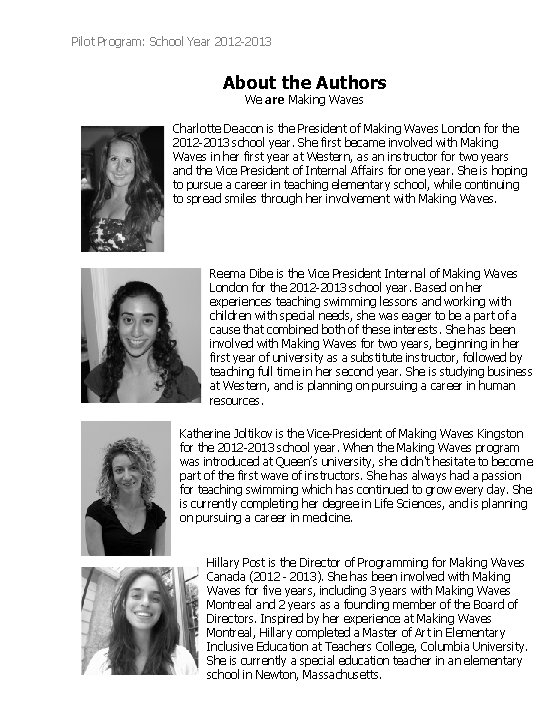
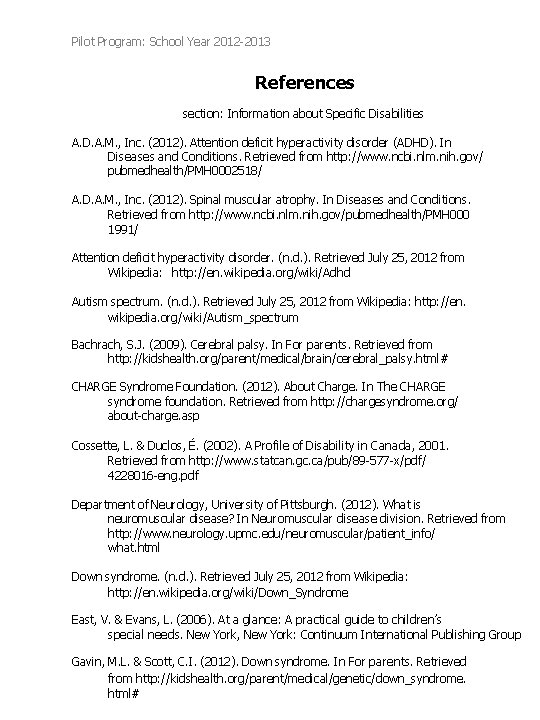
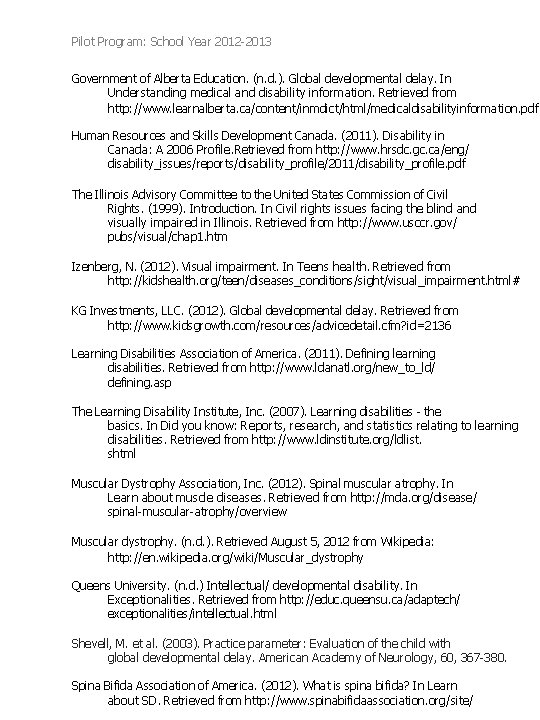
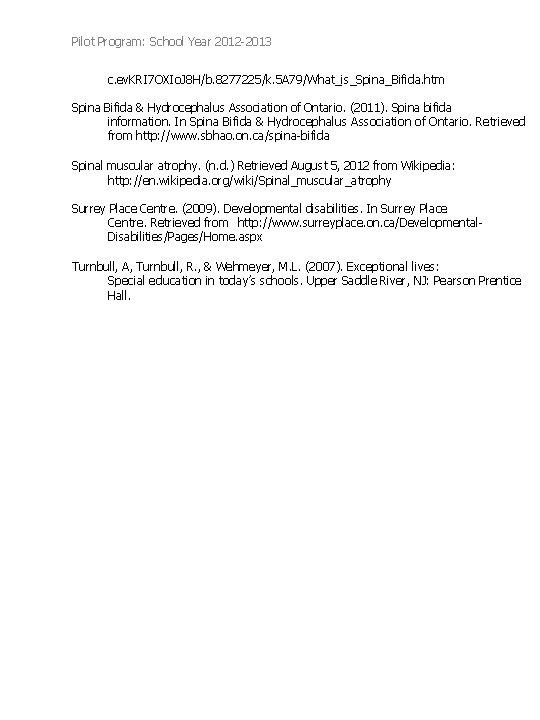
Pilot Program: School Year 2012 -2013 About the Authors We are Making Waves Charlotte Deacon is the President of Making Waves London for the 2012 -2013 school year. She first became involved with Making Waves in her first year at Western, as an instructor for two years and the Vice President of Internal Affairs for one year. She is hoping to pursue a career in teaching elementary school, while continuing to spread smiles through her involvement with Making Waves. Reema Dibe is the Vice President Internal of Making Waves London for the 2012 -2013 school year. Based on her experiences teaching swimming lessons and working with children with special needs, she was eager to be a part of a cause that combined both of these interests. She has been involved with Making Waves for two years, beginning in her first year of university as a substitute instructor, followed by teaching full time in her second year. She is studying business at Western, and is planning on pursuing a career in human resources. Katherine Joltikov is the Vice-President of Making Waves Kingston for the 2012 -2013 school year. When the Making Waves program was introduced at Queen’s university, she didn't hesitate to become part of the first wave of instructors. She has always had a passion for teaching swimming which has continued to grow every day. She is currently completing her degree in Life Sciences, and is planning on pursuing a career in medicine. Hillary Post is the Director of Programming for Making Waves Canada (2012 - 2013). She has been involved with Making Waves for five years, including 3 years with Making Waves Montreal and 2 years as a founding member of the Board of Directors. Inspired by her experience at Making Waves Montreal, Hillary completed a Master of Art in Elementary Inclusive Education at Teachers College, Columbia University. She is currently a special education teacher in an elementary school in Newton, Massachusetts.
Pilot Program: School Year 2012 -2013 References section: Information about Specific Disabilities A. D. A. M. , Inc. (2012). Attention deficit hyperactivity disorder (ADHD). In Diseases and Conditions. Retrieved from http: //www. ncbi. nlm. nih. gov/ pubmedhealth/PMH 0002518/ A. D. A. M. , Inc. (2012). Spinal muscular atrophy. In Diseases and Conditions. Retrieved from http: //www. ncbi. nlm. nih. gov/pubmedhealth/PMH 000 1991/ Attention deficit hyperactivity disorder. (n. d. ). Retrieved July 25, 2012 from Wikipedia: http: //en. wikipedia. org/wiki/Adhd Autism spectrum. (n. d. ). Retrieved July 25, 2012 from Wikipedia: http: //en. wikipedia. org/wiki/Autism_spectrum Bachrach, S. J. (2009). Cerebral palsy. In For parents. Retrieved from http: //kidshealth. org/parent/medical/brain/cerebral_palsy. html# CHARGE Syndrome Foundation. (2012). About Charge. In The CHARGE syndrome foundation. Retrieved from http: //chargesyndrome. org/ about-charge. asp Cossette, L. & Duclos, É. (2002). A Profile of Disability in Canada, 2001. Retrieved from http: //www. statcan. gc. ca/pub/89 -577 -x/pdf/ 4228016 -eng. pdf Department of Neurology, University of Pittsburgh. (2012). What is neuromuscular disease? In Neuromuscular disease division. Retrieved from http: //www. neurology. upmc. edu/neuromuscular/patient_info/ what. html Down syndrome. (n. d. ). Retrieved July 25, 2012 from Wikipedia: http: //en. wikipedia. org/wiki/Down_Syndrome East, V. & Evans, L. (2006). At a glance: A practical guide to children’s special needs. New York, New York: Continuum International Publishing Group Gavin, M. L. & Scott, C. I. (2012). Down syndrome. In For parents. Retrieved from http: //kidshealth. org/parent/medical/genetic/down_syndrome. html#
Pilot Program: School Year 2012 -2013 Government of Alberta Education. (n. d. ). Global developmental delay. In Understanding medical and disability information. Retrieved from http: //www. learnalberta. ca/content/inmdict/html/medicaldisabilityinformation. pdf Human Resources and Skills Development Canada. (2011). Disability in Canada: A 2006 Profile. Retrieved from http: //www. hrsdc. gc. ca/eng/ disability_issues/reports/disability_profile/2011/disability_profile. pdf The Illinois Advisory Committee to the United States Commission of Civil Rights. (1999). Introduction. In Civil rights issues facing the blind and visually impaired in Illinois. Retrieved from http: //www. usccr. gov/ pubs/visual/chap 1. htm Izenberg, N. (2012). Visual impairment. In Teens health. Retrieved from http: //kidshealth. org/teen/diseases_conditions/sight/visual_impairment. html# KG Investments, LLC. (2012). Global developmental delay. Retrieved from http: //www. kidsgrowth. com/resources/advicedetail. cfm? id=2136 Learning Disabilities Association of America. (2011). Defining learning disabilities. Retrieved from http: //www. ldanatl. org/new_to_ld/ defining. asp The Learning Disability Institute, Inc. (2007). Learning disabilities - the basics. In Did you know: Reports, research, and statistics relating to learning disabilities. Retrieved from http: //www. ldinstitute. org/ldlist. shtml Muscular Dystrophy Association, Inc. (2012). Spinal muscular atrophy. In Learn about muscle diseases. Retrieved from http: //mda. org/disease/ spinal-muscular-atrophy/overview Muscular dystrophy. (n. d. ). Retrieved August 5, 2012 from Wikipedia: http: //en. wikipedia. org/wiki/Muscular_dystrophy Queens University. (n. d. ) Intellectual/ developmental disability. In Exceptionalities. Retrieved from http: //educ. queensu. ca/adaptech/ exceptionalities/intellectual. html Shevell, M. et al. (2003). Practice parameter: Evaluation of the child with global developmental delay. American Academy of Neurology, 60, 367 -380. Spina Bifida Association of America. (2012). What is spina bifida? In Learn about SD. Retrieved from http: //www. spinabifidaassociation. org/site/
Pilot Program: School Year 2012 -2013 c. ev. KRI 7 OXIo. J 8 H/b. 8277225/k. 5 A 79/What_is_Spina_Bifida. htm Spina Bifida & Hydrocephalus Association of Ontario. (2011). Spina bifida information. In Spina Bifida & Hydrocephalus Association of Ontario. Retrieved from http: //www. sbhao. on. ca/spina-bifida Spinal muscular atrophy. (n. d. ) Retrieved August 5, 2012 from Wikipedia: http: //en. wikipedia. org/wiki/Spinal_muscular_atrophy Surrey Place Centre. (2009). Developmental disabilities. In Surrey Place Centre. Retrieved from http: //www. surreyplace. on. ca/Developmental. Disabilities/Pages/Home. aspx Turnbull, A, Turnbull, R. , & Wehmeyer, M. L. (2007). Exceptional lives: Special education in today’s schools. Upper Saddle River, NJ: Pearson Prentice Hall.