
Making the Welfare State KS 3 The Beveridge
Making the Welfare State KS 3 The Beveridge Report and the Creation of the Welfare State (1941 -1948) Images and archive material used belong to LSE Library, unless otherwise stated. This is an open access resource under the terms of the Creative Commons Attribution-Non. Commercial-Share. Alike 4. 0 International (CC BY-NC-SA 4. 0) License, which permits use, distribution and reproduction in any non-commercial medium, provided the original work is properly cited.
The Beveridge Report and the Creation of the Welfare State (1941 -1948) We will learn about: • the Beveridge Report and its impact • what is meant by the welfare state and social security • the results of the General Election in 1945 • the formation of the National Health Service (NHS) • the introduction of National Insurance
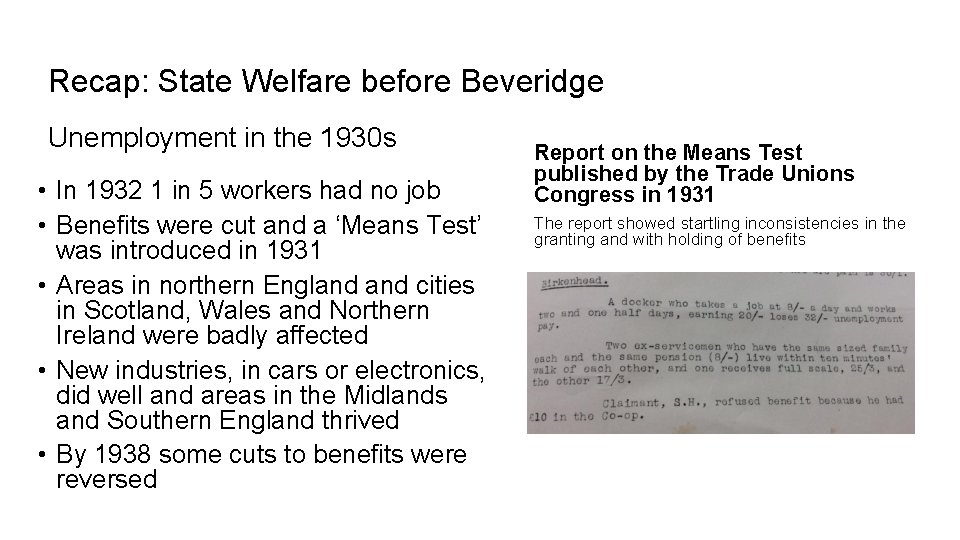
Recap: State Welfare before Beveridge Unemployment in the 1930 s • In 1932 1 in 5 workers had no job • Benefits were cut and a ‘Means Test’ was introduced in 1931 • Areas in northern England cities in Scotland, Wales and Northern Ireland were badly affected • New industries, in cars or electronics, did well and areas in the Midlands and Southern England thrived • By 1938 some cuts to benefits were reversed Report on the Means Test published by the Trade Unions Congress in 1931 The report showed startling inconsistencies in the granting and with holding of benefits
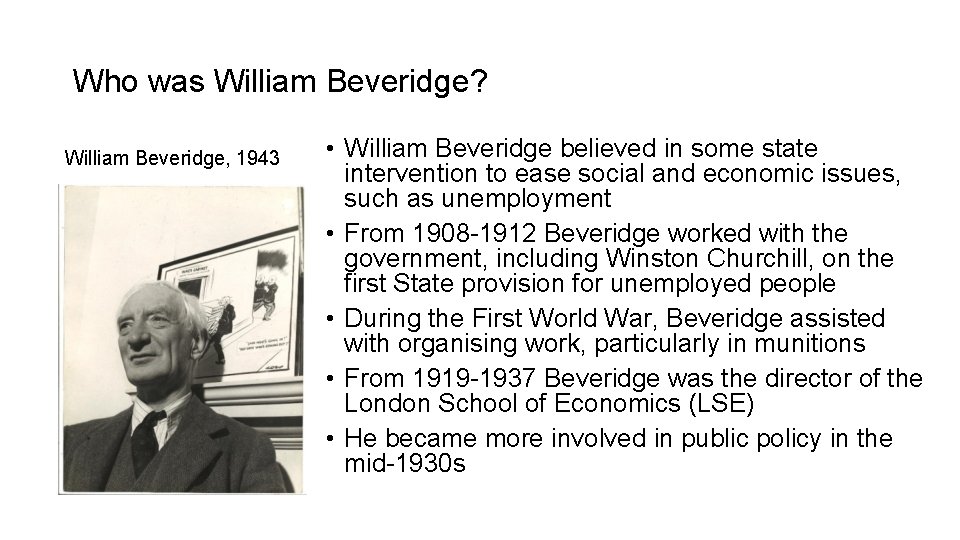
Who was William Beveridge? William Beveridge, 1943 • William Beveridge believed in some state intervention to ease social and economic issues, such as unemployment • From 1908 -1912 Beveridge worked with the government, including Winston Churchill, on the first State provision for unemployed people • During the First World War, Beveridge assisted with organising work, particularly in munitions • From 1919 -1937 Beveridge was the director of the London School of Economics (LSE) • He became more involved in public policy in the mid-1930 s

The Five Giants: Exercise Beveridge identified ‘The Five Giants’ that were the most pressing issues facing the country: • Want • Squalor • Ignorance • Idleness • Disease They are personified in this drawing. Look at the drawings: how are these giants depicted? What are the people saying beneath the giants? Do their comments help get rid of the giants or not?

The Beveridge Report Health and social security ‘from cradle to grave’

The Social Insurance and Allied Services: Report, 1942 Beveridge argued for comprehensive national insurance: • People and employers would pay in, the government would pay out • The payment would be a flat-rate basic payment to protect people not working through sickness, unemployment or old age • There would be no Means Test • There was still a need for full employment The report gave people a cause worth fighting for in the war. Image: Signed letter from Beveridge in his copy of the Social insurance and allied services: report – known as the Beveridge Report, 1942, LSE Beveridge/8/57

Evidence exercise: Guide to the Beveridge Plan, poster, 1943. Look at the poster. What are three main assumptions of the Beveridge plan? Who pays into the contributions? What benefits do they get? What else is suggested besides contributions and benefits?
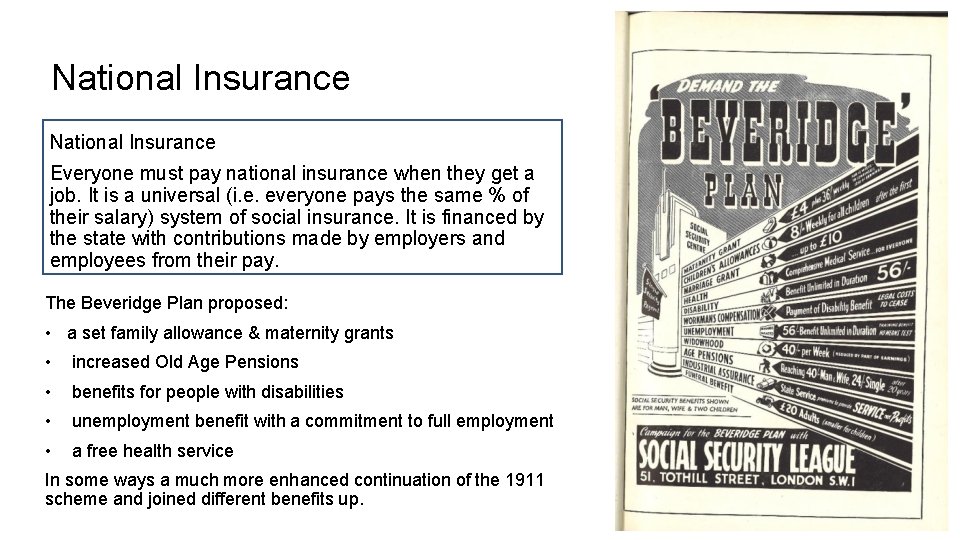
National Insurance Everyone must pay national insurance when they get a job. It is a universal (i. e. everyone pays the same % of their salary) system of social insurance. It is financed by the state with contributions made by employers and employees from their pay. The Beveridge Plan proposed: • a set family allowance & maternity grants • increased Old Age Pensions • benefits for people with disabilities • unemployment benefit with a commitment to full employment • a free health service In some ways a much more enhanced continuation of the 1911 scheme and joined different benefits up.
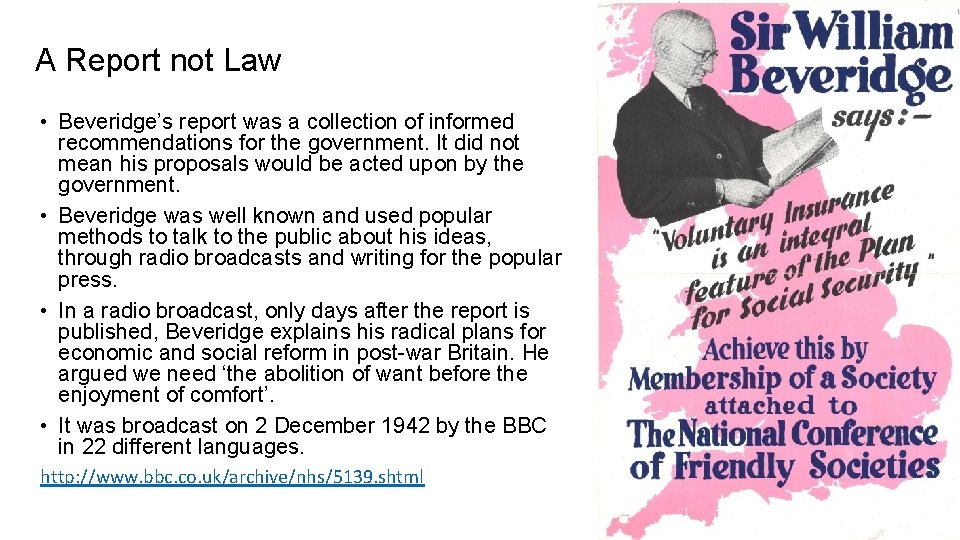
A Report not Law • Beveridge’s report was a collection of informed recommendations for the government. It did not mean his proposals would be acted upon by the government. • Beveridge was well known and used popular methods to talk to the public about his ideas, through radio broadcasts and writing for the popular press. • In a radio broadcast, only days after the report is published, Beveridge explains his radical plans for economic and social reform in post-war Britain. He argued we need ‘the abolition of want before the enjoyment of comfort’. • It was broadcast on 2 December 1942 by the BBC in 22 different languages. http: //www. bbc. co. uk/archive/nhs/5139. shtml
‘A Time for Revolutions’ The reaction and reception of the Beveridge Report
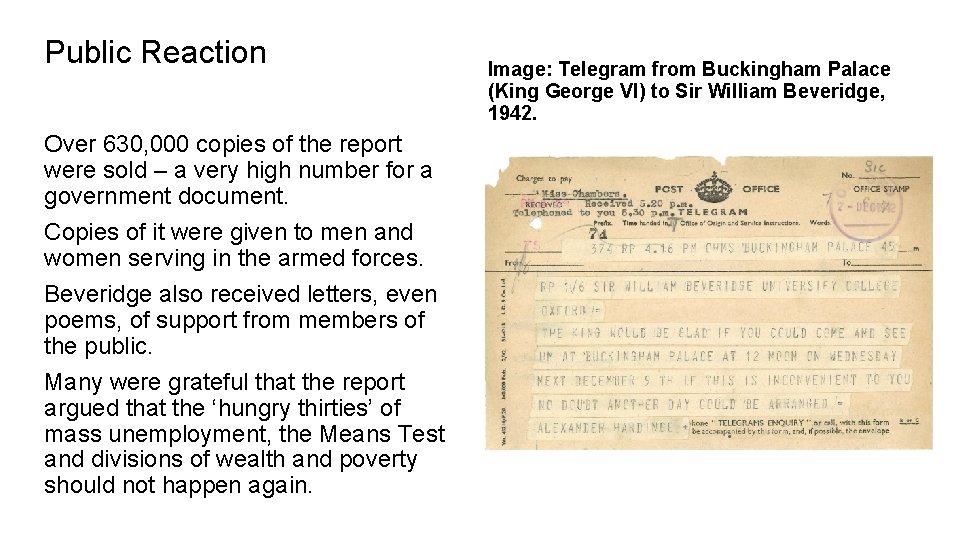
Public Reaction Over 630, 000 copies of the report were sold – a very high number for a government document. Copies of it were given to men and women serving in the armed forces. Beveridge also received letters, even poems, of support from members of the public. Many were grateful that the report argued that the ‘hungry thirties’ of mass unemployment, the Means Test and divisions of wealth and poverty should not happen again. Image: Telegram from Buckingham Palace (King George VI) to Sir William Beveridge, 1942.
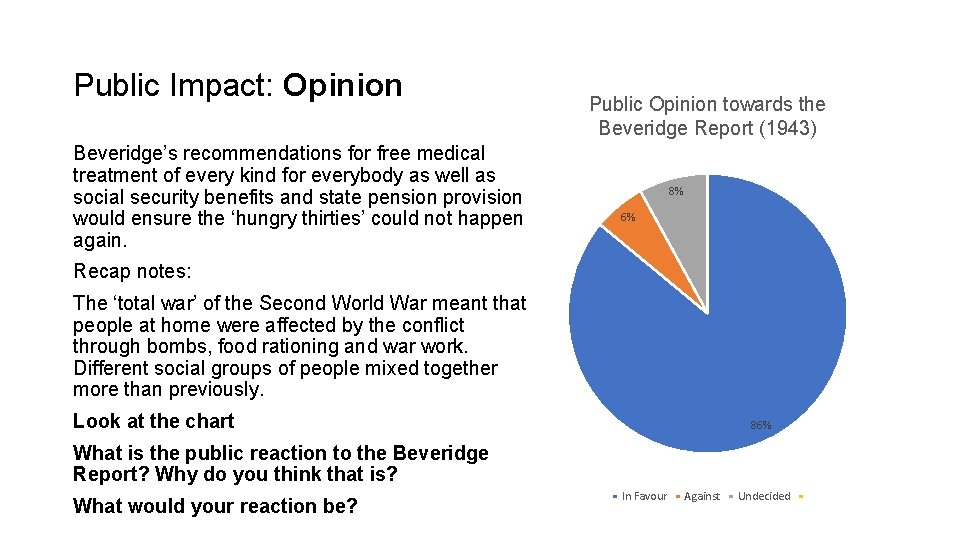
Public Impact: Opinion Beveridge’s recommendations for free medical treatment of every kind for everybody as well as social security benefits and state pension provision would ensure the ‘hungry thirties’ could not happen again. Public Opinion towards the Beveridge Report (1943) 8% 6% Recap notes: The ‘total war’ of the Second World War meant that people at home were affected by the conflict through bombs, food rationing and war work. Different social groups of people mixed together more than previously. Look at the chart 86% What is the public reaction to the Beveridge Report? Why do you think that is? What would your reaction be? In Favour Against Undecided
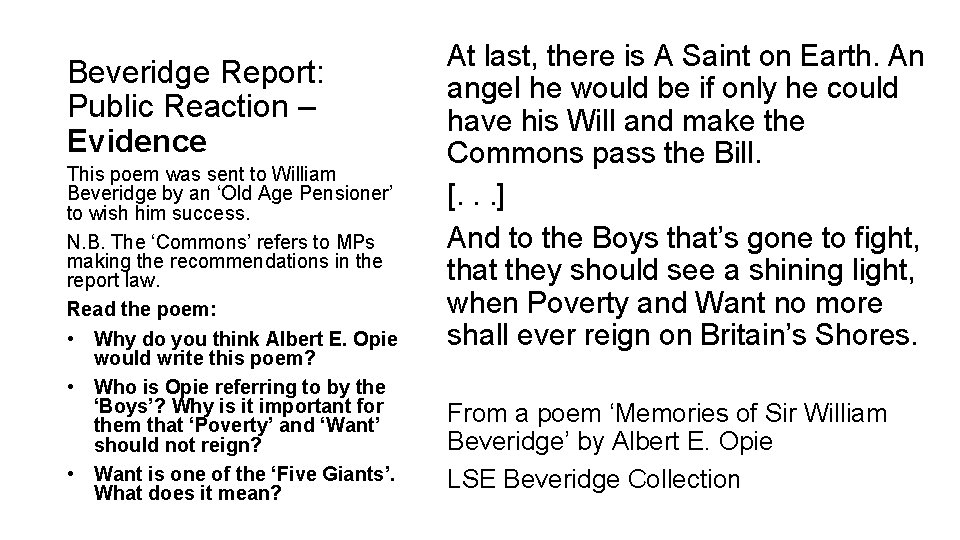
Beveridge Report: Public Reaction – Evidence This poem was sent to William Beveridge by an ‘Old Age Pensioner’ to wish him success. N. B. The ‘Commons’ refers to MPs making the recommendations in the report law. Read the poem: • Why do you think Albert E. Opie would write this poem? • Who is Opie referring to by the ‘Boys’? Why is it important for them that ‘Poverty’ and ‘Want’ should not reign? • Want is one of the ‘Five Giants’. What does it mean? At last, there is A Saint on Earth. An angel he would be if only he could have his Will and make the Commons pass the Bill. [. . . ] And to the Boys that’s gone to fight, that they should see a shining light, when Poverty and Want no more shall ever reign on Britain’s Shores. From a poem ‘Memories of Sir William Beveridge’ by Albert E. Opie LSE Beveridge Collection
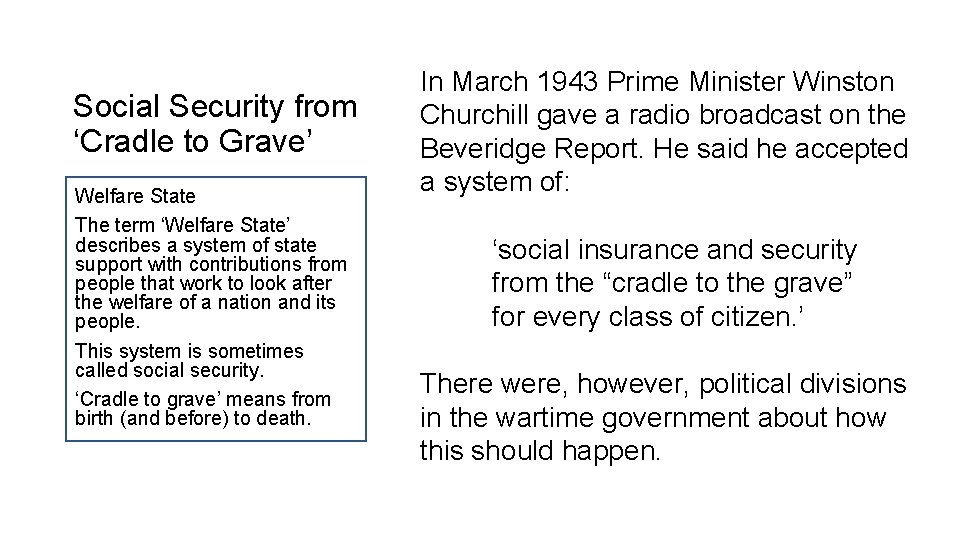
Social Security from ‘Cradle to Grave’ Welfare State The term ‘Welfare State’ describes a system of state support with contributions from people that work to look after the welfare of a nation and its people. This system is sometimes called social security. ‘Cradle to grave’ means from birth (and before) to death. In March 1943 Prime Minister Winston Churchill gave a radio broadcast on the Beveridge Report. He said he accepted a system of: ‘social insurance and security from the “cradle to the grave” for every class of citizen. ’ There were, however, political divisions in the wartime government about how this should happen.
Aftermath: The National Health Service
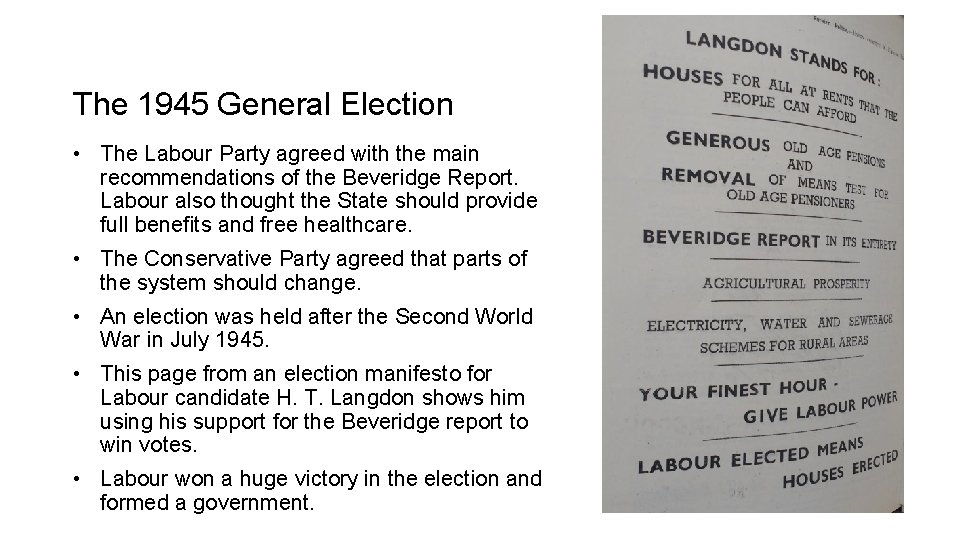
The 1945 General Election • The Labour Party agreed with the main recommendations of the Beveridge Report. Labour also thought the State should provide full benefits and free healthcare. • The Conservative Party agreed that parts of the system should change. • An election was held after the Second World War in July 1945. • This page from an election manifesto for Labour candidate H. T. Langdon shows him using his support for the Beveridge report to win votes. • Labour won a huge victory in the election and formed a government.
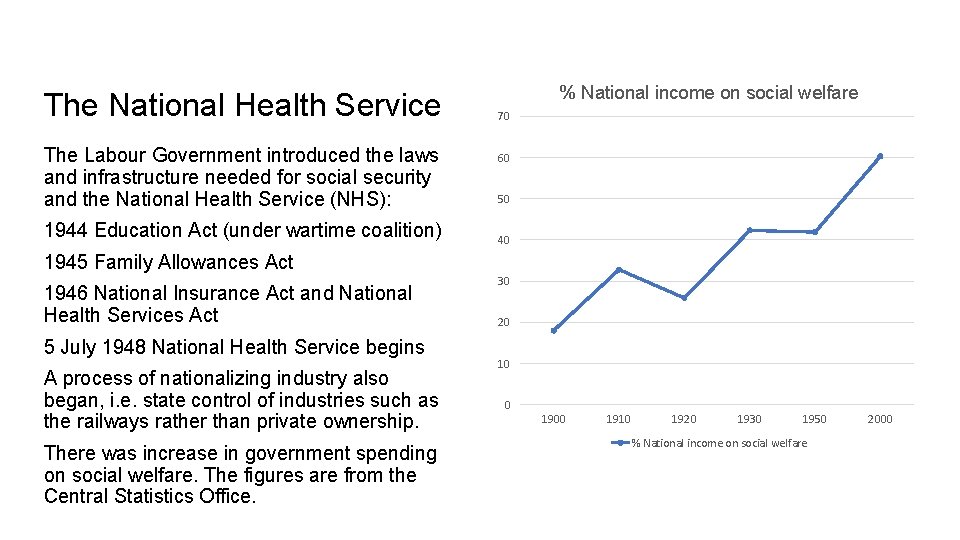
The National Health Service The Labour Government introduced the laws and infrastructure needed for social security and the National Health Service (NHS): 1944 Education Act (under wartime coalition) % National income on social welfare 70 60 50 40 1945 Family Allowances Act 1946 National Insurance Act and National Health Services Act 5 July 1948 National Health Service begins A process of nationalizing industry also began, i. e. state control of industries such as the railways rather than private ownership. There was increase in government spending on social welfare. The figures are from the Central Statistics Office. 30 20 10 0 1900 1910 1920 1930 1950 % National income on social welfare 2000
- Slides: 18