
Making The Most of Your Early Steps Experience


- Slides: 22
Making The Most of Your Early. Steps Experience
How is early intervention different from traditional therapy?
How early intervention is different from traditional therapy: Early Intervention • • Takes place in the home, community, or child care center. Works with the parent or care giver to teach them how to help their child during their daily routine. Services are based upon the child and family’s daily routine. {Example: “Provider shows how to position the child’s arm during meal time. ”} Takes advantage of the way children learn naturally in their everyday experiences with their families. {Example: “Provider shows brother/sister activities they can do with the child during play time. ”} Traditional Therapy • • • Takes place in a clinic or hospital setting. Provider takes the child into a separate room to perform therapy services. Works only with the child, families are not included during the intervention Services are based on the clinic or hospital’s schedule. Services only occur during therapy sessions. Therapist does not collaborate with other providers
What does early intervention mean to you?
Early Intervention should… • Fit into the child and families everyday routines and activities. • Be based on the child’s unique needs. • Be based on the child’s age and the child’s learning ability. • Not leave your child tired or worn out. • Not leave your family feeling stressed or overwhelmed.
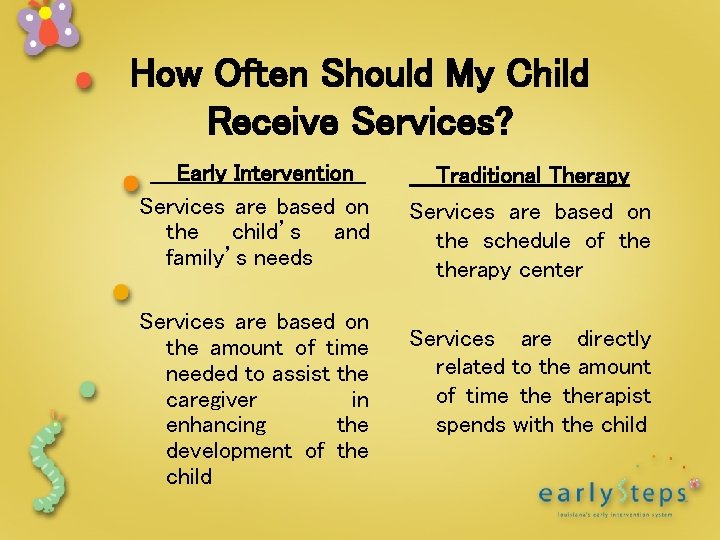
How Often Should My Child Receive Services? Early Intervention Services are based on the child’s and family’s needs Services are based on the amount of time needed to assist the caregiver in enhancing the development of the child Traditional Therapy Services are based on the schedule of therapy center Services are directly related to the amount of time therapist spends with the child
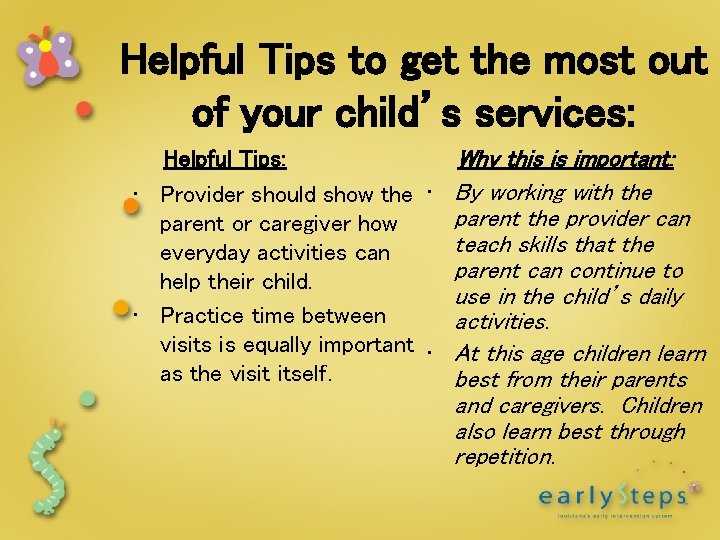
Helpful Tips to get the most out of your child’s services: Helpful Tips: Why this is important: • Provider should show the • By working with the parent the provider can parent or caregiver how teach skills that the everyday activities can parent can continue to help their child. use in the child’s daily • Practice time between activities. visits is equally important • At this age children learn as the visit itself. best from their parents and caregivers. Children also learn best through repetition.
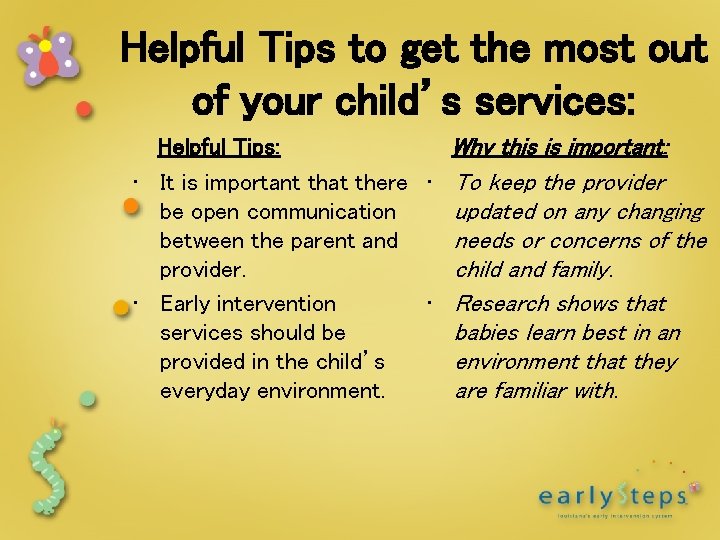
Helpful Tips to get the most out of your child’s services: Helpful Tips: Why this is important: • It is important that there • To keep the provider be open communication updated on any changing between the parent and needs or concerns of the provider. child and family. • Early intervention • Research shows that services should be babies learn best in an provided in the child’s environment that they everyday environment. are familiar with.
What does Natural Environment mean to you?
The term “Natural Environment” refers to where a child lives and plays. Infants and Toddlers from birth to three learn best in their Natural Environment.
What should Early Intervention Services look like?
Example #1: How this helps: Provider meets the family at • This visit at the store the grocery store and would help the child to helps mom by: strengthen the muscles in • showing how to seat their upper body. child in the cart for good • The child will learn new support words. • encouraging mom to talk • This visit teaches mom with the child while how to continue working shopping (talk about the with the child in her daily colors of foods, shapes, labels and smells) routine.
Example #2: How this helps: Provider works with the • (Ex. A) This visit to the toddler and child care center helps to provider at the child care promote the child’s center by: feeding skills. • (Ex. A) arriving during • (Ex. B) This activity helps lunch or snack time to to promote the child’s work with the toddler on social skills in their feeding skills everyday life. • (Ex. B) including other • (Ex. C) This activity helps children in the class as the child care provider to well as the child care continue practicing skills. provider in the activities; • (Ex. C) using classroom toys during sessions.
When should I make changes to the IFSP? • Your child is not making progress after several months of service • Your family feels overwhelmed with the amount of service provided • Your child has made progress and does not need as many services
What is your role at the IFSP team meeting? Providers Parents • Share information with • Base services on the IFSP team about your goal/outcome of child’s progress or your parents and the child’s needs child’s unique need • Helpful information like: • Recommend age-child’s age appropriate services -how soon they get tired • Respect parents’ -how quickly they learn thoughts and opinions Talk to your FSC or regarding their child’s providers if you are care. concerned or have questions
Making Changes to a Child’s Services Changing services on the IFSP can be done in several ways: • By phone on a conference call • In writing • In Person
When should I change my IFSP? • Your child is not making progress after several months of service • Your family feels overwhelmed with the amount of service provided • Your child has made progress and does not need as many services
How Does My IFSP Team Change My Child’s IFSP? • You can discuss your child’s progress or any concerns about your child’s progress at the 6 month review • If you want to hold a meeting before the 6 month review, contact your FSC to schedule a team meeting to talk about ways to help your child and family meet their needs
Explanation of Benefits (EOB) What is an Early. Steps Explanation of Benefits (EOB)? • An EOB is a detailed description of the services that were billed by • and paid to your Early. Steps providers have up to 60 days to bill from the date a service is rendered. Therefore, the date of service and the actual day the provider billed for the service could reflect a difference of up to 60 days. Why is the EOB important to you? • The EOB lists key information such as the name of the provider, the actual date you received the service, and the amount paid to your provider. This information is important because you can verify whether or not these services are occurring for your child.
“Who Do I Contact …. ” Ø When I have questions about services on the IFSP or my providers? – Family Support Coordinator (FSC) Ø When I want to schedule a team meeting? – FSC Ø If I need information about resources in the community? – FSC, Community Outreach Specialist (COS), Families Helping Families Center (FHF) Ø If I need information about my child’s disability or developmental needs? – FSC, COS
“Who Do I Contact …. ” Ø If I would like to attend the State Interagency Coordinating Council (SICC) and Regional Interagency Coordinating Council (RICC) meetings? – Regional Coordinator, COS Ø If I want to meet other parents of children in Early. Steps, or join a support group? – FSC, COS, FHF Ø To file a complaint about anyone or anything involving Early. Steps, or about services for your child and family? – Regional OCDD Office
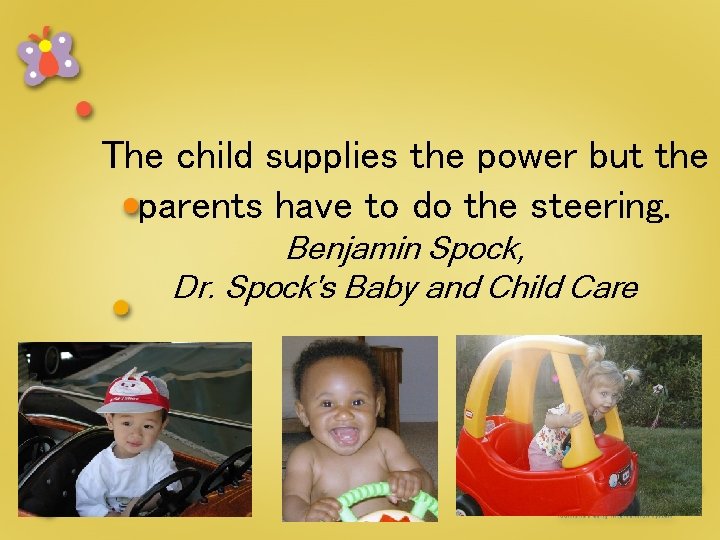
The child supplies the power but the parents have to do the steering. Benjamin Spock, Dr. Spock's Baby and Child Care